A Framework for Improved Access to Museum Databases
in the Semantic Web
Dana Dann´ells
Department of Swedish Language University of Gothenburg SE-405 30 Gothenburg, Sweden
Mariana Damova Ontotext Sofia 1784, Bulgaria
Ramona Enache
Department of Computer Science and Engineering GU and Chalmers University of Technology
SE-412 96 Gothenburg, Sweden
Milen Chechev Ontotext Sofia 1784, Bulgaria
Abstract
Digital museum databases have extremely heterogeneous data structures which re-quire advanced mapping and vocabulary integration for them to benefit from the interoperability enabled by semantic tech-nologies. In addition to establishing ways of extracting and manipulating digitally encoded cultural material, there exists a need to make this material available and accessible to human users in different forms and languages that are available to them. In this paper we describe a method to manage and access museum data by in-tegrating it within a series of interlinked ontological models. The method allows querying and generation of query results in natural language. We report on the results of applying this method from experiments we have been pursuing.
1 Introduction
During the past few years several projects have been undertaken to digitize cultural heritage ma-terials (Clough et al., 2008; Dekkers et al., 2009) through the use of Semantic Technologies such as RDF (Brickley and Guha, 2004) and OWL (Berners-Lee, 2004). Today there exist large num-ber of digital collections and applications provid-ing direct access to cultural heritage content.1
However, digitization is a labour intensive pro-cess and is long from being complete. Because of the heterogeneous data structures different mu-seums have, digitally encoded cultural material
1http://www.europeana.eu/portal/
stored in internal museum databases requires ad-vanced mapping and vocabulary integration for it to be accessible for Semantic Web applications. In addition to establishing ways for managing various vocabularies, and for exploiting semantic alignments across them automatically (van der Meij et al., 2010), computer engineers also need to investigate automatic methods to make this in-formation available to computer users in different forms and languages that are available to them.
Our work is a step towards this direction. It is about an automatic workflow of sharing data in-frastructures that is explicitly targeted towards the Semantic Web. We have developed a method to manage and access museum data by integrating it within a series of interlinked ontological mod-els. The method allows querying and generation of query results in natural language using the Gram-matical Framework (GF). We have been experi-menting with data collections from the Gothen-burg City Museum that we made available for querying in the Museum Reason-able View loaded in the triple store OWLIM.
In the remainder of this paper we present the ontologies that were merged including CIDOC-CRM,2PROTON,3, the Painting ontology and the data that we have been experimenting with (Sec-tion 2). We describe the crea(Sec-tion of the Museum Reason-able View with structured query examples (Section 3). In Section 4, we introduce the Gram-matical Framework and demonstrate the mecha-nisms of interfacing between the structured data and natural language. We provide an overview of related work (Section 5) and end with conclusions.
2
The Conceptual Reference Model (CRM): http:// cidoc.ics.forth.gr/
3http://proton.semanticweb.org/
2 The Ontologies and Museum Data
2.1 The CIDOC-CRM
The International Committee for Documentation Conceptual Reference Model (CIDOC CRM) that was accepted by ISO in 2006 as ISO21127 (Crofts et al., 2008), is one of a widely used standards that has been developed to facilitate the integra-tion, mediation and interchange of heterogeneous cultural heritage information.
The CIDOC CRM, independent of any specific application, is primarily defined as an interchange model for integrating information in the cultural heritage sector. Although it declares rich common semantics of metadata elements, many of the con-cepts that are utilized for describing objects are not directly available in this model. To arrive at the point where information that is available in mu-seum databases about paintings could be recorded using this model, we developed the painting on-tology that integrates the CIDOC-CRM with more specific schemata.
2.2 The Swedish Open Cultural Heritage (SOCH)
The Swedish Open Cultural Heritage (SOCH) is a web service used to search and fetch data from any organization that holds information related to the Swedish cultural heritage.4
The idea behind SOCH is to harvest any data format and structure that is used in the museum sector in Sweden and map it into SOCH’s catego-rization structure. The data model used by SOCH is an uniform data representation which is avail-able in an RDF compatible form.
The schema provided by SOCH helps to inter-mediate data between museums in Sweden and the Europeana portal. More than 20 museums in Swe-den have already made their collections available through this service. By integrating the SOCH data schema in the ontological framework we gain automatic access to these collections in a semanti-cally interoperable way.
2.3 The Painting Ontology
The painting ontology is a domain specific on-tology. It is designed to support integration and interoperability of the CIDOC-CRM ontology with other schemata. The main reference model of the painting ontology is the OWL 2
imple-4http://www.ksamsok.se/in-english/
mentation of the CRM.5 The additional models that are correctly integrated in the ontology are: SOCH, Time Ontology,6 SUMO and Mid-Level-Ontology.7The painting ontology was constructed manually using the Prot´eg´e editing tool.8
Integration of the ontology concepts are accom-plished by using the OWL construct: intersec-tionOfas specified below:
<owl:Class rdf:about="&painting;Painting"> <owl:equivalentClass>
<owl:Class>
<owl:intersectionOf rdf:parseType="Collection"> <rdf:Description rdf:about="&ksasok;item"/> <rdf:Description rdf:about="&milo;PaintedPicture"/> </owl:intersectionOf>
</owl:Class> </owl:equivalentClass>
<rdfs:subClassOf rdf:resource="&core;E22_Man-Made_Object"/> </owl:Class>
The schemata that are stated in the above ex-ample are denoted with the following prefixes: painting ontology (&painting), SOCH (&ksam-sok), Mid-Level-Ontology (&milo) and CIDOC-CRM ontology (&core). In this example, the class Painting is defined in the painting ontology as a subclass ofE22 Man-Made Objectclass from the CIDOC-CRM ontology and is an intersection of two classes, i.e. itemfrom the SOCH schema and PaintedPicturefrom the Mid-Level Ontology.
The painting ontology contains 184 classes and 92 properties of which 24 classes are equivalent to classes from CIDOC-CRM and 17 properties are sub-properties of CIDOC-CRM properties.
2.4 Proton
PROTON (Terziev et al., 2005) is a light weight upper level ontology, which was originally built with a basic subsumption hierarchy comprising about 250 classes and 100 properties providing coverage of most of the upper-level concepts nec-essary for semantic annotation, indexing, and re-trieval. Its modular architecture allows for great flexibility of usage, extension, integration and re-modeling. It is domain independent and com-plies with the most popular metadata standards like DOLCE,9Cyc,10Dublin Core.11
PROTON is encoded in OWL Lite, and contains a minimal set of custom entailment rules (axioms). It is interlinked with CIDOC CRM, and is used in
5http://purl.org/NET/cidoc-crm/core 6
http://www.w3.org/TR/owl-time/ 7http://www.ontologyportal.org/ 8http://protege.stanford.edu/ 9
http://www.loa-cnr.it/DOLCE.html 10
http://www.ontotext.com/downloads/ cycmdb
the data integration model to provide access to the Linked Open Data (LOD) for Cultural Heritage (Damova and Dann´ells, 2011).
2.5 The Gothenburg City Museum Database
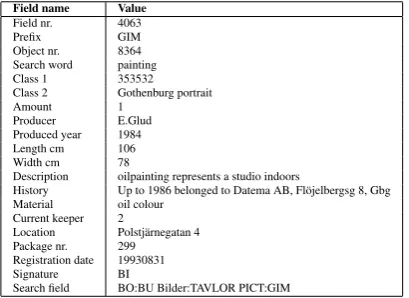
The Gothenburg City Museum (GCM) preserves 8900 museum objects described in two of the mu-seum database tables. These two tables corre-spond to two of the museum collections, i.e. GSM and GIM. Each of these tables contains 39 prop-erties for describing museum objects. Table 1 shows 20 of these properties, including the object type, its material, measurements, location, etc. All properties and object values stored in the database are given in Swedish.
Field name Value
Field nr. 4063 Prefix GIM Object nr. 8364 Search word painting Class 1 353532 Class 2 Gothenburg portrait Amount 1
Producer E.Glud Produced year 1984 Length cm 106 Width cm 78
Description oilpainting represents a studio indoors
History Up to 1986 belonged to Datema AB, Fl¨ojelbergsg 8, Gbg Material oil colour
Current keeper 2
Location Polstj¨arnegatan 4 Package nr. 299 Registration date 19930831 Signature BI
[image:3.595.80.285.280.429.2]Search field BO:BU Bilder:TAVLOR PICT:GIM
Table 1: A painting object representation in the GCM database.
The Gothenburg City Museum’s data that is used as our experimental data follows the struc-ture of the CIDOC-CRM but it contains many con-cepts that are not available in CIDOC-CRM. So, in order to be able to fully integrate the Gothenburg City Museum data into a semantic view it was nec-essary to make use of concepts and relationships from the remaining ontologies.
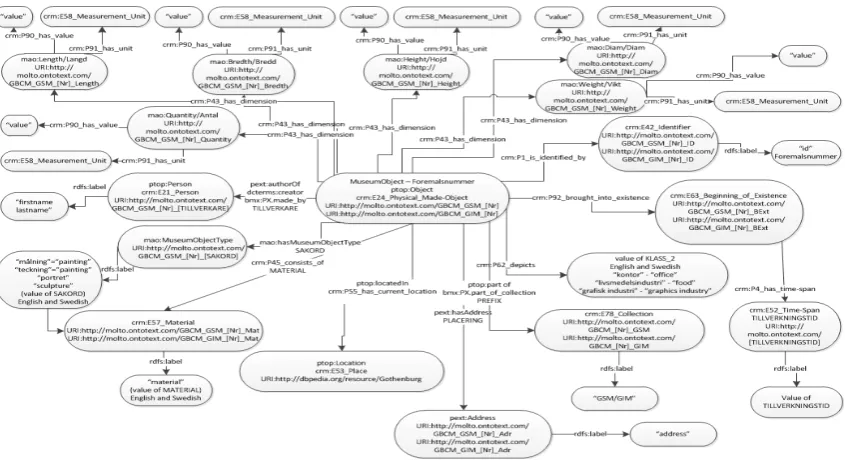
Figure 1 shows how elements from the Goethenburg city museum are represented with elements from different schemata, e.g. CIDOC-CRM, PROTON, SOCH and the Painting ontol-ogy.
2.6 DBpedia
DBpedia (Auer et al., 2007) is the RDF-ized ver-sion of Wikipedia, comprising the information from Wikipedia infoboxes, designed and devel-oped to provide as full as possible coverage of the factual knowledge that can be extracted from Wikipedia with a high level of precision. DBpedia
describes more than 3.5 million things and cov-ers 97 languages. 1.67 million of DBpedia things are classified in a consistent ontology, including 364,000 persons, 462,000 places, and 99,000 mu-sic albums. The DBpedia knowledge base has over 672 million RDF triples out of which 286 million extracted from the English edition of Wikipedia and 386 million extracted from other language edi-tions.
DBpedia is used as an additional source of data, which can enrich the information about the Gothenburg museum data. For example, their lo-cation identified with the DBpedia resource refer-ring to the city of Gothenburg.
3 Integrating and Accessing Museum Data
3.1 Integration for flexible computing
Integrating datasets into linked data in RDF usu-ally takes place by indicating that two instances from two datasets are the same by using the built in OWL predicate: owl:sameAs.12 However, recent research (Damova, 2011; Damova et al., 2011; Jain et al., 2011) has shown that interlinking the models according to which the datasets are de-scribed is a more powerful mechanism of dealing with large amounts of data in RDF, as it exploits inference and class assignment.
We have adopted this approach when creating the infrastructure for the museum linked data, in-cluding several layers of upper-level ontologies. They provide a connection to different sets of linked data, for example PROTON for the LOD cloud. They also provide an extended pool of con-cepts that can be referred to in museum linked data that do not directly pertain to the expert descrip-tions of the museum objects, and the strictly ex-pert museum knowledge is left to CIDOC-CRM. This model of interlinked ontologies offers a flex-ible access to the data with different conceptual access points. This approach is implemented as a Reason-able View of the web of data (Kiryakov et al., 2009).
3.2 The Museum Reason-able View
Using linked data techniques (Berners-Lee, 2006) for data management is considered to have great potential in view of the transformation of the web of data into a giant global graph. Still there are challenges related to them that have to be handled
Figure 1: Dataset interconnectedness in the Museum Reason-able View.
to make this possible. Kiryakov et al. (2009) dis-cuss these challenges and present an approach for reasoning with and management of linked data. In summary, a Reason-able View is an assembly of independent datasets, which can be used as a sin-gle body of knowledge with respect to reasoning and query evaluation. Each Reason-able View is aiming at lowering the cost and the risks of us-ing specific linked datasets for specific purposes. We followed this approach when constructing the Museum Reason-able View with the data from the Gothenburg City Museum, DBpedia, Geonames and the ontologies listed in Section 2.13
Figure 2: Integration of Gothenburg city museum data into the Museum Reason-able View.
The process of Gothenburg city museum data integration into the Museum Reason-able View consists in transforming the information from the museum database into RDF triples on the on-tologies described in the previous section. Fig-ure 2 shows the architectFig-ure of the Museum
13Geonames website:http://www.geonames.org/
Reason-able View, which includes interconnected schemata and links to external to the Gothenburg museum data, such as DBpedia. The knowledge base contains close to 10K museum artifacts from the Gothenburg city museum, and the entire DB-pedia.
3.3 Accessing Museum Linked Data
The Museum Reason-able View is loaded in OWLIM (Bishop et al., 2011) and its data are ac-cessible via a SPARQL (Eric and Andy, 2008) end point and keywords.14 The queries can be for-mulated by combining predicates from different datasets and ontologies in a single SPARQL query, retrieving results from all different datasets that are part of the Reason-able View.
A query example about the location, address, description and time of paintings by Carl Larsson is given below.
PREFIX crm: <http://purl.org/NET/cidoc-crm/core#> PREFIX ptop: <http://proton.semanticweb.org/protontop#> PREFIX painting:<http://spraakbanken.gu.se/rdf/owl/painting#> PREFIX rdfs: <http://www.w3.org/2000/01/rdf-schema#> PREFIX pext: <http://proton.semanticweb.org/protonext#>
select * where {
?museumObject crm:P55_has_current_location ?location . ?museumObject painting:hasCategory [rdfs:label "teckning"@sv]. ?museumObject pext:authorOf [rdfs:label "Carl Larsson"@sv]. ?museumObject crm:P55_has_current_location ?location . OPTIONAL {
?museumObject pext:hasAddress [rdfs:label ?address].} ?museumObject crm:P62_depicts ?description . ?museumObject crm:P92_brought_into_existence [ crm:P4_has_time-span [ rdfs:label ?time ] ]. }
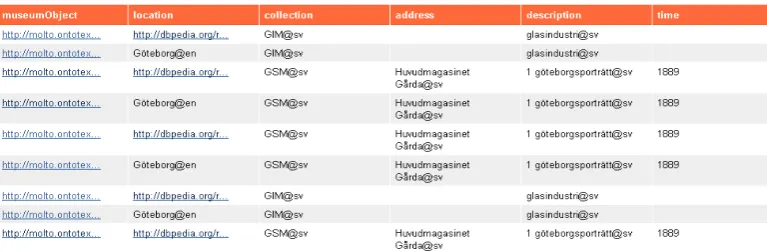
[image:4.595.92.272.529.611.2]Figure 3: The results from a SPARQL query.
The above query returns the results that are de-picted in Figure 3. Note that the returned location is the DBpedia resource about the city of Gothen-burg. The results also show that museum items from the two collections – GIM and GSM – are harvested, which means that the data from the collections are integrated together and accessible from a single query point.
Other queries can be asked about the types of art work preserved in the museum, their material, or about artwork from a certain period of time, etc. Below follows another query example about the address, the time of paintings and the collection they are coming from.
select ?museumObject ?location ?collection ?address ?description ?time where {
?museumObject crm:P55_has_current_location ?location ; ptop:partOf [ rdfs:label ?collection ] ;
painting:hasCategory [ rdfs:label "teckning"@sv ] ; crm:P62_depicts ?description .
OPTIONAL {?museumObject pext:hasAddress [ rdfs:label ?address ] .}
OPTIONAL {?museumObject crm:P92_brought_into_existence [ crm:P4_has_time-span [ rdfs:label ?time ] ] .}
}
The Reason-able View is accessible with SPARQL queries, which require intimate knowl-edge of the schemata describing the data, and tech-nical expertise in SPARQL. Moreover, the results from SPARQL are not always easy to understand, in particular if the retrieved information is given in a language other than English. This is why the results are send forward to the NLP component to verbalize the ontology links.
4 Ontologies Verbalization
4.1 The Grammatical Framework (GF)
The Grammatical Framework GF (Ranta, 2004) is a grammar formalism, based on Martin-L¨of’s
type theory (Martin-L¨of, 1982). Its key feature is the division of a grammar in the abstract syntax-which acts as a semantic interlingua and the con-crete syntaxes-representing verbalizations in vari-ous target languages (natural or formal).
GF comes with a resource library (Ranta, 2009), where the abstract syntax describes the most com-mon grammatical constructions allowing text gen-eration, which are further mapped to concrete syn-taxes corresponding to 18 languages.15 The re-source library aids the development of new gram-mars for specific domains by providing the op-erations for basic grammatical constructions, and thus making it possible for users without linguistic background to generate syntactically correct natu-ral language.
To verbalize the data that is stored in the Mu-seum Reason-able View, we utilize GF. The ad-vantages of using GF for verbalization is three fold: it provides mechanisms for type checking, by validating coercions between the basic class of an instance and the class required by the definition of the relation that uses it; the framework offers sup-port of direct verbalization which makes it easier to generate text from the ontology and so to create natural language applications using it without the aid of external tools; GF has a resource library that cover the syntax for 18 languages.
4.2 Translation of the Museum Reason-able View to GF
The capabilities of GF as a host-language for ontologies were already investigated in Enache and Angelov (2010), where SUMO, the largest open-source ontology was translated to GF. It was shown that the type system provides a robust
framework for encoding classes, instances and re-lations. The same basic implementation design that was used for encoding SUMO in GF is applied in this work for representing the Museum Reason-able View.
The classes form a hierarchy modelled by an inheritance relation, which is the reflexive-transitive closure of the subclass relation rdfs:subClassOf from the ontology, are encoded as functions in the GF grammar. Other information stated in the ontology, is encoded in GF as axioms, external to the grammar. These are used for verbalization as in the following example from the OWL entry corresponding to the painting Big Garden:
<owl:NamedIndividual
rdf:about="&painting; BigGardenObj"> <rdf:type
rdf:resource="&painting;Painting"/> <isPaintedOn
rdf:resource="&painting;Canvas"/> <createdBy
rdf:resource="&painting;CarlLarsson"/> <hasCreationDate rdf:resource=
"&painting;Year1937"/> </owl:NamedIndividual>
A representation of the instanceBigGardenObj is defined as follows:
fun BigGardenObj : Ind Painting ;
Where thePaintingwas defined previously as a class. The remaining information aboutBig Gar-denfrom the ontology is encoded as a set of ax-ioms with the following syntax:
isPaintedOn (el BigGradenObj) (el Canvas)
createdBy (el BigGardenObj)(el CarlLarsson)
hasCreationDate (el BigGardenObj) (el (year 1937))
A couple of clarifying remarks about the GF encoding are needed in order to understand bet-ter the representation of the ontology: the depen-dent typeIndis used to encode class information of instances, and the wrapper functionelis used to make the above-mentioned coercion, where the two types, along with the inheritance object that represents the proof that the coercion is valid are not visible here, since GF features implicit argu-ments.
In GF, the natural language generation is based on composeable templates. We obtain the ver-balization of classes and templates automatically, mainly based on their Camel-Case representation. For the relations, more work is needed, since a grammatically correct verbalization is not possible based only on the ontology information.
Below follow a few English sentence examples that we are able to generate:
• Big Garden is a painting
• Big Garden is painted on canvas
• Big Garden is painted by Carl Larsson
• Big Garden was created in 1937
Below we provide examples for ontology rela-tions in the shape ofO1 is painted by O2and feed these to the GF parser which will build an abstract syntax tree, from which we abstract over the place-holdersO1andO2, replacing them with function arguments.
For example, the relation
hasCurrentLocation and hasCreationDate have the following abstract syntax representation:
fun hasCurrentLocation : El Painting -> El Place -> Formula ;
fun Painting_hasCreationDate : El Painting_Artwork
-> El Painting_TimePeriod -> Formula ;
Their English representation in the concrete syntax is:
lin hasCurrentLocation o1 o2 = mkPolSent (mkCl o1
(mkVP (passiveVP locate_V2) (mkAdv at_Prep o2))) ;
lin Painting_hasCreationDate o1 o2 = mkPolSentPast (S.mkCl o1 (S.mkVP
(S.passiveVP create_V2) (S.mkAdv in_Prep o2))) ;
Since the parser uses the resource library gram-mars, the result sentence will be syntactically correct, regardless of the arguments we use it with. Also, one does not need extensive knowl-edge of the GF library or GF programming in or-der to build verbalization. This might not make a difference for English, which is morphologi-cally simple, but future work involves building such a representation for French, German, Finnish and Swedish, where it would be more difficult to achieve correct agreement, without grammatical tools.
Equiv_TimePeriod = Equivalent TimePeriod (both E52_TimeSpan Sumo.YearDuration) ;
Equivalent Class Classis a dependent type that encodes type equivalence.
5 Related Work
Museum Data Integration with semantic technolo-gies as proposed in this paper is intended to enable efficient sharing of museum and cultural heritage information. Initiatives for developing such shar-ing museum data infrastructures have emerged in the recent years. Only a few of them rely on se-mantic technologies.
The Museum Data Exchange 2010 project has developed a metadata publishing tool to extract data in XML.16Brugman et al. (2008) have devel-oped an Annotation Meta Model providing a way of defining annotation values and anchors in an an-notation for multimedia resources. The difference between these approaches and our approach is that we chose to reuse many of the concepts and the re-lationships that are already defined in the standard model CIDOC-CRM.
Other related initiatives in the Web of structured data is the Amsterdam Museum Linked Open Data project,17 aiming at producing Linked Data within the Europeana data model (Dekkers et al., 2009; Haslhofer and Isaac, 2011), and the Na-tional Database Project of Norwegian University Museums (Ore, 2001) who developed a unified in-terface for digitalizing cultural material.18
In Sweden, as well as other countries, seman-tic technologies enter the cultural heritage field in-creasingly and there have been some suggestions describing the tools and techniques that should be applied to digitalize the Swedish Union Cat-alogue (Malmsten, 2008). Following these ideas and experiences from experimenting with museum data (Bryne, 2009) who have shown that con-version of museum databases is best approached through integration of existing models, we decided to invest in a manual design step to built a frame-work that captures specific characteristics of mu-seum databases.
16
http://www.oclc.org/research/ activities/museumdata/default.htm
17
http://www.europeana.eu/portal/ thoughtlab_linkedopendata.html
18http://www.muspro.uio.no/engelsk-omM. shtml
To our knowledge, we made the first attempt of using CIDOC-CRM to produce museum linked data with connections to external sources like DB-pedia. Our attempt to generate natural language sentences from ontologies, and more precisely from the structured results of SPARQL queries are the novelty of the work presented in this paper.
6 Conclusions
We presented a framework for integrating and ac-cessing museum linked data, and a method to present this data using natural language generation technology.
A series of upper-level and domain specific ontologies have been used to transform Gothen-burg museum data from a relational database into RDF and build a Museum Reason-able View. We showed how federated results to SPARQL queries using predicates from multiple ontologies can be obtained. Consequently, we demonstrated how templates are automatically obtained in GF to gen-erate the query results in natural language.
Future work includes extending the museum data in the Museum Reason-able View, running several queries, and increasing the coverage of the GF grammar. We intend to have a grammatical coverage for at least five languages. Other direc-tions for future work, also include fluent discourse generation from the ontology axioms, as well as paraphrasing of the existing patterns for verbaliza-tion.
Acknowledgments
This work is supported by MOLTO Euro-pean Union Seventh Framework Programme (FP7/2007-2013) under grant agreement FP7-ICT-247914.
References
S¨oren Auer, Christian Bizer, Georgi Kobilarov, Jens Lehmann, Richard Cyganiak, and Zachary Ives. 2007. DBpedia: A nucleus for a web of open data. InLecture Notes in Computer Science (LNCS), vol-ume 4825, pages 722–735.
Tim Berners-Lee. 2004. OWL Web Ontology Lan-guage reference, February. W3C Recommendation.
T. Berners-Lee. 2006. Design
is-sues: Linked data. Retrieved from
B. Bishop, A. Kiryakov, D. Ognyanoff, I. Peikov, Z. Ta-shev, and R. Velkov. 2011. OWLIM: A family of scalable semantic repositories. Semantic Web Journal, Special Issue: Real-World Applications of
OWL.
Dan Brickley and R.V. Guha, 2004. RDF Vocabulary
Description Language 1.0: RDF Schema. W3C.
http://www.w3.org/TR/rdf-schema/.
Hennie Brugman, V´eronique Malais´e, and Laura Hollink. 2008. A common multimedia annotation framework for cross linking cultural heritage digi-tal collections. InInternational Conference on Lan-guage Resources and Evaluation (LREC).
Kate Bryne. 2009. Putting hybrid cultural data on the semantic web. Journal of Digital Information (JoDI), 10(6). Eds. Martha Larson, Kate Fernie, John Oomen.
Paul Clough, Jennifer Marlow, and Neil Ireson. 2008. Enabling semantic access to cultural heritage: A case study of tate online. In Proceedings of the ECDL. Workshop on Information Access to Cultural Heritage, ISBN 978-90-813489-1-1, Aarhus, Den-mark, September.
Nick Crofts, Martin Doerr, Tony Gill, Stephen Stead, and Matthew Stiff, 2008. Definition of the CIDOC Conceptual Reference Model.
Mariana Damova and Dana Dann´ells. 2011. Reason-able view of linked data for cultural heritage. In
Proceedings of the third International Conference on Software, Services and Semantic Technologies (S3T).
Mariana Damova, Atanas Kiryakov, Maurice Grinberg, Michael K. Bergman, Frederik Giasson, and Kiril Simov. 2011. Creation and integration of reference ontologies for efficient lod management. In Semi-Automatic Ontology Development: Processes and Resources, IGI Global, Hershey PA, USA.
Mariana Damova, 2011. Data Models and Alignment, May. Deliverable 4.2. MOLTO FP7-ICT-247914.
Makx Dekkers, Stefan Gradmann, and Carlo Meghini, 2009. Europeana Outline Functional Specification For development of an operational European Digital Library. Europeana Thematic Network Deliverable 2.5.
Ramona Enache and Krasimir Angelov. 2010. Type-ful ontologies with direct multilingual verbalization.
Workshop on Controlled Natural Languages (CNL) 2010.
Prud’hommeaux Eric and Seaborne Andy. 2008. SPARQL. the query language for RDF, January. W3C Recommendation.
Bernhard Haslhofer and Antoine Isaac. 2011. data.europeana.eu the europeana linked open data pilot. In Proceedings of the Intl. Conf. on Dublin Core and Metadata Applications.
Prateek Jain, Peter Z. Yeh, Kunal Verma, Reymonrod G., Mariana Damova, Vasquez Pascal Hitzler, and Amit P. Sheth. 2011. Contextual ontology align-ment of lod with an upper ontology: A case study with proton. InProceedings of 8th ESWC, Extended Semantic Web Conference, Heraklion, Greece, May.
A. Kiryakov, D. Ognyanoff, R. Velkov, Z. Tashev, and I. Peikov. 2009. LDSR: Materialized reason-able view to the web of linked data. In Proceedings of
OWL: Experiences and Directions (OWLED) 2009,
Chantilly, USA.
Martin Malmsten. 2008. Making a library catalogue part of the semantic web. InProceedings of the Intl. Conf. on Dublin Core and Metadata Applications, Berlin, German.
Per Martin-L¨of. 1982. Constructive mathematics and computer programming. In Cohen, Los, Pfeif-fer, and Podewski, editors,Logic, Methodology and Philosophy of Science VI, pages 153–175. North-Holland, Amsterdam.
Christian-Emil Smith Ore. 2001. The norwegian mu-seum project, access to and interconnection between various resources of cultural and natural history. In
European Conference on Research and Advanced Technology for Digital Libraries ECDL.
Aarne Ranta. 2004. Grammatical framework, a type-theoretical grammar formalism. Journal of Func-tional Programming, 14(2):145–189.
Aarne Ranta. 2009. The GF resource grammar library.
Linguistic Issues in Language Technology, 2(2).
I. Terziev, A. Kiryakov, , and D. Manov, 2005.D.1.8.1
Base upper-level ontology (BULO) Guidance.
De-liverable of EU-IST Project IST.