Multiword Expressions in Statistical Dependency Parsing
G ¨uls¸en Eryi˘git Tugay ˙Ilbay Ozan Arkan Can Department of Computer Engineering
Istanbul Technical University Istanbul, 34469, Turkey
{gulsen.cebiroglu,ilbay, cano}@itu.edu.tr
Abstract
In this paper, we investigated the impact of ex-tracting different types of multiword expres-sions (MWEs) in improving the accuracy of a data-driven dependency parser for a morpho-logically rich language (Turkish). We showed that in the training stage, the unification of MWEs of a certain type, namely compound verb and noun formations, has a negative ef-fect on parsing accuracy by increasing the lex-ical sparsity. Our results gave a statistlex-ically significant improvement by using a variant of the treebank excluding this MWE type in the
training stage. Our extrinsic evaluation of
an ideal MWE recognizer (for only extracting MWEs of type named entities, duplications, numbers, dates and some predefined list of compound prepositions) showed that the pre-processing of the test data would improve the labeled parsing accuracy by 1.5%.
1 Introduction
Multiword expressions are compound word forma-tions formed by two or more words. They gener-ally represent a different meaning than the words which compose them. The importance of detecting multiword expressions in different NLP problems is emphasized by many researchers and is still a topic which is being investigated for different NLP lay-ers (Kordoni et al., 2011). It is impossible to ne-glect the importance for machine translation where the translation of a MWE would be totally different than the translation of its constituents. But the effect of different MWE types on parsing accuracy is still
an open research topic and needs to be analyzed in detail.
Hogan et al. (2011) recently give their prelim-inary results on detecting named-entities and re-ports no improvement in parsing accuracy for En-glish. Nivre and Nilsson (2004) reports a 5% pars-ing accuracy increase for Swedish by uspars-ing a depe-dency parser which uses a memory-based learner as its oracle. In this study, they only focus on multi-word names and compound function multi-words. Caffer-key (2008) reports very small (falling short of their initial expectations) but statistically significant im-provements for a PCFG parser (on English). Ko-rkontzelos and Manandhar (2010) reports an im-provement of sentence accuracy 7.5% in shallow parsing by concentrating on MWE of types com-pound nominals, proper names and adjective noun constructions. The conflicting results and the differ-ence in success ranges may be caused by many fac-tors; such as the parsing paradigm, the language in focus, the MWE types used in the experiments and the evaluation metrics.
In this study, we are making a detailed investiga-tion of extracting different MWE classes as a pre-processing step for a statistical dependency parser (MaltParser v1.5.1 Nivre et al. (2007)). We con-ducted our experiments on Turkish Dependency Treebanks (Oflazer et al., 2003; Eryi˘git, 2007). We semi-automatically created different versions of the data by manually annotating and classifying MWEs. We made an in depth analysis of using the new treebank versions both on training and testing stages. We evaluated the parser’s performance both on MWEs and the remaining parts of the sentences.
Our results showed that different MWE types have different impacts on the parsing accuracy. For Turkish, we showed that the preprocessing of com-pound verb and noun formations causes a consid-erable decrease in accuracy. We also demonstrated that a MWE extractor which finds the MWEs from the remaining types would make a significant im-provement for parsing. For now, it is not possible to generalize the results for other languages and pars-ing paradigms. But we believe, we present a system-atic approach for evaluating the scenario.
2 Motivation
Eryigit et al. (2008) in their article “Dependency Parsing of Turkish” points out to a decrease of nearly 4 percentage points when they test their parser on the raw data. Although they only look at this de-crease from the point of the errors caused by parts-of-speech (POS) tagging, the decrease could actu-ally be due to two reasons: 1. The errors caused by the automatic POS tagging, 2. The lack of MWE handling which exists in the gold standard. In this study, we will focus on to the second item and on the improvement that could be reached by handling MWEs. With this purpose, we are asking and an-swering the following questions during the remain-ing of the paper:
1. What is the success of available MWE extrac-tors on detecting the MWEs manually anno-tated in the treebank?
2. When we analyze the “false positives”1 of the MWE extractors, we see that most of them are actually valid MWEs. Should we as well man-ually annotate these in the treebanks?
3. When we decide to annotate these MWEs2, the results of the automatic parsing become worse then the previous results with the orig-inal treebank. Should we concentrate on differ-ent MWE types?
The paper is structured as follows: Section 3 makes a short description of the Turkish language. Section 4 presents the configuration used in our ex-periments. Section 5 gives our experimental results.
1
the group of words which are tagged as MWEs by the au-tomatic analyzers but not in the current treebanks (somehow missed by the human annotators).
2described in the 2nd item
Section 6 gives our conclusion and comments for fu-ture works.
3 Turkish
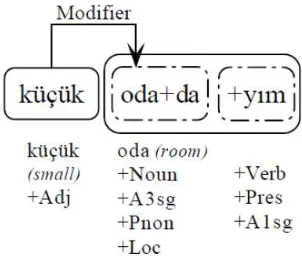
[image:2.612.349.500.462.593.2]Turkish is an agglutinative language with a very rich morphological structure. The dependencies be-tween the words constructing a sentence is almost entirely head-final in the written text. The deriva-tional and inflecderiva-tional richness of the language re-sults in shorter sentence lengths when compared to other languages (8.16 words/sentence3). In simi-lar studies, the Turkish words are most of the time analyzed as a sequence of one or more inflectional groups (IGs). Each IG consists of either a stem or a derivational suffix plus all the inflectional suffixes belonging to that stem/derivational suffix. The head of a whole word is not just another word but a spe-cific IG of another word. Figure 1 shows the IGs in a simple sentence: “k¨uc¸¨uk odadayım” (I’m in the small room). The word “odadayım” is formed from two IGs; a verb is derived from an inflected noun “odada” (in the room). In the example, the adjec-tive “k¨uc¸¨uk” (small) should be connected to the first IG of the second word. It is the word “oda” (room) which is modified by the adjective, not the derived verb form “odadayım” (I’m in the room). So both the correct head word and the correct IG in the head word should be determined by the parser.
Figure 1: Word and dependency representations
A1sg = 1sg number/person agreement, A3sg = 3sg num-ber/person agreement, Loc = Locative case, Pnon = No pos-sessive agreement, Pres = Present Tense
These properties of the language makes it very
3
hard for dependency parsing4. Buchholz and Marsi (2006) reports the Turkish Treebank having the highest number of different surface forms and the second with new lemma within 13 different lan-guages. As a result, any change on lexical repre-sentation could end up with severe lexical sparsity problems.
4 Configuration
4.1 Parser
We are using MaltParser v1.5.1 (Nivre et al., 2007) which is a data-driven dependency parser whose success is reported to be very high across a vari-ety of different languages (Nivre et al., 2006). For the repeatability of the results we used exactly the same feature representation and parser options from Eryigit et al. (2008) . The cited reference gives these options in details so we do not repeat them here again. The parser’s current version uses a support vector machine (SVM) classifier for predicting the parser’s actions. The usage of SVM in this area has been proven to be very successful. And we know that the parser’s capability is very high at learning many syntactic structures especially the ones with shorter distances. In the following sections, we will see that the extraction of MWE types where the parser is already good at determining have a negative effect on parsing accuracy by increasing the lexical sparsity.
4.2 Data Sets
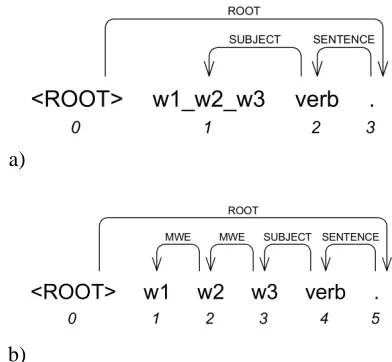
In our experiments, we are using the METU-Sabancı Turkish Treebank (Oflazer et al., 2003) which con-sists of 5635 sentences (in Conll format). The second column of Table 1 gives the statistics for the original treebank (Vo); there exist 2040 MWEs which are manually combined into single units. Fig-ure 2-a gives the symbolic representation of MWEs in the original treebank. In the figure, w1 w2 w3 are the three constituents of a MWE and are collapsed into a single unit (by the use of underscores) which acts as a single word in the dependency structure. We created 3 new versions of the treebank:
1. Detached Version (Vd): is the version where the annotated MWEs are detached and a new
4
Interested reader may refer to Eryigit et al. (2008) for de-tailed examples.
a)
[image:3.612.316.512.70.251.2]b)
Figure 2: MWE representation in the Turkish Treebank (picture drawn with MaltEval TreeViewer(Nilsson and Nivre, 2008))
dependency type “MWE” is created between the MWE constituents (Figure 2-b). The strat-egy that is adopted while creating these pendencies is to connect the last IG of the de-pendent to the first IG of the head except for compound functional words (explained later in this section). In the treebank, the gold-standard POS tag and inflectional features given for the MWE in focus is only valid for the last con-stituent of that MWE. After the detachment process, we need to assign the correct tags (to-ken index, lemma, surface form, postag, inflec-tional features, dependency type and head in-dex) to the new coming IGs (words are con-structed from one or more IGs each having their own tags). In order to select the correct postags, we passed these words from a morpho-logical analyzer (Oflazer, 1994) and then man-ually disambiguated the ones having more than one possible analyses (1265/2437 words). Af-ter this stage, we created the new tags, inserted them to the sentences and renumbered the to-ken indices, incoming and outgoing dependen-cies within the remaining of the sentence. 2. Enlarged Version (Ve): We needed to create
Turkish Treebank
Validation Set
Version Vo Vd Ve Ve-o
[image:4.612.120.491.57.158.2]# of sentences 5635 5635 5635 5635 300 # of tokens 65184 67803 63318 65887 4513 # of words inc. punctuations 53992 56424 52267 54642 3610 # of words exc. punctuations 43572 45999 41847 44217 3080 # of combined collocations 2040 0 3674 1697 89
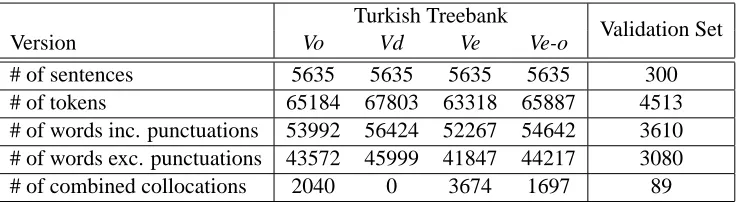
Table 1: Data sets’ statistics: Version (Vo Version Original; Vd Version detached; Ve Version enlarged; Veo -Version enlarged excluding the combined collocations of Vo )
we first extracted a MWE list consisting the 30150 MWEs available in the Turkish Dictio-nary (TDK, 2011) and then automatically listed the entire treebank sentences where the lemmas of the co-occurring words could match5 the lemmas of the MWE constituents in the list. We manually marked the sentences where the co-occurring words may be actually accepted as a MWE (but somehow missed during the con-struction of the treebanks) and then automat-ically combined these words into single units and renumbered the token indices and incom-ing and outgoincom-ing dependencies within the re-maining of the sentence. By this process, 1697 new MWEs are added to the treebank (Table 1). 3. Version Ve-o: is the treebank version where only the MWEs coming from the dictionary are annotated over the detached version. In other words, the annotated MWEs in Ve-o is the rel-ative complement of Vo in Ve.6
Table1 gives the statistics for all the versions and the validation set (Eryi˘git, 2007). We see from the table that different versions change the number of tokens and dependencies that should be discovered by the parser; as an example Vd increases the de-pendency number that will be evaluated from 43572 to 45999. In Table 1, the difference between # of combined collocations 1697 and 3674-2040 are due to overlapping MWEs consisting 2 or more words.
In the Turkish Treebank, there exists a very small amount (54) of compound functional words which
5
The lemmas of the words in the treebank are gold-standard. But in order to create the possible lemmas for the MWE con-stituents of the dictionary list, we used a morphological ana-lyzer.
6
Thus this version similarly to the version Vd, consists also a new dependency label “MWE”.
are combined into a single unit. These are mostly the conjunctions which has an extra -da/-de/-ki encl-itics written on the right side of and separately from the conjunction they attach to. We see that since these head-initial dependencies do not obey the gen-eral head-final dependency tradition of the treebank, only this type of compound functional words are preferred to be combined into single units in the con-struction phase of the treebank. While creating the detached version, we only process these differently and detach them in a head-initial manner.7 Figure 3 shows the detachment for the “ya da” (or) conjunc-tion.
Figure 3: The detachment of Combined Functional
Words
4.3 MWE Extractors
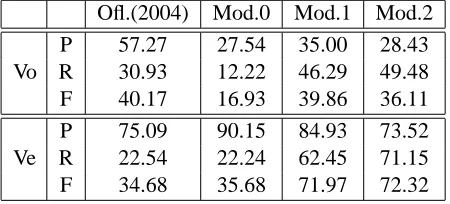
In order to understand the structure of the data in hand and the behavior of the current MWE extrac-tors on it, we evaluated the success of two different MWE extractors. Table 2 gives the precision, recall and F values. All the experiments have been con-ducted on the detached version of the treebank and evaluated both on the original and enlarged versions.
7In our preliminary tests, we have detached these as regular
The first MWE extractor is the rule based processor of Oflazer et al. (2004). For the second one, we developed a MWE checker by using the dictionary MWE list described in the previous section. Due to the inflectional structure of Turkish, MWE con-stituent words go under inflection as well. That’s why we tried 3 different models while catching the MWEs in the treebank:
•Model 0: The co-occurring words in the tree-bank sentences are accepted as a MWE if and only if they have the exact surface forms with the MWE’s constituents in the dictionary list.
•Model 1: Only the last constituent of the MWE is allowed to go under inflection (the ones at the beginning should have exactly the same surface form).
•Model 2: All of the constituents are allowed to be inflected.
Ofl.(2004) Mod.0 Mod.1 Mod.2
Vo
P 57.27 27.54 35.00 28.43 R 30.93 12.22 46.29 49.48 F 40.17 16.93 39.86 36.11
Ve
[image:5.612.71.296.320.422.2]P 75.09 90.15 84.93 73.52 R 22.54 22.24 62.45 71.15 F 34.68 35.68 71.97 72.32
Table 2: Performance of MWE Extractors: Ofl.(2004):the MWE processor of Oflazer et al. (2004);Mod.x:Model x
We see from Table 2 that the results of the eval-uation by using the version Vo is very low than ex-pected; the highest F score that could be obtained with Ofl.(2004) is 40.17 and the dictionary list is 39.86. When we look at the cause, we notice that many of the compound verb and noun formations in the Turkish Dictionary are not marked in the original treebank and that causes very low precision scores (Mod.0 27.54). In order to alleviate this problem and with the hope to achieve better results in pars-ing accuracy, we created the version Ve of the tree-bank described in the previous section. By evalu-ating with this new version of the treebank, we see that the precision values are increased drastically for all of the models; Ofl.(2004) from 57.27→ 75.09, Mod.0 from 27.54→90.15. The recalls are still low for many of the models; Mod.2 with the highest re-call value. The next section will search the answer
of the question what will happen to the parsing per-formance if we develop a perfect MWE recognizer with an F score of 100%.
5 Experiments
We have four sets of experiments. Before introduc-ing them, we will first explain our evaluation strat-egy.
5.1 Evaluation Metrics
We exactly follow the evaluation metrics used in Eryigit et al. (2008): We use ten-fold cross-validation in the experiments on the treebank (ex-cept the experiments on the validation set). We re-port the results as mean scores of the ten-fold cross-validation, with standard error. The main evalua-tion metrics that we use are the unlabeled attachment score (ASU) and labeled attachment score (ASL), namely, the proportion of IGs that are attached to the correct head (with the correct label for ASL). A correct attachment is one in which the dependent IG (the last IG in the dependent word) is not only attached to the correct head word but also to the cor-rect IG within the head word. We also report the (un-labeled) word-to-word score (W WU), which only measures whether a dependent word is connected to (some IG in) the correct head word. We will re-fer to this metric (W WU) especially while evaluat-ing the dependencies between MWEs’ constituents since we are automatically creating these dependen-cies (thus automatically selecting the IG to which the dependent will be connected). Where relevant, we also test the statistical significance of the results.
5.2 Evaluation Type
In order to see the impact of different approaches, we are making 3 different evaluations:
1. overall;ASU,ASL,W WU scores provided
2. the dependencies with “MWE” labels (appear-ing after the detachment of MWE units Figure 2-b):ASU, precision, recall,W WUscores pro-vided
5.3 Experiment Set I
In this set of experiments we first repeated the re-sults of Eryigit at al. (2008) with the new Malt-parser version. And then, tested the trained model on the different treebank versions that we had pre-pared. The first two lines of Table 3 gives the results reported in Eryigit at al. (2008); the second line is their results on the raw data where the pos tagging has been done by using an automatic analyzer. The fourth line gives our results when we test our parser on the detached version of the treebank. We see that our results on this version are better than the results obtained with raw data (73.3 - 74.7ASU) since we are using gold standard pos tags in order to be able to focus on the errors caused by the lack of MWE annotation. So, if we compare the tests on Vo with Vd, we see that the parser’s performance drops from 76.1 to 74.7 (-1.4) in ASU, 83.0 to 81.8 (-1.2) in W WU and 67.4 to 63.3 (-4.1) in ASL. We provide two values for the labeled accuracy on Vd: Since there is not any dependency with “MWE” label in the training model trained with the original treebank, it is impossible for the parser to assign correct labels to this kind of dependencies. If we accept all the la-bels assigned to these dependencies as correct than we will obtain a labeled accuracy of 66.5 given after the slash in theASLcell. And in this case, the drop in labeled accuracy would be 0.9. Of course this is a very optimistic evaluation but the real labeled ac-curacy should be something in between these two if the parsing model have already seen this dependency type.
tested on ASU ASL W WU Ery.(2008)
76.0±0.2 67.0±0.3 82.7±0.5
Vo
Ery.(2008)
73.3±0.3 63.2±0.3 80.6±0.7
Raw Data
Vo 76.1±0.2 67.4±0.3 83.0±0.2
Vd 74.7±0.2 63.3/66.5±0.3 81.8±0.2
Ve 75.5±0.2 66.7±0.3 82.5±0.2
Ve-o 74,0±0,2 62,4/65.7±0,3 81,1±0,1
Table 3: The parser’s performance trained on the original treebank (Vo)
The fifth line of the Table 3 gives the results on the enlarged version of the treebank. We see that
al-though the results are higher than Vd, they are not as good as Vo. From here, we understand that by collapsing some words into single units, we disap-peared some of the dependencies where the parser was already very successful at finding; the average scores were getting higher by the success coming from this type of dependencies. As a final step in this set of experiments, we tested our parser on ver-sion Ve-o and saw that the results are worse than the results on the detached version (Vd): Collecting the new MWE components into single units gives worse results than doing no MWE processing at all. But is this just an illusion8or is there really a bad effect on the discovery of the remaining dependencies also? Actually the results provided here is not enough for answering this question. In order to see the exact picture we should examine the results more closely (Section 5.5).
5.4 Experiment Set II
In this set of experiments, we are looking at the re-sults by using the new treebank versions in the train-ing stage as well. Table 4 shows that in all of the test set combinations, the worst results are obtained by training with the enlarged treebank (Ve).
train. test. ASU ASL W WU
Vo
Ve 75.5±0.2 66.7±0.3 82.5±0.2
Vo 76.1±0.2 67.4±0.3 83.0±0.2
Vd 74.7±0.2 63.3±0.3 81.8±0.2
Vd
Ve 75.3±0.2 65.9±0.3 82.4±0.2
Vo 76.0±0.2 66.7±0.3 82.9±0.1
Vd 76.0±0.2 65.9±0.3 82.7±0.2
Ve
Ve 75.3±0.2 66.7±0.3 82.3±0.2
Vo 75,7±0.2 67,1±0.3 82,7±0.2
Vd 74.3±0.2 63.0±0.3 81.4±0.2
Table 4: Parser’s performance by training and testing with the different versions of the treebank
Table 4 shows that the results on the detached test set (Vd) are better when trained by Vd (76.0±0.2
ASU) rather than the original treebank Vo (74.7±0.2
ASU). This means that the parser is better at
find-8
ing the dependencies if it has samples from the same genre. But again by just looking the results this way, it is not possible to understand the situation entirely.
5.5 Experiment Set III
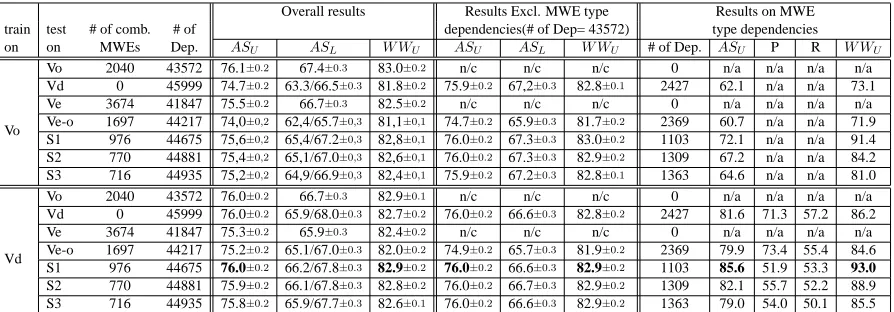
In order to be able to understand what is happen-ing on the dependencies within MWEs and their sur-rounding structures, we are evaluating the results on 3 different ways described in Section 5.2. Table 5 gives the scores in all of thees three evaluation types; The first column block states each training and testing combination together with the number of combined MWEs and the total number of depen-dencies in the test sets. The second column block gives the overall results of the parser. The fourth column block lists the results obtained on the depen-dencies (with MWE label) occurring between the constituent words which appeared after the detach-ment of the MWEs annotated on the original tree-bank. The third column block gives the results ob-tained on the remaining dependencies (excluding the ones with MWE label). Example: The number of MWE labeled dependencies is 0 for the Vo and 2427 for Vd meaning that the detachment of 2040 com-bined MWEs (two or more words) on Vo resulted to 2427 dependencies. Thus, the average number of dependency per MWE is 1.19.
From the Table 5, we may now analyze the parser’s performance in detail; We observe that the parser’s performance (trained on the original tree-bank) drops significantly when it is tested on the detached version both on the overall results (76.1
→ 74.7ASU) and excluding MWEs (76.1→75.9 ASU, 83.0→82.8W WU the difference is small but statistically significant (McNemar p<0.01)). We see that the tests on Ve-o not only causes a decrease on the overall accuracy (74.7 → 74.0 ASU) but also a decrease on the dependencies excluding MWEs (75.9 → 74.7 ASU). Thus, we may say that the combination of MWEs listed in the dictionary has a harming effect on the determination of other syn-tactic structures as well. On the other side, we ob-serve that the combination of MWEs annotated in the original treebank has a positive effect on the de-termination of other syntactic structures (from Vd to Vo theASUdiffers 75.9→76.1 but from Vd to Ve-o theASU differs 75.9→74.7).
These results bring the question: “What is the
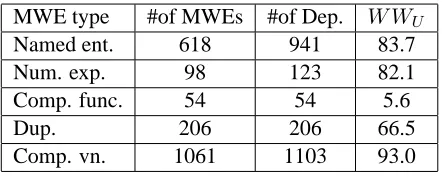
dif-ference between the dictionary MWE list and the treebank MWE list?” In order to answer this ques-tion, we manually classified the MWEs in the Turk-ish treebank into six categories which are listed in Table 6. The second column in the table lists the number of MWEs in each categories, the third col-umn lists the number of dependencies when we de-tach these MWEs and the fourth column gives the W WU scores on the dependencies from these spe-cific MWE categories. We only look at theW WU scores since the IG-based links are created automat-ically and W WU scores is considered to be more informative. The results are obtained with a parsing model trained with Version Vd. (it is obvious that a model trained with Vo won’t be able to find most of these dependencies because of the lack of samples.)
MWE type #of MWEs #of Dep. W WU Named ent. 618 941 83.7 Num. exp. 98 123 82.1 Comp. func. 54 54 5.6
Dup. 206 206 66.5
[image:7.612.314.535.287.376.2]Comp. vn. 1061 1103 93.0
Table 6: Parser’s success on special MWE types:
Named Entities (Named ent.), Numerical Expressions (Num.exp.), Compound function words (Comp.func.), Duplications (Dup), Compound verb and noun forma-tions (Comp.vn.)
We see from the Table 6, the parser is very bad (5.6W WU) at determining the compound function words (which are very rare) (Figure 3) and duplica-tions9 (66.5W W
U). These dependencies could
ac-tually be easily discovered by a rule-based extractor. The success on named entities (83.7) and number expressions (82.1) could be considered as good but one shouldn’t forget that the training and testing data is from the same treebank and the sentences could actually not be considered as random. Thus on a to-tally unseen data, these results would be lower. But again we believe a rule-based extractor for numer-ical and date expressions could be developed with
9
Overall results Results Excl. MWE type Results on MWE train test # of comb. # of dependencies(# of Dep= 43572) type dependencies on on MWEs Dep. ASU ASL W WU ASU ASL W WU # of Dep. ASU P R W WU
Vo
Vo 2040 43572 76.1±0.2 67.4±0.3 83.0±0.2 n/c n/c n/c 0 n/a n/a n/a n/a
Vd 0 45999 74.7±0.2 63.3/66.5±0.3 81.8±0.2 75.9±0.2 67,2±0.3 82.8±0.1 2427 62.1 n/a n/a 73.1
Ve 3674 41847 75.5±0.2 66.7±0.3 82.5±0.2 n/c n/c n/c 0 n/a n/a n/a n/a
Ve-o 1697 44217 74,0±0,2 62,4/65.7±0,3 81,1±0,1 74.7±0.2 65.9±0.3 81.7±0.2 2369 60.7 n/a n/a 71.9
S1 976 44675 75,6±0,2 65,4/67.2±0,3 82,8±0,1 76.0±0.2 67.3±0.3 83.0±0.2 1103 72.1 n/a n/a 91.4
S2 770 44881 75,4±0,2 65,1/67.0±0,3 82,6±0,1 76.0±0.2 67.3±0.3 82.9±0.2 1309 67.2 n/a n/a 84.2
S3 716 44935 75,2±0,2 64,9/66.9±0,3 82,4±0,1 75.9±0.2 67.2±0.3 82.8±0.1 1363 64.6 n/a n/a 81.0
Vd
Vo 2040 43572 76.0±0.2 66.7±0.3 82.9±0.1 n/c n/c n/c 0 n/a n/a n/a n/a
Vd 0 45999 76.0±0.2 65.9/68.0±0.3 82.7±0.2 76.0±0.2 66.6±0.3 82.8±0.2 2427 81.6 71.3 57.2 86.2
Ve 3674 41847 75.3±0.2 65.9±0.3 82.4±0.2 n/c n/c n/c 0 n/a n/a n/a n/a
Ve-o 1697 44217 75.2±0.2 65.1/67.0±0.3 82.0±0.2 74.9±0.2 65.7±0.3 81.9±0.2 2369 79.9 73.4 55.4 84.6
S1 976 44675 76.0±0.2 66.2/67.8±0.3 82.9±0.2 76.0±0.2 66.6±0.3 82.9±0.2 1103 85.6 51.9 53.3 93.0
S2 770 44881 75.9±0.2 66.1/67.8±0.3 82.8±0.2 76.0±0.2 66.7±0.3 82.9±0.2 1309 82.1 55.7 52.2 88.9
[image:8.612.87.534.321.477.2]S3 716 44935 75.8±0.2 65.9/67.7±0.3 82.6±0.1 76.0±0.2 66.6±0.3 82.9±0.2 1363 79.0 54.0 50.1 85.5
high success. The best performance (93.0) of the parser is on the MWE of types compound verb and noun formations. We see that this is the class with the highest number of MWEs. And when we look at the dependencies on the dictionary list, we see that almost all of the MWEs are from this class; i.e. com-pound verb and noun formations. So actually by cre-ating the enlarged version (Ve) of the treebank, we added 1697 more MWEs into this category where the parser is already very good at discovering. So what is going wrong when we combine these MWEs into single units in the preprocessing step? Instead of having an accuracy of 93% with automatic detec-tion, we would have an accuracy of 100% with our deterministic approach. The problem is that when we do this we actually increase the lexical sparsity. For example, the verb “etmek” (to do) in Turkish may produce many MWEs such as “ikaz etmek” (to warn), “buyur etmek” (to welcome), “fark etmek” (to notice) and so on. And this is a very frequent verb in Turkish; it occurs 388 times in the current Turkish Treebank where in 340 of them it formed a MWE (already annotated in the treebank). With the addition of the dictionary list, 27 more MWEs constructed with “etmek” is added to the treebank. When we combine the MWEs constructed with this verb into single units we are actually splitting its fre-quency to many rarely occurring MWEs.
The next question is “If the addition of more MWEs of type compound verb and noun forma-tions caused an accuracy decrease in parsing perfor-mance, could we obtain better or similar results by detaching the MWEs from this type and leaving the others as in the original?” If the answer is yes, then we could develop type specific MWE extractors ac-cording to the results. To answer our new question, we tested on 3 new versions of the treebank which consists the following subsets of MWEs:
•Subset 1 (S1)- Vo excluding MWEs of type compound verb and noun formations (meaning that only this type of MWEs are detached into their constituents and the others are left com-bined.)
•Subset 2 (S2)- S1 excluding MWEs of type du-plications.
•Subset 3 (S3)- S2 excluding MWEs type com-pound function words.
Table 5 gives the results for the subsets as well. We see from the table that S1 has 1103 dependencies with MWE label (of type compound verb and noun formations). The unlabeled results of the tests on S1 are better than the tests on Vd, Ve, Ve-o and very close to the results on Vo. This means that, a MWE extractor concentrating only on the MWEs of type named entities, numerical expressions, duplications and some compound function words already anno-tated in the treebank could obtain similar results to the scores on the original treebank. But we see that we still have a problem with labeled accuracies. The addition of the new label increased the complexity for the parser and caused false positive assignments on dependencies from other types.
5.6 Experiment Set IV
To alleviate the problem observed in the labeled ac-curacy, instead of assigning the new “MWE” label to the detached MWEs, we developped a rule based dependency label chooser which assigns an appro-priate label to these dependencies obeying the Turk-ish Treebank annotation approach. We have 16 rules similar to the following one:
if DEPENDENCY LABEL eq ‘MWE’{
if HEAD’s POSTAG eq ‘Verb’
&& DEPENDENT’s POSTAG eq ‘Adverb’ then change MWE→MODIFIER
}
We changed the MWE labels in S1 and Vd by using this rule based dependency label chooser. Table 7 gives the results at the end of this operation.
train. test. ASU ASL W WU
Vo Vo 76.1
±0.2 67.4±0.3 83.0±0.2
Vd* 74.7±0.2 66.1±0.2 81.8±0.2
S1* S1* 76.1
±0.2 67.6±0.3 82.9±0.2
[image:9.612.317.531.501.573.2]Vd* 75.3±0.2 66.7±0.2 81.9±0.2
Table 7: Parsing results with MWE labels replaced by the label chooser
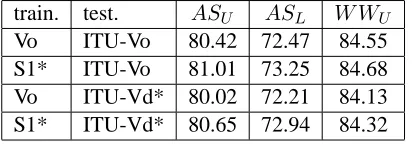
signif-icant with McNemar (p < 0.01)). We also vali-dated this outcome by testing on the validation set. Table 8 gives the results on both the original ver-sion of the validation set (ITU-Vo) and the detached version (ITU-Vd*). Although the small number of available MWEs (only 89), we observe an improve-ment by using the model trained with S1*. For the first two lines the improvement is rather small but statistically significant on labeled accuracy with Mcnemar(p<0.05).
[image:10.612.81.287.207.280.2]train. test. ASU ASL W WU Vo ITU-Vo 80.42 72.47 84.55 S1* ITU-Vo 81.01 73.25 84.68 Vo ITU-Vd* 80.02 72.21 84.13 S1* ITU-Vd* 80.65 72.94 84.32
Table 8: Results on Validation Set
(The trained model is on the data of 9 cross validation fold; the training set size is the same with other experiments)
Another outcome that could be observed from Ta-ble 7 (by comparing the first and third lines of re-sults) is that a MWE extractor for only MWEs of types named entities, duplications, numbers, dates and some predefined list of compound prepositions would be enough for obtaining the results of the gold-standard treebank (there is no statistically sig-nificant results between these two lines). As a fi-nal comment, we may conclude that the prepro-cessing of the test data would improve the results by nearly 1.5 in IG-based evaluations (74.7→76.1, 66.1→67.6) and 1.1 (81.8→82.9) in word-based evaluation (2nd and 3rd lines of Table 7) if we also train with S1* instead of the original treebank. One should remember that there are in total 1324 fewer dependencies (Table 5) in S1 compared to Vd. These dependencies are expected to be discovered by the MWE extractor.
6 Conclusion
In this paper, we made a detailed analysis on mul-tiword expression extraction on parsing accuracy of a statistical dependency parser. Our results showed that different MWE types have different impacts on the parser’s performance. During the experiments, for the representation of MWEs in parsing data, we used a highly adopted strategy and combined the
MWEs’ constituents into single units. But we ob-served that when this approach is applied to the MWE types that could already be determined by the parser with a high success, the overall performance is decreased instead of increasing. The reason is mostly due to the lexical sparsity caused by the rep-resentation of the MWEs (as a single unit).
Although the development of a high accuracy MWE extractor was out of scope of this paper, dur-ing the analysis of different MWE types, we ob-served that most of them (which helped to increase parsing performance) could be easily found by creat-ing rule-based MWE extractors. As the future work, we plan to develop such an extractor and evaluate the real parsing performance by using it. Another re-search topic will certainly be to investigate different MWE representations (others than the combination strategy).
Acknowledgments
The authors want to thank Mehmet Altıparmak for his help during the creation of the new treebank ver-sions.
References
Sabine Buchholz and Erwin Marsi. 2006. Conll-X
shared task on multilingual dependency parsing. In
Proceedings of the 10th Conference on Computational Natural Language Learning, pages 149–164, New
York, NY. Association for Computational Linguistics.
Conor Cafferkey. 2008. Exploiting multi-word units
in statistical parsing and generation. Master’s thesis, Dublin City University, Ireland.
G¨uls¸en Eryi˘git. 2007. ITU validation set for
Metu-Sabancı Turkish treebank. March.
G¨uls¸en Eryi˘git, Joakim Nivre, and Kemal Oflazer. 2008. Dependency parsing of Turkish. Computational
Lin-guistics, 34(3):357–389.
Deirdre Hogan, Jennifer Foster, and Josef van Genabith. 2011. Decreasing lexical data sparsity in statistical syntactic parsing - experiments with named entities. In Proceedings of the Workshop on Multiword
Expres-sions: from Parsing and Generation to the Real World,
pages 14–19, Portland, Oregon, USA, June. Associa-tion for ComputaAssocia-tional Linguistics.
Valia Kordoni, Carlos Ramisch, and Aline Villavicencio, editors. 2011. Proceedings of the Workshop on
the Real World. Association for Computational
Lin-guistics, Portland, Oregon, USA, June.
Ioannis Korkontzelos and Suresh Manandhar. 2010. Can recognising multiword expressions improve shallow
parsing? In Human Language Technologies: The
2010 Annual Conference of the North American Chap-ter of the Association for Computational Linguistics,
pages 636–644, Los Angeles, California, June. Asso-ciation for Computational Linguistics.
Jens Nilsson and Joakim Nivre. 2008. Malteval: An evaluation and visualization tool for dependency pars-ing. In In Proceedings of the Sixth International
Lan-guage Resources and Evaluation. LREC.
Joakim Nivre and Jens Nilsson. 2004. Multiword units in syntactic parsing. In MEMURA 2004 -
Methodolo-gies and Evaluation of Multiword Units in Real-World Applications, Workshop at LREC 2004, pages 39–46,
Lisbon, Portugal, May. In Dias, G., Lopes, J. G. P. and Vintar, S. (eds.).
Joakim Nivre, Johan Hall, Jens Nilsson, G¨uls¸en Eryi˘git,
and Stetoslav Marinov. 2006. Labeled
pseudo-projective dependency parsing with support vector
machines. In Proceedings of the 10th Conference
on Computational Natural Language Learning, pages
221–225, New York, NY.
Joakim Nivre, Johan Hall, Jens Nilsson, Atanas Chanev,
G¨uls¸en Eryi˘git, Sandra K¨ubler, Stetoslav
Mari-nov, and Erwin Marsi. 2007. Maltparser: A
language-independent system for data-driven depen-dency parsing. Natural Language Engineering
Jour-nal, 13(2):99–135.
Kemal Oflazer, Bilge Say, Dilek Z. Hakkani-T¨ur, and G¨okhan T¨ur. 2003. Building a Turkish treebank. In A. Abeill´e, editor, Treebanks: Building and Using Parsed
Corpora, pages 261–277. Kluwer, London.
Kemal Oflazer, ¨Ozlem C¸ etino˘glu, and Bilge Say. 2004. Integrating morphology with multi-word expression
processing in Turkish. In Takaaki Tanaka, Aline
Villavicencio, Francis Bond, and Anna Korhonen, editors, Second ACL Workshop on Multiword
Ex-pressions: Integrating Processing, pages 64–71,
Barcelona, Spain, July. Association for Computational Linguistics.
Kemal Oflazer. 1994. Two-level description of Turk-ish morphology. Literary and Linguistic Computing, 9(2):137–148.
TDK. 2011. Turkish Language Association Turkish