An Unsupervised Model for Text Message Normalization
Paul Cook
Department of Computer Science University of Toronto
Toronto, Canada [email protected]
Suzanne Stevenson Department of Computer Science
University of Toronto Toronto, Canada
Abstract
Cell phone text messaging users express them-selves briefly and colloquially using a variety of creative forms. We analyze a sample of cre-ative, non-standard text message word forms to determine frequent word formation pro-cesses in texting language. Drawing on these observations, we construct an unsupervised noisy-channel model for text message normal-ization. On a test set of 303 text message forms that differ from their standard form, our model achieves59% accuracy, which is on par with the best supervised results reported on this dataset.
1 Text Messaging
Cell phone text messages—or SMS—contain many shortened and non-standard forms due to a variety of factors, particularly the desire for rapid text entry (Grinter and Eldridge, 2001; Thurlow, 2003).1 Fur-thermore, text messages are written in an informal register; non-standard forms are used to reflect this, and even for personal style (Thurlow, 2003). These factors result in tremendous linguistic creativity, and hence many novel lexical items, in the language of text messaging, or texting language.
Normalization of non-standard forms— converting non-standard forms to their standard forms—is a challenge that must be tackled before other types of natural language processing can take place (Sproat et al., 2001). In the case of text messages, text-to-speech synthesis may be
1The number of characters in a text message may also be
limited to160characters, although this is not always the case.
particularly useful for the visually impaired; au-tomatic translation has also been considered (e.g., Aw et al., 2006). For texting language, given the abundance of creative forms, and the wide-ranging possibilities for creating new forms, normalization is a particularly important problem, and has indeed received some attention in computational linguistics (e.g., Aw et al., 2006; Choudhury et al., 2007; Kobus et al., 2008).
In this paper we propose an unsupervised noisy channel method for texting language normalization, that gives performance on par with that of a super-vised system. We pursue unsupersuper-vised approaches to this problem, as large collections of text mes-sages, and their corresponding standard forms, are not readily available.2 Furthermore, other forms of computer-mediated communication, such as Inter-net messaging, exhibit creative phenomena similar to text messaging, although at a lower frequency (Ling and Baron, 2007). Moreover, technological changes, such as new input devices, are likely to have an impact on the language of such media (Thur-low, 2003).3 An unsupervised approach, drawing on linguistic properties of creative word formations, has the potential to be adapted for normalization of text in other similar genres—such as Internet dis-cussion forums—without the cost of developing a large training corpus. Moreover, normalization may be particularly important for such genres, given the
2One notable exception is Fairon and Paumier (2006),
al-though this resource is in French. The resource used in our study, Choudhury et al. (2007), is quite small in comparison.
3
The rise of other technology, such as word prediction, could reduce the use of abbreviations, although it’s not clear such technology is widely used (Grinter and Eldridge, 2001).
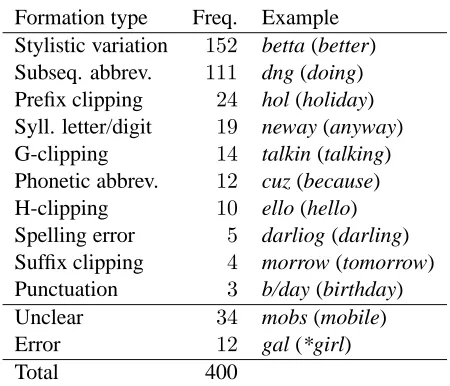
Formation type Freq. Example Stylistic variation 152 betta (better)
Subseq. abbrev. 111 dng (doing)
Prefix clipping 24 hol (holiday)
Syll. letter/digit 19 neway (anyway)
G-clipping 14 talkin (talking)
Phonetic abbrev. 12 cuz (because)
H-clipping 10 ello (hello)
Spelling error 5 darliog (darling)
Suffix clipping 4 morrow (tomorrow)
Punctuation 3 b/day (birthday)
Unclear 34 mobs (mobile)
Error 12 gal (*girl)
[image:2.612.73.298.58.251.2]Total 400
Table 1: Frequency of texting forms in the development set by formation type.
need for applications such as translation and ques-tion answering.
We observe that many creative texting forms are the result of a small number of specific word for-mation processes. Rather than using a generic er-ror model to capture all of them, we propose a mix-ture model in which each word formation process is modeled explicitly according to linguistic observa-tions specific to that formation.
2 Analysis of Texting Forms
To better understand the creative processes present in texting language, we categorize the word forma-tion process of each texting form in our development data, which consists of400texting forms paired with their standard forms.4 Several iterations of catego-rization were done in order to determine sensible categories, and ensure categories were used consis-tently. Since this data is only to be used to guide the construction of our system, and not for formal evaluation, only one judge (a native English speak-ing author of this paper) categorized the expressions. The findings are presented in Table 1.
Stylistic variations, by far the most frequent cat-egory, exhibit non-standard spelling, such as
repre-4
Most texting forms have a unique standard form; however, some have multiple standard forms, e.g., will and well can both be shortened to wl. In such cases we choose the category of the most frequent standard form; in the case of frequency ties we choose arbitrarily among the categories of the standard forms.
senting sounds phonetically. Subsequence abbrevi-ations, also very frequent, are composed of a sub-sequence of the graphemes in a standard form, of-ten omitting vowels. These two formation types ac-count for approximately 66% of our development data; the remaining formation types are much less frequent. Prefix clippings and suffix clippings con-sist of a prefix or suffix, respectively, of a standard form, and in some cases a diminutive ending; we also consider clippings which omit just a g or h from a standard form as they are rather frequent.5 A sin-gle letter or digit can be used to represent a syllable; we refer to these as syllabic (syll.) letter/digit. Pho-netic abbreviations are variants of clippings and sub-sequence abbreviations where some sounds in the standard form are represented phonetically. Several texting forms appear to be spelling errors; we took the layout of letters on cell phone keypads into ac-count when making this judgement. The items that did not fit within the above texting form categories were marked as unclear. Finally, for some expres-sions the given standard form did not appear to be appropriate. For example, girl is not the standard form for the texting form gal; rather, gal is an En-glish word that is a colloquial form of girl. Such cases were marked as errors.
No texting forms in our development data corre-spond to multiple standard form words, e.g., wanna for want to.6 Since such forms are not present in our development data, we assume that a texting form al-ways corresponds to a single standard form word.
It is important to note that some text forms have properties of multiple categories, e.g., bak (back) could be considered a stylistic variation or a subse-quence abbreviation. In such cases, we simply at-tempt to assign the most appropriate category.
The design of our model for text message normal-ization, presented below, uses properties of the ob-served formation processes.
3 An Unsupervised Noisy Channel Model for Text Message Normalization
Let S be a sentence consisting of standard forms
s1s2...sn; in this study the standard forms are
reg-5
Thurlow (2003) also observes an abundance of g-clippings. 6A small number of similar forms, however, appear with a
ular English words. LetT be a sequence of texting
formst1t2...tn, which are the texting language
real-ization of the standard forms, and may differ from the standard forms. Given a sequence of texting formsT, the challenge is then to determine the cor-responding standard formsS.
Following Choudhury et al. (2007)—and vari-ous approaches to spelling error correction, such as, e.g., Mays et al. (1991)—we model text mes-sage normalization using a noisy channel. We want to find argmaxSP(S|T). We apply Bayes rule and ignore the constant term P(T), giving argmaxSP(T|S)P(S). Making the independence assumption that eachti depends only onsi, and not
on the context in which it occurs, as in Choudhury et al., we expressP(T|S)as a product of probabili-ties: argmaxS(QiP(ti|si))P(S).
We note in Section 2 that many texting forms are created through a small number of specific word for-mation processes. Rather than model each of these processes at once using a generic model forP(ti|si),
as in Choudhury et al., we instead create several such models, each corresponding to one of the observed common word formation processes. We therefore rewrite P(ti|si) as Pwf P(ti|si,wf)P(wf) where wf is a word formation process, e.g., subsequence abbreviation. Since, like Choudhury et al., we focus on the word model, we simplify our model as below.
argmaxsiX wf
P(ti|si,wf)P(wf)P(si)
We next explain the components of the model,
P(ti|si,wf), P(wf), and P(si), referred to as the
word model, word formation prior, and language model, respectively.
3.1 Word Models
We now consider which of the word formation pro-cesses discussed in Section 2 should be captured with a word model P(ti|si,wf). We model
stylis-tic variations and subsequence abbreviations simply due to their frequency. We also choose to model prefix clippings since this word formation process is common outside of text messaging (Kreidler, 1979; Algeo, 1991) and fairly frequent in our data. Al-though g-clippings and h-clippings are moderately frequent, we do not model them, as these very spe-cific word formations are also (non-prototypical)
graphemes w i th ou t phonemes w I T au t
Table 2: Grapheme–phoneme alignment for without.
subsequence abbreviations. We do not model syl-labic letters and digits, or punctuation, explicitly; in-stead, we simply substitute digits with a graphemic representation (e.g., 4 is replaced by for), and re-move punctuation, before applying the model. The other less frequent formations—phonetic abbrevia-tions, spelling errors, and suffix clippings—are not modeled; we hypothesize that the similarity of these formation processes to those we do model will allow the system to perform reasonably well on them.
3.1.1 Stylistic Variations
We propose a probabilistic version of edit-distance—referred to here as edit-probability— inspired by Brill and Moore (2000) to model
P(ti|si,stylistic variation). To compute
edit-probability, we consider the probability of each edit operation—substitution, insertion, and deletion— instead of its cost, as in edit-distance. We then sim-ply multisim-ply the probabilities of edits as opposed to summing their costs.
In this version of edit-probability, we allow two-character edits. Ideally, we would compute the probability of two strings as the sum of the edit-probability of each partitioning of those strings into one or two character segments. However, following Brill and Moore, we approximate this by the prob-ability of the partition with maximum probprob-ability. This allows us to compute edit-probability using a simple adaptation of edit-distance, in which we con-sider edit operations spanning two characters at each cell in the chart maintained by the algorithm.
We then estimate two probabilities: P(gt|gs,pos)
is the probability of texting form graphemegtgiven
standard form grapheme gs at position pos, where pos is the beginning, middle, or end of the word;
P(ht|ps,hs,pos) is the probability of texting form
graphemeshtgiven the standard form phonemesps
and graphemeshsat positionpos.ht,ps, andhscan
be a single grapheme or phoneme, or a bigram. We compute edit-probability between the graphemes of si and ti. When filling each cell
segments ofsiandti of length0–2, referred to asa
andb, respectively. Ifaaligns with phonemes insi,
we also consider those phonemes,p. In our lexicon, the graphemes and phonemes of each word are aligned according to the method of Jiampojamarn et al. (2007). For example, the alignment for
without is given in Table 2. The probability of each edit operation is then determined by three properties—the length of a, whether aaligns with any phonemes insi, and if so,p—as shown below:
|a|=0or1, not aligned w/siphonemes:P(b|a,pos)
|a|=2, not aligned w/siphonemes: 0
|a|=1or2, aligned w/siphonemes: P(b|p, a,pos)
3.1.2 Subsequence Abbreviations
We model subsequence abbreviations according to the equation below:
P(ti|si,subseq abrv) = (
c iftiis a subseq ofsi 0 otherwise
wherecis a constant.
Note that this is similar to the error model for spelling correction presented by Mays et al. (1991), in which all words (in our terms, all si) within
a specified edit-distance of the out-of-vocabulary word (ti in our model) are given equal probability.
The key difference is that in our formulation, we only consider standard forms for which the texting form is potentially a subsequence abbreviation.
In combination with the language model,
P(ti|si,subseq abbrev) assigns a non-zero
prob-ability to each standard form si for which ti is
a subsequence, according to the likelihood of si
(under the language model). The models interact in this way since we expect a standard form to be recognizable relative to the other words for whichti
could be a subsequence abbreviation
3.1.3 Prefix Clippings
We model prefix clippings similarly to subse-quence abbreviations.
P(ti|si,prefix clipping) =
c iftiis possible
pre. clip. ofsi 0 otherwise
Kreidler (1979) observes that clippings tend to be mono-syllabic and end in a consonant.
Further-more, when they do end in a vowel, it is often of a regular form, such as telly for television and
breaky for breakfast. We therefore only consider P(ti|si,prefix clipping)iftiis a prefix clipping
ac-cording to the following heuristics: ti is
mono-syllabic after stripping any word-final vowels, and subsequently removing duplicated word-final con-sonants (e.g, telly becomes tel, which is a candidate prefix clipping). Iftiis not a prefix clipping
accord-ing to these criteria, P(ti|si) simply sums over all
models except prefix clipping.
3.2 Word Formation Prior
Keeping with our goal of an unsupervised method, we estimateP(wf)with a uniform distribution. We also consider estimating P(wf) using maximum likelihood estimates (MLEs) from our observations in Section 2. This gives a model that is not fully unsupervised, since it relies on labelled training data. However, we consider this a lightly-supervised method, since it only requires an estimate of the fre-quency of the relevant word formation types, and not labelled texting form–standard form pairs.
3.3 Language Model
Choudhury et al. (2007) find that using a bigram lan-guage model estimated over a balanced corpus of English had a negative effect on their results com-pared with a unigram language model, which they attribute to the unique characteristics of text messag-ing that were not reflected in the corpus. We there-fore use a unigram language model forP(si), which
also enables comparison with their results. Never-theless, alternative language models, such as higher order ngram models, could easily be used in place of our unigram language model.
4 Materials and Methods
4.1 Datasets
forms. The test data consists of1213 texting forms and their corresponding standard forms. A subset of 303of these texting forms differ from their standard form.7 This subset is the focus of this study, but we also report results on the full dataset.
4.2 Lexicon
We construct a lexicon of potential standard forms such that it contains most words that we expect to encounter in text messages, yet is not so large as to make it difficult to identify the correct standard form. Our subjective analysis of the standard forms in the development data is that they are frequent, non-specialized, words. To reflect this observation, we create a lexicon consisting of all single-word en-tries containing only alphabetic characters found in both the CELEX Lexical Database (Baayen et al., 1995) and the CMU Pronouncing Dictionary.8 We remove all words of length one (except a and I) to avoid choosing, e.g., the letter r as the standard form for the texting form r. We further limit the lexicon to words in the 20K most frequent alphabetic uni-grams, ignoring case, in the Web 1T 5-gram Corpus (Brants and Franz, 2006). The resulting lexicon con-tains approximately 14K words, and excludes only three of the standard forms—cannot, email, and
on-line—for the400development texting forms.
4.3 Model Parameter Estimation
MLEs for P(gt|gs,pos)—needed to estimate P(ti|si,stylistic variation)—could be estimated
from texting form–standard form pairs. However, since our system is unsupervised, no such data is available. We therefore assume that many texting forms, and other similar creative shortenings, occur on the web. We develop a number of character substitution rules, e.g.,s⇒z, and use them to create hypothetical texting forms from standard words. We then compute MLEs forP(gt|gs,pos)using the
frequencies of these derived forms on the web.
7
Choudhury et al. report that this dataset contains1228 tex-ting forms. We found it to contain 1213 texting forms cor-responding to1228standard forms (recall that a texting form may have multiple standard forms). There were similar incon-sistencies with the subset of texting forms that differ from their standard forms. Nevertheless, we do not expect these small dif-ferences to have an appreciable effect on the results.
8http://www.speech.cs.cmu.edu/cgi-bin/
cmudict
We create the substitution rules by examining ex-amples in the development data, considering fast speech variants and dialectal differences (e.g., voic-ing), and drawing on our intuition. The derived forms are produced by applying the substitution rules to the words in our lexicon. To avoid con-sidering forms that are themselves words, we elimi-nate any form found in a list of approximately480K words taken from SOWPODS9and the Moby Word Lists.10 Finally, we obtain the frequency of the de-rived forms from the Web 1T 5-gram Corpus.
To estimate P(ht|ps,hs,pos), we first
esti-mate two simpler distributions: P(ht|hs,pos) and P(ht|ps,pos). P(ht|hs,pos) is estimated in the
same manner asP(gt|gs,pos), except that two
char-acter substitutions are allowed. P(ht|ps,pos)is
es-timated from the frequency of ps, and its
align-ment with ht, in a version of CELEX in which
the graphemic and phonemic representation of each word is many–many aligned using the method of Jiampojamarn et al. (2007).11 P(ht|ps,hs,pos)
is then an evenly-weighted linear combination of
P(ht|hs,pos) and P(ht|ps,pos). Finally, we
smooth each ofP(gt|gs,pos)and P(ht|ps,hs,pos)
using add-alpha smoothing.
We set the constant c in our word models for subsequence abbreviations and prefix clippings such thatPsiP(ti|si,wf)P(si) = 1. We similarly
nor-malizeP(ti|si,stylistic variation)P(si).
We use the frequency of unigrams (ignoring case) in the Web 1T 5-gram Corpus to estimate our lan-guage model. We expect the lanlan-guage of text mes-saging to be more similar to that found on the web than that in a balanced corpus of English.
4.4 Evaluation Metrics
To evaluate our system, we consider three accuracy metrics: in-top-1, in-top-10, and in-top-20.12 In-top-nconsiders the system correct if a correct stan-dard form is in thenmost probable standard forms. The in-top-1 accuracy shows how well the system determines the correct standard form; the in-top-10
9http://en.wikipedia.org/wiki/SOWPODS 10http://icon.shef.ac.uk/Moby/
11
We are very grateful to Sittichai Jiampojamarn for provid-ing this alignment.
12These are the same metrics used by Choudhury et al.
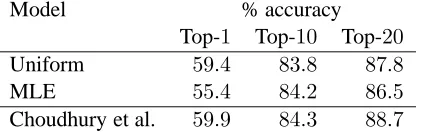
Model % accuracy Top-1 Top-10 Top-20 Uniform 59.4 83.8 87.8
MLE 55.4 84.2 86.5
[image:6.612.317.534.60.227.2]Choudhury et al. 59.9 84.3 88.7
Table 3: % in-top-1, in-top-10, and in-top-20accuracy on test data using both estimates forP(wf). The results reported by Choudhury et al. (2007) are also shown.
and in-top-20 accuracies may be indicative of the usefulness of the output of our system in other tasks which could exploit a ranked list of standard forms, such as machine translation.
5 Results and Discussion
In Table 3 we report the results of our system using both the uniform estimate and the MLE ofP(wf). Note that there is no meaningful random baseline to compare against here; randomly ordering the 14K words in our lexicon gives very low accuracy. The results using the uniform estimate ofP(wf)— a fully unsupervised system—are very similar to the supervised results of Choudhury et al. (2007). Surprisingly, when we estimateP(wf)using MLEs from the development data—resulting in a lightly-supervised system—the results are slightly worse than when using the uniform estimate of this proba-bility. Moreover, we observe the same trend on de-velopment data where we expect to have an accurate estimate ofP(wf)(results not shown). We hypothe-size that the ambiguity of the categories of text forms (see Section 2) results in poor MLEs for P(wf), thus making a uniform distribution, and hence fully-unsupervised approach, more appropriate.
Results by Formation Type We now consider
in-top-1accuracy for each word formation type, in Ta-ble 4. We show results for the same word forma-tion processes as in Table 1, except for h-clippings and punctuation, as no words of these categories are present in the test data. We present results using the same experimental setup as before with a uniform estimate of P(wf) (All), and using just the model corresponding to the word formation process (Spe-cific), where applicable.13
13In this case our model then becomes, for each word
forma-tion processwf, argmaxsiP(ti|si,wf)P(si).
Formation type Freq. % in-top-1acc.
n= 303 Specific All
Stylistic variation 121 62.8 67.8
Subseq. abbrev. 65 56.9 46.2
Prefix clipping 25 44.0 20.0
G-clipping 56 - 91.1
Syll. letter/digit 16 - 50.0
Unclear 12 - 0.0
Spelling error 5 - 80.0
Suffix clipping 1 - 0.0
Phonetic abbrev. 1 - 0.0
Error 1 - 0.0
Table 4: Frequency (Freq.), and % in-top-1accuracy us-ing the formation-specific model where applicable (Spe-cific) and all models (All) with a uniform estimate for
P(wf), presented by formation type.
We first examine the top panel of Table 3 where we compare the performance on each word forma-tion type for both experimental condiforma-tions (Specific and All). We first note that the performance using the formation-specific model on subsequence abbre-viations and prefix clippings is better than that of the overall model. This is unsurprising since we ex-pect that when we know a texting form’s formation process, and invoke a corresponding specific model, our system should outperform a model designed to handle a range of formation types. However, this is not the case for stylistic variations; here the over-all model performs better than the specific model. We observed in Section 2 that some texting forms do not fit neatly into our categorization scheme; in-deed, many stylistic variations are also analyzable as subsequence abbreviations. Therefore, the subse-quence abbreviation model may benefit normaliza-tion of stylistic varianormaliza-tions. This model, used in iso-lation on stylistic variations, gives an in-top-1 accu-racy of33.1%, indicating that this may be the case.
[image:6.612.82.293.62.129.2]un-derP(ti|si,prefix clipping)for the texting form fri,
which has the standard form friday in our data. (The language model, however, does distinguish between these forms.) However, if we consider the phonemic representations of these words, friday might emerge as more likely. Syllable structure information may also be useful, as we hypothesize that clippings will tend to be formed by truncating a word at a syllable boundary. We may similarly be able to improve our estimate of P(ti|si,subseq. abrrev.). For example,
both text and taxation have the same probability un-der this distribution, but intuitively text, the correct standard form in our data, seems more likely. We could incorporate knowledge about the likelihood of omitting specific characters, as in Choudhury et al. (2007), to improve this estimate.
We now examine the lower panel of Table 4, in which we consider the performance of the overall model on the word formation types that are not ex-plicitly modeled. The very high accuracy on g-clippings indicates that since these forms are also a type of subsequence abbreviation, we do not need to construct a separate model for them. We in fact also conducted experiments in which g-clippings and h-clippings were modeled explicitly, but found these extra models to have little effect on the results.
Recall from Section 3.1 our hypothesis that suf-fix clippings, spelling errors, and phonetic abbrevia-tions have common properties with formation types that we do model, and therefore the system will per-form reasonably well on them. Here we find pre-liminary evidence to support this hypothesis as the accuracy on these three word formation types (com-bined) is 57.1%. However, we must interpret this result cautiously as it only considers seven expres-sions. On the syllabic letter and digit texting forms the accuracy is 50.0%, indicating that our heuris-tic to replace digits in texting forms with an ortho-graphic representation is reasonable.
The performance on types of expressions that we did not consider when designing the system— unclear and error—is very poor. However, this has little impact on the overall performance as these ex-pressions are rather infrequent.
Results by Model We now consider in-top-1
ac-curacy using each model on the 303 test expres-sions; results are shown in Table 5. No model on its
Model % in-top-1accuracy Stylistic variation 51.8
Subseq. Abbrev. 44.2
Prefix clipping 10.6
Table 5: % in-top-1accuracy on the303test expressions using each model individually.
own gives results comparable to those of the over-all model (59.4%, see Table 3). This indicates that the overall model successfully combines informa-tion from the specific word formainforma-tion models.
Each model used on its own gives an accuracy greater than the proportion of expressions of the word formation type for which the model was de-signed (compare accuracies in Table 5 to the num-ber of expressions of the corresponding word forma-tion type in the test data in Table 4). As we note in Section 2, the distinctions between the word forma-tion types are not sharp; these results show that the shared properties of word formation types enable a model for a specific formation type to infer the stan-dard form of texting forms of other formation types.
All Unseen Data Until now we have discussed
re-sults on our test data of303texting forms which dif-fer from their standard forms. We now consider the performance of our system on all1213 unseen tex-ting forms,910 of which are identical to their stan-dard form. Since our model was not designed with such expressions in mind, we slightly adapt it for this new task; ifti is in our lexicon, we return that
form assi, otherwise we apply our model as usual,
using the uniform estimate of P(wf). This gives an in-top-1 accuracy of 88.2%, which is very sim-ilar to the results of Choudhury et al. (2007) on this data of89.1%. Note, however, that Choudhury et al. only report results on this dataset using a uniform language model;14since we use a unigram language model, it is difficult to draw firm conclusions about the performance of our system relative to theirs.
6 Related Work
Aw et al. (2006) model text message normaliza-tion as translanormaliza-tion from the texting language into the
14
standard language. Kobus et al. (2008) incorporate ideas from both machine translation and automatic speech recognition for text message normalization. However, both of these approaches are supervised, and have only limited means for normalizing texting forms that do not occur in the training data.
Our work, like that of Choudhury et al. (2007), can be viewed as a noisy-channel model for spelling error correction (e.g., Mays et al., 1991; Brill and Moore, 2000), in which texting forms are seen as a kind of spelling error. Furthermore, like our ap-proach to text message normalization, apap-proaches to spelling correction have incorporated phonemic in-formation (Toutanova and Moore, 2002).
The word model of the supervised approach of Choudhury et al. consists of hidden Markov models, which capture properties of texting language similar to those of our stylistic variation model. We pro-pose multiple word models—corresponding to fre-quent texting language formation processes—and an unsupervised method for parameter estimation.
7 Conclusions
We analyze a sample of texting forms to determine frequent word formation processes in creative tex-ting language. Drawing on these observations, we construct an unsupervised noisy-channel model for text message normalization. On an unseen test set of303texting forms that differ from their standard form, our model achieves59% accuracy, which is on par with that obtained by the supervised approach of Choudhury et al. (2007) on the same data.
More research is required to determine the impact of our normalization method on the performance of a system that further processes the resulting text. In the future, we intend to improve our word models by incorporating additional linguistic knowledge, such as information about syllable structure. Since con-text likely plays a role in human interpretation of texting forms, we also intend to examine the perfor-mance of higher order ngram language models.
Acknowledgements
This work is financially supported by the Natu-ral Sciences and Engineering Research Council of Canada, the University of Toronto, and the Dictio-nary Society of North America.
References
John Algeo, editor. 1991. Fifty Years Among the New
Words. Cambridge University Press, Cambridge.
AiTi Aw, Min Zhang, Juan Xiao, and Jian Su. 2006. A phrase-based statistical model for SMS text normaliza-tion. In Proc. of the COLING/ACL 2006 Main
Confer-ence Poster Sessions, pages 33–40. Sydney.
R.H. Baayen, R. Piepenbrock, and L. Gulikers. 1995. The CELEX Lexical Database (release 2). Linguistic Data Consortium, University of Pennsylvania.
Thorsten Brants and Alex Franz. 2006. Web 1T 5-gram Corpus version 1.1.
Eric Brill and Robert C. Moore. 2000. An improved error model for noisy channel spelling correction. In
Pro-ceedings of ACL 2000, pages 286–293. Hong Kong.
Monojit Choudhury, Rahul Saraf, Vijit Jain, Animesh Mukherjee, Sudeshna Sarkar, and Anupam Basu. 2007. Investigation and modeling of the structure of texting language. International Journal of Document
Analysis and Recognition, 10(3/4):157–174.
C´edrick Fairon and S´ebastien Paumier. 2006. A trans-lated corpus of 30,000 French SMS. In Proceedings of
LREC 2006. Genoa, Italy.
Rebecca E. Grinter and Margery A. Eldridge. 2001. y do tngrs luv 2 txt msg. In Proceedings of the 7th
Euro-pean Conf. on Computer-Supported Cooperative Work (ECSCW ’01), pages 219–238. Bonn, Germany.
Sittichai Jiampojamarn, Gregorz Kondrak, and Tarek Sherif. 2007. Applying many-to-many alignments and hidden markov models to letter-to-phoneme conver-sion. In Proc. of NAACL-HLT 2007, pages 372–379. Rochester, NY.
Catherine Kobus, Franc¸ois Yvon, and G´eraldine Damnati. 2008. Normalizing SMS: are two metaphors better than one? In Proc. of the 22nd Int. Conf. on
Computational Linguistics, pp. 441–448. Manchester.
Charles W. Kreidler. 1979. Creating new words by short-ening. English Linguistics, 13:24–36.
Rich Ling and Naomi S. Baron. 2007. Text messaging and IM: Linguistic comparison of American college data. Journal of Language and Social Psychology,
26:291–98.
Eric Mays, Fred J. Damerau, and Robert L. Mercer. 1991. Context based spelling correction. Information
Pro-cessing and Management, 27(5):517–522.
Richard Sproat, Alan W. Black, Stanley Chen, Shankar Kumar, Mari Ostendorf, and Christopher Richards. 2001. Normalization of non-standard words.
Com-puter Speech and Language, 15:287–333.
Crispin Thurlow. 2003. Generation txt? The sociolin-guistics of young people’s text-messaging. Discourse
Analysis Online, 1(1).
Kristina Toutanova and Robert C. Moore. 2002. Pronun-ciation modeling for improved spelling correction. In