Optimization Strategies for Online Large-Margin Learning in Machine
Translation
Vladimir Eidelman
UMIACS Laboratory for Computational Linguistics and Information Processing Department of Computer Science
University of Maryland, College Park, MD
Abstract
The introduction of large-margin based dis-criminative methods for optimizing statistical machine translation systems in recent years has allowed exploration into many new types
of features for the translation process. By
removing the limitation on the number of parameters which can be optimized, these methods have allowed integrating millions of sparse features. However, these methods have not yet met with wide-spread adoption. This may be partly due to the perceived complex-ity of implementation, and partly due to the lack of standard methodology for applying these methods to MT. This papers aims to shed light on large-margin learning for MT, explic-itly presenting the simple passive-aggressive algorithm which underlies many previous ap-proaches, with direct application to MT, and empirically comparing several widespread op-timization strategies.
1 Introduction
Statistical machine translation (SMT) systems rep-resent knowledge sources in the form of features, and rely on parameters, or weights, on each feature, to score alternative translations. As in all statistical models, these parameters need to be learned from the data. In recent years, there has been a growing trend of moving away from discriminative training using batch log-linear optimization, with Minimum-Error Rate Training (MERT) (Och, 2003) being the principle method, to online linear optimization (Chi-ang et al., 2008; Watanabe et al., 2007; Arun and Koehn, 2007). The major motivation for this has been that while MERT is able to efficiently optimize
a small number of parameters directly toward an ex-ternal evaluation metric, such asBLEU(Papineni et al., 2002), it has been shown that its performance can be erratic, and it is unable to scale to a large set of features (Foster and Kuhn, 2009; Hopkins and May, 2011). Furthermore, it is designed for batch learning, which may be prohibitive or undesirable in certain scenarios, for instance if we have a large tuning set. One or both of these limitations have led to recent introduction of alternative optimization strategies, such as minimum-risk (Smith and Eis-ner, 2006), PRO (Hopkins and May, 2011), Struc-tured SVM (Cherry and Foster, 2012), and RAM -PION (Gimpel and Smith, 2012), which are batch learners, and online large-margin structured learn-ing (Chiang et al., 2009; Watanabe et al., 2007; Watanabe, 2012).
A popular method of large-margin optimiza-tion is the margin-infused relaxed algorithm (MIRA) (Crammer et al., 2006), which has been shown to perform well for machine translation, as well as other structured prediction tasks, such as parsing. (McDonald et al., 2005). This is an at-tractive method because we have a simple analytical solution for the optimization problem at each step, which reduces to dual coordinate descent when us-ing 1-best MIRA. It is also quite easy to implement, as will be shown below.
Despite the proven success of MIRA-based large-margin optimization for both small and large num-bers of features, these methods have not yielded wide adoption in the community. Part of the rea-son for this is a perception that these methods are complicated to implement, which has been cited as motivation for other work (Hopkins and May, 2011; Gimpel and Smith, 2012). Furthermore, there is a
vergence between the standard application of these methods in machine learning, and our application in machine translation (Gimpel and Smith, 2012), where in machine learning there are usually clear correct outputs and no latent structures. As a con-sequence of the above, there is a lack of standard practices for large-margin learning for MT, which has resulted in numerous different implementations of MIRA-based optimizers, which further add to the confusion.
This paper aims to shed light on practical con-cerns with online large margin training. Specif-ically, our contribution is first, to present the MIRA passive-aggressive update, which underlies all MIRA-based training, with an eye to applica-tion in MT. Then, we empirically compare several widespread as well as novel optimization strategies for large-margin training on Czech-to-English (cs-en) and French-to-English (fr-(cs-en) translation. Ana-lyzing the findings, we recommend an optimization strategy which should ensure convergence and sta-bility.
2 Large-Margin Learning
2.1 Description
MIRA is an online large-margin learner, and be-longs to a class of passive-aggressive (PA) algo-rithms (Crammer et al., 2006). Although the exact procedure it employs is different from other subgra-dient optimizers, in essence it is performing a sub-gradient descent step, where the step size is adjusted based on each example. The underlying objective of MIRA is the same as that of the margin rescaled Structural SVM (Tsochantaridis et al., 2004; Mar-tins et al., 2010), where we want to predict the cor-rect output over the incorcor-rect one by a margin at least as large as the cost incurred by predicting the in-correct output. However, the norm constraint from SVM is replaced with a proximity constraint, indi-cating we want to update our parameters, but keep them as close as possible to the previous parame-ter estimates. In the original formulation for sepa-rable classification (Crammer and Singer, 2003), if no constraints are violated, no update occurs. How-ever, when there is a loss, the algorithm updates the parameters to satisfy the constraints. To allow for noise in the data, i.e. nonseparable instances, a slack
variable ξi is introduced for each example, and we
optimize a soft-margin. The usual presentation of MIRA is then given as:
wt+1 = arg min w
1
2||w−wt||
2+Cξ
i
s.t.w>f(xi, yi)−w>f(xi, y0)≥cost(yi, y0)−ξi
(1) wheref(xi, yi)is a vector of feature functions1,w
is a vector of corresponding parameters,y0 ∈ Y(xi),
whereY(xi)is the space of possible translations we are able to produce fromx,2and cost(y
i,·) is
com-puted using an external measure of quality, such as BLEU.
The underlying structured hinge loss objective function can be rewritten as:
`h=−w>f(xi, yi)+
max y0∈Y(x
i)
w>f(xi, y0) +cost(yi, y0)
(2)
2.2 Hypothesis Selection
Our training corpusT = (xi, yi)Ti=1for selecting the
parameterswthat optimize this objective consists of input sentencesxiin the source language paired with
reference translationsyiin the target language.
No-tice that `h depends on computing the margin
be-tweeny0 ∈ Y(xi)and thecorrectoutput,yi.
How-ever, there is no guarantee that yi ∈ Y(xi) since
our decoder is often incapable of producing the ref-erence translationyi. Since we need to have some
notion of the correct output in order to compute its feature vector for the margin, in practice we revert to using surrogate references in place ofyi. These are
often referred to as oracles,y+, which are selected from the hypothesis spaceY(xi)of the decoder.
We are also faced with the problem of how best to select the most appropriatey0 to shy away from, which we will refer to asy−. Since optimization will proceed by setting parameters to increase the score ofy+, and decrease the score ofy−, the selection of these two hypotheses is crucial to success. The range of possibilities is presented in Eq. 3 below.
1More appropriately, since we only observe translations yi, which may have many possible derivationsdj, we model
the derivations as a latent variable, and our feature functions are actually computed over derivation and translation pairs
f(xi, yi, dj). We omitdjfor clarity.
2
`r=− max y+∈Y(x
i)
γ+w>f(xi, y+)−β+cost(yi, y+)
+ max y−∈Y(x
i)
γ−w>f(xi, y−) +β−cost(yi, y−)
(3) Although this formulation has commonly been referred to as the hinge loss in previous litera-ture, Gimpel and Smith (2012) have recently pointed out that we are in fact optimizing losses that are closer to different variants of the structured ramp loss. The difference in definition between the two is subtle, in that for the ramp loss,yi is replaced with
y+. Each setting ofγ±andβ±corresponds to opti-mizing a different loss function. Several definitions of `r have been explored in the literature, and we
discuss them below with corresponding settings of γ±andβ±.
In selecting y+, we vary the settings of γ+ and β+. Assuming our cost function is based onBLEU, in settingβ+ → 1andγ+ → 0, ifY(x
i) is taken
to be the entire space of possible translations, we are selecting the hypothesis with the highest BLEU overall. This is referred to in past work as max-BLEU(Tillmann and Zhang, 2006) (MB). If we ap-proximate the search space by restricting Y(xi) to
a k-best list, we have the local-update (Liang et al., 2006), where we select the highest BLEU can-didate from those hypotheses that the model consid-ers good (LU). With increasingk-best size, the max-BLEUand local-update strategies begin to converge. Setting both β+ → 1 and γ+ → 1, we ob-tain the cost-diminished hypothesis, which consid-ers both the model and the cost, and corresponds to the “hope” hypothesis in Chiang et al. (2008) (M-C). This can be computed over the entire space of hypotheses or a k-best list. In a sense, this is the intuition that local-updating is after, but expressed more directly.
The alternatives for selecting y− are quite sim-ilar. Setting β− → 1 and γ− → 0, we select the hypothesis with the highest cost (MC). Setting β− → 0 and γ− → 1, we have the highest sing hypothesis accordsing to the model, which cor-responds to prediction-based selection (Crammer et al., 2006) (PB). Setting both to 1, we have the cost-augmented hypothesis, which is referred to as the “fear” (Chiang et al., 2008), and max-loss
(Cram-mer et al., 2006) (M+C). This hypothesis is consid-ered the most dangerous because it has a high model score along with a high cost.
Considering the settings for both parts of Eq. 3, γ+, β+ andγ−, β−, assigning all γ± and β± to 1 corresponds to the most commonly used loss func-tion in MT (Gimpel and Smith, 2012; Chiang et al., 2009). This is the “hope”/“fear” pairing, where we use the cost-diminished hypothesisy+and cost-augmented hypothesisy−. Other loss functions have also been explored, such as γ± → 1, β+ → 1, β− → 0 (Liang et al., 2006), and something ap-proximatingγ± → 1, β+ → 0, β− → 1 (Cherry and Foster, 2012), which is closer to the usual loss used for max-margin in machine learing. To our best knowledge, other loss functions explored below are novel to this work.
Since our external metric,BLEU, is a gain, we can think of the first term in Eq. 3 as the model score plus the BLEUscore, and the second term as the model minus theBLEUscore. That is, with allγ±andβ± set to 1, we want y+ to be the hypothesis with a high model score, as well as being close to the refer-ence translation, as indicated by a highBLEUscore. While for y−, we want a high model score, but it should be far away from the reference, as indicated by a lowBLEUscore. The motivation for choosing y− in this fashion is grounded in the fact that since we are penalized by this term in the ramp loss ob-jective, we should try to optimize on it directly. In practice, we can compute the cost for both terms as (1-BLEU(y,yi)), or use that as the cost of the first
term, and after selectingy+, compute the cost ofy− by taking the difference between BLEU(y+,yi) and
BLEU(y,yi).
2.3 Parameter Update
The major practical concern with these methods for SMT is that oftentimes the implementation aspect is unclear, a problem which is further exacerbated by the apparent difficulty of implementation. This is further compounded with a lack of standard prac-tices; both theoretical, such as the objective to op-timize, and practical, such as efficient paralleliza-tion. The former is a result of the disconnect be-tween the standard machine learning setting, which posits reachable references and lack of latent vari-ables, and our own application. The latter is an active engineering problem. Both of these aspects have been receiving recent attention (McAllester et al., 2010; Mcallester and Keshet, 2011; Gimpel and Smith, 2012; McDonald et al., 2010), and although certain questions remain as to the exact loss being optimized, we now have a better understanding of the theoretical underpinnings of this method of opti-mization.
The first adaptations of MIRA-based learning for structured prediction in NLP utilized a set ofk con-straints, either fory+,y−, or both. This complicated
the optimization by creating a QP problem with a set of linear constraints which needed to be solved with either Hildreth’s algorithm or SMO style optimiza-tion, thereby precluding the possibility of a sim-ple analytical solution. Later, Chiang (2012) intro-duced a cutting-plane algorithm, like that of Struc-tural SVM’s (Tsochantaridis et al., 2004), which op-timizes on a small set of active constraints.
While these methods of dealing with structured prediction may perform better empirically, they come with a higher computational cost. Crammer et al. (2006) shows that satisfying the single most violated margin constraint, commonly referred to as 1-best MIRA, is amenable to a simple analyt-ical solution for the optimization problem at each step. Furthermore, the 1-best MIRA update is con-ceptually and practically much simpler, while retain-ing most of the optimization power of the more ad-vanced methods. Thus, this is the method we present below.
Since the MIRA optimization problem is an in-stance of a general structured problem with an `2
norm, the update at each step reduces to dual co-ordinate descent (Smith, 2011). In our soft-margin
Algorithm 1MIRA Training
Require: : Training setT = (xi, yi)Ti=1,w, C
1: forj←1 to Ndo
2: fori←1 to Tdo
3: Y(xi)←Decode(xi,w)
4: y+←FindOracle(Y(xi)) 5: y−←FindPrediction(Y(xi))
6: margin←w>f(xi, y−)−w>f(xi, y+)
7: cost←BLEU(yi, y+)−BLEU(yi, y−)
8: loss = margin + cost 9: ifloss>0then
10: δ←min
C,k loss
f(xi,y+)−f(xi,y−)k2
11: w←w+δ(f(xi, y+)−f(xi, y−))
12: end if
13: end for
14: end for 15: return w
Algorithm 2FindOracle Require: :Y(xi)
1: ifγ+=0 andβ+=1then
2: y+←arg maxy∈Y(xi)−cost(yi, y)
3: else ifγ+=β+= 1then
4: y+ ← arg maxy∈Y(xi)w >f(x
i, y) −
cost(yi, y)
5: end if
6: return y+
setting, this is analogous to the PA-I update of Cram-mer et al. (2006). In fact, this update remains largely intact as the inner core within k-best constraint or cutting plane optimization. Algorithm 1 presents the entire training regime necessary for 1-best MIRA training of a machine translation system. As can be seen, the parameter update at step 11 depends on the difference between the features ofy+andy−, where
δis the step size, which is controlled by the regular-ization parameterC; indicating how far we are will-ing to move at each step.Y(xi)may be ak-best list
or the entire space of hypotheses.3
3
Algorithm 3FindPrediction Require: :Y(xi)
1: ifγ−=0 andβ−=1then
2: y−←arg maxy∈Y(xi)cost(yi, y)
3: else ifγ−=1 andβ−=0then
4: y−←arg maxy∈Y(xi)w >f(x
i, y)
5: else ifγ−=β− = 1then
6: y− ← arg maxy∈Y(xi)w >f(x
i, y) +
cost(yi, y)
7: end if 8: return y−
3 Experiments
3.1 Setup
To empirically analyze which loss, and thereby which strategy, for selecting y+ and y− is most appropriate for machine translation, we conducted a series of experiments on Czech-to-English and French-to-English translation. The parallel corpora are taken from the WMT2012 shared translation task, and consist of Europarl data along with the News Commentary corpus. All data were tokenized and lowercased, then filtered for length and aligned using the GIZA++ implementation of IBM Model 4 (Och and Ney, 2003) to obtain bidirectional align-ments, which were symmetrized using the grow-diag-final-and method (Koehn et al., 2003). Gram-mars were extracted from the resulting parallel text and used in our hierarchical phrase-based system us-ing cdec (Dyer et al., 2010) as the decoder. We con-structed a 5-gram language model from the provided English News monolingual training data as well as the English side of the parallel corpus using the SRI language modeling toolkit with modified Kneser-Ney smoothing (Chen and Goodman, 1996). This was used to create a KenLM (Heafield, 2011).
As the tuning set for both language pairs, we used the 2051 sentences in news-test2008 (NT08), and re-port results on the 2525 sentences of news-test2009 (NT09) and 2489 of news-test2010 (NT10).
Corpus Sentences Tokens
en *
cs-en 764K 20.5M 17.5M
fr-en 2M 57M 63M
Table 1: Corpus statistics
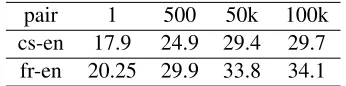
pair 1 500 50k 100k
[image:5.612.340.513.54.97.2]cs-en 17.9 24.9 29.4 29.7 fr-en 20.25 29.9 33.8 34.1
Table 2: Oracle score for model 1-best (baseline) and for
k-best of size 500, 50k, and 100k on NT08
[image:5.612.76.302.64.207.2]We approximate cost-augmented decoding by ob-taining ak-best list withk=500 unique best from our decoder at each iteration, and selecting the respec-tive hypotheses for optimization from it. To approx-imate max-BLEUdecoding using ak-best list, we set k=50k unique best hypotheses.4 As can be seen in Table 2, we found this size was sufficient for our pur-poses as increasing size led to small improvements in oracleBLEUscore.Cis set to 0.01.
For comparison with MERT, we create a base-line model which uses a small standard set of fea-tures found in translation systems: language model probability, phrase translation probabilities, lexi-cal weighting probabilities, and source word, pass-through, and word penalties.
While BLEU is usually calculated at the corpus level, we need to approximate the metric at the sen-tence level. In this, we mostly follow previous ap-proaches, where in the first iteration through the cor-pus we use a smoothed sentence levelBLEU approx-imation, similar to Lin and Och (2004), and in sub-sequently iterations, theBLEUscore is calculated in the context of the previous set of 1-best translations of the entire tuning set.
To make parameter estimation more efficient, some form of parallelization is preferred. While ear-lier versions of MIRA training had complex paral-lelization procedures which necessitated passing in-formation between learners, performing iterative pa-rameter mixing (McDonald et al., 2010) has been shown to be just as effective (Chiang, 2012). We use a simple implementation of this regime, where we divide the tuning set intonshards and distribute them amongstnlearners, along with the parameter vectorw. Each learner decodes and updates
parame-4We are able to theoretically extract more constraints from
cs-en NT09 NT10
LU M-C LU M-C
PB 16.4 18.3 17 19.3
MC 18.5 16 19.1 17.5
[image:6.612.96.277.52.127.2]M+C 17.8 18.7 18.4 19.6
Table 3: Results with different strategies on cs-en transla-tion. MERT baseline is 18.4 for NT09 and 19.7 for NT10
ters on its shard of the tuning set, and once all learn-ers are finished, thesenparameter vectors are aver-aged to form the initial parameter vector for the next iteration. In our experiments,n=20.
3.2 Results
The results of using different optimization strategies for cs-en and fr-en are presented in Tables 3 and 4 below. For all experiments, all settings are kept ex-actly the same, with the only variation being the se-lection of the oracley+and predictiony−. The first
column in each table indicates the method for se-lecting the prediction,y−. PB indicates prediction-based, MC is the hypothesis with the highest cost, and M+C is cost-augmented selection. Analogously, the headings across the table indicate oracle selec-tion strategies, with LU indicating local updating, and M-C being cost-diminished selection.
From the cs-en results in Table 3, we can see that two settings fair the best: LU oracle selection paired with MC prediction selection (LU/MC), and M-C oracle selection paired with M+C prediction selec-tion (M±C). On both sets, (M±C) performs better, but the results are comparable. Pairing M-C with PB is also a viable strategy, while no other pairing is successful for LU.
When comparing with MERT, note that we use a hypergraph based MERT (Kumar et al., 2009), while the MIRA updates are computed from ak-best list. For max-BLEUoracle selection paired with MC, the performance decreases substantially, to 15.4 and 16.6BLEUon NT09 and NT10, respectively. Using the augmentedk-best list did not significantly affect performance for M-C oracle selection.
For fr-en, we see much the same behavior as in cs-en. However, here LU/MC slightly outperforms M±C. From both tasks, we can see that LU is more sensitive to prediction selection, and can only
op-fr-en NT09 NT10
LU M-C LU M-C
PB 20.5 23.1 22.2 25
MC 23.9 23 25.8 24.8
M+C 22.2 23.6 24 25.4
Table 4: Results with different strategies on fr-en transla-tion. MERT baseline is 24.2 for NT09 and 26 for NT10
timize effectively when paired with MC. M-C on the other hand, is more forgiving, and can make progress with PB and MC, albeit not as effectively as with M+C.
3.3 Large Feature Set
Since one of the primary motivations for large-margin learning is the ability to effectively handle large quantities of features, we further evaluate the ability of the strategies by introducing a large num-ber of sparse features into our model. We introduce sparse binary indicator features of the form com-monly found in MT research (Chiang et al., 2009; Watanabe et al., 2007). Specifically, we introduce two types of features based on word alignment from hierarchical phrase pairs and a target bigram fea-ture. The first type, a word pair feature, fires for every word pair(ei, fj)observed in the phrase pair.
The second, insertion features, account for spurious words on the target side of a phrase pair by firing for unaligned target words, associating them with ev-ery source word, i.e. (ei, fj),(ei, fj+1), etc.. The
target bigram feature fires for every pair of consec-utive words on the target side(ei, ei+1). In all, we
introduce 650k features for cs-en, and 1.1M for fr-en. Taking the two best performing strategies from the baseline model, LU/MC and M±C, we compare their performance with the larger feature set in Ta-ble 5.
[image:6.612.335.518.53.127.2]0.07 0.12 0.17 0.22 0.27 0.32
1 2 3 4 5 6 7 8 9 10 11 12 13 14 15 16 17 18 19 20
B
LE
U
[image:7.612.323.548.52.185.2]Iteration
Figure 1: Comparison of performance on development set
for cs-en when using LU/MC and M±C selection.
0.07 0.12 0.17 0.22 0.27 0.32 0.37 0.42
1 2 3 4 5 6 7 8 9 10 11 12 13 14 15 16 17 18 19 20
B
LE
U
Iteration
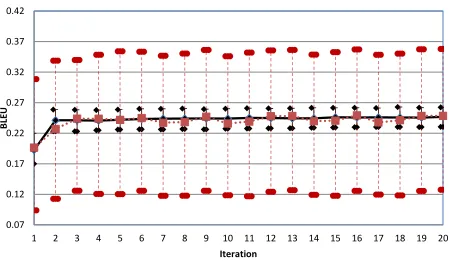
Figure 2: Comparison of performance on development set
for fr-en when using LU/MC and M±C selection.
fr-en cs-en
NT09 NT10 NT09 NT10
LU/MC 23.9 25.7 18.5 19.6
M±C 23.8 25.4 18.6 19.6
Table 5: Results on cs-en and fr-en with extended feature set.
4 Discussion
Although the performance of the two strategies is competitive on the evaluation sets, this does not re-lay the entire story. For a more complete view of the differences between optimization strategies, we turn to Figures 1-6. Figure 1 and 2 present the comparison of performance on the NT08 develop-ment set for cs-en and fr-en, respectively, when us-ing LU/MC to select the oracle and prediction ver-sus M±C selection. M±C is indicated with a solid black line, while LU/MC is a dotted red line. The corpus-level oracle and prediction BLEU scores at each iteration are indicated with error bars around each point, using solid lines for M±C and dotted lines for LU/MC. As can be seen in Figure 1, while optimizing with M±C is stable and smooth, where we converge on our optimum after several iterations, optimizing with LU/MC is highly unstable. This is at least in part due to the wide range inBLEUscores for the oracle and prediction, which are in the range of 10 BLEUpoints higher or lower than the current model best. On the contrary, the range of BLEU scores for the M±C optimizer is on the order of 2 BLEUpoints, leading to more gradual changes.
We see a similar, albeit slightly less pronounced
behavior on fr-en in Figure 2. M±C optimization is once again smooth, and converges quickly, with a small range for the oracle and prediction scores around the model best. LU/MC remains unstable, oscillating up to 2BLEUpoints between iterations.
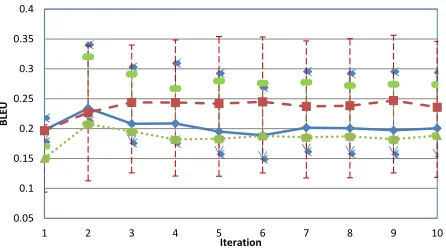
Figures 3-6 compare the different optimization strategies further. In Figures 3 and 5, we use M-C as the oracle, and show performance on the develop-ment set while using the three prediction selection strategies, M+C with a solid blue line, PB with a dotted green line, and MC with a dashed red line. Error bars indicate the oracle and prediction BLEU scores for each pairing as before. In all three cases, the oracle BLEU score is in about the same range, as expected, since all are using the same oracle se-lection strategy. We can immediately observe that PB has no error bars going down, indicating that the PB method for selecting the prediction keeps pace with the model best at each iteration. On the other hand, MC selection also stands out, since it is the only one with a large drop in predictionBLEUscore. Crucially, all learners are stable, and move toward convergence smoothly, which serves to validate our earlier observation that M-C oracle selection can be paired with any prediction selection strategy and op-timize effectively. In both cs-en and fr-en, we can observe that M±C performs the best.
[image:7.612.77.301.53.184.2]predic-0.05 0.07 0.09 0.11 0.13 0.15 0.17 0.19 0.21 0.23 0.25
1 2 3 4 5 6 7 8 9 10
B
LE
U
[image:8.612.326.547.54.178.2]Iteration
Figure 3: Comparison of performance on development set for cs-en of the three prediction selection strategies when using M-C selection as oracle.
0.05 0.1 0.15 0.2 0.25 0.3 0.35
1 2 3 4 5 6 7 8 9 10
B
LE
U
[image:8.612.79.301.55.178.2]Iteration
Figure 4: Comparison of performance on development set for cs-en of the three prediction selection strategies when using LU selection as oracle.
0.05 0.1 0.15 0.2 0.25 0.3
1 2 3 4 5 6 7 8 9 10
B
LE
U
Iteration
Figure 5: Comparison of performance on development set for fr-en of the three prediction selection strategies when using M-C selection as oracle.
0.05 0.1 0.15 0.2 0.25 0.3 0.35 0.4
1 2 3 4 5 6 7 8 9 10
B
LE
U
Iteration
Figure 6: Comparison of performance on development set for fr-en of the three prediction selection strategies when using LU selection as oracle.
tion selection methods, PB and M+C significantly underperforming it.
Given that the translation performance of optimiz-ing the loss functions represented by LU/MC and M±C selection is comparable on the evaluation sets for fr-en and cs-en, it may be premature to make a general recommendation for one over the other. However, taking the unstable nature of LU/MC into account, the extent of which may depend on the tun-ing set, as well as other factors which need to be further examined, the current more prudent alterna-tive is selecting the oracle and prediction pair based on M±C.
5 Conclusion
In this paper, we strove to elucidate aspects of large-margin structured learning with concrete application to the MT setting. Towards this goal, we presented the MIRA passive-aggressive algorithm, which can
be used directly to effectively tune a statistical MT system with millions of parameters, in the hope that some confusion surrounding MIRA-based methods may be cleared, and more MT researchers can adopt it for their own use. We then used the presented al-gorithm to empirically compare several widespread loss functions and strategies for selecting hypothe-ses for optimization. We showed that although there are two competing strategies with comparable per-formance, one is an unstable learner, and before we understand more regarding the nature of the insta-bility, the preferred alternative is to use M±C as the hypothesis pair in optimization.
Acknowledgments
[image:8.612.325.548.245.370.2] [image:8.612.79.303.245.371.2]Fellow-ship. Any opinions, findings, conclusions, or rec-ommendations expressed are the author’s and do not necessarily reflect those of the sponsors.
References
Abishek Arun and Philipp Koehn. 2007. Online learning methods for discriminative training of phrase based
statistical machine translation. InMT Summit XI.
Stanley F. Chen and Joshua Goodman. 1996. An empir-ical study of smoothing techniques for language
mod-eling. InProceedings of the 34th Annual Meeting of
the Association for Computational Linguistics, pages 310–318.
Colin Cherry and George Foster. 2012. Batch tuning
strategies for statistical machine translation. In
Pro-ceedings of NAACL.
David Chiang, Yuval Marton, and Philip Resnik. 2008. Online large-margin training of syntactic and
struc-tural translation features. InProceedings of the 2008
Conference on Empirical Methods in Natural Lan-guage Processing, Honolulu, Hawaii, October.
David Chiang, Kevin Knight, and Wei Wang. 2009.
11,001 new features for statistical machine
transla-tion. InProceedings of Human Language
Technolo-gies: The 2009 Annual Conference of the North Ameri-can Chapter of the Association for Computational Lin-guistics, NAACL ’09, pages 218–226.
David Chiang. 2012. Hope and fear for discriminative
training of statistical translation models. To appear in
J. Machine Learning Research.
Koby Crammer and Yoram Singer. 2003.
Ultraconser-vative online algorithms for multiclass problems. J.
Mach. Learn. Res., 3:951–991, March.
Koby Crammer, Ofer Dekel, Joseph Keshet, Shai Shalev-Shwartz, and Yoram Singer. 2006. Online
passive-aggressive algorithms. J. Mach. Learn. Res., 7:551–
585.
Chris Dyer, Adam Lopez, Juri Ganitkevitch, Jonathan Weese, Ferhan Ture, Phil Blunsom, Hendra Setiawan, Vladimir Eidelman, and Philip Resnik. 2010. cdec: A decoder, alignment, and learning framework for
finite-state and context-free translation models. In
Proceed-ings of ACL System Demonstrations.
George Foster and Roland Kuhn. 2009. Stabilizing
minimum error rate training. In Proceedings of the
Fourth Workshop on Statistical Machine Translation, pages 242–249, Athens, Greece, March. Association for Computational Linguistics.
Kevin Gimpel and Noah A. Smith. 2012. Structured ramp loss minimization for machine translation. In
Proceedings of NAACL.
Kenneth Heafield. 2011. Kenlm: faster and smaller
language model queries. InProceedings of the Sixth
Workshop on Statistical Machine Translation, WMT ’11, pages 187–197.
Mark Hopkins and Jonathan May. 2011. Tuning as
rank-ing. InProceedings of the 2011 Conference on
Empir-ical Methods in Natural Language Processing, pages 1352–1362, Edinburgh, Scotland, UK., July. Associa-tion for ComputaAssocia-tional Linguistics.
Philipp Koehn, Franz Josef Och, and Daniel Marcu.
2003. Statistical phrase-based translation. In
Pro-ceedings of the 2003 Conference of the North Ameri-can Chapter of the Association for Computational Lin-guistics on Human Language Technology - Volume 1, NAACL ’03, Stroudsburg, PA, USA.
Shankar Kumar, Wolfgang Macherey, Chris Dyer, and Franz Och. 2009. Efficient minimum error rate train-ing and minimum bayes-risk decodtrain-ing for translation
hypergraphs and lattices. InProceedings of the Joint
Conference of the 47th Annual Meeting of the ACL and the 4th International Joint Conference on Natural Lan-guage Processing of the AFNLP, pages 163–171. Percy Liang, Alexandre Bouchard-Cˆot´e, Dan Klein, and
Ben Taskar. 2006. An end-to-end discriminative
ap-proach to machine translation. InProceedings of the
21st International Conference on Computational Lin-guistics and the 44th annual meeting of the Associ-ation for ComputAssoci-ational Linguistics, ACL-44, pages 761–768.
Chin-Yew Lin and Franz Josef Och. 2004. Orange: a method for evaluating automatic evaluation metrics for
machine translation. InProceedings of the 20th
inter-national conference on Computational Linguistics. A. F. T. Martins, K. Gimpel, N. A. Smith, E. P.
Xing, P. M. Q. Aguiar, and M. A. T. Figueiredo. 2010. Learning structured classifiers with dual coor-dinate descent. Technical Report CMU-ML-10-109, Carnegie Mellon University.
David Mcallester and Joseph Keshet. 2011. Generaliza-tion bounds and consistency for latent structural pro-bit and ramp loss. In J. Shawe-Taylor, R.S. Zemel, P. Bartlett, F.C.N. Pereira, and K.Q. Weinberger,
edi-tors,Advances in Neural Information Processing
Sys-tems 24, pages 2205–2212.
David McAllester, Tamir Hazan, and Joseph Keshet. 2010. Direct loss minimization for structured predic-tion. In J. Lafferty, C. K. I. Williams, J. Shawe-Taylor,
R.S. Zemel, and A. Culotta, editors,Advances in
Neu-ral Information Processing Systems 23, pages 1594– 1602.
Ryan McDonald, Koby Crammer, and Fernando Pereira.
2005. Online large-margin training of dependency
Association for Computational Linguistics, ACL ’05. Association for Computational Linguistics.
Ryan McDonald, Keith Hall, and Gideon Mann. 2010. Distributed training strategies for the structured
per-ceptron. InHuman Language Technologies: The 2010
Annual Conference of the North American Chapter of the Association for Computational Linguistics, pages 456–464, Los Angeles, California.
Franz Och and Hermann Ney. 2003. A systematic
com-parison of various statistical alignment models. In
Computational Linguistics, volume 29(21), pages 19– 51.
Franz Josef Och. 2003. Minimum error rate training in
statistical machine translation. InProceedings of the
41st Annual Meeting of the Association for Computa-tional Linguistics, pages 160–167.
Kishore Papineni, Salim Roukos, Todd Ward, and
Wei-Jing Zhu. 2002. BLEU: a method for automatic
eval-uation of machine translation. InProceedings of 40th
Annual Meeting of the Association for Computational Linguistics, pages 311–318.
David A. Smith and Jason Eisner. 2006. Minimum
risk annealing for training log-linear models. In
Pro-ceedings of the COLING/ACL 2006 Main Conference Poster Sessions, Sydney, Australia, July. Association for Computational Linguistics.
Noah A. Smith. 2011. Linguistic Structure
Predic-tion. Synthesis Lectures on Human Language
Tech-nologies. Morgan and Claypool, May.
Christoph Tillmann and Tong Zhang. 2006. A discrim-inative global training algorithm for statistical mt. In
Proceedings of the 21st International Conference on Computational Linguistics and the 44th annual meet-ing of the Association for Computational Lmeet-inguistics, ACL-44, pages 721–728.
Ioannis Tsochantaridis, Thomas Hofmann, Thorsten Joachims, and Yasemin Altun. 2004. Support vec-tor machine learning for interdependent and structured
output spaces. InProceedings of the twenty-first
inter-national conference on Machine learning, ICML ’04. Taro Watanabe, Jun Suzuki, Hajime Tsukada, and Hideki
Isozaki. 2007. Online large-margin training for
sta-tistical machine translation. In Proceedings of the
2007 Joint Conference on Empirical Methods in Natu-ral Language Processing and Computational NatuNatu-ral Language Learning (EMNLP-CoNLL), Prague, Czech Republic, June. Association for Computational Lin-guistics.
Taro Watanabe. 2012. Optimized online rank learning