A Prototype Tool Set to Support Machine-Assisted Annotation
Brett R. South
1,2, Shuying Shen
1,2, Jianwei Leng
2, Tyler B. Forbush
4,
Scott L. DuVall
3,4, Wendy W. Chapman
5Departments of 1Biomedical Informatics, 2Internal Medicine, and 3Radiology University of Utah, Salt Lake City, Utah, USA
4IDEAS Center SLCVA Healthcare System, Salt Lake City, Utah, USA
5University of California, San Diego, Division of Biomedical Informatics, La Jolla, California, USA
[email protected], [email protected], [email protected], [email protected],
Abstract
Manually annotating clinical document corpora to generate reference standards for Natural Language Processing (NLP) sys-tems or Machine Learning (ML) is a time-consuming and labor-intensive endeavor. Although a variety of open source annota-tion tools currently exist, there is a clear opportunity to develop new tools and assess functionalities that introduce efficiencies into the process of generating reference standards. These features include: man-agement of document corpora and batch as-signment, integration of machine-assisted verification functions, semi-automated cu-ration of annotated information, and sup-port of machine-assisted pre-annotation. The goals of reducing annotator workload and improving the quality of reference standards are important considerations for development of new tools. An infrastruc-ture is also needed that will support large-scale but secure annotation of sensitive clinical data as well as crowdsourcing which has proven successful for a variety of annotation tasks. We introduce the Ex-tensible Human Oracle Suite of Tools (eHOST) http://code.google.com/p/ehost that provides such functionalities that when coupled with server integration offer an end-to-end solution to carry out small or large scale as well as crowd sourced anno-tation projects.
1
Introduction
Supervised learning methods benefit from a ref-erence standard that is used to train and evaluate
the performance of Natural Language Processing (NLP) or Machine Learning (ML) systems for information extraction and classification. Ideal-ly, generating a reference standard involves the review of more than one annotator with an ac-companying adjudication step to resolve dis-crepancies (Roberts et al., 2007; Roberts et al., 2009). However, manual annotation of clinical, texts is time-consuming, expensive, and requires considerable effort. Reducing the time and costs required for manual annotation could be achieved by developing new tools that integrate methods to more efficiently annotate clinical texts and integrate a management interface that allows administration of large or small scale an-notation projects. Such a tool could also inte-grate methods to pre-annotate entities such as noun phrases or clinical concepts mapped to a standard vocabulary. Efficiencies could be real-ized via reduction in human workload, modifica-tion of annotamodifica-tion tasks that could include crowd sourcing, and implementation of machine-assisted approaches.
Typically annotation of clinical texts requires human reviewers to identify information classes of interest called “markables”. These tasks may also require reviewers to assign attributes to those information classes and build relations between spans of annotated text. For each anno-tation task there may be one or many types of markables and each markable class may be asso-ciated with one or more spans of text and may include single or even multiple tokens. These tasks may occur simultaneously, or may also be done in different steps and by multiple review-ers. Furthermore, these activities require written guidelines that clearly explicate what
mation to annotate, specifics about each marka-ble class, such as how much information to in-clude in annotated spans, or syntactic rules to provide further guidance on annotated spans. Annotation tasks may benefit by incorporating rules or guidelines as part of the annotation task itself in the form of machine-assisted verifica-tion.
There are many annotation tools available, and the majority of them were designed for lin-guistic or gene annotation. Linlin-guistic annotation tools such as Callisto and WordFreak are stand-alone clients suitable for small to medium scale tasks where collaborative effort is not empha-sized. Functionality integrated with eHOST was inspired by existing features of these tools with the intent of providing a more efficient means of reference standard generation in a large collabo-rative environment. One annotation tool called Knowtator, a plug-in for Protégé (Musen, M.A., et al, 1995) developed by Ogren (2006) has been widely used to annotate clinical texts and gener-ate reference standards. However, no stand-alone system exists that can provide end users with the ability to manually or semi-automatically edit, curate, and easily navigate annotated information. There are also specific functionalities that are missing from open source annotation tools in the clinical and biomedical domains that would introduce efficiencies into manual annotation tasks. These functionalities include: annotation of clinical texts along with database storage of stand-off annotations, the ability to interactively annotate texts in a way that allows users to react to either pre-annotations imported from NLP or ML systems or use exact string matching across an active corpus to identify similar spans of text to those already annotated. Additionally, these systems do not generally support crowd sourcing, ma-chine-assisted pre-annotation or verification ap-proaches integrated directly with the annotation tool.
This paper discusses development of a proto-type open source system designed to provide functionality that supports these activities and offers an end-to-end solution when coupled with server integration to reduce both annotator and administrative workload associated with refer-ence standard. We introduce the Extensible
Hu-man Oracle Suite of Tools (eHOST) created with these expectations in mind.
2
Background
Our goal for these development efforts was to build a prototype open source system that im-proves upon existing tools by including new functions and refining capabilities available in other annotation tools. The resulting GUI inter-face provides a means of visually representing annotated information, its attributes, and rela-tions between annotated menrela-tions. These efforts also focused integrating various machine-assisted approaches that can be used to easily curate and navigate annotated information with-in a document corpus, pre-annotate with-information, and also verify annotations based on rules checks that correspond with annotation guide-lines or linguistic and syntactic cues.
The eHOST provides basic functionality in-cluding manual annotation of information repre-senting markable classes and assignment of information attributes and relationships between markable classes. Annotations exported from eHOST are written using the XML format as Knowtator thus allowing integration of inputs and outputs to and from Knowtator and indirect-ly to Protégé 3.3.1. Coupling eHOST with an integrated server package such as the one under development by the VA Informatics and Com-puting Infrastructure (VINCI) called the Chart Administration Server for Patient Review (CASPR) provides one method of increasing efficiencies for small or large-scale annotation efforts that could also include crowd sourcing.
2.1
System Features Development
pre-annotation of PubMed queries. This study showed a significant reduction in the number of required annotations when using pre-annotations, reduction in annotation time with higher inter-annotator agreement. Pre-annotation using simple approaches such as regular expres-sions coupled with dictionaries (South et al., 2010a) based on the UMLS as a source of lexi-cal knowledge (Friedman, 2001) and pre-annotation of information representing protected health information (South et al., 2010b). In both cases finding that annotators preferred particular types of pre-annotation over others, but im-provements in reference standard quality occur when pre-annotation was provided. Others have explored the use of third party tools for the pre-annotation task for UMLS concepts (Savova, 2008) and pre-annotation using an algorithmic approach (Chapman, et al., 2007) combined with domain expert annotations reused for temporal relation annotation (Mowery, 2008). Savova (2008) suggests limited utility when a third party tool is used for pre-annotation and Mowery (2008) suggest that even with domain expert pre-annotations, additional features are required to discern temporality. Finally, Fort and Sagot (2008) evaluated using pre-annotation for part-of-speech tagging on the Penn Tree bank corpus and demonstrate a gain in quality and annotation speed even with a not so accurate tagger.
Semi-automated curation has been explored as a means to build custom dictionaries for in-formation extraction tasks (Riloff, 1993). More recently this approach was spurred on by the BioCreative II competition (Yeh et al., 2003). Alex et al., (2008), explored the use of NLP-assisted text mining to speed up curation of bi-omedical texts. Settles et al., (2008) estimates true labeling costs and provides a review of ac-tive and interacac-tive learning approaches as a means of providing labels and reducing the cost of obtaining training data (Settles, 2010). Alt-hough eHOST does not yet include an active learning module it does provide one means of interactive annotation so these are important considerations for future development efforts.
In the biomedical informatics domain crowd sourcing has been evaluated as part of the 2009 i2b2 Medication Challenge (Uzuner, 2010). Nowak and Ruger (2010) provide estimates of annotation reliability from crowd sourcing of
image annotation. Hsueh et al., (2009) provide estimates of the quality of crowd sourcing for sentiment classification using both experts and non-expert annotators. In all three cases the re-sulting annotation set was of comparable quality to that derived from expert annotators. Wang et al., (2008) make general recommendations for best approaches to crowd sourcing that include closer interactions between human and machine methods in ways that more efficiently connect domain expertise with the annotation task.
Subsequent sections in this paper walk the reader through the various basic and advanced features eHOST provides. These features have been developed in a way that provides flexibility to add additional modules that support im-provements in annotation workflow and effi-ciency for a variety of annotation scenarios applicable to computational linguistics and bio-medical informatics. Some of these features may be useful for crowd-sourced efforts whereas oth-ers may simply represent an improvement in the way annotation is visualized or how manual ef-fort can be reduced. Figures in this paper use a set of synthetic clinical documents and a demon-stration annotation project based on the 2010 and 2011 i2b2/VA annotation tasks as examples available from http://code.google.com/p/ehost.
2.2
Systems Architecture
The eHOST is a client application that can run on most operating systems that supports Java including, most Microsoft Windows x86/x64 platforms, Apple Mac OS X, Sun Solaris, and Linux. The application uses standardized for-mats including a file folder system, and struc-tured XML inputs and outputs. These capabilities also support integration with other open source tools for annotation and knowledge management including Knowtator and Protégé. An Extract-Transform-Load process (ETL) is used by the system to import concept infor-mation from different sources, such as XML or Protégé PINS files. These inputs sources are normalized for loading into eHOST. All data that exists in the data pool can be transformed into various output formats. Raw input data doc-uments in a single text file or sequential text files in a file folder system.
in-cluding concept attributes such as the annotated span, attributes, and relationships between anno-tations are inserted into a common data pool us-ing a dynamic structured storage space. The data pool ensures that eHOST has capabilities to add new functions easily without making major changes to system architecture.
2.3
Annotation Project Workspace
In eHOST each project has its own user assigned workspace that includes an annotation schema and document corpus. Annotation schema can also be imported from an existing Protégé PINS file. Project settings can be inherited from exist-ing projects for similar annotations tasks usexist-ing eHOST. Other workspace functions include quickly switching between up to five of the most recently used workspaces. A workspace can be assigned for each annotation layer or document batch. In these situations, an annotator would receive a pre-compiled project that specifies all settings including any text documents and the annotation schema. Defining a workspace is a particularly useful function in situations where annotations may be crowd sourced and there may be multiple layers of annotation that are potentially fielded to many annotators.
2.3.1
Corpus Management
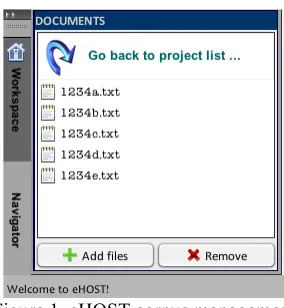
For any annotation task, the end user must man-age the document corpus, which can originate from a server or a file folder system that con-tains individual text files. Using the stand-alone eHOST client tool, corpus management is ac-complished via the current workspace (Figure 1). When the user initializes a new project, docu-ments are placed in a “corpus” folder that is as-sociated with the newly created annotation project. All text files, are copied to the “corpus” folder at the time of workspace assignment. Therefore, there is no risk of deleting the origi-nal documents associated with each new annota-tion project. This feature makes distribuannota-tion of projects easier, because of the consistency be-tween the workspace, corpus assignment and annotation output folders. For crowd-sourced projects eHOST can be integrated with a backend server via web services using an admin-istrative module called CASPR.
Figure 1. eHOST corpus management
2.3.2
Viewer/Editor Panels
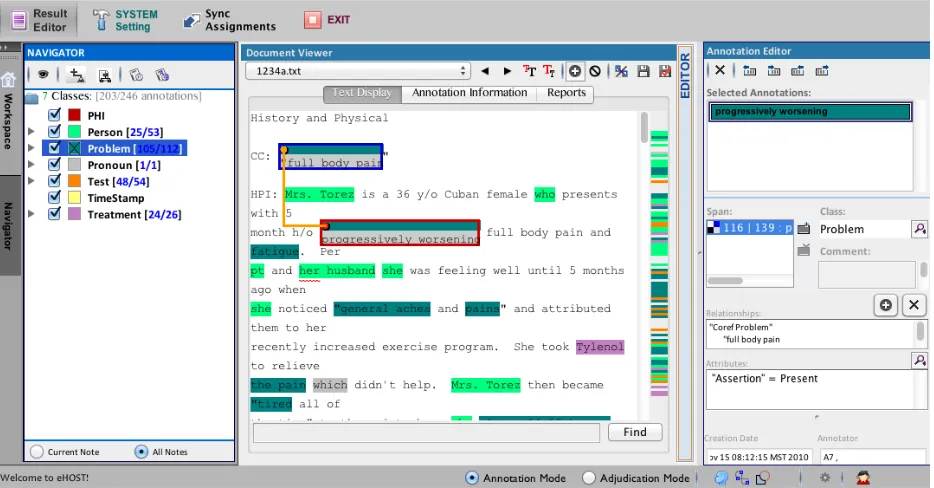
Figure 2 shows an annotation for “full body pain”, (shown with black bar above and below the active annotation) and information for that annotation including the annotated span, the class assignment and an assertion for the 2010 and 2011 i2b2/VA Challenge annotation tasks (Uzuner et al., 2011 and Uzuner et al., 2012). The result editor tab and its associated panels serve as the central place for basic annotation features. These functionalities include: assigning an annotator, creating new annotations or adjust-ing annotated spans of text and assignment of attributes or creating relationships between an-notated spans of text. Other functions in the re-sults editor tab include navigation between documents in the active corpus, resizing the text displayed in the document viewer, and “save”
and “save as” functions that assigns a path for XML output files. The end user can easily re-move all annotations in a document or rere-move specific kinds of annotations by deleting a “markable” class as well as remove attributes, and relationships between all annotations.
From the navigator screen in the stand-alone eHOST client tool a user can build annotation schema specifying markable classes, their asso-ciated attributes, and any allowed relationships. The navigator interface allows the user to review all annotated spans either within the current document or across the entire document corpus, toggle the view of each class on or off, see counts for all unique annotations and all annota-tions for each class, and choose a class for a fast annotate mode.
[image:4.612.360.502.68.222.2]annotation. This includes the time stamp of when the annotation was created, annotator as-signment, comments on the annotation and class, attribute and relationship information.
Annotations can be created using several ap-proaches from the result editor. In the normal mode, a class assignment window appears when the user selects a span of text, new annotations are generated by selecting any one of the marka-ble classes. Activating a “one click annotate”
mode is possible by checking the box next to a class of markables. Under this mode, any text
[image:5.612.74.541.237.481.2]selected is automatically annotated as that mark-able class. This feature improves task efficien-cies when categories of markables are low or annotations of the same category cluster in small sections. Keyboard shortcuts have also been in-tegrated with eHOST to reduce annotator click burden and dependence on a mouse. These shortcuts are available for tasks such as modifi-cation of spans, deletion of annotations, and nav-igation between annotations.
Figure 2. Example annotations using the eHOST interface
2.3.3
Server Integration
Annotation projects of any scale benefit from an automated means of building and distributing batches of texts to annotators, managing stand-off XML files generated from annotation tasks or written directly to a database and getting and submitting assignments with minimal user input. Coupling eHOST with server components that comply with the web services API defined for eHOST allows these functionalities. The CASPR module under development by VINCI provides a means to automate the administration of annotation efforts that could include crowd-sourced annotation projects.
Clicking on the sync assignments tab in the eHOST client (Figure 2) brings up a GUI that
2.3.4
Additional Features
The document viewer panel employs visual cues to display relationships between annotations us-ing color codus-ing representus-ing a parent and child node and line indicator between them showing the relationship. An “annotation profiler” to the right of the scroll bar shows the density of anno-tations color-coded to their categories, as well as relative to their positions in the document. This type of data visualization is useful to see the
rel-ative location of annotations within a single document or across an en tire document corpus.
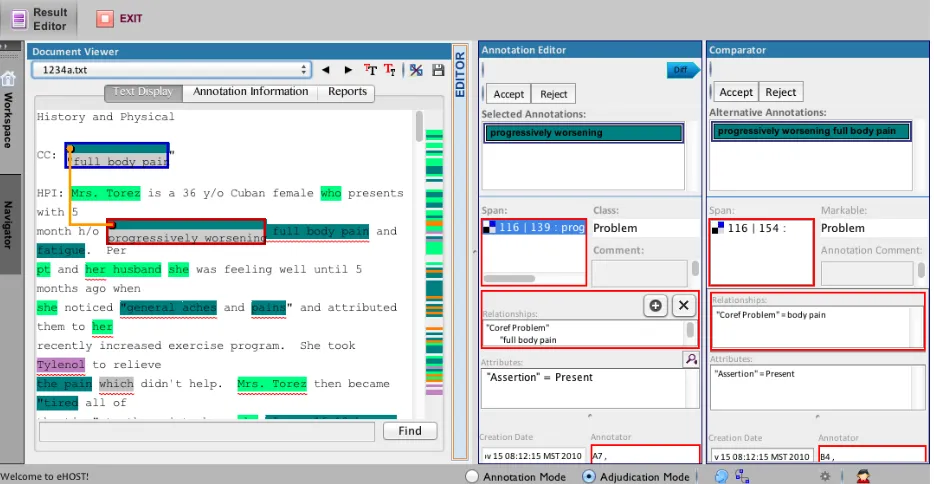
[image:6.612.74.541.222.464.2]An adjudication mode is also included in the stand-alone eHOST client that allows difference matching and side-by-side comparison of anno-tations for efficient adjudication of discrepancies between annotations. Standard reporting metrics can be calculated including Inter-Annotator Agreement (IAA), Recall, Precision and F1-Measure.
Figure 3. eHOST adjudication mode showing discrepant annotations between annotators A7 and B4
In Adjudication mode discrepant annotations are shown using a wavy red underline in the editor window and by a red bolded outline in a side by side two panel view between the annotation edi-tor and comparaedi-tor (Figure 3). These metrics and comparison tables between annotator results on the same documents can be output as HTML formatted reports that can be used by an adjudi-cator to quickly identify discrepancies between
Figure 4. HTML Formatted report showing discrepant annotations between annotators A7 and B4
3
Advanced eHOST Features
There are also other more advanced features that have been integrated with eHOST. These in-clude an “Oracle” mode that allows semi-automated annotation of similar spans of text across a document corpus, a means to easily and quickly curate annotated spans of text to create custom dictionaries, and machine-assisted pre-annotation integrated with the pre-annotation tool itself.
3.1
Oracle Mode
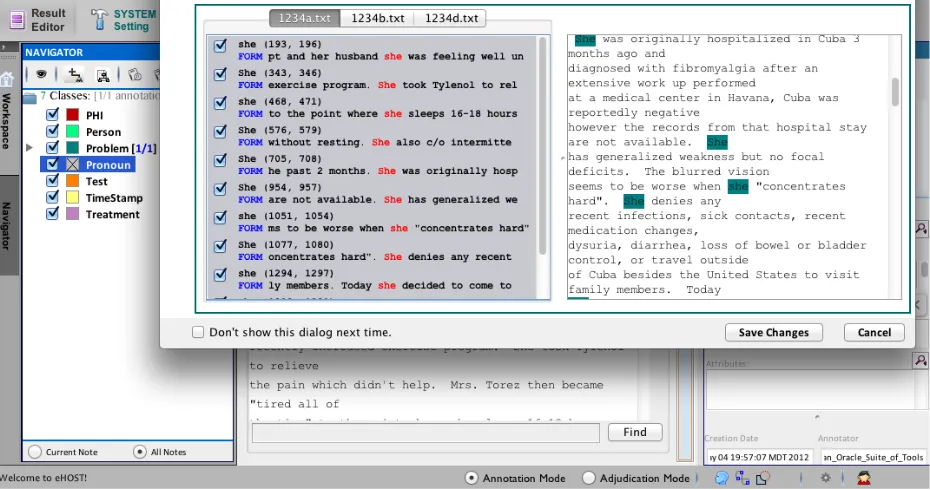
Also implemented with eHOST is an “Oracle” mode which uses exact string matching allowing the user to annotate all spans of text that are
identical to a new annotation. The oracle lists where these candidate annotations are found along with the surrounding context. The annota-tor can then accept or reject candidate spans an-notated with the same markable class. Oracle mode can run within the current document or across the entire document corpus. This type of functionality is useful for annotation tasks that may involve identifying and marking spans of text that are repetitive or follow the same format For example, the 2011 i2b2/VA annotation task in which annotation of pronominal information was required for co-reference resolution (Figure 5).
[image:7.612.75.540.448.693.2]3.2
Semi-Automated Curation and
Dictionary Management
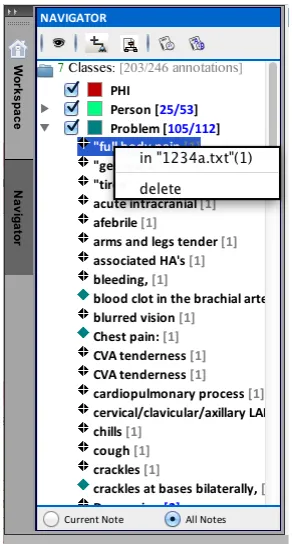
[image:8.612.107.253.260.532.2]Using the navigator window users can navigate to all annotations in either a single document or across an entire document corpus (Figure 6). The end user can curate annotations directly, create classes on the fly, or add attributes to an-notations found from the navigator pane. These functions also allow users to easily identify spu-rious annotations introduced from machine-assisted approaches correct misclassification errors, and quickly curate all annotations within a single document or across an entire document corpus.
Figure 6. Semi-Automated curation within the document corpus
One task often associated with development of NLP systems involves manually creating or en-hancing some existing representation of lexical knowledge that can be used as a domain specific dictionary. Using eHOST users can export anno-tations to create a dictionary of terms, phrases, or individual tokens that have been identified by human annotators and assigned to markable formation classes. Once curated, annotated in-formation can be exported as a new dictionary. User created dictionaries can be integrated with
a database or exported and used in the creation of some ontologic representation of information using Protégé. Output from a dictionary manager is in the form of a delimited text file and can therefore be modified to fit any standardized information model or used to pre-annotate sub-sequent document batches.
3.3
Machine-Assisted Pre-Annotation
An interface is provided in eHOST that can be used for machine-assisted pre-annotation of documents in the active project corpus using either dictionaries or regular expressions based approaches. Users can import libraries of regular expressions or build their own regular expres-sions using a custom regular expression builder. Users can build and modify dictionaries created as part of annotation tasks that may include semi-automated curation steps. Dictionaries and regular expressions can also be coupled with the ConText algorithm (Chapman et al., 2007) to identify concept attributes such as negation, ex-periencer, and temporality. Pre-annotations de-rived from some external third party source such as an NLP system written as Knowtator XML outputs may also be imported into eHOST or passed to eHOST using CASPR.
Computational speed required for pre-annotation can be improved by selecting an op-tion to use an internal statistical dicop-tionary in-dexing function. This feature is particularly useful in situations where pre-annotation dic-tionaries are extremely large, such as where a subset of some standard vocabulary may be used to pre-annotate documents. Using the result edi-tor and its associated functions annotaedi-tors can add missed annotations, modifying existing an-notations and delete spurious anan-notations. Han-dling pre-annotations in this way allows troubleshooting and error analysis of NLP sys-tem outputs imported into eHOST that can be shown to a reviewer in context and also facili-tates interactive annotator training.
3.4
Machine-Assisted Verification
Ma-chine-Assisted verification is most useful when used on lexical or syntax rules to ensure that candidate phrases generated by automated sys-tems are similar to those marked by humans. These rules rely more on adherence to patterns than on decision-making, so the strengths of human review with machine approaches to semi-automated verification can be leveraged. When identifying medical concepts, it is common that noun phrases are marked as candidates. The de-termination of how much of a noun phrase to mark (inclusion of articles, adjectives, noun-modifiers, prepositional phrases) and at what granularity (simple nouns or complex noun phrases) may vary with each project.
The verifier allows portions of an annotation guideline to be programmed into rules that check for consistency. Rules check whether a word appears within a user-defined window before and after an annotation. Each rule can be linked to text that describes why the annotation was flagged. Annotators are then provided sugges-tions on the correct span based on the rule. Us-ing the surroundUs-ing text, the guideline text, and the suggestion, the annotator can determine the final span for an annotation. These machine-assisted verifier functions help support reference standard generation by providing the context of annotations that seem to fail syntactic and lexi-cal rules while allowing human annotators to focus on domain expertise required to identify and classify information found in clinical texts.
Conclusion
Our prototype system provides functionalities that have been created to more efficiently sup-port reference standard generation including ma-chine-assisted annotation approaches. It is our hope that these system features will serve as the basis for the further development efforts that will be part of an enterprise level system. Out-puts of such an annotation tool could be used as inputs for pipeline NLP systems or as one com-ponent of a common workbench of tools used for clinical NLP development tasks.
We have implemented and tested eHOST for the 2010 and 2011 i2b2/VA challenge annota-tion tasks and annotaannota-tion projects for the Con-sortium for Healthcare Informatics Research (CHIR). The stand-alone eHOST client tool is
available from http://code.google.com/p/ehost along with a demonstration project, a users guide, API documentation, and source code. The eHOST/CASPR interfaces will be used to sup-port a large-scale crowd sourced annotation task used for annotation of disorders, temporal ex-pressions, uncertainty, and negation along with data standardization. These efforts will include more rigorous analysis and usability assessment of eHOST/CASPR for crowd sourcing and other small and large-scale annotation projects.
Acknowledgments
Support and funding was provided by the VA Salt Lake City HealthCare System and the VA Consortium for Healthcare Informatics Research (CHIR), VA HSR HIR 08-374, the VA Infor-matics and Computing Infrastructure (VINCI), VA HIR 08-204, and NIH Grant U54 HL 108460 for integrating Data for Analysis, An-nonymization and Sharing (iDASH), NIGMS 7R01GM090187.
References
Beatrice Alex, Claire Grover, Barry Haddow, Mijail Kabadjov, Ewan Klein, Michael Matthews, Stuart Roebuck, Richard Tobin, and Xinglong Wang. 2008. Assisted curation: does text mining really help? In: Proceedings of the Pacific Symposium on Biocomputing.
Wendy W. Chapman, David Chu, John N. Dowling. 2007. ConText: An Algorithm for Identifying Contextual Features from Clinical Text. In: ACL-07 20ACL-07.
Carol Friedman, Hongfang Liu, Lyudmila Shagina, Stephen Johnson, George Hripcsak. 2001. Evaluat-ing the UMLS as a source of lexical knowledge for medical language processing. In: Proc AMIA Symp, 2001: 189-93.
Karen Fort and Saggot B. 2010. Influence of Pre-Annotation on POS-tagged Corpus Development. In: Proceedings of the Fourth Linguistic Annota-tion Workshop. ACL 2010: 56-63.
Pei-Yun Hsueh, Prem Melville, Vikas Sindhwani. 2009. Data Quality from Crowdsourcing: A study of Annotation Selection Criteria.In: Proceedings of the NAACL HLT Workshop on Active Learning for Natural Language Processing. June 2009: 27-35.
Mark A. Musen, John Gennari, Henrik Eriksson, Samson W. Tu, and Angel R. Puerta. 1995. PROTEGE-II: computer support for development of intelligent systems from libraries of compo-nents. In: Medinfo 1995.
Aurélie Névéol, Rezarta Islamaj-Doğan, Zhiyong Lu. 2011. Semi-automatic semantic annotation of PubMed queries: a study on quality, efficiency, satisfaction. In: J Biomed Inform. 2011 Apr; 44(2):310-8.
Stefanie Nowak and Stefan Ruger. 2010. How Relia-ble are Annotations via Crowdsourcing? A Study about Inter-Annotator Agreement for Multi-label Image Annotation. In: MIR 10 2010.
Philip V. Ogren. 2006. Knowtator a protege plug-in for annotated corpus construction. In: Proceedings of the 2006 Conference of the North American Chapter of the Association for Computational Lin-guistics on Human Language Technology, 2006: 273-5.
Philip V. Ogren, Guergana K. Savova, Christopher G. Chute. 2008. Constructing Evaluation Corpora for Automated Clinical Named Entity Recogni-tion. In: Proceedings of the sixth international conference on Language Resources and Evalua-tion LREC 2008: 3143-3150.
Angus Roberts, Robert Gaizauskas, Mark Hepple, Neil Davis, George Demetriou, Yikun Guo, Jay Kola, Ian Roberts, Andrea Setzer, Archana Tapuria, Bill Wheeldin. 2007. The CLEF corpus: semantic annotation of clinical text. In: AMIA An-nu Symp Proc, 625-9.
Angus Roberts, Robert Gaizauskas, Mark Hepple, George Demetriou, Yikun Guo, Ian Roberts, An-drea Setzer. 2009. Building a semantically anno-tated corpus of clinical texts. In: J Biomed Inform, 42(5): 950-66.
Ellen Riloff. 1993. Automatically constructing a dic-tionary for information extraction tasks. In: Pro-ceedings of the Eleventh National Conference on Artificial Intelligence, 811-816.
Burr Settles, Mark Craven, and Lewis Friedland. 2008. Active Learning with Real Annotation Costs. In: Proceedings of the NIPS Workshop on Cost-Sensitive Learning. 2008.
Burr Settles. 2009. Active Learning Literature Sur-vey. In: Computer Sciences Technical Report 1648. University of Wisconsin-Madison. 2009. Brett R. South, Shuying Shen, F. Jeff Friedlin,
Mat-thew H. Samore, and Stephane M. Meystre. 2010. Enhancing Annotation of Clinical Text using Pre-Annotation of Common PHI. In: AMIA Annu Symp Proc. 2010.
Brett R. South, Shuying Shen, Robyn Barrus, Scott L. DuVall, Ozlem Uzuner, and Charlene Weir. 2011. Qualitative analysis of workflow modifications used to generate the reference standard for the 2010 i2b2/VA challenge. In: AMIA Annu Symp Proc. 2011.
Özlem Uzuner, Imre Solti, Fei Xia, and Eithon Cadag. 2010. Community annotation experiment for ground truth generation for the i2b2 medica-tion challenge. In: J Am Med Inform Assoc, 2010. 17(5):519-23.
Özlem Uzuner, Brett R. South, Shuying Shen, and Scott L. DuVall. 2011. 2010 i2b2/VA challenge on concepts, assertions, and relations in clinical text. In: JAMIA 18(5): 552-556.
Özlem Uzuner, Andreea Bodnari, Shuying Shen, Tyler B. Forbush, John Pestian, and Brett R. South. 2012. Evaluating the state of the art in co-reference resolution for electronic medical records.
In: JAMIA doi: 10.1136/amiajnl-2011-000784.
Aobo Wang, Cong Duy Vu Hoang, and Min-Yen Kan. 2010. Perspectives on Crowdsourcing Anno-tations for Natural Language Processing. In: CSIDM Project No. CSIDM-200805.