Proc. of the Joint Workshop on Automatic Knowledge Base Construction & Web-scale Knowledge Extraction (AKBC-WEKEX), pages 46–51,
Adding Distributional Semantics to Knowledge Base Entities
through Web-scale Entity Linking
Matthew Gardner
Carnegie Mellon University 5000 Forbes Avenue Pittsburgh, PA 15213, USA
Abstract
Web-scale knowledge bases typically consist entirely of predicates over entities. However, the distributional properties of how those en-tities appear in text are equally important as-pects of knowledge. If noun phrases mapped unambiguously to knowledge base entities, adding this knowledge would simply require counting. The many-to-many relationship between noun phrase mentions and knowl-edge base entities makes adding distributional knowledge about entities difficult. In this pa-per, we argue that this information should be explicitly included in web-scale knowledge bases. We propose a generative model that learns these distributional semantics by per-forming entity linking on the web, and we give some preliminary results that point to its use-fulness.
1 Introduction
Recent work in automatically creating web-scale knowledge bases (like YAGO, Freebase, and NELL) has focused on extracting properties of concepts and entities that can be expressed as n-ary rela-tions (Suchanek et al., 2007; Bollacker et al., 2008; Carlson et al., 2010b). Examples might be Athlete( Michael Jordan 1), Professor(Michael Jordan 2), PlaysForTeam(Michael Jordan 1, Chicago Bulls), and UniversityFaculty(UC Berkeley,Michael Jordan 2). The task of the knowledge extraction algorithm is to find new instances of these relations given some training examples, perhaps while jointly determining the set of relevant entities.
While these knowledge extraction approaches have focused on relational knowledge, knowing how UC Berkeley appears distributionally in text is also an important aspect of the entity that is poten-tially useful in a variety of tasks. For example, Pe˜nas and Hovy (2010) showed that a collection of dis-tributional knowledge about football entities helped in interpreting noun compounds like “Young touch-down pass.” Haghighi and Klein (2010) used dis-tributional information about entity types to achieve state-of-the-art coreference resolution results. It has long been known that word sense disambiguation and other tasks are best solved with distributional in-formation (Firth, 1957), yet this inin-formation is lack-ing in web-scale knowledge bases.
The primary reason that distributional informa-tion has not been included in web-scale knowledge bases is the inherent ambiguity of noun phrases. Knowledge bases typically aim to collect facts about entities, not about noun phrases, but distributional information is only easily obtained for noun phrases. In order to add distributional semantics to knowl-edge base entities, we must perform entity linking, determining which entity any particular noun phrase in a document refers to, at web scale.
semantics for the set of entities in a knowledge base in the context of an entity linking task. Finally, in Section 4 we conclude.
2 Related Work
Our work builds off of a few related ideas. First, Haghighi and Klein (2010) presented a coreference resolution system that had at its core a set of distri-butional semantics over entity types very similar to what we propose. For each of a set of entity types (like Person, Organization, and Location) and each of a set of properties (like “proper head,” “common head,” “subject of verb”), they have a distribution over values for that property. People are thus more likely to have “Steve” or “John” as noun modifiers, while Organizations are more likely to have “Corp.” as proper heads.
Their system learned these distributions in a semi-supervised fashion, given a few seed examples to their otherwise unsupervised coreference model. Their system did not, however, have any notion of global entities; they had global types whose pa-rameters were shared across document-specific en-tities. Every time they saw the noun phrase “Barack Obama” in a new document, for example, they cre-ated a new entity of type “Person” for the mentions in the document. Even though they did not model in-dividual entities, their system achieved state-of-the-art coreference resolution results. We believe that their modeling of distributional semantics was key to the performance of their model, and we draw from those ideas in this paper.
Our proposal is also very similar to ideas pre-sented by Hovy (2011). Hovy describes a “new kind of lexicon” containing both relational informa-tion tradiinforma-tionally contained in knowledge bases and distributional information very similar to that used in Haghighi and Klein’s coreference model. Each item in this “new lexicon” is represented as a set of distributions over feature values. The lexical en-try for “dog,” for example, might contain a feature “name,” with “Spot” and “Lassie” receiving high weight, and a feature “agent-of,” with highly proba-ble values “eat,” “run,” and “bark.” While Hovy has presented this vision of a new lexicon, he has left as open questions how to actually construct it, and how compositionality, dependence, and logical operators
can function efficiently in such a complex system.
Pe˜nas and Hovy (2010) have shown how a very small instance of a similar kind of lexicon can per-form well at interpreting noun compounds, but they needed to resort to a severely restricted domain in order to overcome the challenges of constructing the lexicon. Because they only looked at a small set of news articles about football, they could accurately assume that all mentions of the word “Young” re-ferred to a single entity, the former San Francisco 49ers quarterback. At web scale, such assumptions quickly break down.
There has been much recent work in distantly supervised relation extraction, using facts from a knowledge base to determine which sentences in a corpus express certain relations in order to build re-lation classifiers (Hoffmann et al., 2011; Riedel et al., 2010; Mintz et al., 2009). This work depends on first performing entity linking, finding sentences which contain pairs of knowledge base entities. Typ-ically, this linking has been a simple string-matching heuristic, a noisy alignment that throws away a lot of useful information. Using coreference resolution after a noisy alignment can help to mitigate this is-sue (Gabbard et al., 2011), but it is still mostly a heuristic matching. A benefit of our approach to adding distributional semantics to web-scale knowl-edge bases is that in the process we will create a large entity-disambiguated corpus that can be used for further relational learning.
3 Entity Linking
N
|N|
|N||F|
E
e
φe,f
θe
f
v
[image:3.612.107.265.69.304.2]F MD
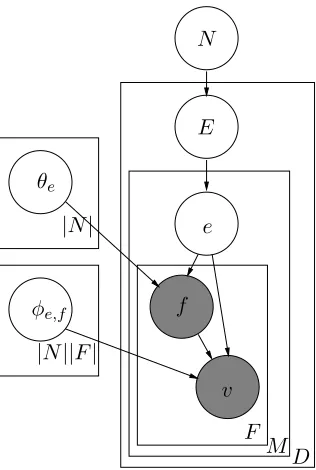
Figure 1: Graphical model for entity linking.
3.1 Model Structure
The model we propose is similar in structure to hier-archical models like latent Dirichlet allocation (Blei et al., 2003) or hierarchical Dirichlet processes (Teh et al., 2006). Instead of the “topics” of those mod-els, we have entities (i.e., one “topic” in the model for every entity in the knowledge base, plus one “un-known” topic), and instead of modeling individual words, we model entity mentions in the document.
The generative story of the model is as follows. First, given a set of entities from a knowledge base, fix a Dirichlet prior N over them, and draw a set of multinomial parametersφe,f andθefor each
en-tity from a set of Dirichlet priors α and β. Next, for each of D documents, draw a multinomial dis-tribution over entitiesEappearing in that document fromN. Then for each ofM mentions in the docu-ment, draw fromEan entityeto which that mention refers. Given the entity e, draw a set ofF feature typesffromθe. For each feature typef, draw a
fea-ture valuevfrom the distributionφe,fcorresponding
to the entityeand the feature typef. This model is shown graphically in Figure 1.
We chose a generative model with multinomial distributions instead of other options because we want the resultant distributions φ and θ to be im-mediately interpretable and usable in other models,
as the intent is that they will be stored as part of the knowledge in the knowledge base. Also, we intend to extend this model to allow for the creation of new entities, a relatively easy extension with a model of this form.
3.2 Features
Here we describe in more detail what we use as the features f in the model. These features and their corresponding parametersφandθconstitute the dis-tributional information that we propose to include in web-scale knowledge bases, and they aim to capture the way knowledge-base entities tend to appear in text.
The features we propose are the set of Stanford dependency labels that attach to the head word of each mention, with the values being its dependents or governors. We also have features for the head word of the mention, whether it is a proper noun, a common noun, or a pronoun. We keep track of the direction of the dependencies by prepending “gov-” to the dependency label if the mention’s head word is governed by another word, and we stem verbs. For example, in the sentence “Barack Obama, president of the United States, spoke today in the Rose Gar-den,” the mention “Barack Obama” would have the following features:
Feature Value proper-head Obama
nn Barack
gov-nsubj speak appos president
When there are deterministically coreferent men-tions, as with appositives, we combine the features from both mentions in preprocessing.
ex-pression of relations directly, which would also be very useful to have in web-scale knowledge bases.
3.3 Inference
Inference in our model is done approximately in a MapReduce sampling framework. The map tasks sample the entity variables for each mention in a document, sequentially. The entity variables are constrained to either refer to an entity already seen in the document, or to a new entity from the knowl-edge base (or unknown). Sampling over the entire knowledge base at every step would be intractable, and so when proposing a new entity from the edge base we only consider entities that the knowl-edge base considers possible for the given noun phrase (e.g., NELL has a “CanReferTo” relation mapping noun phrases to concepts (Krishnamurthy and Mitchell, 2011), and Freebase has a similar “alias” relation). Thus the first mention of an tity in a document must be a known alias of the en-tity, but subsequent mentions can be arbitrary noun phrases (e.g., “the college professor” could not refer toMichael Jordan 2 until he had been intro-duced with a noun phrase that the knowledge base knows to be an alias, such as “Michael I. Jordan”). This follows standard journalistic practice and aids the model in constraining the “topics” to refer to ac-tual knowledge base entities.
The reduce tasks reestimate the parameters for each entity by computing a maximum likelihood es-timate given the sampled entity mentions from the map tasks. Currently, there is no parameter sharing across entities, though we intend to utilize the struc-ture of the knowledge base to tie parameters across instances of the same category in something akin to a series of nested Dirichlet processes.
While we have not yet run experiments with the model at web scale, it is simple enough that we are confident in its scalability. Singh et al. and Ahmed et al. have shown that similarly structured models can be made to scale to web-sized corpora (Singh et al., 2011; Ahmed et al., 2012).
3.4 Evaluation
Evaluating this model is challenging. We are aim-ing to linkevery noun phrasein every document to an entity in the knowledge base, a task for which no good dataset exists. It is possible to use Wikipedia
articles as labeled mentions (as did Singh et al. (2011)), or the word sense labels in the OntoNotes corpus (Weischedel et al., 2011), though these re-quire a mapping between the knowledge base and Wikipedia entities or OntoNotes senses, respec-tively. The model also produces a coreference de-cision which can be evaluated. These evaluation methods are incomplete and indirect, but they are likely the best that can be hoped for without a labor-intensive hand-labeling of large amounts of data.
3.5 Preliminary Results
We do not yet have results from evaluating this model on an entity linking task. However, we do have preliminary distributional information learned from 20,000 New York Times articles about base-ball. Some of the distributions learned for the New York Mets baseball team are as follows.
gov-nsubj gov-poss had: 0.040 manager: .088 have: 0.035 president: .032 won: 0.028 clubhouse: .024 lost: 0.026 victory: .024 got: 0.018 baseman: .020 scored: 0.015 coach: .019
These distributions themselves are inherently use-ful for classification tasks—knowing that an en-tity possesses managers, presidents, basemen and coaches tells us a lot about what kind of entity it is. The learning system for the NELL knowledge base currently uses distributions over noun phrase contexts (a few words on either side) to learn in-formation about its concepts (Carlson et al., 2010a). The results of this model could provide much bet-ter data to NELL and other learning systems, giv-ing both more structure (distributions over depen-dency links instead of windowed contexts) and more refined information (distributions over concepts di-rectly, instead of over noun phrases) than current data sources.
4 Conclusion
distributional knowledge for knowledge base enti-ties (instead of for ambiguous noun phrases) by per-forming entity linking at web scale. While pro-ducing useful distributional knowledge about enti-ties, this work will also provide much richer data sources to traditional relation extraction algorithms. Though our work is still preliminary and there are challenges to be overcome, the primary purpose of this paper is to argue that this research direction is feasible and worth pursuing. A knowledge base that includes both properties about entities and distribu-tional knowledge of how those entities appear in text is much more useful than a knowledge base contain-ing facts alone.
Acknowledgments
We thank Jayant Krishnamurthy and Tom Mitchell for helpful conversations, the anonymous reviewers for their comments, and the Intel Science and Tech-nology Center on Embedded Computing for finan-cial support.
References
A. Ahmed, M. Aly, J. Gonzalez, S. Narayanamurthy, and A.J. Smola. 2012. Scalable inference in latent vari-able models. In Proceedings of the fifth ACM inter-national conference on Web search and data mining, pages 123–132. ACM.
David M. Blei, Andrew Y. Ng, and Michael I Jordan. 2003. Latent dirichlet allocation. Journal of Machine Learning Research, 3:993–1022.
K. Bollacker, C. Evans, P. Paritosh, T. Sturge, and J. Tay-lor. 2008. Freebase: a collaboratively created graph database for structuring human knowledge. In Pro-ceedings of the 2008 ACM SIGMOD international conference on Management of data, pages 1247–1250. ACM.
A. Carlson, J. Betteridge, R.C. Wang, E.R. Hruschka Jr, and T.M. Mitchell. 2010a. Coupled semi-supervised learning for information extraction. InProceedings of the third ACM international conference on Web search and data mining, pages 101–110. ACM.
Andrew Carlson, Justin Betteridge, Bryan Kisiel, Burr Settles, Estevam R. Hruschka Jr., and Tom M. Mitchell. 2010b. Toward an architecture for never-ending language learning. In Proceedings of the Twenty-Fourth Conference on Artificial Intelligence (AAAI 2010).
A. Fader, S. Soderland, and O. Etzioni. 2011. Identify-ing relations for open information extraction. In Pro-ceedings of the Conference on Empirical Methods in Natural Language Processing, pages 1535–1545. As-sociation for Computational Linguistics.
J.R. Firth, 1957. A synopsis of linguistic theory 1930– 1955, pages 1–32. Philological Society, Oxford. R. Gabbard, M. Freedman, and R. Weischedel. 2011.
Coreference for learning to extract relations: yes, vir-ginia, coreference matters. In Proceedings of the 49th Annual Meeting of the Association for Compu-tational Linguistics: Human Language Technologies: short papers-Volume 2, pages 288–293. Association for Computational Linguistics.
A. Haghighi and D. Klein. 2010. Coreference resolution in a modular, entity-centered model. InProceedings of the 48th Annual Meeting of the Association for Com-putational Linguistics: Human Language Technolo-gies, pages 385–393. Association for Computational Linguistics.
R. Hoffmann, C. Zhang, X. Ling, L. Zettlemoyer, and D.S. Weld. 2011. Knowledge-based weak supervision for information extraction of overlapping relations. In
Proceedings of the 49th Annual Meeting of the Asso-ciation for Computational Linguistics: Human Lan-guage Technologies-Volume 1, pages 541–550. Asso-ciation for Computational Linguistics.
E.H. Hovy. 2011. Toward a new semantics: Merging propositional and distributional information. Presen-tation at Carnegie Mellon University.
J. Krishnamurthy and T.M. Mitchell. 2011. Which noun phrases denote which concepts? InProceedings of the 49th Annual Meeting of the Association for Compu-tational Linguistics: Human Language Technologies, volume 1, pages 570–580.
M. Mintz, S. Bills, R. Snow, and D. Jurafsky. 2009. Dis-tant supervision for relation extraction without labeled data. InProceedings of the 47th Annual Meeting of the Association for Computational Linguistics, pages 1003–1011. Association for Computational Linguis-tics.
A. Pe˜nas and E. Hovy. 2010. Filling knowledge gaps in text for machine reading. InProceedings of the 23rd International Conference on Computational Linguis-tics: Posters, pages 979–987. Association for Compu-tational Linguistics.
S. Riedel, L. Yao, and A. McCallum. 2010. Mod-eling relations and their mentions without labeled text. Machine Learning and Knowledge Discovery in Databases, pages 148–163.
distributed inference and hierarchical models. Asso-ciation for Computational Linguistics: Human Lan-guage Technologies (ACL HLT).
F.M. Suchanek, G. Kasneci, and G. Weikum. 2007. Yago: a core of semantic knowledge. InProceedings of the 16th international conference on World Wide Web, pages 697–706. ACM.
Y.W. Teh, M.I. Jordan, M.J. Beal, and D.M. Blei. 2006. Hierarchical Dirichlet processes. Journal of the Amer-ican Statistical Association, 101(476):1566–1581. R. Weischedel, M. Palmer, M. Marcus, E. Hovy, S.