Character based String Kernels for Bio-Entity Relation Detection
Ritambhara Singh
Department of Computer Science University of Virginia
Charlottesville
Yanjun Qi
Department of Computer Science University of Virginia
Charlottesville
Abstract
Extracting bio-entity relations has emerged as an important task due to the ever-growing number of bio-medical doc-uments. In this paper, we present a simple and novel representation for extracting bio-entity relationships. The state-of-the-art systems for such tasks rely on word based representations and variations of linguistic driven features. In contrast, we model bio-text by the most basic character based string representation with a family of string kernels. This eliminates time consuming parsing, issue of rare words and domain specific pre-processing. This simple representation makes our approach fast and flexible for any bio-NLP dataset. We demonstrate comparable performance and faster computation time of our ap-proach versus previous state-of-the-art kernel methods.
1 Introduction
Relation extraction from biomedical documents is an important task in knowledge representation and inference. It helps to construct and enhance structured knowledge-bases and in turn support automatic question answering and decision mak-ing. In today’s era of vast amount of information collection and retrieval, the task of naming and identifying the relations between annotated bio-entities can become complex and time consuming. This can be deducted from the fact that the MED-LINE database has more than 22 million journal articles related to biomedicine. Many state-of-the art methods have been applied for state-of-the popu-lar tasks of extracting protein-protein interaction (PPI) and drug-drug interaction (DDI) as a part of BioCreative shared task challenges (Segura Bed-mar et al., 2011; Segura BedBed-mar et al., 2013;
Krallinger et al., 2008). While these methods have achieved good performance, they mostly rely on word-level features, are dependent on time-consuming parsers or require domain knowledge for pre-processing.
This paper uses characters instead of words for bio-entity relation extraction. Characters are the most fundamental building blocks in any lan-guage. We propose to model bio-text using its most basic character-based string representation. Through a string kernel implementation, in the framework of support vector machine (SVM), we separate positive and negative interaction in-stances to detect bio-entity relationships. This basic representation is independent of parsers, does not require domain-related pre-processing and eliminates the rare words problem. It not only performs comparable to other state-of-the-art methods but also provides an exploration of new and simple feature sets (complementary to exist-ing features) that have not been previously studied for bio-NLP shared tasks.
2 Related Work
Convolution-based kernel methods have been used extensively in the tasks of PPI and DDI traction, and differ in the feature sets they ex-plore. While the shallow linguistic (SL) ker-nel (Giuliano et al., 2006) uses simple linguis-tic features, others utilize more complex fea-tures. Constituent parse tree-based kernels, like subtree (ST) (Vishwanathan et al., 2004), sub-set tree (SST) (Collins and Duffy, 2001), partial tree (PT) (Moschitti, 2006) kernels, and spectrum tree (SpT) (Kuboyama et al., 2007) kernel, use subtree forms or path structures from constituent parse trees. Another category of methods use de-pendency parse tree-based features. This includes edit distance and cosine similarity kernels (using shortest paths) (Erkan et al., 2007), k-band short-est path spectrum (kBSPS) (Tikk et al., 2010) (a
Kip1 binds to CDK2
protein1 binds to protein2
k=4 or
Family of String Kernels ϕ
Support Vector Machine Negative instance
Positive instance g=9
(1) Original Instance
(2) Tokenization
(3) Character-level features
(4) Mapping of strings using k-mer or g-mer level features into numerical feature space
(5) Binary classification using SVM
b i n d s t o . . . . . . . .
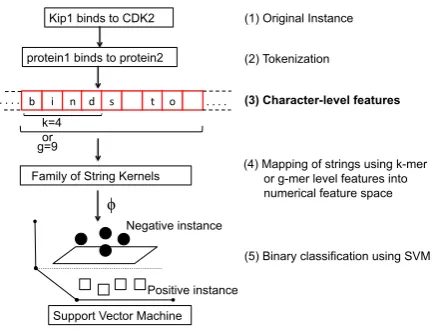
Figure 1: End-to-end implementation of character-based string kernels for bio-entity re-lation detection.
k-band extension of shortest paths), all-path graph (APG) kernel (Airola et al., 2008) (weighing dif-ferently shortest paths), and Kim’s kernels (Kim et al., 2008) (combines shortest path with differ-ent lexical, part-of-speech and syntactic features). Benchmark papers, such as (Tikk et al., 2010) and (Tikk et al., 2013), have performed thorough com-parative and error analyses of all these different kernels. They concluded that APG, kBSPS and SL kernels give the best performance. Therefore, we use these three kernels as baselines in our experi-mental comparisons. Some studies include a com-bination of kernels and parsers for PPI extraction task, e.g. (Miwa et al., 2009). Similarly, (Thomas et al., 2013) implemented a two-step approach to first detect general DDIs and then classify detected DDIs into subtypes. For the general DDI task, they used voting to combine kernels including APG, subtree (ST), SST, SpT, and SL kernels.
All the above discussed methods suffer from the rare words problem, and require time consum-ing and domain specific pre-processconsum-ing steps like parsing to obtain lexical features, constituent and dependency trees. Several recent studies have dis-covered that character-based representation pro-vides simple and powerful models for sentiment classification (Zheng et al., 2015) and transition-based parsing (Ballesteros et al., 2015). (Lodhi et al., 2002) first used string kernels with charac-ter level features for text categorization. However, their kernel computation used dynamic program-ming which is computationally intensive. Over recent years, more efficient string kernel meth-ods have been devised (Leslie and Kuang, 2004;
Corpus Task Sent. Pos Neg Total
MEDLINE DDI 1301 232 1555 1787 AIMed PPI 1955 1000 4834 5834
LLL PPI 77 164 166 330
Table 1: Statistics (number of sentences, pos-itive, negative and total instances) of the MED-LINE corpus about DDI and, AIMed and LLL cor-pus about PPI extraction respectively.
Kuksa et al., 2009). Therefore, we apply a fam-ily of state-of-the-art string kernels using sim-ple character-based string representation for bio-entity relation detection in this work.
3 Approach
Figure 1 shows our end-to-end implementation of character-based string kernel approach for bio-entity relation detection.
3.1 Character-level features
Without relying on any pre-processing, we di-rectly use the instance sentences of bio-NLP datasets as input to the string kernels. Here, each instance (whole sentence) is viewed as one long contiguous string comprised of characters. A string kernel is then used to convert these strings into a feature space (implicitly through kernel cal-culation) that can be used as input for support vec-tor machine (SVM) classification algorithm.
3.2 Family of string kernels
The key idea of string kernels is to apply a func-tion φ(·), which maps strings of arbitrary length into a vectorial feature space of fixed length. In this space, a standard classifier such as SVM (Vapnik, 1998) can then be applied. Kernel-version of SVMs calculate the decision function for an input samplex:
f(x) =XN i=1
αiK(xi, x) +b (1)
whereN is the total number of training samples. String kernels (Leslie and Kuang, 2004; Kuksa et al., 2009; Ghandi et al., 2014a), implicitly com-pute an inner product in the mapped feature space φ(x)as:
K(x, x0) =hφ(x), φ(x0)i, (2)
[image:2.595.73.290.61.226.2]all strings composed of dictionaryΣ.φ:S →Rm defines the mapping from a sequencex ∈ S to a m-dimensional feature vector.
The feature representationφ(·)plays a key role in the effectiveness of string analysis since strings cannot be readily described as feature vectors. We have implemented the following string kernels on the character representation.
Spectrum Kernel (SK): One classic represen-tation is to represent a string as unordered set of k-mers, that is, combinations of kadjacent char-acters. A feature vector indexed by all k-mers records the number of occurrences of eachk-mer in the current string. The string kernel using this representation is called spectrum kernel (Leslie et al., 2002), where the spectrum representation counts the occurrences of eachk-mer in a string. Kernel scores between strings are then computed by taking an inner product between corresponding “k-mer - indexed” feature vectors:
K(x, x0) = X γ∈Γk
cx(γ)·cx0(γ) (3)
whereγrepresents ak-mer,Γkis the set of all pos-siblek-mers, and cx(γ) is the number of occur-rences (with normalization) of k-mer γ in string x. (Kuboyama et al., 2007) applied spectrum ker-nel on the constituent parse tree features.
Mismatch Kernel (MK): The spectrum kernel implementation is modified to includemnumber of mismatches in the k-mers (Leslie and Kuang, 2004; Kuksa et al., 2009). Thus, for a givenk-mer γ in a stringx, the(k, m)-neighborhood is gener-ated. This consists of allk-length stringsα from dictionary Σk such that they differ from original k-mer by at mostmmismatches. The feature map of mismatch kernel can be defined as:
φ(k,m)(γ) = (φα(γ))α∈Σk (4)
whereφα(γ) = 1ifα ∈(k, m)-neighborhood of γ, otherwiseφα(γ) = 0. A mismatch kernel with m= 0is essentially a spectrum kernel.
Wildcard Kernel (WK): For implementation of wildcard kernel, the dictionary Σ is augmented with a wildcard character ? (Leslie and Kuang, 2004). Thus, the feature space consists of set of k-mersΓkobtained fromΣ∪ {?}that consists of moccurrences of wildcard character (?). The fea-ture map of wildcard kernel can be defined as:
φ(k,m,λ)(γ) = X
Γkinx
(φα(γ))α∈(Σ∪{?}) (5)
whereφα(γ) =λmifγ matchesαwithm occur-rences of character?, otherwiseφα(γ) = 0. Here 0< λ≤1.
Gappedk-mer based Kernel (GK): The previ-ously described k-mer based string kernels gener-ate extremely sparse feature vectors for even mod-erately sized values ofk, resulting in overfitting. (Ghandi et al., 2014b) introduced a new feature set, called gapped k-mers, resolving the sparsity limitation withk-mer features. It is characterized by two parameters; (1)g, size of a gapped instance which is a segment of string including gaps and (2) k, the number of non-gapped k-mers or positions in each segment of size g. Thus, the number of gapsd=g−k. The inner product in equation 3 includes sum over all gappedk-mers features:
K(x, x0) = X γ∈Θg
cx(γ)·cx0(γ) (6)
where γ represents ak-mer, Θg is the set of all possibleg-mers in the given data.
3.3 Classification
Once the kernel matrix K is calculated, we input it into an SVM classifier as an empirical feature map using SV Mlight (Joachims, 1999; Sch¨olkopf and Burges, 1999). SVM maximizes the margin between the positive and negative in-stances of bio-entity interactions in the kernel de-fined feature space.
4 Experiment Setup
Datasets We demonstrate the benchmark imple-mentations of our approach on three datasets with different sample sizes. They include MEDLINE corpus from the DDI extraction task (Segura Bed-mar et al., 2011; Segura BedBed-mar et al., 2013), and the AIMed and LLL corpus from the PPI extrac-tion task (Krallinger et al., 2008).1. The details of
the datasets have been presented in Table 1.
Baselines We selected SL (Giuliano et al., 2006), APG (Airola et al., 2008), and kBSPS
1We use the same format as used in previous studies, that
Corpus Task kBSPS APG SL SK (k) MK (k, m) WK (k, m) GK (g, k) MEDLINE DDI - 82.3 78.9 82.1 (7) 82.7 (7,3) 83 (7,3) 82.4 (7,4) AIMed PPI 75.1 84.6 83.5 75.6 (8) 74.9 (10,5) 75.2 (10,5) 75.4 (8,6) LLL PPI 84.3 83.5 81.2 67.9 (7) 77.9 (7,3) 78.4 (8,5) 78.1 (7,5)
Table 2: Using AUC score to compare four character-based string kernels with APG, kBSPS and SL baselines. The best performing kernel parameters are also presented. AUC scores for APG and SL kernels for MEDLINE corpus have been reported in (Thomas et al., 2013), while scores of all three baseline kernels for AIMed and LLL corpus are reported in (Tikk et al., 2010).
Corpus Task kBSPS APG SL SK MK WK GK
MEDLINE DDI 169.13 169.13 5.2 0.4 2.6 3.1 2.6 AIMed PPI 254.15 254.14 7.82 76.8 79.5 78 41.3
LLL PPI 10 10 0.3 0.2 1.3 1 0.2
Table 3: Comparing the kernel computation time (in seconds) for all four character-based string kernels versus the estimated parsing times of state-of-the-art baselines reported from (Tikk et al., 2010).
(Tikk et al., 2010) kernels as baselines for com-paring with character-based string kernels. These kernels are the top-performing approaches, as re-ported by(Tikk et al., 2010; Tikk et al., 2013) and (Luo et al., 2016).
Parameters We ran all our string kernels across multiple kernel parameter settings as follows: (1) SK : k = {6,7,8,9,10}, (2) MK,WK : k =
{6,7,8,9,10}andm={1, .., k−1}, and (3) GK :g={6,7,8,9,10}andk={1, ..., g−1}. These string kernels were implemented using gkmsvm
(Ghandi et al., 2014a) tool. The character level dictionary, Σ = {a, ..., z,0,1, ...9} (size=36), is consistent for all the datasets and kernels.
Evaluation Metrics We performed 10-fold doc-ument level cross-validation on each selected cor-pus and calculated the AUC score (area under the receiver operating characteristic curve) for perfor-mance evaluation. (Tikk et al., 2010) confirmed that AUC score is more stable to parameter mod-ifications and less sensitive to the ratio of pos-itive/negative pairs in the corpus than F-score. Hence, AUC score is our choice for performance metric. We also recorded the kernel calculation times (in seconds) for all four string kernels.
5 Results
Table 2 summarizes the performance evalua-tion. The AUC scores for APG and SL kernels for MedLine corpus have been reported in (Thomas et al., 2013), while scores of all baseline kernels for AIMed and LLL corpus are reported in (Tikk et
al., 2010). Our string kernel approaches, with sim-ple character features, (WK,MK, and GK), outper-form the baseline kernels (Table 2) on the Med-Line corpus. For the AIMed corpus, SK, GK, and WK give higher AUC score than the baseline kB-SPS kernel. Our methods give reasonable perfor-mance for LLL corpus as well, however not as good as the three baseline kernels. The parameters giving the best AUC performance are also reported (Table 2). Our representation is complementary and can be plugged into state-of-the-art baselines to further improve their systems.
Table 3 presents the kernel computation time comparison of all four character-based string ker-nels versus the baselines. We compare this with the estimated parsing times. For the baseline ker-nels, these have been reported and calculated in (Tikk et al., 2010). Unlike baseline kernels, we use character level features directly and thus do not need the parsing step.
6 Discussion
[image:4.595.132.473.198.256.2]References
Antti Airola, Sampo Pyysalo, Jari Bj¨orne, Tapio Pahikkala, Filip Ginter, and Tapio Salakoski. 2008. All-paths graph kernel for protein-protein interac-tion extracinterac-tion with evaluainterac-tion of cross-corpus learn-ing. BMC bioinformatics, 9(11):1.
Miguel Ballesteros, Chris Dyer, and Noah A Smith. 2015. Improved transition-based parsing by
model-ing characters instead of words with LSTMs. arXiv
preprint arXiv:1508.00657.
Michael Collins and Nigel Duffy. 2001. Convolution kernels for natural language. InAdvances in neural information processing systems, pages 625–632. G¨unes Erkan, Arzucan ¨Ozg¨ur, and Dragomir R Radev.
2007. Semi-supervised classification for extract-ing protein interaction sentences usextract-ing dependency
parsing. InEMNLP-CoNLL, volume 7, pages 228–
237.
Mahmoud Ghandi, Dongwon Lee, Morteza
Mohammad-Noori, and Michael A Beer. 2014a. Enhanced regulatory sequence prediction using
gapped k-mer features. PLoS Comput Biol,
10(7):e1003711.
Mahmoud Ghandi, Morteza Mohammad-Noori, and Michael A Beer. 2014b. Robust k-mer frequency
estimation using gapped k-mers. Journal of
mathe-matical biology, 69(2):469–500.
Claudio Giuliano, Alberto Lavelli, and Lorenza Ro-mano. 2006. Exploiting shallow linguistic informa-tion for relainforma-tion extracinforma-tion from biomedical litera-ture. InEACL, volume 18, pages 401–408. Citeseer. Thorsten Joachims. 1999. Making large scale SVM learning practical. Technical report, Universit¨at Dortmund.
Seonho Kim, Juntae Yoon, and Jihoon Yang. 2008. Kernel approaches for genic interaction extraction.
Bioinformatics, 24(1):118–126.
Martin Krallinger, Florian Leitner, Carlos Rodriguez-Penagos, Alfonso Valencia, et al. 2008. Overview of the protein-protein interaction annotation
ex-traction task of BioCreative II. Genome biology,
9(Suppl 2):S4.
Tetsuji Kuboyama, Kouichi Hirata, Hisashi Kashima, Kiyoko F Aoki-Kinoshita, and Hiroshi Yasuda.
2007. A spectrum tree kernel. Information and
Me-dia Technologies, 2(1):292–299.
Pavel P Kuksa, Pai-Hsi Huang, and Vladimir Pavlovic. 2009. Scalable algorithms for string kernels with
in-exact matching. InAdvances in Neural Information
Processing Systems, pages 881–888.
Christina Leslie and Rui Kuang. 2004. Fast string kernels using inexact matching for protein
se-quences. The Journal of Machine Learning
Re-search, 5:1435–1455.
Christina S Leslie, Eleazar Eskin, and William Stafford Noble. 2002. The spectrum kernel: A string kernel
for SVM protein classification. In Pacific
sympo-sium on biocomputing, volume 7, pages 566–575. Huma Lodhi, Craig Saunders, John Shawe-Taylor,
Nello Cristianini, and Chris Watkins. 2002. Text classification using string kernels. The Journal of Machine Learning Research, 2:419–444.
Yuan Luo, ¨Ozlem Uzuner, and Peter Szolovits. 2016. Bridging semantics and syntax with graph algorithms–state-of-the-art of extracting biomedical relations. Briefings in bioinformatics, page bbw001. Makoto Miwa, Rune Sætre, Yusuke Miyao, and Jun’ichi Tsujii. 2009. Protein–protein interac-tion extracinterac-tion by leveraging multiple kernels and parsers. International journal of medical informat-ics, 78(12):e39–e46.
Alessandro Moschitti. 2006. Efficient convolution ker-nels for dependency and constituent syntactic trees. InMachine Learning: ECML 2006, pages 318–329. Springer.
Bernhard Sch¨olkopf and Christopher JC Burges. 1999.
Advances in kernel methods: support vector learn-ing. MIT press.
Isabel Segura Bedmar, Paloma Martinez, and Daniel S´anchez Cisneros. 2011. The 1st DDIextraction-2011 challenge task: Extraction of drug-drug inter-actions from biomedical texts.
Isabel Segura Bedmar, Paloma Mart´ınez, and Mar´ıa Herrero Zazo. 2013. Semeval-2013 task 9: Ex-traction of drug-drug interactions from biomedical texts (ddiextraction 2013). Association for Compu-tational Linguistics.
Philippe Thomas, Mariana Neves, Tim Rockt¨aschel, and Ulf Leser. 2013. WBI-DDI: drug-drug
inter-action extrinter-action using majority voting. InSecond
Joint Conference on Lexical and Computational Se-mantics (* SEM), volume 2, pages 628–635. Domonkos Tikk, Philippe Thomas, Peter Palaga, J¨org
Hakenberg, and Ulf Leser. 2010. A comprehensive benchmark of kernel methods to extract protein–
protein interactions from literature. PLoS Comput
Biol, 6(7):e1000837.
Domonkos Tikk, Ill´es Solt, Philippe Thomas, and Ulf Leser. 2013. A detailed error analysis of 13 kernel methods for protein–protein interaction extraction.
BMC bioinformatics, 14(1):1.
Vladimir N. Vapnik. 1998. Statistical Learning
The-ory. Wiley-Interscience, September.
Xiaoqing Zheng, Haoyuan Peng, Yi Chen, Pengjing Zhang, and Wenqiang Zhang. 2015. Character-based parsing with convolutional neural network. In