Correlation-based Intrinsic Evaluation of Word Vector Representations
Yulia Tsvetkov♠ Manaal Faruqui♠ Chris Dyer♣♠ ♠Carnegie Mellon University ♣Google DeepMind
{ytsvetko,mfaruqui,cdyer}@cs.cmu.edu
Abstract
We introduce QVEC-CCA—an intrinsic evaluation metric for word vector repre-sentations based on correlations of learned vectors with features extracted from lin-guistic resources. We show that QVEC -CCA scores are an effective proxy for a range of extrinsic semantic and syntactic tasks. We also show that the proposed evaluation obtains higher and more consis-tent correlations with downstream tasks, compared to existing approaches to in-trinsic evaluation of word vectors that are based on word similarity.
1 Introduction
Being linguistically opaque, vector-space rep-resentations of words—word embeddings—have limited practical value as standalone items. They are effective, however, in representing meaning— through individual dimensions and combinations of thereof—when used as features in downstream applications (Turian et al., 2010; Lazaridou et al., 2013; Socher et al., 2013; Bansal et al., 2014; Guo et al., 2014,inter alia). Thus, unless it is coupled with an extrinsic task, intrinsic evaluation of word vectors has little value in itself. The main purpose of an intrinsic evaluation is to serve as aproxyfor the downstream task the embeddings are tailored for. This paper advocates a novel approach to con-structing such a proxy.
What are the desired properties of an intrinsic evaluation measure of word embeddings? First, retraining models that use word embeddings as features is often expensive. Acomputationally ef-ficientintrinsic evaluation thatcorrelates with ex-trinsic scoresis useful for faster prototyping. Sec-ond, an intrinsic evaluation that enables interpre-tationand analysis of properties encoded by vector
dimensions is an auxiliary mechanism for analyz-ing how these properties affect the target down-stream task. It thus facilitates refinement of word vector models and, consequently, improvement of the target task. Finally, an intrinsic evaluation that approximates a range of related downstream tasks (e.g., semantic text-classification tasks) allows to assess generality (or specificity) of a word vec-tor model, without actually implementing all the tasks.
Tsvetkov et al. (2015) proposed an evalua-tion measure—QVEC—that was shown to corre-late well with downstream semantic tasks. Ad-ditionally, it helps shed new light on how vec-tor spaces encode meaning thus facilitating the interpretation of word vectors. The crux of the method is to correlate distributional word vec-tors with linguistic word vecvec-tors constructed from rich linguistic resources, annotated by domain ex-perts. QVEC can easily be adjusted to specific downstream tasks (e.g., part-of-speech tagging) by selecting task-specific linguistic resources (e.g., part-of-speech annotations). However,QVEC suf-fers from two weaknesses. First, it is not invariant to linear transformations of the embeddings’ basis, whereas the bases in word embeddings are gener-ally arbitrary (Szegedy et al., 2014). Second, it produces an unnormalized score: the more dimen-sions in the embedding matrix the higher the score. This precludes comparison of models of different dimensionality. In this paper, we introduceQVEC -CCA, which simultaneously addresses both prob-lems, while preserving major strengths ofQVEC.1
2 QVECandQVEC-CCA
We introduceQVEC-CCA—an intrinsic evaluation measure of the quality of word embeddings. Our method is a modification of QVEC—an
evalua-1https://github.com/ytsvetko/qvec
tion based on alignment of embeddings to a ma-trix of features extracted from a linguistic resource (Tsvetkov et al., 2015). We reviewQVEC, and then describeQVEC-CCA.
QVEC. The main idea behind QVECis to quan-tify the linguistic content of word embeddings by maximizing the correlation with a manually-annotated linguistic resource. Let the number of common words in the vocabulary of the word em-beddings and the linguistic resource be N. To quantify the semantic content of embeddings, a semantic/syntactic linguistic matrix S ∈ RP×N
is constructed from a semantic/syntactic database, with a column vector for each word. Each word vector is a distribution of the word overP linguis-tic properties, based on annotations of the word in the database. Let X ∈ RD×N be
embed-ding matrix with every row as a dimension vec-tor x ∈ R1×N. Ddenotes the dimensionality of
word embeddings. Then, SandXare aligned to maximize the cumulative correlation between the aligned dimensions of the two matrices. Specif-ically, let A ∈ {0,1}D×P be a matrix of
align-ments such that aij = 1 iff xi is aligned to sj,
otherwise aij = 0. If r(xi,sj) is the Pearson’s
correlation between vectorsxiandsj, thenQVEC
is defined as:
QVEC= max
A:P
jaij≤1 X
X
i=1 S
X
j=1
r(xi,sj)×aij
The constraintPjaij ≤1, warrants that one
dis-tributional dimension is aligned to at most one lin-guistic dimension.
QVEC-CCA. To measure correlation between the embedding matrix X and the linguistic ma-trixS, instead of cumulative dimension-wise cor-relation we employ canonical corcor-relation analysis (Hardoon et al., 2004, CCA). CCA finds two sets of basis vectors, one forX>and the other forS>,
such that the correlations between the projections of the matrices onto these basis vectors are maxi-mized. Formally, CCA finds a pair of basis vectors
vandwsuch that
QVEC-CCA= CCA(X>,S>)
= max v,w r(X
>v,S>w)
Thus,QVEC-CCAensures invariance to the matri-ces’ bases’ rotation, and since it is a single corre-lation, it produces a score in[−1,1].
3 Linguistic Dimension Word Vectors
Both QVEC and QVEC-CCA rely on a matrix of linguistic properties constructed from a manu-ally crafted linguistic resource. Linguistic re-sources are invaluable as they capture generaliza-tions made by domain experts. However, resource construction is expensive, therefore it is not al-ways possible to find an existing resource that captures exactly the set of optimal lexical prop-erties for a downstream task. Resources that cap-ture more coarse-grained, general properties can be used instead, for example, WordNet for seman-tic evaluation (Fellbaum, 1998), or Penn Treebank (Marcus et al., 1993, PTB) for syntactic evalua-tion. Since these properties are not an exact match to the task, the intrinsic evaluation tests for a nec-essary (but possibly not sufficient) set of general-izations.
Semantic vectors. To evaluate the semantic content of word vectors, Tsvetkov et al. (2015) exploit supersense annotations in a WordNet-annotated corpus—SemCor (Miller et al., 1993). The resulting supersense-dimension matrix has 4,199 rows (supersense-annotated nouns and verbs that occur in SemCor at least 5 times2), and 41
columns: 26 for nouns and 15 for verbs. Example vectors are shown in table 1.
WORD NN.ANIMAL NN.FOOD · · · VB.MOTION fish 0.68 0.16 · · · 0.00 duck 0.31 0.00 · · · 0.69
chicken 0.33 0.67 · · · 0.00
Table 1: Linguistic dimension word vector matrix with semantic vectors, constructed using SemCor.
Syntactic vectors. Similar to semantic vectors, we construct syntactic vectors for all words with 5 or more occurrences in the training part of the PTB. Vector dimensions are probabilities of the part-of-speech (POS) annotations in the corpus. This results in 10,865 word vectors with 45 in-terpretable columns, each column corresponds to a POS tag from the PTB; a snapshot is shown in table 2.
4 Experiments
Experimental setup. We replicate the experi-mental setup of Tsvetkov et al. (2015):
2We exclude sparser word types to avoid skewed
WORD PTB.NN PTB.VB · · · PTB.JJ spring 0.94 0.02 · · · 0.00 fall 0.49 0.43 · · · 0.00 light 0.52 0.02 · · · 0.41
Table 2: Linguistic dimension word vector matrix with syntactic vectors, constructed using PTB.
• We first train 21 word vector models: variants of CBOW and Skip-Gram models (Mikolov et al., 2013); their modifications CWindow, Struc-tured Skip-Gram, and CBOW with Attention (Ling et al., 2015b; Ling et al., 2015a); GloVe vectors (Pennington et al., 2014); Latent Se-mantic Analysis (LSA) based vectors (Church and Hanks, 1990); and retrofitted GloVe and LSA vectors (Faruqui et al., 2015).
• We then evaluate these word vector models using existing intrinsic evaluation methods: QVEC and the proposed QVEC-CCA, and also word similarity tasks using the WordSim353 dataset (Finkelstein et al., 2001, WS-353), MEN dataset (Bruni et al., 2012), and SimLex-999 dataset (Hill et al., 2014, SimLex).3
• In addition, the same vectors are evaluated using extrinsictext classification tasks. Our semantic benchmarks are four binary categorization tasks from the 20 Newsgroups (20NG); sentiment an-alysis task (Socher et al., 2013, Senti); and the metaphor detection (Tsvetkov et al., 2014, Metaphor).
• Finally, we compute the Pearson’s correlation coefficientr to quantify the linear relationship between the intrinsic and extrinsic scorings. The higher the correlation, the better suited the intrinsic evaluation to be used as a proxy to the extrinsic task.
We extend the setup of Tsvetkov et al. (2015) with two syntactic benchmarks, and evaluate QVEC-CCA with the syntactic matrix. The first task is POS tagging; we use the LSTM-CRF model (Lample et al., 2016), and the second is de-pendency parsing (Parse), using the stack-LSTM model of Dyer et al. (2015).
Results. To test the efficiency of QVEC-CCA in capturing the semantic content of word vectors, we evaluate how well the scores correspond to the scores of word vector models on semantic bench-marks. QVECandQVEC-CCAemploy the seman-tic supersense-dimension vectors described in §3.
3We employ an implementation of a suite of word
similar-ity tasks atwordvectors.org(Faruqui and Dyer, 2014).
In table 3, we show correlations between intrin-sic scores (word similarity/QVEC/QVEC-CCA) and extrinsic scores across semantic benchmarks for 300-dimensional vectors.QVEC-CCAobtains high positive correlation with all the semantic tasks, and outperformsQVECon two tasks.
20NG Metaphor Senti WS-353 0.55 0.25 0.46
MEN 0.76 0.49 0.55
SimLex 0.56 0.44 0.51
QVEC 0.74 0.75 0.88
QVEC-CCA 0.77 0.73 0.93
Table 3: Pearson’s correlations between word similarity/QVEC/QVEC-CCAscores and the down-stream text classification tasks.
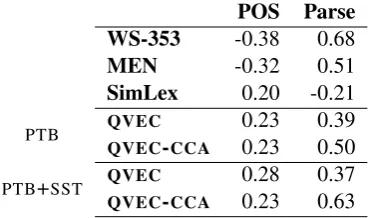
In table 4, we evaluate QVEC and QVEC-CCA on syntactic benchmarks. We first use linguistic vectors with dimensions corresponding to part-of-speech tags (denoted as PTB). Then, we use lin-guistic vectors which are a concatenation of the semantic and syntactic matrices described in §3 for words that occur in both matrices; this setup is denoted asPTB+SST.
POS Parse WS-353 -0.38 0.68
MEN -0.32 0.51
SimLex 0.20 -0.21
PTB QVEC 0.23 0.39
QVEC-CCA 0.23 0.50
PTB+SST QVEC 0.28 0.37
QVEC-CCA 0.23 0.63
Table 4: Pearson’s correlations between word similarity/QVEC/QVEC-CCAscores and the down-stream syntactic tasks.
Although some word similarity tasks obtain high correlations with syntactic applications, these results are inconsistent, and vary from a high negative to a high positive correlation. Con-versely, QVEC and QVEC-CCA consistently ob-tain moderate-to-high positive correlations with the downstream tasks.
[image:3.595.316.517.156.239.2] [image:3.595.327.512.410.519.2]since the additional linguistic information is not relevant for approximating how well dimensions of word embeddings encode POS-related prop-erties. In the case of dependency parsing—the task which encodes not only syntactic, but also semantic information (e.g., captured by subject-verb-object relations)—supersenses introduce rel-evant linguistic signals that are not present in POS-annotated columns. Thus, appending supersense-annotated columns to the linguistic matrix im-proves correlation of QVEC-CCAwith the depen-dency parsing task.
5 Conclusion
We introduced QVEC-CCA—an approach to in-trinsic evaluation of word embeddings. We also showed that both QVEC and QVEC-CCA are not limited to semantic evaluation, but are general approaches, that can evaluate word vector con-tent with respect to desired linguistic proper-ties. Semantic and syntactic linguistic features that we use to construct linguistic dimension ma-trices are rather coarse, thus the proposed eval-uation can approximate a range of downstream tasks, but may not be sufficient to evaluate finer-grained features. In the future work we propose to exploit existing semantic, syntactic, morpho-logical, and typological resources (e.g., univer-sal dependencies treebank (Agi´c et al., 2015) and WALS (Dryer and Haspelmath, 2013)), and also multilingual resources (e.g., Danish supersenses (Martínez Alonso et al., 2015)) to construct bet-ter linguistic matrices, suited for evaluating vec-tors used in additional NLP tasks.
Acknowledgments
This work was supported by the National Science Foundation through award IIS-1526745. We thank Benjamin Wilson for helpful comments.
References
Željko Agi´c, Maria Jesus Aranzabe, Aitziber Atutxa, Cristina Bosco, Jinho Choi, Marie-Catherine de Marneffe, Timothy Dozat, Richárd Farkas, Jennifer Foster, Filip Ginter, Iakes Goenaga, Koldo Gojenola, Yoav Goldberg, Jan Hajiˇc, An-ders Trærup Johannsen, Jenna Kanerva, Juha Kuokkala, Veronika Laippala, Alessandro Lenci, Krister Lindén, Nikola Ljubeši´c, Teresa Lynn, Christopher Manning, Héctor Alonso Martínez, Ryan McDonald, Anna Missilä, Simonetta Monte-magni, Joakim Nivre, Hanna Nurmi, Petya
Osen-ova, Slav Petrov, Jussi Piitulainen, Barbara Plank, Prokopis Prokopidis, Sampo Pyysalo, Wolfgang Seeker, Mojgan Seraji, Natalia Silveira, Maria Simi, Kiril Simov, Aaron Smith, Reut Tsarfaty, Veronika Vincze, and Daniel Zeman. 2015. Universal de-pendencies 1.1. LINDAT/CLARIN digital library at Institute of Formal and Applied Linguistics, Charles University in Prague.
Mohit Bansal, Kevin Gimpel, and Karen Livescu. 2014. Tailoring continuous word representations for dependency parsing. InProc. of ACL.
Elia Bruni, Gemma Boleda, Marco Baroni, and Nam-Khanh Tran. 2012. Distributional semantics in tech-nicolor. InProc. of ACL.
Kenneth Ward Church and Patrick Hanks. 1990. Word association norms, mutual information, and lexicog-raphy.Computational Linguistics, 16(1):22–29. Matthew S. Dryer and Martin Haspelmath, editors.
2013. WALS Online. Max Planck Institute for Evo-lutionary Anthropology. http://wals.info/. Chris Dyer, Miguel Ballesteros, Wang Ling, Austin
Matthews, and Noah A. Smith. 2015. Transition-based dependency parsing with stack long short-term memory. InProc. of ACL.
Manaal Faruqui and Chris Dyer. 2014. Community evaluation and exchange of word vectors at word-vectors.org. InProc. of ACL (Demonstrations).
Manaal Faruqui, Jesse Dodge, Sujay Kumar Jauhar, Chris Dyer, Noah A. Smith, and Eduard Hovy. 2015. Retrofitting word vectors to semantic lexi-cons. InProc. of NAACL.
Christiane Fellbaum, editor. 1998. WordNet: an elec-tronic lexical database. MIT Press.
Lev Finkelstein, Evgeniy Gabrilovich, Yossi Matias, Ehud Rivlin, Zach Solan, Gadi Wolfman, and Ey-tan Ruppin. 2001. Placing search in context: the concept revisited. InProc. of WWW.
Jiang Guo, Wanxiang Che, Haifeng Wang, and Ting Liu. 2014. Revisiting embedding features for sim-ple semi-supervised learning. InProc. of EMNLP. David R Hardoon, Sandor Szedmak, and John
Shawe-Taylor. 2004. Canonical correlation analysis: An overview with application to learning methods.
Neural Computation, 16(12):2639–2664.
Felix Hill, Roi Reichart, and Anna Korhonen. 2014. SimLex-999: Evaluating semantic mod-els with (genuine) similarity estimation. CoRR, abs/1408.3456.
Angeliki Lazaridou, Eva Maria Vecchi, and Marco Baroni. 2013. Fish transporters and miracle homes: How compositional distributional semantics can help NP parsing. InProc. of EMNLP.
Wang Ling, Lin Chu-Cheng, Yulia Tsvetkov, Silvio Amir, Ramon Fermandez, Chris Dyer, Alan W Black, and Isabel Trancoso. 2015a. Not all con-texts are created equal: Better word representations with variable attention. InProc. of EMNLP. Wang Ling, Chris Dyer, Alan Black, and Isabel
Tran-coso. 2015b. Two/too simple adaptations of
word2vec for syntax problems. In Proc. of NAACL.
Mitchell P Marcus, Mary Ann Marcinkiewicz, and Beatrice Santorini. 1993. Building a large anno-tated corpus of English: The penn treebank. Com-putational Linguistics, 19(2):313–330.
Héctor Martínez Alonso, Anders Johannsen, Sussi Olsen, Sanni Nimb, Nicolai Hartvig Sørensen, Anna Braasch, Anders Søgaard, and Bolette Sandford Pedersen. 2015. Supersense tagging for Danish. In
Proc. of NODALIDA, page 21.
Tomas Mikolov, Kai Chen, Greg Corrado, and Jeffrey Dean. 2013. Efficient estimation of word represen-tations in vector space. InProc. of ICLR.
George A. Miller, Claudia Leacock, Randee Tengi, and Ross T. Bunker. 1993. A semantic concordance. In
Proc. of HLT, pages 303–308.
Jeffrey Pennington, Richard Socher, and Christo-pher D. Manning. 2014. GloVe: Global vectors for word representation. InProc. of EMNLP.
Richard Socher, Alex Perelygin, Jean Wu, Jason Chuang, Christopher D. Manning, Andrew Y. Ng, and Christopher Potts. 2013. Recursive deep mod-els for semantic compositionality over a sentiment treebank. InProc. of EMNLP.
Christian Szegedy, Wojciech Zaremba, Ilya Sutskever, Joan Bruna, Dumitru Erhan, Ian Goodfellow, and Rob Fergus. 2014. Intriguing properties of neural networks. InProc. of ICLR.
Yulia Tsvetkov, Leonid Boytsov, Anatole Gershman, Eric Nyberg, and Chris Dyer. 2014. Metaphor de-tection with cross-lingual model transfer. InProc. of ACL, pages 248–258.
Yulia Tsvetkov, Manaal Faruqui, Wang Ling, Guil-laume Lample, and Chris Dyer. 2015. Evaluation of word vector representations by subspace alignment. InProc. of EMNLP, pages 2049–2054.