1-[4-(3-Phenylalkyl)phenyl]-2-aminopropanes as 5-HT
2APartial Agonists
Cynthia S. Dowd,
†,#Katharine Herrick-Davis,
‡Christina Egan,
‡Ann DuPre,
‡Carol Smith,
‡Milt Teitler,
‡and
Richard A. Glennon*
,†Department of Medicinal Chemistry, School of Pharmacy, Virginia Commonwealth University, Richmond, Virginia 23298-0540, and Center for Neuropharmacology and Neuroscience, Albany Medical College, Albany, New York 12208
Received December 13, 1999
Phenylalkylamines such as 1-(4-bromo-2,5-dimethoxyphenyl)-2-aminopropane (DOB; 1a) and
its corresponding iodo derivative DOI (2) are commonly used 5-HT
2serotonin agonists. Previous
studies have established that the 2,5-dimethoxy substitution pattern found in these compounds
is optimal for high affinity at 5-HT
2Areceptors and that substituents at the 4-position can
modulate affinity over a wide range. We have previously shown, however, that when the
4-position is substituted with a 3-phenylpropyl substituent (i.e., 3), the compound binds with
an affinity comparable to that of 1a but that it possesses 5-HT
2Aantagonist character. The
present study examined the structure
-
affinity relationships of 3, and the results were very
much unexpected. That is, the 2,5-dimethoxy substitution pattern of 3 is not required for high
affinity. Either of the two methoxy groups can be removed without untoward effect on affinity,
and relocation of the methoxy substituents actually enhances affinity by as much as an order
of magnitude. None of the compounds displayed more than 20-fold selectivity for 5-HT
2Aover
5-HT
2Creceptors. In addition, several were demonstrated to act as 5-HT
2Apartial agonists. As
such, the results of this study suggest that the structure
-
affinity relationships of
phenyl-alkylamines as 5-HT
2Aligands now be reinvestigated in greater detail.
The 5-HT
2family of serotonin (5-HT) receptors has
been implicated in cardiovascular function,
thermoregu-lation, schizophrenia, depression, anxiety, and eating
disorders (reviewed in refs 1
-
3). Considerable literature
exists on the search for, and development of, novel
5-HT
2agents
s
in particular, of novel 5-HT
2antagonists
(reviewed in refs 3 and 4). Perhaps one reason there
has been less emphasis on 5-HT
2agonists is that agents
with demonstrated 5-HT
2agonist character have been
shown to be hallucinogenic in humans.
5Phenylalkyl-
aminessuchas1-(4-bromo-2,5-dimethoxyphenyl)-2-amino-propane (DOB; 1a) and
1-(2,5-dimethoxy-4-iodophenyl)-2-aminopropane (DOI; 2) represent well-established
5-HT
2receptor ligands, and [
3H]DOB and [
125I]DOI have
been introduced as radioligands to label 5-HT
2receptors.
Both DOB and DOI are considered 5-HT
2agonists,
2and
both are psychoactive in humans.
6The structure
-affinity relationships for the binding of these agents at
5-HT
2receptors have been investigated in some
de-tail.
2,7,8For example, it has been reported that the
presence of the 2,5-dimethoxy pattern is optimal for
5-HT
2binding, and that removal of either of the
meth-oxy groups of DOB results in a dramatic decrease in
affinity.
9During the course of our investigations with
phenyl-alkylamines, we prepared the 4-(3-phenylpropyl)
de-rivative 3.
7Compound 3 was found to bind at 5-HT
2A
receptors with high affinity (K
i)
10 nM) and with an
affinity comparable to that of R(
-
)DOB (K
i)
24 nM).
7,10Interestingly however, unlike DOB, compound 3 was
found to act as a 5-HT
2Aantagonist in a
phospho-inositide hydrolysis assay.
10As such, compound 3
represented the first example of a DOB-like
phenyl-alkylamine with 5-HT
2antagonist character. It has been
proposed that although 5-HT
2Aagonists and antagonists
might share a common amine binding site (i.e., an
aspartate moiety in transmembrane helix III), they
otherwise appear to utilize different receptor binding
features (reviewed in ref 11). The possibility exists, then,
that 3 binds at 5-HT
2Areceptors in a somewhat different
fashion than DOB (1a). If such is the case, the structure
-affinity requirements of 3 might be different than those
of DOB. This prompted the present investigation. The
purpose of this study, then, was to examine the
struc-ture
-
affinity requirements for the binding of 3-type
compounds at 5-HT
2Areceptors. Because few compounds
display selectivity for 5-HT
2Aversus 5-HT
2Creceptors,
5-HT
2Cbinding data were also obtained.
Chemistry
Compound 3 was prepared as previously reported.
7Compounds 4
-
6 (Scheme 1) were prepared in a similar
* Address correspondence to Dr. Richard A. Glennon, Department of Medicinal Chemistry, School of Pharmacy, Box 980540, Virginia Commonwealth University, Richmond, VA 23298-0540. Phone: 804-828-8487. Fax: 804-828-7404. E-mail: [email protected].
†Virginia Commonwealth University. ‡Albany Medical College.
#Present address: School of Medicine, University of Pennsylvania, Philadelphia, PA 19104-6100.
3074 J. Med. Chem. 2000, 43, 3074 3084
manner. That is, beginning with the
N-trifluoroacetyl-protected phenylalkylamines 28 and 29, Friedel
-
Crafts
acylation provided the 4-acyl analogues 30
-
32.
Acyla-tions of this type have been shown to occurs exclusively
at the 4-position.
12Catalytic reduction of the ketone and
subsequent deprotection afforded compounds 4
-
6.
Com-pounds 7 and 8 were prepared in a somewhat different
manner (Scheme 1). The phenylalkylamines 28 and 29
were iodinated to give 36 and 37, respectively. We have
previously reported the synthesis of 37.
13The iodo
derivatives were reacted with 4-(phenyl)butyn-1-yl
cu-prate to give the corresponding alkynes 38 and 39,
which were then catalytically reduced to 40 and 41,
respectively. Deprotection afforded compounds 7 and 8.
Compounds 9 and 10, chloro and methoxy analogues of
3, were obtained using a reaction similar to that used
for the preparation of 4 except that a Wolff
-
Kishner
reduction was used to reduce the intermediate ketone
leading to 9.
Compounds 12, 13, 17, and 18 were prepared via a
common route (Scheme 2) employing a Suzuki-type
reaction
14with the appropriately substituted triflates
(i.e., 42, 47, or 50) as starting material. Reaction of the
triflates with 9-(3-phenylpropyl)-9-BBN (45) and 1,1
′
-bis(diphenylphosphinoferrocene)Pd afforded
phenylpro-pylbenzaldehydes 43, 48, and 51. The benzaldehyde
derivatives were converted to their nitrostyrenes and
reduced with LiAlH
4to the required amines. Compound
14 was obtained by introduction of a 3-(3-phenylpropyl)
group to 1,2-dimethoxybenzene, followed by formylation
and elaboration to the amine as described above. In
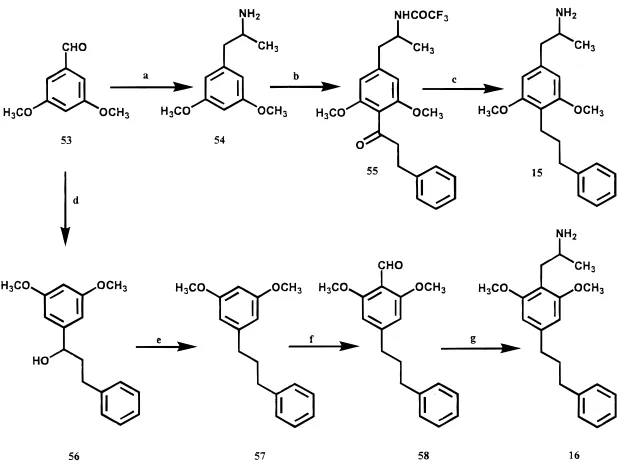
contrast, compound 15 was prepared directly from the
preformed phenylisopropylamine 54 by an acylation
-reduction reaction (Scheme 3). Compound 54 was
obtained from 3,5-dimethoxybenzaldehyde (53) via a
literature procedure.
15Compound 53 was also used to
obtain the phenylpropyl derivative 57 which was
sub-sequently formylated and elaborated to the desired
amine 16 (Scheme 3).
Scheme 1a
aReagents and conditions: (a) phenylacetyl chloride or hydrocinnamoyl chloride, TiCl
4, CH2Cl2; (b) H2, 10% Pd/C, HOAc, 70% HClO4,
(c) 15% NaOH, MeOH; (d) ICl, NaI, HOAc, NaOH; (e) 4-(phenyl)butyn-1-yl cuprate, pyridine; (f) H2, 10% Pd/C, MeOH; (g) 15% NaOH,
MeOH.
Scheme 2a
aReagents and conditions: (a) 45, 1,1′ -bis(diphenylphosphino-ferrocene)Pd, THF, NaOH; (b) CH3NO2or C2H5NO2, NH4OAc,∆;
Results and Discussion
5-HT
2AReceptor Binding. The study began by
examining the role of chain length and the necessity of
the
R
-methyl group on the 5-HT
2Aaffinity of 3 (K
i)
30
nM) (Table 1). Shortening the propyl chain to an ethyl
chain (i.e., 5) reduced affinity by about 3-fold whereas
lengthening the chain to a n-butyl group (i.e., 8)
enhanced affinity by about the same amount. The
R
-methyl substituent seems to have a different effect
depending upon chain length. That is, demethylation
of 5 (i.e., 4) resulted in a 3-fold increase in affinity,
whereas demethylation of 3 (i.e., 6) and demethylation
of 8 (i.e., 7) decreased affinity by nearly 5-fold and
15-fold, respectively. Because the longer chain compound
8 displayed slightly higher affinity than 3, it was
thought that adding some lipophilic character to 3 in
the form of a lipophilic chloro group (i.e., compound 9)
might enhance affinity whereas introduction of a
meth-oxy group (i.e., compound 10) might have no effect.
These compounds would additionally assist in exploring
the influence of varied electronic character of the
terminal phenyl ring on 5-HT
2binding. Both 9 (K
i)
12
nM) and 10 (K
i)
28 nM) were found to bind with an
affinity comparable to that of 3. All of the changes
shown in Table 1 had minimal effect on 5-HT
2Areceptor
affinity.
Of major interest was the role of the 2,5-dimethoxy
groups of 3 on 5-HT
2Aaffinity because this substitution
pattern is generally considered optimal for high affinity.
Interestingly, removal of either the 5-methoxy group
(i.e., 12; K
i)
8 nM) or removal of the 2-methoxy group
(i.e., 13; K
i)
17 nM) resulted in retention of affinity
(Table 2). Even relocation of the two methoxy groups to
the 2,3-, 3,5-, and 2,6-positions (i.e., compounds 14
-
16;
Ki
)
4 nM, 4 nM, and 3 nM, respectively) was tolerated.
In fact, the latter three compounds displayed
ap-proximately 10-fold higher affinity than 3 itself.
Fur-thermore, removal of the two methoxy groups (i.e., 17;
Ki
)
78 nM) only halved affinity, whereas the
des-methoxy analogue of 6 (i.e., 18; K
i)
60 nM) displayed
twice the affinity of its parent (6, K
i)
150 nM).
Apparently, the presence and location of the methoxy
groups are not as important for the binding of 3 as they
appear to be for DOB (1a)-type compounds.
Because most of the structure
-
affinity relationships
for DOB-type compounds were originally formulated a
decade ago on the basis of rat brain-homogenate binding
data, and because the present investigation employed
cloned 5-HT
2Areceptors, the affinities of some known
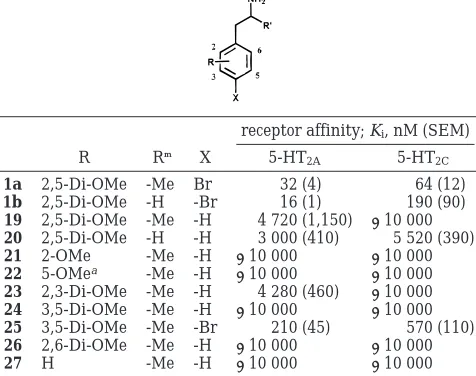
DOB analogues were reinvestigated. Table 3 shows that
DOB (1a; K
i)
32 nM) binds with high affinity at these
5-HT
2Areceptors and that removal of the
R
-methyl
group (i.e., 1b; K
i)
16 nM) has little effect on affinity.
Removal of the 4-bromo group of 1a and 1b, as in 19
and 20, reduces affinity by about 150- to 200-fold,
Scheme 3a
aReagents and conditions: (a) i. C
2H5NO2, NH4OAc,∆; ii. LiAlH4, THF,∆; (b) i. (CF3CO)2O, CH2Cl2; ii. hydrocinnamoyl chloride,
TiCl4, CH2Cl2; (c) i. H2, 10% Pd/C, 70% HClO4, HOAc; ii. 15% NaOH, MeOH; (d) Mg, PhCH2CH2Br, Et2O; (e) TMSCl, MeCN, NaI, Et2O;
[image:3.612.152.461.60.292.2](f) nBuLi, DMF, THF; (g) i. C2H5NO2, NH4OAc,∆; ii. LiAlH4, THF,∆.
Table 1. 5-HT2Aand 5-HT2CSerotonin Receptor Binding Data
for Derivatives of 3
receptor affinity; Ki, nM (SEM)
n R Z 5-HT2A 5-HT2C
5-HT2A
selectivitya
4 2 -H -H 37 (3) 76 (6) 2.0
5 2 -Me -H 95 (5) 140 (20) 1.5
6 3 -H -H 150 (15) 28 (2) 0.2
3 3 -Me -H 30 (3) 50 (1) 1.7
7 4 -H -H 115 (45) 25 (6) 0.2
8 4 -Me -H 8 (1) 6 (1) 0.8
9 3 -Me -Cl 12 (3) 16 (1) 1.3
10 3 -Me -OMe 28 (3) 24 (1) 0.9
aSelectivity represented by 5-HT
respectively. Removal of either of the methoxy groups
reduces the affinity of 19; that is, the two individual
monomethoxy derivatives (i.e., 21 and 22) lack affinity
for 5-HT
2Areceptors. Relocation of the 2,5-dimethoxy
groups to the 3,5- or 2,6-positions (i.e., 24, 26; K
i>
10 000 nM), and removal of both methoxy groups (i.e.,
27; K
i>
10 000 nM), essentially abolishes affinity. We
previously reported that 27 binds with a K
i)
43 000
nM.
9Reincorporation of a 4-bromo group (i.e., 25)
enhances the affinity of 24. In general, these results are
qualitatively similar to what we have previously
re-ported: (a) monomethoxy phenylalkylamine derivatives
lack affinity, (b) dimethoxy derivatives lack affinity or
bind only with low affinity, and (c) substitution at the
4-position of 2,5-dimethoxy derivatives modulates
af-finity.
2,7What is remarkable about the present results
is the influence of the 4-(3-phenylpropyl) group on
5-HT
2Aaffinity. Incorporation of this group enhances
the affinity of the monomethoxy-, dimethoxy-, and even
the unsubstituted phenylalkylamines. In particular,
each of the following conversions enhances affinity by
more than 1000-fold: 21
f
12 (1,250-fold), 23
f
14
(1070-fold), 24
f
15 (2500-fold), and 26
f
16 (
>
3000-fold). For the 4-(3-phenylpropyl) series, 2,5-dimethoxy
substitution cannot be considered optimal. Monomethoxy
derivative 12, and dimethoxy derivatives 14
-
16, bind
with K
ivalues of
<
10 nM. Even the nonmethoxy
analogues 17 and 18 bind with affinities not much less
than that of 3.
5-HT
2CReceptor Binding. For those compounds
examined in the present study, the structure
-
affinity
requirements for 5-HT
2Cbinding are not very different
from those for 5-HT
2Abinding. Consequently, none of
the compounds displayed dramatic selectivity for one
population over the other. Compound 3 binds at 5-HT
2Creceptors with high affinity (K
i)
50 nM) and with
<
2-fold selectivity for 5-HT
2Areceptors (Table 1).
Shorten-ing the propyl chain by a sShorten-ingle methylene group (i.e.,
5) decreases affinity by about 3-fold, whereas
lengthen-ing the chain by a methylene group (i.e., 8) enhances
affinity by about 8-fold. Removal of the
R
-methyl group
has relatively little effect on 5-HT
2Caffinity. The only
change that seems to have less effect on 5-HT
2Cbinding
than on 5-HT
2Abinding is the influence of the methoxy
groups. For example, although removal of one of the
methoxy groups of 3 has little effect on 5-HT
2Caffinity,
relocation of the 2,5-methoxy groups to the 2,3-, 3,5-,
or 2,6-positions does not show the affinity-enhancing
effect that it did at 5-HT
2Areceptors. Consequently,
compounds 14
-
16 display about 10- to 20-fold
selectiv-ity for 5-HT
2Areceptors. Nevertheless, selectivity is not
remarkable.
PI Hydrolysis. Several compounds were examined
for their 5-HT
2Afunctional activity in a PI hydrolysis
assay, and all showed agonist actions. Compounds
examined (followed by apparent intrinsic activity)
in-clude the following: 3 (0.71
(
0.08), 12 (0.63
(
0.04),
[image:4.612.54.294.69.267.2]13 (0.90
(
0.02), 15 (1.09
(
0.02), and 17 (0.48
(
0.08).
That is, these compounds behaved either as partial or
full agonists relative to 5-HT. Because we had
previ-ously demonstrated that 3 can act as an antagonist, this
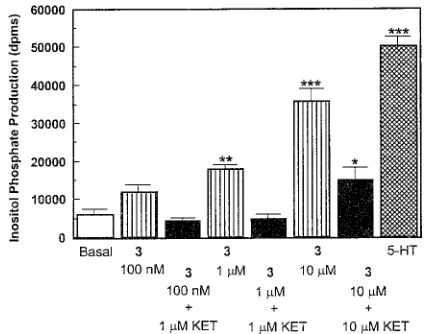
effect was examined in greater detail. Several
concen-trations of 3 were examined (Figure 1); 100 nM 3 was
without significant agonist activity, and even 1
µ
M 3
produced only about 25% of the maximal 5-HT effect.
However, at a concentration of 10
µ
M, 3 produced 71%
of the maximal agonist effect. It would appear, then,
that 3 is a 5-HT
2Apartial agonist. However, 10
µ
M 3
plus 10
µ
M ketanserin (a 5-HT
2antagonist that reduces
the effect of 10
µ
M 5-HT to basal levels; data not shown),
still produced 30% of the maximal possible effect (Figure
1). These results suggest that 3 is producing its effect
by a combination of a 5-HT
2mechanism plus some other
ketanserin-insensitive mechanism. Because 15
ap-peared to be a full agonist, it too was examined in the
absence and presence of ketanserin (Figure 2). At first
glance, it would seem that 15 is a full agonist; that is,
10
µ
M 15 produced an effect comparable to that
pro-duced by 10
µ
M 5-HT. However, 10
µ
M 15 plus 10
µ
M
ketanserin produced 43% of the maximal possible effect.
Table 2. 5-HT2Aand 5-HT2CSerotonin Receptor Binding Data
for Methoxy-Modified Derivatives of 3
receptor affinity; Ki, nM (SEM)
R R′ 5-HT2A 5-HT2C
5-HT2A
selectivitya
3 2,5-Di-OMe -Me 30 (3) 50 (1) 1.7
12 2-OMe -Me 8 (1) 89 (1) 11.1
13 5-OMeb -Me 17 (1) 135 (6) 7.9 14 2,3-Di-OMe -Me 4 (1) 79 (8) 19.8 15 3,5-Di-OMe -Me 4 (1) 40 (2) 10.0 16 2,6-Di-OMe -Me 3 (1) 39 (2) 13.0 17 H -Me 78 (6) 530 (19) 6.8 18 H -H 60 (6) 525 (65) 8.9
aSelectivity represented by 5-HT
2CKivalue/5-HT2AKivalue.
bThe 5-methoxy derivative actually represents the 3-methoxy-substituted compound; the present terminology is used for ease of discussion.
Table 3. 5-HT2Aand 5-HT2CSerotonin Receptor Binding Data
for Simple Monomethoxy, Dimethoxy, and Nonmethoxy Phenylalkylamine Analogues
receptor affinity; Ki, nM (SEM)
R R′ X 5-HT2A 5-HT2C
1a 2,5-Di-OMe -Me Br 32 (4) 64 (12) 1b 2,5-Di-OMe -H -Br 16 (1) 190 (90) 19 2,5-Di-OMe -Me -H 4 720 (1,150) >10 000 20 2,5-Di-OMe -H -H 3 000 (410) 5 520 (390) 21 2-OMe -Me -H >10 000 >10 000 22 5-OMea -Me -H >10 000 >10 000 23 2,3-Di-OMe -Me -H 4 280 (460) >10 000 24 3,5-Di-OMe -Me -H >10 000 >10 000 25 3,5-Di-OMe -Me -Br 210 (45) 570 (110) 26 2,6-Di-OMe -Me -H >10 000 >10 000 27 H -Me -H >10 000 >10 000
[image:4.612.55.293.348.536.2]Like 3, 15 seems to be producing its agonist effects via
more than one mechanism. Compounds 3 and 15 might
best be classified as partial agonists in this assay.
Summary. Although 2,5-dimethoxy substitution is
common to DOB (1a) and DOI-type 5-HT
2agonists and
is thought to be an important factor for high affinity,
the present study provides the first evidence that this
dimethoxy pattern is not required for binding at this
receptor population.
1-[2,5-Dimethoxy-4-(3-phenylpro-pyl)phenyl]-2-aminopropane (3; K
i)
30 nM) binds at
5-HT
2Areceptors with an affinity comparable to that of
DOB (K
i)
32 nM). However, unlike what is seen with
DOB,
9removal of either one of the two methoxy groups
has little effect on 5-HT
2Aaffinity. In fact, removal of
either of the two methoxy groups actually enhances
affinity. In addition, the location of these methoxy
groups is seemingly unimportant for binding. That is,
the 2,3-, 3,5-, and 2,6-dimethoxy analogues of 3 bind
with up to 10 times the affinity of 3. Even removal of
both methoxy groups has little effect on affinity.
Ster-eochemistry (i.e., optical isomerism and regioisomerism)
may play a role in the binding of some of these
compounds; although this remains to be investigated in
detail, it is unlikely that stereochemical differences by
themselves can account for the observed variation in
5-HT
2Aaffinity. None of the investigated compounds
displayed
>
20-fold selectivity for 5-HT
2Aversus 5-HT
2Creceptors. Several of the compounds were examined in
a 5-HT
2API hydrolysis assay and were found to behave
as partial agonists. It now can be concluded that when
a 4-(3-phenylpropyl) substituent is present, the resulting
phenylalkylamine derivatives defy currently established
DOB-like structure
-
affinity relationships for 5-HT
2Abinding. The same may be true of certain other
4-alkyl-or 4-(arylalkyl)-substituted derivatives, but this remains
to be determined. In retrospect, because the presence
of 2,5-dimethoxy substitution now has been
demon-strated to result in compounds that retain 5-HT
2agonist
character, the structure
-
activity relationships of
phen-ylalkylamines require reinvestigation.
Experimental Section
A. Synthesis. Melting points were determined with a Thomas-Hoover melting point apparatus and are uncorrected. Proton magnetic resonance (1H NMR) spectra were obtained with a Varian Gemini 300 spectrometer, using tetramethyl-silane as an internal standard. Infrared spectra were recorded on a Nicolet 5ZDX FT-infrared spectrometer. Elemental analysis was performed by Atlantic Microlab, Inc., and deter-mined values are within 0.4% of theory. Unless otherwise stated, amine salts were obtained and purified by the following standard methods: (a) hydrochlorides: by the dropwise ad-dition of a saturated, anhydrous solution of ethereal HCl into a cold solution of the free base in anhydrous ether until addition of ethereal HCl did not produce further precipitate; (b) oxalates: by the dropwise addition of a solution of an excess of oxalic acid in anhydrous ether into a cold solution of the free base in anhydrous ether. Addition was terminated when oxalic acid failed to produce more precipitate. Thin-layer chromatography (TLC) was performed using silica gel-coated GHIF plates (250µm, 2.5 ×10 cm, Analtech, Inc., Newark, DE). Dry THF was obtained by distillation over sodium metal and benzophenone. Dry CH2Cl2was obtained by distillation over phosphorus pentoxide (P2O5). Most compounds shown in Table 3 were available from previous studies or were resyn-thesized using methods we had reported earlier and, with the exception of 27 sulfate, were used as their HCl salts.
2-[2,5-Dimethoxy-4-(2-phenylethyl)phenyl]-1-amino-ethane HCl (4). A solution of 33 (0.18 g, 0.47 mmol) in MeOH (15 mL) and 15% NaOH (15 mL) was heated at reflux for 2 h. The MeOH was removed under reduced pressure, and the basic solution was cooled to room temperature and extracted with Et2O (3 × 30 mL). The ethereal solution was dried (MgSO4) and evaporated under reduced pressure. The HCl salt was formed and recrystallized from 2-PrOH to give 0.07 g (46%) of 4 as a white powder; mp 197-198 °C. 1H NMR (D2O): δ2.86-2.89 (m, 6H, CH2), 3.13 (t, 2H, CH2), 3.66 (s, 3H, OCH3), 3.69 (s, 3H, OCH3), 6.72 (s, 1H, Ar-H), 6.85 (s, 1H, Ar-H), 7.14-7.28 (m, 5H, Ar-H); IR (KBr pellet): 2962 (NH+) cm-1. Anal. Calcd. for (C
18H24ClNO2) C, H, N.
(( )1-[2,5-Dimethoxy-4-(2-phenylethyl)phenyl]-2-amino-propane HCl (5). Compound 5 was prepared in 47% overall yield from 35 in the same manner used for the preparation of 4. The HCl salt was recrystallized from 2-PrOH to give 0.10 g of 5; mp 165-167 °C.1H NMR (D
2O): δ 1.20 (d, 3H, CH3), 2.79-2.84 (m, 6H, CH2), 3.50-3.57 (m, 1H, CH), 3.64 (s, 3H, OCH3), 3.68 (s, 3H, OCH3), 6.70 (s, 1H, Ar-H), 6.81 (s, 1H, Ar-H), 7.12-7.24 (m, 5H, Ar-H); IR (KBr pellet): 2892 (NH+) cm-1. Anal. Calcd. for (C
19H26ClNO2) C, H, N.
[image:5.612.67.279.47.214.2]2-[2,5-Dimethoxy-4-(3-phenylpropyl)phenyl]-1-amino-ethane HCl (6). Compound 6 was prepared from 34 in the same manner used for the synthesis of 4. The HCl salt was recrystallized from 2-PrOH to give 0.08 g (45%) of the desired Figure 1. Effect ((SEM) of compound 3, alone and in
combination with the 5-HT2antagonist ketanserin (KET), on
PI turnover. Basal)basal level; 5-HT)10µM 5-HT. The response to 5-HT was completely blocked by 10µM ketanserin (data not shown). *p<0.05; **p<0.01; ***p<0.001 relative to Basal (Student’s t-test).
Figure 2. Effect ((SEM) of compound 15, alone and in combination with the 5-HT2antagonist ketanserin (KET), on
[image:5.612.65.281.286.442.2]compound as a white powder; mp 155-156 °C. 1H NMR (D2O): δ1.80 (t, 2H, CH2), 2.52-2.61 (m, 4H, CH2CH2), 2.87 -2.88 (m, 2H, CH2), 3.13 (t, 2H, CH2), 3.71 (s, 3H, OCH3), 3.74 (s, 3H, OCH3), 6.81-6.85 (m, 2H, Ar-H), 7.15-7.29 (m, 5H, Ar-H); IR (KBr pellet): 2955 (NH+) cm-1. Anal. Calcd. for (C19H26ClNO2) C, H, N.
2-[2,5-Dimethoxy-4-(4-phenylbutyl)phenyl]-1-amino-ethane HCl (7). A solution of 40 (0.20 g, 0.49 mmol) in 15% NaOH (15 mL) and MeOH (10 mL) was heated at reflux for 2 h. The MeOH was removed under reduced pressure and the aqueous solution was extracted with Et2O (4×50 mL). The ethereal solution was dried (MgSO4), and solvent was removed under reduced pressure. The oil was dissolved in anhydrous Et2O and ethereal HCl was added to form the salt, which was recrystallized from 2-PrOH to give 0.08 g (47%) of 7 as a white powder; mp 172-174 °C.1H NMR (D
2O): δ1.30-1.45 (m, 4H, CH2CH2), 2.30-2.40 (m, 4H, CH2CH2), 2.79 (t, 2H, CH2), 3.04 (t, 2H, CH2), 3.48 (s, 3H, OCH3), 3.54 (s, 3H, OCH3), 6.48 (s, 1H, Ar-H), 6.72 (s, 1H, Ar-H), 6.91-7.03 (m, 5H, Ar-H); IR (KBr pellet): 2936 (NH+) cm-1. Anal. Calcd. for (C
20H28ClNO2) C, H, N.
(( )1-[2,5-Dimethoxy-4-(4-phenylbutyl)phenyl]-2-amino-propane HCl (8). Compound 8 was obtained from 41 in the same manner used for the synthesis of 7. The resulting crude solid material was recrystallized from absolute EtOH to give 0.40 g (18%) of the desired compound; mp 111-113 °C. 1H NMR (CDCl3): δ2.93 (t, 2H, CH2), 3.57 (t, 2H, CH2), 3.81 (s, 3H, OCH3), 3.88 (s, 3H, OCH3), 4.32 (s, 2H, CH2), 6.76 (s, 1H, Ar-H), 6.99 (bs, 1H, NH), 7.21-7.31 (m, 6H, Ar-H); IR (film): 3314 (NH), 1709 (CdO, amide), 1671 (CdO, ketone)
cm-1. Anal. Calcd. for (C
20H20F3NO4) C, H, N.
(( )1-[2,5-Dimethoxy-4-(3-(4-chloro)phenylpropyl)phen-yl]-2-aminopropane HCl (9). Compound 9 was prepared from 2913in a manner similar to that of compound 4, except that a Wolff-Kishner reduction was used to reduce the intermediate ketone. Acylation of 29 with 3-(4-chlorophenyl)-propionyl chloride afforded (( )N-trifluoroacetyl-1-[2,5-dimeth-oxy-4-(3-(4-chloro)phenylpropionyl)phenyl]-2-aminopropane in 68% yield; mp 160-163 °C after recrystallization from aqueous EtOH. This compound (1.16 g, 2.54 mmol) in diethylene glycol (10 mL) was added to a preheated (150 °C) solution of KOH (4.2 g) and 97% hydrazine (7.3 mL) in diethylene glycol (18 mL). The stirred mixture was heated at this temperature for 2 h; H2O (10 mL) and MeOH (10 mL) were added, and the reaction mixture was heated at reflux overnight. Once cool, the reaction mixture was extracted with CH2Cl2(3×50 mL); the organic solvent was removed under reduced pressure, and the oily product was purified by distillation (bp 90 °C, 0.05 mmHg) to give 0.52 g (59%) of the target compound as its free base. The product was converted to its HCl salt, 9; mp 164 -166 °C after recrystallization from an absolute EtOH/anhy-drous Et2O mixture.1H NMR (DMSO-d6): δ1.10 (d, 3H, CH3), 1.85 (m, 2H, CH2), 2.70 (m, 6H, CH2), 3.51 (m, 1H, CH), 3.70 (s, 6H, OCH3), 6.80 (s, 2H, ArH), 7.25 (m, 4H, ArH), 8.10 (bs, 3H, NH+); IR (KBr pellet): 2931 (NH+) cm-1. Anal. Calcd. for (C20H27Cl2NO2) C, H, N.
(( )1-[2,5-Dimethoxy-4-(3-(4-methoxy)phenylpropyl)-phenyl]-2-aminopropane HCl (10). Compound 10 was prepared from 2913in the same manner used for the synthesis of 4. Acylation of 29 with 3-(4-methoxyphenyl)propionyl chlo-ride afforded (( )N-trifluoroacetyl-1-[2,5-dimethoxy-4-(3-(4-methoxy)phenylpropionyl)phenyl]-2-aminopropane (11) in 16% yield after distillation; bp 105-110 °C (0.05 mmHg). Catalytic reduction of 11 and removal of the protecting group afforded an 85% yield of the target compound (free base) as a yellow oil. A sample was converted to the HCl salt; mp 158-160 °C after recrystallization from an absolute EtOH/anhydrous Et2O mixture.1H NMR (DMSO-d
6): δ1.35 (d, 3H, CH3), 1.85 (m, 2H, CH2), 2.60 (t, 4H, CH2), 2.95 (m, 2H, CH2), 3.65 (m, 1H, CH), 4.80 (s, 9H, OCH3), 6.60 (s, 1H, ArH), 6.70 (s, 1H, ArH), 6.82 (d, 2H, ArH), 7.10 (d, 2H, ArH), 8.30 (bs, 3H, NH+); IR (KBr pellet): 2935 (NH+) cm-1. Anal. Calcd. for (C
21H30ClNO3) C, H, N.
(( )1-[2-Methoxy-4-(3-phenylpropyl)phenyl]-2-amino-propane HCl (12). Compound 12 was prepared from 49 in the same manner as 18. The crude free amine was converted immediately to the HCl salt using ethereal HCl. The white solid was recrystallized from 2-PrOH to give 0.19 g (45%) of 12; mp 134-136 °C.1H NMR (D
2O): δ1.17 (d, 3H, CH3), 1.77 -1.85 (m, 2H, CH2), 2.47-2.53 (m, 4H, CH2, CH2), 2.79 (d, 2H, CH2), 3.49-3.55 (m, 1H, CH), 3.70 (s, 3H, OCH3), 6.69 (d, 1H, Ar-H), 6.75 (s, 1H, Ar-H), 7.02 (d, 1H, Ar-H), 7.10-7.25 (m, 5H, Ar-H); IR (KBr pellet): 2922 (NH+) cm-1. Anal. Calcd. for (C19H26ClNO) C, H, N.
(( )1-[3-Methoxy-4-(3-phenylpropyl)phenyl]-2-amino-propane HCl (13). Compound 13 was prepared from 52 using the same procedure used for the synthesis of 18. The HCl salt was obtained and recrystallized from 2-PrOH/anhydrous Et2O to give 0.17 g (23%) of 13; mp 107-109 °C.1H NMR (D
2O): δ 1.12 (d, 3H, CH3), 1.65 (quintet, 2H, CH2), 2.34-2.40 (m, 4H, CH2, CH2), 2.66 (dd, 1H, CH2), 2.89 (dd, 1H, CH2-b), 3.43 (m, 1H, CH), 3.60 (s, 3H, OCH3), 6.59 (d, 1H, Ar-H), 6.74 (s, 1H, Ar-H), 6.83 (d, 1H, Ar-H), 7.03 (m, 5H, Ar-H); IR (KBr pellet): 2939.6 (NH+) cm-1. Anal. Calcd. for (C
19H26ClNO) C, H, N.
(( )1-[2,3-Dimethoxy-4-(3-phenylpropyl)phenyl]-2-amino-propane Hemioxalate (14). At 0 °C and under N2, dry THF (5 mL) was added to LiAlH4(0.14 g, 3.67 mmol), followed by the addition of nitropropene 59 (0.29 g, 0.85 mmol) in dry THF (7 mL). The reaction mixture was heated at reflux for 1 h, then cooled to 0 °C. Excess LiAlH4was decomposed by the addition of H2O (0.2 mL), 10% NaOH (0.2 mL), and H2O (1 mL). The salts were removed by filtration, and the filtrate was diluted with Et2O (25 mL) and dried (MgSO4); removal of the solvents under reduced pressure gave a clear oil. Preparation of the HCl salt was unsuccessful. The oxalate salt was prepared and recrystallized from 2-PrOH to give 0.05 g (16%) of 14; mp 228 -230 °C.1H NMR (DMSO-d
6): δ1.01 (d, 3H, CH3), 1.77-1.88 (m, 2H, CH2), 2.53-2.72 (m, 6H, CH2, CH2, CH2), 3.13-3.21 (m, 1H, CH), 3.65 (bs, 3H, NH3+), 3.71 (s, 3H, OCH3), 3.75 (s, 3H, OCH3), 6.86-6.90 (m, 2H, Ar-H), 7.17-7.31 (m, 5H, Ar -H); IR (KBr pellet): 2946 (NH+) cm-1. Anal. Calcd. for (C
20H27 -NO2‚0.5C2H2O4) C, H, N.
(( )1-[3,5-Dimethoxy-4-(3-phenylpropyl)phenyl]-2-amino-propane HCl (15). A solution of 62 (0.43 g, 1.05 mmol) in MeOH (15 mL) and 15% NaOH (10 mL) was heated at reflux for 1 h. After cooling the reaction mixture to room temperature, MeOH was removed under reduced pressure. The aqueous solution was extracted with Et2O (3×50 mL), the organic portion was dried (MgSO4), and solvent was removed under reduced pressure to give an oil. The HCl salt was prepared and recrystallized from 2-PrOH to give 0.27 g (73%) of 15; mp 158-160 °C.1H NMR (D
2O): δ1.20 (d, 3H, CH3), 1.64-1.71 (m, 2H, CH2), 2.48-2.54 (m, 4H, CH2, CH2), 2.74 (dd, 1H, CH2), 2.87 (dd, 1H, CH2), 3.48-3.55 (m, 1H, CH), 3.67 (s, 6H, (OCH3)2), 6.50 (s, 2H, Ar-H), 7.08-7.20 (m, 5H, Ar-H); IR (KBr pellet): 2940 (NH+) cm-1. Anal. Calcd. for (C
20H28ClNO2) C, H, N.
(( )1-[2,6-Dimethoxy-4-(3-phenylpropyl)phenyl]-2-amino-propane HCl (16). At 0 °C under N2, dry THF (5 mL) was added to LiAlH4(0.21 g, 5.53 mmol), followed by the addition of nitropropene 64 (0.50 g, 1.46 mmol) in dry THF (8 mL). The reaction mixture was heated at reflux under N2for 1 h, then cooled to 0 °C (ice bath). Excess LiAlH4was decomposed by the addition of H2O (0.2 mL), 10% NaOH (0.2 mL), and H2O (1 mL). The reaction mixture was filtered and washed with Et2O (3×25 mL). The ethereal solution was dried (MgSO4) and concentrated under reduced pressure to give 0.41 g (90%) of a colorless oil. The HCl salt was prepared and recrystallized from 2-PrOH/anhydrous Et2O to give 0.26 g (51%) of 16 as a white powder; mp 160-162 °C.1H NMR (D
2O): δ1.16 (d, 3H, CH3), 1.65-1.75 (m, 2H, CH2), 2.33-2.41 (m, 4H, CH2, CH2), 2.80 (d, 2H, CH2), 3.42-3.49 (m, 1H, CH), 3.57 (s, 6H, [OCH3]2), 6.24 (s, 2H, Ar-H), 6.95-7.08 (m, 5H, Ar-H); IR (KBr pellet): 2936 (NH+) cm-1. Anal. Calcd. for (C
(()1-[4-(3-Phenylpropyl)phenyl]-2-aminopropane HCl (17). At 0 °C and under N2, 46 (1.50 g, 5.33 mmol) in dry THF (25 mL) was added in a dropwise manner to a suspension of LiAlH4(0.73 g, 19.24 mmol) in dry THF (25 mL). The reaction mixture was heated at reflux for 1 h then cooled to 0 °C (ice bath). Excess LiAlH4was decomposed by the dropwise addition of H2O (1 mL), 15% NaOH (1 mL), and H2O (3 mL). The reaction mixture was filtered, and the solids were washed with excess CH2Cl2. After drying (MgSO4), the organic portion was evaporated under reduced pressure to give 1.10 g (81%) of an oil. The HCl salt was prepared and recrystallized from 2-PrOH/ anhydrous Et2O to give 0.36 g (23%) of 17; mp 123-125 °C. 1H NMR (D
2O): δ1.14 (d, 3H, CH3), 1.67-1.77 (m, 2H, CH2), 2.38-2.47 (m, 4H, CH2, CH2), 2.72 (dd, 1H, CH2-a), 2.90 (dd, 1H, CH2), 3.41-3.48 (m, 1H, CH), 6.98-7.20 (m, 9H, Ar-H); IR (KBr pellet): 2939 (NH+) cm.-1Anal. Calcd. for (C
18H24 -ClN) C, H, N.
2-[4-(3-Phenylpropyl)phenyl]-1-aminoethane Hemifu-marate (18). A solution of 44 (0.55 g, 2.06 mmol) in dry THF (20 mL) was added in a dropwise manner to a stirred suspension of LiAlH4(0.30 g, 7.90 mmol) in THF (10 mL) at 0 °C under an N2atmosphere. The reaction mixture was heated at reflux for 1.5 h then cooled to 0 °C; excess LiAlH4was decomposed by the successive addition of H2O (0.4 mL), 15% NaOH (0.4 mL), and H2O (1 mL). The lithium salts were collected by filtration and washed with Et2O. The filtrate was dried (MgSO4) and evaporated under vacuum to afford a brown oil. Attempts to prepare the HCl, oxalate, or maleate salts failed. Preparation of the fumarate salt yielded a solid material which was recrystallized from 2-PrOH to give 0.14 g (19%) of 18; mp 179-181 °C.1H NMR (CD
3OD): δ1.76-1.81 (m, 2H, CH2), 2.47-2.52 (m, 4H, CH2, CH2), 2.78 (t, 2H, CH2), 3.01 (t, 2H, CH2) 6.54 (s, 1H, CH)(for 2 CH)of the fumarate)), 7.00 -7.18 (m, 9H, Ar-H); IR (KBr pellet): 2936 (NH+) cm-1. Anal. Calcd. for (C17H21N‚0.5C4H4O4) C, H, N.
(( )1-(4-Bromo-3,5-dimethoxyphenyl)-2-aminopro-pane HCl (25). At 0 °C, LiAlH4(0.07 g, 1.84 mmol) was added to AlCl3(0.10 g, 0.75 mmol) in anhydrous Et2O (2 mL) under an N2atmosphere. Nitropropene 65 (0.20 g, 0.66 mmol) in a dry THF (2 mL)/anhydrous Et2O (6 mL) solution was added to the alane mixture in a dropwise manner. The reaction mixture was heated at reflux under N2for 1 h and was then cooled over ice. Decomposition of the alane was accomplished by the addition of H2O (1 mL). Solids were removed by filtration and washed with Et2O. The combined ethereal solution was dried (MgSO4), and solvent was evaporated to give a colorless oil. The HCl salt was prepared by the addition of ethereal HCl solution to the oil in anhydrous Et2O. The salt was recrystallized from 2-PrOH/anhydrous Et2O to give a beige-colored powder (0.008 g, 4%); mp 222-224 °C (lit.16mp 221-222 °C).
N-Trifluoroacetyl-2-(2,5-dimethoxyphenyl)-1-amino-ethane (28). At 0 °C, trifluoroacetic anhydride (2.4 mL, 17.03 mmol) was added in a dropwise manner to the free base of 2-(2,5-dimethoxyphenyl)-1-aminoethane (1.26 g, 6.59 mmol) with stirring. The reaction mixture was poured onto crushed ice (50 g) and a white solid was formed. The solid was collected by filtration to give 1.77 g (92%) of the desired compound 28; mp 56-57 °C.1H NMR (CDCl
3): δ2.89 (t, 2H, CH2), 3.55 (t, 2H, CH2), 3.76 (s, 3H, OCH3), 3.82 (s, 3H, OCH3), 6.71-6.82 (m, 3H, Ar-H), 7.17 (bs, 1H, NH); IR (film): 3327 (NH), 1731 (CdO, carbonyl), 1715 (CdO, amide) cm-1.
N-Trifluoroacetyl-2-(2,5-dimethoxy-4-(phenylacetyl)-phenyl)-1-aminoethane (30). At-30 °C (dry ice/acetone) and under a nitrogen atmosphere, titanium(IV) chloride (2.6 mL, 23.71 mmol) was added in a dropwise manner to a stirred solution of 28 (1.60 g, 5.77 mmol) in dry CH2Cl2 (30 mL) followed by the addition of phenylacetyl chloride (1.0 mL, 7.56 mmol) in dry CH2Cl2 (20 mL). The reaction mixture was allowed to stir at-30 °C for 30 min and then warmed to room temperature where stirring continued under N2 for an ad-ditional 2 d. The reaction mixture was poured onto crushed ice (100 g) and placed in a refrigerator overnight. The layers were separated, and the aqueous portion was washed with
CH2Cl2(4 × 50 mL). The combined organic portions were extracted with H2O (3×30 mL), 5% HCl (3×30 mL), H2O (3 ×30 mL), saturated NaHCO3(3×30 mL), saturated NaCl (3 ×30 mL), and dried (MgSO4). Solvent was removed under reduced pressure, and the residual solid was recrystallized from absolute EtOH to give 0.40 g (18%) of the desired compound; mp 111-113 °C.1H NMR (CDCl
3): δ2.93 (t, 2H, CH2), 3.57 (t, 2H, CH2), 3.81 (s, 3H, OCH3), 3.88 (s, 3H, OCH3), 4.32 (s, 2H, CH2), 6.76 (s, 1H, Ar-H), 6.99 (bs, 1H, NH), 7.21 -7.31 (m, 6H, Ar-H); IR (film): 3314 (NH), 1709 (CdO, amide),
1671 (CdO, ketone) cm-1. Anal. Calcd. for (C20H20F3NO4) C, H, N.
N-Trifluoroacetyl-2-(2,5-dimethoxy-4-hydrocinnam-oylphenyl)-1-aminoethane (31). Compound 31 was pre-pared from 28 and hydrocinnamoyl chloride in the same manner used for the preparation of 30. The resulting crude solid (1.39 g) was recrystallized from absolute EtOH to give 0.41 g (31%) of the desired compound as an off-white crystal-line solid; mp 102-104 °C.1H NMR (CDCl
3): δ2.97 (t, 4H, CH2CH2), 3.32 (t, 2H, CH2), 3.59 (t, 2H, CH2), 3.85 (s, 6H, (OCH3)2), 6.76 (s, 1H, Ar-H), 7.00 (bs, 1H, NH), 7.23-7.30 (m, 6H, Ar-H); IR (film): 3333 (NH), 1715 (CdO, amide), 1665
(CdO, ketone) cm-1. Anal. Calcd. for (C21H22F3NO4) C, H, N.
(( )N-Trifluoroacetyl-1-[2,5-dimethoxy-4-(phenylacetyl)-phenyl]-2-aminopropane (32). Compound 32 was prepared from 2913and phenylacetyl chloride in the same manner used for the synthesis of 30. The resulting solid was recrystallized from absolute EtOH to give a 60% yield of the desired compound; mp 146-148 °C.1H NMR (CDCl
3): δ1.29 (d, 3H, CH3), 2.80-2.97 (m, 2H, CH2), 3.85 (s, 6H, (OCH3)2), 4.14 -4.17 (m, 1H, CH), 4.32 (s, 2H, CH2), 6.76 (s, 1H, Ar-H), 7.21 -7.31 (m, 7H, Ar-H, NH); IR (film): 3295 (NH), 1693 (CdO,
amide), 1673 (CdO, ketone) cm-1. Anal. Calcd. for (C21H22F3 -NO4) C, H, N.
N-Trifluoroacetyl-2-[2,5-dimethoxy-4-(2-phenylethyl)-phenyl]-1-aminoethane (33). A solution of 30 (0.30 g, 0.76 mmol) in HOAc (70 mL) and 70% HClO4 (0.3 mL) was hydrogenated over 10% Pd/C (0.15 g, 1.43 mmol) for 6 h at 60 psi. Catalyst was removed by filtration, and the reaction mixture was diluted with H2O (100 mL) and extracted with CH2Cl2(3×50 mL). The organic phase was extracted with H2O (3×30 mL), saturated NaHCO3(3×30 mL), and H2O (3 × 30 mL). The organic portion was dried (MgSO4) and solvent was removed under reduced pressure. The resulting solid was recrystallized from absolute EtOH to give 0.23 g (79%) of 33 as a white powder; mp 95-96 °C. 1H NMR (CDCl3): δ3.16-3.20 (m, 6H, CH2), 3.83 (t, 2H, CH2), 4.02 (s, 3H, OCH3), 4.07 (s, 3H, OCH3), 6.89 (s, 1H, Ar-H), 6.96 (s, 1H, Ar-H), 7.48-7.60 (m, 5H, Ar-H), 7.68 (bs, 1H, NH); IR (film): 3320 (NH), 1703 (CdO) cm-1. Anal. Calcd. for (C20H22F3 -NO3) C, H, N.
N-Trifluoroacetyl-2-[2,5-dimethoxy-4-(3-phenylpropyl)-phenyl]-1-aminoethane (34). Compound 34 was prepared from 31 in the same manner used for the synthesis of 33. The product was isolated as a yellow oil which solidified upon standing (0.89 g). The solid was purified by column chroma-tography using silica gel (grade 62, 60-200 mesh, 150 Å) (eluted, 5:1, hexanes/EtOAc) to give 0.25 g (43%) of 34; mp 95-98 °C.1H NMR (CDCl
3): δ1.89-1.94 (m, 2H, CH2), 2.62 -2.70 (m, 4H, CH2CH2), 2.87 (t, 2H, CH2), 3.56-3.58 (m, 2H, CH2), 3.77 (s, 3H, OCH3), 3.80 (s, 3H, OCH3), 6.63 (s, 1H, Ar -H), 6.69 (s, 1H, Ar-H), 7.18-7.31 (m, 6H, Ar-H, NH); IR (film): 3339 (NH), 1709 (CdO) cm-1. The product was used
in the preparation of 6 without further characterization. (( )N-Trifluoroacetyl-1-[2,5-dimethoxy-4-(2-phenyleth-yl)phenyl]-2-aminopropane (35). Compound 35 was pre-pared from 32 in the same manner used for the preparation of 33. The resulting white solid was recrystallized from absolute EtOH to give a 47% yield of the desired compound; mp 127-129 °C.1H NMR (CDCl
3314 (NH), 1703 (CdO) cm-1. Anal. Calcd. for (C21H24F3NO3) C, H, N.
N-Trifluoroacetyl-2-(2,5-dimethoxy-4-iodophenyl)-1-aminoethane (36). At room temperature, a solution of iodine monochloride (0.2 mL, 3.84 mmol) in HOAc (3 mL) was added to a solution of NaI (0.08 g, 0.52 mmol) in 0.1 N NaOH (0.3 mL) and HOAc (3 mL). After stirring the solution for 5 min, a solution of N-trifluoroacetyl-2-(2,5-dimethoxyphenyl)-1-amino-ethane (28) (0.75 g, 2.71 mmol) in HOAc (14 mL) was added to the reaction mixture. Stirring was allowed to continue overnight, and the reaction mixture was poured onto crushed ice (50 g). The gray solid was collected by filtration and washed with H2O (30 mL), 1% Na2S2O3/1% KI (50 mL), and H2O (30 mL), then recrystallized from absolute EtOH to give 0.63 g (58%) of the title compound as shiney, white crystals; mp 132 -134 °C (lit.17mp 137 °C).1H NMR (CDCl
3): δ2.88 (t, 2H, CH2), 3.55 (t, 2H, CH2), 3.81 (s, 3H, OCH3), 3.82 (s, 3H, OCH3), 6.63 (s, 1H, Ar-H), 6.92 (bs, 1H, NH), 7.27 (s, 1H, Ar-H); IR (film): 3327 (NH), 1703 (CdO) cm-1.
N-Trifluoroacetyl-2-[2,5-dimethoxy-4-(4-phenyl-1-bu-tynyl)phenyl]-1-aminoethane (38). N-Trifluoroacetyl-2-(2,5-dimethoxy-4-iodophenyl)-1-aminoethane (36) (0.55 g, 1.36 mmol) and 4-(phenyl)butyn-1-yl cuprate (0.46 g, 2.39 mmol) were dissolved in dry pyridine (12 mL), and the reaction mixture was heated no higher than 120 °C under a nitrogen atmosphere overnight. [Preparation of cuprate: At room temperature and under a nitrogen atmosphere, H2O (30 mL) was added to a solution of CuSO4 (1.78 g, 7.11 mmol) in ammonium hydroxide (7.5 mL), followed by the addition of hydroxylamine hydrochloride (0.99 g, 14.22 mmol). The reac-tion mixture was cooled on ice for 5 min, followed by the addition of a solution of 4-(phenyl)-1-butyne (1.0 mL, 7.11 mmol) in absolute EtOH (40 mL). The reaction mixture was allowed to stir at room temperature under a nitrogen atmo-sphere for 2 h. The yellow solid was collected by filtration, washed with H2O (30 mL), absolute EtOH (20 mL), and Et2O (20 mL), and dried under high vacuum to yield 1.10 g (80%) of the desired compound; mp 187-189 °C (decomp). The product was used in the preparation of 38 and 39 without further characterization.] The reaction mixture was allowed to cool to room temperature, diluted with H2O (50 mL), and extracted with Et2O (4×50 mL). The ethereal solution was dried (MgSO4) and evaporated under reduced pressure to give a crude solid which was purified by column chromatography using silica gel (grade 62, 60-200 mesh, 150 Å) (eluted, 5:1, hexanes/EtOAc) to give a solid (0.47 g). Recrystallization from absolute EtOH gave 0.36 g (65%) of 38; mp 93-95 °C.1H NMR (CDCl3): δ 2.77 (t, 2H, CH2), 2.74-2.99 (m, 4H, CH2CH2), 3.53-3.59 (m, 2H, CH2), 3.81 (s, 3H, OCH3), 3.83 (s, 3H, OCH3), 6.65 (s, 1H, Ar-H), 6.87 (s, 1H, Ar-H), 6.98 (bs, 1H, NH), 7.27-7.32 (m, 5H, Ar-H); IR (film): 3320 (NH), 2351 (C∞C), 1734 (CdO) cm-1. Anal. Calcd. for (C22H22F3NO3) C, H, N.
(( )N-Trifluoroacetyl-1-[2,5-dimethoxy-4-(4-phenyl-1-butynyl)phenyl]-2-aminopropane (39). 4-(Phenyl)butyn-1-yl cuprate (see write-up for compound 38) (0.57 g, 2.95 mmol) was added to a solution of N-trifluoroacetyl-1-(2,5-dimethoxy-4-iodophenyl)-2-aminopropane (37)13(0.60 g, 14.38 mmol) in dry pyridine (14 mL) and heated overnight under N2on an oil bath no higher than 120 °C. The reaction mixture was cooled to room temperature and extracted between H2O and Et2O. The ethereal portion was dried (MgSO4) and evaporated under reduced pressure to give a brown oil. The oil was purified twice by column chromatography using silica gel (grade 62, 60-200 mesh, 150 Å) (eluted, 5:1, hexanes/EtOAc) and the resulting solid was recrystallized from EtOAc/hexanes to give 0.30 g (50%) of the desired compound as white cottony crystals; mp 146-147 °C.1H NMR (CDCl
3): δ1.27 (d, 3H, CH3), 2.74-2.88 (m, 4H, CH2CH2), 2.95-3.00 (m, 2H, CH2), 3.82 (s, 3H, OCH3), 3.84 (s, 3H, OCH3), 4.09-4.18 (m, 1H, CH), 6.64 (s, 1H, Ar -H), 6.88, (s, 1H, Ar-H), 7.26-7.33 (m, 6H, Ar-H, NH); IR (film): 2359 (CtC), 1694 (CdO) cm-1. The product was used
in the preparation of 41 without further characterization.
N-Trifluoracetyl-2-[2,5-dimethoxy-4-(4-phenylbutyl)-phenyl]-1-aminoethane (40). A solution of 38 (0.35 g, 0.86
mmol) in MeOH (50 mL) was hydrogenated over 10% Pd/C (0.15 g, 1.43 mmol) for 3 h at 40 psi. The reaction mixture was filtered, and the solvent was removed under reduced pressure to give a crude solid (0.43 g). The solid was purified by column chromatography using silica gel (grade 62, 60-200 mesh, 150 Å) (eluted, 5:1, hexanes/EtOAc) to yield 0.23 g (65%) of 40; mp 78-80 °C.1H NMR (CDCl
3): δ1.60-1.69 (m, 4H, CH2CH2), 2.59-2.67 (m, 4H, CH2CH2), 2.85-2.89 (m, 2H, CH2), 3.56 (t, 2H, CH2), 3.76 (s, 3H, OCH3), 3.78 (s, 3H, OCH3), 6.62 (s, 1H, Ar-H), 6.68 (s, 1H, Ar-H), 7.17-7.30 (m, 5H, Ar
-H); IR (film): 3308 (NH), 1709 (CdO) cm-1. Anal. Calcd. for
(C22H26F3NO3) C, H, N.
(( )N-Trifluoroacetyl-1-[2,5-dimethoxy-4-(4-phenylbu-tyl)phenyl]-2-aminopropane (41). Compound 41 was pre-pared from 39 in the same manner used for the preparation of 40 to give a white solid. The solid was purified by radial chromatography on a Chromatotron (TLC grade 7749) (eluted, 10:1, hexanes/EtOAc) and recrystallized from EtOAc/hexanes to give 0.13 g (46%) of 41; mp 119-121 °C.1H NMR (CDCl
3):
δ1.26 (d, 3H, J)7 Hz, CH3), 1.59-1.69 (m, 4H, CH2CH2), 2.59-2.65 (4H, CH2CH2), 2.76-2.84 (m, 2H, CH2), 3.76 (s, 3H, OCH3), 3.80 (s, 3H, OCH3), 4.05-4.14 (m, 1H, CH), 6.60 (s, 1H, Ar-H), 6.67 (s, 1H, Ar-H), 7.17-7.30 (m, 5H, Ar-H), 7.52 (bs, 1H, NH); IR (film): 1693 (CdO) cm-1. The product was
used in the preparation of 8 without further characterization. 4-(3-Phenylpropyl)benzaldehyde (43). Trifluoromethane-sulfonic anhydride (3.10 mL, 18.43 mmol) in CH2Cl2(10 mL) was added in a dropwise manner to a solution of 4-hydroxy-benzaldehyde (2.00 g, 16.38 mmol) in CH2Cl2(20 mL) and pyridine (5 mL) under N2at 0 °C. The reaction mixture was allowed to warm to room temperature where stirring continued for 20 min. Solvent was removed under reduced pressure, and the resulting residue was placed under high vacuum for 1 h. The residue was distilled using a Kugelrohr apparatus to give 2.56 g (61%) of a clear oil (42) at 0.06 mmHg (oven temp: 85 -90 °C).1H NMR (CDCl
3): δ7.48 (d, 2H, Ar-H), 8.02 (d, 2H, Ar-H), 10.06 (s, 1H, CHO); IR (film): 1709 (CdO) cm-1. Under
a nitrogen atmosphere, 9-phenylpropyl-9-BBN (45) (8.52 mmol) was added to a stirred solution of triflate 42 (2.00 g, 7.89 mmol), THF (34 mL), 3 M NaOH (7.7 mL), and 1,1′ -bis-(diphenylphosphinoferrocene)Pd (163 mg, 0.20 mmol). Upon addition, the reaction mixture turned from red to dark brown. The reaction mixture was heated at reflux for 1.5 h. After allowing the reaction mixture to cool to room temperature, the solvents were removed under reduced pressure. The dark residue was extracted between Et2O and H2O. The ethereal solution was dried (MgSO4) and evaporated under reduced pressure to give 43 as a brown oil. Kugelrohr distillation gave 1.67 g (94%) of a clear oil at 0.05 mmHg (oven temp.: 70-75 °C).1H NMR (CDCl
3): δ1.95-2.05 (m, 2H, CH2), 2.65-2.76 (m, 4H, CH2, CH2), 7.81 (d, 2H, Ar-H), 7.18-7.36 (m 7H, Ar -H), 9.98 (s, 1H, CHO); IR (film): 1703 (CdO) cm-1. The
product, 43, was used in the preparation of 44 and 46 without further characterization.
2-[4-(3-Phenylpropyl)phenyl]-1-nitroethene (44). A mix-ture of 4-(3-phenylpropyl)benzaldehyde (43) (1.00 g, 4.46 mmol) and ammonium acetate (0.30 g, 3.89 mmol) in nitromethane (25 mL) was heated at reflux under N2for 2.5 h. Solvent was removed under reduced pressure to give a yellow oil which crystallized upon standing. The solid was recrystallized from absolute EtOH to give 44 as yellow leaflets (0.59 g, 49%); mp 83-85 °C.1H NMR (CDCl
3): δ1.92-2.03 (m, 2H, CH2), 2.64 -2.72 (m, 4H, CH2, CH2), 7.17-7.32 (m, 7H, Ar-H), 7.47 (d, 2H, Ar-H), 7.58 (d, 1H, CH)), 8.00 (d, 1H, CH)); IR (film): 1494 (NdO) cm-1. The product was used without further
characterization in the synthesis of 18.
1-[4-(3-Phenylpropyl)phenyl]-2-nitropropene (46). A solution of 4-(3-phenylpropyl)benzaldehyde (43) (1.60 g, 7.13 mmol) and ammonium acetate (0.44 g, 5.71 mmol) in nitro-ethane (30 mL) was heated at reflux under N2for 3 h. After allowing the reaction mixture to cool to room temperature, the solvent was removed under reduced pressure, and the yellow residue was purified by column chromatography (silica gel, grade 62, mesh 60-120 Å) (eluted hexanes/EtOAc, 5:1) to give 1.59 g (79%) of 46.1H NMR (CDCl
3): δ1.96-2.04 (m, 2H, CH2), 2.47 (s, 3H, CH3), 2.65-2.73 (m, 4H, CH2, CH2), 7.18 -7.39 (m, 9H, Ar-H), 8.09 (s, 1H, CH)); IR (film): 1522 (Nd
O) cm-1. The product was used in the preparation of 17 without further characterization.
2-Methoxy-4-(trifluoromethanesulfonyl)benzalde-hyde (47). Compound 47 was prepared from 4-hydroxy-2-methoxybenzaldehyde in the same manner used for the preparation of 42. Purification by column chromatography (silica gel, grade 62, mesh 60-120 Å) (eluted hexanes/EtOAc, 5:1) gave 0.97 g (44%) of 47.1H NMR (CDCl
3): δ3.98 (s, 3H, OCH3), 6.91 (s, 1H, Ar-H), 6.96 (d, 1H, Ar-H), 7.93 (d, 1H, Ar-H), 10.43 (s, 1H, CHO); IR (film): 1681 (CdO) cm-1. The
product was used in the synthesis of 48 without further characterization.
2-Methoxy-4-(3-phenylpropyl)benzaldehyde (48). Com-pound 48 was prepared from 47 in the same manner used for the synthesis of 43 to give a crude product. Kugelrohr distillation gave a colorless oil (0.60 g, 84%) at 0.06 mmHg (oven temp.: 185-195 °C).1H NMR (CDCl
3): δ1.94-2.04 (m, 2H, CH2), 2.65-2.72 (m, 4H, CH2, CH2), 3.92 (s, 3H, OCH3), 6.77 (s, 1H, Ar-H), 6.86 (d, 1H, Ar-H), 7.21-7.33 (m, 5H, Ar-H), 7.76 (d, 1H, Ar-H), 10.41 (s, 1H, CHO); IR (film): 1681 (CdO) cm1. The product was used in the preparation of 49
without further characterization.
1-[2-Methoxy-4-(3-phenylpropyl)phenyl]-2-nitropro-pene (49). Compound 49 was prepared from 48 in the same manner as 44 to give a dark-yellow oil. Purification by column chromatography (silica gel, grade 62, mesh 60-120 Å) (eluted hexanes/EtOAc, 5:1) gave 0.43 g (61%) of 49 as a pale-yellow oil.1H NMR (CDCl
3): δ2.41 (s, 3H, CH3), 2.67-2.72 (m, 4H, CH2, CH2), 3.88 (s, 3H, OCH3), 6.76 (s, 1H, Ar-H), 6.85 (d, 1H, Ar-H), 7.20-7.31 (m, 6H, Ar-H), 8.31 (s, 1H, CH)); IR (film): 1525 (NdO) cm-1. The product was used in the
preparation of 12 without further characterization.
3-Methoxy-4-(trifluoromethanesulfonyl)benzalde-hyde (50). Compound 50 was prepared from 3-methoxy-4-hydroxybenzaldehyde in the same manner as compound 42 to afford a dark-colored solid material. The crude product was purified by Kugelrohr distillation to yield a colorless oil (1.51 g, 27%) which was homogeneous to thin-layer chromatography. 1H NMR (CDCl
3): δ 4.01 (s, 3H, OCH3), 7.41-7.58 (m, 3H, Ar-H), 9.99 (s, 1H, CHO); IR: 1706 (CdO) cm-1. The product
was used in the synthesis of 51 without further purification. 3-Methoxy-4-(3-phenylpropyl)benzaldehyde (51). This compound was prepared from 50 in the same manner as 43 to yield a dark oil. The oil was dissolved in a small amount of Et2O (5 mL) and combined with a saturated solution of NaHSO3 (50 mL). After 30 min of vigorous stirring, the mixture was extracted with Et2O (3×25 mL). The aqueous portion was made basic with 15% NaOH and re-extracted with Et2O (3×25 mL). The ether portion was dried (MgSO4), and the solvent was removed under reduced pressure to yield the product (0.56 g) as a clear oil. The solvent of the original ether portion was removed under reduced pressure. The resulting oil was purified by Kugelrohr distillation to give a colorless oil (0.73 g) at 0.04 mmHg (oven temp.: 170-180 °C). Total yield is 99%.1H NMR (CDCl
3): δ 1.66-1.97 (m, 2H, CH2), 2.65-2.75 (m, 4H, CH2, CH2), 3.88 (s, 3H, OCH3), 7.19-7.40 (m, 8H, Ar-H), 9.93 (s, 1H, CHO); IR (film): 1687 (CdO) cm-1.
The product was used in the synthesis of 52 without further purification.
1-[3-Methoxy-4-(3-phenylpropyl)phenyl]-2-nitropro-pene (52). Compound 52 was prepared from 51 using the same procedure employed in the synthesis of 44. The product was purified by column chromatography (silica gel, grade 62,
mesh 60-120 Å) (eluted hexanes/EtOAc, 5:1) to give 0.75 g (56%) of 52 as a yellow oil.1H NMR (CDCl
3): δ1.91-1.98 (m, 2H, CH2), 2.47 (s, 3H, CH3), 2.65-2.71 (m, 4H, CH2, CH2), 3.84 (s, 3H, OCH3), 6.86 (s, 1H, Ar-H), 6.98 (d, 1H, Ar-H), 7.18 -7.31 (m, 6H, Ar-H), 8.07 (s, 1H, CH)); IR (film): 1518 (Nd
O) cm-1. The product was used in the preparation of 13 without further characterization.
(( )N-Trifluoroacetyl-1-[3,5-dimethoxy-4-(1-oxo-3-phen-ylpropyl)phenyl]-2-aminopropane (55). At-30 °C (dry ice/ acetone) under N2, titanium(IV) chloride (1.20 mL, 10.94 mmol) was added in a dropwise manner to a stirred solution of the acetamide 63 (1.50 g, 5.15 mmol) in dry CH2Cl2(50 mL), followed by the addition of hydrocinnamoyl chloride (1.20 mL, 8.08 mmol) in dry CH2Cl2(40 mL). The reaction mixture was allowed to stir at-30 °C for 30 min and was then allowed to warm to room temperature where stirring continued for 2 d. The reaction mixture was poured over crushed ice (10 g) to hydrolyze any remaining acid chloride. The layers were separated, and the aqueous portion was washed with CH2Cl2 (3×50 mL). The combined CH2Cl2portions were successively washed with H2O (3×50 mL), 3 M HCl (3×50 mL), H2O (3 ×50 mL), saturated NaHCO3(3×50 mL), and saturated NaCl (3 × 50 mL). The organic portion was dried (MgSO4), and solvent was removed under reduced pressure to give a solid. Kugelrohr distillation removed impurities (0.09 mmHg, oven temp: 225 °C). The residual solid was recrystallized from absolute EtOH to give 1.11 g (51%) of ketone 55; mp 118-120 °C.1H NMR (CDCl
3): δ1.24 (d, 3H, CH3), 2.78 (dd, 1H, CH2), 2.89 (dd, 1H, CH2), 2.99-3.09 (m, 4H, CH2, CH2), 3.75 (s, 6H, (OCH3)2), 4.25-4.35 (m, 1H, CH), 6.10 (bs, 1H, NH), 6.32 (s, 2H, Ar-H), 7.18-7.27 (m, 5H, Ar-H); IR (film): 1720 (ketone CdO), 1702 (amide CdO) cm-1. The product was used without
further characterization in the synthesis of 62.
1-(3,5-Dimethoxyphenyl)-3-phenylpropane (57). Cleaned, oven-dried Mg turnings (1.19 g, 48.95 mmol) and a few crystals of iodine were placed in a three-neck round-bottom flask with anhydrous Et2O (5 mL). A small portion (5 mL) of a solution of 1-bromo-2-phenylethane (3.20 mL, 23.43 mmol) in anhy-drous Et2O (15 mL) was added, and the Grignard reaction began with the disappearance of the brown iodine color. The remainder of the bromo compound was added. After bubbling ceased, the reaction mixture was heated at reflux on an oil bath for 1 h, then allowed to cool to room temperature. At 0 °C and under N2, the Grignard reagent was added via syringe to a solution of 3,5-dimethoxybenzaldehyde (53) (3.00 g, 18.05 mmol) in anhydrous Et2O (12 mL). The reaction mixture was allowed to stir at 0 °C for 30 min, then at room temperature for 30 min, whereupon the reaction was quenched by the addition of 30% H2SO4(15 mL), and the mixture was extracted between H2O and Et2O. The ethereal portion was dried (MgSO4) and evaporated under reduced pressure to give an oil. Purification by column chromatography (silica gel, grade 62, 60-120 mesh, 150 Å) (eluted, hexanes/EtOAc, 10:1) gave 3.50 g (71%) of the desired propanol 56. Further purification of the impure fractions by radial chromatography on a Chro-matotron (silica gel, grade 7769) (eluted, hexanes/EtOAc, 10: 1) gave 0.58 g of 56 (83% total yield).1H NMR (CDCl
3): δ1.88 (bs, 1H, OH), 1.94-2.17 (m, 2H, CH2), 2.62-2.89 (m, 2H, CH2), 3.78 (s, 6H, (OCH3)2), 4.61 (dd, 1H, CH), 6.37 (t, 1H, Ar-H), 6.51 (d, 2H, Ar-H), 7.16-7.30 (m, 5H, Ar-H); IR (film): 3433 (OH) cm-1. Chlorotrimethylsilane (5.00 mL, 39.40 mmol), sodium iodide (5.93 g, 39.56 mmol), and dry MeCN (2.61 mL, 49.97 mmol) were combined and allowed to stir at room temperature under an N2atmosphere for 15 min. A solution of propanol 56 (1.79 g, 6.57 mmol) in anhydrous Et2O (4.5 mL) and hexanes (3.5 mL) was added. The reaction mixture was allowed to stir at room temperature for 24 h and was then quenched with H2O, extracted between Et2O and H2O, and the ethereal portion was dried over MgSO4. Filtration and removal of the solvent gave 6 g of a dark oil. Purification by column chromatography (silica gel, grade 62, 60-120 mesh, 150 Å) (eluted, hexanes/EtOAc, 10:1) gave 1.31 g (78%) of the desired 57 as a reddish oil.1H NMR (CDCl
(s, 1H, Ar-H), 6.35 (s, 2H, Ar-H), 7.18-7.28 (m, 5H, Ar-H); IR (film): 2937 (aromatic) cm-1. The product was used without further characterization for the preparation of 58.
2,6-Dimethoxy-4-(3-phenylpropyl)benzaldehyde (58). At-10 °C and under an N2atmosphere, n-butyllithium (2.5 M in hexanes) (3.0 mL, 7.5 mmol) was added to 57 (0.96 g, 3.75 mmol) in dry THF (8 mL). The red reaction mixture was stirred under a nitrogen atmosphere at-10 °C for 2 h; DMF (0.60 mL, 6.32 mmol) in dry THF (2 mL) was added. The reaction mixture, which turned from red to colorless, was allowed to stir at room temperature for 2 h. The reaction was quenched by the addition of 30% H2SO4(4 mL) and extracted between H2O and Et2O; the ethereal portion was washed with saturated NaCl solution and dried (MgSO4), and solvent was evaporated under reduced pressure to give 1.10 g of a yellow oil. Purification by column chromatography (silica gel, grade 62, 60-120 mesh, 150 Å) (eluted, hexanes/EtOAc, 5:1) gave 0.79 g (74%) of the desired aldehyde 58.1H NMR (CDCl
3): δ 1.93-2.04 (m, 2H, CH2), 2.62-2.71 (m, 4H, CH2, CH2), 3.88 (s, 6H, (OCH3)2), 6.38 (s, 2H, Ar-H), 7.18-7.33 (m, 5H, Ar -H), 10.45 (s, 1H, CHO); IR (film): 1684 (CHO) cm-1. Compound
58 was used for the preparation of 64.
1-[2,3-Dimethoxy-4-(3-phenylpropyl)phenyl]-2-nitro-propene (59). Aldehyde 61 (0.50 g, 1.76 mmol) was combined with ammonium acetate (0.08 g, 1.04 mmol) in nitroethane (10 mL), and the reaction mixture was heated at reflux under N2. After 3 h, the solvent was removed under reduced pressure to give a yellow oil. Purification by column chromatography on silica gel (grade 62, 60-120 mesh, 150 Å) (eluted, 100:1, hexanes/EtOAc) gave 0.05 g of product. Purification of the impure fractions by radial chromatography on a Chromatotron (silica gel, grade 7769) (eluted, 100:1, hexanes/EtOAc) gave an additional 0.25 g of the nitropropene (59), for a total yield of 0.30 g (50%), as a yellow oil.1H NMR (CDCl
3): δ1.90-2.00 (m, 2H, CH2), 2.41 (s, 3H, CH3), 2.67-2.74 (m, 4H, CH2, CH2), 3.84 (s, 3H, OCH3), 3.88 (s, 3H, OCH3), 6.96-7.03 (m, 2H, Ar -H), 7.20-7.33 (m, 5H, Ar-H), 8.24 (s, 1H, CH)); IR (film): 1522 (NdO) cm-1. The product was used in the preparation
of 14 without further characterization.
1,2-Dimethoxy-3-(3-phenylpropyl)benzene (60). At 0 °C under N2, n-butyllithium (2.5 M in hexanes) (27.0 mL, 67.5 mmol) was added to 1,2-dimethoxybenzene (9.0 g, 65.1 mmol) in dry THF (40 mL). The reaction mixture was allowed to stir at 0 °C for 1.5 h. 3-Phenyl-1-bromopropane (13.0 g, 65.1 mmol) in THF (35 mL) was added in a dropwise manner at 0 °C, and the reaction mixture was heated at reflux for 3 h. After the solution had cooled to room temperature, stirring was contin-ued overnight under N2. The reaction was quenched with 3 M HCl, and the layers were separated. The organic portion was washed with brine. The aqueous portion was washed with Et2O, the combined organic portions were dried (MgSO4), and solvent was removed to give a brown oil which had three components as determined by thin-layer chromatography. The product was partially purified by column chromatography using silica gel (grade 62, 60-200 mesh, 150 Å) (eluted, 15:1, hexanes/EtOAc), then further purified using radial chroma-tography on a Chromatotron (silica gel, grade 7769) (eluted, 15:1, hexanes/EtOAc) to give 5.6 g (34%) of 60 as a colorless oil which was used in the preparation of 61. (Yield is 80% based on recovered 1,2-dimethoxybenzene.) 1H NMR (CDCl
3): δ 1.88-1.98 (m, 2H, CH2), 2.65-2.70 (m, 4H, CH2, CH2), 3.78 (s, 3H, OCH3), 3.86 (s, 3H, OCH3), 6.76-6.78 (m, 2H, Ar-H). 6.98 (t, 1H, Ar-H), 7.17-7.30 (m, 5H, Ar-H); IR (film): 2940 (aromatic) cm-1.
2,3-Dimethoxy-4-(3-phenylpropyl)benzaldehyde (61). At 0 °C and under a nitrogen atmosphere, TMEDA (1.54 mL, 10.20 mmol) was added to n-butyllithium (2.5 M in hexanes) (4.0 mL, 10.00 mmol) and allowed to stir for 5 min. 1,2-Dimethoxy-3-(3-phenypropyl)benzene (60) (2.50 g, 9.75 mmol) in dry THF (25 mL) was added to the reaction mixture, and stirring was continued for 0.5 h. DMF (2.30 mL, 29.70 mmol) was added, and stirring was continued at 0 °C for an additional 1 h, then at room temperature for 4 h. The reaction was quenched by the addition of 3 M HCl. Et2O (25 mL) was added,
and the layers were separated. The organic portion was washed with brine, and the aqueous portion was washed with Et2O. The combined organic portions were dried (MgSO4) and evaporated to give 3.0 g of a yellow oil. Purification by column chromatography on silica gel (grade 62, 60-120 mesh, 150 Å) (eluted, 40:3, hexanes/EtOAc) gave 0.24 g of 61. Further purification of the crude material by radial chromatography on a Chromatotron (silica gel, grade 7769) gave another 0.31 g, for a total of 0.55 g (20%), of the desired compound as a clear oil.1H NMR (CDCl
3): δ1.89-1.99 (m, 2H, CH2), 2.68 -2.72 (m, 4H, CH2, CH2), 3.84 (s, 3H, OCH3), 3.98 (s, 3H, OCH3), 7.01 (d, 1H, Ar-H), 7.19-7.32 (m, 5H, Ar-H), 7.51 (d, 1H, Ar-H), 10.34 (s, 1H, CHO); IR (film): 1686 (CdO) cm-1. The
aldehyde was used without further identification in the preparation of 59.
(( )N-Trifluoroacetyl-1-[3,5-Dimethoxy-4-(3-phenylpro-pyl)phenyl]-2-aminopropane (62). A suspension of the amine-protected ketone 55 (0.70 g, 1.65 mmol), HOAc (60 mL), perchloric acid (70%, 0.30 mL), and 10% palladium on carbon (0.35 g) was shaken at room temperature on a Parr hydroge-nator at 45 psi for 6 h. The catalyst was removed by filtration, and the filtrate was diluted with H2O (75 mL). The aqueous solution was extracted with Et2O (3×50 mL). The ethereal solution was washed with saturated NaHCO3solution (3× 50 mL), dried (MgSO4), and evaporated under reduced pres-sure. (Heptane and hexanes were used to remove acetic acid azeotropically.) The resulting white solid (0.79 g) was recrys-tallized from absolute EtOH to give 0.44 g (65%) of the desired material; mp 124-125 °C.1H NMR (CDCl
3): δ1.24 (d, 3H, CH3), 1.74-1.85 (m, 2H, CH2), 2.62-2.69 (m, 2H, CH2), 2.69 -2.84 (m, 2H, CH2), 3.78 (s, 6H, (OCH3)2), 4.36-4.26 (m, 1H, CH), 6.12 (bs, 1H, NH), 6.30 (s, 2H, Ar-H), 7.19-7.30 (m, 5H, Ar-H); IR (film): 1696 (CdO) cm-1.
(( )N-Trifluoroacetyl-1-(3,5-dimethoxyphenyl)-2-amino-propane (63). At 0 °C under N2, trifluoroacetic anhydride (2.10 mL, 14.90 mmol) in CH2Cl2(10 mL) was added in a dropwise manner to a solution of 1-(3,5-dimethoxyphenyl)-2-aminopropane (54)15(2.31 g, 11.83 mmol) in CH
2Cl2(10 mL). The reaction mixture was brought to room temperature where stirring was continued for another 15 min. Solvent was removed under reduced pressure to give a yellow oil which solidified upon the addition of crushed ice (0.5 g). The solid was collected by filtration and recrystallized from absolute EtOH to give white feathery crystals of the trifluoroacetamide (1.55 g, 33%); mp 111-113 °C.1H NMR (CDCl
3): δ1.23 (d, 3H, CH3), 2.74 (dd, 1H, CH2), 2.83 (dd, 1H, CH2), 3.78 (s, 6H, (OCH3)2), 4.24-4.33 (m, 1H, CH), 6.17 (bs, 1H, NH), 6.31 (d, 2H, Ar-H), 6.36 (t, 1H, Ar-H); IR (film): 1696 (CdO) cm-1.
Compound 63 was used in the preparation of 55.
1-[2,6-Dimethoxy-4-(3-phenylpropyl)phenyl]-2-nitro-propene (64). 2,6-Dimethoxy-4-(3-phenylpropyl)benzaldehyde (58) (0.70 g, 2.46 mmol) and ammonium acetate (0.15 g, 1.95 mmol) were dissolved in nitroethane (6.2 mL), and the reaction mixture was heated at reflux for 1 h. The solvents were removed under reduced pressure to give a brown oil. The oil was purified by radial chromatography on a Chromatotron (silica gel, grade 7749) (eluted, 10:1, hexanes/EtOAc) to give 0.57 g (68%) of a nitropropene 64 as a yellow oil.1H NMR (CDCl3): δ1.94-2.04 (m, 2H, CH2), 2.10 (s, 3H, CH3), 2.64 -2.72 (m, 4H, CH2, CH2), 3.82 (s, 6H, (OCH3)2), 6.40 (s, 2H, Ar -H), 7.19-7.31 (m, 5H, Ar-H), 7.95 (s, 1H, CH)); IR (film): 1518 (NdO) cm-1. The product was used without further
characterization in the synthesis of 16.
(()1-(4-Bromo-3,5-dimethoxyphenyl)-2-nitropropene (65). A solution of 4-bromo-3,5-dimethoxybenzaldehyde (0.30 g, 1.22 mmol) and NH4OAc (0.08 g, 1.04 mmol) in nitroethane (3 mL) was heated at reflux for 5 h under an N2atmosphere. Solvent was removed under reduced pressure to give a semisolid material. Purification by column chromatography (silica gel, grade 62, 60-120 mesh, 150 Å) (eluted, hexanes/ EtOAc, 20:1) gave 0.21 g (57%) of the desired nitrostyrene; mp 108-110 °C (lit.16mp 121-121.5 °C).1H NMR (CDCl