A Lightweight Evaluation Framework for Machine Translation Reordering
David Talbot1 and Hideto Kazawa2 and Hiroshi Ichikawa2 Jason Katz-Brown2 and Masakazu Seno2 and Franz J. Och1
1Google Inc. 2 Google Japan
1600 Amphitheatre Parkway Roppongi Hills Mori Tower Mountain View, CA 94043 6-10-1 Roppongi, Tokyo 106-6126
{talbot, och}@google.com {kazawa, ichikawa}@google.com
{jasonkb, seno}@google.com
Abstract
Reordering is a major challenge for machine translation between distant languages. Recent work has shown that evaluation metrics that explicitly account for target language word or-der correlate better with human judgments of translation quality. Here we present a simple framework for evaluating word order indepen-dently of lexical choice by comparing the sys-tem’s reordering of a source sentence to ref-erence reordering data generated from manu-ally word-aligned translations. When used to evaluate a system that performs reordering as a preprocessing step our framework allows the parser and reordering rules to be evaluated ex-tremely quickly without time-consuming end-to-end machine translation experiments. A novelty of our approach is that the translations used to generate the reordering reference data are generated in analignment-oriented fash-ion. We show that how the alignments are generated can significantly effect the robust-ness of the evaluation. We also outline some ways in which this framework has allowed our group to analyze reordering errors for English to Japanese machine translation.
1 Introduction
Statistical machine translation systems can perform poorly on distant language pairs such as English and Japanese. Reordering errors are a major source of poor or misleading translations in such systems (Isozaki et al., 2010). Unfortunately the stan-dard evaluation metrics used by the statistical ma-chine translation community are relatively
insensi-tive to the long-distance reordering phenomena en-countered when translating between such languages (Birch et al., 2010).
The ability to rapidly evaluate the impact of changes on a system can significantly accelerate the experimental cycle. In a large statistical machine translation system, we should ideally be able to ex-periment with separate components without retrain-ing the complete system. Measures such as per-plexity have been successfully used to evaluate lan-guage models independently in speech recognition eliminating some of the need for end-to-end speech recognition experiments. In machine translation, alignment error rate has been used with some mixed success to evaluate word-alignment algorithms but no standard evaluation frameworks exist for other components of a machine translation system (Fraser and Marcu, 2007).
Unfortunately, BLEU (Papineni et al., 2001) and other metrics that work with the final output of a ma-chine translation system are both insensitive to re-ordering phenomena and relatively time-consuming to compute: changes to the system may require the realignment of the parallel training data, extraction of phrasal statistics and translation of a test set. As training sets grow in size, the cost of end-to-end ex-perimentation can become significant. However, it is not clear that measurements made on any single part of the system will correlate well with human judg-ments of the translation quality of the whole system. Following Collins et al. (2005a) and Wang (2007), Xu et al. (2009) showed that when translating from English to Japanese (and to other SOV languages such as Korean and Turkish) applying reordering as
a preprocessing step that manipulates a source sen-tence parse tree can significantly outperform state-of-the-art phrase-based and hierarchical machine translation systems. This result is corroborated by Birch et al. (2009) whose results suggest that both phrase-based and hierarchical translation systems fail to capture long-distance reordering phenomena.
In this paper we describe a lightweight framework for measuring the quality of the reordering compo-nents in a machine translation system. While our framework can be applied to any translation sys-tem in which it is possible to derive a token-level alignment from the input source tokens to the out-put target tokens, it is of particular practical interest when applied to a system that performs reordering as a preprocessing step (Xia and McCord, 2004). In this case, as we show, it allows for extremely rapid and sensitive analysis of changes to parser, reorder-ing rules and other reorderreorder-ing components.
In our framework we evaluate the reordering pro-posed by a system separately from its choice of tar-get words by comparing it to a reference reordering of the sentence generated from a manually word-aligned translation. Unlike previous work (Isozaki et al., 2010), our approach does not rely on the sys-tem’s output matching the reference translation lexi-cally. This makes the evaluation more robust as there may be many ways to render a source phrase in the target language and we would not wish to penalize one that simply happens not to match the reference.
In the next section we review related work on reordering for translation between distant language pairs and automatic approaches to evaluating re-ordering in machine translation. We then describe our evaluation framework including certain impor-tant details of how our reference reorderings were created. We evaluate the framework by analyz-ing how robustly it is able to predict improvements in subjective translation quality for an English to Japanese machine translation system. Finally, we describe ways in which the framework has facili-tated development of the reordering components in our system.
2 Related Work
2.1 Evaluating Reordering
The ability to automatically evaluate machine trans-lation output has driven progress in statistical ma-chine translation; however, shortcomings of the dominant metric, BLEU (Papineni et al., 2001) , par-ticularly with respect to reordering, have long been recognized (Callison-burch and Osborne, 2006). Reordering has also been identified as a major fac-tor in determining the difficulty of statistical ma-chine translation between two languages (Birch et al., 2008) hence BLEU scores may be most unreli-able precisely for those language pairs for which sta-tistical machine translation is most difficult (Isozaki et al., 2010).
There have been many results showing that met-rics that account for reordering are better correlated with human judgements of translation quality (Lavie and Denkowski, 2009; Birch and Osborne, 2010; Isozaki et al., 2010). Examples given in Isozaki et al. (2010) where object and subject arguments are reversed in a Japanese to English statistical machine translation system demonstrate how damaging re-ordering errors can be and it should therefore not come as a surprise that word order is a strong pre-dictor of translation quality; however, there are other advantages to be gained by focusing on this specific aspect of the translation process in isolation.
One problem for all automatic evaluation metrics is that multiple equally good translations can be con-structed for most input sentences and typically our reference data will contain only a small fraction of these. Equally good translations for a sentence may differ both in terms of lexical choice and word or-der. One of the potential advantages of designing a metric that looks only at word order, is that it may, to some extent, factor out variability along the di-mension of the lexical choice. Previous work on au-tomatic evaluation metrics that focus on reordering, however, has not fully exploited this.
a work-around to this problem which combines the reordering score with a lexical precision term, this clearly introduces a bias in the metric whereby poor translations are evaluated primarily on their lexical choice and good translations are evaluated more on the basis of their word order. In our experience word order is particularly poor in those sentences that have the lowest lexical overlap with reference translations; hence we would like to be able to com-pute the quality of reordering in all sentences inde-pendently of the quality of their lexical choice.
Birch and Osborne (2010) are closer to our ap-proach in that they use word alignments to induce a permutation over the source sentence. They com-pare a source-side permutation generated from a word alignment of the reference translation with one generated from the system’s using various permuta-tion distances. However, Birch and Osborne (2010) only demonstrate that these metrics are correlated with human judgements of translation quality when combined with BLEU score and hence take lexical choice into account.
Birch et al. (2010) present the only results we are aware of that compute the correlation be-tween human judgments of translation quality and a reordering-only metric independently of lexical choice. Unfortunately, the experimental set-up there is somewhat flawed. The authors ‘undo’ reorderings in their reference translations by permuting the ref-erence tokens and presenting the permuted transla-tions to human raters. While many machine trans-lation systems (including our own) assume that re-ordering and translation can be factored into sepa-rate models, e.g. (Xia and McCord, 2004), and per-form these two operations in separate steps, the lat-ter conditioned on the former, Birch et al. (2010) are making a much stronger assumption when they per-form these simulations: they are assuming that lexi-cal choice and word order are entirelyindependent. It is easy to find cases where this assumption does not hold and we would in general be very surprised if a similar change in the reordering component in our system did not also result in a change in the lical choice of the system; an effect which their ex-periments are unable to model.
Another minor difference between our evaluation framework and (Birch et al., 2010) is that we use a reordering score that is based on the minimum
number of chunks into which the candidate and ref-erence permutations can be concatenated similar to the reordering component of METEOR (Lavie and Denkowski, 2009). As we show, this is better cor-related with human judgments of translation quality than Kendall’sτ. This may be due to the fact that it counts the number of ‘jumps’ a human reader has to make in order to parse the system’s order if they wish to read the tokens in the reference word order. Kendall’s τ on the other hand penalizes every pair of words that are in the wrong order and hence has a quadratic (all-pairs) flavor which in turn might ex-plain why Birch et al. (2010) found that the square-root of this quantity was a better predictor of trans-lation quality.
2.2 Evaluation Reference Data
To create the word-aligned translations from which we generate our reference reordering data, we used a novelalignment-orientedtranslation method. The method (described in more detail below) seeks to generate reference reorderings that a machine translation system might reasonably be expected to achieve. Fox (2002) has analyzed the extent to which translations seen in a parallel corpus can be broken down into clean phrasal units: they found that most sentence pairs contain examples of re-ordering that violate phrasal cohesion, i.e. the cor-responding words in the target language are not completely contiguous or solely aligned to the cor-responding source phrase. These reordering phe-nomena are difficult for current statistical transla-tion models to learn directly. We therefore deliber-ately chose to create reference data that avoids these phenomena as much as possible by having a single annotator generate both the translation and its word alignment. Our word-aligned translations are cre-ated with a bias towards simple phrasal reordering.
context of reordering evaluation (Birch et al., 2008), our results suggest that this is not the case at least for the language pair we consider, English-Japanese.
3 A Lightweight Reordering Evaluation
We now present our lightweight reordering evalu-ation framework; this consists of (1) a method for generating reference reordering data from manual word-alignments; and (2) a reordering metric for scoring a sytem’s proposed reordering against this reference data; and (3) a stand-alone evaluation tool.
3.1 Generating Reference Reordering Data
We follow Birch and Osborne (2010) in using ref-erence reordering data that consists of permuations of source sentences in a test set. We generate these from word alignments of the source sentences to reference translations. Unlike previous work, how-ever, we have the same annotator generate both the reference translation and the word alignment. We also explicitly encourage the translators to generate translations that are easy to align even if this does result in occasionally unnatural translations. For in-stance in English to Japanese translation we require that all personal pronouns are translated; these are often omitted in natural Japanese. We insist that all but an extremely small set of words (articles and punctuation for English to Japanese) be aligned. We also disprefer non-contiguous alignments of a sin-gle source word and require that all target words be aligned to at least one source token. In Japanese this requires deciding how to align particles that mark syntactic roles; we choose to align these to-gether with the content word (jiritsu-go) of the cor-responding constituent (bunsetsu). Asking annota-tors to translate and perform word alignment on the same sentence in a single session does not necessar-ily increase the annotation burden over stand-alone word alignment since it encourages the creation of
alignment-friendlytranslations which can be aligned more rapidly. Annotators need little special back-ground or training for this task, as long as they can speak both the source and target languages.
To generate a permutation from word alignments we rank the source tokens by the position of the first target token to which they are aligned. If multiple source tokens are aligned to a single target word
or span we ignore the ordering within these source spans; this is indicated by braces in Table 2. We place unaligned source words immediately before the next aligned source word or at the end of the sentence if there is none. Table 2 shows the ref-erence reordering derived from various translations and word alignments.
3.2 Fuzzy Reordering Score
To evaluate the quality of a system’s reordering against this reference data we use a simple reorder-ing metricrelated to METEOR’s reordering compo-nent (Lavie and Denkowski, 2009) . Given the refer-ence permutation of the source sentrefer-enceσrefand the
system’s reordering of the source sentenceσsys
ei-ther generated directly by a reordering component or inferred from the alignment between source and tar-get phrases used in the decoder, we align each word inσsysto an instance of itself inσref taking the first
unmatched instance of the word if there is more than one. We then defineC to be the number chunks of contiguously aligned words. IfM is the number of words in the source sentence then thefuzzy reorder-ing scoreis computed as,
FRS(σsys, σref) = 1−
C−1
M −1. (1)
This metric assigns a score between0and1where
1indicates that the system’s reordering is identical to the reference. Chas an intuitive interpretation as the number of times a reader would need to jump in order to read the system’s reordering of the sentence in the order proposed by the reference.
3.3 Evaluation Tool
While the framework we propose can be applied to any machine translation system in which a reorder-ing of the source sentence can be inferred from the translation process, it has proven particularly use-ful applied to a system that performs reordering as a separate preprocessing step. Such pre-ordering
The performance of a parser-based pre-ordering component is a function of the reordering rules and parser; it is therefore desirable that these can be eval-uated efficiently. Both parser and reordering rules may be evaluated using end-to-end automatic met-rics such as BLEU score or in human evaluations. Parsers may also be evaluated using intrinsic tree-bank metrics such as labeled accuracy. Unfortu-nately these metrics are either expensive to compute or, as we show, unpredictive of improvements in hu-man perceptions of translation quality.
Having found that the fuzzy reordering score pro-posed here is well-correlated with changes in human judgements of translation quality, we established a stand-alone evaluation tool that takes a set of ordering rules and a parser and computes the re-ordering scores on a set of reference rere-orderings. This has become the most frequently used method for evaluating changes to the reordering component in our system and has allowed teams working on parsing, for instance, to contribute significant im-provements quite independently.
4 Experimental Set-up
We wish to determine whether our evaluation frame-work can predict which changes to reordering com-ponents will result in statistically significant im-provements in subjective translation quality of the end-to-end system. To that end we created a num-ber of systems that differ only in terms of reorder-ing components (parser and/or reorderreorder-ing rules). We then analyzed the corpus- and sentence-level corre-lation of our evaluation metric with judgements of human translation quality.
Previous work has compared either quite separate systems, e.g. (Isozaki et al., 2010), or systems that are artificially different from each other (Birch et al., 2010). There has also been a tendency to measure corpus-level correlation. We are more interested in comparing systems that differ in a realistic manner from one another as would typically be required in development. We also believe sentence-level cor-relation is more important than corpus-level corre-lation since good sentence-level correcorre-lation implies that a metric can be used for detailed analysis of a system and potentially to optimize it.
4.1 Systems
We carried out all our experiments using a state-of-the-art phrase-based statistical English-to-Japanese machine translation system (Och, 2003). Dur-ing both trainDur-ing and testDur-ing, the system reorders source-language sentences in a preprocessing step using a set of rules written in the framework pro-posed by (Xu et al., 2009) that reorder an English dependency tree into target word order. During de-coding, we set the reordering window to 4 words. In addition to the regular distance distortion model, we incorporate a maximum entropy based lexical-ized phrase reordering model (Zens and Ney, 2006). For parallel training data, we use an in-house collec-tion of parallel documents. These come from vari-ous sources with a substantial portion coming from the web after using simple heuristics to identify po-tential document pairs. We trained our system on about 300 million source words.
The reordering rules applied to the English de-pendency tree define a precedence order for the chil-dren of each head category (a coarse-grained part of speech). For example, a simplified version of the precedence order for child labels of a verbal head HEADVERBis: advcl, nsubj, prep, [other children], dobj, prt, aux, neg,HEADVERB, mark, ref, compl.
The dependency parser we use is an implementa-tion of a transiimplementa-tion-based dependency parser (Nivre, 2008). The parser is trained using the averaged per-ceptron algorithm with an early update strategy as described in Zhang and Clark (2008).
We created five systems using different parsers; here targeted self-training refers to a training pro-cedure proposed by Katz-Brown et al. (2011) that uses our reordering metric and separate reference re-ordering data to pick parses for self-training: an n-best list of parses is generated for each English sen-tence for which we have reference reordering data and the parse tree that results in the highest fuzzy reordering score is added to our parser’s training set. Parsers P3, P4 and P5 differ in how that framework is applied and how much data is used.
• P1 Penn Treebank, perceptron, greedy search
• P2 Penn Treebank, perceptron, beam search
• P4 Penn Treebank, perceptron, beam search, targeted self-training on web data
• P5 Penn Treebank, perceptron, beam search, targeted self-training on web data, case insen-sitive
We also created five systems using the fifth parser (P5) but with different sets of reordering rules:
• R1 No reordering
• R2 Reverse reordering
• R3 Head final reordering with reverse reorder-ing for words before the head
• R4 Head final reordering with reverse reorder-ing for words after the head
• R5 Superset of rules from (Xu et al., 2009)
Reverse reordering places words in the reverse of the English order. Head final reordering moves the head of each dependency after all its children. Rules in R3 and R4 overlap significantly with the rules for noun and verb subtrees respectively in R5. Otherwise all systems were identical. The rules in R5 have been extensively hand-tuned while R1 and R2 are rather naive. System P5R5 was our best performing system at the time these experiments were conducted.
We refer to systems by a combination of parser and reordering rules set identifiers, for instance, sys-tem P2R5, uses parser P2 with reordering rules R5. We conducted two subjective evaluations in which bilingual human raters were asked to judge trans-lations on a scale from 0 to 6 where 0 indicates nonsense and 6 is perfect. The first experiment (Parsers) contrasted systems with different parsers and the second (Rules) varied the reordering rules. In each case three bilingual evaluators were shown the source sentence and the translations produced by all five systems.
4.2 Meta-analysis
We perform a meta-analysis of the following metrics and the framework by computing correlations with the results of these subjective evaluations of transla-tion quality:
1. Evaluation metrics: BLEU score on final trans-lations, Kendall’sτ and fuzzy reordering score on reference reordering data
2. Evaluation data: both manually-generated and automatically-generated word alignments on both standard professional and alignment-orientedtranslations of the test sentences
The automatic word alignments were generated us-ing IBM Model 1 in order to avoid directional biases that higher-order models such as HMMs have.
Results presented in square parentheses are 95 percent confidence intervals estimated by bootstrap resampling on the test corpus (Koehn, 2004).
Our test set contains 500 sentences randomly sampled from the web. We have both professional and alignment-friendly translations for these sen-tences. We created reference reorderings for this data using the method described in Section 3.1. The lack of a broad domain and publically avail-able Japanese test corpus makes the use of this non-standard test set unfortunately unavoidable.
The human raters were presented with the source sentence, the human reference translation and the translations of the various systems simultaneously, blind and in a random order. Each rater was allowed to rate no more than 3 percent of the sentences and three ratings were elicited for each sentence. Rat-ings were a single number between 0 and 6 where 0 indicates nonsense and 6 indicates a perfectly gram-matical translation of the source sentence.
5 Results
Table 2 shows four reference reorderings generated from various translations and word alignments. The automatic alignments are significantly sparser than the manual ones but in these examples the refer-ence reorderings still seem reasonable. Note how the alignment-oriented translation includes a pronoun (translation for ‘I’) that is dropped in the slightly more natural standard translation to Japanese.
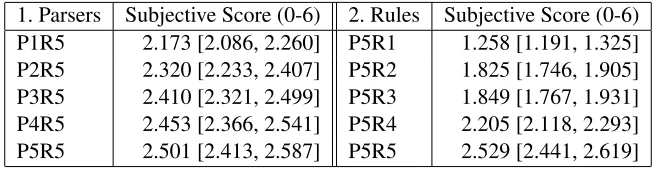
1. Parsers Subjective Score (0-6) 2. Rules Subjective Score (0-6) P1R5 2.173 [2.086, 2.260] P5R1 1.258 [1.191, 1.325] P2R5 2.320 [2.233, 2.407] P5R2 1.825 [1.746, 1.905] P3R5 2.410 [2.321, 2.499] P5R3 1.849 [1.767, 1.931] P4R5 2.453 [2.366, 2.541] P5R4 2.205 [2.118, 2.293] P5R5 2.501 [2.413, 2.587] P5R5 2.529 [2.441, 2.619]
Table 1: Human judgements of translation quality for 1. Parsers and 2. Rules.
Metric Sentence-level correlation
r ρ
Fuzzy reordering 0.435 0.448
Kendall’sτ 0.371 0.450
[image:7.612.79.293.177.246.2]BLEU 0.279 0.302
Table 6: Pearson’s correlation (r) and Spearman’s rank correlation (ρ) with subjective translation quality at sentence-level.
we see that both the choice of parser and reordering rules clearly effects subjective translation quality.
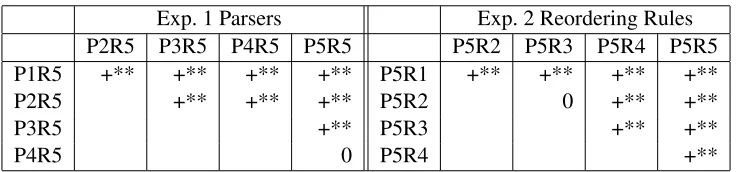
We performed pairwise significance tests using bootstrap resampling for each pair of ‘improved’ systems in each experiment. Tables 3, 4 and 5 shows which pairs were judged to be statistically significant improvements at either 95 or 90 percent level under the different metrics. These tests were computed on the same 500 sentences. All pairs but one are judged to be statistically significant im-provements in subjective translation quality. Sig-nificance tests performed using the fuzzy reorder-ing metric are identical to the subjective scores for the Parsers experiment but differ on one pairwise comparison for the Rules experiment. According to BLEU score, however, none of the parser changes are significant at the 95 percent level and only one pairwise comparison (between the two most differ-ent systems) was significant at the 90 percdiffer-ent level. BLEU score appears more sensitive to the larger changes in the Rules experiment but is still in dis-agreement with the results of the human evaluation on four pairwise comparisons.
Table 6 shows the sentence-level correlation of different metrics with human judgments of transla-tion quality. Here both the fuzzy reordering score and Kendall’s τ are computed on the reference reordering data generated as described in Section 3.1. Both metrics are computed by running our
Translation Alignment Sentence-level
r ρ
Alignment-oriented Manual 0.435 0.448 Alignment-oriented Automatic 0.234 0.252
Standard Manual 0.271 0.257
[image:7.612.312.546.178.260.2]Standard Automatic 0.177 0.159
Table 7: Pearson’s correlation (r) and Spearman’s rank correlation (ρ) with subjective translation quality at the sentence-level for different types of reordering reference data: (i) alignment-oriented translation vs. standard, (ii) manual vs. automatic alignment.
lightweight evaluation tool and involve no transla-tion whatsoever. These lightweight metrics are also more correlated with subjective quality than BLEU score at the sentence level.
Table 7 shows how the correlation between fuzzy reordering score and subjective translation quality degrades as we move from manual to automatic alignments and from alignment-oriented translations to standard ones. The automatically aligned refer-ences, in particular, are less correlated with subjec-tive translation scores then BLEU; we believe this may be due to the poor quality of word alignments for languages such as English and Japanese due to the long-distance reordering between them.
Standard / Manual
Standard / Manual
Source How Can I Qualify For A Mortgage Tax Deduction ? Reordering A Mortgage {{ Tax Deduction }} For I Qualify How Can ?
Translation 住宅 ローン 減税 に 必要 な 資格 を 得る に は どう すれ ば よい です か ? Alignment 6,6,7_8,4,3,3,3,3,3,0,0,0,0,0,1,1,9,9
Alignment-oriented / Manual
Alignment-oriented / Manual
Source How Can I Qualify For A Mortgage Tax Deduction ? Reordering I How A Mortgage {{ Tax Deduction }} For Qualify Can ?
Translation 私 は どう し たら 住宅 ローン の 減税 の 資格 に 値する こと が でき ます か ? Alignment 2,2,0,0,0,6,6,6,7_8,4,3,3,3,1,1,1,1,1,9
Standard / Automatic
Standard / Automatic
Source We do not claim to cure , prevent or treat any disease . Reordering any disease cure , prevent or treat claim to We do not .
Translation いかなる 病気 の 治癒 , 防止 , または 治療 も 断言 する もの で は あり ませ ん . Alignment 10,11,,5,6,7,,8,9,,,4,,,,2,2,2,12
Alignment-oriented / Automatic
Alignment-oriented / Automatic
Source We do not claim to cure , prevent or treat any disease . Reordering We any disease cure , prevent or treat claim to do not .
[image:8.612.123.493.372.458.2]Translation 私 達 は あらゆる 疾患 の 治癒 , 予防 ある いは 治療 を 行う と 主張 し ま せ ん . Alignment 0,0,,10,11,,5,6,7,8,9,,,,3,4,2,2,12
Table 2: Reference reordering data generated via various methods: (i) alignment-oriented vs. standard translation, (ii) manual vs. automatic word alignment
Exp. 1 Parsers Exp. 2 Reordering Rules
P2R5 P3R5 P4R5 P5R5 P5R2 P5R3 P5R4 P5R5
P1R5 +** +** +** +** P5R1 +** +** +** +**
P2R5 +** +** +** P5R2 0 +** +**
P3R5 +** P5R3 +** +**
[image:8.612.119.492.489.576.2]P4R5 0 P5R4 +**
Table 3: Pairwise significance in subjective evaluation (0 = not significant, * = 90 percent, ** = 95 percent).
Exp. 1 Parsers Exp. 2 Reordering Rules
P2R5 P3R5 P4R5 P5R5 P5R2 P5R3 P5R4 P5R5
P1R5 +** +** +** +** P5R1 0 +** +** +**
P2R5 +** +** +** P5R2 +** +** +**
P3R5 +** +** P5R3 +** +**
[image:8.612.122.491.608.695.2]P4R5 0 P5R4 +**
Table 4: Pairwise significance in fuzzy reordering score (0 = not significant, * = 90 percent, ** = 95 percent).
Exp. 1 Parsers Exp. 2 Reordering Rules
P2R5 P3R5 P4R5 P5R5 P5R2 P5R3 P5R4 P5R5
P1R5 0 0 +* +* P5R1 +** +** +** +**
P2R5 0 0 0 P5R2 0 +** +**
P3R5 0 0 P5R3 0 +*
P4R5 0 P5R4 0
Parser Labeled attachment POS accuracy
P1 0.807 0.954
P2 0.822 0.954
P3 0.827 0.955
P4 0.830 0.955
[image:9.612.72.283.53.139.2]P5 0.822 0.944
[image:9.612.313.541.64.272.2]Table 8: Intrinsic parser metrics on WSJ dev set.
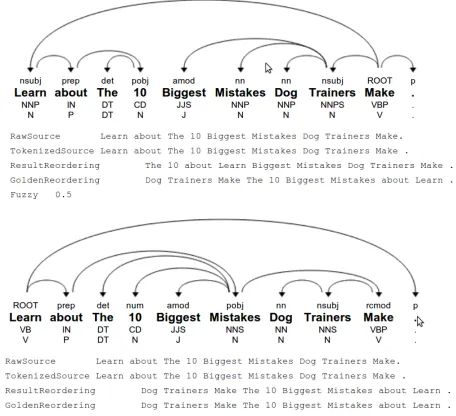
Figure 1: P1 and P5’s parse trees and automatic reorder-ing (usreorder-ing R5 ruleset) and fuzzy score.
hurts parsing performance on cleaner newswire.
6 Discussion
We have found that in practice this evaluation frame-work is sufficiently correlated with human judg-ments of translation quality to be rather useful for performing detailed error analysis of our English-to-Japanese system. We have used it in the following ways in simple error analysis sessions:
• To identify which words are most frequently re-ordered incorrectly
• To identify systematic parser and/or POS errors
• To identify the worst reordered sentences
• To evaluate individual reordering rules
Figures 1 and 2 show pairs of parse trees together with their resulting reorderings and scores against
Figure 2: P1 and P5’s parse trees and automatic reorder-ing (usreorder-ing R5 ruleset) and fuzzy score.
the reference. These are typical of the parser er-rors that impact reordering and which are correctly identified by our framework. In related joint work (Katz-Brown et al., 2011) and (Hall et al., 2011), it is shown that the framework can be used to optimize reordering components automatically.
7 Conclusions
[image:9.612.76.298.176.360.2]that differ only in small but realistic aspects such as parser quality. In future work we plan to use the framework to provide a more comprehensive analy-sis of the reordering capabilities of a broad range of machine translation systems.
References
Alexandra Birch and Miles Osborne. 2010. Lrscore for evaluating lexical and reordering quality in mt. In Pro-ceedings of the Joint Fifth Workshop on Statistical Ma-chine Translation and MetricsMATR, pages 327–332, Uppsala, Sweden, July.
Alexandra Birch, Miles Osborne, and Philipp Koehn. 2008. Predicting success in machine translation. In
Proceedings of the 2008 Conference on Empirical Methods in Natural Language Processing, pages 745– 754, Honolulu, Hawaii, October. Association for Com-putational Linguistics.
Alexandra Birch, Phil Blunsom, and Miles Osborne. 2009. A quantitative analysis of reordering phenom-ena. In Proceedings of the Fourth Workshop on Sta-tistical Machine Translation, pages 197–205, Athens, Greece, March.
Alexandra Birch, Miles Osborne, and Phil Blunsom. 2010. Metrics for mt evaluation: evaluating reorder-ing. Machine Translation, 24:15–26, March.
Chris Callison-burch and Miles Osborne. 2006. Re-evaluating the role of bleu in machine translation re-search. InIn EACL, pages 249–256.
Michael Collins, Philipp Koehn, and Ivona Kucerova. 2005a. Clause restructuring for statistical machine translation. InProceedings of the 43rd Annual Meet-ing of the Association for Computational LMeet-inguis- Linguis-tics (ACL’05), pages 531–540, Ann Arbor, Michigan, June. Association for Computational Linguistics. Michael Collins, Philipp Koehn, and Ivona Kuˇcerov´a.
2005b. Clause restructuring for statistical machine translation. InProceedings of the 43rd Annual Meet-ing on Association for Computational LMeet-inguistics, ACL ’05, pages 531–540, Stroudsburg, PA, USA. As-sociation for Computational Linguistics.
Heidi Fox. 2002. Phrasal cohesion and statistical ma-chine translation. InProceedings of the 2002 Confer-ence on Empirical Methods in Natural Language Pro-cessing, pages 304–3111, July.
Alexander Fraser and Daniel Marcu. 2007. Measuring word alignment quality for statistical machine transla-tion. Comput. Linguist., 33:293–303, September. Keith Hall, Ryan McDonald, and Jason Katz-Brown.
2011. Training dependency parsers by jointly optimiz-ing multiple objective functions. InProc. of EMNLP 2011.
Hideki Isozaki, Tsutomu Hirao, Kevin Duh, Katsuhito Sudoh, and Hajime Tsukada. 2010. Automatic evalu-ation of translevalu-ation quality for distant language pairs. In Proceedings of the 2010 Conference on Empirical Methods in Natural Language Processing, pages 944– 952, Cambridge, MA, October. Association for Com-putational Linguistics.
Jason Katz-Brown, Slav Petrov, Ryan McDonald, Franz Och, David Talbot, Hiroshi Ichikawa, Masakazu Seno, and Hideto Kazawa. 2011. Training a Parser for Ma-chine Translation Reordering. In Proc. of EMNLP 2011.
Philipp Koehn. 2004. Statistical significance tests for machine translation evaluation. In EMNLP, pages 388–395.
Alon Lavie and Michael J. Denkowski. 2009. The me-teor metric for automatic evaluation of machine trans-lation.Machine Translation, 23(2-3):105–115. J. Nivre. 2008. Algorithms for deterministic
incremen-tal dependency parsing. Computational Linguistics, 34(4):513–553.
F. Och. 2003. Minimum error rate training in statistical machine translation. InACL ’03.
Kishore Papineni, Salim Roukos, Todd Ward, and Wei-Jing Zhu. 2001. Bleu: a method for automatic evalua-tion of machine translaevalua-tion. InACL ’02: Proceedings of the 40th Annual Meeting on Association for Compu-tational Linguistics, pages 311–318, Morristown, NJ, USA. Association for Computational Linguistics. Chao Wang. 2007. Chinese syntactic reordering for
statistical machine translation. In In Proceedings of EMNLP, pages 737–745.
Fei Xia and Michael McCord. 2004. Improving a sta-tistical mt system with automatically learned rewrite patterns. InProceedings of the 20th international con-ference on Computational Linguistics, COLING ’04, Stroudsburg, PA, USA. Association for Computational Linguistics.
Peng Xu, Jaeho Kang, Michael Ringgaard, and Franz Och. 2009. Using a dependency parser to improve SMT for subject-object-verb languages. In Proceed-ings of Human Language Technologies: The 2009 An-nual Conference of the North American Chapter of the Association for Computational Linguistics, pages 245–253, Boulder, Colorado, June.
Richard Zens and Hermann Ney. 2006. Discriminative reordering models for statistical machine translation. InProceedings of the Workshop on Statistical Machine Translation, pages 55–63.