Observed versus latent features for knowledge base and text inference
Kristina Toutanova
Microsoft Research Redmond, WA, USA
Danqi Chen∗
Computer Science Department Stanford University
Abstract
In this paper we show the surprising effectiveness of a simple observed tures model in comparison to latent fea-ture models on two benchmark knowl-edge base completion datasets, FB15K and WN18. We also compare latent and observed feature models on a more chal-lenging dataset derived from FB15K, and additionally coupled with textual mentions from a web-scale corpus. We show that the observed features model is most effec-tive at capturing the information present for entity pairs with textual relations, and a combination of the two combines the strengths of both model types.
1 Introduction
Representing information about real-world en-tities and their relations in structured knowl-edge bases (KBs) enables numerous applications. Large, collaboratively created knowledge bases have become recently available (some examples are Freebase (Bollacker et al., 2008), YAGO (Suchanek et al., 2007), and DBPedia (Auer et al., 2007)), but even though they are impres-sively large, their coverage is far from complete. This has motivated research in automatically de-riving new facts to extend a manually built knowl-edge base, by using information from the exist-ing knowledge base and information from textual mentions of entities in documents.
Many statistical models for predicting new links in knowledge bases have been applied to this task, with most successful ones being latent feature models that learn continuous representations for entities and relations (Bordes et al., 2011; Nickel et al., 2011; Bordes et al., 2013), and observed feature models which predict based on observable
∗Parts of this research were conducted during the au-thor’s internship at Microsoft Research.
features in the knowledge graphs (Lao et al., 2011; Riedel et al., 2013). Additionally, studies have looked at the contribution of text-based extraction to knowledge base completion (Lao et al., 2012; Gardner et al., 2013).
In this paper we compare empirically a very simple observed features model to state-of-the-art latent feature models recently applied to two com-monly used datasets for knowledge base comple-tion: a dataset adapted from the Freebase KB, called FB15K (Bordes et al., 2013) and a dataset derived from the WordNet graph WN18, also in-troduced in (Bordes et al., 2013). We show that the simple observed features model substantially out-performs latent feature models, possibly due to the arguably unrealistic redundancy in the KB graphs of these datasets. Nevertheless, it is intriguing that the latent feature models studied are not able to learn the target concept as well, even given a large number of latent features.
We also construct a harder, perhaps more re-alistic dataset derived from FB15K, in which we remove near-duplicate or inverse-duplicate rela-tions. We show that in this new dataset our studied latent feature models substantially outperform the observed feature models. When we augment the newly constructed dataset with textual mentions derived from the ClueWeb 12 web-scale document collection, we see that the observed features model is more powerful than the latent feature models, but also that a combination of the two is superior to either of them.
2 Related Work
There has been a large amount of work on statisti-cal models for knowledge base completion. Nickel et al. (2015) provide a recent overview.
Most related to our current focus is recent work applying latent feature models to the FB15K and WN18 datasets (Bordes et al., 2013; Wang et al., 2014; Yang et al., 2015), work containing compar-isons between observed and latent feature
Knowledge Base
Barack Obama
United States
Honolulu
Textual Mentions
Barack Obama is the 44th and current President of United States.
Obama was born in the United States
just as he has always said. …
ClueWeb place_of_birth
city_of
[image:2.595.75.286.59.218.2]nationality
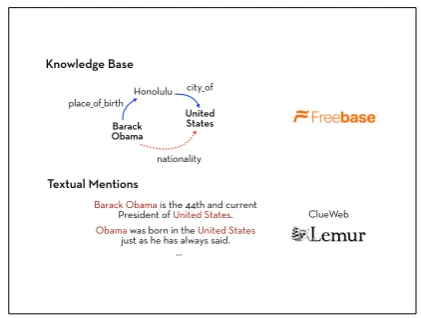
Figure 1:A knowledge base fragment coupled with textual mentions of pairs of entities.
els (Dong et al., 2014; Nickel et al., 2014), and work using inference from both text and knowl-edge base relations (Lao et al., 2012; Riedel et al., 2013; Dong et al., 2014; Gardner et al., 2014).
Our work differs from this prior work in that we compare a very simple form of observed feature models, based on using only direct links between candidate entity pairs, to state-of-the-art latent fea-ture models on two benchmark datasets, with sur-prising results.
Our work on using textual mentions for knowl-edge base inference differs from prior work in the scale and richness of the knowledge base and tex-tual relations used, as well as in that we evaluate the impact of text not only on mentioned entity pairs like (Gardner et al., 2014; Riedel et al., 2013) but on all links. We represent knowledge base and textual patterns in a single knowledge graph, like Lao et al. (2012) and Riedel et al. (2013), but re-fine the learning method to treat textual relations differently in the loss function, to maximize pre-dictive performance on the knowledge base rela-tions. We show the impact of observed and latent feature models and their combination in knowl-edge graphs with and without textual relations.
3 Models for knowledge base completion We begin by introducing notation to define the task, largely following the terminology in Nickel et al. (2015). We assume knowledge bases are represented using RDF triples, in the form (subject, predicate,object), where the subject and object are entities and the predicate is the type of relation. For example, the KB fragment shown in Figure 1 is shown as a knowledge graph, where the entities are the nodes, and the relations are shown as
di-rected labeled edges: we see three entities which participate in three relation instances indicated by the edges.
The task we are interested in is, given a train-ing KB consisttrain-ing of entities with some relations between them, to predict new relations (links) that do not appear in the training KB. For example, the triple (Barack Obama,nationality,United States) could
be predicted from the training KB triples (Barack Obama,place of birth,Honolulu) and (Honolulu,city of,
United States). More specifically, we will build
mod-els that rank candidate entities for given queries
(e1, r,?)or(?, r, e2), which ask about the subject or object of a given relation.
The following notation will help us define the statistical models over knowledge graphs that we consider. Let E = (e1, e2, . . . , eNe) denote the
set of entities in the knowledge graph and let
R = (r1, r2, . . . , rNr) denote the set of
rela-tion types. We denote each possible triple as
xi,j,k = (ei, rk, ej) and model its presence with a binary random variable yi,j,k ∈ {0,1} which indicates whether the triple exists. We will fo-cus on models that score possible triplesxi,j,k us-ing either observed features from the knowledge graph or latent features of the three elements of the triple. Both model classes use scoring func-tionsf(xi,j,k; Θ)that represent the model’s confi-dence in the existence of the triple. We first spec-ify the forms of scoring functions we consider in this study, and later detail the loss functions used for training model parameters. We use the same loss function (as a function of triple scores) for training all models in this study.
3.1 Observed feature models
We consider an extremely simple form of ob-served feature models, which can be seen as an impoverished variant of path ranking (PRA) for KB completion (Lao and Cohen, 2010; Lao et al., 2011). In particular we define features for existing paths of length one for candidate triples
(ei, rk, ej). These can be paths fromei to ej or from ej to ei. Length one paths from ei to ej: we define binary features of the form 1(r0&r
k), which fire when the triple ei, r0, ej exists in the training knowledge graph, andr0 6=rk. This
paths from ej to ei: we define binary indicator features of the form1(r0
inv&rk), which fire when the tripleej, r0, eiexists in the training knowledge graph. Here r0 can capture the correlation with
inverse relations, for examplenationalityand peo-ple of nationality.
Such features will fire only if the candidate en-tity pair (ei, ej) is already directly connected in the training knowledge graph (by a link in either direction). Thus such features are expected to be helpful only when there are multiple correlated re-lation types that tend to connect similar sets of entity pairs. In the experiments section, we will show that this is indeed the case for two commonly used KB completion datasets we study. It is also true for knowledge graphs augmented with textual links, where each co-occurrence of (ei, ej) in a document collection induces a link of a textually-defined relation type. In addition to the features looking at length one paths, for the observed fea-ture models we define an indicator feafea-ture for ev-ery entity and relation in the triple. This captures a bias for these entities to occur in the subject or object position of the relation. The features are
1(ei =s&rk) and1(ej =o&rk), where sando indicate the subject and object positions, respec-tively. These features can capture the frequency with which each argument of the relation is oc-cupied by a specific entity. For example, we can learn that United States is a common nationality for entities in Freebase.
Given a feature vector Φi,j,k, the score of a triple is defined by its dot product with a param-eter vector, which contains a weight for each fea-ture:f(xi,j,k; Θ) = ΦTi,j,kΘ.
3.2 Latent feature models
In latent feature models, the score of a candidate triple is assumed to depend only on learned latent features of the entities and relations, and possi-bly additional global parameters. In this work we consider two simple latent feature models, which have been found to be competitive or outperform more complex alternatives in prior work (Yang et al., 2015; Riedel et al., 2013).
The first model we consider is model E (abbre-viated from ENTITY), which captures the compat-ibility between entities and the subject and object positions of relations. It can be seen as learning a soft notion of entity types. The model was applied to knowledge-base completion for text-augmented
n
s.
+
.
n
o [image:3.595.306.537.60.149.2]r
sr
oFigure 2:The continuous representations for model E.
n
sn
o(
n
s, n
o)
.
.
r
r
Figure 3: The continuous representations for model DIST -MULT.
knowledge graphs using a universal schema ap-proach (Riedel et al., 2013). For each relation type, the model learns two latent feature vectors
rsandroof some dimensionalityK. For each en-tity (node) ei, the model also learns a latent fea-ture vector ni of the same dimensionality. The model is depicted in Figure 2. The score of a candidate triple(es, r, eo)where the sub-scripts s andoare used to indicate subject and object po-sitions, respectively, is defined as: f(xs,r,o) =
rsTns+roTno.
The second model, DISTMULT, is a special form of a bilinear model like RESCAL (Nickel et al., 2011), where the non-diagonal entries in the relation matrices are assumed to be zero. This model was proposed in Yang et al. (2015) un-der the name DISTMULT, and was shown to out-perform the more highly parameterized bilinear model, as well as the additive model TRANSE (Bordes et al., 2013). In this model, each entity
eiis assigned a latent feature vector (embedding)
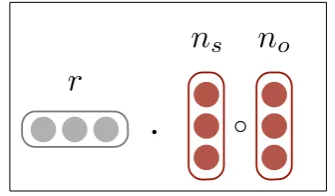
ni of dimensionality K and each relation type is assigned an embeddingr of the same dimension-ality. The model form is shown in Figure 3. The score of a candidate triple(es, r, eo)is defined as:
f(xs,r,o) =rT(ns◦no).
If there are Ne entities, Nr relations, and la-tent feature vectors of dimensionalityKare used, model E hasKNe+ 2KNrparameters and model DISTMULThasKNe+KNrparameters.
Combined models
[image:3.595.334.502.184.282.2]la-tent feature models and observed feature mod-els in a method similar to the one used in the Additive Relational Effects Model of Nickel et al. (2014). Given scoring functionsf1(xi,j,j,Θ1) and f2(xi,j,j,Θ2) defined by two different mod-els, we define a combined model for which the score of a triple is a weighted combination of the scores by the two models w1f1(xi,j,j,Θ1) +
w2f2(xi,j,j,Θ2). The component models could be latent of observed feature models, and the com-bination weights are either uniform (set to 1), or non-uniform and selected via a grid search on a validation set. We train the parameters of com-bined models jointly, by minimizing the loss func-tion based on the combined scores.
3.3 Training loss function
Our loss function is motivated by the link pre-diction task and the performance measures used to assess model performance. As mentioned ear-lier, the task is to predict the subject or object en-tity for given held-out triples (e1, r, e2), i.e. to rank all entities with respect to their likelihood of filling the respective position in the triple. We would thus like the model to score correct triples
(e1, r, e2) higher than incorrect triples (e0, r, e2) and(e1, r, e0)which differ from the correct triple by one entity. One could use a margin-based loss function as used in several approaches (Nickel et al., 2015). We use an approximation to the nega-tive log-likelihood of the correct entity filler. We define the conditional probabilitiesp(e2|e1, r)and
p(e1|r, e2) for object and subject entities given the relation and the other argument as follows:
p(e2|e1, rk; Θ) = e
f(xe1,e2,k;Θ)
P
e02∈Neg(e1,rk,?)e
f(xe
1,e02,k;Θ). Here the denominator is defined using a set of entities that do not fill the object position in any relation triple(e1, r,?) in the training knowledge graph. Since the number of such entities is im-practically large, we sample negative triples from the full set (we use 200 negative examples in our experiments). In some settings we also limit the candidate entities to ones that have types consis-tent with the position in the relation triple (Chang et al., 2014; Yang et al., 2015). We derive approxi-mate type information automatically (as discussed below), but such information could also be present in the knowledge graphs.
Conditional probabilities for subject enti-ties given relation and object are defined analogously, as follows: p(e1|rk, e2; Θ) =
ef(xe1,e2,k;Θ)
P
e01∈Neg(?,rk,e2)e
f(xe0
1,e2,k;Θ)
Given the definition of subject and object con-ditional probabilities for triples, our training loss function is defined as the sum of the negative log-probabilities of observed triples, also including an L2 penalty on the model parameters. If X de-notes the set of all triples in the training knowledge graph, the training loss is defined as:
L(X,Θ, λ) = − X
xe1,e2,rk∈X
logp(e2|e1, rk; Θ)
− X
xe1,e2,rk∈X
logp(e1|rk, e2; Θ)
+λΘTΘ
3.3.1 Entity types
We define the type of an entityeas a pair of sets of relation types [Rs,Ro]; Rs is the set of rela-tion types r for which e is the source node of a link with typer in the training knowledge graph andRo is the set of relation types for whicheis the target node of link with typer. For each rela-tion, we compute a set of allowable entity types by checking the percentage of its arguments that have a given type and restricting the allowable types to the topt(chosen on a validation set, usually two or three). For example, for the subject position of aparentsrelation the most frequent type would be
parents (meaning subject of parent). A second frequent type might beborn insmeaning subject ofborn in. Using this construction we define the compatibility between entities and relation argu-ment positions, which prunes the space of candi-dates quite significantly in many cases, while still maintaining a high upper bound on achievable per-formance. Details on the impact of usage of types are presented in Section 4.
Barack Obama is the 44th and current President of United States. Mention
Barack Obama is the 44th and current President of United States. Dependency paths
Linear paths
Barack Obama President of United States
nsubj prep pobj
[image:5.595.72.286.60.161.2]011 111
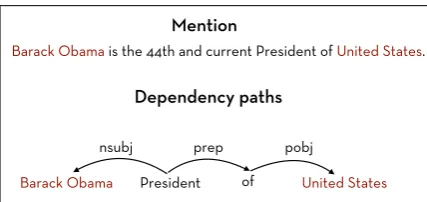
Figure 4: Textual relation extracted from an entity pair mention.
the two types of relations. Figure 4 shows the lexicalized dependency path between two entities that occur together in a sentence. An instance of textual relation of type “←−−−nsubj president −−→prep
of −→obj United States”, corresponding to the
sen-tence is added to the knowledge graph based on this occurrence. Textual co-occurrences of entity pairs often express relations between the entities, which might correspond exactly or approximately to knowledge base relations. Text could thus be a strong signal for predicting knowledge base rela-tions (Lao et al., 2012).
Once a knowledge graph is augmented with tex-tual relations, we can train the same models as be-fore, treating knowledge base and text relations in a uniform manner. However, since we are only interested in predicting knowledge-base relations, it might be suboptimal for the model to try to fit its parameters toward predicting textual relations as hard as it tries to optimize for knowledge base relations. In other words, the part of the loss function looking at subject and object probabili-ties for textual relations t is only useful to pro-vide an auxiliary prediction task which is bene-ficial for the main task using a multi-task learn-ing settlearn-ing. Therefore, one might choose an opti-mal weight τ which could be expected to be less than the weight of the primary loss function. We thus consider a modified loss function for KB+text model training, defined as follows. If the set of all triples using KB relations is X and the set of all triples using text relations isT, the loss is defined asL(X∪T,Θ) = L(X,Θ) +τL(T,Θ). In the experiments section we will see that this simple modification can provide large performance bene-fits.
4 Experiments
We perform experiments with latent and observed feature models and their combination. We first
present results on the FB15K dataset, which was originality constructed (using Freebase) by Bordes et al. (2013) and was subsequently used in sev-eral research studies (Wang et al., 2014; Yang et al., 2015). The number of relations and triples in the training, development and test portions of the datasets are given in Table 5.
4.1 Task and Evaluation Protocol
Given a set of triples in a set disjoint from a train-ing knowledge graph, we test models on predict-ing the subject or object of each triple, given the relation type and the other argument. We rank all entities in the training knowledge base in order of their likelihood of filling the argument position. We report the mean reciprocal rank of the correct entity, as well as HITS@10 – the percent of test triples for which the correct argument was ranked in the top ten. We use filtered measures follow-ing the protocol proposed in Bordes et al. (2013) – that is, when we rank entities for a given posi-tion, we remove all other entities that are known to be part of an existing triple in the training, de-velopment, or test set. This avoids penalizing the model for ranking other correct fillers higher than the tested argument. We thus report filtered mean reciprocal rank (labeled MRR in the Figures), and filtered HITS@10. In the figures we present MRR values scaled by 100, so that the maximum possi-ble MRR is 100.
Implementation details and hyper-parameter settings
For all models implemented in this work, we trained the models using the loss function pre-sented in Section 3.3, usingλ = 1as the weight of the L2 regularizer. We used a batch learn-ing parameter optimization method, after initial experiments showed it did better than stochastic optimization using AdaGrad. We experimented with LBFGS (Liu and Nocedal, 1989) and RProp (Riedmiller and Braun, 1993), and found RProp to converge faster to similar values of the objective for the latent feature models. All reported results use RProp. We also used early stopping to termi-nate optimization when the MRR on the validation set stopped improving.
Dataset Relations Entities Triples in Train / Validation / Test % Test Linked
FB15K 1,345 14,951 483,142 50,000 59, 071 80.9
FB15KSelected 237 14,541 272,115 17,535 20, 466 0
[image:6.595.143.458.60.100.2]WN18 18 40,943 141,442 5,000 5,000 94.0
Figure 5: Datasets used in this study. FB15K and WN18 have been used in prior work and FB15KSelected is a new dataset derived from FB15K and ClueWeb (described in text).
Model FB15K FB15K
Type Constraints No Type Constraints
MRR HITS@10 MRR HITS@10
E 22.7 34.0 21.8 33.6
DISTMULT 63.1 79.0 55.5 79.7
E+DISTMULT 65.9 81.0 56.2 78.3
TransE 32.0 53.9
DISTMULT(Yang et al., 2015) 36.0 57.7
TransH (bern.) (Wang et al., 2014) 64.4
NodeFeat 21.7 32.6 21.6 32.4
LinkFeat 79.1 80.8 77.9 80.4
Node+LinkFeat 82.1 86.1 82.2 87.0
Figure 6:Results on FB15K with and without type constraints for candidate filtering in training and testing.
the textual relations loss, testing values in the set
{0.01,0.1,0.25,0.5,1}.
4.2 Experiments on KB Completion using FB15K and WN18
We present experiments of different models intro-duced in this paper on these datasets, and addi-tionally include results reported in prior work. We also evaluate the impact of our use of types as hard constraints in training and testing, and how these constraints impact latent feature models versus ob-served feature models.
Figure 6 presents the results under two settings: using automatically derived types versus not us-ing them. The results not usus-ing types are pre-sented in the right half of the Figure. The first six rows report performance measures obtained using latent feature models. The first three models pre-sented are the ones defined in Section 3.2 and im-plemented in this work. We evaluate these models when type constraints are used or when they are not used. The next three rows report results from prior work by directly copying reported numbers from the respective papers. Since these papers did not use type constraints, we list the results in the right two columns only. The model TransE was proposed in (Bordes et al., 2013) but we use the results from the implementation of (Yang et al., 2015), because these results were higher. The TransH (bern.) results are obtained by the model presented in (Wang et al., 2014).
The last three rows show results from observed feature models, as defined in Section 3.1, where the first model uses only node features, the second
uses only direct link features, and the third uses both feature types.
The type constraints were defined using the method presented in Section 3.3.1. We choose the best settings for the method based on coverage of the correct triples in the validation set. Given the hard pruning of candidates by type filtering, the method using types has less than100percent achievable accuracy — the oracle HITS@10 by using type constraints is 98.3. We found that the number of latent features did not have a large im-pact on performance for model E, but did have large impact for the other two models. Using 500 hidden dimensions was optimal for these two models. Even though the form of the scoring func-tion for DISTMULTis exactly the same as defined in (Yang et al., 2015), we obtain much higher per-formance. We attribute this to the larger number of hidden dimensions (500 vs 100), and the use of the softmax-based loss function with 200 negative examples and batch training.1As seen, the impact
of the type constraints is large and positive, espe-cially on the MRR values. Our implementation of these embedding models outperforms the other re-cent results by TransH (Wang et al., 2014), which we also attribute to the loss function and optimiza-tion.
The most striking result on this dataset is seen in the last two rows of the Table, where we can
[image:6.595.162.436.146.258.2]Model FB15KSelected
MRR a/t/nt HITS@10 a/t/nt
Without Text
E 23.5 20.2 24.4 35.6 31.7 36.9
DISTMULT 25.3 20.9 26.7 40.8 34.8 42.6
E+DISTMULT 26.6 23.1 27.7 43.0 38.4 44.4
NodeFeat 23.5 20.3 24.5 35.6 31.7 36.8
LinkFeat 6.3 3.1 7.3 7.9 5.2 8.7
Node+LinkFeat 22.6 19.3 23.7 34.7 30.6 36.0
Combined 26.8 23.1 28.0 42.8 37.8 44.3 With Text
E+DISTMULT(τ= 1) 26.6 24.0 27.3 41.3 38.4 42.2 E+DISTMULT(τ=.1) 27.4 24.3 28.3 43.8 39.8 45.0
Node+LinkFeat 27.2 39.6 23.4 41.4 60.5 35.5
[image:7.595.180.420.60.204.2]Combined ((τ=.1) 29.3 39.1 26.3 46.2 60.0 41.9
Figure 7: Results on FB15KSelected with and without addition of textual links. ModelCombinedis a combination of the latent feature models E and DISTMULTand the observed feature modelNode+LinkFeat.
Model WN18
MRR HITS@10 TRANSE (Bordes et al., 2013) 89.2 DISTMULT(Yang et al., 2015) 83.0 94.2 BILNEAR(Yang et al., 2015) 89.0 92.8 TransH (unif) (Wang et al., 2014) 86.7
NodeFeat 2.9 5.0
LinkFeat 93.8 93.9
Node+LinkFeat 94.0 94.3
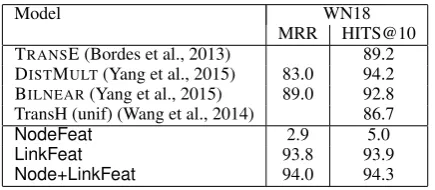
Figure 8:Results on WN18 using performance reported in prior work as well as performance of observed feature models.
see the performance of the observed feature mod-els based on direct links. The performance of these models (in MRR) is much higher that the performance of the latent feature models obtained in this work and in prior work. This is per-haps not so surprising when we look at the num-ber of test set triples (e1, r, e2) for which either
(e1, r0, e2) or(e2, r0, e1)occur in the training set – i.e., which are directly linked in the training knowledge graph. This number is almost 81% (reported in Table 5), and explains why the ob-served features model which uses this information directly can do so well. What is more surprising is that latent feature models have not approached this performance, even given a large number of la-tent feature dimensions. We see this is an inter-esting datapoint which can motivate analysis and improvement in the state-of-the-art in knowledge base completion using latent variable models.
Two other interesting results from these exper-iments are that the observed feature model using only entity features (NodeFeat) has almost the same performance as the latent feature model E and both can be seen as learning a unigram distri-bution over entities for argument positions of re-lations. Additionally, the observed feature models are not substantially affected by the use of type constraints, since they effectively learn to model
similar type concepts using the features.
We also tested the models on WN18, and report results from prior work using latent feature mod-els as well as our implementation of the observed feature models in Figure 8. As seen, the observed feature models using link features strongly outper-form prior work in the MRR measure (achieving around 45% error reduction over the best previ-ously reported results), and are comparable to the best models according to the HITS@10 measure. As shown in Table 5, 94.0 of test triple entities are directly linked in the training KB, explaining the success of these simple models.
[image:7.595.191.409.246.341.2]4.3 Experiments using knowledge graph and text inference on FB15KSelected
The dataset FB15KSelected2 was constructed by
first limiting the set of relations in FB15K to the most frequently used 401 relations (a set-ting using this subset of frequent relations was also used in (Yang et al., 2015)). We then au-tomatically detected near-duplicate and inverse relations by checking whether the set of entity pairs in the relations is either almost the same (at least 97% of the pairs are in the intersection), or whether the set of inverse entity pairs is almost the same e.g. comparing [e1, e2]for r to the set
[e2, e1]forr0. For example, this process detected that the relation /award/award nomineeis inverse of
/award nominee/award. Given this information, we
filtered the set of relations to keep only one of a set of inverse or duplicate relations; this resulted in 237 relations, and we limited the training, val-idation, and development set triples to these rela-tions. We also filtered from the validation and test sets any triples whose entity pairs were directly linked in the training database. Such direct links could admittedly be legitimately present in a real-istic scenario but we excluded them to avoid addi-tional trivial cases which could have not been de-tected via the prior filtering step. The statistics for this resulting dataset are shown in Table 5.
While for this more realistic dataset we have excluded all direct KB links for test entity pairs, there is a realistic source of direct relations be-tween test entity pairs – textual relations expressed by sentences containing these pairs of entities. We use the ClueWeb12 3 corpus coupled with
Freebase mention annotations (Gabrilovich et al., 2013) to extract textual relations for all entity pairs in the knowledge base. We extract textual pat-terns from 200 million dependency-parsed sen-tences and we represent the textual relations via the fully lexicalized dependency path connecting two entities, as shown in Figure 4. After prun-ing, we use 25,000 unique textual relations and add links to the training knowledge graph based on these relations. There are 6.6 million links induced from the textual relations for the FB15KSelected knowledge base. Of the test KB triples, 23.3% of the entity pairs have textual mentions. For the
2A release of the dataset will be available soon. Contact the authors for more details if interested.
3http://www.lemurproject.org/
clueweb12.php/
training set, 31% of the entity pairs that have a KB link have a textual mention, and having a mention increases the chance that a random entity pair has a relation from .1% to 4.2% – a forty-fold increase. Figure 7 shows the results for this dataset – the upper portion contains results for models not us-ing textual mentions, and the lower part contains results of models also using the text. The results are shown using the MRR and HITS@10 mea-sures, and these are further broken down into over-all/with textual mentions/without textual mentions (a/t/nt).
For the setting where no textual mentions are used, we see that the latent feature models outper-form the observed feature models (since there are no direct links in the training set for test triples, the observed features model LinkFeat has perfor-mance which is random subject to the type con-straints (and where ties are broken by order of ap-pearance in the training set)). Using node fea-tures only is best for the observed feature mod-els, and the overall MRR of this model (23.5), is substantially below that of the best latent feature model, E+DISTMULTwith overall MRR of 26.6. A model which combines the latent and observed features (shown in row 7), does not bring substan-tial improvement.
HITS@10 of 46.2. The MRR on test triples with mentions is almost doubled compared to the mod-els not using text.
Conclusion
This work provided two main lessons for knowledge base completion. First, we showed that the presence of relations between candidate pairs can be an extremely strong signal in some cases, and that this signal was not effectively captured by the studied latent feature models. Second, we showed that textual links extracted from a large document collection and added to an existing KB-completion dataset brought substantial improve-ments, especially on test cases with textual occur-rences. It was beneficial to use the direct textual links as features in an observed features model and to combine that with a latent feature model, to ef-fectively capture inferences among KB relations and direct cues from text. We also showed that in a dataset where training and test triples are not arti-ficially limited to only ones that have textual men-tions, it becomes important to tradeoff the weight of the loss incurred from textual versus KB rela-tions.
Acknowledgements
We would like to thank Jianfeng Gao, Scott Yih, Patrick Pantel, Michael Gamon, Hoifung Poon and the anonymous reviewers for useful sugges-tions.
References
S¨oren Auer, Christian Bizer, Georgi Kobilarov, Jens Lehmann, Richard Cyganiak, and Zachary Ives. 2007. Dbpedia: A nucleus for a web of open data. Springer.
Kurt Bollacker, Colin Evans, Praveen Paritosh, Tim Sturge, and Jamie Taylor. 2008. Freebase: a col-laboratively created graph database for structuring human knowledge. InProceedings of the 2008 ACM SIGMOD international conference on Management of data, pages 1247–1250. ACM.
Antoine Bordes, Jason Weston, Ronan Collobert, and Yoshua Bengio. 2011. Learning structured embed-dings of knowledge bases. InConference on Artifi-cial Intelligence, number EPFL-CONF-192344. Antoine Bordes, Nicolas Usunier, Alberto
Garcia-Duran, Jason Weston, and Oksana Yakhnenko. 2013. Translating embeddings for modeling multi-relational data. InAdvances in Neural Information Processing Systems (NIPS).
Kai-Wei Chang, Wen-tau Yih, Bishan Yang, and Christopher Meek. 2014. Typed tensor decompo-sition of knowledge bases for relation extraction. In
Empirical Methods in Natural Language Processing (EMNLP).
Xin Dong, Evgeniy Gabrilovich, Geremy Heitz, Wilko Horn, Ni Lao, Kevin Murphy, Thomas Strohmann, Shaohua Sun, and Wei Zhang. 2014. Knowledge vault: A web-scale approach to probabilistic knowl-edge fusion. InInternational Conference on Knowl-edge Discovery and Data Mining (KDD).
Evgeniy Gabrilovich, Michael Ringgaard, and Amar-nag Subramanya. 2013. FACC1: Freebase anno-tation of ClueWeb corpora, Version 1 (release date 2013-06-26, format version 1, correction level 0). Matt Gardner, Partha Pratim Talukdar, Bryan Kisiel,
and Tom Mitchell. 2013. Improving learning and inference in a large knowledge-base using latent syntactic cues. In Empirical Methods in Natural Language Processing (EMNLP).
Matt Gardner, Partha Talukdar, Jayant Krishnamurthy, and Tom Mitchell. 2014. Incorporating vector space similarity in random walk inference over knowledge bases. InEmpirical Methods in Natural Language Processing (EMNLP).
Ni Lao and William W Cohen. 2010. Relational re-trieval using a combination of path-constrained ran-dom walks.Machine learning.
Ni Lao, Tom Mitchell, and William W Cohen. 2011. Random walk inference and learning in a large scale knowledge base. InEmpirical Methods in Natural Language Processing (EMNLP).
Ni Lao, Amarnag Subramanya, Fernando Pereira, and William W Cohen. 2012. Reading the web with learned syntactic-semantic inference rules. In
Empirical Methods in Natural Language Process-ing and Computational Natural Language LearnProcess-ing (EMNLP/CoNLL).
Dong C Liu and Jorge Nocedal. 1989. On the limited memory bfgs method for large scale optimization.
Mathematical programming, 45(1-3):503–528. Maximilian Nickel, Volker Tresp, and Hans-Peter
Kriegel. 2011. A three-way model for collective learning on multi-relational data. InProceedings of the 28th international conference on machine learn-ing (ICML-11), pages 809–816.
Maximilian Nickel, Kevin Murphy, Volker Tresp, and Evgeniy Gabrilovich. 2015. A review of re-lational machine learning for knowledge graphs: From multi-relational link prediction to automated knowledge graph construction. arXiv preprint arXiv:1503.00759.
Sebastian Riedel, Limin Yao, Benjamin M. Marlin, and Andrew McCallum. 2013. Relation extraction with matrix factorization and universal schemas. In North American Chapter of the Association for Computational Linguistics: Human Language Tech-nologies (NAACL-HLT).
Martin Riedmiller and Heinrich Braun. 1993. A direct adaptive method for faster backpropagation learn-ing: The rprop algorithm. In Neural Networks, 1993., IEEE International Conference on, pages 586–591. IEEE.
Fabian M Suchanek, Gjergji Kasneci, and Gerhard Weikum. 2007. Yago: a core of semantic knowl-edge. InProceedings of the 16th international con-ference on World Wide Web, pages 697–706. ACM. Zhen Wang, Jianwen Zhang, Jianlin Feng, and Zheng
Chen. 2014. Knowledge graph embedding by trans-lating on hyperplanes. InProceedings of the Twenty-Eighth AAAI Conference on Artificial Intelligence, pages 1112–1119.