D S Sharma, R Sangal and E Sherly. Proc. of the 12th Intl. Conference on Natural Language Processing, pages 197–202, Trivandrum, India. December 2015. c2015 NLP Association of India (NLPAI)
Automatic conversion of Indian Language Morphological Processors into
Grammatical Framework (GF)
Harsha Vardhan Grandhi
LTRC IIIT Hyderabad
venkata.harshavardhan@research. iiit.ac.in
Soma Paul
LTRC IIIT Hyderabad [email protected]
Abstract
Grammatical framework (GF) is an open source software which supports seman-tic abstraction and linguisseman-tic generaliza-tion in terms of abstract syntax in a multi-lingual environment. This makes the soft-ware very suitable for automatic multi-lingual translation using abstract syntax which can be treated as a interlingua. As a first step towards building multi-Indian language translation system using GF plat-form, we aim to develop an automatic converter which will convert morphologi-cal processors available in various formats for Indian languages into GF format. In this paper we develop a deterministic au-tomatic converter that converts LTtoolbox and ILMT morphological processors into GF format. Currently we have converted Hindi, Oriya and Tamil processors using our converter with 100% information pre-served in the output. We will also report in this paper our effort of converting San-skrit and Marathi LTtoolbox morphologi-cal processor into GF format.
1 Introduction
Many NLP resources have been developed for pro-cessing Indian languages in the last decade. A major consortium of Indian language - Indian lan-guage MT system (ILMT) has been successfully carried out for 9 language pairs. These systems mainly follow a transfer based approach. MT sys-tem from English to various Indian languages have also been developed through large projects. Mor-phological analyzers and generators have been de-veloped as part of these projects as well as inde-pendently for many Indian languages. In this pa-per, we present an automatic converter that con-verts morphological processors that exist in
differ-ent formats into one common format of Grammat-ical Framework. GrammatGrammat-ical framework (GF) is an open source software which supports se-mantic abstraction and linguistic generalization in terms of abstract syntax in a multi-lingual envi-ronment (Ranta Aarne, 2009). Abstract syntax can be viewed as an interlingua in the context of multi-lingual machine translation. Apart from ab-stract syntax there exists another module called concrete syntax in which the morphological spec-ification and syntactic behavior of a language can be captured. The abstract syntax and concrete syn-taxes of all languages that one wants to handle to-gether can produce very good quality, especially for domain based MT systems. This is the mo-tivation for converting morphological processors, that at present exist in different format for differ-ent Indian languages, into GF format so that good quality meaning driven multi-lingual MT can be accomplished.
Our morphological converter presently converts morph resources designed in Lttoolbox and ILMT morph framework into GF format. We have ex-perimented with Hindi, Oriya, Tamil, Marathi and Sanskrit morphological processors. We have achieved 100% information preservation for the conversion of Hindi, Tamil and Oriya languages. Sanskrit and Marathi LTtoolbox resources are quite huge and we have encountered some issues in conversion which we will discuss in the paper.
and also insight into future work.
2 Frameworks
We will briefly discuss the architecture of the mor-phological processors of the three frameworks, Grammatical Framework, Lttoolbox and ILMT.
2.1 Grammatical Framework
GF is a development platform which allows lin-guists to build grammars (Ranta Aarne, 2009; Ranta Aarne, 2004). It uses paradigm approach in it’s morph resource. Parameters and Operations are used as building blocks to create morph re-source.
A parameter is a user-defined type which is used to model lexical features like number, gen-der etc.
param Number = Sg | Pl
Listing 1: “Example parameter ”
Here, Number is a parameter representing the singularity/plurality of given word. Each parame-ter has a set of constructors, which represent possi-ble values of that parameter. In this case, Number has two constructors namely Sg and Pl, which are declared as shown in the example above.
An Operation is a function which takes a lemma of the given word and generates a table consisting of all possible word forms. A table in operation consists of branches with construc-tors on the left and corresponding word forms on the right. Table is computed by pattern match-ing which returns the value from the first branch whose pattern matches the argument. (Ranta Aarne, 2003)
Ex:
oper regNoun : Str -> {s : Number => Str } = \dog -> {
s = table {
Sg => dog ; Pl => dog + "s" }
};
Listing 2: “Example Operation ”
In the example shown above, the operation reg-Noun takes a String as an argument and returns a Number to String {s: Number => Str }. If the string dog is passed to the operation then it returns a paradigm stating that when the word is singu-lar(Sg) , the operation returns the same word(i.e. dog), if it is plural(Pl) then it returns dogs.
2.2 Lttoolbox
Lttoolbox is an open source finite state toolkit used for lexical processing, morphological analysis and generation of words (Mikel L. Forcada et al., 2011). Like GF, Lttoolbox also uses the paradigm approach for creating morphological analyzer .
Morph resource in Lttoolbox has three impor-tant sections (i.e. for automatic conversion ) namely symbol definition section, paradigm def-inition section and lexicon dictionary.
Symbols are used to define lexical categories, features and their values in the morph. These sym-bols are defined within symbol definition(sdef).
<sdef n="gen:m" c="masculine" />
Listing 3: ”Example symbol definition”
In the above example, gen is the symbol for gen-der, m is the corresponding feature value.
Paradigm takes a lemma and generates all pos-sible word forms. Each paradigm consists of sev-eral entries. Each entry has the data to create a word form for a given set of grammatical sym-bols. These paradigms of the grammar are defined withinparadigm definition(pardef).
<pardef n="kAl/A__adj">
<e><p><l>e</l><r>A<s n="cat:adj"/><s n=" case:o"/><s n="gen:m"/><s n="num:s "/></r></p></e>
</pardef>
Listing 4: “Example paradigm definition ”
In the above example, the lemma in consideration is kAlA. For the given entry (e) , the word form kAle is generated for kAlA when the grammatical symbols are<cat=adj;case=o;gen=m;num=s>
2.3 ILMT
ILMT uses Computational Paninian Grammar (CPG) for analyzing language and combines it with machine learning. It is developed using both traditional rules-based and dictionary-based algo-rithms with statistical machine learning (Sam-park, 2009).
ILMT morph resource has categories, features, feature values and word forms.
Figure 1: Module level Overview of our approach
is stored in its paradigm file with its root and all its forms. These word forms are listed in last varies first order. For example,
• Noun m g m case num means that Noun m is a category depending on features g m, case and num.
• case d o represents that case feature has val-ues d and o. Similarly, g m has value m. num has values s and p.
• Noun m Gara, Gara, Gara, Gara, GaroM/-Garoz . means that the first word is the root form, and rest are its word forms in last varies fast order of category features(i.e,<m,d,s>, <m,d,p>,<m,o,s>,<m,o,p>).
3 Related Work
There’s little work done on automatic resource sharing between frameworks. Some notable works include resource sharing between Apertium and Grammatical Framework (Gregoire and Ranta Aarne, 2014). In this paper, the author proposes an automatic approach to extract Apertium shallow-transfer rules from a GF bilingual grammar. The process of creating GF data from Lttoolbox gram-mar is done manually. They successfully created and tested the system with English-Spanish lan-guage pair. Also some work has been done to im-port Indian languages ( Muhammad Humayoun and Ranta Aarne, 2011) into GF. However, this is manual process and it requires linguists. To the best of our knowledge, there exists no work ad-dressing the automatic conversion from existing morph resources(ILMT/Lttoolbox) of Indian lan-guages into GF.
4 Our Approach
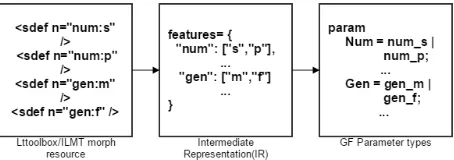
In this section, we describe our approach of con-verting LTtoolbox and ILMT morph resources into GF morph resources. The steps of conversion is presented in the figure 1.
Our approach converts the morphological pro-cessors available either in XML or ILMT syn-tax format and converts them into Grammatical
Framework. The key idea here is that Grammat-ical Framework is a programming language with a definite syntax and we need to transform the given morphological processors such that they ad-here to Grammatical Framework’s syntactic struc-ture. This calls for the need to change morpholog-ical processors into non-ambiguous, permissible units which are supported by Grammatical Frame-work. Some examples of above mentioned chal-lenges are as follows. Further details regarding these decisions are described in algorithms men-tioned below.
• As already mentioned in above sections,
Lt-toolbox supports paradigms which depend on variable number of parameters whereas Grammatical Framework only supports de-pendence on pre-determined parameters. So we need to analyze all paradigms and their dependencies to find the specific occurrences and transform them into tabular syntax struc-ture, supported by Grammatical Framework.
• Some attributes present in the source files
(e.g. numeric attributes, duplicate attributes) cannot be transformed directly into GF e.g. parsarg = 0. We chose to modify the parame-ters to include the actual parameter value and other contextual information e.g. the param-eter type, the paradigm name etc.
4.1 Detecting Grammar
In this step, we classify the user input as Lttool-box or ILMT morph resource. This is a relatively simple step because of widely different syntaxes of both morph resources. We accomplish this us-ing syntax-based heuristics.
4.2 Analyzing Grammar
In this step, we take the respective grammar, parse it and then convert into an intermediate represen-tation (IR). The motivation behind this step is to reduce complexity for the following steps i.e Gen-erating parameters and operations.
across different sources. So we convert it into XML using the same structure as in Lttoolbox, to make the conversion process more generalized. Once we have the XML source, we will convert it into IR by using the algorithm shown in Algo-rithm.1.
Algorithm 1“Algorithm for Analyze Grammar ” features ={} .sdef - represents the set of all
symbol definitions
fors∈sdef do .s contains lexical features
and lexical values
features[s.lexical-feature].add(s.lexical-value)
paradigms ={} .pardef - represents the set of paradigm definitions
forp∈pardefdo
root = p(n) .root word
fore∈pdo .e is an entry in paradigm
definition .e contains feature set and word
form
paradigms[root].add(e.feature-set,e.word-form)
returnfeatures,paradigms
In algorithm 1, we are converting symbol defini-tions and paradigm definidefini-tions into IR (i.e features and paradigms).
4.3 Generating Parameters
In this step, we use the features from IR to gen-erate parameters and their constructors, using the algorithm shown in Algorithm 2. The function
Algorithm 2“Algorithm for generating parameters ”
forf∈featuresdo .features from IR .f
contains feature names and values buildParameters(f.name, f.value)
buildParameters generates GF syntax (parameters and corresponding constructors) for a given fea-ture name and its values. For example call-ing the function buildParameters with arguments (Num,[num s,num p]) returns
Num = num_s | num_p;
Listing 5: “Example Parameter Syntax in GF ”
4.4 Generating Operations
[image:4.612.317.544.38.118.2]In this step, we use the IR ( features, paradigms ) to generate operations using the algorithm given in
Figure 2: The entire process of generating param-eters 1.Lttoolbox/ILMT morph as given by user 2.IR created in the previous step 3.GF morph re-source parameters created in the present module.
Algorithm 3“Algorithm for generating operations ”
function BUILDOPERATIONS(features, paradigms)
forp∈paradigmsdo
buildDecalara-tion(p,dependentFeatures)
buildTable(features,p,dependentFeatures)
return
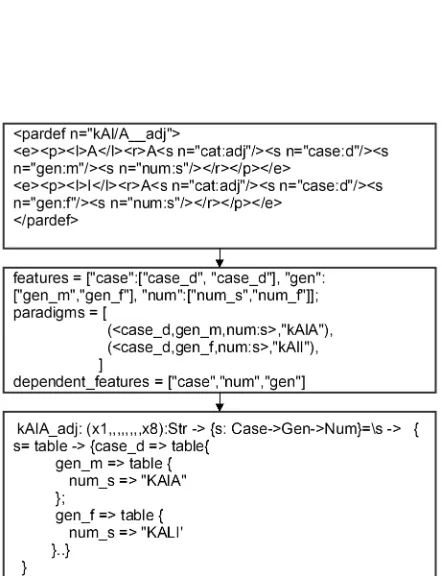
Algorithm 3. The function buildOperations builds operations for each paradigm. As explained in the above section, each operation consists of dec-laration and description which are generated by buildDeclaration and buildTable respectively. To do this we need to keep track of all the features used for a paradigm. So we built a helper function which does this by iterating through all the entries in the paradigm.
For example, calling buildDeclaration with arguments (case,gen,num) produces the x1,,,,,,x8:Str -> Case => Gen => Num => Str
(we used x1-x8 because each feature has two values, total possible values in table are 2x2x2 = 8).
The function buildTable recursively builds the table which is used to generate the possible word forms for a given lemma in GF, using the algo-rithm shown in Algoalgo-rithm 4.
4.5 Code and Datasets
The entire code base has been written in Python. The description of datasets are shown in Table 1. Code and datasets are publicly available under open-source license.1.
1https://github.com/harshavardhangsv/
automaticMorphResourceConverter
Algorithm 4“Algorithm for building table”
function BUILDTABLE(features,paradigm, de-pendentfeatures)
ifdependentFeatures is emptythen return
fordf∈dependentFeaturesdo
forv∈features[df]do
v =>buildTable(features, paradigm,
rest(dependentFeatures))
[image:5.612.81.302.201.489.2].rest(1,2,3) = 2,3
Figure 3: This figure explains the process of gen-erating operations. 1.Lttool/ILMT morph resource given by user 2.variables state in IR form 3.GF syntax operations created from the buildTable
Dataset # of paradigms # of words
Hindi 57 26356
Tamil 254 34290
Oriya 45 2860
Bengali 148 5478
Table 1: Description of Datasets
5 Evaluation and Error Analysis
We measure the accuracy of the converter in the following way. The same text is given to both GF analyzer and the original source tool (LTtool-box and ILMT). We verify that the output of GF analyzer and the original source tool is identical. Thus we ensure that information is faithfully trans-ferred. We found that there is no loss of data for the chosen languages i.e Hindi, Oriya, Tamil and Bengali. This evaluation is repeated for various random news articles and 100% information was preserved in the output. However, we have come across with some problems in converting Sanskrit and Marathi morph resources. These problems are mainly caused due to presence of language-specific syntax which we had trouble in generaliz-ing. Even though we had some troubles, we have found that, after analyzing files manually, our ap-proach will still be able to make the automated conversion to around 65%.
6 Conclusion and Future Work
In this paper, we have explained the process of creating an automatic converter which de-terministically converts morphological processor from different formats into GF format without any information loss for Hindi, Oriya and Tamil. We are presently working on other Indian lan-guages such as Marathi, Sanskrit and Telugu. We have observed that if there exists any language specific morpho-syntactic information in the re-source, conversion of such resources requires ad-ditional work. At present we are converting morph resources created in Lttoolbox and ILMT morph format.
In future we might come across a morphologi-cal processor developed in another framework. In order to bring the complete genericness into our tool, we want to modularize our system. We in-tend to develop a generic system that first asks the user about the format of their morphological pro-cessor and then activate the right module for the conversion. We hope that with our effort we will be able to offer a NLP resource to the community which will eradicate the barrier of framework dif-ferences.
References
Gregoire Dietrez and Ranta Aarne. 2014. Sharing
[image:5.612.80.269.623.691.2]chine translation systems: Grammatical Framework and Apertium. LREC.
Ithisree Jena, Dipti M. Sharma 2011. Developing
Oriya Morphological Analyzer Using Lt-Toolbox . Communications in Computer and Information Sci-ence pp.124-129.
Mikel L. Forcada, Mireia Ginest-Rosell, Jacob Nord-falk, Jim ORegan, Sergio Ortiz-Rojas, Juan Antonio Prez-Ortiz, Felipe Snchez-Martnez, Gema
Ramrez-Snchez and Francis M. Tyers 2011. Apertium: a
free/open-source platform for rule-based machine translation . In Machine Translation: Volume 25, Issue 2 (2011), p. 127-144.
Muhammad Humayoun , Ranta Aarne 2011.
Devel-oping Punjabi Morphology, Corpus and Lexicon . Proceedings of the 24th Pacific Asia Conference on Language, Information and Computation.
Ranta Aarne 2003.A revised version of the on-line GF tutorial, v1.0.. In A. Beckmann and N. Preining, editors, ESSLLI Course Material I (2003).
Ranta Aarne 2004. Grammatical Framework: A
Type-Theoretical Grammar Formalism. The Journal of Functional Programming 14(2) (2004) 145189.
Ranta Aarne 2009. The GF Resource Grammar
Li-brary: A systematic presentation of the library from the linguistic point of view. Linguistics in Language Technology, 2(2).
Ranta Aarne 2009. Grammars as Software Libraries.
From Semantics to Computer Science, Cambridge University Press, Cambridge, pp. 281- 308.
Sampark: Machine Translation
Sys-tem among Indian languages 2009.
http://tdildc.in/index.php?option=com vertical &parentid=74, http://sampark.iiit.ac.in/.