Call Centre Conversation Summarization: A Pilot Task at Multiling 2015
Benoit Favre1, Evgeny Stepanov2, J´er´emy Trione1, Fr´ed´eric B´echet1, Giuseppe Riccardi2 1 Aix-Marseille University, CNRS, LIF UMR 7279, Marseille, France
2 University of Trento, Via Sommarive 5, Trento, Italy [email protected]
Abstract
This paper describes the results of the Call Centre Conversation Summarization task at Multiling’15. The CCCS task consists in generating abstractive synopses from call centre conversations between a caller and an agent. Synopses are summaries of the problem of the caller, and how it is solved by the agent. Generating them is a very challenging task given that deep analysis of the dialogs and text generation are necessary. Three languages were ad-dressed: French, Italian and English trans-lations of conversations from those two languages. The official evaluation metric was ROUGE-2. Two participants submit-ted a total of four systems which had trou-ble beating the extractive baselines. The datasets released for the task will allow more research on abstractive dialog sum-marization.
1 Introduction
Speech summarization has been of great interest to the community because speech is the princi-pal modality of human communications, and it is not as easy to skim, search or browse speech transcripts as it is for textual messages. Speech recorded from call centres offers a great oppor-tunity to study goal-oriented and focused conver-sations between an agent and a caller. The Call Centre Conversation Summarization (CCCS) task consists in automatically generating summaries of spoken conversations in the form of textual syn-opses that shall inform on the content of a con-versation and might be used for browsing a large database of recordings. Compared to news sum-marization where extractive approaches have been very successful, the CCCS task’s objective is to foster work on abstractive summarization in order
to depict what happened in a conversation instead of what people actually said.
The track leverages conversations from the De-coda and Luna corpora of French and Italian call centre recordings, both with transcripts available in their original language as well as English trans-lation (both manual and automatic). Recordings duration range from a few minutes to 15 minutes, involving two or sometimes more speakers. In the public transportation and help desk domains, the dialogs offer a rich range of situations (with emo-tions such as anger or frustration) while staying in a coherent and focused domain.
Given transcripts, participants to the task shall generate abstractive summaries informing a reader about the main events of the conversations, such as the objective of the caller, whether and how it was solved by the agent, and the attitude of both par-ties. Evaluation has been performed by compar-ing submissions to reference synopses written by quality assurance experts from call centres. Both conversations and reference summaries are kindly provided by the SENSEI project.
This paper reports on the results of the CCCS task in term ROUGE-2 evaluation metric. Two participants have submitted four systems to the task. In addition, we provide three baselines which frame the performance that would be obtained by extractive systems. The results are analysed ac-cording to language, human annotator coherence and the impact of automatic translation.
The remaining of the paper is organized as fol-lows: Section 2 describes the synopsis generation task. Section 3 describes the CCCS corpus. Sec-tion 4 describes the results from the systems of the participants. Section 5 discusses future research avenues.
2 Task
The CCCS task consists in creating systems that can analyse call centre conversations and generate
written summaries reflecting why the customer is calling, how the agent answers that query, what are the steps to solve the problem and what is the resolution status of the problem.
Unlike news summarization which focuses on locating facts in text written by journalists and se-lecting the most relevant facts, conversation syn-opses require an extra level of analysis in order to achieve abstraction. Turn taking from the speakers has to be converted to generic expression of their needs, beliefs and actions. Even though extractive systems might give a glimpse of the dialogs, only abstraction can yield synopses that tell the story of what happens in the conversations.
Contrary to previous research on meeting sum-marization (Gillick et al., 2009; Erol et al., 2003; Lai and Renals, 2014; Wang and Cardie, 2012) (among others), we expect that the fact that con-versations are focused and goal oriented will en-able to foster research on more abstractive meth-ods, such as (Murray, 2015; Mehdad et al., 2013) and deeper analysis of the conversations.
Participants to the CCCS task could submit sys-tem output in any of the supported languages, and could submit a maximum of three runs per lan-guage. For each conversation, they had to submit one synopsis of length 7% of the number of words of the transcript of that conversation.
3 Corpus description
The CCCS task draws from two call centre conver-sation corpora, the Decoda corpus in French and the Luna corpus in Italian. Subsets from both cor-pora have been translated to English.
Decoda corpus The French DECODA corpus consists in conversations between customers and one or more agent recorded in 2009 in a call centre of the public transport authority in Paris (Bechet et al., 2012). The topics of the conversations range from itinerary and schedule requests, to lost and found, to complaints (the calls were recorded dur-ing strikes). The dialogues, recorded in ecologi-cal conditions, are very spontaneous and focused on the objective of the caller. They are very chal-lenging for Automatic Speech Recognition due to harsh acoustic conditions such as calling from mo-bile phones directly from the metro. For the CCCS task, manual transcripts were provided to the par-ticipants.
While the original language of the conversa-tions is French, the SENSEI project provided
man-ual translations in English by professional transla-tors which were trained to keep the spontaneous aspects of the originals (a very challenging task ac-cording to them). 97 conversations were manually translated, on which an automatic translation sys-tem based on Moses was trained in order to pro-duce automatic translations for the remaining of the corpus.
The original corpus consists of 1513 conversa-tions (about 70h of speech). 1000 conversaconversa-tions have been distributed without synopses for unsu-pervised system training. 50 conversations were distributed with multiple synopses from up to five annotators. The test set consists of 47 manually translated conversations and corresponding syn-opses, and 53 automatically translated conversa-tions and corresponding synopses. The data for training and testing is also provided in French.
Statistic FR EN
Conversations 100 100
Turns 7,905 7,909
Words 42,130 41,639 Average length 421.3 416.4 Lexicon size 2,995 2,940 Number of synopses 212 227 Average synopsis length 23.0 26.5
Table 1: Decoda test set statistics.
The human written synopses are very diverse and show a high degree of abstraction from the words of the conversation with third person writ-ing, telegraphic style and analysis of the conversa-tions. Examples:
• A man is calling cause he got a fine. He is waiting for a new card so he used his wife’s card. He must now write a letter asking for clemency.
• A user wants to go to the Ambroise Par´e clinic but the employee misunderstands and gives her the wrong itinerary. Luckily the em-ployee realises her mistake and gives the pas-senger the right information in the end.
• School bag lost on line 4, not found.
client and an agent are engaged in a problem solv-ing task over the phone. The dialogs are organised in transcriptions and annotations created within the FP6 LUNA project. For the CCCS shared task, manual transcriptions were used.
Within the FP7 SENSEI project, 100 dialogs were translated from Italian to English using professional translation services according to the methodology described in (Stepanov et al., 2014). For more accurate translations, manual transcrip-tions were converted to an ‘annotated’ text format, which contained mark-up for overlapping turns, fillers, pauses, noise, partial words, etc.; and trans-lators received detailed guidelines on how to han-dle each phenomenon in translation. Addition-ally, the translators were required to translate the speech phenomena such as disfluencies as closely as possible to the source language maintaining ‘naturalness’ in the target language.
Five native Italian speakers have annotated 200 Luna dialogs with synopses so that each dialog was processed by every annotator.1 Synopses of the 100 translated dialogs were also manually translated to English.
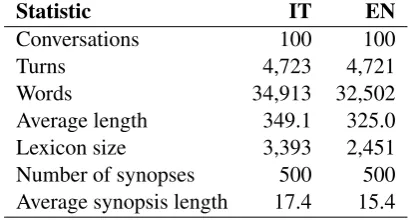
The translated and annotated dialogs were equally split into training and test sets for the CCCS task. The training dialogs were used to au-tomatically translate additional Luna dialogs and synopses for both training and testing. Similar to the DECODA corpus, for the unsupervised train-ing of the systems a supplementary set of 261 di-alogs was automatically translated and provided to the participants without synopses. Dialogs and their associated synopses were provided both in English and Italian. The statistics for Luna manual English test set are provided in Table 2.
Statistic IT EN
Conversations 100 100
Turns 4,723 4,721
[image:3.595.78.285.580.690.2]Words 34,913 32,502 Average length 349.1 325.0 Lexicon size 3,393 2,451 Number of synopses 500 500 Average synopsis length 17.4 15.4
Table 2: Luna test set statistics.
1Few (2) synopses were found to address dialog dimen-sions other than the task and were removed.
4 Results
Metric Evaluation is performed with the ROUGE-2 metric (Lin, 2004). ROUGE-2 is the recall in term of word bigrams between a set of reference synopses and a system submission. The ROUGE 1.5.5 toolkit was adapted to deal with a conversation-dependent length limit of 7%, had lemmatization disabled and stop-words kept, to be as language independent as possible2. Jackknifing and resampling is used in order to compute confidence estimate intervals.
Participation Seven research groups had orig-inally expressed their intention to participate to the CCCS task. Four groups downloaded the test data, and two groups actually submitted system output at the deadline. Those two groups gen-erated four runs: NTNU:1, NTNU:2, NTNU:3,
LIA-RAG:1. The technical details of these sub-missions are described in their own papers.
In addition to those four runs, we provide three baselines which serve to calibrate partici-pant performance. The first baseline is Maxi-mal Marginal Relevance (Baseline-MMR) (Car-bonell and Goldstein, 1998) with λ = 0.7. The second baseline is the first words of the longest turn in the conversation, up to the length limit (Baseline-L). The third baseline is the words of the longest turn in the first 25% of the conversa-tion, which usually corresponds to the description of the caller’s problem (Baseline-LB). Those baselines are described in more details in (Trione, 2014).
In order to estimate the overlap between hu-man synopses, we remove each of the huhu-man syn-opses in turn from the reference and compute their performance as if they were systems. Across languages, 11 annotators (denoted human-1 to
human-5for IT/EN, andhuman-Atohuman-G
for FR/EN) produced from 5 to 100 synopses. Note that some annotators only worked on English conversations.
Performance Performance of the systems is re-ported in Table 3. It shows that in the source lan-guages, the extractive baselines were difficult to beat while one of the systems significantly outper-formed the baselines on English (the EN test set
2The options for running ROUGE 1.5.5 are -a -l
corresponds to the union of manual and automatic translations).
System EN FR IT
NTNU:1 0.023 0.035 0.013 NTNU:2 0.031 0.027 0.015 NTNU:3 0.024 0.034 0.012 LIA-RAG:1 - 0.037 -Basline-MMR 0.029 0.045 0.020 Basline-L 0.023 0.040 0.015 Basline-LB 0.025 0.046 0.027
Table 3: ROUGE-2 performance of the submitted systems and baselines for each of the languages. Confidence intervals are not given but are very tight (±0.005).
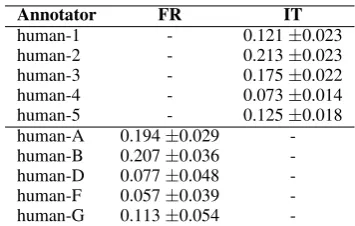
An analysis of the consistency of human synop-sis writers is outlined in Table 4. Consynop-sistency is computed by considering in turn each of the hu-man synopses as system output, and computing ROUGE-2 performance. Humans have much bet-ter scores than the systems, showing that they are consistent in producing the gold standard. How-ever, human annotators suffer from a much higher performance variance than systems (for which confidence intervals are 4-5 times smaller). This partly comes from the low number of manual syn-opses which is greater impacted by resampling than if there were hundreds of references for each conversation. It also comes from local inconsis-tencies between humans on a given conversation, resulting in diverging choices in term of which in-formation is important.
Annotator FR IT
human-1 - 0.121±0.023
human-2 - 0.213±0.023
human-3 - 0.175±0.022
human-4 - 0.073±0.014
human-5 - 0.125±0.018
human-A 0.194±0.029 -human-B 0.207±0.036 -human-D 0.077±0.048 -human-F 0.057±0.039 -human-G 0.113±0.054
-Table 4: ROUGE-2 performance of the human an-notators along with confidence intervals. Note that human-C and human-E only produced synopses in English.
Table 5 shows the impact of automatic transla-tion on system performance for the English set. This experiment is hard to interpret as the set of conversations for automatic and manual
transla-tions is different. However, it seems that pro-cessing MT results leads to better ROUGE scores, probably due to the consistency with which the MT system translates words for both conversa-tions and synopses (reference synopses are auto-matic translations of source language synopses for those conversations).
Annotator EN-man EN-auto
NTNU:1 0.018 0.023 NTNU:2 0.019 0.031 NTNU:3 0.015 0.024 Baseline-MMR 0.024 0.033 Baseline-L 0.015 0.030 Baseline-LB 0.023 0.027 Table 5: ROUGE-2 performance on English ac-cording to whether the conversations have been manually translated or automatically translated
5 Conclusion
The objective of the CCCS pilot task at Multi-ling’15 was to allow work on abstractive sum-marization of goal-oriented spoken conversations. This task involved generating synopses from French and Italian call centre recording scripts, and English translations of those tran-scripts. Four systems were submitted by two par-ticipants, and obtained reasonable results but had trouble exceeding the performance of the extrac-tive baselines.
Clearly, ROUGE evaluation is limited for ab-stractive summarization in that the wording of generated text might be very different from sys-tem to syssys-tem, and from reference to reference, while conveying the same meaning. In addition, ROUGE does not assess fluency and readability of the summaries.
Future work will focus on proposing better eval-uation metrics for the task, probably involving the community for manually evaluating the fluency and adequacy of the submitted system output. In addition, work will be conducted in evaluating and insuring the consistency of the human experts who create the gold standard for the task.
Acknowledgments
[image:4.595.91.269.524.637.2]References
Frederic Bechet, Benjamin Maza, Nicolas Bigouroux, Thierry Bazillon, Marc El-Beze, Renato De Mori, and Eric Arbillot. 2012. Decoda: a call-centre human-human spoken conversation corpus. In Nico-letta Calzolari (Conference Chair), Khalid Choukri, Thierry Declerck, Mehmet Uur Doan, Bente Mae-gaard, Joseph Mariani, Asuncion Moreno, Jan
Odijk, and Stelios Piperidis, editors, Proceedings
of the Eight International Conference on Language Resources and Evaluation (LREC’12), Istanbul, Turkey, may. European Language Resources Asso-ciation (ELRA).
Jaime Carbonell and Jade Goldstein. 1998. The use of mmr, diversity-based reranking for reordering
doc-uments and producing summaries. InProceedings
of the 21st annual international ACM SIGIR confer-ence on Research and development in information retrieval, pages 335–336. ACM.
Marco Dinarelli, Silvia Quarteroni, Sara Tonelli, Alessandro Moschitti, and Giuseppe Riccardi. 2009. Annotating spoken dialogs: from speech
seg-ments to dialog acts and frame semantics. In
Pro-ceedings of EACL Workshop on the Semantic Repre-sentation of Spoken Language, Athens, Greece. Berna Erol, D-S Lee, and Jonathan Hull. 2003.
Mul-timodal summarization of meeting recordings. In
Multimedia and Expo, 2003. ICME’03. Proceed-ings. 2003 International Conference on, volume 3, pages III–25. IEEE.
Daniel Gillick, Korbinian Riedhammer, Benoit Favre,
and Dilek Hakkani-Tur. 2009. A global
op-timization framework for meeting summarization. In Acoustics, Speech and Signal Processing, 2009. ICASSP 2009. IEEE International Conference on, pages 4769–4772. IEEE.
Catherine Lai and Steve Renals. 2014. Incorporat-ing lexical and prosodic information at different
lev-els for meeting summarization. InFifteenth Annual
Conference of the International Speech Communi-cation Association.
Chin-Yew Lin. 2004. Rouge: A package for automatic
evaluation of summaries. In Text Summarization
Branches Out: Proceedings of the ACL-04 Work-shop, pages 74–81.
Yashar Mehdad, Giuseppe Carenini, Frank W Tompa, and Raymond T NG. 2013. Abstractive meeting
summarization with entailment and fusion. In
Pro-ceedings of the 14th European Workshop on Natural Language Generation, pages 136–146.
Gabriel Murray. 2015. Abstractive meeting
summa-rization as a markov decision process. InAdvances
in Artificial Intelligence, pages 212–219. Springer. Evgeny A. Stepanov, Giuseppe Riccardi, and Ali Orkan
Bayer. 2014. The development of the multilingual luna corpus for spoken language system porting. In
Proceedings of the Ninth International Conference on Language Resources and Evaluation (LREC’14), pages 2675–2678, Reykjavik, Iceland, May. Jeremy Trione. 2014. Mthodes par extraction pour le
rsum automatique de conversations parles provenant
de centres dappel. InRECITAL.