IDENTIFYING INSTANCES OF PROCESSING
EFFORT IN TRANSLATION THROUGH HEAT MAPS:
an eye-tracking study using multiple input sources
Fabio ALVES1, José Luiz GONÇALVES2, Karina SZPAK1
(1) FEDERAL UNIVERSITY OF MINAS GERAIS (UFMG), Av. Antonio Carlos 6627, Belo Horizonte/MG, 31.270-901, Brazil
(2) FEDERAL UNIVERSITY OF OURO PRETO (UFOP), Rua do Seminário, S/N, Mariana/MG, 35.420-000, Brazil
[email protected], [email protected],[email protected]
ABSTRACT
Drawing on the seminal work of Just and Carpenter (1980), eye fixations have been used extensively to analyse instances of processing effort in studies of reading and writing processes. More recently, eye tracking has also been applied to experimental studies in translation process research (Jakobsen and Jensen 2008, Pavlović and Jensen 2009, Alves, Pagano and Silva 2009, Hvelplund 2011, Carl and Kay 2011, Carl and Dragsted 2012, among others). In most of these works, eye-tracking data have provided input for quantitative analyses of fixation count and duration in areas of interest in source and target texts. From a linguistic perspective, however, studies using eye-tracking data are considered rather complex since eye fixations tend to vary considerably among subjects. This paper attempts to tackle this issue by proposing a methodological approach that uses overlapped heat maps of different subjects to select and analyse translation problems. The results yield relevant findings for eye-tracking research in translation.
1 Introduction
According to Hvelplund (2011), the allocation of cognitive resources in translation is essentially an information-processing task and research using eye-tracking data as indicators of cognitive processing (Just and Carpenter 1980, Rayner 1998, Duchowski 2007) rests on the overall assumption that eye-tracking data can be interpreted as correlates of on-going cognitive processing of source and/or target texts. Building on Just and Carpenter’s (1980) seminal work, analyses based on the eye-mind assumption suggest that eye fixations can be used as a window into instances of effortful cognitive processing. In more recent years, eye tracking has been used in translation process research to try to locate instances of effortful processing in translation. The works of Jakobsen and Jensen (2008), Pavlović and Jensen (2009), Alves, Pagano and Silva (2009), Alves, Pagano, Neumann, Steiner and Hansen-Schirra (2010), Hvelplund (2011), Carl and Kay (2011), and Carl and Dragsted (2012), among others, have shown that eye fixations differ in areas of interest (AOIs) found in source and/or target texts and, thus, suggest interesting implications in terms of reading/writing for translation.
Jakobsen and Jensen (2008) examined differences in reading for different purposes, namely reading for understanding, for translating, for sight translation and for written translation. Their results indicate that, as measured in terms of fixation duration, translators allocate more cognitive effort to target text (TT) processing rather than to correlated instances in source texts (ST). The results of Jakobsen and Jensen suggest that there is some evidence, although preliminary, that TT processing requires more cognitive effort than ST processing.
Pavlović and Jensen’s (2009) investigated directionality in translation by observing the performance of professional and novice translators. They employed three eye-movement indicators, namely, total gaze time, fixation duration during ST and TT processing, and pupil dilation, to measure cognitive effort. Corroborating Jakobsen and Jensen’s (2008) results, Pavlović and Jensen have also shown that TT processing requires more cognitive effort than ST processing and that ST comprehension and TT production are two processes which differ in terms of the cognitive effort.
The studies reported above used relatively small samples of eye-tracking data and, therefore, their statistical analyses are based on very small populations. As a word of caution, Jakobsen and Jensen (2008: 108) point out that “with such a small sample, any free variable can cause havoc in the data”. More recent studies have thus tried to use larger population samples to increase the statistical significance of their results.
Carl and Kay (2011) also analysed shifts of attention with respect to the segment being processed and segments that lie ahead. They report that a production pause of more than 1000ms in text production is likely to represent a shift of attention towards another segment. Their results have shown that professional translators are capable of typing a translation while already reading ahead in the ST, whereas novice translators often resort to a sequential mode and can only carry out one activity at the same time, thus alternating between actions related to reading and writing.
Carl and Dragsted (2012) have used eye-tracking data to investigate differences between copying and translations tasks. They have shown that translators often resort to sequential reading and writing patterns that seem to be triggered through TT production problems. Carl and Dragsted found evidence of more processing effort during translation than during copying tasks. This indicates more sequential reading/writing processes in translation, whereas parallel reading and writing activities appear to be more prevalent during copying tasks.
In these recent works, eye-tracking data have been studied with a focus on statistical significance and have provided relevant insights into how the translation process unfolds in terms of the allocation of processing effort. However, as Alves, Pagano and Silva (2009) have shown, a fine-grained linguistic analysis of translation problems may also shed light onto relevant aspects of cognitive processing in translation. They claim that such analyses require an account provided by a pertinent linguistic theory. This point has also been addressed by Alves, Pagano, Neumann, Steiner and Hansen-Schirra (2010) in their analysis of micro/macro translation units (cf. Alves and Vale 2009). Alves and Gonçalves (forthcoming) have drawn on Relevance Theory (Sperber and Wilson 1986/1995) and its effort/effect relation to offer an insightful alternative for such fine-grained linguistic analysis by investigating the allocation of effort from a relevance-theoretic perspective. However, Alves and Gonçalves only analysed key-logged data although eye-tracking data had also been collected in their experimental design.
From a linguistic perspective, studies using eye-tracking data are still incipient and considered rather complex since eye fixations tend to vary considerably among subjects. In this paper, we attempt to fill this gap by using eye-tracking data to supplement Alves and Gonçalves’s (forthcoming) analyses of macro translation units and propose a methodological framework that extracts individually gaze-relevant data and combines them into sets of overlapped heat maps which highlight instances where processing effort is greater for a given number of subjects. We claim that this methodological approach can offer an alternative to carry out linguistic analyses of eye-tracking data in translation process research.
2 Theoretical underpinnings
In relevance-theoretic terms, the function of conceptual expressions (i.e., open lexical categories, such as nouns, adjectives and verbs) is to convey conceptual meaning which is propositionally extendable and contributes to expanding the inferential processing of an utterance, whereas the function of procedural expressions is to activate domain-specific cognitive procedures (i.e., morph-syntactic constraints in utterance processing) and contributes to constraining the inferential processing of these same utterances. Relevance Theory assumes that the conceptual-procedural distinction guides inferential processing. And since most content words also carry some procedural meaning (Wilson 2011), therefore, processing effort in translation should concentrate more on instances of procedural than conceptual encodings.
The studies of Alves (2007) and Alves and Gonçalves (2003) have show there is a relation between processing effort and cognitive effect in translation and also that the conceptual-procedural distinction plays a role in such processes. However, these were small-scale studies that only offered qualitative results. Using a larger population, Alves and Gonçalves’s (forthcoming) have tried to build on the previous relevance-theoretic findings and corroborate them by means of statistical analyses. They have used key-logged data to map instances of conceptual and procedural encodings onto micro/macro translation units (cf. Alves and Vale 2009, 2011). Their results show that procedural encodings demand more processing effort both in direct and inverse translation tasks. According to Alves and Vale (2011: 107), a micro translation unit (TU) is defined as “[…] the flow of continuous target text production – which may incorporate the continuous reading of source and target text segments – separated by pauses during the translation process as registered by key-logging and/or eye-tracking software. It can be correlated to a source text segment that attracts the translator’s focus of attention at a given moment.” A macro TU, on the other hand, is “[…] defined as a collection of micro TUs that comprises all the interim text productions that follow the translator’s focus on the same ST segment from the first tentative rendering to the final output that appears in the TT.” Alves and Vale classify macro TUs with editing procedures taking place only in the drafting phase as P1. Those macro TUs that are produced once in the drafting phase and changed only in the revision phase are classified as P2. Finally, those macro TUs that undergo editing procedures both during drafting and revision are classified as P3. Alves and Gonçalves’s (forthcoming) have broadened Alves and Vale’s (2011) taxonomy to include a P0 unit, corresponding to micro TUs that do not undergo any editing at all and, therefore, are also considered macro TUs for annotation purposes.
The results of Alves and Gonçalves’s (forthcoming) suggest that the allocation of cognitive resources in translation can be illustrated as P0>P1>P3>P2. Drawing on relevance-theoretic assumptions, the authors argue that subjects concentrate editing procedures within or very close to the respective initial micro TU and systematically attempt to reduce processing effort in order to optimize the resources in their cognitive environments. If they postpone the solution to a problem, or only fully realize this problem later on, the required processing effort needed to re-activate relevant information will be counter-productive in terms of cognitive processing economy. This is consistent with the relevance-theoretic framework, since additional processing effort diminishes the relevance of the cognitive effects.
Alves and Gonçalves have also found that the total number of occurrences for conceptual and procedural encoding editing procedures is highest in P1, followed by P3. They assume that this can be interpreted in terms of allocation of processing effort to phases in the translation process, indicating where this effort is greater. In P1, subjects interrupt the cognitive flow to deal with more immediate processing problems. In P3, however, problem solving is postponed to the end-revision phase. Their results point to prevalence of processing effort for procedural encodings in absolute terms, particularly in P1 and P3 where processing effort seems to be concentrated.
An interesting question that emerges from the study of Alves and Gonçalves’s (forthcoming) is whether an analysis of eye-tracking data from the same subjects would also corroborate the assumption that eye fixations should be higher and longer in instances of P1 and P3. It would also be interesting to find out if the number of eye fixations would be higher in instances of procedural encodings. However, this would be extremely time-consuming if the whole set of data were to be analysed. In this paper, we propose a methodology to analyse selected instances of translation problems on the basis of overlapped heat maps to provide a fine-grained analysis on the basis of a smaller but yet relevant set of data.
3 Methodology
The overall goal was to investigate whether subject’s performance differed in terms of processing conceptual and procedural encodings while performing a DT and an IT task. As explained in the theoretical section, the same data set was analysed by Alves and Gonçalves (forthcoming) to investigate processing effort in translation from a relevance-theoretic perspective. Their results showed that instances of procedural encodings require more processing effort than cases of conceptual encodings. However, Alves and Gonçalves only analysed key-logged data. As the replication of their methodology using eye-tracking data would be extremely time consuming for the whole data set, we propose here a methodological alternative that focuses on a smaller set of selected examples to see if they yield similar results in relevance-theoretic terms.
3.1 Internal and external support as input for eye-tracking data A major methodological problem in the analysis of conceptual and procedural encodings would be the impact of external support in the complete data set. During task execution, subjects often deviate their gaze from the computer screen or open other windows to look up dictionary entries and/or perform web searches. These actions are an integral part of the translation process but are of no particular interest for the investigation of conceptual and procedural encodings. Therefore, data related to external support had to be filtered out from data related to internal support, i.e, those instances when translators effectively dealt with the linguistic processing of conceptual and procedural encodings.
3.1.1 Filtering out external support from eye-tracking data
As a first step into that direction, the eye-tracking recordings from Jane, Cycy, Adam, Jim, Will, Mona, Tess, and Rui, the fictitious names for the 8 professional translators who volunteered as subjects, were screened using the software Tobii Studio. Altogether there were 32 recordings, 8 from each DT or IT task. As shown in Figure 1, each recording was edited to create a set of scenes which only contained eye-tracking data directly related to internal support. In other words, the filtered data did not show instances of consultations or gaze deviations from the screen and provided access to the linguistic processing of instances of conceptual and procedural encodings.
Using the Tobii Studio replay mode, we selected those stretches of the translation process which related to internal support only. This can be seen in the centre of Figure 1. On the bottom part of the screen, one can visualize the process time line shown in the selection bar. One can click on the white parts of the cursor and drag the mouse to create the desired scenes which are then shown in red and stored by the software. The set of scenes from each subject can be retrieved by clicking on the icon scenes on the bottom part of the computer screen. As a second step, sets of scenes of internal support from each subject were combined to create a set of scenes from the eight subjects for each of the four translation tasks. Thus, the Tobii Studio Add Selection to Scene tool was used to group eye-tracking data of all eight subjects and generate four sets of eye-tracking data, two pertaining DT tasks (DT_1 and DT_2) and two others related to IT tasks (IT_1 and IT_2).
3.2 Extracting heat maps
The creation of individual and group scenes related to internal support aimed at identifying through heat maps those areas of STs and TTs where eye fixations were longer. We expected subjects to show idiosyncratic gaze patterns and, therefore, heat maps would differ among them. However, by overlapping eight correlated sets of scenes, we were able to generate heat maps which are representative of each task in terms of eye fixations. Heat maps provided by Tobii Studio show both fixation count and fixation duration from a graphic perspective according to visual activity. Areas with higher fixation count and longer duration are shown in red and shades become orange, yellow or green as visual activity decreases in intensity. Such activities are easily identified in both ST and TT areas. Instances where those fixations were longer were then considered to be potential candidates for translation problems that were cognitively relevant for all subjects in terms of processing effort. For the purposes of this paper, we would argue that fixation count is a reliable measure for assessing cognitive effort since there is a tendency for fixations to converge to an average duration when dealing with a great deal of occurrences.
3.2.1 Extracting individual heat maps
From the individual scene sets that had been created by filtered data of internal support only, heat maps were generated for each subject. Using the Tobii Studio visualization mode, we selected the desired scenes and clicked on the heat map icon to generate them automatically. Figure 2 shows individual heat maps for the data set 1, comprising DT task 1 and DT task 2 while Figure 3 displays the individual heat maps for data set 2, comprising IT task 1 and IT task 2.
FIGURE 2 – Individual heat maps for data set 1.
The same procedure was repeated for the filtered data related to the execution of IT tasks. Figure 3 shows individual heat maps for the data set 2, comprising IT task 1 and IT task 2.
3.2.2 Extracting overlapped heat maps
[image:9.420.103.334.221.330.2]A methodological alternative to avoid the undesired impact of idiosyncratic patterns is to overlap the eight individual heat maps for each of the four translation tasks. Using the Tobii Studio Add Selection to Scene tool, used to group eye-tracking data, it is possible to generate heat maps which show where eye fixations are longer for all the eight subjects together. These red areas are then considered potential candidates for translation problems which are cognitively relevant in terms of processing effort for the eight subjects on the whole.
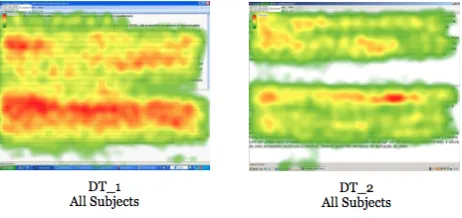
Figure 4 shows heat maps for the data set 1, comprising DT tasks 1 and 2. In both tasks eye fixations are longer at the beginning of the English STs and on the first paragraph of the TT area which corresponds to the rendering of the translation into Portuguese. In our approach, we are not particularly concerned whether fixations are longer in ST or TT AOIs. Our interest lies explicitly on the linguistic encodings related to areas of stronger visual activity and to the features they convey.
FIGURE 4 – overlapped heat maps for DT – data sets 1 and 2.
Looking at the heat maps, one notices that some parts at the bottom of TT in DT_2 seem uncovered. It is important to point out that this is not related to eye-tracking data quality. It happens because, when heat maps are overlapped, the generated image shows the occurrences of all fixations statically. Individual heat maps displayed in Figures 2 and 3 show that such areas were indeed covered. The overlapped heat maps for TTs serve as an approximate indicator of the common region for the identification of problems while the translations were being drafted. Complementarily, the ST heat maps indicate the common problems among the eight subjects with respect to their reading patterns.
FIGURE 5 – complete heat maps for IT – data sets 1 and 2.
In Figures 4 and 5, the heat maps are meant to illustrate how we have chosen the excerpts to be analyzed. The aim is not necessarily to show precisely the respective passages in the text, but rather to illustrate the inductive methodology applied in the paper in order to identify the problems under scrutiny.
Analysing the complete set of heat maps for DT and IT data sets 1 and 2, we notice that what had been observed for Figure 4 also applies to Figure 5. In both tasks eye fixations are long at the beginning of the STs and even longer on the first paragraph of each TT area which corresponds to the rendering of translation into English. Other areas of interest with higher visual activity are also found in the middle of the STs for DT and IT tasks and appear as pontential candidates for equally relevant translation problems in terms of processing effort.
3.3 Identifying potential translation problems through heat maps Our next methodological step was to create areas of interest (AOI) for the selected instances with higher visual activity in order to extract statistically relevant information using the AOI Tool provided by Tobii Studio. Selecting the Statistics tab in the software, we can activate the desired metrics to obtain measures for fixation count, fixation duration, percentage of fixations, number of visits, etc.), and generate tables and graphics automatically.
We assume that there is no visual heat dispersion in the data. Tobii records and displays eye movements by using the center of the pupil and infrared to create corneal reflections that are tracked one or two degrees of the visual angle, known as foveal vision. The vector between the pupil center and the corneal reflections provide the right point of the gaze being tracked. Before data collection we carried out a calibration procedure for all subjects. Therefore, we eliminated the likelihood of visual dispersion in the data.
3.3.1 Potential translation problems for DT and IT
This inductive approach offers a methodological solution for data extraction to be used in a more refined linguistic analysis. For the DT tasks, the first set of problems, located in the beginning of the English STs, corresponds to the title (see example 1) in DT_1 and to the first clause in DT_2 (see example 2).
(1) Coagulation activation and inflammation in sickle cell disease-associated pulmonary hypertension
(2) Crumpling a sheet of paper […]
The second set of problems, located in the middle of the English STs, corresponds to the noun phrases shown in (3) for DT_1 and in (4) for DT_2.
(3) chronic fibrotic pulmonary parenchymal damage […] (4) a mass of conical points connected by curved ridges […]
For the IT tasks, the third set of problems was located in the beginning of the Portuguese STs and corresponds to the title (see example 5) in IT_1, quite similar to the occurrence of (1) in DT_1, and to the first clause in IT_2 (see example 6), also similar to the occurrence of (2) in DT_2.
(5) Hidroxiuréia em pacientes com síndromes falciformes acompanhados no Hospital Hemope, Recife-PE […]
(6) Avaliar um bom café […]
Finally, last set of problems in the IT tasks was located in the middle of the Portuguese STs and corresponds to noun phrases in IT_1 and in IT_2 (see example 7 and 8). (7) leucemia mielóide crônica e policitemia vera […]
(8) uma camada fina de polímeros condutores […]
One can observe a series of similarities for the problems selected in both DT and IT tasks. Problems (1) and (5) refer to the title of the STs and had, respectively, 11 and 12 words. They dealt with the same terminological problem (anemia falciforme/sickle cell disease). (1) and (5) are both complex noun phrases that seem to demand a lot of processing effort for their renderings.
In the next section, we analyse the data based on Alves and Gonçalves’s (forthcoming) taxonomy to see if the results of eye-tracking data corroborate the findings obtained through the analysis of key-logged data. If they do, this would validate the use of smaller data sets of eye-tracking data selected for a fine-grained linguistic analysis.
4 Analysis and discussion
Our analysis builds on the results of Alves and Gonçalves (forthcoming) for key-logged data and compares them with the number of eye fixations for the selected AOIs that were analysed manually with respect to the type of macro TUs (P0, P1, P2, P3) and the type of linguistic editing procedure (t = typos, c = conclusion of a lexical item, l = lexical change, m = morph-syntactic change, p = changes at phrase level). The analysis focuses on the number of occurrences in STs and TTs in both DT and IT tasks. As shown in Alves, Pagano and Silva (2009) and in Alves and Gonçalves (forthcoming), directionality was not an intervening factor in the experimental design. Therefore, the number of fixations was counted for all tasks together irrespective of directionality. Building on Alves and Gonçalves (forthcoming), we decided to count conceptual encodings as the sums of [l+p] because each instance of [p] includes at least one instance of conceptual encoding. We have also decided to count procedural encoding as the sums of [m+p] because each instance of [p] also includes at least one instance of procedural encoding.
In Alves and Gonçalves (forthcoming), there were 504 occurrences of P0 macro TUs, followed by 410 occurrences of P1, 119 occurrences of P3 and, finally, 47 occurrences of P2 macro TUs. In other words, P0>P1>P3>P2; a progression which was interpreted as a sign of cognitive complexity and higher processing effort in translation.
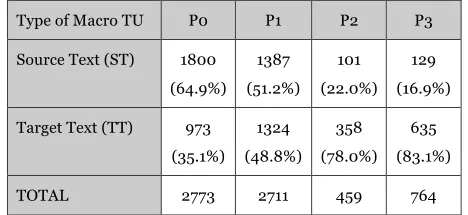
Table 1 shows the absolute and relative numbers of eye fixations in the selected AOIs containing the eight examples described in the previous section. As stated in the methodology, we assume that these AOIs are relevant indicators of cognitive complexity and higher processing effort and show similar patterns found for key-logged data, namely, P0>P1>P3>P2 for both ST and TT AOIs, and for the complete set of data on the whole.
Type of Macro TU P0 P1 P2 P3
Source Text (ST) 1800
(64.9%) 1387
(51.2%) 101
(22.0%) 129
(16.9%)
Target Text (TT) 973
(35.1%) 1324
(48.8%) 358
(78.0%) 635
(83.1%)
TOTAL 2773 2711 459 764
[image:12.420.86.320.374.482.2]Alves and Gonçalves (forthcoming) consider P0 as an indicator of low difficulty as processing effort unfolds without interruption in the flow of TT production. With 2773 fixation counts, P0 shows the highest number of eye fixations, namely 64.9% of counts (1800) in the ST AOI in comparison with the 35.1% of counts (973) in the TT AOI, i.e., nearly twice more eye fixations in the ST than in the TT. For P1 macro TUs, which also occur very close to the cognitive flow of TT production, the results in Table 1 show a very similar number of fixations (1387/1324) with 51.2% of them occurring in ST AOI and 48.4% in the TT AOI. When compared to the number of eye fixations for P0 macro TUs, we notice a decrease in the number of fixations in the ST from 64.9% down to 51.2%, and an increase in the number of fixations in the TT, from 35.1% up to 48.4%.
Considering that P1 macro TUs account mainly for online revisions carried out in the sequential flow of cognitive processing, a balanced focus of attention in eye fixations between ST and TT suggests that P1 macro TUs are cognitively more demanding that P0 macro TUs. On the other hand, the patterns for P2 and P3 macro TUs show a completely different picture. The number of P3 macro TUs (764) is significantly higher than the number of P2 macro TUs (459). Both P2 and P3 also show another congruent pattern with a much higher number of eye fixations occurring in the TT AOI. Bearing in mind that P3 is cognitively more demanding than P2, it is interesting to observe that there are over five times more eye fixations in the TT AOI for P3 than in the ST AOI (129/635), and over three times more eye fixations in the TT AOI for P2 than in the ST AOI (101/358).
All these results are statistically significant when the Student t-test is applied. They provide evidence that subjects tend to concentrate their focus of attention on the ST AOI when renderings unfold in the cognitive flow of TT production without interruption. Results also show a balanced focus of attention with alternations between ST and TT AOIs in cases of P1 macro TUs. And, as the translation process become more demanding in terms of cognitive complexity, subjects tend to focus their gaze on the TT AOI for both P2 and P3 macro TUs.
Type of Encoding t c l m p
Source Text (ST) 846 (51.7%)
224 (47.7%)
134 (27.2%)
254 (36.1%)
159 (25.2%)
Target Text (TT) 791 (48.3%)
246 (52.3%)
359 (72.8%)
449 (63.3%)
472 (74.8%)
[image:14.420.73.333.70.183.2]TOTAL 1637 470 493 703 631
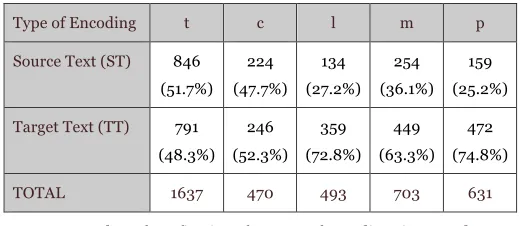
TABLE 2 – Number of eye fixations for types of encodings in ST and TT AOIs
This balanced distribution can be interpreted as evidence that [t] and [c] are actions not necessarily related to the translation process per se but rather entail typing activities such as correcting typing mistakes or finishing typing a word after looking for the right key on the keyboard. Since most subjects were not touch typists, this type of action is expected and should be filtered out from an analysis of processing effort. The pattern is altogether different when [l], [m], and [p] editing procedures are analysed.
Table 2 shows that in terms of fixation counts [m]>[p]>[l] in ST and TT AOIs. This result is statistically significant when the Student t-test is applied. Following Alves and Gonçalves (forthcoming), if [l]+[p] and [m]+[p] are grouped together, the number of eye fixations confirm the claim that processing effort in translation is higher in instances of procedural encodings.
Conclusions and perspectives
The picture emerging from our analyses is manifold. The results point to the validity of the proposed methodology for the selection of translation problems that seem to be relevant for a fine grained linguistic analysis of eye-tracking data. The selected AOIs have proved to be a valid choice which not only confirmed the findings of Alves and Gonçalves’s (forthcoming) key-logging analysis for the same set of data, but also corroborated Carl and Dragted’s (2012) claim that problem solving in translation is TT driven.
References
Alves, F., editor (2003). Triangulating Translation: Perspectives in Process-Oriented Research. John Benjamins, Amsterdam.
Alves, F. (2007). Cognitive Effort and Contextual Effect in Translation: a Relevance-theoretic Approach. Journal of Translation Studies 10(1):18–35.
Alves, F. and Gonçalves, J. L. (2003). A Relevance Theory Approach to the Investigation of Inferential Processes in Translation. In (Alves, 2003), pages 3–24.
Alves, F. and Gonçalves, J. L. (forthcoming). Investigating the conceptual-procedural distinction in the translation process: a relevance-theoretic analysis of micro and macro translation units. To appear in Target 25(1).
Alves, F., Pagano, A., Neumann, S., Steiner, E. and Hansen-Schirra, S. (2010). Translation units and grammatical shifts: towards an integration of product and process-based translation research. In (Shreve and Angelone, 2010), pages 109–142.
Alves, F., Pagano, A. and Silva, I.A.L. (2009). A new window on translators’ cognitive activity: methodological issues in the combined use of eye tracking, key logging and retrospective protocols. In (Mees el al, 2009), pages 267–292.
Alves, F. and Vale, D. (2009). Probing the unit of translation in time: aspects of the design and development of a web application for storing, annotating, and querying translation process data. Across Languages and Cultures 10(2):251–273.
Alves, F. and Vale, D. (2011). On drafting and revision in translation: a corpus linguistics oriented analysis of translation process data. TC3 Translation: Corpora, Computation, and Cognition 1(1):105–122.
Carl, M. and Kay, M. (2011). Gazing and Typing Activities during Translation: A Comparative Study of Translation Units of Professional and Student Translators. Meta: Journal des Traducteurs 56(4):952–975.
Carl, M. and Dragsted, B. (2012). Inside the Monitor Model: Processes of Default and Challenged Translation Production. Translation: Computation, Corpora, Cognition 2(1):127–145.
Duchowski, A.T. (2007). Eye Tracking Methodology: Theory and Practice. Springer, London.
Göpferich, S., Jakobsen, A.L. and Mees. I.M., editors (2008). Looking at Eyes: Eye-Tracking Studies of Reading and Translation Processing (Copenhagen Studies in Language 36). Samfundslitteratur, Copenhagen.
Hvelplund, K.T.J. (2011). Allocation of cognitive resources in translation: an eye-tracking and key-logging study. Unpublished Ph.D. Thesis. Copenhagen Business School, Copenhagen.
Just, M.A. and Carpenter, P.A. (1980). A theory of reading: from eye fixations to comprehension. Psychological Review 87(4):329–354.
Mees, I., Alves, F. and Göpferich, S., editors (2009). Methodology, Technology and Innovation in Translation Process Research: A Tribute to Arnt Lykke Jakobsen. (Copenhagen Studies in Language 37). Samfundslitteratur, Copenhagen.
Pavlović, N. and Jensen, K.T.H. (2009). Eye tracking translation directionality. In (Pym and Perekrestenko, 2009), pages 101–119.
Pym, A. and Perekrestenko, A. editors (2009). Translation Research Projects 2. Universitat Rovira i Virgili, Tarragona.
Rayner, K. (1998). Eye movements in reading and information processing: 20 years of research. Psychological Bulletin 124:372–422.
Shreve, G. and Angelone, E., editors (2010). Translation and Cognition. John Benjamins, Amsterdam.