ISCAS
:
A System for Chinese Word Sense Induction Based on
K-means Algorithm
Zhenzhong Zhang*
Le Sun†
Wenbo Li†
*Institute of Software, Graduate University
Chinese Academy of Sciences
[email protected]
†Institute of Software
Chinese Academy of Sciences
{sunle,wenbo02}@iscas.ac.cn
Abstract
This paper presents an unsupervised method for automatic Chinese word sense induction. The algorithm is based on clustering the similar words according to the contexts in which they occur. First, the target word which needs to be disambiguated is represented as the vector of its contexts. Then, reconstruct the matrix constituted by the vectors of target words through singular value decomposition (SVD) method, and use the vectors to cluster the similar words. Our system participants in CLP2010 back off task4-Chinese word sense induction.
1
Introduction
It has been shown that using word senses instead of surface word forms could improve performance on many nature language processing tasks such as information extraction (Joyce and Alan, 1999), information retrieval (Ozlem et al., 1999) and machine translation (David et al., 2005). Historically, word senses are represented as a fixed-list of definitions coming from a manually complied dictionary. However, there seem to be some disadvantages associated with such fixed-list of senses paradigm. Since dictionaries usually contain general definitions and lack explicit semantic, they can’t reflect the exact content of the context where the target word appears. Another disadvantage is that the granularity of sense distinctions is fixed, so it may not be entirely suitable for different applications.
In order to overcome these limitations, some techniques like word sense induction (WSI) have
been proposed for discovering words’ senses automatically from the unannotated corpus. The word sense induction algorithms are usually base on the Distributional Hypothesis, proposed by (Zellig, 1954), which showed that words with similar meanings appear in similar contexts (
Michael, 2009
). And the hypothesis is also popularized with the phrase “a word characte-rized by the company it keeps” (John, 1957). This concept shows us a method to automatical-ly discover senses of words by clustering the target words with similar contexts (Lin, 1998). The word sense induction can be regarded as an unsupervised clustering problem. First, select some features to be used when comparing simi-larity between words. Second, represent disam-biguated words as vectors of selected features according to target words’ contexts. Third, clus-ter the similar words using the vectors. But compared with European languages such as Eng-lish, Chinese language has its own characteris-tics. For example, Chinese ideographs have senses while the English alphabets don’t have. So the methods which work well in English may not be entirely suitable for Chinese.Our system participants in CLP2010 back off task4 - Chinese word sense induction.
The remainder of this paper is organized as follows. Section 2 presents the Chinese word senses induction algorithm. Section 3 presents the evaluation sheme and the results of our system. Section 4 gives some discussions and conclusions.
2
Chinese Word Senses Induction
This section will present the strategies of select-ing features for disambiguated Chinese words and k-means algorithm for clustering vectors of the contexts.
2.1 Features Selection
Since the input instances of target words are un-structured, it's necessary to select features and transform them into structured format to fit the automatic clustering algorithm. Following the example in (Ted, 2007), words are chosen as features to represent the contexts where target words appear. A word w in the context of the target word can be represented as a vector whose ith component is the average of the calculated conditional probabilities of w and wj.
The target words are usually removed from the corpus in the task of English word sense in-duction. But Chinese language is very different from European languages such as English. Chi-nese ideographs usually have meanings of their own while English alphabets don’t have. In Chinese word senses induction tasks, the target word may be a Chinese word which could have one or more Chinese ideographs or a Chinese ideograph. And the meaning of Chinese ideo-graphs is determined by the Chinese word where it appears. The following example shows us this case.
z 我国依靠推广超级稻累计增产稻谷 162 亿公斤。
z 在木化石园附件的一处山谷,是大佛寺 近期增加的五百罗汉堂。
In this example, the target word is Chinese ideograph “谷” displayed in italic in the con-texts. In the first context, its meaning is paddy which is determined by the Chinese word “稻 谷”, and similarly in the second context its meaning is valley determined by “山谷”. Since
the meaning of the Chinese ideograph “谷” is determined by the word where it appears, it may not be appropriate to remove it from the con-texts simply while the others of the word are left. Different strategies are employed to remove tar-get words. If the tartar-get word contains two or more Chinese ideographs, it will be removed from the context. Otherwise it will be kept. To solve the problem of data sparseness, we extracted extra 100 instances for each target word from Sogou Data and also used the thesauruses (TongYiCi CiLin of HIT) to reduce the dimensionality of the word space (feature space). Two filtering heuristics are applied when selecting features. The first one is the minimum frequency p1 of words, and the second one is the maximum frequency p2 of words.
Each selected word (feature) should be as-signed a weight, which indicates the relative fre-quency of two co-occurring words. Using condi-tional probabilities for weighting for object/verb and subject/verb pairs is better than point-wise mutual information (Philipp et al., 2005). So we used conditional probabilities for weighting words pairs. Let numi,j denote the number of the instances where the word i and word j co-occur , and numi denote the number of the instances in which the word i appears. Then the jth compo-nent of the vector of the word i can be calculated using the following equation.
,
( | )
( | )
2
i j
p j i
p i j
w
=
+
Where
(
|
)
i, jj
n u m
p
i
j
n u m
=
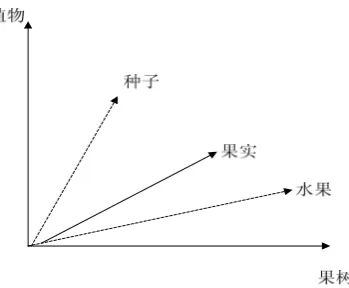
Figure 1: An example of a context vector for “果实”, calculated as the centroid of vectors of “种子” and “水果”.
2.2 Clustering Algorithm
K-means algorithm is applied to cluster the vec-tors of the target word. It assigns each element to one of K clusters according to which centroid the element is close to by the similarity function. The cosine function is used to measure the simi-larity between two vectors V and W:
1
2 2
1 1
( ,
)
|
| |
|
n
i i i n n
i i i i
VW
V W
sim V W
V
W
V
W
=
= =
•
=
=
×
∑
∑ ∑
where n is the number of features in each vector. Before clustering the vectors of instances, we put together the vectors of instances in the cor-pus and obtain a co-occurrence matrix of in-stances and words. Singular value decomposi-tion is applied to reduce the dimensionality of the resulting multidimensional space and finds the major axes of variation in the word space (Golub and Van Loan, 1989). After the reduc-tion, the similarity between two instances can be measured using the cosine function mentioned as above between the corresponding vectors. The clustering algorithm stops when the centroid of each cluster does not change or the iteration of the algorithm exceed a user-defined threshold p3. And the number of the clusters is determined by the corpus where the target word appears. Each cluster to which some instances belong represents one senses of the target word represented by the vector.
We also employed a graph-based clustering algorithm -Chinese Whispers (CW) (Chris, 2006)
to deal with the task of Chinese WSI. CW does not require any input parameters and has a good performance in WSI (Chris, 2006). For more details about CW algorithm please refer to (Chris, 2006). We first constructed a graph, whose vertexes were instances of target word and edges’ weight was the similarity of the cor-responding two vertexes. Then we removed the edges with minimum weight until the percentage of the kept edges’ sum respect the total was be-low a threshold p4. CW algorithm was employed to cluster the graph and each clusters represented a sense of target word.
3
Evaluation
This section presents the evaluation scheme, set of parameters and the result of our system.
3.1 Evaluation Scheme
We use standard cluster evaluation methods to measure the performance of our WSI system. Following the former practice (Zhao and Kary-pis, 2005), we consider the FScore measure for assessing WSI methods. The FScore is used in a similar fashion to Information Retrieval exercis-es.
Let we assume that the size of a particular class sr is nr, the size of a particular cluster hj is nj and the size of their common instances set is nr,j. The precision can be calculated as follow:
,
( ,
r j)
r jj
n
P s h
n
=
The recall value can be defined as:
,
( ,
r j)
r jr
n
R s h
n
=
Then FScore of this class and cluster is defined to be:
2
( ,
)
( ,
)
( ,
)
( ,
)
( ,
)
r j r j r jr j r j
P s h
R s h
F s h
P s h
R s h
×
×
=
+
The FScore of class sr, F(sr), is the maximum F(sr, hj) value attained by any cluster, and it is defined as:
( ) max( ( , ))
j
r r j
h
F s = F s h
1
( )
qr r
r
n
F s
FScore
n
=
×
=
∑
Where q is the number of classes and n is the total number of the instances where target word appears.
3.2 Tuning the Parameters
We tune the parameters of our system on the training data. But because of time restrictions, we do not optimize these parameters. The max-imum frequency of a word (p2) and the maxi-mum number of the K-means’ iteration (p3) are tuned on the training data. The minimum fre-quency of a word (p1) was set to two following our intuition. The last parameter K -the number of the clusters is determined by the test data in which the target word appears. When tuning pa-rameters, we first fixed the parameter p3 and found the best value of parameter p2, which could lead to the best performance. The results have been shown in Table 1 and Table 2.
[image:4.595.92.281.358.511.2]Parameters FScore P3=300,p2=35 0.7502 P3=400,p2=40 0.7523 P3=500,p2=40 0.7582
Table 1: The results of K-means with SVD
Parameters FScore P3=300,p2=40 0.7454 P3=400,p2=40 0.7493
P3=500,p2=45 0.7404 Table 2: The results of K-means
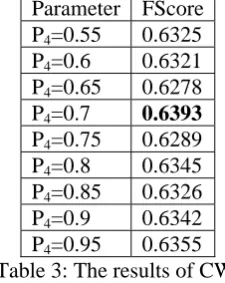
The performance of CW algorithm is shown in Table 3. The parameter p4 is a threshold for pruning graph as describing in section 2.2.
Parameter FScore P4=0.55 0.6325 P4=0.6 0.6321 P4=0.65 0.6278 P4=0.7 0.6393
P4=0.75 0.6289 P4=0.8 0.6345 P4=0.85 0.6326 P4=0.9 0.6342 P4=0.95 0.6355 Table 3: The results of CW.
The result shows that the K-means algorithm has a better performance than CW. That may
because CW can’t use the information of the number of clusters, but K-means could. Another problem for CW is that the size of corpus is small and the constructed graph can’t reflect the inherent relation between the instances.
Based on the result of experiments, we em-ployed K-means algorithm for our system and the parameters is shown in Table 4.
Parameters Value P1: Minimum frequency of a word 2 P2: Maximum frequency of a word 40 P3: Maximum number of K-means ite-ration
500
[image:4.595.123.236.558.700.2]K: the number of the cluster - Table 4: Parameters for the system. The last pa-rameter K is provided by the test data.
3.3 Result
Our system participants in the CLP2010 back-off task4 and disambiguate 100 target words, total 5000 instances. The F-score of our system on the test data is 0.7209 against the F-score 0.7933 of the best system.
4
Conclusion
We have presented a model for Chinese word sense induction. Different strategies are applied to deal with Chinese ideographs and Chinese words that contain two or more Chinese ideo-graphs. After selecting the features –words, sin-gular value decomposition is used to find the major axes of variation in the feature space and reconstruct the vector of each context. Then we employ k-means cluster algorithm to cluster the vectors of contexts. Result shows that our sys-tem is able to induce correct senses. One draw-back of our system is that it overlooks the infre-quent senses because of lacking enough data. And our system only uses the information of word co-occurrences. So in the future we would like to integrate different kinds of information such as topical information, syntactic informa-tion and semantic informainforma-tion, and see if we could get a better result.
Acknowledgement
and by “863” Key Projects #2006AA010108, “863” Projects #2008AA01Z145. We would like to thank anonymous reviewers for their detailed comments.
References
Chris Biemann, 2006. Chinese whispers - an efficient
graph clustering algorithm and its application to natural language processing problems, In Pro-ceedings of TextGraphs, pp. 73–80, New York, USA.
David Vickrey, Luke Biewald, Marc Teyssley, and
Daphne Koller. 2005. Word-sense disambiguation
for machine translation. In Proceedings of the con-ference on Human Language Technology and Em-pirical Methods in Natural Language Processing, pages 771-778, Vancouver, British Columbia, Canada
Dekang Lin. 1998. Automatic retrieval and clustering
of similar words. In Proceedings of the 17th inter-national conference on Computational linguistics, volume 2, pages 768-774, Montreal, Quebec, Can-ada
Golub, G. H. and Van Loan, C. F. 1989. Matrix
Computations. The John Hopkins University Press, Baltimore, MD
John, R., Firth. 1957. A Synopsis of Linguistic Theory
1930-1955, pages 1-32.
Joyce Yue Chai and Alan W. Biermann. 1999. The
use of word sense disambiguation in an informa-tion extracinforma-tion system. In Proceedings of the six-teenth national conference on Artificial intelli-gence and the eleventh Innovative applications of artificial intelligence conference innovative appli-cations of artificial intelligence, pages 850-855, Orlando, Florida, United States.
Michael Denkowski. 2009. A Survey of Techniques
for Unsupervised Word Sense Induction.
Ozlem Uzuner, Boris Katz, and Deniz Yuret. 1999.
Word sense disambiguation for information re-trieval. In Proceedings of the sixteenth national conference on Artificial intelligence and the ele-venth Innovative applications of artificial intelli-gence conference innovative applications of artifi-cial intelligence, page 985, Orlando, Florida, Unit-ed States.
Philipp Cimiano, Andreas Hotho, and Steffen Staab,
2005. Learning concept hierarchies from text
cor-pora using formal concept analysis, Journal of Ar-tificial Intelligence Research (JAIR), 24, 305–339.
Ted Pedersen, 2007. Umnd2: Senseclusters applied to
the sense induction task of senseval-4. In Proceed-ings of the Fourth International Workshop on Se-mantic Evaluations, pages 394–397, Prague, Czech Republic.
Zellig Harris. 1954. Distributional Structure, pages
146-162.
Ying Zhao and George Karypis. 2005. Hierarchical