Building Ontologies from Collaborative Knowledge Bases to Search
and Interpret Multilingual Corpora
Yegin Genc
Elizabeth A. Lennon
Winter Mason
Jeffrey V. Nickerson
Stevens Institute of Technology
Center for Decision Technologies
Castle Point on Hudson, Hoboken, NJ USA
{ygenc
,
elennon
,
wmason
,
jnickerson}@stevens.edu
Abstract
Tools and techniques that automate the inter-pretation of multilingual corpora are useful on many fronts; scholars, as an example, could use such tools to more readily pinpoint relevant articles from journals in a wide vari-ety of languages. This work describes tech-niques to build and characterize ontologies using collaborative knowledge bases, e.g., Wikipedia. These ontologies can then be used to search and classify texts. Originally devel-oped for monolingual corpora, we extend the approach to multilingual texts and test the methods with Mandarin scientific abstracts. The presented techniques provide a novel and efficient mechanism to obtain contextually rich ontologies and measure document rele-vancy within multilingual corpora.
1
Introduction
The wealth of data available online in the form of unstructured text drives the development of tools that automatically extract meaning from cross-lingual corpora. Techniques that quantify the degree to which texts exhibit similar meaning improve a variety of search processes – for ex-ample, academic research. However, automating the interpretation of multilingual corpora re-quires detecting similarities in meaning, while ignoring irrelevant linguistic differences. For example, the understanding that emerges from the connections and associations among words, i.e. context, can manifest very differently in dif-ferent languages (Goddard, 2011). Furthermore, the meanings of words used in natural language are often context dependent, and context itself both shapes and reveals meaning (Gennaro et al., 2007).
For the purposes of this work, an ontology is defined as a model that represents word entities as concepts and their interrelationships (Lanzen-berger et al., 2010). In this sense, ontologies
rep-resent the relevant aspects of context. To effec-tively comprehend cross-lingual corpora, tools that can explore the dependencies between lan-guage and context are needed.
One way to do this is to make use of well-understood existing texts that have explicitly linked concept graphs. Examples of such texts are collaborative knowledge stores, databases built up through the contributions of many indi-viduals.
The techniques described here use Wikipedia to build ontologies from journal article abstracts in different languages, which we test on text written in Mandarin. In order to compare alterna-tive ways of deriving ontologies, a set of articles that have both Mandarin and English abstracts are used as the test corpus.
The rest of the paper is organized into four sections. The background section briefly summa-rizes prior research relevant to this work. Next, the methods section details the processing steps used to create and visualize the ontologies for three experimental conditions. Sample ontology visualizations for each of the experimental condi-tions are shown. A discussion comparing some of the emergent features in each of the three gen-erated ontologies follows. Finally, we outline next steps for the extension of these techniques.
2
Background
Translation is used to convey the meaning repre-sented in one language in another language. Au-tomated text translation was a goal of early com-puting (Locke and Booth, 1955), and is still chal-lenging today. Approaches taken include diction-ary look-ups, cognate matching, and parallel cor-pora based methods (Kishida, 2005). Cognate matching uses untranslatable terms such as prop-er nouns or technical tprop-erminology as the bases of cross-lingual connections. For example, Freitas-Juniar et al. (2006) leveraged medical terms, commonly used across languages, to classify medical documents from multiple languages.
Landauer and Littman (1991) used parallel cor-pora based methods when they created a lan-guage independent indexing space via Singular Value Decomposition to generate a comparable corpus. This permitted texts to be represented in a language-independent space, solely using the terms of the presentation language.
One early machine translation system, DIO-NYSUS, used three static knowledge sources: a lexicon, an ontological domain model, and a text-meaning-representation language in an effort to automate translation. The DIONYSUS re-searchers noted the challenge of developing an ontology based on a detailed version of a “con-structed reality” (Onyshkevych and Nirenburg 1992). In other words, an ontological model of concepts representing a worldview is only as good as its ability to capture the breadth and depth of the world it attempts to model. Creating ontologies for machine translation applications arguably require knowledge stores as rich, ex-pansive, and comprehensive as human language itself (Hovy, 2005).
One challenge related to reliable ontology creation is the relevance of the produced ontolo-gy in the future (Hovy, 2005). That is, word meanings morph over time, and so the ontology needs to shift also. Moreover, shifts in word meanings happen differently in different lan-guages. Nichols et al. (2006) explored multilin-gual ontology acquisition using robust minimal recursion semantics and machine-readable dic-tionaries. Though they demonstrated a language-agnostic tool for automated ontology generation, it was still limited to the static database of words contained in the dictionaries.
Attempting to overcome the limitations of dictionaries, Gabrilovich and Markovitch (2009) turned to Wikipedia to perform what they called explicit semantic analysis (ESA). They drew up-on both the reference and cup-ontextual knowledge embedded throughout Wikipedia with the goal of outperforming statistical methods, like latent se-mantic analysis (LSA), in computing sese-mantic relatedness of texts (Gabrilovich and Mar-kovitch, 2009). However, in explicit semantic analysis, the semantic interpreter, which consists of weighted lists of concepts, i.e. Wikipedia arti-cles, is built directly from Wikipedia’s text, a timeconsuming process. Sorg and Cimiano (20
-12) developed an approach leveraging explicit semantic analysis for cross-lingual information retrieval using Wikipedia.
Building on the premise that collaborative knowledge stores, like Wikipedia, are superior for semantic-analysis related tasks, other re-searchers have mapped extracted word entities from Twitter tweets directly to the titles of Wik-ipedia pages. The reported technique outper-formed statistically-based, semantic categoriza-tion methods, specifically LSA and string-edit-distance (Genc et al. 2011). In addition, the ap-proach could categorize concepts in short text strings, a widely known challenge in semantics (Michelson and Macskassy, 2010). In addition, using the Wikipedia title pages instead of the actual article content enabled a faster semantic transform (Genc et al. 2012). Mapping extracted entities to online collaborative knowledge bases, like Wikipedia, also presents a path to accessing an ever-relevant contextual framework based upon the most current human knowledge base (Michelson and Macskassy 2010).
3
Methods
This study compares simplified Chinese Wikipe-dia and English WikipeWikipe-dia in their resourceful-ness to build ontologies. For the comparison, we used a sample abstract that is available in both Mandarin and English (Figure 1). We construct-ed ontologies from our sample using both Chi-nese and English Wikipedia according to the ex-perimental conditions detailed in section 3.2.
3.1 Text Segmentation and Entity Extrac-tion
Figure 1: Sample journal abstract in Mandarin and English (from Su et al. 2006)
The words and word phrases resulting from text segmentation are potential entities. We then check which of these phrases match a title in Wikipedia. These titles are either a page name in Wikipedia domain or a redirection page to an entity with an alternate title. Redirections happen for alternative names, plurals, closely related words, adjectives/adverbs pointing to the corre-sponding noun, less or more specific forms of names, abbreviations, alternative spellings, or punctuation and likely misspellings. The poten-tial entities that have matches to Wikipedia titles are then considered existing entities, and are used in the ontology generation.
3.2 Ontology Generation
Wikipedia offers a network of networks: each language domain provides concepts and their relationships. These language-specific networks connect through the language links given on a Wikipedia page for a particular concept, and point users to pages with the same conceptual meaning in the alternate, target language. It is important to note that language links in Wikipe-dia do not direct the reader to the translation of the original content but to another Wikipedia page created for the same concept in the desig-nated language. To give an example, machine learning page in English is linked to 机器学习
(Machine learning) in the Chinese Wikipedia,
but the contents of these two pages are different; the two pages are created and updated by differ-ent users at differdiffer-ent times.
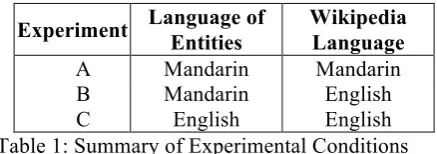
Experiment Language of Entities
Wikipedia Language
A Mandarin Mandarin
B Mandarin English
[image:4.595.73.292.82.159.2]C English English
Table 1: Summary of Experimental Conditions
3.3 Ontology Visualization
For the visualizations, the python library, pypro-cessing, was used to apply Processing (www.pro-cessing.org), a platform that allows for the crea-tion of interactive visualizacrea-tions. Orange
circles
show extracted entities that landed on
Wik-ipedia titles with existing pages in the
re-spective language. The first-level categories
associated with those pages were visualized
as blue circles. A line shows the link back to
the corresponding entity represented as a
Wikipedia title. At this time a spring
weight-ing function is used to automate the
position-ing of the items in the bipartite graphs
con-stituting the ontology visualizations.
4
Results and Discussion
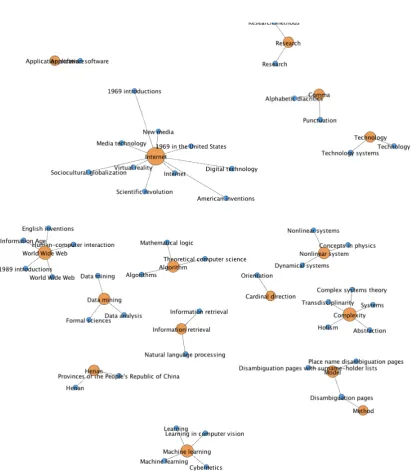
Figures 2 (below), 3, and 4 (following pages) display the ontologies resulting from experi-mental conditions A, B, and C respectively. Fig-ure 2 shows several key concepts from the jour-nal abstract about machine learning in NLP have been effectively captured as entities using the collective knowledge base of Chinese Wikipedia. In Figure 2 the English entity names are given in
parentheses for reference. A native Mandarin speaker translated the Mandarin characters, which had been presented as a list of terms. Fig-ure 3 contains many of the same concepts seen in Figure 2. Figure 4, created from the English ab-stract and English Wikipedia, displays approxi-mately fifty percent more entities (excluding dis-ambiguation). The entities associated with the disambiguation category currently in figure 4 can be filtered out as needed.
Table 2 summarizes the number of entities and maximum number of categories for each of the experiments. A total of eight entities were shared among all three experimental conditions.
Experiment # of Entities
Max # of 1st level Categories
A 20 4
B 16 10
C 33 * 11
[image:5.595.310.523.132.213.2]Table 2: Summary of Ontology Metrics, (* Excludes entities connected to disambiguation categories)
[image:5.595.97.518.252.724.2]Figure 4: Ontology generated using experimental condition C, in which English Wikipedia is used to build an ontology from English entities.
These visualizations yield preliminary in-sights into the manner in which varying lan-guages represent concepts in Wikipedia. Com-paring the ontologies in Figures 2-4 reveals dif-ferent languages in Wikipedia exhibit difdif-ferent breadth. English Wikipedia provided more con-cepts than the Chinese counterpart for this text sample. This is not surprising given the English Wikipedia is larger. However, the Mandarin enti-ties shown in Figure 2 offer a satisfactory repre-sentation of the text. In addition, the extra con-cepts from English Wikipedia add little to the general understanding of the text, and may even distract from the abstract’s key concepts.
Wikipedia pages from different languages generate different ontologies for seemingly simi-lar concepts. For example, in Experiment A
provide further insight into the differences be-tween the two methods.
5
Summary and Next Steps
As a context-rich, collaborative knowledge base, Wikipedia is ideal for building ontologies. This study presented varying approaches to construct-ing ontologies from simplified Chinese and Eng-lish Wikipedias, as a first step in evaluating cross-lingual corpora. The methods employed in this study can be further adopted to extract on-tologies across multiple languages provided the analogous collaborative knowledge stores exist in the target languages. The sample ontology visualizations generated in this work demonstrat-ed there are multiple ways to pursue concept rep-resentation using the Chinese and English ver-sions of Wikipedia.
Wikipedia offers networks of concepts in dif-ferent languages. Networks of difdif-ferent guages in Wikipedia are mapped through lan-guage links within pages, but this is rarely a one-to-one mapping. Thus, we also need ways to align ontologies with different levels of explicit-ness and formalization.
Future research might build on the visualiza-tion techniques discussed here in order to explore mechanisms for ontology alignment. For exam-ple, the percentage of entity coexistence within a set of ontologies could be used as a metric for the alignment of ontologies. In addition, the tech-niques described here could be used to assess semantic similarity using ontologies coming from different collaborative data stores in differ-ent languages.
Finally, there are two approaches to extracting ontologies from cross-lingual corpora: work can be translated first and then ontologies extracted, or ontologies can be extracted, and then the on-tologies translated. With more experiments, it may be possible to determine which is the best order to use, taking into account the corpus, the languages involved, and the collaborative data stores available.
Acknowledgments
The authors acknowledge and thank Dorian Zac-caria for helping with the ontology visualizations and Yue Han for help with verification of Chi-nese character translations.
References
Freitas-Junior, H. R., Ribeiro-Neto, B., Vale, R. F., Laender, A. H. F., & Lima, L. R. S. (2006).
Cate-gorization-driven cross-language retrieval of med-ical information. Journal of the American Society for Information Science and Technology, 57(4), 501–510. doi:10.1002/asi.20320
Gabrilovich, E., & Markovitch, S. (2009). Wikipedia-based semantic interpretation for natural language processing. Journal of Artificial Intelligence Re-search, 34(2), 443-498.
Genc, Y., Mason, W., & Nickerson, J. (2012). Seman-tic transforms using collaborative knowledge ba-ses. Paper presented at Workshop on Information
in Networks, New York University, September
28-29, 2012. Available at SSRN 2154367.
Genc, Y., Sakamoto, Y., & Nickerson, J. V. (2011). Discovering context: Classifying tweets through a semantic transform based on Wikipedia, In Pro-ceedings on Foundations of Augmented Cognition. Directing the Future of Adaptive Systems. Orlan-do, FL. pp. 484-492.
Gennari, S. P., MacDonald, M. C., Postle, B. R., & Seidenberg, M. S. (2007). Context-dependent in-terpretation of words: Evidence for interactive neural processes. Neuroimage, 35(3), 1278-1286. doi:10.1016/j.neuroimage.2007.01.015
Goddard, C. (2011). Semantic Analysis: A Practical Introduction (2nd Ed.). Oxford University Press, New York, NY.
Hovy, E. (2005). Methodologies for the reliable con-struction of ontological knowledge. In Proceed-ings of the 13th international conference on Con-ceptual Structures: Common Semantics for Shar-ing Knowledge (ICCS '05). pp. 91–106.
doi:10.1007/11524564_6
Kishida, K. (2005). Technical issues of cross- language information retrieval: a review. Infor-mation Processing & Management, 41(3), 433– 455.
Landauer, T. K., & Littman, M. L. (1991). A statisti-cal method for language-independent representa-tion of the topical content of text segments. In Proceedings of the Eleventh International Confer-ence: Expert Systems and Their Applications, 8, pp. 77-85.
Lanzenberger, M., Sampson, J., & Rester, M. (2010). Ontology visualization: Tools and techniques for visual representation of semi-structured meta-data. Journal of Universal Computer Science, 16(7), 1036-1054.
Locke, W. N., & Booth, A. D. (Eds.). (1955). Ma-chine translation of languages: fourteen essays. Published jointly by Technology Press of the Mas-sachusetts Institute of Technology and Wiley, New York, NY.
look. In Proceedings of the fourth workshop on Analytics for noisy unstructured text data (AND '10) Toronto, Canada.
doi:10.1145/1871840.1871852
Nichols, E., Bond, F., Tanaka, T., & Fujita, S. (2006). Multilingual ontology acquisition from multiple MRDS. In Proceedings of the 2nd Workshop on
Ontology Learning and Population, Sydney,
Aus-traliapp. 10–17.
Onyshkevych, B. A., & Nirenburg, S. (1992). Lexi-con, ontology, and text meaning, 289–303. doi:10.1007/3-540-55801-2_42
Sorg, P., & Cimiano, P. (2012). Exploiting Wikipedia for cross-lingual and multilingual information re-trieval. Data & Knowledge Engineering, 74 (2012) 26–45. doi:10.1016/j.datak.2012.02.003
Su J.S., Zhang B.F., & Xu X. (2006). Advances in machine learning based text categorization. Jour-nal of Software, 2006,17(9), 1848-1859. doi: 10.1360/jos171848
Youli, D. (2011). Chinese Segmentation Analysis [Software]. Available from