A Joint Model of Rhetorical Discourse Structure and Summarization
Naman Goyal and Jacob Eisenstein
School of Interactive Computing Georgia Institute of Technology
{naman.goyal21 + jacobe}@gmail.com
Abstract
In Rhetorical Structure Theory, discourse units participate in asymmetric relationships, with one element acting as thenucleusand the other as thesatellite. In the resulting tree-like nuclearity structure, the importance of each discourse unit can be measured by the num-ber of relations in which it acts as the nu-cleus or as the satellite. Existing approaches to automatically parsing such structures suffer from two problems: they employ local infer-ence techniques that do not capture document-level structural regularities, and they rely on annotated training data, which is expensive to obtain at the discourse level. We investi-gate the SampleRank structure learning algo-rithm as a potential solution to both problems. SampleRank allows us to incorporate arbitrary document-level features in a global stochastic inference algorithm. Furthermore, it enables the training of a joint model of discourse struc-ture and summarization, which can be learned from document-level summaries alone, with-out discourse-level supervision. We obtain mixed results in the fully supervised case, and negative results for the joint model of dis-course structure and summarization.
1 Introduction
Rhetorical structure theory (RST) is a hierarchi-cal model of document-level organization, in which segments of text are linked in binary or multi-way discourse relations (Mann and Thompson, 1988). Many RST relations are asymmetric, containing a
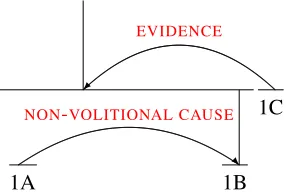
nucleusand asatellite. An example is shown in Fig-ure 1, with unit 1B as the nucleus of its relationship
EVIDENCE
R
NON-VOLITIONAL CAUSE
1A 1B
1C
[The more people you love,]1A[the weaker you
are.]1B[You’ll do things for them that you know you
[image:1.612.355.498.239.336.2]shouldn’t do.]1C
Figure 1:An example Rhetorical Structure Theory parse of a small segment of text.
with 1A, and then the combined unit 1A:B at the nucleus of its relationship with 1C. In any given dis-course relation, the nucleus is more likely to relevant to a summary of the document (Marcu, 1999c), and its sentiment is more likely to be relevant to the over-all document-level polarity (Heerschop et al., 2011; Bhatia et al., 2015). Thus, recovering this nuclear-ity structureis a key task for discourse parsing, with important practical applications.
All known RST discourse parsers take one of two approximations, which are well known in structure prediction. In dynamic programming approaches to discourse parsing, the feature space is locally re-stricted, allowing only features of discourse units that are sequentially adjacent (Joty et al., 2015), or adjacent in the discourse parse (Yoshida et al., 2014; Li et al., 2014). This makes exact inference pos-sible, but at the cost of ignoring aspects of doc-ument structure that may be relevant for
ing the correct parse. For example, we may pre-fer balanced nuclearity structures, or we may prepre-fer to avoid left-branching structures, but these proper-ties cannot be captured with local features. Alter-natively, transition-based methods construct the dis-course parse through a series of local decisions, typ-ically driven by a classifier (Marcu, 1999b; Sagae, 2009; Ji and Eisenstein, 2014). While the classifier is free to examine any aspect of the document or the existing partial parse, the accuracy of such methods may be limited by search errors.
A second limitation of existing discourse parsers relates to the amount of available training data. Because discourse is a high-level linguistic phe-nomenon, relatively large amounts of text must be annotated to produce each training instance. In RST, the smallest possible components of each discourse relation are elementary discourse units (EDUs), which correspond roughly to clauses. A relatively long news article might feature only a few dozen discourse relations, yet it still requires considerable time for the annotator to read and understand. This suggests that it will be inherently difficult to train accurate discourse parsers using standard supervised learning techniques.
This paper proposes to solve both problems using SampleRank, a structure learning algorithm (Wick et al., 2011). SampleRank uses stochastic search to explore the space of possible outputs, updating its model after each sample. It imposes no limitations on the feature set; given an appropriate sampling dis-tribution, it is capable of exploring the entire space of output configurations (in the limit).
Furthermore, SampleRank can be trained using indirect supervision, which provides a potential so-lution to the problem of limited training data for discourse parsing. Because discourse nuclearity structures are closely linked to other document-labeling tasks — such as summarization and senti-ment analysis — it is in principle possible to use labels from those tasks as a supervision signal for discourse parsing itself. To do this, we link dis-course structure and summarization using a con-straintproposed by Hirao et al. (2013). SampleRank then explores the joint space of extractive summaries and discourse parses, scoring the summaries against automatically-obtained reference summaries, while simultaneously learning to produce discourse parses
that are compatible with high-scoring summaries. At this stage, we have obtained only mixed em-pirical results with the application of SampleRank to RST discourse parsing: SampleRank offers im-provements on one metric for RST parsing in the su-pervised learning scenario, but it does not improve over a summarization baseline in the indirect super-vision scenario. Nonetheless, we hope the ideas pre-sented here will inspire further research in stochastic structure prediction for automated discourse struc-ture analysis.
2 Discourse Parsing as Structure Prediction
We first describe a supervised discourse parser that uses SampleRank to escape the limitations of local features and local structure prediction. Our parser is designed to recover the nuclearity structure of a document, e.g., the unlabeled edges in Figure 1. The full discourse parsing task also requires pre-dicting the nature of the relation between discourse units, e.g., ELABORATION or CONDITION, but we do not consider the relation prediction problem in this work. We also do not consider the problem ofdiscourse segmentation, which involves splitting the text intoelementary discourse units. Prior work shows that relatively simple classification-based ap-proaches can achieve high accuracy on the discourse segmentation task (Hernault et al., 2010; Xuan Bach et al., 2012).
Letdi ∈ D(xi)represent the nuclearity structure
for documenti, wherexirepresents both the text of
the document and its segmentation into elementary discourse units. The set of possible nuclearity struc-tures D(xi) includes trees in which adjacent
dis-course units are related by either mononuclear (sub-ordinating) or multinuclear (co(sub-ordinating) discourse relations.1 Each relation instantiates a larger dis-course unit, which may then be related to its neigh-bors, until the entire document is covered by a con-nected nuclearity structure. Danlos (2008) offers a formal comparison of the representational capacity of RST and related discourse models.
We propose a log-linear probability model over discourse structures,
P(d|x)∝expθ>f(d, x), (1)
wheref(d, x)represents a vector of features andθ represents a vector of weights. As noted above, prior work has largely focused on two restrictions to this model: either constraining the feature functionf(·)
to consider only local phenomena, or using a local, transition-based approach to incrementally construct the discourse nuclearity structure.
Instead, we use stochastic search to identify the top-scoring discourse structure for any document. This enables the use of arbitrary features, while avoiding making premature commitments to lo-cal discourse structures. The SampleRank algo-rithm (Wick et al., 2011; Zhang et al., 2014) enables us to learn the weight vectorθin the context of this stochastic inference algorithm. To use SampleRank, we must define three things:
• a feature functionf(·); • a sampling distributionq(·); • a scoring functionω(·).
At each step in the algorithm, we sample a discourse structure d0 ∼ q(d), where d is the previous
dis-course structure. This sample is then stochastically accepted or rejected, according to the Metropolis-Hastings algorithm: if the sampled0achieves higher
likelihood`(d0)than the previous sample`(d), then
it is accepted; if not, the sample may still be ac-cepted with probability ``((dd0)). When the probability P(d|x)and scoring functionω(d)disagree, an up-date is made toθto try to align the probability with the scoring metric. For more on the details of the algorithm, see the original paper (Wick et al., 2011).
2.1 Features
We employ the following features for every internal node (discourse unit) of an RST tree:
Lexical Features These features capture the first
word and last word of both the left and right EDU of internal node. We also add lexical fea-tures combined with nuclearity of the EDU.
Cluster Features These features include the Brown
et al. (1992) cluster prefix for last and first word of both left and right EDU of internal node.
Syntactic Features These set of features employ
POS tags for last and first word of both left and right EDU of internal node.
Sentence-Paragraph Features We also add two
features if left and right EDU are in same sen-tence and if they are in same paragraph.
Text Organizational Features Each sample
con-tains a complete nuclearity structure for the document, and we can compute global features of this structure. Specifically, we compute: whether the full RST tree is left sided, right sided or fully balanced; the sequential position of the overall root nucleus EDU in the docu-ment.
2.2 Sampling
The SampleRank algorithm proceeds by making a series of local changes to a complete discourse struc-ture. These changes must preserve the validity of the structure (so that it is impossible to transition from a valid RST nuclearity structure to an invalid struc-ture); they must also beergodic, meaning that they enable a complete exploration of the space of valid RST trees for a given document.
To facilitate stochastic exploration of the space of discourse parses, we convert the RST nuclearity structure to a representation proposed by Hirao et al. (2013), calleddependency discourse trees (DEP-DT). This representation is a spanning tree over the elementary discourse units (EDUs) of a text. The relationship between RST nuclearity structures and dependency discourse trees is analogous to the rela-tionship in syntax between context-free constituency structures and dependency grammar: just as syntac-tic constituents have a head element, each compos-ite discourse unit has a most central elementary dis-course unit. However, due to the more constrained nature of RST, it is possible to uniquely identify the original RST nuclearity structure from a DEP-DT.
The discourse proposal distribution qdisc
parse tree, a set of internal nodes represent rela-tions between adjacent discourse units. Our sam-pler chooses any internal node with equal probabil-ity, and performs one of three possible alterations to the subtree defined by the internal node: edge polar-ity change, left rotate, and right rotate.
2.2.1 Edge polarity change
This moves changes the “polarity” of the chosen internal node. There are three possible polarities: N−N (indicating a multinuclear relation),N −S (indicating that the leftmost element is the nucleus), andS−N (indicating that the rightmost element is the nucleus). Non-binary multinuclear relations are binarized. As an example, consider switching the polarity of the root node fromN−StoS−N:
2.2.2 Tree Rotations
A rotation is an operation that changes one binary tree into another. In a tree ofnleaf nodes, there are n−1possible rotations: one for each non-root in-ternal node. The rotation corresponding to a node changes the structure of the tree near the node, but leaves the structure intact elsewhere. A rotation op-eration will keep the order of the leaf nodes intact, but it will change the depth for some nodes.
As shown in Figure 2, a right rotation operation on any internal node (Q) will consist of following operations
• Take the left child (P) of the chosen internal node (Q) and cut off its right subtree (B).
• Move it (P) to the place of the chosen internal node (Q) and attach that as its right child.
• Attach the removed subtree (B) from step 1 as the left child of the original chosen node (Q).
The left rotate is exactly the opposite of the above operation and can be described as following on in-ternal nodeP:
• Take the right child (Q) of the chosen internal node (P) and cut off its right subtree (B). • Move it (Q) to the place of the chosen internal
node (P) and attach that as its left child. • Attach the removed subtree (B) from step 1 as
the right child of the original chosen node (P).
Figure 2: Left and right tree rotation. (Image
Tree rotation.png from Ramasamy at the English
Language Wikipedia.)
To show that this sampler is ergodic, consider that any arbitrary n-node binary search tree can be trans-formed into any other arbitrary n-node binary search tree using O(n) rotations. We can convert any binary search tree withnnodes into a right-branching chain of lengthnusing at most O(n) right rotation oper-ations. If a node in the tree has a left subtree then we perform a right rotation on that tree node. There can beO(n)such nodes, so we need at mostnright rotations. By using similar argument we can prove that a right-branching chain of lengthncan be con-verted into any binary search tree withnnodes using as mostnleft rotations. Combining these two trans-formations, it is possible to convert any arbitraryn -node binary search tree into any other arbitraryn -node binary search tree, usingO(n)rotations.
2.3 Objective function
metric. The relation metric is not relevant for this research, as we do not attempt to predict discourse relations. Therefore, we define the objective func-tion as,
ω(d) =F1span(d, dgold) +F1nuclearity(d, dgold).
(2) This definition carries the usual advantage of Sam-pleRank training, which is to optimize the de-sired objective, rather than a proxy such as log-likelihood.
3 Summaries as Supervision
The previous section describes how SampleRank can enable the training of an RST discourse parser with arbitrary features and (approximate) global in-ference. A further advantage of SampleRank is that training can directly target the F1 objective, rather than a log-likelihood or max-margin objective that may relate only tangentially to the true scoring func-tion.
However, a second challenge for discourse pars-ing is the expense of obtainpars-ing labeled trainpars-ing data. In syntactic parsing, each sentence con-tains many syntactic dependencies; in contrast, in discourse parsing, each elementary discourse unit corresponds to only a single discourse depen-dency. This means that annotators produce an order-of-magnitude fewer discourse annotations for a given amount of text, making the creation of large discourse-annotated corpora difficult. The RST Treebank is the largest known dataset for discourse parsing, but it contains only a few hundred docu-ments.
Prior work has frequently noted the connection between discourse nuclearity structure and summa-rization: for example, Marcu (1999c) shows that the nuclearity of a segment predicts its overall im-portance in the discourse, and Hirao et al. (2013) show that RST nuclearity trees can be exploited for single-document summarization in a constraint-based optimization framework. Summarization an-notations are considerably easier to obtain than dis-course parses, since they are often available “for free”, in the form of bullet-point summaries of news articles (Marcu, 1999a; Svore et al., 2007).
We propose to exploit these annotations to train a discourse parser. We scrape a corpus of newspaper
articles and summaries from the CNN website. We then introduce the summarysas an additional vari-able, while using the discourse parsed to constrain the space of possible summaries: specifically, the el-ements of the text that align with the summary must be close to the root of the RST tree. By training a model to produce a good summary, we simultane-ously train a discourse parser to produce nuclearity structures that are compatible with the ground truth summaries. In this way, a discourse parser can be trained by indirect supervision.
Again, this model can be defined in a log-linear framework:
P(s|x) = X
d∈D(x)
P(s, d|x) (3)
P(s, d|x) = exp(θ>f(d, x) +µ>g(s, d, x))
×δ(s∈ C(d, x)), (4)
wheresindicates a summary, C(d, x) indicates the set of summaries that are compatible with discourse parsedon textx, andδ(s∈ C(d, x))is an indicator function,
δ(s∈ C(d, x)) = (
1, s∈ C(d, x)
0, s /∈ C(d, x). (5)
The vector g(·) indicates a vector of features de-scribing the summary, discourse parse, and text; µ indicates a vector of weights on these features; and θandf(·)are weights and features as in Equation 1. We use a slightly modified version of SampleR-ank to learn in this setting. To do so, we first define the constraints, features, and scoring function. We then present our adaptation of SampleRank to this form of indirect supervision.
3.1 Summary Constraints
permissible summaries:
N
X
i=1
`isi ≤L (6)
∀i:sparent(i) ≥si (7)
whereN is the number of EDUs in the document; sis anN-dimensional binary vector that represents the summary, i.e. si = 1 indicates that the ith
EDU is included in the summary; `i is the number
of words of the ith EDU; and L is the maximum length of the summary in words. Constraint (6) en-sures that the entire summary contains fewer thanL words, and constraint (7) captures the connection to the discourse structure, ensuring that the summary is a rooted subtree of the dependency discourse tree. Thus, the elementary discourse unitican be present in the summary only if all of its ancestors in the DEP-DT are also present.
Hirao et al. (2013) the performance of constraint-based summarization on the RST treebank, which includes paired summaries and discourse structures for 30 documents. They find that constraint-based summarization yields better ROUGEscores than two extractive baselines: a maximum-coverage summa-rizer, and a “LEAD” baseline of simply selecting the first few sentences. However, most of these gains are obtained using gold summaries. The improve-ments offered by automatically produced summaries are much more modest; for ROUGE-2, they do not rise to the level of statistical significance. Our ap-proach is motivated by the idea that using the sum-marization task to train discourse parser may yield discourse parses that are better, particularly for the downstream task of summarization. To train our sys-tem, we gather a much larger dataset by scraping the CNN news website, where each news article is ac-companied by a bullet point summary. This data is described in more detail in§4.2.
3.2 Features
The feature vectorg(s, d, x)includes features of the summary. We add the following simple summary features:
Depth-weighted term Frequency Many extractive
summarization algorithms are based in part on term frequency, preferring sentences that cover
some of the most important elements in the text (Mani and Maybury, 1999). We reward EDUs for containing high-frequency words, in proportion to their depth in the dependency dis-course tree:
ψi= N
X
i
si
PV
j xi,jPNi0 xi0,j
Depth(i) , (8)
wheresi is an indicator of whether EDUi
ap-pears in the summary,V is the vocabulary size, xi,j is the count of word j in EDU i, and
PN
i0 xi0,j counts the term frequency over the
entire document.
Summary EDU position Previous summarization
research shows that the position of each sen-tence is an important factor in extractive sum-marization. We employ three positioned-based features: the minimum, maximum and average position of all EDUs appearing in the summary.
Many more summarization features are considered by Berg-Kirkpatrick et al. (2011), and these may be incorporated in the model in future work.
3.3 Summary proposal distribution
To use SampleRank to train from indirect supervi-sion, we must augment the sample state to the tuple
(s, d), wheresis the summary anddis the discourse structure. The proposal distribution must therefore modify the summary as well as the discourse struc-ture. Our proposal takes a stage-wise approach, first sampling a discourse structure d ∼ qd(dold),
and then sampling a summary conditioned on the discourse structure, s ∼ qs|d(d), such that s is
guaranteed to obey the constraints described above. The discourse structure proposal is unchanged from §2.2; the summary proposal is as follows:
• Initialize thesummary frontierto a list contain-ing one element, the root of the dependency discourse tree.
• Repeat until the summary containsLtokens:
– Add the sampled EDU node text to the summary, remove it from the frontier, and add its DEP-DT children to the frontier list.
The discourse structure sampler is unchanged and is not conditioned on the summaries, so the sampler is ergodic over the space of possible discourse struc-tures for a given document. The summary sampler can generate any summary that meets the constraints for a given discourse structure, and is not condi-tioned on its prior state. Thus, the overall sampler is ergodic over the paired space of discourse struc-tures and summaries that satisfy their constraints.
To compute the Hastings correction for the Metropolis-Hastings acceptance probability, it is necessary to compute the sampling probabilities. The probability of sampling any summary is equal to the product of probabilities of selecting each EDU at each stage of the sampling procedure, which is in turn based on the frontier size.
Algorithm 1 Sample Rank algorithm for learning
discourse parsing and extract summarization from indirect supervision
1: fore= 1to #epochs do
2: fori= 1toN do 3: d0 ∼qd(· |xi, di) 4: s0 ∼qs|d(· |xi, d0) 5: y0 ← {d0, s0}
6: y+←argmaxy∈{yi,y0}ω(y) 7: y−←argminy∈{yi,y0}ω(y) 8: yi←acceptOrReject(y0, yi;θt, ω, q) 9: Of ←f(xi, y+)−f(xi, y−) 10: ∆ω=ω(y+)−ω(y−)
11: if∆ω6= 0andθ>t Of <∆ωthen 12: θt+1←update(Of,∆ω,θt)
13: t←t+ 1
14: end if
15: end for
16: end for
3.4 Scoring function
In this setting, we receive no supervision on the dis-course structure, only on the summarys. Our scor-ing function therefore can only quantify the
sum-mary quality, which we do using the ROUGE met-ric (Lin, 2004).
For completeness, Algorithm 1 presents our spe-cialization of the SampleRank algorithm to learning joint discourse parsing and summarization from in-direct summary-based supervision.
4 Evaluation
We evaluate the supervised model from § 2 on the RST parsing task, and the indirectly-supervised model§3 on summarization.
4.1 Supervised evaluation
The supervised model is evaluated on supervised task of discourse parsing on RST-DT dataset (Carl-son et al., 2002). The RST Discourse Treebank (RST-DT) consists of 385 documents, with 347 for train and 38 for testing in the standard split. We only focus on nuclearity and span prediction tasks. We use the same F1 score on span and nuclearity as our evaluation metrics defined in the section 2.3.
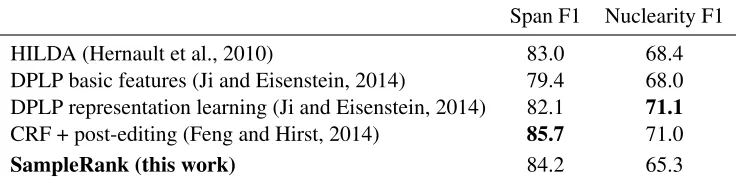
We compare our SampleRank approach with several competitive parsers from the literature: HILDA (Hernault et al., 2010), a bottom-up classification-driven parser; DPLP (Ji and Eisen-stein, 2014), a shift-reduce parser that uses represen-tation learning; and a condition random field (CRF) based parser with post-editing operations and a rich array of features (Feng and Hirst, 2014). SampleR-ank is competitive on the span metric, outperform-ing all systems except for the CRF approach, which employs rich linguistic features including syntax and entity transitions. On the nuclearity metric, the SampleRank-based parser does somewhat worse than these prior efforts.
4.2 Indirect supervision
Span F1 Nuclearity F1
HILDA (Hernault et al., 2010) 83.0 68.4
DPLP basic features (Ji and Eisenstein, 2014) 79.4 68.0
DPLP representation learning (Ji and Eisenstein, 2014) 82.1 71.1
CRF + post-editing (Feng and Hirst, 2014) 85.7 71.0
[image:8.612.121.492.63.154.2]SampleRank (this work) 84.2 65.3
Table 1:Evaluation of RST discourse parsing
the TKP constraints.) The average summary length in the CNN dataset is roughly10%of the full docu-ment length.
We use ROUGE-1 and ROUGE-2 scores, as de-fined by Lin (2004), for scoring the summaries.§4.2 presents the results, in comparison with a simple “LEAD” baseline, which selects the firstnsentences of the document. The learning-based method was not able to outperform LEAD, a negative result.
We also apply the Tree Knapsack Problem (TKP) summarization algorithm (Hirao et al., 2013), which incorporates Rhetorical Structure Theory by pro-ducing summaries that obey the constraints elabo-rated in § 3.1, using the RST parses produced by supervised SampleRank training on the RST tree-bank. Even this method is not able to produce better scoring summaries than LEAD. Hirao et al. (2013) obtained slight improvements on ROUGE-1 over LEAD, using HILDA discourse parses on a dataset of 30 single-document summaries in the RST treebank. The CNN dataset may be less amenable to discourse-driven summarization than the RST data, or the difference may be explained HILDA’s supe-rior performance on nuclearity metric.
5 Related Work
Early work on RST discourse parsing focused on local classifiers (Marcu, 1999b; Hernault et al., 2010), with more recent work exploring struc-ture prediction techniques such as sequence label-ing (Joty et al., 2015), chart parslabel-ing (Li et al., 2014), and minimum spanning tree (Feng and Hirst, 2014). A parallel line of research has consid-ered incremental discourse parsing techniques such as shift-reduce (Sagae, 2009; Ji and Eisenstein, 2014). Muller et al. (2012) apply more advanced search-based algorithms for transition-based dis-course parsing in the framework of Segmented
Dis-course Representation Theory (SDRT). Our pro-posed approach has the advantage of allowing arbi-trary features, and avoiding local search errors; how-ever, stochastic search is not guaranteed to fully ex-plore the search space in any finite amount of time.
We are unaware of prior work on indirect super-vision for discourse parsing from downstream tasks. A somewhat related line of work has used explicitly labeled discourse relations as a source of supervi-sion for the classification of implicit discourse re-lations. Marcu and Echihabi (2002) were the first to explore this approach, working in the context of RST. Sporleder and Lascarides (2008) suggest that informational differences between explicit and im-plicit discourse relations limit the possible efficacy of this approach. More recent work has treated these two relation types as separate domains, obtaining good results by applying domain adaptation tech-niques (Braud and Denis, 2014; Ji et al., 2015).
ROUGE-1 ROUGE-2 F score Recall F score Recall
LEAD 0.2818 0.2569 0.1154 0.1042
SampleRank, trained on CNN summaries (this work) 0.2317 0.2304 0.0858 0.0851
[image:9.612.94.519.62.139.2]TKP+SampleRank trained on RST treebank 0.2731 0.2730 0.0967 0.0963
Table 2:Evaluation of joint summarization and discourse parsing algorithm
6 Discussion
This paper proposes a new structure learning ap-proach for discourse parsing, based on the SampleR-ank algorithm. This approach has the potential to address two major problems with existing discourse parsing algorithms: (1) use of local features or in-cremental decoding algorithms, and (2) lack of suf-ficient labeled data. We find some advantages in the supervised setting, with good results on span identification, but relatively poor results on nucle-arity. It is possible that fine-tuning the training ob-jective could better balance between these two met-rics. We then showed how SampleRank can learn a model that jointly parses the discourse nuclearity structure and produces an extractive summary, using only summary-document pairs as training data. Un-fortunately the resulting summarizer fails to outper-form a simple baseline. A natural next step would be to design more expressive features for capturing summarization quality, and to learn a joint model from both labeled discourse parses and summaries.
Acknowledgments
This work is supported by a Google Faculty Re-search award. Thanks to the reviewers for their help-ful feedback, to Yangfeng Ji, for help with the fea-tures, and to Gongbo Zhang, for helping to build the summary dataset.
References
Steven Abney, S Flickenger, Claudia Gdaniec, C Grish-man, Philip Harrison, Donald Hindle, Robert Ingria, Frederick Jelinek, Judith Klavans, Mark Liberman, et al. 1991. Procedure for quantitatively comparing the syntactic coverage of english grammars. In Pro-ceedings of the workshop on Speech and Natural Lan-guage, pages 306–311. Association for Computational Linguistics.
Taylor Berg-Kirkpatrick, Dan Gillick, and Dan Klein. 2011. Jointly learning to extract and compress. In Proceedings of the Association for Computational Lin-guistics (ACL), pages 481–490, Portland, OR. Parminder Bhatia, Yangfeng Ji, and Jacob Eisenstein.
2015. Better document-level sentiment analysis from rst discourse parsing. In Proceedings of Empirical Methods for Natural Language Processing (EMNLP), Lisbon, September.
Chlo´e Braud and Pascal Denis. 2014. Combining nat-ural and artificial examples to improve implicit dis-course relation identification. InProceedings of the International Conference on Computational Linguis-tics (COLING).
Peter F Brown, Peter V Desouza, Robert L Mercer, Vin-cent J Della Pietra, and Jenifer C Lai. 1992. Class-based n-gram models of natural language. Computa-tional linguistics, 18(4):467–479.
Lynn Carlson, Mary Ellen Okurowski, and Daniel Marcu. 2002. RST discourse treebank. Linguistic Data Con-sortium, University of Pennsylvania.
Laurence Danlos. 2008. Strong generative capacity of RST, SDRT and discourse dependency DAGSs. In Anton Benz and Peter K¨uhnlein, editors,Constraints in Discourse, pages 69–95. Benjamins.
Vanessa Wei Feng and Graeme Hirst. 2014. A linear-time bottom-up discourse parser with constraints and post-editing. In Proceedings of the Association for Computational Linguistics (ACL), pages 511–521, Baltimore, MD.
Bas Heerschop, Frank Goossen, Alexander Hogen-boom, Flavius Frasincar, Uzay Kaymak, and Franciska de Jong. 2011. Polarity analysis of texts using dis-course structure. InProceedings of the 20th ACM in-ternational conference on Information and knowledge management, pages 1061–1070. ACM.
Hugo Hernault, Helmut Prendinger, David A. duVerle, and Mitsuru Ishizuka. 2010. HILDA: A discourse parser using support vector machine classification. Di-alogue and Discourse, 1(3):1–33.
InProceedings of Empirical Methods for Natural Lan-guage Processing (EMNLP), pages 1515–1520, Seat-tle, WA.
Yangfeng Ji and Jacob Eisenstein. 2014. Representation learning for text-level discourse parsing. In Proceed-ings of the Association for Computational Linguistics (ACL), Baltimore, MD.
Yangfeng Ji, Gongbo Zhang, and Jacob Eisenstein. 2015. Closing the gap: Domain adaptation from explicit to implicit discourse relations. In Proceedings of Empirical Methods for Natural Language Processing (EMNLP), Lisbon, September.
Shafiq Joty, Giuseppe Carenini, and Raymond Ng. 2015. CODRA: A novel discriminative framework for rhetorical analysis.Computational Linguistics, 41(3). Jiwei Li, Rumeng Li, and Eduard Hovy. 2014. Recursive
deep models for discourse parsing. InProceedings of Empirical Methods for Natural Language Processing (EMNLP).
Chin-Yew Lin. 2004. Rouge: A package for auto-matic evaluation of summaries. InText summarization branches out: Proceedings of the ACL-04 workshop, volume 8.
Inderjeet Mani and Mark T Maybury. 1999. Advances in automatic text summarization, volume 293. MIT Press.
William C Mann and Sandra A Thompson. 1988. Rhetorical structure theory: Toward a functional the-ory of text organization.Text, 8(3):243–281.
Daniel Marcu and Abdessamad Echihabi. 2002. An unsupervised approach to recognizing discourse rela-tions. InProceedings of the Association for Computa-tional Linguistics (ACL), pages 368–375.
Daniel Marcu. 1999a. The automatic construction of large-scale corpora for summarization research. In Proceedings of the 22nd annual international ACM SI-GIR conference on Research and development in infor-mation retrieval, pages 137–144. ACM.
Daniel Marcu. 1999b. A decision-based approach to rhetorical parsing. InSIGIR, pages 365–372.
Daniel Marcu. 1999c. Discourse trees are good indica-tors of importance in text. Advances in automatic text summarization, pages 123–136.
Daniel Marcu. 2000. The Theory and Practice of Dis-course Parsing and Summarization. MIT Press. Philippe Muller, Stergos Afantenos, Pascal Denis, and
Nicholas Asher. 2012. Constrained decoding for text-level discourse parsing. InProceedings of COLING 2012, pages 1883–1900, Mumbai, India, December. The COLING 2012 Organizing Committee.
Alexander M. Rush, Sumit Chopra, and Jason Weston. 2015. A neural attention model for abstractive sen-tence summarization. In Proceedings of Empirical
Methods for Natural Language Processing (EMNLP), pages 379–389, Lisbon, September.
Kenji Sagae. 2009. Analysis of discourse structure with syntactic dependencies and data-driven shift-reduce parsing. InProceedings of the 11th International Con-ference on Parsing Technologies (IWPT’09), pages 81–84, Paris, France, October. Association for Com-putational Linguistics.
Caroline Sporleder and Mirella Lapata. 2005. Dis-course chunking and its application to sentence com-pression. InProceedings of the conference on Human Language Technology and Empirical Methods in Natu-ral Language Processing, pages 257–264. Association for Computational Linguistics.
Caroline Sporleder and Alex Lascarides. 2008. Using automatically labelled examples to classify rhetorical relations: An assessment. Natural Language Engi-neering, 14(3):369–416.
Krysta Marie Svore, Lucy Vanderwende, and Christo-pher JC Burges. 2007. Enhancing single-document summarization by combining ranknet and third-party sources. In Proceedings of Empirical Methods for Natural Language Processing (EMNLP), pages 448– 457.
Michael Wick, Khashayar Rohanimanesh, Kedar Bellare, Aron Culotta, and Andrew McCallum. 2011. Sam-plerank: Training factor graphs with atomic gradients. InProceedings of the International Conference on Ma-chine Learning (ICML), pages 777–784, Seattle, WA. Ngo Xuan Bach, Nguyen Le Minh, and Akira Shimazu.
2012. A reranking model for discourse segmentation using subtree features. InProceedings of the 13th An-nual Meeting of the Special Interest Group on Dis-course and Dialogue, pages 160–168, Seoul, South Korea, July. Association for Computational Linguis-tics.
Yasuhisa Yoshida, Jun Suzuki, Tsutomu Hirao, and Masaaki Nagata. 2014. Dependency-based discourse parser for single-document summarization. In Pro-ceedings of Empirical Methods for Natural Language Processing (EMNLP).