Not-So-Latent Dirichlet Allocation:
Collapsed Gibbs Sampling Using Human Judgments
Jonathan Chang
1601 S. California Ave.
Palo Alto, CA 94304
[email protected]
Abstract
Probabilistic topic models are a popular tool for the unsupervised analysis of text, providing both a predictive model of future text and a la-tent topic representation of the corpus. Recent studies have found that while there are sugges-tive connections between topic models and the way humans interpret data, these two often dis-agree. In this paper, we explore this disagree-ment from the perspective of the learning pro-cess rather than the output. We present a novel
task,tag-and-cluster, which asks subjects to
simultaneously annotate documents and cluster those annotations. We use these annotations as a novel approach for constructing a topic model, grounded in human interpretations of documents. We demonstrate that these topic models have features which distinguish them from traditional topic models.
1
Introduction
Probabilistic topic models have become popular tools for the unsupervised analysis of large document collections (Deerwester et al., 1990; Griffiths and Steyvers, 2002; Blei and Lafferty, 2009). These mod-els posit a set of latenttopics, multinomial distribu-tions over words, and assume that each document can be described as a mixture of these topics. With algorithms for fast approximate posterior inference, we can use topic models to discover both the topics and an assignment of topics to documents from a collection of documents. (See Figure 1.)
These modeling assumptions are useful in the sense that, empirically, they lead to good models of documents (Wallach et al., 2009). However, re-cent work has explored how these assumptions corre-spond to humans’ understanding of language (Chang et al., 2009; Griffiths and Steyvers, 2006; Mei et al., 2007). Focusing on the latent space, i.e., the inferred mappings between topics and words and between documents and topics, this work has discovered that although there are some suggestive correspondences
between human semantics and topic models, they are often discordant.
In this paper we build on this work to further explore how humans relate to topic models. But whereas previous work has focused on the results of topic models, here we focus on the process by which these models are learned. Topic models lend themselves to sequential procedures through which the latent space is inferred; these procedures are in effect programmatic encodings of the modeling as-sumptions. By substituting key steps in this program with human judgments, we obtain insights into the semantic model conceived by humans.
Here we present a novel task, tag-and-cluster, which asks subjects to simultaneously annotate a doc-ument and cluster that annotation. This task simulates the sampling step of the collapsed Gibbs sampler (de-scribed in the next section), except that the posterior defined by the model has been replaced by human judgments. The task is quick to complete and is robust against noise. We report the results of a large-scale human study of this task, and show that humans are indeed able to construct a topic model in this fash-ion, and that the learned topic model has semantic properties distinct from existing topic models. We also demonstrate that the judgments can be used to guide computer-learned topic models towards models which are more concordant with human intuitions.
2
Topic models and inference
Topic models posit that each document is expressed as a mixture of topics. These topic proportions are drawn once per document, and the topics are shared across the corpus. In this paper we focus on Latent Dirichlet allocation (LDA) (Blei et al., 2003) a topic model which treats each document’s topic assign-ment as a multinomial random variable drawn from a symmetric Dirichlet prior. LDA, when applied to a collection of documents, will build a latent space: a collection of topics for the corpus and a collection of topic proportions for each of its documents.
computer, technology, system, service, site,
phone, internet, machine
play, film, movie, theater,
production, star, director, stage sell, sale, store, product,
business, advertising,
market, consumer TOPIC 1
TOPIC 2
TOPIC 3
(a) Topics
Forget the Bootleg, Just Download the Movie Legally
Multiplex Heralded As Linchpin To
Growth The Shape of
Cinema, Transformed At
the Click of a
Mouse A Peaceful Crew
Puts Muppets Where Its Mouth Is
Stock Trades: A Better Deal For Investors Isn't
Simple Internet portals
begin to distinguish among themselves as shopping malls Red Light, Green
Light: A 2-Tone L.E.D. to Simplify Screens
TOPIC 2 "BUSINESS"
TOPIC 3 "ENTERTAINMENT"
TOPIC 1 "TECHNOLOGY"
[image:2.612.157.453.88.229.2](b) Document Assignments to Topics
Figure 1: The latent space of a topic model consists of topics, which are distributions over words, and a distribution over these topics for each document. On the left are three topics from a fifty topic LDA model trained on articles from the New York Times. On the right is a simplex depicting the distribution over topics associated with seven documents. The line from each document’s title shows the document’s position in the topic space.
LDA can be described by the following generative process:
1. For each topick,
(a) Draw topicβk∼Dir(η)
2. For each documentd,
(a) Draw topic proportionsθd∼Dir(α) (b) For each wordwd,n,
i. Draw topic assignmentzd,n∼Mult(θd) ii. Draw wordwd,n∼Mult(βzd,n)
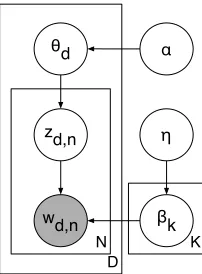
This process is depicted graphically in Figure 2. The parameters of the model are the number of topics,
K, as well as the Dirichlet priors on the topic-word distributions and document-topic distributions,αand
η. The only observed variables of the model are the words, wd,n. The remaining variables must be learned.
There are several techniques for performing pos-terior inference, i.e., inferring the distribution over hidden variables given a collection of documents, in-cluding variational inference (Blei et al., 2003) and Gibbs sampling (Griffiths and Steyvers, 2006). In the sequel, we focus on the latter approach.
Collapsed Gibbs sampling for LDA treats the topic-word and document-topic distributions,θdandβk, as nuisance variables to be marginalized out. The poste-rior distribution over the remaining latent variables,
D N
θd α
βk η
zd,n
wd,n
K
Figure 2: A graphical model depiction of latent Dirichlet allocation (LDA). Plates denote replication. The shaded circle denotes an observed variable and unshaded circles denote hidden variables.
the topic assignmentszd,n, can be expressed as
p(z|α, η,w)∝
Y
d Y
k
Γ(nd,k+αk)
Γ(ηwd,n +nwd,n,k)
Γ(P
wnw,k+ηw)
,
wherend,kdenotes the number of words in document
dassigned to topickandnw,kthe number of times word w is assigned to topic k. This leads to the sampling equations,
p(zd,i=k|α, η,w,zy)∝
(n¬d,kd,i+αk)
ηwd,i+n
¬d,i wd,i,k
P wn
¬d,i w,k +ηw
, (1)
[image:2.612.371.472.303.440.2]statis-tics should exclude the current variable under consid-eration,zd,i.
In essence, the model performs inference by look-ing at each word in succession, and probabilistically assigning it to a topic according to Equation 1. Equa-tion 1 is derived through the modeling assumpEqua-tions and choice of parameters. By replacing Equation 1 with a different equation or with empirical observa-tions, we may construct new models which reflect different assumptions about the underlying data.
3
Constructing topics using human
judg-ments
In this section we propose a task which creates a formal setting where humans can create a latent space representation of the corpus. Our task, tag-and-cluster, replaces the collapsed Gibbs sampling step of Equation 1 with a human judgment. In essence, we are constructing a gold-standard series of samples from the posterior.1
Figure 3 shows howtag-and-clusteris presented to users. The user is shown a document along with its title; the document is randomly selected from a pool of available documents. The user is asked to select a word from the document which is discriminative, i.e, a word which would help someone looking for the document find it. Once the word is selected, the user is then asked to assign the word to the topic which best suits the sense of the word used in the document. Users are specifically instructed to focus on the meanings of words, not their syntactic usage or orthography.
The user assigns a word to a topic by selecting an entry out of a menu of topics. Each topic is repre-sented by the five words occuring most frequently in that topic. The order of the topics presented to the user is determined by the number of words in that document already assigned to each topic. Once an instance of a word in a document has been assigned, it cannot be reassigned and will be marked in red when subsequent users encounter this document. In practice, we also prohibit users from selecting infre-quently occurring words and stop words.
1Additionally, since Gibbs sampling is by nature stochastic,
we believe that the task is robust against small perturbations in the quality of the assignments, so long as in aggregate they tend toward the mode.
4
Experimental results
We conducted our experiments using Amazon Me-chanical Turk, which allows workers (our pool of prospective subjects) to perform small jobs for a fee through a Web interface. No specialized training or knowledge is typically expected of the workers. Amazon Mechanical Turk has been successfully used in the past to develop gold-standard data for natural language processing (Snow et al., 2008).
We prepare two randomly-chosen, 100-document subsets of English Wikipedia. For convenience, we denote these two sets of documents asset1andset2. For each document, we keep only the first 150 words for our experiments. Because of the encyclopedic nature of the corpus, the first 150 words typically provides a broad overview of the themes in the article. We also removed from the corpus stop words and words which occur infrequently2, leading to a lexicon of 8263 words. After this pruning set1 contained 11614 words andset2contained 11318 words.
Workers were asked to perform twenty of the tag-gings described in Section 3 for each task; workers were paid $0.25 for each such task. The number of latent topics,K, is a free parameter. Here we explore two values of this parameter,K = 10andK = 15, leading to a total of four experiments — two for each set of documents and two for each value ofK.
4.1 Tagging behavior
For each experiment we issued 100 HITs, leading to a total of 2000 tags per experiment. Figure 4 shows the number of HITs performed per person in each experiment. Between 12 and 30 distinct workers par-ticipated in each experiment. The number of HITs performed per person is heavily skewed, with the most active participants completing an order of mag-nitude more HITs than other particpants.
Figure 5 shows the amount of time taken per tag, in log seconds. Each color represents a different experiment. The bulk of the tags took less than a minute to perform and more than a few seconds.
4.2 Comparison with LDA
Learned topics As described in Section 3, the
tag-and-cluster task is a way of allowing humans to
con-2Infrequently occurring words were identified as those
Figure 3: Screenshots of our task. In the center, the document along with its title is shown. Words which cannot be selected, e.g., distractors and words previously selected, are shown in red. Once a word is selected, the user is asked to find a topic in which to place the word. The user selects a topic by clicking on an entry in a menu of topics, where each topic is expressed by the five words which occur most frequently in that topic.
0 5 10 15 20 25 30 0
5 10 15 20 25
(a)set1,K= 10
0 2 4 6 8 10 12 0
10 20 30 40 50 60
(b)set1,K= 15
0 5 10 15 20 0
10 20 30 40 50
(c) set2,K= 10
0 5 10 15 20 25 30 0
5 10 15 20
[image:4.612.110.503.345.455.2](d)set2,K= 15
Figure 4: The number of HITs performed (y-axis) by each participant (x-axis). Between 12 and 30 people participated in each experiment.
0.05 0.1 0.2 0.5 1 2 set1 set2 0
0.5 1 1.5 2 2.5
entrop
y
α
(a)K= 10
0.05 0.1 0.2 0.5 1 2 set1 set2 0
0.5 1 1.5 2 2.5 3
entrop
y
α
(b)K= 15
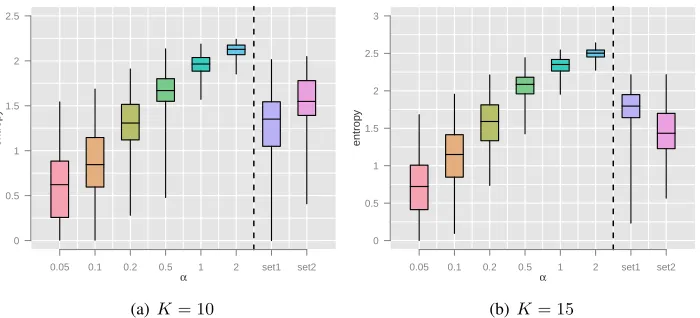
Figure 6: A comparison of the entropy of distributions drawn from a Dirichlet distribution versus the entropy of the topic proportions inferred by workers. Each column of the boxplot shows the distribution of entropies for 100 draws
from a Dirichlet distribution with parameterα. The two rightmost columns show the distribution of the entropy of the
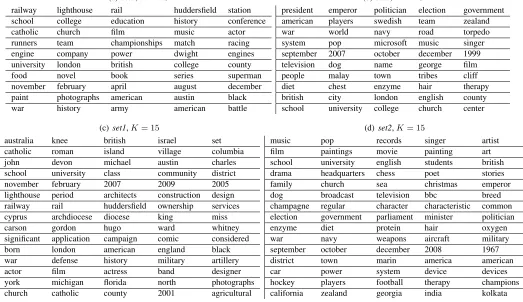
[image:4.612.130.480.497.656.2]Table 1: The five words with the highest probability mass in each topic inferred by humans using the task described in Section 3. Each subtable shows the results for a particular experimental setup. Each row is a topic; the most probable words are ordered from left to right.
(a)set1,K= 10
railway lighthouse rail huddersfield station school college education history conference
catholic church film music actor
runners team championships match racing engine company power dwight engines university london british college county
food novel book series superman
november february april august december paint photographs american austin black
war history army american battle
(b)set2,K= 10
president emperor politician election government american players swedish team zealand
war world navy road torpedo
system pop microsoft music singer september 2007 october december 1999 television dog name george film people malay town tribes cliff diet chest enzyme hair therapy british city london english county school university college church center
(c) set1,K= 15
australia knee british israel set catholic roman island village columbia
john devon michael austin charles
school university class community district
november february 2007 2009 2005
lighthouse period architects construction design railway rail huddersfield ownership services cyprus archdiocese diocese king miss
carson gordon hugo ward whitney
significant application campaign comic considered born london american england black war defense history military artillery
actor film actress band designer
york michigan florida north photographs church catholic county 2001 agricultural
(d)set2,K= 15
music pop records singer artist
film paintings movie painting art school university english students british drama headquarters chess poet stories family church sea christmas emperor dog broadcast television bbc breed champagne regular character characteristic common election government parliament minister politician
enzyme diet protein hair oxygen
war navy weapons aircraft military
september october december 2008 1967 district town marin america american
car power system device devices
hockey players football therapy champions california zealand georgia india kolkata
0 10 20 30 40 −70000
−65000 −60000 −55000 −50000
log lik
elihood
iteration
(a) set1,K= 10
0 10 20 30 40 −70000
−65000 −60000 −55000 −50000 −45000
log lik
elihood
iteration
(b)set2,K= 10
0 10 20 30 40 −70000
−65000 −60000 −55000 −50000
log lik
elihood
iteration
(c)set1,K= 15
0 10 20 30 40 −70000
−65000 −60000 −55000 −50000 −45000
log lik
elihood
iteration
(d) set2,K= 15
Figure 7: The log-likelihood achieved by LDA as a function of iteration. There is one series for each value of
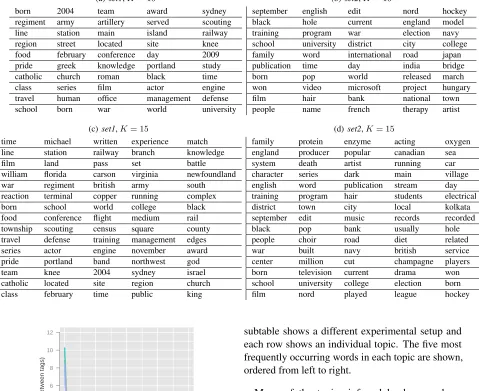
[image:5.612.52.575.154.456.2]Table 2: The five words with the highest probability mass in each topic inferred by LDA, withα= 0.2. Each subtable shows the results for a particular experimental setup. Each row is a topic; the most probable words are ordered from left to right.
(a) set1,K= 10
born 2004 team award sydney
regiment army artillery served scouting line station main island railway region street located site knee food february conference day 2009 pride greek knowledge portland study catholic church roman black time class series film actor engine travel human office management defense school born war world university
(b) set2,K= 10
september english edit nord hockey black hole current england model training program war election navy school university district city college family word international road japan publication time day india bridge
born pop world released march
won video microsoft project hungary
film hair bank national town
people name french therapy artist
(c) set1,K= 15
time michael written experience match line station railway branch knowledge
film land pass set battle
william florida carson virginia newfoundland war regiment british army south reaction terminal copper running complex born school world college black food conference flight medium rail township scouting census square county travel defense training management edges series actor engine november award pride portland band northwest god
team knee 2004 sydney israel
catholic located site region church class february time public king
(d) set2,K= 15
family protein enzyme acting oxygen england producer popular canadian sea system death artist running car character series dark main village english word publication stream day training program hair students electrical district town city local kolkata september edit music records recorded
black pop bank usually hole
people choir road diet related
war built navy british service
center million cut champagne players born television current drama won school university college election born
film nord played league hockey
0 500 1000 1500 2000 −2
0 2 4 6 8 10 12
log(seconds betw
een tags)
Figure 5: The distribution of times taken per HIT. Each se-ries represents a different experiment. The bulk of the tags took less than one minute and more than a few seconds.
struct a topic model. One way of visualizing a learned topic model is by examining its topics. Table 1 shows the topics constructed by human judgments. Each
subtable shows a different experimental setup and each row shows an individual topic. The five most frequently occurring words in each topic are shown, ordered from left to right.
Many of the topics inferred by humans have straightforward interpretations. For example, the
{november, february, april, august, december}topic for theset1corpus withK = 10
Table 2 shows the topics learned by LDA un-der the same experimental conditions, with the Dirichlet hyperparameter α = 0.2 (we justify this choice in the following section). These topics are more difficult to interpret than the ones created by humans. Some topics seem to largely make sense except for some anoma-lous words, such as {district, town, city, local, kolkata} or {school, university, college, election, born}. But the small amount of data means that it is difficult for a model which does not leverage prior knowledge to infer meaningful topic. In contrast, several humans, even working independently, can leverage prior knowledge to construct meaningful topics with little data.
There is another qualitative difference between the topics found by the tag-and-cluster task and LDA. Whereas LDA must rely on co-occurrence, humans can use ontological information. Thus, a topic which has ontological meaning, such as a list of months, may rarely be discovered by LDA since the co-occurrence patterns of months do not form a strong pattern. But users in every experimental con-figuration constructed this topic, suggesting that the users were consistently leveraging information that would not be available to LDA, even with a larger corpus.
Hyperparameter values A persistent question
among practitioners of topic models is how to set or learn the value of the hyperparameterα.αis a Dirich-let parameter which acts as a control on sparsity — smaller values ofαlead to sparser document-topic distributions. By comparing the sparsity patterns of human judgments to those of LDA for different set-tings ofα, we can infer the value ofαthat would best match human judgments.
Figure 6 shows a boxplot comparison of the en-tropy of draws from a Dirichlet distribution (the gerative process in LDA), versus the observed en-tropy of the models learned by humans. The first six columns show the distributions for the Dirichlet draws for various values ofα; the last two columns show the observed entropy distributions on the two corpora,set1andset2.
[image:7.612.313.542.144.252.2]The empirical entropy distributions across the cor-pora are comparable to those of a Dirichlet distri-bution with αbetween approximately 0.2and0.5.
Table 3: The five words with the highest probability mass
in each topic inferred by LDA on set1with α = 0.2,
K = 10, and initialized using human judgments. Each
row is a topic; the most probable words are ordered from left to right.
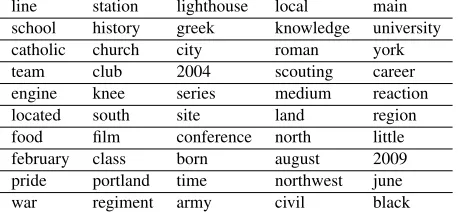
line station lighthouse local main school history greek knowledge university catholic church city roman york team club 2004 scouting career engine knee series medium reaction located south site land region food film conference north little february class born august 2009 pride portland time northwest june war regiment army civil black
These settings ofαare slightly higher than, but still in line with a common rule-of-thumb ofα= 1/K. Fig-ure 7 shows the log-likelihood, a measFig-ure of model fit, achieved by LDA for each value of α. Higher log-likelihoods indicate better fits. Commensurate with the rule of thumb, using log-likelihoods to se-lectαwould encourage values smaller than human judgments.
However, while the entropy of the Dirichlet draws increases significantly when the number of clusters is increased fromK = 10toK = 15, the entropies assigned by humans does not vary as dramatically. This suggests that for any given document, humans are likely to pull words from only a small number of topics, regardless of how many topics are available, whereas a model will continue to spread probability mass across all topics even as the number of topics increases.
Improving LDA using human judgments The
re-sults of the previous sections suggests that human be-havior differs from that of LDA, and that humans con-ceptualize documents in ways LDA does not. This motivates using the human judgments to augment the information available to LDA. To do so, we initialize the topic assignments used by LDA’s Gibbs sampler to those made by humans. We then run the LDA sampler till convergence. This provides a method to weakly incorporate human knowledge into the model.
0 10 20 30 40 −70000
−65000 −60000 −55000 −50000
log lik
elihood
[image:8.612.109.264.86.243.2]iteration
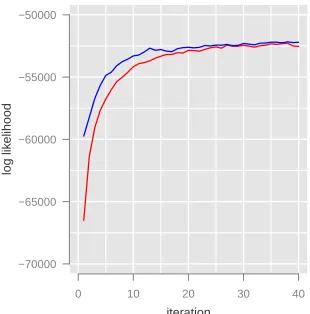
Figure 8: The log likelihood achieved by LDA onset1
withα = 0.2, K = 10, and initialized using human
judgments (blue). The red line shows the log likelihood without incorporating human judgments. LDA with hu-man judgments dominates LDA without huhu-man judgments and helps the model converge more quickly.
south, site, land, region}, have appeared in its place.
Figure 8 shows the log-likelihood course of LDA when initialized by human judgments (blue), versus LDA without human judgments (red). Adding hu-man judgments strictly helps the model converge to a higher likelihood and converge more quickly. In short, incorporating human judgments shows promise at improving both the interpretability and conver-gence of LDA.
5
Discussion
We presented a new method for constructing topic models using human judgments. Our approach re-lies on a novel task, tag-and-cluster, which asks users to simultaneously annotate a document with one of its words and to cluster those annotations. We demonstrate using experiments on Amazon Mechan-ical Turk that our method constructs topic models quickly and robustly. We also show that while our topic models bear many similarities to traditionally constructed topic models, our human-learned topic models have unique features such as fixed sparsity and a tendency for topics to be constructed around concepts which models such as LDA typically fail to find.
We also underscore that the collapsed Gibbs sam-pling framework is expressive enough to use as the basis for human-guided topic model inference. This
may motivate, as future work, the construction of dif-ferent modeling assumptions which lead to sampling equations which more closely match the empirically observed sampling performed by humans. In effect, our method constructs a series of samples from the posterior, a gold standard which future topic models can aim to emulate.
Acknowledgments
The author would like to thank Eytan Bakshy and Professor Jordan Boyd-Graber-Ying for their helpful comments and discussions.
References
David Blei and John Lafferty, 2009. Text Mining: Theory
and Applications, chapter Topic Models. Taylor and Francis.
David Blei, Andrew Ng, and Michael Jordan. 2003.
La-tent Dirichlet allocation.JMLR, 3:993–1022.
Jonathan Chang, Jordan Boyd-Graber, Sean Gerrish, Chong Wang, and David M. Blei. 2009. Reading tea leaves: How humans interpret topic models. In
NIPS.
Scott Deerwester, Susan Dumais, Thomas Landauer, George Furnas, and Richard Harshman. 1990.
Index-ing by latent semantic analysis.Journal of the
Ameri-can Society of Information Science, 41(6):391–407. Thomas L. Griffiths and Mark Steyvers. 2002. A
prob-abilistic approach to semantic representation. In
Pro-ceedings of the 24th Annual Conference of the Cogni-tive Science Society.
T. Griffiths and M. Steyvers. 2006. Probabilistic topic models. In T. Landauer, D. McNamara, S. Dennis, and
W. Kintsch, editors,Latent Semantic Analysis: A Road
to Meaning. Laurence Erlbaum.
Qiaozhu Mei, Xuehua Shen, and ChengXiang Zhai. 2007. Automatic labeling of multinomial topic models. In
KDD.
R. Snow, Brendan O’Connor, D. Jurafsky, and A. Ng. 2008. Cheap and fast—but is it good? Evaluating non-expert annotations for natural language tasks. In
EMNLP.
Hanna M. Wallach, Iain Murray, Ruslan Salakhutdinov, and David Mimno. 2009. Evaluation methods for topic