The TermiNet Project: an Overview
Ariani Di Felippo
Interinstitutional Center for Research and Development in Computational Linguistics (NILC)/ Research Group of Terminology (GETerm), Federal University of São Carlos (UFSCar)
Rodovia Washington Luís, km 235 - SP-310 CP 676, 13565-905, São Carlos, SP, Brazil
Abstract
Linguistic resources with domain-specific coverage are crucial for the development of concrete Natural Language Processing (NLP) systems. In this paper we give a global intro-duction to the ongoing (since 2009) TermiNet project, whose aims are to instantiate a gener-ic NLP methodology for the development of terminological wordnets and to apply the in-stantiated methodology for building a termi-nological wordnet in Brazilian Portuguese.
1
Introduction
In knowledge-based Natural Language Processing (NLP) systems, the lexical knowledge database is responsible for providing, to the processing mod-ules, the lexical units of the language and their morphological, syntactic, semantic-conceptual and even illocutionary properties (Hanks, 2004).
In this scenario, there is an increasing need of accurate general lexical-conceptual resources for developing NLP applications.
A revolutionary development of the 1990s was the Princeton WordNet (WN.Pr) (Fellbaum, 1998), an online reference lexical database built for North-American English that combines the design of a dictionary and a thesaurus with a rich ontolog-ical potential.
Specifically, WN.Pr is a semantic network, in which the meanings of nouns, verbs, adjectives, and adverbs are organized into “sets of cognitive synonyms” (or synsets), each expressing a distinct
concept. Synsets are interlinked through concep-tual-semantic (i.e., hypernymy1/hyponymy2,
holo-nymy/meronymy, entailment3, and cause4) and
lexical (i.e., antonymy) relations. Moreover, WN.Pr encodes a co-text sentence for each word-form in a synset and a concept gloss for each syn-set (i.e., an informal lexicographic definition of the concept evoked by the synset).
The success of WN.Pr is largely due to its ac-cessibility, linguistic adequacy and potential in terms of NLP. Given that, WN.Pr serves as a mod-el for similarly conceived wordnets in several lan-guages. In other words, the success of WN.Pr has determined the emergence of several projects that aim the construction of wordnets for other lan-guages than English or to develop multilingual wordnets (the most important project in this line is EuroWordNet) (Vossen, 2002).
Many recent projects with the objective of (i) in-tegrating generic and specialized wordnets (e.g., Magnin and Speranza, 2001; Roventini and Mari-nelli, 2004; Bentivogli et al., 2004), (ii) enriching generic wordnets with terminological units (e.g., Buitelaar and Sacaleanu, 2002) or (iii) constructing terminological wordnets (e.g.: Sagri et al., 2004; Smith and Fellbaum, 2004) have shown that
1 The term Y is a hypernym of the term X if the entity denoted by X is a (kind of) entity denoted byY.
2 If the term Y is a hypernym of the term X then the term X is a hyponym of Y.
3 The action A1 denoted by the verb X entails the action A2 denoted by the verb Y if A1 cannot be done unless A2 is, or has been, done
4 The action A1 denoted by the verb X causes the action A2 denoted by the verb Y.
crete NLP application must be able to comprehend both expert and non-expert vocabulary.
Despite the existence of a reasonable number of terminological wordnets, there is no a general me-thodology for building this type of lexical data-base. Thus, motivated by this gap and by the fact that Brazilian Potuguese (PB) is a resource-poor language, the two-years TermiNet project has been developed since September 2009.
This paper gives an overview of the TermiNet project. Accordingly, in Section 2 we brief de-scribe the original WN.Pr design that motivated the project. In Section 3 we present the aims of the TermiNet project and its methodological approach. In Section 4 we depict the current state of the project. In Section 5 we describe future work, and in Section 6 we outline potential points for collabo-ration with researchers from the rest of the Ameri-cas.
2
Princeton WordNet and its Design
WN.Pr contains information about nouns, verbs, adjectives and adverbs in North-American English and is organized around the notion of a synset. As mentioned, a synset is a set of words with the same part-of-speech that can be interchanged in a certain context. For example, {car; auto; automobile; ma-chine; motorcar} form a synset because they can be used to refer to the same concept. A synset is often further described by a concept gloss5, e.g.:
“4-wheeled; usually propelled by an internal combus-tion engine”.
Finally, synsets can be related to each other by the conceptual-semantic relations of hyperonymy/ hyponymy, holonymy/meronymy, entailment and cause, and the lexical relation of antonymy.
In the example, taken from WN.Pr (2.1), the synset {car; auto; automobile; machine; motorcar} is related to:
(i) more general concepts or the hyperonym syn-set: {motor vehicle; automotive vehicle}; (ii) more specific concepts or hyponym synsets:
e.g. {cruiser; squad car; patrol car; police car; prowl car} and {cab; taxi; hack; taxicab}; and (iii) parts it is composed of: e.g. {bumper}; {car
door}, {car mirror} and {car window}.
5An informal lexicographic definition of the concept evoked by the synset.
WN.Pr also includes an English co-text sen-tence for each word-form in a synset, and a seman-tic type for each synset.
Based on WN.Pr design, Brazilian Portuguese WordNet (WordNet.Br or WN.Br) project launched in 2003 departed from a previous lexical resource: the Brazilian Portuguese Thesaurus (Di-as-da-Silva et al, 2002). The original WN.Br data-base is currently being refined, augmented, and upgraded. The improvements include the encoding of the following bits of information in to the data-base: (a) the co-text sentence for each word-form in a synset; (b) the concept gloss for each synset; and (c) the relevant language-independent hierar-chical conceptual-semantic relations.
The current WN.Br database presents the fol-lowing figures: 11,000 verb forms (4,000 synsets), 17,000 noun forms (8,000 synsets), 15,000 adjec-tive forms (6,000 synsets), and 1,000 adverb forms (500 synsets), amounting to 44,000 word forms and 18,500 synsets (Dias-da-Silva et al, 2008).
3
The TermiNet Project
The TermiNet (“Terminological WordNet”) project started in September 2009 and shall be fi-nished finish in August 2011. It has been devel-oped in the laboratory of the Research Group of Terminology6 (GETerm) in Federal University of
São Carlos (UFSCar) with the collaboration of the Interinstitutional Center for Research and Devel-opment in Computational Linguistics7
(NILC/University of São Paulo) researchers. The TermiNet project has two main objectives. The first is to instantiate the generic NLP metho-dology, proposed by Dias-da-Silva (2006), for de-veloping terminological databases according to the WN.Pr model. Such methodology distinguishes itself by conciliating the linguistic and computa-tional facets of the NLP researches. The second is to apply the instantiated methodology to build a terminological wordnet or terminet8 in BP, since
BP is a resource-poor language in NLP for which domain-specific databases in wordnet format have not been built yet.
It is important to emphasize that the main terminological resources in BP, which are
6http://www.geterm.ufscar.br/ 7http://www.nilc.icmc.usp.br
ble through the OntoLP9 website, are in fact
(for-mal) ontologies or taxonomies. There is no nological WordNet-like database in BP.
In order to achieve its objectives, TermiNet has, apart from the project leader (Prof. Ariani Di Fe-lippo), an interdisciplinary team that includes six undergraduate students: five from Linguistics and one from Computer Science courses. The Linguis-tics students are responsible for specific linguistic tasks in the project, such as: (i) corpus compila-tion, (ii) candidate terms extraccompila-tion, (iii) synonymy identification, and (iv) semantic-conceptual rela-tions extraction (hypernymy/hyponymy). The res-ponsability of the Computer Science student is to support the automatic processing related to the lin-guistic (e.g., tagging, parsing, term extraction, etc.) and linguistic-computational domains during the initial stages of the project.
Moreover, the project counts with the collabora-tion of four PhD researchers from NILC. Specifi-cally, TermiNet has the support of Prof. Gladis Maria de Barcellos Almeida, a specialist in termi-nological research and the coordinator of GETerm; Prof. Maria da Graças Volpe Nunes, the coordina-tor of NILC and one of the most important Brazili-an NLP researchers; Prof. SBrazili-andra Aluisio, a specialist in corpus construction, and Prof. Thiago Pardo, who has interests in the development of lex-ical resources for the automatic processing of BP.
3.1 Instantiation of the NLP Tree-Domain Methodology
Based on Expert Systems development, Dias-da-Silva (2006) established a three-domain approach methodology to develop any research in NLP do-main, assuming a compromise between Human Language Technology and Linguistics (Dias-da-Silva, 1998).
The linguistic-related information to be compu-tationally modeled is likened to a rare metal. So, it must be "mined", "molded", and "assembled" into a computer-tractable system (Durkin, 1994). Ac-cordingly, the processes of designing and imple-menting a terminet lexical database have to be developed in the following complementary do-mains: the linguistic domain, the linguistic-computational domain, and implementational or computational domain.
9http://www.inf.pucrs.br/~ontolp/downloads.php
(a) The Linguistic-related Domain
In this domain, the lexical resources and the lexi-cal-conceptual knowledge are mined. More specif-ically, the research activities in the linguistic domain are divided in two processes: the selection of the lexical resources for building the terminet database, and the specification of the lexical-conceptual knowledge that characterize a terminet. The linguist starts off these procedures by deli-mitating the specialized domain that will be en-coded in wordnet format.
According to Almeida and Correia (2008), deal-ing with an entire specialized domain is a very problematic task because the domains (e.g.: Mate-rials Engineering) in general are composed of sub-domains (e.g.: Ceramic Materials, Polymers and Metals) with different characteristics, generating a large universe of sources from which the lexical-conceptual knowledge will have to be mined. Consequently, the authors present some criteria that may lead to delimitate a specialized domain: (i) the interest of the domain experts by termino-logical products (in this case, by a terminet); (ii) the relevance of the domain in the educational, so-cial, political, economic, scientific and/or technol-ogical scenarios, and (iii) the availability of specialized resources in digital format from which the lexical-conceptual knowledge will be extracted. After delimitating the domain, it is necessary to select the lexical resources describe in (iii). Ac-cording to Rigau (1998), the two main sources of information for building wide-coverage lexicons for NLP systems are: structured resources (e.g.: conventional monolingual and bilingual dictiona-ries, thesauri, taxonomies, vocabularies, etc.) and unstructured resources (i.e., corpora10).
Due to the unavailability of reusing structured resources, the corpora have become the main source of lexical knowledge (Nascimento, 2003; Agbago and Barrière, 2005; Cabré et al., 2005; Almeida, 2006). The increasing use of corpora in terminological researches is also due to the fact that “el carácter de término no se da per se, sino en función del uso de una unidad léxica en un contex-to expresivo y situacional determinado” (Cabré, 1999: 124). Thus, in the TermiNet project, the
pus is considered the main lexical resource that can be used to construct a terminet.
Although there are available several specialized
corpora, the development of a terminet of certain domains may require the compilation of a corpus. Based on the assumptions of Corpus Linguistics (Aluisio and Alemida, 2007), the construction of a
corpus must follow three steps: (i) the corpus pro-jection, i.e., the specification of the corpus typolo-gy according to the research purposes; (ii) the compilation of the texts that will compose the cor-pus, and (iii) the pre-processing of the corpus (i.e., conversion, clean-up, manipulation, and annotation of the texts).
From the corpus, the specialized knowledge will be extracted, i.e., the terminological units (or terms), the lexical relations, and the conceptual-semantic relations11.
As mentioned in previous sections, the lexical units are organized into four syntactic categories in WN.Pr: verbs, nouns, adjectives and adverbs. Giv-en the relevance of nouns in the organization of any terminology (i.e., the set of all terms related to a given subject field or discipline), we decided to restrict the construction of a terminet to the catego-ry of nouns. In other words, a terminet database, in principle, will only contain information about con-cepts lexicalized by nouns. Additionally, it will only encode the hyperonymy/hyponymy relations, which are the most important conceptual-semantic relations between nouns. The co-text sentence for each word-form in a synset and the concept gloss for each synset will not be focused in building a terminet.
As the TermiNet a corpus-based project, we will apply approaches and strategies to automatically recognize and extract candidate terms and relations from corpus.
In order to better understand the automatic can-didate terms and extraction, it can be useful to identify two mainstream approaches to the prob-lem. In the first approach, statistical measures have been proposed to define the degree of termhood of candidate terms, i.e., to find appropriate measures that can help in selecting good terms from a list of candidates. In the second approach, computational terminologists have tried to define, identify and recognize terms looking at pure linguistic
11 The glosses and co-text sentences will not be specificied in the TermiNet projet.
ties, using linguistic filtering techniques aiming to identify specific syntactic term patterns (Bernhard, 2006; Pazienza et al., 2005; Cabré et al., 2001). Once extrated, the candidate terms have be vali-dated. Two validation estrategies will be consi-dered in the TermiNet project. The first strategy consists on manually validating by domain experts. The second consists on automatically comparing the list of candidate terms with a list of lexical un-ities extracted from a general corpus in BP. The automatic acquisition of hyper-onym/hyponymy relation from corpus is common-ly based on linguistic methods. These methods look for linguistic clues that indisputably indicate the relation of interest (Hearst, 1992). The linguis-tic clues are basically lexico-syntaclinguis-tic patters such as: [NP such {NP,}*{(or|and)} NP] (e.g., “works by such authors as Herrick, and Shakespeare”). The hierarchical relations extrated from corpus are commonly validated by domain experts.
(b) The Linguistic-Computational Domain
In this domain, the overall information selected and organized in the preceding domain is molded into a computer-tractable representation; in the case of a WordNet-like database, the computer-tractable representation is based on the notions of:
word form – a orthographic representation of an individual word or a string of individual words joined with underscore characters;
synset – a set of words built on the basis of the notion of synonymy in context, i.e. word inter-changeability in some context;
lexical matrix – associations of sets of word forms and the concepts they lexicalize;
relational pointers – formal representations of the relations between the word forms in a syn-set and other synsyn-sets; synonymy of word forms is implicit by inclusion in the same synset; hyperonymy always relates one synset to another, and is an example of a semantic rela-tion; hyperonymy, in particular, is represented by reflexive pointers (i.e., if a synset contains a pointer to another synset, the other synset should contain a corresponding reflexive poin-ter back to the original synset).
(c) The Computational Domain
other words, it is generated, in this domain, the terminet database. The software tool that we will use to generate the terminet database is under in-vestigation.
4
TermiNet: Past and Current Stages of
Development
The project, which started in September 2009, is still in its early stages. Consequently, the research tasks that have been developed so far are those re-lated to the linguistic domain. As described in Sec-tion 3.1a, there are several linguistic tasks in the TermiNet project. Two of them – the delimitation of the specialized domain and the corpus projec-tion – are completed. In subsecprojec-tions 4.1 and 4.2, we present these finished processes and in 4.3 we focus on the current activity.
4.1 Delimitation of the specialized domain DE is conventionally defined as "any educational or learning process or system in which the teacher or instructor is separated geographically or in time from his or her students or educational re-sources”.
According to the second Brazilian Yearbook of Statistics on Open and Distance Education (Anuário Brasileiro Estatístico de Educação Aberta e a Distância12), in 2007 there were approximately 2,5 millions of students enrolled in accredited DE courses, from basic to graduate education, in 257 accredited institutions. The number of students in DE courses has grown 24.9% in relation to 2006. Thus, we can see the relevance of the DE modality in Brazil. Despite the relevance of the DE in the Brazilian educational (and political) scenario, there is no a lexical-conceptual representation of this domain, especially in a machine-readable format. Consequently, the instantiated methodology will be validated by building DE.WordNet (DE.WN), a specialized wordnet of the Distance Education (or Distance Learning) domain in BP. The construc-tion of such database has been supported by do-main experts from the “Open University of Brazil” (Universidade Aberta do Brasil – UAB) project of the Federal University of São Carlos (UFSCar). DE.WN can be integrated into the wordnet lexi-cal database for BP, the WordNet.Br
12http://www.abraead.com.br/anuario/anuario_2008.pdf
Silva et al., 2008), enriching it with domain specif-ic knowledge.
4.2 Corpus projection
Following the assumptions of Corpus Linguistics described in Section 3, the corpus of DE domain has been constructed according to the steps: (i)
corpus projection, (ii) corpus compilation, and (iii) the pre-processing of the texts.
The corpus typology in the TermiNet project was specified based on: (i) the conception of “ cor-pus”, (ii) the type of lexical resource to be built, and (iii) the project decisions (Di Felippo and Sou-za, 2009).
The corpus definition or conception is common-ly related to three criteria: representativeness, bal-ance and authenticity.
According to the representativeness criterion, we have been compiled a representative corpus of the DE domain. There have been many attempts to set the size, or at least establish a minimum num-ber of texts, from which a specialized corpus may be compiled. To satisfy the representativeness cri-terion, we have been constructed a medium-large
corpus, with at least 1 million of words.
In a specialized corpus, it is important to gather texts from different genres (i.e. technical-scientific, scientific divulgation, instructional, informative, and technical-administrative) and media (i.e, newswire, books, periodicals, etc.). Following the
balance and authenticity criteria, we have been constructed a corpus with a balanced number of real texts per genre.
Besides, the format of the lexical database (i.e. a terminet) determined some characteristics of the
corpus. Specifically, the corpus has to be syn-chronic/ contemporary, since a wordnet (termino-logical or not) encodes synchronic lexical-conceptual knowledge. The corpus has only to store written texts, since wordnets are lingwares for written language processing. Finally, the cor-pus in the TermiNet project has only to store texts from a specialized domain and in one language.
annotated with part-of-speech (PoS) information, since some automatic extraction methods require it. As a consequency of the decision presented in (ii), the corpus will be available and usable as widely as possible on the web.
Finally, we also decided that once the corpus
has been assembled, it will not be changed until the first version of DE.WN is ready.
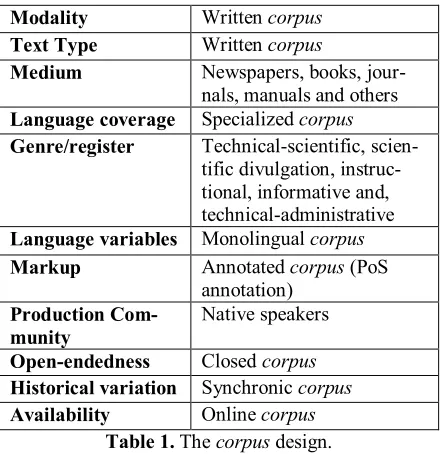
Based on the typology proposed by Giouli and Peperidis (2002), the Table 1 summarizes the cha-racteritics of the corpus previously described.
Modality Written corpus
Text Type Written corpus
Medium Newspapers, books, jour-nals, manuals and others
Language coverage Specialized corpus
Genre/register Technical-scientific, scien-tific divulgation, instruc-tional, informative and, technical-administrative
Language variables Monolingual corpus
Markup Annotated corpus (PoS
annotation)
Production
Com-munity Native speakers
Open-endedness Closed corpus
Historical variation Synchronic corpus
[image:6.612.76.298.210.437.2]Availability Online corpus
Table 1. The corpus design.
The specialized domain and corpus typology were specified by the undergraduate student responsible for the corpus compilation under the supervision of a PhD in Linguistics (leader of the project).
4.3 Corpus compilation
Currently, one undergraduate student from Lin-guistics has been compiled the corpus. Specifical-ly, the corpus compilation comprises two processes: (i) the selection of resources and (ii) the collect of texts from these resources.
In the TermiNet project, the web is the main source for collecting texts of DE. The choice of web reflects the fact that web has become an un-precedented and virtually inexhaustible source of authentic natural language data for researchers in linguistics.
Although there are many computational tools that assist in gathering a considerable amount of texts on the web, the selection/collection of texts
has been followed a manual process, which is composed of three steps: (i) to access a webpage whose content is important for compiling the cor-pus, (ii) to search the texts on the webpage by search queries as “distance education” and “dis-tance learning”, and (iii) to save the text files on the computer.
In the pre-processing step, the text files in a non-machine readable format (e.g. pdf) are manually converted to text format (txt), which is readable by machines. This process is important because the lexical-conceptual knowledge will be (semi)automatically extracted from the corpus, and the extraction tools require a corpus whose texts are in txt format.
Data corrupted by the conversion or even unne-cessary to the research (e.g. references, informa-tion about filliainforma-tion, etc.) are excluded during the cleaning process. After that, the metadata or exter-nal information (e.g. authorship, publication de-tails, genre and text type, etc.) on each text are being automatically annotated and encoded in a header. In the TermiNet project, we are using the header editor available at the “Portal de Corpus” website13.
5
Future Work
According to the three-domain methodology, fu-ture steps will involve the following tasks of the linguistic domain: candidate terms and relations extraction (and validation).
In the TermiNet project, two specific software tools constructed based on lingustic approaches will be used to extract candidate terms from the DE corpus: EXATOLP (Lopes et al., 2009) and On-toLP (Ribeiro Jr., 2008). Additionally, we intend to extract the terms from corpus using the NSP (Ngram Statistics Package) tool (Bannerjee and Pedersen, 2003), i.e., a flexible and easy-to-use software tool that supports the identification and analysis of Ngrams.
To extract the hyperonymy and hyponymy rela-tions, we will also use the OntoLP, which is a tool, actually a plug-in, for the ontologies editor Protégé14, a widely used editor in the scientific
community and which gives support to the con-struction of ontologies. The process of automatic
ontology construction in the OntoLP tool also en-globes the identification of hierarchical relation between the terms.
The synonymy relation will be also recognized and extracted automatically from the corpus. How-ever, the automatic extraction method of such lexi-cal relation is still under investigation.
After the acquisition of all lexical-conceptual information, we will develop the tasks or processes of the linguistic-computational and computational domains.
Among the expected results of the TermiNet projet are: (i) a methodological framework for building a specific type of lingware, i.e. termino-logical wordnets; (ii) a specialized corpus of the DE domain; (iii) a terminological lexical database based on the WN.Pr format of the DE domain. Moreover, there is the possibility of extending the WN.Br database through the inclusion of specia-lized knowledge.
Besides the benefits to NLP domain, the DE.WN may also contribute to the development of standard terminographic products (e.g., glossary, dictionary, vocabulary, etc.), of the DE domain since the organization of the lexical-conceptual knowledge is an essential step in building such products.
6
Collaborative OpportunitiesWe consider our experience in developing a termi-net in BP as the major contribution that we can offer to other researchers in Latin America. Since the resources (i.e., corpus and lexical database)and tools (i.e., terms and relations extractors) that we have been used are language-dependent, they can-not be used directly for Spanish and English. But, we are willing to share our expertise on (i) compil-ing a terminological corpus, (ii) automatically ex-tracting lexical-conceptual knowledge from
corpus, and (iii) constructing a terminet database in order to develop similar projects for Spanish and English.
We are really interested in actively taking part in joint research projects that aim to construct termi-nological lexical database for Spanish or English, especially in wordnet format.
Collaboration of researchers from the USA that were directly involved in the development of wordnet databases (terminological or not), willing
to share their experience and tools, would be wel-come.
We would appreciate collaboration from re-searchers in the USA specifically in relation to computational programs or software tools used in building WordNet-like lexical database, which are responsible for the computer-tractable representa-tion described in 3.1(b). The current WN.Br edit-ing tool, which was originally designed to aid the linguist in carrying out the tasks of building syn-sets, selecting co-text sentences from corpora, and writing synset concept glosses, has been modified to aid the linguistic in carrying out the task of en-coding conceptual relations. However, this editor is just able to deal with the hypernymy/hyponymy relations when they are inherited from WN.Pr through a conceptual-semantic alignment strategy (Dias-da-Silva et al, 2008). So, the WN.Br editor is not the most appropriate tool to TermiNer project tasks. Consequently, contributions to develop “a kind of” Grinder15 for TermiNet would be wel-come. We would also appreciate collaboration from re-searchers in the USA in relation to metho-dological approaches to enriching generic word-nets with terminological units.
Acknowledgments
We thank the Brazilian National Council for Scien-tific and Technological Development (CNPq) (471871/2009-5), and the State of São Paulo Re-search Foundation (FAPESP) (2009/06262-1) for supporting the TermiNet project. We also thank the NAACL HLT Young Investigators Workshop refe-rees, who helped make this paper better.
References
Adriana Roventini and Rita Marinelli. 2004. Extending the Italian Wordnet with the specialized language of the maritime domain. In: Proceedings of the 2nd
In-ternational Global Wordnet Conference. Masaryk University, Brno, 193-198.
Akakpo Agbago and Caroline Barrière. 2005. Corpus construction for Terminology. In: Proceedings of the Corpus Lingustics Conference. Birmingham, 14-17. Bento Carlos Dias-da-Silva. 2006. Bridging the gap
between linguistic theory and natural language processing. In: Proceedings of the 16th International
Congress of Linguistics, 1997. Oxford: Elsevier Sciences, 1998, 1-10.
Bento Carlos Dias-da-Silva. 2006. O estudo linguístico-computacional da linguagem. Letras de Hoje, 41(2): 103-138.
Bento Carlos Dias-da-Silva, Ariani Di Felippo and Ma-ria G. V. Nunes. 2008. The automatic mapping of Princeton Wordnet lexical-conceptual relations onto the Brazilian Portuguese Wordnet database. In: Pro-ceedings of the 6th LREC. Marrakech, Morocco.
Bento Carlos Dias-da-Silva, Mirna Fernanda de Olivei-ra, Hélio Roberto de Moraes. 2002. Groundwork for the development of the Brazilian Portuguese Word-net. In: Proceedings of the 3rd International
Confe-rence Portugal for Natural Language Processing (PorTal). Faro, Portugal. Berlin: Springer-Verlag, 189-196.
Bernardo Magnini and Manuela Speranza. 2001. Inte-grating generic and specialized wordnets. In: Pro-ceedings of the Conference on Recent Advances in Natural Language Processing. Bulgaria.
Christiane Fellbaum (ed.). 1998. Wordnet: an electronic lexical database. The MIT Press, Ca, MA: 423p. Delphine Bernhard. 2006. Multilingual term extraction
from domain-specific corpora using morphological structure. In: Proceedings of the 11th European
Chapter Meeting of the ACL, Trento, Italy, 171-174. German Rigau Claramunt. 1998. Automatic acquisition
of lexical knowledge from MRDs. PhD Thesis. De-partament de Llenguatges i Sistemes Informàtics, Barcelona.
Gladis Maria Barcellos de Almeida. 2006. A Teoria Comunicativa da Terminologia e a sua prática. Alfa, 50:81-97
Gladis Maria de Barcellos Almeida and Margarita Correia. 2008. Terminologia e corpus: relações, métodos e recursos. In: Stella E. O. Tagnin and Oto Araújo Vale (orgs.). Avanços da Lingüística de Cor-pus no Brasil. 1 ed. Humanitas/FFLCH/USP; São Paulo, volume 1, 63-93.
Gladis Maria Barcellos de Almeida, Sandra Maria Alui-sio and Leandro H. M. Oliveira. 2007. O método em Terminologia: revendo alguns procedimentos. In: Aparecida N. Isquerdo and Ieda M. Alves. (orgs.). Ciências do léxico: lexicologia, lexicografia, termi-nologia. 1 ed. Editora da UFMS/Humanitas: Campo Grande/São Paulo, volume 3, 409-420.
John Durkin. 1994. Expert Systems: Design and Devel-opment. Prentice Hall International, London, 800p. John Sinclair, J. 2005. Corpus and text: basic principles.
In: Martin Wynne (ed.). Developing linguistic corpo-ra: a guide to good practice. Oxbow Books: Oxford, 1-16. Available at http://ahds.ac.uk/linguistic-corpora/
Lucelene Lopes, Paulo Fernandes, Renata Vieira and Gustavo Fedrizzi. 2009. ExATOlp - an automatic
tool for term extraction from Portuguese language corpora. In: Proceedings of the LTC’09, Poznam, Poland.
Luisa Bentivogli, Andrea Bocco and Emanuele Pianta. 2004. ArchiWordnet: integrating Wordnet with do-main-specific knowledge. In: Proceedings of the 2nd
International Global Wordnet Conference. Masaryk University, Brno, 39-47.
Luiz Carlos Ribeiro Jr. 2008. OntoLP: construção semi-automática de ontologias a partir de textos da língua portuguesa. MSc Thesis, UNISINOS, 131p.
Maria Fernanda Bacelar do Nascimento. 2003. O papel dos corpora especializados na criação de bases termi-nológicas. In: I. Castro and I. Duarte (orgs.). Razões e emoções, miscelânea de estudos em homenagem a Maria Helena Mateus. Imprensa Nacional-Casa da Moeda: Lisboa, volume II, 167-179.
Maria Tereza Cabré. 1999. La terminología: represen-tación y comunicación: elementos para una teoría de base comunicativa y otros artículos. Institut Univer-sitari de Linguística Aplicada: Barcelona.
Maria Tereza Cabré, Anne Condamines and Fidelia Ibekwe-SanJuan. 2005. Application-driven terminol-ogy engineering. Terminolterminol-ogy, 11(2):1-19.
Maria Tereza Cabré, Rosa Estopà and Jordi Vivaldi Palatresi. 2001. Automatic term detection: a review of current systems, In: Didier Bourigault et al. (eds.). Recent Advances in Computational Terminology. John Benjamins Publishing Co: Amsterdam & Phila-delphia, 53-87.
Maria Teresa Pazienza, Marco Pennacchiotti and Fabio Massimo Zanzotto. 2005. Terminology extraction: an analysis of linguistic and statistical approaches. Stu-dies in Fuzziness and Soft Computing, 185:255-280. Maria Teresa Sagri, Daniela Tiscornia and Francesca
Bertagna. 2004. Jur-Wordnet. In: Proceedings of the 2nd International Global Wordnet Conference. Ma-saryk University, Brno, 305-310.
Marti A. Hearst, M. 1992. Automatic acquisition of hyponyms from large text corpora. In: Proceedings 14th of the International Conference on
Computa-tional Linguistics. Nantes, 539-545.
Paul Buitelaar and Bogdan Sacaleanu. 2002. Extending synsets with medical terms. In: Proceedings of the 1st International Global Wordnet Conference. My-sore, India, 2002.