ISSN Online: 2151-4771 ISSN Print: 2151-4755
DOI: 10.4236/ce.2018.914168 Oct. 30, 2018 2280 Creative Education
Anxiety and Achievement in Statistics: A
Systematic Review on Quantitative Studies
Farah Hani Abdul Ghani, Siti Mistima Maat
Center of Teaching and Learning Innovations, Faculty of Education, The National University of Malaysia, Bangi, Selangor, Malaysia
Abstract
Statistics is a challenging course for students and of which is often associated with subsequent concerns that may affect statistical achievement. Therefore, this study aims to identify the relationship between statistical concerns and statistical achievement in the systematic literature review context. This study also identifies the statistical method used in articles relating to the relation-ship between statistical concerns and statistical achievement. Four electronic databases were used; ERIC, DOAJ, Science Direct and Google Scholar. The eligibility of article selection is based on a few criteria that assess the rela-tionship between anxiety and statistical achievement, quantitative research, access and use of Malay and English. 10 articles fulfilled the eligibility selec-tion criteria. Extracselec-tion of data is based on the name of the researcher and the year, country, title, sample size, instrument, statistical component of statistic-al concerns, statisticstatistic-al methods and findings. The findings revestatistic-aled that most of studies reported statistical concerns negatively affecting statistical achievements either directly or indirectly. Additionally, the findings also re-ported statistical methods frequently used in the study article were Structural Equation Modeling, correlations of 4 articles using this method followed by regression method, ANCOVA and MANCOVA. The results of this systemat-ic literature survey provide insights of relationship between statistsystemat-ical con-cerns and statistical achievements. To conclude, educators should consider assessing the method of teaching that they use on students who are facing sta-tistical concerns.
Keywords
Statistics, Anxiety, Achievement, Systematic, Literature Review
1. Introduction
Statistics is one of the important components in mathematics which focuses on How to cite this paper: Ghani, F. H. A., &
Maat, S. M. (2018). Anxiety and Achieve-ment in Statistics: A Systematic Review on Quantitative Studies. Creative Education, 9, 2280-2290.
https://doi.org/10.4236/ce.2018.914168
Received: August 16, 2018 Accepted: October 27, 2018 Published: October 30, 2018
Copyright © 2018 by authors and Scientific Research Publishing Inc. This work is licensed under the Creative Commons Attribution International License (CC BY 4.0).
http://creativecommons.org/licenses/by/4.0/
DOI: 10.4236/ce.2018.914168 2281 Creative Education methods of collecting, sorting, decomposing, analyzing numbered data and also drawing conclusions from the analysis of the data (Gani & Amalia, 2015). Statis-tics is widely used and contributes significantly to various fields. However, sta-tistical courses are well known amongst students as difficult courses (Sandoz,
Butcher, & Protti, 2017).
Most statistical courses are key requirements in the various programs offered by the university. Statistics can help students learn the skills needed to conduct their own research and interpret and critically evaluate the real-world concepts
(Gal, 2002). However, statistical courses have also been found among courses
that drive concern for graduate and non-mathematical students.
Statistical worries have been defined as any concerns that occur when dealing with statistics regardless of the type or complexity of statistical analysis con-ducted. (Onwuegbuzie, Daros, & Ryan, 1997); (Chiu, 2013) propose a broader statistical definition of a negative state of emotional stimulation experienced by individuals as a result of dealing with statistics in any form and at any stage. This emotional state is preceded by a negative attitude towards statistics and which is related to it but different from mathematical concerns. In addition, Cruise and Wilkins (1980) have identified six components in statistical concerns: 1) statis-tical value, 2) interpretation concerns, 3) fears of exams and classes, 4) fear of asking for help, and 5) fear of statistical teacher (Macher, Paechter, Papousek,
Ruggeri, Freudenthaler, & Arendasy, 2013).
Students with high statistical concerns will be exposed to a variety of bad learning behaviors. They will spend some time and effort on learning, less effi-cient in organizing their learning environment, and less focusing on learning sessions(Onwuegbuzie, 2004). In addition, they are also more likely to post-pone in completing assignments or supplies for the exam(Bell, 2001). There-fore, they have less knowledge about statistics and are less prepared to take the exam. This will cause students’ academic achievement to be affected by statis-tical concerns.
Various studies have been conducted, which revealed a consistent negative relationship between statistical concerns and statistical achievements(Hanna &
Dempster, 2009; Onwuegbuzie, 1995; Tremblay, Gardner, & Heipel, 2000). In
other words, students with high statistical concerns are more likely to have lower achievement in statistical exams. For example, in a study conducted by (Galli,
Ciancaleoni, Chiesi, & Primi, 2008), a total of 162 (37%) students failed in
statis-tical courses at least once. The 162 students had statisstatis-tical concerns higher than 280 students who passed the statistical course on the first attempt. In addition,
(Chiesi & Primi, 2010) used structural equation modeling to explore in 487
stu-dent samples on cognitive and non-cognitive factors that affect statistical achievement. They found that achievement was indirectly affected by statistical concerns through a negative attitude towards statistics.
con-DOI: 10.4236/ce.2018.914168 2282 Creative Education cerns may have facilitating components (Onwuegbuzie & Wilson, 2003). Ac-cording to (Keeley, Zayac, & Correia, 2008), the high level of statistical fears is in line with low performance, while statistical concerns at mid-level match to higher performance. It should be noted that concerns should not be removed as a whole to ensure students succeed because some concerns are acceptable
(Keeley, Zayac, & Correia, 2008). This is supported by (Macher, Papousek,
Ruggeri, & Paechter, 2015) that statistical concerns can also have a positive
ef-fect such as an increase in terms of effort as long as the level of concern is not too high.
The difference in the findings of studies related to statistical concerns can be attributed to various factors such as the quality of the study, the uncertainty of the definitive concerns, and the testing strategies used in the study. Therefore, this study will examine more closely the impact of statistical concerns on achievement. Exploring the study of statistical concerns relating to statistical achievement is one of the steps in understanding the needs of students in learn-ing. In addition, studies on statistical concerns and achievements are less studied in the form of systematic surveys either locally or abroad. Hence, this systematic survey study aims to review articles relating to concerns and statistical achieve-ments. In particular, the objectives of the study are as follows:
• To identify the statistical methods used in articles relating to the relationship between statistical concerns and statistical achievement.
• To identify the relationship between statistical concerns and statistical achieve-ment.
2. Methodology
This study uses a systematic survey method. Systematic review is a way of iden-tifying, evaluating critically and interpreting research findings related to research questions, research topics or the importance of such phenomena(Cooper, 2003). Hence, systematic survey research is best suited for studying articles on statis-tical concerns and statisstatis-tical outcomes. The study involved 10 articles that examined the relationship between statistical concerns and statistical achieve-ment. The qualitative analysis method was implemented in this study using content analysis. The handling and reporting of this study follows the guide-lines outlined in Preferred Reporting Items for Systematic Reviews and Me-ta-Analyzes (PRISMA).
2.1. Searching Strategy
statis-DOI: 10.4236/ce.2018.914168 2283 Creative Education tics achievement, and statistics performance. Researchers also handle search strategies on all the referral lists included in the article. Preliminary checks have been carried out based on the articles and abstracts. Full text is searched for articles that meet the eligibility criteria based on the title and abstract and then the final selection of studies is determined by the criteria included and excluded.
2.2. Selection Criteria
Selection of articles is based on systematic considerations on articles generated from article writing about statistical concerns and statistical achievement. Other sources of writing such as blogging, unpublished reports or proceedings are not included in this study. Scientific writing of these sources is not selected be-cause of their objectivity and credibility which should be taken into account as they do not go through peer review process (Liyanagunawardena, Adams, &
Williams, 2013). The selected article is only quantitative and non-qualitative.
In addition, selected articles only involve open-access articles. This is to simpl-ify the procurement process and download the article. In addition, the study also selected articles written in Malay and English only. Articles will be ex-cluded if only studying statistical concerns with regard to statistical achieve-ment. In addition, this study only focuses on students at secondary and uni-versity level. Articles that use a sample size of less than 30 will also be excluded from the selection.
3. Data Extraction
The researcher reads his own articles based on the headings and abstracts to ex-clude articles that do not meet the criteria. Then, the researcher reads the full text in the remaining article to determine whether this article is to be in-cluded in the last study or not. Researchers use a coordinated data extraction form to record information on each study including researcher name and year, country, title, sample size, instrument, statistical component of statistic-al concerns, statisticstatistic-al methods and research findings. The instruments listed are only instruments related to testing statistical concerns and statistical achievement.
3.1. Results and Discussions
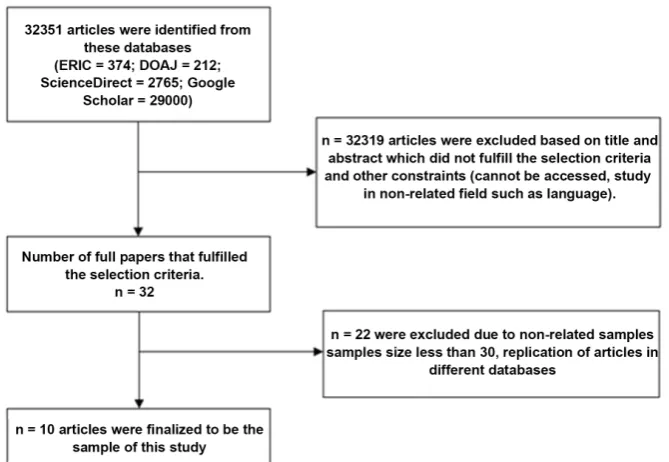
This systematic survey study aims to review articles relating to concerns and sta-tistical achievements. Such a study can explore stasta-tistical concerns relating to statistical achievement and is one of the steps in understanding the needs of students towards learning. Figure 1 shows the flow of the article selection process article.
DOI: 10.4236/ce.2018.914168 2284 Creative Education Figure 1. The flowchart of the article selection.
statistical achievements. Of the 32 full articles taken, 20 were further excluded and left a total of 12 articles meeting the criteria included and the criteria ex-cluded in the study.
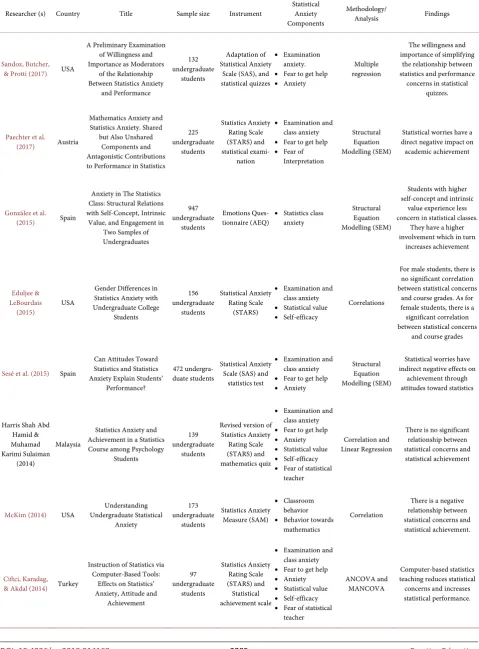
A summary of the articles featured included in this study is shown in Table 1. A total of 10 articles are identified to match the criteria included for this study. 3 articles are run in the United States, 2 in Austria, 2 in Spain, 1 in Malaysia, 1 in Turkey and 1 in Holland. The median for sample size of each study is 199 (range 97 - 947). In addition, there are several instruments used to test statistical con-cerns such as Statistical Anxiety Scale (SAS), Statistics Anxiety Rating Scale (STARS), Statistics Anxiety Measure (SAM) and Achievement Emotions Ques-tionnaire (AEQ). Based on Table 1, the most commonly used instruments in the article were STARS instruments of 6 articles followed by 2 articles using SAS in-struments, 1 articles using SAM instruments and 1 article using AEQ instru-ments.
DOI: 10.4236/ce.2018.914168 2285 Creative Education Table 1. Summary of the selected articles.
Researcher (s) Country Title Sample size Instrument
Statistical Anxiety Components
Methodology/
Analysis Findings
Sandoz, Butcher, & Protti (2017) USA
A Preliminary Examination of Willingness and Importance as Moderators
of the Relationship Between Statistics Anxiety
and Performance 132 undergraduate students Adaptation of Statistical Anxiety
Scale (SAS), and statistical quizzes
• Examination anxiety. • Fear to get help • Anxiety
Multiple regression
The willingness and importance of simplifying
the relationship between statistics and performance
concerns in statistical quizzes.
Paechter et al.
(2017) Austria
Mathematics Anxiety and Statistics Anxiety. Shared but Also Unshared
Components and Antagonistic Contributions to Performance in Statistics
225 undergraduate students Statistics Anxiety Rating Scale (STARS) and statistical exami-nation
• Examination and class anxiety • Fear to get help • Fear of
Interpretation
Structural Equation Modelling (SEM)
Statistical worries have a direct negative impact on
academic achievement
González et al.
(2015) Spain
Anxiety in The Statistics Class: Structural Relations with Self-Concept, Intrinsic
Value, and Engagement in Two Samples of Undergraduates 947 undergraduate students Emotions Ques-tionnaire (AEQ)
• Statistics class anxiety
Structural Equation Modelling (SEM)
Students with higher self-concept and intrinsic
value experience less concern in statistical classes.
They have a higher involvement which in turn
increases achievement
Eduljee & LeBourdais
(2015)
USA
Gender Differences in Statistics Anxiety with Undergraduate College Students 156 undergraduate students Statistical Anxiety Rating Scale (STARS)
• Examination and class anxiety • Statistical value • Self-efficacy
Correlations
For male students, there is no significant correlation between statistical concerns
and course grades. As for female students, there is a significant correlation between statistical concerns
and course grades
Sesé et al. (2015) Spain
Can Attitudes Toward Statistics and Statistics Anxiety Explain Students’
Performance?
472 undergra-duate students
Statistical Anxiety Scale (SAS) and
statistics test
• Examination and class anxiety • Fear to get help • Anxiety
Structural Equation Modelling (SEM)
Statistical worries have indirect negative effects on
achievement through attitudes toward statistics
Harris Shah Abd Hamid & Muhamad Karimi Sulaiman
(2014)
Malaysia
Statistics Anxiety and Achievement in a Statistics Course among Psychology
Students
139 undergraduate
students
Revised version of Statistics Anxiety
Rating Scale (STARS) and mathematics quiz
• Examination and class anxiety • Fear to get help • Anxiety • Statistical value • Self-efficacy • Fear of statistical
teacher
Correlation and Linear Regression
There is no significant relationship between statistical concerns and statistical achievement
McKim (2014) USA Undergraduate Statistical Understanding Anxiety 173 undergraduate students Statistics Anxiety Measure (SAM)
• Classroom behavior • Behavior towards
mathematics
Correlation
There is a negative relationship between statistical concerns and statistical achievement.
Ciftci, Karadag, & Akdal (2014) Turkey
Instruction of Statistics via Computer-Based Tools:
Effects on Statistics’ Anxiety, Attitude and
Achievement 97 undergraduate students Statistics Anxiety Rating Scale (STARS) and Statistical achievement scale
• Examination and class anxiety • Fear to get help • Anxiety • Statistical value • Self-efficacy • Fear of statistical
teacher
ANCOVA and MANCOVA
DOI: 10.4236/ce.2018.914168 2286 Creative Education Continued
Beurze et al.
(2013) Holland
Statistics Anxiety: A Barrier for Education in Research Methodology for Medical
Students?
520 undergraduate
students
Statistics Anxiety Rating Scale
(STARS)
• Examination and class anxiety • Fear to get help • Anxiety • Statistical value • Self-efficacy • Fear of statistical
teacher
Pearson correlation
There was a negative corre-lation between statistical
concerns and course achievements, but the impact was minor and limited to questions about statistics and epidemiology.
Macher et al.
(2013) Austria
Statistics Anxiety, State Anxiety during an Examination, and Academic
Achievement
284 undergraduate
students
Statistics Anxiety Rating Scale (STARS) and statistical test
• Examination and class anxiety • Fear to get help • Anxiety
Structural Equation Modelling (SEM).
Through the anxiety of the situation experienced before and during the examination, statistical concerns have a
negative effect on achievement. However, statistical concerns also have
a direct positive influence on achievement.
3.2. Types of Data Analysis
Based on the summary in Table 1, it is found that there are various methods of data analysis used in the review article to identify the relationship between sta-tistical concerns and stasta-tistical achievement. The stasta-tistical method used fre-quently in the research article is structural equation modeling (SEM) and corre-lation that is 4 articles using this method. SEM is a multivariate statistical analy-sis that examines the relationship between constructs according to theory or previous studies through hypothesis model built (Hamid et al., 2013). This shows that the use of the SEM method is an appropriate method of studying the relationship model between the constructs of statistical and achievement con-cerns. The correlation is used to describe the strength of the relationship be-tween the two variables, while the regression analysis focuses on the relationship between the variables (Zou, Tuncali, & Silverman, 2003). Hence, using correla-tion and regression can provide contact informacorrela-tion between statistical concerns and statistical achievement. There are 2 articles using regression analysis and 1 article using ANCOVA analysis as well as MANCOVA. Articles that carry out ANCOVA and MANCOVA analysis use quasi-experimental design designs and it helps to test causal relationships in situations where classic designs are difficult to be used or not (Neuman, 2008).
3.3. Relationship between Statistical Anxiety and Achievement
The findings of Table 1 summarize the relationship of statistical concerns and statistical achievements for each article. The results of the study findings, the majority of the articles reported statistical concerns negatively affect statistical achievement. 3 studies found statistical fears had a direct negative effect on sta-tistical achievement (Beurze, Donders, Zielhuis, Vegt, & Verbeek, 2013;McKim,2014;Paechter, Macher, Martskvishvili, Wimmer, & Papousek, 2017)While, two
DOI: 10.4236/ce.2018.914168 2287 Creative Education
Montaño, & Palmer, 2015). This indirect negative effect is based on attitudes
toward statistics and the concerns of the students before and during the exami-nation. The concerns faced before the exam may be due to lack of preparation and this may affect the students’ performance. This is supported by the state-ment of (Onwuegbuzie, 2004) which states that the concerns experienced before the examination are largely due to difficulties in time management and post-ponement during the preparation phase.
In addition, there are several elements that simplify the negative relationship between statistical concerns and statistical achievement. Among these elements are the willingness (individual openness to a particular personal experience), personal interests (Sandoz, Butcher, & Protti, 2017), and high intrinsic concepts and intrinsic values (González, Rodríguez, Faílde, & Carrera, 2015). Students with high self-concept and intrinsic value are more readily available in the class-room and are content to complete the assignment. This can reduce fears and thus increase achievement. This is supported by (Chiesi, Primi, & Carmona,
2011) stating that good self-concept in high statistical and intrinsic value
posi-tively affects achievement and reduces statistical fears. Computer-based statistics teaching also reduces statistical concerns and increases statistical performance
(Ciftci, Karadag, & Akdal, 2014). This may be due to students understood better
statistical functions and applications through computer-based learning than tra-ditional learning and this understands statistical fears. The meta-analysis con-ducted by (Chiu, 2013)shows that computer-based learning has a positive im-pact on the success of the course, the development of positive attitude towards the course and facilitating student learning.
In addition, the analysis results also found that there was 1 article reporting no significant relationship between statistical concerns and statistical achieve-ment (Harris Shah Abd Hamid & Muhamad Karimi Sulaiman, 2014). This may be due to statistical concerns indirectly affecting statistical achievement. There is 1 article that compared statistical worrying relationships and gender-based sta-tistical achievements. The results showed that for male students, there was no significant correlation between statistical concerns and course grades. While for female students, there is a significant correlation between statistical concerns and course grades (Eduljee & LeBourdais, 2015). This is because the female stu-dents have higher statistical concerns from male stustu-dents. According to Baharun and Porter (2009), male students have more confidence in the understanding of statistical topics and less concern in dealing with numbers than girls (Eduljee &
LeBourdais, 2015).
DOI: 10.4236/ce.2018.914168 2288 Creative Education
4. Conclusion
The results of this systematic survey study provide an insight of the relationship between statistical concerns and statistical achievements as well as the elements associated with it. Based on statistical constructs, educators should consider re-evaluating the teaching methods that they use to students who are facing sta-tistical related problems. Different teaching techniques such as comput-er-assisted teaching can reduce fears and thus improve statistical achievement. To emphasize statistical methods taught, it is recommended that students should engage with actual collected data. Among other ways in which teachers can in-fluence students’ feelings towards statistics, it is to discuss their concerns and give them a way to overcome their concerns.
This study focuses only on articles with quantitative studies only. The in-volvement of qualitative studies may reveal a clearer connection between con-straints of concern to statistical achievement and support quantitative findings. Additionally, this study only covers articles in four electronic databases only. Further studies should include more electronic databases to add insights on sta-tistical concerns and achievements. In addition, the involvement of qualitative studies also improves the current study.
Conflicts of Interest
The authors declare no conflicts of interest regarding the publication of this paper.
References
Bell, J. A. (2001). Length of Course and Levels of Statistics Anxiety. Education, 121,
713-716.
Beurze, S. M., Donders, A. R. T., Zielhuis, G. A., Vegt, F., & Verbeek, A. L. M. (2013). Statistics Anxiety: A Barrier for Education in Research Methodology for Medical Stu-dents? Medical Science Educator, 23, 377-384.
https://doi.org/10.1007/BF03341649
Chiesi, F., & Primi, C. (2010). Cognitive and Non-Cognitive Factors Related to Students’ Statistics Achievement. Statistics Education Research Journal, 9, 6-26.
Chiesi, F., Primi, C., & Carmona, J. (2011). Measuring Statistics Anxiety: Cross-Country Validity of the Statistical Anxiety Scale (SAS). Journal of Psychoeducational Assess-ment, 29, 559-569.https://doi.org/10.1177/0734282911404985
Chiu, Y. H. (2013). Computer-Assisted Second Language Vocabulary Instruction: A Me-ta-Analysis. British Journal of Educational Technology, 44, 52-56.
https://doi.org/10.1111/j.1467-8535.2012.01342.x
Ciftci, S. K., Karadag, E., & Akdal, P. (2014). Instruction of Statistics via Computer-Based Tools: Effects on Statistics Anxiety, Attitude and Achievement. Journal of Educational Computing Research, 50, 119-133. https://doi.org/10.2190/EC.50.1.f
Cooper, H. M. (2003). Editorial. Psychological Bulletin, 129, 3-9.
https://doi.org/10.1037/0033-2909.129.1.3
Eduljee, N., & LeBourdais, P. (2015). Gender Differences in Statistics Anxiety with Un-dergraduate College Students. The International Journal of Indian Psychology, 2,
DOI: 10.4236/ce.2018.914168 2289 Creative Education Gal, I. (2002). Adults’ Statistical Literacy: Meanings, Components, Responsibilities.
In-ternational Statistical Review, 70, 1-51.
https://doi.org/10.1111/j.1751-5823.2002.tb00336.x
Galli, S., Ciancaleoni, M., Chiesi, F., & Primi, C. (2008). Who Failed Introductory Statis-tics? Mexico: International Congress on Mathematical Education.
Gani, I., & Amalia, S. (2015). Alat Analisis Data: Aplikasi Statistik untuk Penelitian Bi-dang Ekonomi dan Sosial. Yogyakarta: Penerbit Andi.
González, A., Rodríguez, Y., Faílde, J. M., & Carrera, M. V. (2015). Anxiety in the Statis-tics Class: Structural Relations with Self-Concept, Intrinsic Value, and Engagement in Two Samples of Undergraduates. Learning and Individual Differences, 45, 214-221.
https://doi.org/10.1016/j.lindif.2015.12.019
Hanna, D., & Dempster, M. (2009). The Effect of Statistics Anxiety on Students’ Predicted and Actual Test Scores. The Irish Journal of Psychology, 30, 201-209.
https://doi.org/10.1080/03033910.2009.10446310
Keeley, J., Zayac, R., & Correia, C. (2008). Curvilinear Relationships between Statistics Anxiety and Performance among Undergraduate Students: Evidence for Optimal An-xiety. Statistics Education Research Journal, 7, 4-15.
Liyanagunawardena, T. R., Adams, A. A., & Williams, S. A. (2013). MOOCs: A Systemat-ic Study of the Published Literature 2008-2012. The International Review of Research in Open and Distributed Learning, 14, 202-227.
https://doi.org/10.19173/irrodl.v14i3.1455
Macher, D., Paechter, M., Papousek, I., & Ruggeri, K. (2011). Statistics Anxiety, Trait An-xiety, Learning Behaviour and Academic Performance. European Journal of Psycholo-gy of Education, 27, 483-498. https://doi.org/10.1007/s10212-011-0090-5
Macher, D., Paechter, M., Papousek, I., Ruggeri, K., Freudenthaler, H. H., & Arendasy, M. (2013). Statistics Anxiety, State Anxiety during an Examination, and Academic Achieve-ment. British Journal of Educational Psychology, 83, 535-549.
https://doi.org/10.1111/j.2044-8279.2012.02081.x
Macher, D., Papousek, I., Ruggeri, K., & Paechter, M. (2015). Statistics Anxiety and Per-formance: Blessings in Disguise. Frontiers in Psychology, 6, 1116.
https://doi.org/10.3389/fpsyg.2015.01116
McKim, C. (2014). Understanding Undergraduate Statistical Anxiety. Journal of Research in Education, 24, 204-210.
Neuman, W. L. (2008). Social Research Methods: Qualitative and Quantitative Ap-proaches. Istanbul: Yayinodasi.
Onwuegbuzie, A. J. (1995). Statistics Test Anxiety and Female Students. Psychology of Women Quarterly, 19, 413-418. https://doi.org/10.1111/j.1471-6402.1995.tb00083.x
Onwuegbuzie, A. J. (2004). Academic Procrastination and Statistics Anxiety. Assessment & Evaluation in Higher Education, 29, 3-19.
https://doi.org/10.1080/0260293042000160384
Onwuegbuzie, A. J., & Wilson, V. A. (2003). Statistics Anxiety: Nature, Etiology, Antece-dents, Effects, and Treatments: A Comprehensive Review of the Literature. Teaching in Higher Education, 8, 195-209. https://doi.org/10.1080/1356251032000052447
DOI: 10.4236/ce.2018.914168 2290 Creative Education
https://doi.org/10.3389/fpsyg.2017.01196
Sandoz, E. K., Butcher, G., & Protti, T. A. (2017). A Preliminary Examination of Willing-ness and Importance as Moderators of the Relationship between Statistics Anxiety and Performance. Journal of Contextual Behavioral Science, 6, 47-52.
https://doi.org/10.1016/j.jcbs.2017.02.002
Sesé, A., Jiménez, R., Montaño, J., & Palmer, A. (2015). Can Attitudes toward Statistics and Statistics Anxiety Explain Students’ Performance? Revista de Psicodidáctica 20,
285-304. https://doi.org/10.1387/RevPsicodidact.13080
Tremblay, P. F., Gardner, R. C., & Heipel, G. G. (2000). A Model of the Relationships among Measures of Affect, Aptitude, and Performance in Introductory Statistics. Ca-nadian Journal of Behavioral Science, 32, 40-48. https://doi.org/10.1037/h0087099