doi:10.4236/ampc.2011.12009 Published Online September 2011 (http://www.SciRP.org/journal/ampc)
Plasma Surface Functionalization of Biaxially
Oriented Polypropylene Films with Trimethyl Borate
Nursel Dilsiz1*, Hande Yavuz1, Süleyman Çörekçi2, Mehmet Çakmak3
1
Department of Chemical Engineering, Gazi University, Ankara, Türkiye 2
Department of Physics, Kırklareli University, Kırklareli, Turkey 3
Department of Physics, Gazi University, Ankara, Türkiye E-mail:*[email protected]
Received May 1, 2011; revised June 19, 2011; accepted June 18, 2011
Abstract
The radiofrequency plasma (13.56 MHz) was employed to polymerize trimethyl borate (TMB) monomer/N2
gas mixture on the surface of biaxially oriented polypropylene (BOPP) films. Plasma polymer coated poly-propylene films were examined by flame retardancy test (limiting oxygen index, LOI). The highest LOI value calculated for the untreated BOPP sample was 18.4 (v/v O2%) and 24.2 (v/v O2%) for the 55 W 30
minutes treated sample. The plasma polymers were characterized by FTIR spectroscopy and AFM. Accord-ing to the FTIR results, the -OH, B-CH3, B-O, and BH2 functional groups were detected. It was found that
the highest surface roughness belonged to 40 W 30 min treated BOPP sample which was calculated as 9.78 nm (10 μm × 10 μm). Moreover, the wettability of the modified BOPP film surfaces was characterized via contact angle measurements. The water contact angle values have decreased from 109.6˚ to the lowest value of 68.2˚ after the plasma treatment. The results showed that TMB/N2 plasma modification could be used as
an alternative method for the enhancement of flame retardancy and hydrophilicity of BOPP film.
Keywords:Polypropylene Film, Trimethyl Borate, Plasma Treatment, Flame Retardancy, Hydrophilicity
1. Introduction
It is well known that the thermal and the mechanical pro- perties of the polyolefins vary with their type and the degree of their crystallinity. Some of these polymers su- ch as low modulus and low tenacity type polypropylene exhibit low thermal resistance and low tensile strength. In order to enhance their thermal resistivity and mech- anical strength, surface modification or layer deposition in micrometer or nanometer scale may be employed.
Among all other modification processes plasma modi- fication draws great attention over the past years due to the discovery of its various advantages comparing to conventional methods [1]. Cold plasma process, which is an environmentally friendly and safe method, allows the surface of any polymer to be changed to achieve the de-sired functionality while retaining the bulk properties of material. Due to the fragmentation of organic comp- ounds one may not always obtain the expected polymer formations by plasma polymerization [2]. In other words, organic vapor polymerization under the influence of pla- sma is quite complex and can not be specifically des-
cribed by general cases. In plasma treatments, a wide variety of monomers can be used for various applications. According to the applied plasma conditions and selected substrate types, desired functional film layer formations can be obtained in a very short time. For example, mon- omers such as oxygen based ones can lead to the forma- tion of carboxylic acids, ketones and esters where, nitro- gen based monomers show high level of nitrogen incur- poration into the deposited polymer layer [3]. Typically, these plasma polymers have high degree of branching and crosslinking in comparing to conventional polymeric structures [2]. Jama et al. [4-6] reported first promising
results for improvement of fire behavior of polymer sur- face by plasma modification with organosiloxanes. Sch- artel et al. [7] described the surface controlled fire retar-
51
which are available in consumer products are mainly composed of phosphorus, antimony, aluminum, chlorides, bromides [8-10] and boron-containing compounds. Dur- ing the thermal degradation of polymers, borates leads to the formation of impenetrable glass coatings on the sur- face of materials, therefore they can be classified in the effective flame retardants [11].
In this current research, BOPP films were modified in TMB/N2 gas mixture in order to improve the flame re-tardancy of polymer films. To describe and to measure the properties of BOPP films response to heat and flame, Limiting Oxygen Index (LOI) method was evaluated. Fourier Transform Infrared Spectroscopy (FTIR) was used in the determination of the chemical structure of functionalized surface. Atomic Force Microscopy (AFM) and wettability measurements were carried out to char-acterize the surface properties of BOPP films. The results showed that TMB/N2 plasma modification could be used as an alternative method for the enhancement of flame retardancy and hydrophilicity of BOPP film.
2. Experimental
2.1. Materials
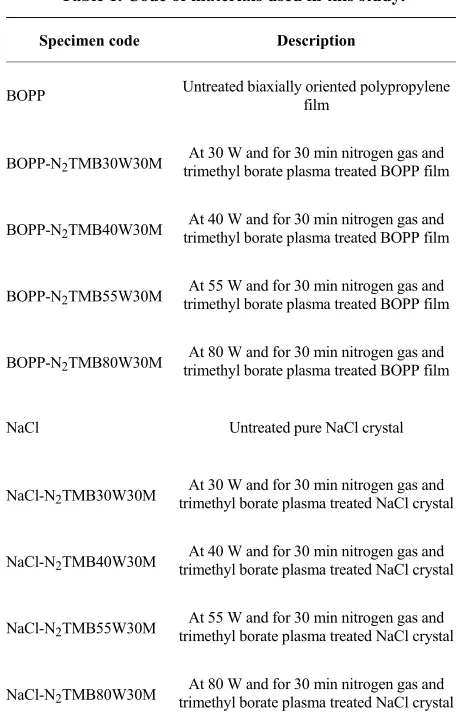
Biaxially oriented polypropylene films (BOPP, thickness: 40 μm), which were supplied by Super Film A.S. (Ga-ziantep, Turkey), were used as received. Trimethyl borate (TMB), B(OCH3)3 was supplied by Fluka (Germany). The code of materials used in this study is given in the Table 1.
2.2. Surface Modification of BOPP Films
[image:2.595.307.535.93.454.2]The radio frequency (RF) plasma was generated by Diener Electronic Pico UHP system (Germany) at 13.56 MHz with an electrical power ranging between 0 W and 100 W. The applied discharge power of 30 W, 40 W, 55 W, and 80 W was chosen. The impedance match be- tween the reactor chamber and the radiofrequency gen- erator was optimized by the matching network, which provided power loses at the minimum. The dimension of a cylindrical shaped quartz plasma reactor was 130 mm (diameter) × 300 mm (length) and two copper ele- ctrodes were located on the reactor externally. A combina- tion of cold trap and vacuum pump was used to maintain the pressure range in the reactor between 0.1 mbar and 1 mbar. In the absence of the TMB/N2, the pressure of the reactor was decreased to about 0.1 mbar. The BOPP film and NaCl crystal were used as the substrates onto which the plasma polymer films were deposited and were placed in the reactor and treated simultaneously with the same plasma conditions. The plasma polymer coated on the NaCl crystals were used to determine the FTIR spectra of the
Table 1. Code of materials used in this study.
Specimen code Description
BOPP Untreated biaxially oriented polypropylene film
BOPP-N2TMB30W30M trimethyl borate plasma treated BOPP filmAt 30 W and for 30 min nitrogen gas and
BOPP-N2TMB40W30M trimethyl borate plasma treated BOPP filmAt 40 W and for 30 min nitrogen gas and
BOPP-N2TMB55W30M trimethyl borate plasma treated BOPP filmAt 55 W and for 30 min nitrogen gas and
BOPP-N2TMB80W30M trimethyl borate plasma treated BOPP filmAt 80 W and for 30 min nitrogen gas and
NaCl Untreated pure NaCl crystal
NaCl-N2TMB30W30M trimethyl borate plasma treated NaCl crystalAt 30 W and for 30 min nitrogen gas and
NaCl-N2TMB40W30M trimethyl borate plasma treated NaCl crystalAt 40 W and for 30 min nitrogen gas and
NaCl-N2TMB55W30M trimethyl borate plasma treated NaCl crystalAt 55 W and for 30 min nitrogen gas and
NaCl-N2TMB80W30M trimethyl borate plasma treated NaCl crystalAt 80 W and for 30 min nitrogen gas and
polymer film. The substrates were pretreated in the plasma chamber with argon gas before each plasma op-eration to clean and to improve the adhesion of the flame retardant coating. When the TMB/N2 mixture was fed into the reactor by a needle valve, the pressure was ad-justed to 0.26 mbar - 0.30 mbar and was kept at that level during the plasma operation. Polymerization were carried out for TMB/N2 under different discharge power and plasma exposure time was kept constant at 30 minutes. Additionally, the effluents from the reactor in which plasma polymerization took place were discharged th- rough a piping system. After the completion of treatment, argon was fed into the reactor for 15 min to deactivate free radicals. For a given conditions, all experiments were carried out as triplicate.
2.3. Characterization of Plasma Surface Modified BOPP Films
52
used to determine the functional groups present in a molecule. The infrared region was taken from 4000 cm–1 to 400 cm–1 wavenumbers where the most vibrations mainly occur.
med on Krüss100 DSA equipped with a fast CCD camera. Sessile drop type was selected for the static contact angle setup, and distilled water was used for the each contact angle measurement. Five separate TMB/N2 plasma modi- fied films were measured to get an average value.
In order to determine the effect of the deposited film layer on the surface topography, the BOPP samples were examined by atomic force microscopy (AFM). Surface topography of TMB/N2 plasma modified BOPP film was investigated by AFM operated in tapping mode on an Omicron VT STM/AFM Instrument. The main objective of the collection of AFM images is to measure the ato- mic level forces between the sample surface and the pro- be. Acquiring images over a small area is possible with the small probe-specimen separation, thus, in this work scanning ranges were adjusted to 10 μm × 10 μm. The images were collected while the tip was operated at Tap-ping Mode. Roughness (RMS) was determined as a mean from five AFM scans over the same area.
3. Results and Discussion
3.1. FTIR Spectroscopy
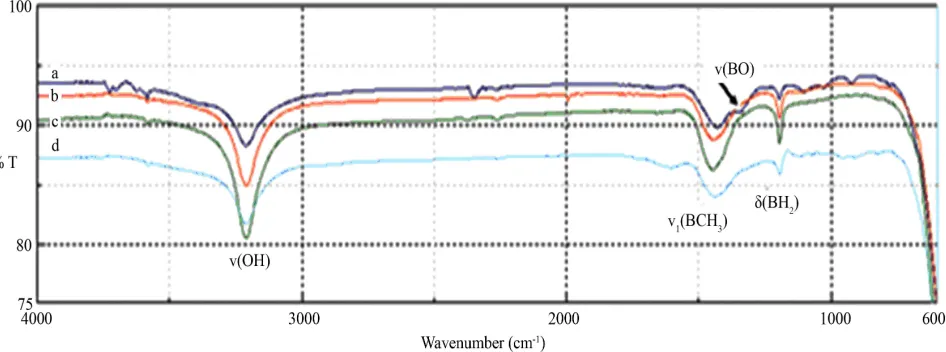
The chemical structure of plasma modified BOPP film, which was treated under N2 gas and TMB vapor, indicated that at the surface mainly boron based functional groups were included. Since the methylene deformations mainly occur between 1500 cm–1 and 1300 cm–1 wave numbers, plasma polymer coated NaCl crystals were used to help the identification of B-CH3, B-O, BH2 functional groups which consistently produce absorption bands between 1460 cm–1 - 1405 cm–1, 1350 cm–1 - 1310 cm–1 and 1205 cm–1 - 1140 cm–1, respectively. In order to relate plasma power effect with constant plasma exposure time (at 30 min), the FTIR spectra were collected as represented in Figure 1. It can be seen that almost all of the plasma polymers obtained from different (30 W, 40 W, 55 W and 80 W) discharge power gave similar characteristic peaks, indicating similar func- tional groups in the plasma polymers. In general the relative intensities of these peaks have varied with increasing dis- charge power. One of the major peaks observed for all plasma polymers was obtained at 3450 cm–1 - 3100 cm–1, which is mostly due to O-H stretching band. The peak at 1460 cm–1 - 1405 cm–1 can be assigned to B-CH
3 symmetrical deformation and absorption at 1205 cm–1 - 1140 cm–1 may be assigned to BH
2 in-plane deformation [14]. Aditionally, the formation of B-O stretching band was observed at 1350 cm–1 - 1310 cm–1 at 30 W discharge power. Fire response of plasma modified BOPP films were
studied according to the LOI test method under contro- lled laboratory conditions described in ASTM D 2863-00 standard [13]. Dynisco LOI polymer test equipment was used to determine the flammability of the films according to the ASTM D 2863 standard. According to the test method, flexible films (e.g. BOPP films) should be sup-ported vertically in the center of a heat resistant transpar-ent chimney and tested in accordance with the test method B. At least fifteen specimens were prepared in order to maintain LOI and fire response unmodified and each plasma modified sample. In order to assess fire response of individual test specimens, period and extent of burning were considered. Dixon’s “Up-and-Down” method, which is described in ASTM D 2863-00 standard, was used to calculate the LOI of each series of specimens.
[image:3.595.64.537.519.695.2]The wettability tests for the BOPP films were perfor-
53
The formation of new groups in the TMB plasma polymer (BH2, B-CH3, etc.) is mainly caused by the fragmentation of monomers under plasma conditions. Due to fragmentation of organic compounds in plasma the polymer formed is not always what one would expect from the chemical structure of the monomer [15]. When the discharge power was increased to 55 W, the inten- sities of the peaks has increased slightly. The absorption intensities for all plasma polymers seemed to increase first upon increasing the discharge power up to 55 W. When the discharge power was raised to 80 W the intensities of all the peaks have decreased. This result can be explained by the fact that by increasing discharge power a growing portion of the modified polymer is ablated [16] and thinner layer of modified polymer is available for subsequent FTIR measurement. It can be concluded that the decrease in the peak intensites may be due to increased decomposition of the deposited poly- mers with increasing power.
3.2. Limiting Oxygen Index (LOI)
Results of oxygen index test are given in Table 2. The results demonstrate that TMB/N2 plasma polymers modi- fied BOPP film have higher LOI value than the untreated BOPP film. From Table 2 it can be seen that when plasma power increases to 30 W, LOI value TMB/N2 pl- asma treated BOPP film increases from 18.4 (untreated BOPP) to 23.6 (%O2, v/v). When the plasma power in-creases to 55 W, the maximum LOI value obtained was 24.2 (%O2, v/v). The LOI difference between untreated and plasma modified films was calculated as approxi-mately 30%. This trend could be related to the deposition of B-O functional groups rather than the deposition of B-C and/or B-H functional groups, which can be formed in the cold plasma environment, on the surface of the BOPP films. This conclusion was also supported by FTIR spectra given in Figure 1.
3.3. Atomic Force Microscopy
The effect of plasma discharge power on the surface morphology of TMB/N2 modified BOPP can be seen
Table 2. LOI data for plasma treated BOPP film.
Specimen code LOI (O2%, v/v)
Untreated BOPP 18.4 ± 0.20
BOPP-N2TMB30W30M 23.6 ± 0.18
BOPP-N2TMB40W30M 22.5 ± 0.16
BOPP-N2TMB55W30M 24.2 ± 0.27
BOPP-N2TMB80W30M 22.4 ± 0.21
from AFM images shown in Figure 2. As seen from the images, surface morphologies of the treated samples slightly changed compared to the untreated one.
Roughness was determined as a mean from five AFM scans over the same area and its dependence on dis-charge power is given in Table 3. As is shown in Figure 2, the effects of different power on surface morphologies of BOPP film were characterized by AFM. For the untreated BOPP film, the surface roughness was 5.64 nm. However, after 40 W TMB/N2 plasma treated for 30 min, the fiber surface roughness increased to 9.78 nm. It was found that the untreated BOPP film had a smooth surface (Figure 2(a)). It can be found that BOPP films were notably roughened by the plasma power. The surface roughness of plasma polymer modified BOPP films enhanced with the plasma power up to 40 W then the surface rougness slightly decrease with increasing the plasma treatment power. These results indicate that BOPP film were notably roughened by the TMB/N2 plasma treatment.
3.4. Contact Angle
Under various discharge conditions, it is found that the chemical structure of the top BOPP film layer was changed significantly. The relation between the treatment conditions and contact angle values can be followed in Table 4. It is known that plasma polymer deposition
Table 3. Surface roughness of untreated and plasma po-lymerized BOPP film.
Surface roughness (nm)
Sample code 10 µm × 10 µm
BOPP 5.64 ± 0.83
BOPP-N2TMB30W30M 7.27 ± 0.72
BOPP-N2TMB40W30M 9.78 ± 1.25
BOPP-N2TMB55W30M 7.85 ± 0.52
BOPP-N2TMB80W30M 6.22 ± 0.48
Table 4. Contact angle values of untreated and plasma po-lymerized BOPP film.
Specimen code Contact Angle (°)
Untreated BOPP 109.6 ± 0.25
BOPP-N2TMB30W30M 73.6 ± 2.65
BOPP-N2TMB40W30M 68.2 ± 1.58
BOPP-N2TMB55W30M 88.6 ± 5.00
BOPP-N2TMB80W30M 83.3 ± 0.72
54
Figure 2. AFM images of a) Untreated BOPP film; b) BOPP-N2TMB30W30M; c) BOPP-N2TMB40W30M; d) BOPP-N2
TMB55W30M; e) BOPP-N2TMB80W30M (10 μm ×10 μm).
depends strongly on the nature of monomer type and discharge power. TMB/N2 plasma led to the formation of polar groups (e.g. B-O, -OH) on thesurface and caused the removal of some C-H groups from the surface of BOPP film. So that, wettability of surface was increased, samples became more hydrophilic comparing to the original value (108.3˚). While the highest contact angle was obtained at 55 W (88.6˚), the lowest one was ob-tained at 40 W (68.1˚). This can be attributed to the in-troduction of hydrophilic groups (-OH) on the polymer surface which was seen on the FTIR spectra. All these results are quite interesting from the point of view of seeing no linear trend between the discharge power and contact angle. The differences among these values can be attributed to the change in distribution of polymer depo-sition due to the applied conditions. There seems to be no obvious correlation between surface roughness and dis-charge power. It can be seen that AFM images of TMB/N2 plasma polymers and their structure have changed considerably upon increasing discharge power. These results follow the same tendency as reported by Svorick et al. [16] It is known that the value of the
con-tact angle is mostly affected by the chemical structure and morphology of the polymer surface layer [17]. Various reactions that takes place during plasma poly- merization include excitation, ionization, homolitic bond splitting, molecular fragmentation etc. For a low level of energy input, the extent of ionization is low and ion- molecule reactions dominate polymer formation resulting in deposition rate increase with power [18]. Above certain levels of energy, there is greater loss of functional groups from the monomer resulting in compe- titive polymerization and ablation [19].
4. Conclusions
55
W, LOI of BOPP films obtained have increased from 18.4 to 24.2. It can be seen that the plasma modified BOPP films have gained resistance to flame comparing to unmodified samples. Besides, the effects of plasma polymer deposition on the surface of BOPP film samples were studied from the AFM and FTIR results. These results have showed that boron-based functional layer deposition can be applied to enhance the flame retar-dancy of BOPP films.
5. Acknowledgements
This work was supported by National Boron Research Institute (BOREN) contact grant number BOREN-2006- Ç-02 and The State Planning Organization (DPT) contact grant number 2001K-120590.
6. References
[1] N. Inagaki, “Plasma Surface Modification and Plasma Polymerization,” Technomic Publication Co., Lancaster, 1996.
[2] N. Dilsiz and G. Akovali, “Plasma Polymerization of Selected Organic Compounds,” Polymer, Vol. 37, No. 2, 1996, pp. 333-342.doi:10.1016/0032-3861(96)81107-4
[3] M. C. Porter, “Handbook of Industrial Membrane Tech-nology,” Noyes Publications, USA, 1990.
[4] S. Bourbigot, C. Jama, M. Le Bras, R. Delobel, O. Dessaux and P. Goudmand, “New Approach to Flame Retardancy Using Plasma Assisted Surface Polymeri- sation Techniques,” Polymer Degradation and Stability, Vol. 66, No. 1, 1999, pp. 153-155.
doi:10.1016/S0141-3910(99)00059-2
[5] C. Jama, A. Quede, P. Goudmand, O. Dessaux, M. Le Bras, R. Delobel, S. Bourbigot, J. W. Gilman and T. Ka-shiwagi, “Fire and Polymer Materials and Solutions for Hazard Prevention,” G. L. Nelson, C. A. Wilkie, Eds., ACS Publication, ACS Symp Ser, Washington D. C., 2001, pp. 797-200.
[6] C. Jama, A. Quede, H. Sadiki, O. Dessaux, P. Goudmand, R. Delobel and M. Le Bras, “Recent Advances in Flame Retardancy of Polymeric Materials,” M. Lewin, Ed., Business Communications Co., Norwalk, 2001, pp. 127-136.
[7] B. Schartel, G. Kühn, R. Mix and J. Friedrich, “Surface Controlled Fire Retardancy of Polymers Using Plasma
Polymerisation,” Macromolecular Materials and Engi- neering, Vol. 287, No. 9, 2002, pp. 579-582.
doi:10.1002/1439-2054(20020901)287:9<579::AID-MA ME579>3.0.CO;2-6
[8] J. Troitzsch, “International Plastics Flammability Hand-book,” Hanser Publications, New York, 1990.
[9] M. Sain, S. H. Park, F. Suhara and S. Law, “Flame Re-tardant and Mechanical Properties of Natural Fibre-PP Composites Containing Magnesium Hydroxide,” Polymer Degradation and Stability, Vol. 83, No. 2, 2004, pp. 363-367. doi:10.1016/S0141-3910(03)00280-5
[10] S. Zhu and W. Shi, “Thermal Degradation of a New Flame Retardant Phosphate Methacrylate Polymer,” Polymer Degradation and Stability, Vol. 80, No. 2, 2003, pp. 217-222.doi:10.1016/S0141-3910(02)00401-9
[11] C. Martin, J. C. Ronda and V. Cadiz, “Boron-Containing Novolac Resins as Flame Retardant Materials,” Polymer Degradation and Stability, Vol. 91, No. 4, 2006, pp. 747-754. doi:10.1016/j.polymdegradstab.2005.05.025
[12] H. Yasuda and C. E. Lamaze, J. Appl. Poly. Sci, Vol. 14, 1971, p. 227.
[13] American Society for Testing and Materials, “D2863-00 Standart Test Method for Measuring the Minimum Oxy-gen Concentration to Support Candle-like Combustion of Plastics (Oxygen Index),” ASTM International, 2000, pp. 452-464.
[14] J. G. Grasselli, “CRC Atlas of Spectral Data and Physical Constants for Organic Compounds,” 1973.
[15] H. Yasuda, M. Shen and A. T. Bell, eds., Plasma Polymerization, USA, 1978.
[16] V. Svorcik, V. Kotal, P. Slepicka, O. Blahova, M. Spirkova, P. Sajdl and V. Hnatowicz, Nucl. Instr. and Meth. in Phys. Res B, Vol. 244, 2006, pp. 365-372. [17] K. Rockova, V. Svorcik, L. Bacakova, B. Dvorankova
and V. Hnatowicz, “Bio-Compatibility of İon Beam- modified and RGD-Grafted Polyethylene,” Nuclear Instruments and Methods in Physics Research Section B, 2004, Vol. 225, No. 3, pp. 275-282.
doi:10.1016/j.nimb.2004.05.004
[18] H. Yasuda, “Plasma Polymerization,” Academic Press Inc., New York, 1985.
[19] L. O’Toole and R. D. Short, “An Investigation of the Mechanisms of Plasma Polymerisationof Allyl Alcohol,” Journal of the Chemical Society, Faraday Transactions, Vol. 93, 1997, pp. 1141-1145.