ALPHA CLUSTERING STUDY IN EVEN NUCLEI
*Anjana Acharya and Rajib Lochan Nayak
Veer Surendra Sai University of
ARTICLE INFO ABSTRACT
The α
approach are discussed. The electromagnetic properties of some even even nuclei including the rotational and vibrational modes are found out. The possibilities th
of α- particles have the importance in nucleosynthesis .Considering the dynamical symmetries the excited states of α
Copyright © 2016 Anjana Acharya and Rajib Lochan Nayak
permits unrestricted use, distribution, and reproduction in any medium, provided the original work is properly cited.
INTRODUCTION
Cluster Physics which comes under basic science give us a fundamental idea about the physical world.
existence we must know its basic constituents, which could be well understood by studying nuclear physics. This branch of physics deals with the nucleus and its configuration inside an atom. But here we not deal with all the concepts hide
just try to know how the constituents of nucleus arranged inside it and how it would affects the properties associated with it. It is seen that in a stable nucleus the constituents i.e. the nucleons makes spherical structure depending upon its nucleon numbers. The spherical structures inside the nucleus taken as nucleus of certain atoms, generally known as cluster. In physics cluster denotes small, multi atom particle. It composed of no. of atoms ranging from 3 to 3
first report on cluster species was evolved. But in 1980s the cluster science emerged as a direction of research. Scientists are much more aggressive to know the geometry and electronic configuration of clusters and how the different properties depend on it. It is seen that in clusters, nucleons are present on
*Corresponding author: Anjana Acharya, Veer Surendra Sai University of Technology, Bula Odisha India.
ISSN: 0975-833X
Article History:
Received 25th December, 2015
Received in revised form 15th January, 2016
Accepted 18th February, 2016
Published online 16th March,2016
Citation: Anjana Acharya and Rajib Lochan Nayak
27401-27406.
Key words:
AGS equation, V-and p- branches, Evolution path.
PACS NOs:
21.10.sf, 21.10.Pc, 21.60.Gx, 24.50.+g, 21.60.cs
RESEARCH ARTICLE
ALPHA CLUSTERING STUDY IN EVEN NUCLEI
Anjana Acharya and Rajib Lochan Nayak
Veer Surendra Sai University of Technology, Bula-768018, Odisha India
ABSTRACT
The α-clustering in transfer reactions in terms of Alt Grassberger Sandhas version of Faddeev approach are discussed. The electromagnetic properties of some even even nuclei including the rotational and vibrational modes are found out. The possibilities th
particles have the importance in nucleosynthesis .Considering the dynamical symmetries the excited states of α-clustering mechanism on even even nuclei are discussed.
Anjana Acharya and Rajib Lochan Nayak. This is an open access article distributed under the Creative Commons Att use, distribution, and reproduction in any medium, provided the original work is properly cited.
Cluster Physics which comes under basic science give us a fundamental idea about the physical world. To understand its existence we must know its basic constituents, which could be well understood by studying nuclear physics. This branch of physics deals with the nucleus and its configuration inside an atom. But here we not deal with all the concepts hide in it. We just try to know how the constituents of nucleus arranged inside it and how it would affects the properties associated with it. It is seen that in a stable nucleus the constituents i.e. the nucleons makes spherical structure depending upon its ucleon numbers. The spherical structures inside the nucleus taken as nucleus of certain atoms, generally known as cluster. In physics cluster denotes small, multi atom particle. It composed of no. of atoms ranging from 3 to 3×10⁷. In 1940s cluster species was evolved. But in 1980s the cluster science emerged as a direction of research. Scientists are much more aggressive to know the geometry and electronic configuration of clusters and how the different properties at in clusters, nucleons are present on
Veer Surendra Sai University of Technology, Bula-768018,
or near its surface. Due to which its surface to volume ratio is high. So in this case surface becomes more important. As a result the physical properties of cluster like electronic, optical, photochemical, thermodynamic etc. become size dependent. The loss or addition of a single component diminished its reactivity due to which it can be used as highly effective catalyst. Optical properties of cluster use in new generation of micro-miniature high capacity data storage disk for computers, certain types of clusters assembled to form new bulk materials, which used to make strong and more flexible ceramics. Clusters have much more contribution in the field of semiconductor research. e.g. gallium arsenide has unique electronic and optical properties. So it is
gallium arsenide to make ‘quantum dots’ in nanometer sized crystals with potential applications in photonics and electronics. Cluster can be made from any element on the periodic table. If the constituents are single type then element cluster found out. Clusters also composed of two or more types of components. Depending on the compositions cluster is divided into two types (i) metallic and (ii) non
Electrically clusters also divided into two types (i) electrically neutral and (ii) electrically charged (ionic cluster). Cluster frequently exhibit physical and chemical properties. But that is not observed in bulk phase material properties. This gives a great tragedy in scientist’s mind and they hope to exploit it in a
International Journal of Current Research
Vol. 8, Issue, 03, pp.27401-27406, March, 2016
INTERNATIONAL
Anjana Acharya and Rajib Lochan Nayak, 2016. “Alpha clustering study in even nuclei”, International Journal of Current Research,
768018, Odisha India
clustering in transfer reactions in terms of Alt Grassberger Sandhas version of Faddeev approach are discussed. The electromagnetic properties of some even even nuclei including the rotational and vibrational modes are found out. The possibilities that A=4n nuclei could be composed particles have the importance in nucleosynthesis .Considering the dynamical symmetries the
clustering mechanism on even even nuclei are discussed.
is an open access article distributed under the Creative Commons Attribution License, which
or near its surface. Due to which its surface to volume ratio is high. So in this case surface becomes more important. As a result the physical properties of cluster like electronic, optical, photochemical, thermodynamic etc. become size dependent. s or addition of a single component diminished its reactivity due to which it can be used as highly effective catalyst. Optical properties of cluster use in new generation of miniature high capacity data storage disk for computers, clusters assembled to form new bulk materials, which used to make strong and more flexible ceramics. Clusters have much more contribution in the field of semiconductor research. e.g. gallium arsenide has unique electronic and optical properties. So it is a big dream to use of gallium arsenide to make ‘quantum dots’ in nanometer sized crystals with potential applications in photonics and electronics. Cluster can be made from any element on the periodic table. If the constituents are single type then elemental cluster found out. Clusters also composed of two or more types of components. Depending on the compositions cluster is divided into two types (i) metallic and (ii) non-metallic. Electrically clusters also divided into two types (i) electrically and (ii) electrically charged (ionic cluster). Cluster frequently exhibit physical and chemical properties. But that is not observed in bulk phase material properties. This gives a great tragedy in scientist’s mind and they hope to exploit it in a
INTERNATIONAL JOURNAL OF CURRENT RESEARCH
broad no of areas. Cohen calls a ‘Jellium model’ for large clusters, in which cluster exhibit a ‘shell structure’ like that of atomic nuclei[1]. By this model, it can be classified whether the cluster is metallic or non-metallic on the basis of their ionization potential. The similarities between cluster energy shells found in atomic nuclei can gives a greater benefits towards the research of nuclear scientists. Lee, Price and Mark Croften demonstrated that the correlation of infrared spectral features with cluster size can provide information about a clusters geometrical structure and how its physical properties change in liquid and solid form[2]. Clustering is considered as transitional phenomena between crystalline and quantum liquid
phases of fermionic systems. We know is the most stable
light element. It is observed that inside the nucleus neutrons and protons move in a particular path.12C,16O,24Mg,
28
Si,32S,40Ca,48Cr,56Fe etc clustering in α-form are also possible [3]. In 12C three -clustering structure is observed. Thus for a beginner it will be helpful. So we start our work from -clustering. Basically we have to calculate the reaction cross-section for -transfer reaction in terms of the reaction channels. The reaction cross-section gives accurate prediction that what is the probability the reaction will take place. Prediction of structure of elements, calculation of half lives of elements, prediction of stability of elements etc. will be done by -clustering study. The -clustering study increases the hope of scientists towards the building of stable super heavy elements in artificial way. The α- cluster structure of 18O are calculated by Avila et al [4].
Different approximations to study –clustering
To study -clustering here we go through three different approaches. They are (i) DWBA approximation, (ii) Faddeev approximation and (iii) AGS version of Faddeev’s approximation[5]
DWBA (Distorted Wave Born Approximation) Approach A nuclear cluster can be written in the reaction form as
A + a (b+x) ⇋ B (A+x) + b
For different rearrangement channels. Each arrangement is referred to as a partition and corresponding to each partition there can be several channels characterized by different internal states of residual nuclei. The distorted term arises due to the effect of coulomb and optical potential (complex) term [6]. For a specific channel, Schrodinger’s equation is
| > = | > ………..2.1
The potential equation
( + ) ( ⃗)= U( ⃗) ( ⃗) ……….. 2.2
Will be converted into the form
( + ) ( ⃗)=
ℏ ∫ ( + ) (⃗, ⃗
|
) V (⃗′) (⃗′) ′ 2.3
The Green’s function (⃗, ⃗|
)has the expression
(⃗, ⃗|
) =
| ⃗ ⃗ | ⃗
| ⃗ ⃗ | ……… 2.4
The reaction amplitude between the final and initial states in DWBA approach
, = J ∬ ( ⃗, ⃗) f ( ⃗, ⃗) ( ⃗, ⃗)
f ( ⃗, ⃗) = <B, b| − |A, a>
Where = V -
The reaction cross-section can be calculated as
= ( ℏ) | , ( , )|2 ………. 2.5
The angular distributions of deuterons from the reaction are analyzed within the framework of the DWBA to determine the transferred -particle angular momentum. The characteristic shapes of the angular distribution indicate the dominance of a direct reaction process which describes the -particle transfer mechanism for each allowed angular momentum transfer.
Demerits of DWBA
In DWBA approximation no independent choice of optical
potentials parameters of the colliding pairs i.e. there is considerable arbitrariness in the choice.
The arbitrariness is also in the radial cut off values.
In this approximation other than elastic channel, effects of other channels are ignored.
It ignores break up effect. To overcome these demerits Faddeev gives an equation.
Faddeev Approach
The T-matrix in Lippmann Schwinger equation can be written as
Ti(z) = Vi + ViG0(z) Ti(z) ………. 2.6
The transition operator for a specific channel
Tα(z) = Vα + G0(z) Tα(z) ……..……. 2.7
can be solved by iteration method.
In matrix form
⎣ ⎢ ⎢ ⎢ ⎢ ⎡ ( )( ) ( )( ) ( )( ) . .. ⎦⎥ ⎥ ⎥ ⎥ ⎤ = ⎣ ⎢ ⎢ ⎢ ⎢ ⎡ . . . ⎦ ⎥ ⎥ ⎥ ⎥ ⎤ + ⎣ ⎢ ⎢ ⎢ ⎢ ⎢
⎡ 0 0
0 . . . . . . . . . ⎦ ⎥ ⎥ ⎥ ⎥ ⎥ ⎤ ⎣ ⎢ ⎢ ⎢ ⎢ ⎡ ( )( ) ( )( ) ( )( ) . .. ⎦⎥ ⎥ ⎥ ⎥ ⎤ …….. 2.8
where, Ti(z) is sum of all terms contributing to T(z) in which the interaction between the particles (any two) occurs
proceeded by all other interactions. In momentum
representation, the integral form of Faddeev’s equation is (Alt
< ⃗ , ⃗ | T(i)(z) | ,⃗ ′ ⃗′> = < ⃗ ⃗ |Ti(z)| ⃗′ ⃗′> +
∫ | ( )|
||
( || ) < ,
||
| ( )(z) + ( )(z)| |, ||> d3 ||
………. 2.9
Which contains three variables and seven continuous parameters
T(z) = T(i)(z) + T(j)(z) + T(k)(z) ……… 2.10 T(z) G0(z) = V G(z)
The Green function version of Faddeev equation is written as
G(i)(z) = - Gi(z) + G0(z) + G0(z) Ti(z)[ G(j)(z) + G(k)(z)] … 2.11
In matrix form
⎣ ⎢ ⎢ ⎢ ⎢ ⎡ ( )( ) ( )( ) ( )( ) . .. ⎦⎥ ⎥ ⎥ ⎥ ⎤ = - ⎣ ⎢ ⎢ ⎢ ⎢ ⎡ −− − . . . ⎦ ⎥ ⎥ ⎥ ⎥ ⎤ + ⎣ ⎢ ⎢ ⎢ ⎢ ⎢
⎡ 0 0
0 . . . . . . . . . ⎦ ⎥ ⎥ ⎥ ⎥ ⎥ ⎤ ⎣ ⎢ ⎢ ⎢ ⎢ ⎡ ( )( ) ( )( ) ( )( ) . .. ⎦⎥ ⎥ ⎥ ⎥ ⎤ …………...…. 2.12
The Green function version of Faddeev equation has certain limitations which can overcome by writing the Faddeev equations in state version. But the state version of Faddeev equation is not so useful for the calculation of reaction cross section of a rearrangement process. Therefore an alternative method was proposed by Alt-Grass Berger and Sandhas, which is more useful known as AGS equation.
AGS Version of Faddeev Approach
AGS operatoris defined by the equation
Uβα(z) = (1 - αβ) (z – H0) + ∑ ∑ ……….. 2.13
Where = Vk + VkG Vλ
The resolvant operator is then written as
G (z) = βα(z) (z) + (z) Vβα(z) (z) ………….. 2.14
The AGS operator between the final and initial states can be expressed in terms of the S-matrix which is defined as
, = lim→ < ∅ ( )| ( ) > ……… 2.15
Initially the system consists of a bound pair and a free particle both being far from each other. As time passes, the particle comes closer to the pair and rearrangement takes place. | ( )> is the total state at any time‘t’ which is a superposition of various final states into which the initial state | > evolves at time‘t’ when all interactions are operative. | , |2 gives the probability that the system will be found in
the state | ( )> at time t (t→∞).
| > = <lim→
→ G ( + )| >
, = lim→
→
/ℏ< ( ) +
( ) ( ) ( )] >
lim→
→
( )
= 2 (− + )
………. 2.16
For ≠ , we will get
, = -2 ( − )< | | > ……… 2.17
This simple relationship between the matrix element of AGS operator and S-matrix in AGS formalism is very useful in the calculation of rearrangement process (Faddeev, 1993).
Spectroscopic factor
Spectroscopic factor is defined as the ratio of the experimental cross-sections to the predicted cross-section from a reaction model. Taking DWBA approximation it describes the single particle structure of nuclei in the shell model. It is defined as the overlap between the initial and final state in the reaction model. In a transfer reaction differential cross-section written in the form (Anjana Acharya, 2007; Wang et al., 2013)
( , )
= ( , E)
Where , a number known as the spectroscopic factor which
depends on the initial and final states and the quantum numbers J, L of the transferred particle and ( , E) is a factor that depends on the reaction mechanism, containing all the angular and energy dependence. The expectation value of creation and annihilation operator taken in between the final and initial state of the nuclei gives the spectroscopic amplitude for stripping and pick up reactions. The spectroscopic factors are the squares of this amplitude with some angular momentum co-efficient. Knock out reactions show reduced spectroscopic factor strength with strongly bound valence nucleons. This trend is not observed in transfer reactions. But it is observed that quenching of spectroscopic factor increases for more neutron rich nuclei, which is opposite to the trend established by knock out reactions. The spectroscopic calculations for the even even nuclei are given in Table 1.
Electromagnetic properties of α-clustering nuclei
The spectra of different nuclei arise due to the
Rotation if the nucleus as a whole
(ii)Vibration of the constituent nuclei and(iii)change in the electronic configuration
So ET=Ee+Ev+Er
V- and R-branches:
When transition between levels occurs from J→J-1 ,it is known
as a V branch whereas transition from J→J+1 level is termed as
Table 1. The spin parity for different α-clustering nuclei
Element State L ( + )
/ 1 -1 to 1
(-1,0,1)
1/2 or -1/2 -2 to 2 3/2
/ 1 -1 to 1
(-1,0,1)
1/2 or -1/2 -2 to 2 1/2
/ 0 0 1/2 or -1/2 -1 to 1 1/2
/ 2 -2 to 2
(-2,-1,0,1,2)
1/2 or -1/2 -3 to 3 3/2
/ 1 -1 to 1
(-1,0,1)
1/2 or -1/2 -2 to 2 3/2
/ 0 0 1/2 or -1/2 -1 to 1 1/2
/ 2 -2 to 2
(-2,-1,0,1,2)
1/2 or -1/2 -3 to 3 3/2
/ 0 0 1/2 or -1/2 -1 to 1 1/2
/ 1 -1 to 1
(-1,0,1)
1/2 or -1/2 -2 to 2 1/2
/ 1 -1 to 1
(-1,0,1)
1/2 or -1/2 -2 to 2 3/2
/ 0 0 1/2 or -1/2 -1 to 1 1/2
/ 2 -2 to 2
(-2,-1,0,1,2)
1/2 or -1/2 -3 to 3 5/2
/ 1 -1 to 1
(-1,0,1)
1/2 or -1/2 -2 to 2 1/2
/ 1 -1 to 1
(-1,0,1)
1/2 or -1/2 -2 to 2 3/2
/ 0 0 1/2 or -1/2 -1 to 1 1/2
/ 2 -2 to 2
(-2,-1,0,1,2)
1/2 or -1/2 -3 to 3 3/2
/ 0 0 1/2 or -1/2 -1 to 1 1/2
/ 2 -2 to 2
(-2,-1,0,1,2)
1/2 or -1/2 -3 to 3 5/2
/ 1 -1 to 1
(-1,0,1)
1/2 or -1/2 -2 to 2 1/2
/ 1 -1 to 1
(-1,0,1)
1/2 or -1/2 -2 to 2 3/2
/ 0 0 1/2 or -1/2 -1 to 1 1/2
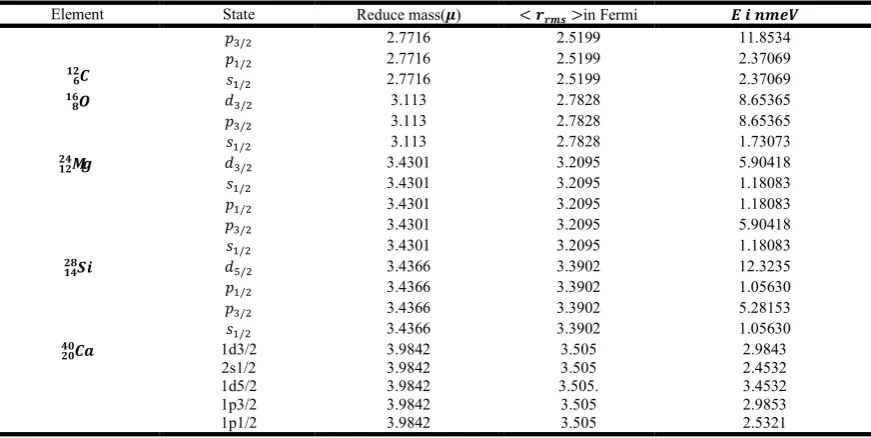
Table 2. The RRMS and Energy values for different α-clustering EVEV-even nuclei
Element State Reduce mass( ) < >in Fermi
/ 2.7716 2.5199 11.8534
/ 2.7716 2.5199 2.37069
/ 2.7716 2.5199 2.37069
/ 3.113 2.7828 8.65365
/ 3.113 2.7828 8.65365
/ 3.113 2.7828 1.73073
/ 3.4301 3.2095 5.90418
/ 3.4301 3.2095 1.18083
/ 3.4301 3.2095 1.18083
/ 3.4301 3.2095 5.90418
/ 3.4301 3.2095 1.18083
/ 3.4366 3.3902 12.3235
/ 3.4366 3.3902 1.05630
/ 3.4366 3.3902 5.28153
/ 3.4366 3.3902 1.05630
1d3/2 3.9842 3.505 2.9843
2s1/2 3.9842 3.505 2.4532
1d5/2 3.9842 3.505. 3.4532
1p3/2 3.9842 3.505 2.9853
[image:4.595.79.515.473.692.2]Selection rules: ⧍J=±1 for rotational case
⧍J=0 forbidden region
⧍V=±1 vibrational case
⧍(mL+2mB)=0 or ±1 Paschen Back effect
⧍mJ= 0 or ±1 Anomalous Zeeman effect
There are ten transitions possible in total for 12C6. But the
selection rule permits only six transitions. The spin, parity, angular momentum, total angular momentum& the possible transition between the different states of even-even nuclei
12
C6,16O8,24Mg12,28Si14,40Ca20 are calculated and shown in
Table 2.
Work in National and International Level
In India many research centers as well as academic institutions do lots of works to develop the technology in optical, electronics, energy production, high capacity nuclear weapons, in medical science etc. by taking cluster research. SINP, TIFR, BITS, BARC, BRNS, RTAC, IIT Kanpur, IIT Indore, NCL Pune, VECC etc. are the leading research centers, where the cluster research brings the development in many sectors. In international level Aquitaine, Innovative companies in photonic technologies, the industrialists are involved in high level applied research. Their main sectors concern with industrial production, aeronautics and space, scientific instrumentation, medical technology and electronics. The international cluster’s laboratories like PYLA, CELIA, CPMOH, CEA, ICMCB etc. has a greater contribution towards medical science, nanophysics, bio-photonics etc.. The ALPHANOV optics and laser technological center, a unique center in France for technology transfer between academic laboratories and companies, develop optics and imaging, terahertz applications, medical applications. The laser Mega joule (LMJ), a scientific flagship for global visibility. With the arrival of the LMJ, the national ignition facility in Livermore, California opens opportunities for research in the physics of matter, energy and astrophysics.
RESULT AND DISCUSSION
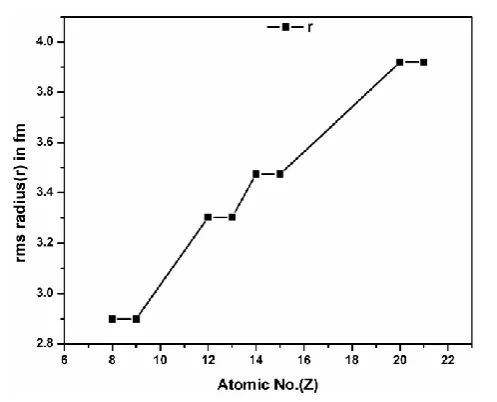
The variation of atomic number with the root mean square radii is shown in the Figure 1. The value of the rms radius is 3.25 fermi for the nuclei having Z=12 to 14, again about 3.45 fermi for Z= 15 to 16 and rrms=3.85 fm for Z=20 to 22. Starting
from 5.525 Mev for the magic number Z=8, the energy value gradually decreases, and rises to 5.575 Mev for Z= 12 to 13, .5Mev for Z=14 to 16 and finally decreases to the value. 255Mev for Z=20 to 21.
Conclusion
The reaction cross sections for the α-clustering for even even nuclei by AGS version can be calculated and compared with the experimental values. For some nuclei in the excited states obeying the conservation of channel spin, the cross section values are higher. The transition from the 5/2 to the 3/2 states of different nuclei give the R branches and when the transition occurs from the 3/2 states to the 5/2 states we get V branches. Starting from the α-clustering in carbon nuclei the path of evolution can be traced out which opens to the study of astrophysics about the origin of universe.
REFERENCES
Agrawal B.K., Tapas Sil, S.K. Samaddar, J.N.De & S.Shlomo Physical Review C 64 024305 (2001)
Alt E.O., P.Grassberger and W.Sandhas Nuclear Physics B2 167(1967)
Anjana Acharya Indian Journal of Physics 81(8) 803-817 (2007) Avila M L, G V Rogachev, V Z Goldberg, E D Johnson , K W
Kemper et al. Phys. Rev. C 90 024327 (2014)
Cenxi Yuan,Chang Qi, Furong Xu, Toshio Suzuki & Takaharu Otsuka Physical Review C 89 044327(2014)
Chakraborty D.R. and M.A.Eswaran Physical Review C 25 1933 (1982)
Cohen, B. L. 1971. Concepts of Nuclear Physics ISBN 0-07-099249-5 McGraw-Hill, New York.
Faddeev L D, S P Markoniev Quantum Scattering for several particle systems Springer 1993
Lee, Price and Mark Croften Clusters A new state of matter www2.lbl.gov/science-Article/Archieve/clusters.html
Stefan I. Physical Review C 90 014307(2014)
[image:5.595.54.303.53.254.2] [image:5.595.307.548.53.249.2]Wang S M, J.C Pei & F R Xu Physical Review C 87 014311(2013)
Yarris L. 1991. Clusters: A new state of matter, http://www2.lbl.gov/ScienceArticles/Archive/clusters.html Zhang Y, E Himaya, Y Yamamoto Nuclear Physics A 881 288
(2012)