EFFECTS OF PROCESSING METHODS ON SOME NUTRITIONAL AND ANTI
PROPERTIES OF SELECTED PULSES
*Chinchitha
PG Department of Environmental Sciences, All Saints’ College, Thiruvananthapuram, Kerala, India
ARTICLE INFO ABSTRACT
Pulses are important source of macronutrients, containing almost twice the amount of protein compared to cereal grains. In addition to being a source of macronutrients and minerals, pulses also contain plant secondary metabolites that are increasingly bein
for human health.
human and animal nutrition as well as crop rotation. It has been established that pulses contain various substan
However, it has been observed that the effects of these factors disappear or decrease when legumes are properly prepared.
some of the nutritional and anti Soya bean,
cooking).
The carbohydrate content was increased as a result of cooking in all the pulses, while other factors decreased. The highest value of carbohydrate was found to be in cooked Horse gram (68
and the lowest in sprouted Green peas (7460 mg/ml). Sprouted Soybean gave highest protein content (3562.5776 mg/ml) and the lowest by cooked Horse gram (102.6416 mg/ml). Soaked Chick pea showed maximum value for Total Phenol (2.615 mg/ml) and co
(0.089 mg/ml). In case of Tannin, soaked Soybean gave the highest value (2077.1422 mg/ml) and the lowest by cooked Horse gram (61.4284 mg/ml). Soaked Soybean was found to give maximum Phytic acid (16.2375 mg/ml) and the m
the increase in the protein content in all the pulses, while carbohydrate, tannin, phenol and phytic acid contents were decreased. The decreased concentration in Total phenol, Tannin and Phyt content was due to enzymatic changes during germination period in seeds. The reduction of anti nutrients may improve the nutritional quality of legumes. Thus it can be said that through proper processing methods, the nutritional factors can be impr
nutritional factors can be minimized
Copyright©2016, Chinchitha Lawrence and Rajani. This
unrestricted use, distribution, and reproduction in any medium, provided the original work is properly cited.
INTRODUCTION
Pulses are important source of macronutrients, containing almost twice the amount of protein compared to cereal grains. In addition to being a source of macronutrients and minerals, pulses also contain plant secondary metabolites that are increasingly being recognized for their potential benefits for human health. The present study was based on the comparison of effects of processing on nutritional and anti
properties of five selected pulses (Mung bean, Chickpea,
*Corresponding author: Chinchitha Lawrence,
PG Department of Environmental Sciences, All Saints’ College, Thiruvananthapuram, Kerala, India.
ISSN: 0975-833X
Article History:
Received 27th June, 2016
Received in revised form 18th July, 2016
Accepted 10th August, 2016
Published online 30th September,2016
Key words: Pulses, Carbohydrate, Protein, Total Phenol, Tannin, Phytic acid.
Citation: Chinchitha Lawrence and Rajani, V., 2016.
International Journal of Current Research, 8, (09), 38510
RESEARCH ARTICLE
EFFECTS OF PROCESSING METHODS ON SOME NUTRITIONAL AND ANTI
PROPERTIES OF SELECTED PULSES
*Chinchitha Lawrence and Rajani, V.
PG Department of Environmental Sciences, All Saints’ College, Thiruvananthapuram, Kerala, India
ABSTRACT
Pulses are important source of macronutrients, containing almost twice the amount of protein compared to cereal grains. In addition to being a source of macronutrients and minerals, pulses also contain plant secondary metabolites that are increasingly being recognized for their potential benefits for human health. Pulses, whose history of cultivation dates back to earlier times, are essential for human and animal nutrition as well as crop rotation. It has been established that pulses contain various substances, some varieties of which can be toxic (though rare) or may cause indigestion. However, it has been observed that the effects of these factors disappear or decrease when legumes are properly prepared. The present study was based on the comparison of eff
some of the nutritional and anti- nutritional properties of five selected pulses (
Soya bean, Horse gram and Green peas) during various stages of processing (soaking, sprouting and cooking). In all the cases, it was observed that the pulses were affected by the processing methods. The carbohydrate content was increased as a result of cooking in all the pulses, while other factors decreased. The highest value of carbohydrate was found to be in cooked Horse gram (68
and the lowest in sprouted Green peas (7460 mg/ml). Sprouted Soybean gave highest protein content (3562.5776 mg/ml) and the lowest by cooked Horse gram (102.6416 mg/ml). Soaked Chick pea showed maximum value for Total Phenol (2.615 mg/ml) and cooked Horse gram, the minimum value (0.089 mg/ml). In case of Tannin, soaked Soybean gave the highest value (2077.1422 mg/ml) and the lowest by cooked Horse gram (61.4284 mg/ml). Soaked Soybean was found to give maximum Phytic acid (16.2375 mg/ml) and the minimum by cooked Green peas (4.217 mg/ml). The sprouting led to the increase in the protein content in all the pulses, while carbohydrate, tannin, phenol and phytic acid contents were decreased. The decreased concentration in Total phenol, Tannin and Phyt content was due to enzymatic changes during germination period in seeds. The reduction of anti nutrients may improve the nutritional quality of legumes. Thus it can be said that through proper processing methods, the nutritional factors can be improved and negative impacts due to anti nutritional factors can be minimized.
This is an open access article distributed under the Creative Commons Att use, distribution, and reproduction in any medium, provided the original work is properly cited.
Pulses are important source of macronutrients, containing almost twice the amount of protein compared to cereal grains. In addition to being a source of macronutrients and minerals, pulses also contain plant secondary metabolites that are g recognized for their potential benefits for The present study was based on the comparison of effects of processing on nutritional and anti- nutritional
Mung bean, Chickpea, Soya
PG Department of Environmental Sciences, All Saints’ College,
bean, Horse gram and Green peas)
processing (soaking, sprouting and cooking). an efficient process to reduce heat
compounds such as tannins, phytic acid, raffinose, stachyose and verbascose. Therefore, soaking increases the nutritional benefits of pulses. It involves soaking and draining the pulses every 4 to 8 hours and this process usually takes 1 to 5 days. Sprouting pulses is vital to render them edible in a raw state and make them more easily digestible. Interestingly, sprouted pulses can significantly diminish polyphenols and tannins, and the protein, carbohydrates and fats begin to break down into a predigested form, leading to an easier and better digestion and making for better overall digestion.
International Journal of Current Research
Vol. 8, Issue, 09, pp.38510-38516, September, 2016
INTERNATIONAL
2016. “Effects of processing methods on some nutritional and anti-nutritional properties of selected pulses 38510-38516.
EFFECTS OF PROCESSING METHODS ON SOME NUTRITIONAL AND ANTI-NUTRITIONAL
PG Department of Environmental Sciences, All Saints’ College, Thiruvananthapuram, Kerala, India
Pulses are important source of macronutrients, containing almost twice the amount of protein compared to cereal grains. In addition to being a source of macronutrients and minerals, pulses also g recognized for their potential benefits Pulses, whose history of cultivation dates back to earlier times, are essential for human and animal nutrition as well as crop rotation. It has been established that pulses contain ces, some varieties of which can be toxic (though rare) or may cause indigestion. However, it has been observed that the effects of these factors disappear or decrease when legumes The present study was based on the comparison of effects of processing on nutritional properties of five selected pulses (Mung bean, Chickpea, during various stages of processing (soaking, sprouting and was observed that the pulses were affected by the processing methods. The carbohydrate content was increased as a result of cooking in all the pulses, while other factors decreased. The highest value of carbohydrate was found to be in cooked Horse gram (68730 mg/ml) and the lowest in sprouted Green peas (7460 mg/ml). Sprouted Soybean gave highest protein content (3562.5776 mg/ml) and the lowest by cooked Horse gram (102.6416 mg/ml). Soaked Chick pea oked Horse gram, the minimum value (0.089 mg/ml). In case of Tannin, soaked Soybean gave the highest value (2077.1422 mg/ml) and the lowest by cooked Horse gram (61.4284 mg/ml). Soaked Soybean was found to give maximum Phytic inimum by cooked Green peas (4.217 mg/ml). The sprouting led to the increase in the protein content in all the pulses, while carbohydrate, tannin, phenol and phytic acid contents were decreased. The decreased concentration in Total phenol, Tannin and Phytic acid content was due to enzymatic changes during germination period in seeds. The reduction of anti-nutrients may improve the nutritional quality of legumes. Thus it can be said that through proper
oved and negative impacts due to anti-
is an open access article distributed under the Creative Commons Attribution License, which permits
Green peas) during various stages of processing (soaking, sprouting and cooking). Soaking pulses is an efficient process to reduce heat-stable anti-nutritional compounds such as tannins, phytic acid, raffinose, stachyose and verbascose. Therefore, soaking increases the nutritional benefits of pulses. It involves soaking and draining the pulses very 4 to 8 hours and this process usually takes 1 to 5 days. Sprouting pulses is vital to render them edible in a raw state and make them more easily digestible. Interestingly, sprouted pulses can significantly diminish polyphenols and tannins, and otein, carbohydrates and fats begin to break down into a predigested form, leading to an easier and better digestion and making for better overall digestion.
INTERNATIONAL JOURNAL OF CURRENT RESEARCH
Thermal processes such as canning, pressure cooking, microwave cooking, traditional or stove-top cooking, roasting, and others are used in cooking or processing pulses. Lectins and enzymes inhibitors are proteins which could undergo denaturation by thermal processing prior to consumption. Protease inhibitors show different degrees of susceptibility to various processing treatments. Thus processing technique and conditions used to denature protease inhibitors could vary from one pulse type to another.
MATERIALS AND METHODS
The present study was based on the comparison of effects of processing on some of the nutritional and anti- nutritional properties of five selected pulses (Mung beans, Chick pea, Soyabean, Horse gram and Green peas) during various stages of processing (soaking, sprouting, and cooking). The following biochemical methods were used for the study.
Estimation of Total Carbohydrate
The Total Carbohydrate was estimated by the method of Hedge, J E and Hofreiter et al., 1962
Estimation of Protein
The protein content was estimated by Lowry‘s method (Lowry
et al., 1951).
Estimation of Total phenol
The total phenol was estimated using the method by Malick et
al., (1980)
Estimation of Tannin
Estimation of Tannin was done according to the method by Robert E B (1971)
Estimation of Phytic acid
The Phytic acid content was estimated for all the selected pulses (Wheeler and Feerel et al., 1971).
RESULTS AND DISCUSSION
Diet is an important contributor to health, and to disease. Most countries face nutritional problems, from under nutrition and micronutrient deficiencies to obesity and diet-related diseases (such as type II diabetes and certain types of cancer), or a mix of these. Pulses such as lentils, dried beans, peas and chickpeas have been staple foods for many civilizations. Yet today, their nutritional benefits are often greatly underestimated. In some cultures pulses have a stigma of being a ‘poor man’s food’ and are replaced by meat once people can afford meat. Many pulses are soaked in water from 4 to 8 hours – a practice that will dramatically reduce their phytate content and cooking time and their propensity to cause flatulence. Soaking ensures that pulses can be more easily digested and their nutrients better absorbed by the body. In fact, soaking dried pulses for several hours brings them back to life, activating their enzymes.
Sprouting as a simple technological method that is used to germinate seeds has been reported to improve the nutritive value of seeds (Amal et al., 2007). At the same time there are indications that sprouting is effective in reducing phytic acid and flatulence causing oligosaccharides (namely stachyose and raffinose), thereby increasing protein digestibility and improving sensory properties (Lintschinger et al., 1997). The presence of anti-nutritional factors such as trypsin and chymotrypsin inhibitors, oligosaccharides, lectins and tannins (Lyimo et al., 1992) limits the availability of nutrients present in the leguminous crops. Removal of these factors is achieved by soaking and cooking of dry grains of legumes. For the present study, the pulses were subjected to various processing methods (soaking, sprouting and cooking) and were used to study the effects of these processing methods on some of their nutritional and anti- nutritional properties.
Estimation of Total Carbohydrate
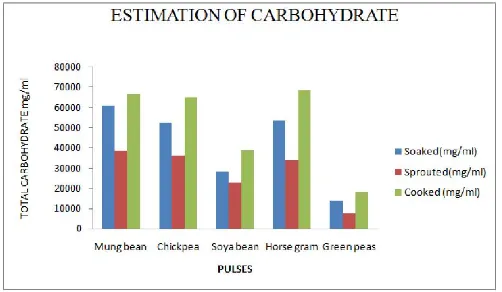
[image:2.595.310.561.526.672.2]The concentration of many important nutrients found in pulses can be greatly affected by soaking and cooking. The results of the estimation of carbohydrate were given in the Figure 1. The highest value of carbohydrate was given by cooked Horse gram (68730mg/ml) and lowest concentration was found in sprouted Green peas (7460 mg/ml). In soaked Mung bean, the concentration of carbohydrate was found to be 61060 mg/ml, in sprouted 38380 mg/ml and in cooked, 66630 mg/ml. In soaked Chickpea, concentration of carbohydrate was found to be 52730 mg/ml, in sprouted 36250 mg/ml and in cooked 64960 mg/ml. In soaked Soybean, concentration of carbohydrate was found to be 28300 mg/ml, in sprouted, the concentration was 22910 mg/ml and in cooked, concentration was 38880 mg/ml. In soaked Horse gram, the concentration of carbohydrate was 53530 mg/ml, in sprouted 33790 mg/ml and in cooked, 68730mg/ml. In soaked Green peas, concentration of carbohydrate was 13800 mg/ml, sprouted was 7460 mg/ml and cooked 18380mg/ml. The result of the study revealed that the carbohydrate content was increased in all pulses as a result of the cooking, at the same time the sprouting led to the lowering of the carbohydrate content.
Figure 1. Estimation of Total Carbohydrate
This result was in agreement with the findings of Finney et al., 1982 which showed that sprouting resulted to a reduction in the carbohydrate content of Mung bean. This could be due to increased starch digestibility promoted by improved hydrolytic activities of the enzymes during sprouting. Akinjayeju and Francis 2007 reported the conversion of carbohydrate by alpha amylases to simple and more soluble sugars needed by the growing seeds. The decrease in carbohydrate due to germination might also be due to the use of carbohydrate for metabolism by the young seedling (Obizoba and Atu, 1993). So from the study, it can be concluded that the various processing methods can affect the carbohydrate content of the selected pulses.
Estimation of Protein
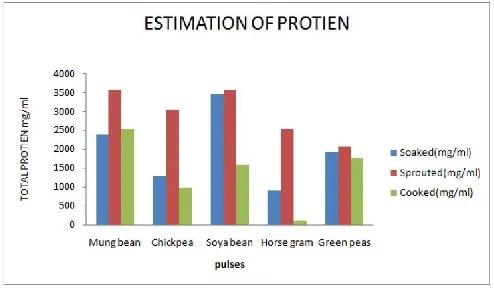
[image:3.595.41.288.552.700.2]Proteins are required for maintenance (replacement of wear and tear of tissues) in adults for the growth of infants and children, for fetal development in pregnancy and secretion of milk during lactation. The requirement of proteins for the later groups is higher than the adults (Rao et al., 1989). Legume seeds are valuable source of protein, oil, carbohydrates, minerals and vitamins. They are playing an important role in human nutrition mainly in developing countries (Yanez et al., 1995). Protein content was significantly (p< 0.01) influenced by sprouting treatments. Heat processing increased the protein digestibility most likely by destroying heat labile protease inhibitors and by denaturing other protein globulins highly resistant to proteases in the native state (Rani et al., 1996). High mean values for protein content was noted in sprouted mung bean (26.82%) as compared to chickpea (20.83%) over different sprouting intervals (Masood et al., 2014). The increasing trend in protein content with progress in sprouting was almost similar to the results of the current study. The results of the estimation of protein were given in the Figure 2. In the present study of protein estimation, the highest concentration of protein was in sprouted Soybean (3562.5776 mg/ml) and lowest concentration was found in cooked Horse gram (102.6416 mg/ml). Akinyele, 1989 reported that traditional cooking had a negative impact on protein content and maximum decrease was observed in Mung bean (58% over control) in cooked samples.
Figure 2. Estimation of Protein
In soaked Mung bean, concentration of protein was found to be 2378.6072 mg/ml, in sprouted, the concentration was 3561.458 mg/ml and in cooked, concentration was 2522.6036 mg/ml. in
soaked Chickpea, concentration of protein was 1282.6346 mg/ml; in sprouted, concentration was 3039.924 mg/ml and in cooked, 973.309 mg/ml. In soaked Soyabean, concentration of protein was 3461.2468 mg/ml, in sprouted 3562.5776 mg/ml and in cooked, 1578.6272 mg/ml. The soaked Horse gram gave 894.964 mg/ml of protein, in sprouted, concentration was 2522.6036 mg/ml and in cooked, concentration was 102.6416 mg/ml. In soaked Green peas, the concentration of protein was 1919.952 mg/ml, in sprouted concentration was 2063.9484 mg/ml and in cooked concentration was 1762.6226 mg/ml. 48 hour sprouting brought maximum improvement in nutritional quality of Mung bean and chickpea with minimum loss of dry matter, which can be used as seeds in making different dishes. (Masood et al, 2014).
Many researchers reported increase in percent protein in germinated grains (Dogra et al., 2001; Sood et al. 2002; Urbano et al., 2005; Khatoon and Prakash, 2006; Kaushik et
al., 2010). The difference in results for protein content of
sprouts not only depends on cultivar but also on germination conditions (Dagnia et al., 1992; Urbano et al., 2005). The present study indicated maximum protein content in germinated pulses. The increase in the protein content may be mainly due to the use of seed components during the germination process (Mubarak, 2005), breakdown of complex proteins into simpler form and breakdown of nutritionally undesirable constituents (Chavan and Kadam, 1989). The metabolic activities of resting seeds increase as soon as they are hydrated during soaking. The complex biochemical changes that occur during hydration and sprouting lead the protein constituents being broken down by enzymes into simple compounds that are used to make new compounds. The increased hydrolytic activities of the enzymes caused by sprouting resulted in improvements in the contents of the total protein due to the disappearance of starch (Anonymous, 2008). According to Morgan et al., 1992, the absorption of nitrate facilitates the metabolism of the nitrogenous compounds from carbohydrate reserves; thus increasing crude protein level.
Estimation of Phenol
Figure 3. Estimation of phenol
concentration was 0.195 mg/ml. Randhir et al.,2004 reported that germination causes a decrease of total phenolic content in Green mung. Barroga et al., 1985 reported similar total phenolic content values for raw and 24 h germinated Mung bean. In soaked Chick pea, the concentration of Phenol was 2.615 mg/ml, sprouted concentration was 1.070 mg/ml and in cooked, the concentration was 0.145mg/ml. In Soya bean after soaking, concentration of Phenol was 0.449 mg/ml, sprouted concentration was 0.815 mg/ml and cooked concentration was 2.749 mg/ml. Horse gram when soaked gave the concentration of Phenol as 0.344 mg/ml, sprouted concentration was 0.230 mg/ml and cooked concentration was 0.089 mg/ml. In case of Green peas, after soaking, the concentration of Phenol was 1.895mg/ml, sprouted concentration was 0.865 mg/ml and cooked concentration was 0.228 mg/ml. Thus the results explain that for all the selected pulses, the total phenol content was lowered as a result of sprouting and cooking. Bressani and Elias 1980 observed that about 40% of phenolics could be removed from common beans (P. vulgaris) by cooking and discarding the cooking water. Xu and Chang, 2008 found that most total phenol in black soybean is lost during cooking. Regular cooking caused greater total phenol losses than steaming treatments, which could be attributed to water-soluble phenolics leaching into the soaking and cooking water (Xu and Chang, 2008). Randhir et al.,2004 reported that germination causes a decrease of total phenolic content in Green mung. Barroga et al., 1985 reported similar total phenolic content values for raw and 24 h germinated Mung bean. It is observed that the concentrations of the total phenolics, of the sprouted seeds decreases as the ratio of water and temperature of sprouting are increased. (Khandelwal et al., 2010) reported that the total phenolic was reduced significantly in germinated green gram compared to Bengal gram, red gram and lentil. In germinated kidney bean, the loss of total phenolic content can be as high as 96% as shown by (Shimelis and Rakshit, 2007).
Estimation of Tannin
Tannins are mainly located in seed coat of pulses, hence physical removal of seed coat by either dehulling or milling and separating hulls decreases the tannin content of pulses and improves their nutritional quality. Dehulling eliminates about 68 to 99% of tannins in seed. Soaking of seeds before cooking is a common household practice and, used to soften the texture and hasten the process of cooking.
Leaching of tannins increases with the time of soaking in distilled water. Raising the period of soaking from 6 to 12 and 18 hrs further reduces tannin content of seed (Jood et al., 1988). Cooking and discarding the cooking water results in about 37.5 to 77% decrease in tannin content of seeds (Reddy
et al., 1985). Overnight soaking in water and subsequent
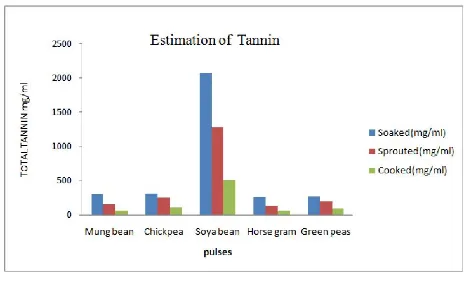
germination for 48 hrs removes more than 50% of the tannins in pigeon pea, chickpea and mung bean (Jood et al., 1987). As a result of the present study (Figure 4), it can be observed that the highest concentration of Tannin was observed in soaked Soya bean (2077.1422 mg/ml) and lowest concentration was found in cooked Horse gram (61.4284 mg/ml).
Figure 4. Estimation of Tannin
In soaked Mung bean, concentration of the tannin was found to be 301.4284 mg/ml, in sprouted 161.4285 mg/ml and cooked value was found to be 65.7141 mg/ml. In soaked Chickpea, concentration of Tannin was 315.7141 mg/ml, in sprouted was 254.2856 mg/ml and cooked 104.4284 mg/ml. In soaked Soya bean, the value of Tannin was found to be 2077.1422 mg/ml, in sprouted 1278.5713 mg/ml and cooked 508.5706 mg/ml. In soaked Horse gram, concentration of Tannin was found to be 264.2856 mg/ml, in sprouted 132.8570 mg/ml and cooked 61.4284 mg/ml. In the soaked Green peas, concentration of Tannin was found to be 265.7142 mg/ml mg/ml, sprouted 199.9999 mg/ml and cooked 95.7141 mg/ml. The present study revealed that, in case of tannin also, the sprouting and cooking processes lowers the concentration. The observed reduction in tannin content after germination may be a result of formation of hydrophobic association of tannins with seed proteins and enzymes. In addition, loss of tannins during germination also may be due to the leaching of tannins into the water (Shimelis and Rakshit, 2007) as well as washing during germination and binding of polyphenols with other organic substances such as carbohydrate or protein (Saharan et al., 2002). Apart from that, during the period of soaking prior to germination, the enzyme polyphenol oxidase may be activated, resulting in degradation and consequent losses of polyphenols (Saxena et al., 2003; Khandelwal et al., 2010). The decrease might also be due to break down of protein tannin complex and release of free tannins into soaking water during sprouting (Megat and Azrina, 2012).
Estimation of Phytic acid
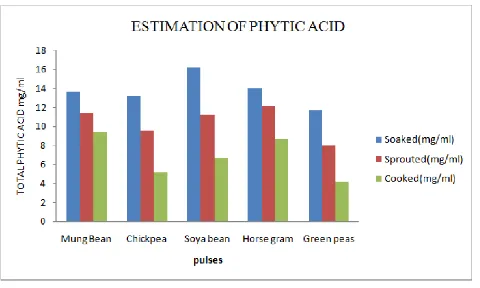
[image:4.595.316.550.207.350.2]The decreased of phytic acid contents of germinated legumes has been frequently reported (Ibrahim et al., 2002). The reduction could be due to increase in endogenous phytase activity (Shimelis and Rakshit, 2007; Khattak et al., 2007) depending on different types of legume. It could also be due to diffusion into the soaking medium also known as leeching out. Soaking of legumes in distilled water was an effective way of removing phytic acid from legumes (Liang et al., 2009).The cooking processes inecrease both water- and acid-extractable phytate phosphorus in 1egumes. Poor extractability of phytate phosphorus with water and HCl in cooked legumes was noticed by Kumar et al., 1978 and it was attributed to the formation of insoluble complexes between phytate phosphorus and other components in legumes during cooking, which subsequently could not be extracted with water or HCl. In the present study (Figure 5), the highest concentration of phytic acid was in soaked Soyabean (16.2375 mg/ml) and lowest concentration was found in cooked green peas (4.217 mg/ml). In soaked Mung bean concentration was 13.6395 mg/ml, sprouted concentration was 11.423 mg/ml and cooked concentration was 9.3715 mg/ml. In soaked Chickpea, concentration of phytic acid was 13.2065 mg/ml; sprouted concentration was 9.5365 mg/ml and cooked concentration was 5.218 mg/ml.
Figure 5. Estimation of Phytic acid
In case of soaked Soya bean, the concentration was 16.2375 mg/ml, sprouted concentration was 11.237 mg/ml and cooked concentration was 6.6705 mg/ml. The concentration in soaked Horse gram was 14.0725 mg/ml, sprouted concentration was in 12.1725 mg/ml and cooked concentration was 8.722 mg/ml. Green peas gave maximum value in soaked form (11.691 mg/ml) and minimum in cooked form (4.217 mg/ml). So it can be concluded that the phytate content of the study materials are being lowered as a result of the sprouting and germination. A significant improvement in availability of Fe was also observed on cooking treatments compared to the unprocessed treatment, which may be due to leaching out of anti-nutrients (Kakker, 1992). Phytate, the major phosphorus-bearing compound in cereals and pulses, chelates divalent and trivalent cations, like Ca, Fe and Zn, forming insoluble complexes and thereby decreasing the availability of minerals in humans (Vohra et al.,1965). The decrease in phytic acid content, possibly through its destruction by heat treatments, may result in the divalent and trivalent cations being freed from the phytate mineral complexes thus accounting for the improved availability of minerals in processed seeds.
Reduction in Fe availability by the presence of phytate has also been reported in red gram, Bengal gram and green gram (Murthy et al., 1985; Hazel1 and Johnson 1987 and Khalil
et al., 2007).
Summary and Conclusion
Pulse grains are high in protein, carbohydrates, and dietary fibre and are a rich source of other nutritional components. Legumes contain a number of bioactive substances including enzyme inhibitors, lectins, phytates, oligosaccharides, and phenolic compounds that play metabolic roles in humans or animals that frequently consume these foods. These effects may be regarded as positive, negative, or both (Champ, 2002). Some of these substances have been considered as anti-nutritional factors due to their effect on diet quality. The present study was based on the comparison of effects of processing on nutritional and anti- nutritional properties of five selected pulses (Mung bean, Chickpea, Soya bean, Horse gram and Green peas) during various stages of processing (soaking, sprouting, cooking) and their effects on some nutritional and anti- nutritional factors were also analyzed. In all the cases, it was observed that the pulses were affected by the processing methods. The carbohydrate content was enhanced as a result of cooking in all the pulses, while other factors decreased. The highest value of carbohydrate was shown by cooked Horse gram and the lowest by sprouted Green peas. Soaked Chick pea showed maximum value for Total Phenol and cooked Horse gram, the minimum value. In case of Tannin, soaked Soybean gave the highest value and the lowest by cooked Horse gram. Soaked Soybean had given maximum value for Phytic acid and the minimum by cooked green peas. The sprouting led to the increase in the protein content in all the pulses, while carbohydrate, tannin, phenol and phytic acid contents were decreased. The decreased in total phenolic, tannin and phytic acid content was due to enzymatic changes during germination period in seeds. The reduction of anti-nutrients may improve the nutritional quality of legumes. Pulses are an important source of macronutrients, containing almost twice the amount of protein compared to cereal grains. In addition to being a source of macronutrients and minerals, pulses also contain plant secondary metabolites that are increasingly being recognized for their potential benefits for human health. So it can be concluded that germinated pulses are rich in protein content and the cooking process helps to increase the carbohydrate content in pulses. The cooking process also helps to lower the anti- nutritional factors in pulses. Future studies can be carried out with more nutritional and anti- nutritional factors.
REFERENCES
Akinyele, I.O. 1989. Effects of traditional methods of processing on the nutrient content and some anti-nutritional factors in cowpeas (Vignuunguiculata). Food Chem., 33: 291-299.
Amal, B.K., Aurang, Z., Nizakat, B., Shahid. A.K., Mohammad. S.K. 2007. Influence of germination techniques on phytic acid and polyphenols content of chickpea (Cicerarietinum L.) sprouts. Food Chem., 104: 1074-1079
Barroga, C.F., Laurena, A.C,.Mendoza., M.T. 1985. Poly-phenols in mung bean (Vignaradiata L, Wilczek): determination and removal. J Agric Food Chem., 33: 1006-1009.
Bressani and L. G. Elias., 1980.“The Nutritional Role of Polyphenols in Beans,” In: J. H. Hulse Ed., Polyphenols in Cereal and Legumes, International Development Research Center, Ottawa, Canada, pp 61-68.
Champ, M. M. 2002. Non-nutrient bioactive substances of pulses. British Journal of Nutrition, 88(Suppl. 3), S307– S319.
Chavan, J. and S.S. Kadam, 1989. Nutritional Importance of cereals by sprouting. Crit. Rev. Food Sci. Nutr., 28: 401-437.
Dagnia, S.G., D.S. Petterson, R.R. Bell and F.V. Flanagan 1992. Germination alters the nutritional value of lupin seed.
J. Sci. Food Agri., 60: 419-423.
Dogra, J., Y.S. Dhaliwal and M. Kalia. 2001. Effect of soaking, germination, heating and roasting on the chemical composition and nutritional quality of Soybean and Its Utilization in Various Indian leavened products.
J. Food Sci. Technol., 38 (5): 453-456.
Finney, P.L., D. Beguin and J.D. Hubbard, 1982. Effects of germination on Bread-baking properties of Mungbean (Phaseolusaureus) and Garbanzo bean (Cicerarietinum).
Cereal Chem., 59: 520-524
Hazell, T. and I.T. Johnson. 1987. In vitro estimation of iron availability from a range of plant foods: influence of phytate, ascorbate and citrate. Brit. J. Nut., 57: 223-233 Hedge, J. E. and Hofreiter, B. T. 1962 In: Carbohydrate
Chemistry 17 (EdsWhisteler R L and Be Miller, JN)Academic Press Newyork.
IIbrahim, S. S., Habiba, R. A., Shatta, A. A. and Embaby, H. E. 2002. Effect of soaking, germination, cooking and fermentation on antinutritional factors in cowpeas. Nahrung 46: 92–95.
Jood, S., B.M. Chauhan and A.C. Kapoor. 1987. Polyphenols of chickpea and blackgram as affected by domestic processing and cooking methods. J. Sci. Food Agric., 39:145-149.
Jood, S., Chauhan, B.M. and Kapoor, A.C. 1988. Contents and digestibility of carbohydrates of chickpea and black gram as affected by domestic processing and cooking. Food
Chemistry, 30: 113-127.
Kakker, S. 1992. Bioavailability of minerals: Effect of domestic processing and level of the anti-nutrients. Ph. D Dissert. HaryanaAgric. Univ. Hisar, India.
Kaushik, G., Satya, S. and Naik, S.N. 2010. Effect of domestic processing techniques on the nutritional quality of the soybean. Mediterranean Journal of Nutrition and
Metabolism, 3: 39-46.
Khandelwal S, Udipi SA, Ghugre P. 2010. Polyphenols and tannins in Indian pulses: Effect of soaking, germination and pressure cooking. Food Res. Int., 4: 526-530.
Khalil, A.W., A. Zeb, F. Mahmood, S. Tariq, A.B. Khattak and H.U. Shah. 2007. Comparison of sprout quality
characteristics of desi and kabuli type chickpea cultivars (Cicerarietinum L.). LWT 40: 937-945.
Khattak AB, Zeb A, Bibi N. 2007. Impact of germination time and type of illumination on carotenoid content, protein solubility and in vitro protein digestibility of chickpea (Cicerarietinum L.) sprouts. Food Chemistry 104: 1074-1079.
Khatoon, N. and Prakash, J. 2006. Nutrient retention in microwave cooked germinated legumes. Food Chemistry, 97 (1): 115-121.
Kumar, K. G., Venkataraman, L. V., Jaya, T. V., & Krishnamurthy, K. S. 1978. Cooking characteristics of
some germinated legumes: changes in phytins, Ca++,
Mg++, and pectins. Journal of Food Science, 43, 85–88.
Liang, J., B.Z. Han, M.J.R. Nout and R.J. Hamer, 2008. Effects of soaking, germination and fermentation on phytic acid, total and in vitrosoluble zinc in brown rice.
Food Chem., 110: 821-828.
Lintschinger J, Fuchs N, Moser H, Jager R, Hlebeina T, Markolin G, Gossler W. 1997. Uptake of various trace elements during germination of wheat, buckwheat and quinoa. Plant Foods Hum. Nutri., 50: 223-237.
D.H. Lowry, N.J. Rosebrough, A.L. Tarr, R.J. Randall. 1951. Protein measurement with the folin-Phenol reagent. J. Biol.
Chem., 193: 265- 276
Lyimo M, Mugula J, Elias T. 1992. Nutritive composition of broth from selected bean varieties cooked for various periods. J Sci Food Agric., 58:535–539.
Malick CP, Singh MB. 1980. Estimation of polyphenols, In: CP. Malik,MB. Singh, (eds). In : Int. J. Adv. Res. Biol.Sci. 2(2): (2015): 185–189 189 Plant enzymology and histoenzymology., Kalyani publishers, New Delhi, p. 286. Masood, H. U. Shah and A. Zeb.2014.The Journal of Animal
& Plant Sciences, 24(3):, Page: 850-859 ISSN: 1018-7081 MegatRusydi MR, Azrina A. 2012. Effect of germination on
total phenolic, tannin and phytic acid contents in soy bean and peanut. Int. Food Res. J., 19(2): 673-676
Morgan, J., R.R. Hunter and R. O’Hare, 1992. Limiting factors
in hydroponic barley grass production. 8th Int’l Conference
on Sioless culture. Hunters’ rest, South Africa.
Mubarak, A.E. 2005. Nutritional composition and
antinutritional factors of mungbean seeds
(Phaseolusaureus) as affected by some home traditional processes. J. Food Chem., 89: 489-495
Murthy, N.K., S. Annapurani, P. Premjyothi, J. Rajah and K. Shubha. 1985. Bioavailability of iron by in vitro method from selected foods and effects of fortification promoters and inhibitors. Indian J. Nut. Diet. 22: 68-72.
Obizoba, I.C. and L.N. Atu, 1993. Production and chemical evaluation of some food condiments of Nigeria. Plant Food
Hum. Nutr., 44: 249-254.
Randhir R, Lin Y, Shetty K. 2004. Stimulation of phenolics, antioxidant and antimicrobial activities in dark germinated mung bean sprouts in response to peptide and phytochemical elicitors. Process Biochemistry 39: 637-46. Rani, S., S. Jood and S .Sehgal. 1996. Cultivar differences and
effect of pigeonpea seeds boiling on Trypsin lnhibitor activity and in vicro digestibility of protein and starch. Die Nahrung. 40: 145-146.
cooking. Journal of Science Food and Agriculture, 33: 1013 – 1016.
Rao, B.S.N., Deosthale, Y.G., Pant, K.C. 1989. Nutritive value of Indian goods. Pp 47-91. Hyderabad, India. National
Institute of Nutrition. Indian Council of Medical Research.
Reddy, N.R., Pierson, M.D., Sathe, S.K., & Salunkhe, D.K., 1985. Chemical, nutritional and physiological aspects of dry bean carbohydrates - A review. Food Chem. 13, 25-68. E.B. Robert. 1971. Method for estimation of tannin in grain
sorghum. Agro. J., 63: 511-512
Saharan, K., Khetarpaul, N., Bishnoi, S. 2002..Antinutrients and protein digestibility of Faba bean and Rice bean as affected by soaking, dehulling and germination. J. Food
Sci. Technol., 39: 418-422.
Salunkhe, D.K. 1982. Legumes in human nutrition: current status and future research needs. Current Science, 57: 387-394
Saxena AK, Chadha M, Sharma S. 2003. Nutrients and antinutrients in chickpea (Cicerarietinum L.) cultivars after soaking and pressure cooking. J. Food Sci. Technol., 40: 93-497.
Shanthakumari, S., Mohan, V.R. Britto J. De. 2008. Nutritional evaluation and elimination of toxic principles in wild yam
(Dioscorea spp.). Tropical and Subtropical
Agroecosystems, 8: 313-319.
Shimelis, E.A., Rakshit, S.K. 2007. Effect of processing on antinutrients and in vitro protein digestibility of kidney bean (Phaseolus vulgaris L.) varieties grown in East Africa.
Food Chem., 103: 161-172.
Sood. 2002. Effect of processing and cooking on proximate composition of chickpea varieties. J. Food Sci. Technol. 39: 69–71.
Urbano, G., Lopez-Jurado, M., Frejnagel, S., GomezVillalva, E., Porres, J.M., Frias, J., Vidal-Valverde, C. and Aranda, P. 2005. Nutritional assesment of raw and germinated pea (PisumSativum L.) protein and carbohydrate by in vitro and in vivo techniques. Nutrition, 21 (2): 230-239.
Vohra, P., G.A. Gray and F.H. Kratzer. 1965. Phytic acid metal complexes. Proc. SOC. Exp. Biol. Med. 120:447. Wheeler, E. L. and Ferrel, R. E. 1971. A method for phytic
acid determination in wheat and wheat fractions. Cereal
Chem., 48, 312 – 20
Xu, M. J., J. D. Dong and M. Y. Zhu. 2005. Effects of germination conditions on ascorbic acid leveland yield of soybean sprouts. J. Sci. Food Agric., 85(6): 943-947. Yanez, E., Zacarias, I., Aguayo, M. Vasquez, M., Guzman, E.
1995. Nutritive value evaluated on rats of new cultivars of common beans (Phaseolus vulgaris) released on Chile.
Plant Foods for Human Nutrition, 47: 301-307.