FAST AND SENSITIVE VALIDATED METHOD FOR QUANTITATION
OF HALOPERIDOL IN HUMAN PLASMA USING ULTRA
PERFORMANCE LIQUID CHROMATOGRAPHY (UPLC) WITH
DIODE ARRAY DETECTION
M. Siva Selva Kumar1 and M. Ramanathan*2
1
Department of Pharmaceutical Analysis, PSG College of Pharmacy, Peelamedu,
Coimbatore-641004, Tamilnadu, India.
2
Department of Pharmacology, PSG College of Pharmacy, Peelamedu, Coimbatore-641004,
Tamilnadu, India.
ABSTRACT
A simple, sensitive and rapid ultra-performance liquid chromatography
(UPLC) method has been developed and validated for estimation of
haloperidol (HAL) in human plasma in vitro. Sample was prepared by
simple liquid-liquid extraction technique. Chromatographic separation
of HAL and IS was achieved by using Acquity UPLC BEH shield
RP18 column and maintained at 35ºC temperature. The mobile phase
consist of a mixture of 12 mM ammonium acetate buffer pH 3.5
adjusted with acetic acid (80%, v/v) and acetonitrile (20%, v/v) at a
flow rate of 0.4 mL/min. Quantification was carried out on a
photodiode array detector set at 240 nm. HAL and IS retention time
were found to be 1.8 and 1.4 respectively. The total run time was 2.5
min. The method was validated for specificity, selectivity, recovery, accuracy, precision,
recovery and stability. The calibration curve was linear the concentration range of 1 to 100
ng/mL. The method can be employed in therapeutic drug monitoring practices and clinical
toxicological assays.
KEYWORDS: UPLC; Haloperidol; Therapeutic drug monitoring; human plasma.
Volume 5, Issue 1, 677-685. Research Article ISSN 2277– 7105
Article Received on 20 Oct 2015,
Revised on 10 Nov 2015, Accepted on 30 Nov 2015
*Correspondence for Author
Dr. M. Ramanathan
Professor
PSG College of Pharmacy
Peelamedu
INTRODUCTION
Antipsychotic agents are used to manage the psychotic episodes and behavioural symptoms
in psychiatric patients. First generation Antipsychotics (haloperidol and chlorpromazine) are
popular for the treatment of schizophrenia.[1] Haloperidol (HAL) is a known dopamine
antagonist and has been widely used in the treatment of psychosis.[2] In addition, the drug has
established that the notable value for determining poor compliance of patients in the
Therapeutic Drug Monitoring (TDM) studies. Therefore, highly selective, sensitive and
accurate bio-analytical methods are essential since most of these drugs are presents in low
concentration in plasma.[3]
Several analytical methods have been described for determination of antipsychotics using
HPLC; hence these methods have various disadvantages in terms of expensive solvent,
complex sample extraction and run time. In previous studies, different High Performance
Liquid Chromatography (HPLC) methods with UV detection[4,5], caplillary gas-liquid
chromatography[6], coulometric[7,8] and fluorescence detection[9,10] were reported to detect and
quantify the antipsychotic medications. Recently numerous studies have developed methods
base on Liquid chromatography coupled with mass spectrometry (LC-MS/MS) to have
increased sensitivity in detection with less run time.[11,12] Although LC-MS/MS methods are
beneficial in many ways, the costly instrumentation and less accessibility to regular hospital
practice and laboratories are major limitations.
The aim of the study is to establish a rapid, simple and accurate UPLC method to detect and
quantify the HAL in plasma. In this view, a simple, sensitive and reproducible Ultra High
Performance Liquid Chromatography (UPLC) with Diode Array Detection (DAD) for HAL
was developed and validated. The method has less run time, can able to transfer to
LC-MS/MS if needed as compatible buffer and chromatographic conditions were used in
determination. It can be employed in therapeutic drug monitoring and clinical toxicological
studies.
MATERIALS AND METHODS Chemicals and reagents
Haloperidol (HAL) and clozapine (IS) were purchased from Sigma-Aldrich, India. Acetic
acid and Methyl tert-butyl ether of HPLC grade were obtained from Himedia, India. The
Human blank plasma was obtained from blood bank at PSG Hospitals, Coimbatore. Ultrapure
water was obtained using a milli-Q system from Millipore (Milford, USA).
Instrumentation and Chromatography conditions
Analysis was performed on an UPLC system that consisted of a Waters Acquity H class
UPLC system equipped with a quaternary pump and 96-vial autosampler coupled with a
diode array UV detector (Waters, Milford, MA, USA) set at 240 nm. The analysis was
carried out on an Acquity UPLC BEH C18 column from Waters (2.1 mm × 100mm; 1.7µm)
and the column temperature maintained at 35ºC and the autosampler was kept at 8ºC. The
mobile phase consisted of a mixture of 12 mM ammonium acetate buffer pH 3.5 adjusted
with acetic acid (80%, v/v) and acetonitrile (20%, v/v) at a flow rate of 0.4 mL/min. The total
run time was 2.5 min and the injection volume was 5µL.
Preparation of stock and standard solution
Stock solution of HAL and IS were prepared at a concentration of 1 mg/mL. The stock
solution of HAL and IS were stored at 4ºC and were found to be stable for one month.
Further dilution was made in methanol: water (50:50. v/v) to produce working stock solution
for the calibration standards and quality control (QC) standards. The IS working stock
solution of 250 µg/mL was prepared in methanol-water (50:50 v/v) by dilution of the stock
solutions. Calibration samples were prepared by spiking 240 µL of blank human plasma with
the appropriate working solution of HAL (10µL) on the day of analysis. All the samples were
stored at -80 ± 10°C until analysis.
Sample preparation
A liquid-liquid extraction method was carried out for extraction of HAL from human plasma.
To an aliquot of 250µL of plasma, IS solution (25µL of 5µg/mL) and 12mM ammonium
acetate (pH-9.0) were added and mixed for 30 seconds on a spinix vortex shaker (Tarsons,
India). After the addition of 3.0 mL of tert-butyl methyl ether, the mixture was vortexed for 5
min and followed by centrifuged at 10,000 rpm for 5 min at 4ºC on an eppendrof 5810R
centrifuge (Eppendrof AG, Hamburg, Germany). The clear organic layer (2.5mL) was
separated into 5mL polypropylene tubes and evaporated to dryness at 40ºC using nitrogen
evaporator (Turebovap®, Biotage, USA). The residue was reconstituted in 200µL of the
mobile phase, vortex mixed for 3.0 min and 5µL were injected onto the UPLC system for
METHOD VALIDATION
The present method was validated for specificity, linearity, accuracy, precision, recovery and
stability using Food and Drug Administration (FDA) guidelines[13] for the assay in human
plasma.
Specificity
Specificity of the method was determination by analysing six replicates of blank plasma
obtained from six different donors and investigating the possible interference at the LC peak
region for HAL and IS. The acceptance criterion was that at least five out of six lots should
have response less than five times the lower limit of quantitation (LLOQ) level in the same
matrix.
Linearity
Linearity was assessed by linear regression analysis with the use of working standard
solutions and spiked biological samples containing the drugs of interest at different
concentrations within the range of 1.0 to 100 ng/mL. The calibration curve were constructing
by plotting the ratio of the peak area of each analyte to the peak area of the IS versus the
normal drug concentration. The slopes, intercept and coefficients of determination were
calculated with least square linear regression analysis of the data with the use of a 1/x2
(x-concentration) weighting factor. The acceptance criteria for each back calculated standard
concentration were ±15% deviation from the nominal value except at LLOQ which was set at
±20%.[13]
Accuracy and precision
Accuracy and precision for intra- and inter-day assay samples were estimated by analysing
six replicates containing HAL at three different QC levels, that is, 5, 50 and 85ng/mL.
Accuracy, which represents the closeness of agreement between the mean values obtained
from the series of measurements by the method to the actual value. The accuracy should be
within 85-115% of the nominal value, except at LLOQ, where it should not deviate more than
20 %.[13]
Recovery
The efficiency of HAL and IS extraction from the human plasma was determined by
extraction process. HAL recovery was assessed by analytes of the three various concentration
(5, 50, 85 ng/mL) while the recovery of the IS was determined at a single concentration of 2
µg/mL.
Stability
Stability assessment was conducted to evaluate the stability of HAL in human plasma
samples under different conditions. Freeze-thaw (three cycles) and long-term stability was
assessed by QC samples stored at 30 days at -80ºC. Bench-top stability study evaluate the
stability of analyte in plasma at room temperature was determined at low (5 ng/mL) and high
(85 ng/mL) QC concentration for 8 h.
RESULTS AND DISCUSSION Specificity
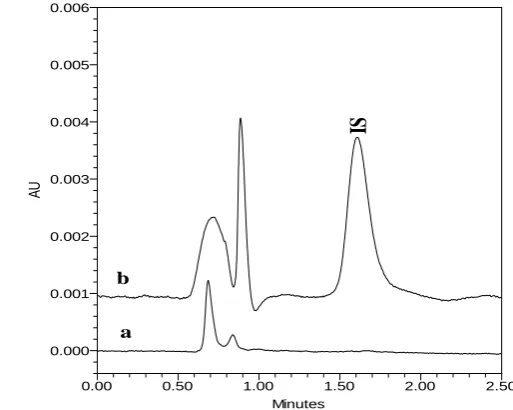
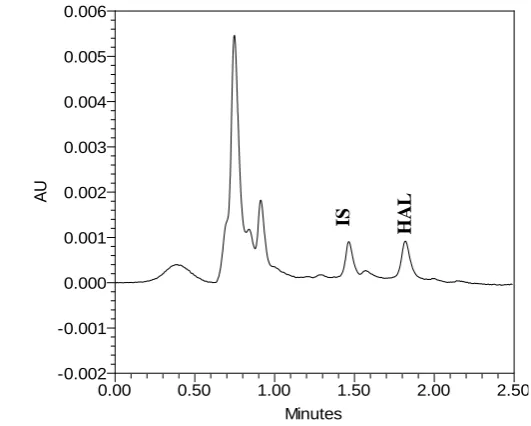
Specificity of the developed method was determined by comparing the chromatogram of
blank plasma, blank plasma spiked with IS and with analyte (1ng/mL). As shown in Fig. 1
and Fig. 2, no interfering peaks from endogenous compounds were observed at the retention
time of analyte and IS. The total chromatographic run time was 2.5 min.
AU
0.000 0.001 0.002 0.003 0.004 0.005 0.006
Minutes
0.00 0.50 1.00 1.50 2.00 2.50
IS
a b
[image:5.595.172.429.425.630.2]AU
-0.002 -0.001 0.000 0.001 0.002 0.003 0.004 0.005 0.006
Minutes
0.00 0.50 1.00 1.50 2.00 2.50
H
A
L
IS
Fig. 2. Representative UPLC chromatograms of blank plasma spiked with analyte (1ng/mL).
Linearity
The quantification of HAL was based on the area ratio of the analyte over the IS vs HAL
concentration. The plasma calibration curve was constructed using eight calibration standards
(viz., 1-100 ng/mL) in human plasma and showed excellent linearity with regression
coefficient (r2 > 0.991). The standard curve had a consistent reproducibility over the standard
concentration across the calibration range. The calibration curve was prepared by determining
the best fit of peak-area ratio (peak area analyte / peak area IS) vs concentration and fitted to
the y=mx+c using weighting factor (1/x2). The lowest concentration with the RSD < 20% was
taken as the LLOQ and was found to be 1.0 ng/mL for HAL. The percentage accuracy
observed for the mean of back-calculated concentration for four calibration curves for the
HAL was within 92.72-106.57.
Accuracy and precision
Accuracy and precision data for intra- and inter-day human plasma samples are presented in
Table 1. The assay values on both the occurrences (intra- and inter-day) were found to be
[image:6.595.168.434.73.286.2]Table 1. Intra- and inter-day precision and accuracy of HAL in human plasma in vitro.
Nominal concentration
(ng/mL)
Intra-day (n = 6) Inter-day (n = 18)
Measured concentration
(mean ± SD), ng/mL) CV (%) Accuracy (%) Measured concentration
(mean ± SD), ng/mL) CV (%) Accuracy (%) HAL
4.94 4.85 ± 0.13 2.68 98.18 4.82 ± 0.14 2.90 97.57 50.16 48.76 ± 0.67 1.37 97.21 49.34 ± 1.37 2.78 98.37 84.92 84.55 ± 2.69 3.18 99.56 83.80 ± 2.22 2.65 98.68
Recovery
Liquid-liquid extraction method gave adequate recovery and cleaner samples. Comparison of
neat standards vs human plasma-extracted standards were estimated for HAL (5, 50, 85
ng/mL) and the mean recovery was ranged from 81.51 ± 3.51, 78.91 ± 1.70 and 81.18 ±
1.86%, respectively. The recovery of IS at 2 µg/mL was 77.82 ± 1.61%.
Stability
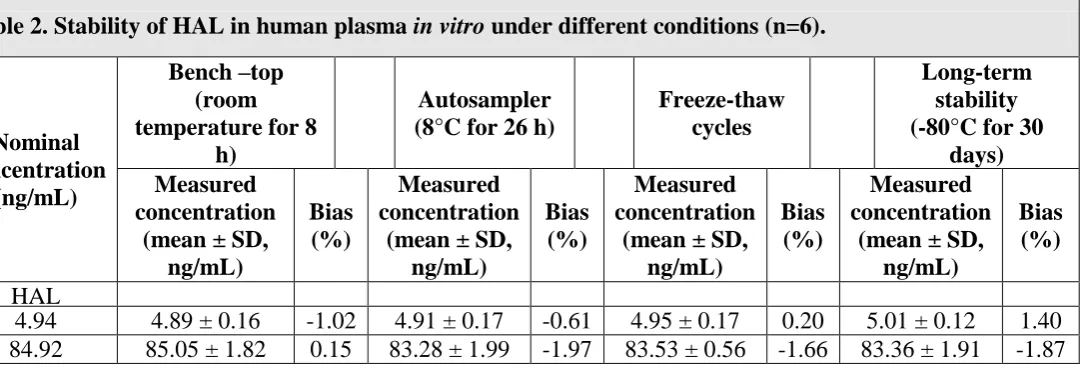
The expected concentration of HAL at 5 and 85 ng/mL samples deviated within ±15% of the
nominal concentrations in a series of stability test, viz. Bench-top (8 h), three freeze-thaw
cycles and long-term stability at -80ºC for 30 days (Table 2). The results were found to be
[image:7.595.69.529.68.246.2]within the assay variability limits during the entire process.
Table 2. Stability of HAL in human plasma in vitro under different conditions (n=6).
Nominal concentration
(ng/mL)
Bench –top (room temperature for 8
h)
Autosampler (8°C for 26 h)
Freeze-thaw cycles
Long-term stability (-80°C for 30
days) Measured
concentration (mean ± SD,
ng/mL)
Bias (%)
Measured concentration
(mean ± SD, ng/mL)
Bias (%)
Measured concentration
(mean ± SD, ng/mL)
Bias (%)
Measured concentration
(mean ± SD, ng/mL)
Bias (%)
HAL
4.94 4.89 ± 0.16 -1.02 4.91 ± 0.17 -0.61 4.95 ± 0.17 0.20 5.01 ± 0.12 1.40 84.92 85.05 ± 1.82 0.15 83.28 ± 1.99 -1.97 83.53 ± 0.56 -1.66 83.36 ± 1.91 -1.87
CONCLUSION
This paper describes a rapid, sensitive and specific UPLC-DAD method to quantify the HAL
[image:7.595.39.580.491.677.2]chromatographic run time, sharper peaks and higher extraction recovery. It can be employed
in therapeutic drug monitoring practices and clinical toxicological assays. This method
provides similar sensitivity like LC-MS/MS and can be used as an alternative method with a
highly cost effective and sensitive analytes yield.
REFERENCES
1. Titier K, Bouchet S, Pehourcq F, Moore N, Molimard M. High-performance liquid
chromatographic method with diode array detection to identify and quantify atypical
antipsychotics and haloperidol in plasma after overdose. J Chromatogr B Analyt Technol
Biomed Life Sci., 2003; 788: 179-85.
2. Hempenius J, Steenvoorden RJ, Lagerwerf FM, Wieling J, Jonkman JH. 'High
throughput' solid-phase extraction technology and turbo ionspray LC-MS-MS applied to
the determination of haloperidol in human plasma. J Pharm Biomed Anal., 1999; 20:
889-98.
3. Zhang G, Jr AV, Bartlett MG. Bioanalytical methods for the determination of
antipsychotic drugs. Biomed Chromatogr, 2008; 22: 671-687.
4. Zhang G, Terry AV Jr and Bartlett MG. Simultaneous determination of five antipsychotic
drugs in rat plasma by high performance liquid chromatography with ultraviolet
detection. Journal of Chromatography B Analytical Technologies in the Biochemical and
Life Sciences, 2007; 856: 20-28.
5. Titier K, Bouchet S, Péhourcq F, Moore N, Molimard M. High-performance liquid
chromatographic method with diode array detection to identify and quantify atypical
antipsychotics and haloperidol in plasma after overdose. J Chromatogr B Analyt Technol
Biomed Life Sci., 2003; 788: 179-185.
6. Sanchez de la Torre C, Martinez MA, Almarza E. Determination of several psychiatric
drugs in whole blood using capillary gas-liquid chromatography with nitrogen
phosphorus detection: comparison of two solid phase extraction procedures. Forensic Sci
Int., 2005; 155: 193-204.
7. Hariharan M, Kindt EK, Van Noord T, Tandon R. An improved sensitive assay for
simultaneous determination of plasma haloperidol and reduced haloperidol levels by
liquid chromatography using a coulometric detector. Ther Drug Monit., 1989; 11:
701-707.
plasma by high-performance liquid chromatography with coulometric detection. Ther
Drug Monit., 1988; 10: 177-183.
9. Rahman N, Siddiqui S. Development and validation of spectrofluorimetric method for
determination of haloperidol in pharmaceutical dosage forms. Drug Test Anal., 2010; 2:
252-259.
10.Kishikawa N, Hamachi C, Imamura Y, Ohba Y, Nakashima K, Tagawa Y, Kuroda N.
Determination of haloperidol and reduced haloperidol in human serum by liquid
chromatography after fluorescence labeling based on the Suzuki coupling reaction. Anal
Bioanal Chem., 2006; 386: 719-724.
11.Juenke JM, Brown PI, Urry FM, Johnson-Davis KL, McMillin GA. Simultaneous
UPLC-MS/MS assay for the detection of the traditional antipsychotics haloperidol, fluphenazine,
perphenazine and thiothixene in serum and plasma. Clin Chim Acta., 2013; 423: 32-35.
12.Hempenius J, Steenvoorden RJ, Lagerwerf FM, Wieling J, Jonkman JH. 'High
throughput' solid-phase extraction technology and turbo ionspray LC-MS-MS applied to
the determination of haloperidol in human plasma. J Pharm Biomed Anal., 1999; 20:
889-898.
13.US DHHS, FDA and CDER. Guidance for Industry: Bioanalytical Method Validation.
US Department of Health and Human Services, Food and Drug Administration, Center
for Drug Evaluation and Research and Center for Veterinary Medicine: Rockville, MD,