STUDY ON MARINE DIVERSITY AS A SOURCE OF BINDER
Rinu K. A.* and Dhanish Joseph
Department of Pharmaceutics, Nirmala College of Pharmacy, Muvattupuzha, Kerala, Indian –
686661.
ABSTRACT
Binders are the prominent inactive ingredient in development of solid
dosage form. Varieties of natural and synthetic binders are available
and many are in use by pharmaceutical industry. The scope of
identifying the need of binder with different property and varying
viscosity still exists. Sargassum wightii is brown seaweed belongs to
the class Phaeophyceae, is widely distributed in tropical and temperate
oceans. It belongs to the family Sargassaceae and order Fucales.
Aqueous soxhlet extraction method was used for the extraction of gum.
The extracted gum was incorporated as binder in the formulation of
tablets using Acyclovir as the model drug by wet granulation method.
The prepared acyclovir tablets were compared with tablets prepared
using standard binders such as Acacia and Methyl cellulose. The result shows that the
granules prepared with Sargassum wightii binder shows good flow properties as that of
Acacia and Methylcellulose and can be compressed into tablets. The prepared Acyclovir
tablets with Sargassum wightii shows good result for friability and hardness test from a
concentration 12.5 to 25%. The prepared tablets get disintegrate within 3 minutes and shows
a complete drug release within 1 hour. Hence on comparing with Acacia and Methyl
cellulose Sargassum wightii binder shows good binding property and safely be used as a
pharmaceutical binder for the formulation of tablets.
KEYWORDS: Natural binders, Sargassum wightii, extraction, acyclovir, pharmaceutical
excipient.
INTRODUCTION[1, 2, 3, 4]
Binders hold the ingredients in a tablet together. Binders ensure that tablets and granules can
be formed with required mechanical strength, and give volume to low active doses tablets.
Volume 7, Issue 19, 688-704. Research Article ISSN 2277– 7105
Article Received on 25 Sept. 2018,
Revised on 15 Oct. 2018, Accepted on 04 Nov. 2018
DOI: 10.20959/wjpr201819-13476
*Corresponding Author
Rinu K. A.
Department of
Pharmaceutics, Nirmala
College of Pharmacy,
Muvattupuzha, Kerala,
Binders are usually starches, sugars, cellulose or modified cellulose such as microcrystalline
cellulose, hydroxypropyl cellulose, lactose, or sugar alcohols such as xylitol, sorbitol.
Seaweeds or marine macro algae are primitive non-flowering plants without true root, stem
and leaves. They form one of the commercially important marine living renewable resources.
They are the only source for the production of phytochemicals such as Agar, Carrageenan
and Algin. Seaweeds are utilised for the production of phytochemicals such as agar,
carrageenan and alginate which are widely used as gelling, stabilising and thickening agents
in many industries such as food, confectionary, pharmaceutical, dairy, textile, paper, paint
and varnish, etc.
Sargassum wightii, is one of the marine macroalgal genera belonging to the class
Phaeophyceae, is widely distributed in tropical and temperate oceans. It belongs to the family
Sargassaceae and order Fucales.
The aim of my study is to develop a potential binder from the seaweed Sargassum wightii
which meet the current industrial needs.
The specific objective of the study may be stated as follows:
To identify the potential of Sargassum wightii as seaweed as novel source of binder.
To collect and identify the seaweed Sargassum wightii
To establish method of extraction of Sargassum wightii
To evaluate the extracted gum for their suitability as pharmaceutical binder
To formulate the dosage form
To do the comparative study with existing binders.
MATERIAL AND METHODS
Acyclovir (Chemdyes corporation, Rajkot), Acacia (Sara fine chemicals, Baroda), Methyl
Cellulose (Research lab, Mumbai), Cross povidone (Chemdyes corporation, Rajkot), Lactose
monohydrate (Nice chemicals Pvt. Ltd, Edappally), Magnesium stearate (Nice chemicals Pvt.
Ltd, Edappally), Talc (Nice chemicals Pvt. Ltd, Edappally).
Sample collection and identification
The sea weed Sargassum wightii was collected from Thirumullavaram beach of Kollam,
Kerala and was identified by Dr. Sr. Tessy Joseph, HOD, Dept. of Botany, Nirmala College,
Extraction of Sargassum wightii
Aqueous soxhlet extraction method was used for the extraction of Sargassum wightii. The
dried samples of Sargassum wightii were taken and powdered to form a fine particle. It was
then filled in the soxhlet apparatus. The apparatus was then fixed above the round bottom
flask and placed in the heating mantle. A sufficient quantity of water was added into the
soxhlet apparatus. The reflux condenser was fixed over the soxhlet apparatus and started the
extraction at 400 C. Continue the extraction for 2 days for the complete extraction of the
sample. The extracted sample was taken for distillation to remove the methanol and kept the
sample for drying. The dried sample was packed in a container.
Preparation of Acyclovir granules[5]
Wet granulation method was used for the preparation of Acyclovir tablet granules.
Sarrgassum wightii gum was used as a binder at different concentration (2.5, 5, 7.5, 10, 12.5,
15, 20, and 25%), while Acacia (5%) and Methyl cellulose (5%) were used as standard.
The required quantity of Acyclovir, Lactose and Crosspovidone were taken in a mortar
triturated to form a fine powder. To this binder solution was added and mixed thoroughly to
form dough mass. The mass passed through sieve No: 22 to obtain wet granules. The wet
granules were dried at 600 C in hot air oven. The dried granules were passed through sieve
No. 36 to break the aggregates. Talc (1%) and magnesium stearate (0.5%) were added to the
dried granules and blended in a poly ethylene bag.
Table 1: Formula used for the preparation of Acyclovir granules.
Excipients Quantity For 1 Tablet (Mg)
Sargassum Wightii Acacia Methyl Cellulose
F1 F2 F3 F4 F5 F6 F7 F8 F9 F10
Acyclovir 25 25 25 25 25 25 25 25 25 25
Lactose 68 65.5 63 60.5 58 55.5 50.5 45 65.5 65.5
Binder (%) 2.5 5 7.5 10 12.5 15 20 25 5 5
Crosspovidone 3 3 3 3 3 3 3 3 3 3
Talc 1 1 1 1 1 1 1 1 1 1
Magnesium stearate 0.5 0.5 0.5 0.5 0.5 0.5 0.5 0.5 0.5 0.5
TOTAL (mg) 100 100 100 100 100 100 100 100 100 100
Precompression evaluation of Acyclovir granules[6, 7]
The flow properties of granules were characterized in terms of angle of repose, Carr’s index
and Hausner’s ratio. The bulk density and tapped density were determined from this data
Formulation of Acyclovir Tablets[8]
Acyclovir tablet granules prepared with different binder concentrations were compressed into
100 mg tablet each batch containing 25 tablets using rotary multi-station tablet punching
machine using a die size of 6 mm round and flat punches. The prepared tablets were packed
in a well closed container for further studies.
Post compression evaluation of Acyclovir Tablets
i) General appearance: The morphological characterizations which include size, shape,
color, presence or absence of odour, taste and surface texture of the tablets was determined.
ii) Thickness and Diameter: Five tablets were picked from each formulation randomly and
thickness and diameter was measured individually. It is expressed in mm and standard
deviate on was also calculated. The tablet thickness and diameter was measured using Screw
gauge.
iii) Hardness: Hardness indicates the ability of a tablet to withstand mechanical shocks while
handling. The hardness of the tablet was determined using Monsanto hardness tester. It is
expressed in kg/cm2. Five tablets were randomly picked and hardness of the same tablets
from each formulation was determined. The mean and standard deviation values were also
calculated.
iv) Friability test: Friability test is performed to assess the effect of friction and shocks,
which may often cause tablet to chip, cap or break. Roche Friabilator was used for the
purpose. Pre-weighed samples of ten tablets were placed in the Friabilator, which was then
operated at 25 rpm for 4 minutes or ran upto 100 revolutions. After 100 revolutions the
tablets were dusted and reweighed. Compressed tablets should not lose more than 1% of their
weight.
The % friability was then calculated by the following formula.
Percentage friability = (initial weight-final weight) / (initial weight) x 100
v) Weight variation: Twenty tablets were randomly selected from each batch and
individually weighed using an electronic balance. The average weight was calculated. The
vi) Disintegration tests: Using disintegration test apparatus, six tablets were picked at
random from each formulation placed in the basket individually. The water bath was
thermostatically set at 37±1ºC. The time that took the tablet to disintegrate was recorded
using a stop watch.
vii) In vitro drug release studies: In vitro drug release studies were performed by using USP
dissolution test apparatus. The drug release profile was studied 90 ml of 0.1 N HCl buffer at
37±20C. Rotational speed of the paddle at 50 rpm. Aliquots of 5 ml of dissolution medium
were withdrawn at specific time intervals filtered and replaced with fresh medium. The
absorbance of the samples was measured by UV spectrophotometer at 252 nm.
viii) Drug content estimation: Weigh and powder 20 tablets. Disperse a quantity of powder
containing 0.1 g of Acyclovir in 60 ml of 0.1 M NaOH with the aid of ultrasound for 15
minutes and dilute to 100 ml with 0.1 M NaOH and filter. To 15 ml of the filtrate add 50 ml
of water, 5.8 ml of 2 M HCl and sufficient water to produce 100 ml. To 5.0 ml of this
solution add sufficient 0.1 M HCl to produce 50 ml and mix well. Measure the absorbance of
the solution at the maximum at about 252 nm, using 0.1 M HCl as the blank. Calculate the
content of C8H11N5O3 taking 560 as the specific absorbance at 255 nm.
ix) Accelerated stability study for F7 formulation: Accelerated stability study for tablets of
F7 formulation were carried out at 400C±20C /75% RH ±5% RH for 3 days in open condition
in a humidity chamber. The samples were withdrawn at every 24th hour and evaluated for
colour change. Also the third day samples were evaluated for the hardness, thickness,
RESULT AND DISCUSSION
[image:6.595.61.541.132.380.2]Preparation of Acyclovir granules
Table 2: Result for Precompression evaluation of Acyclovir granules
Binder concentra tion (%) Formul ation code
Derived properties Flow properties
Bulk density (gm/cc) Tapped density (gm/cc) Angle of repose in degree Carr’s index (%) Hausner’s ratio
2.5 F1 0.40±0.01 0.47±0.01 33.23±0.76 14.89±0.315 1.17±0.00
5 F2 0.42±0.01 0.48±0.01 32.29±0.18 12.5±0.26 1.14±0.00
7.5 F3 0.40±0.02 0.47±0.02 32.98±0.82 14.26±3.14 1.17±0.04
10 F4 0.40±0.01 0.46±0.01 31.60±0.15 13.00±1.77 1.15±0.02
12.5 F5 0.39±0.01 0.46±0.01 29.93±0.19 14.89±0.317 1.17±0.004
15 F6 0.41±0.01 0.47±0.01 30.44±0.45 12.76±0.271 1.14±0.00
20 F7 0.42±0.01 0.48±0.01 28.44±0.23 12.44±3.90 1.14±0.05
25 F8 0.39±0.01 0.46±0.00 26.57±0.33 13.67±1.34 1.15±0.01
Acacia
(5%) F9 0.42±0.01 0.49±0.01 28.20±0.21 14.17±5.00 1.16±0.06
Methyl Cellulose
(5%)
F10 0.43±0.01 0.47±0.00 22.50±0.39 8.51±2.12 1.09±0.02
Bulk Density
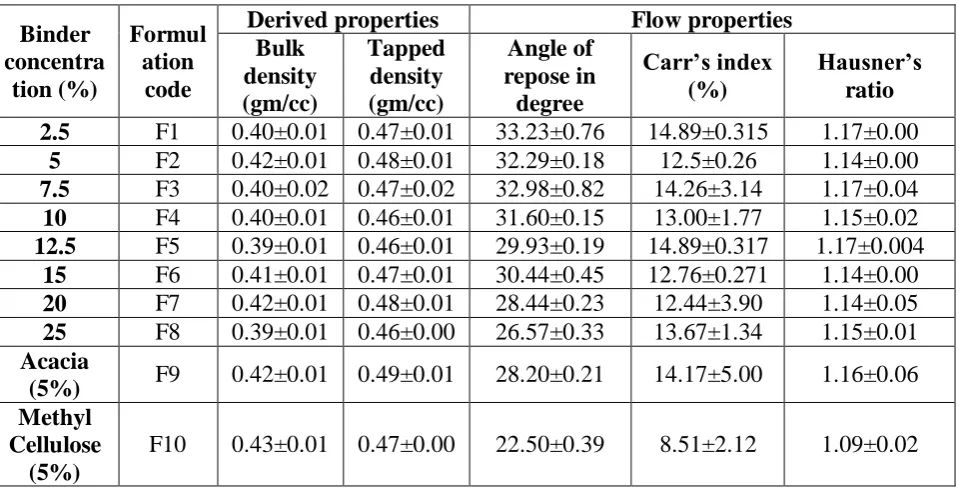
The bulk density of Acyclovir tablet granules were shown in the Table: 2. The granules
prepared with Sargassum wightii binder was found to be in the range of 0.39±0.01 to
0.42±0.01gm/cc. The bulk density of Acyclovir tablet granules formed with Acacia was
found to be 0.42±0.01 and Methyl cellulose found to be 0.43±0.01 gm/cc.
Tapped density
The tapped density of Acyclovir tablet granules were shown in Table: 2. The granules
prepared with Sargassum wightii binder was found to be in the range of 0.46±0.00 to
0.48±0.01. The tapped density of granules with Acacia was found to be 0.49±0.01 and for
Methyl cellulose it was found to be 0.47±0.00.
Carr’s Index
From the results shown in Table: 2 it was found that the granules prepared with Sargassum
wightii binder shows the Carr’s index in the range of 12.44±3.90 to 14.89±0.31% implying the granules have good flow property. The Carr’s index of granules formed with Acacia was
found to be: 14.17±5.00% and for Methyl cellulose it was found to be: 8.5±2.12%. Acacia
Hausner’s Ratio
The Hausner’s ratio of acyclovir granules were shown in Table: 2. The Acyclovir tablet
granules prepared with Sargassum wightii was observed to be in the range of 1.14±0.03 to
1.17±0.04 which signifies that granules have good flow property. The Hausner’s ratio of
granules with Acacia was found to be: 1.16±0.06, which shows good flow property, and for
Methyl cellulose it was found to be: 1.09±0.02 which shows excellent flow property.
Angle of Repose
The angle of repose of Acyclovir granules were shown in Table: 2. From the result it was
found that the granules prepared with Sargassum wightii was found to be in the range of
26.570 ±0.33 to 33.230±0.76. The angle of repose of granules with Acacia was found to be:
28.200±0.21 and for Methyl cellulose it was found to be 22.500±0.39. The granules formed
with Sargassum wightii binder and Acacia shows good flow property, while that of granules
formed with Methyl cellulose shows excellent flow property.
[image:7.595.95.503.379.658.2]Formulation of Acyclovir Tablets
Fig. 2: Tablets prepared with Acacia and Methyl cellulose.
The prepared tablets were evaluated for general appearance, hardness, friability, weight
variation, thickness, diameter, disintegration study, Percentage drug content, dissolution
study using methods specified in Indian Pharmacopoeia.
Table 3: Result for post compression parameters of Acyclovir Tablets.
Binder concentration
(%)
Formulation code
Diameter (mm)
Thickness (mm)
Hardness (kg/cm2)
Friability (%)
Percentage Weight variation (%)
S
ar
gas
su
m
wigh
tii 2.5 5 F1 F2 5.9±0.06 6.0±0.09 2.55±0.03 2.53±0.02 1.8±0.33 2.4±0.72 1.56±0.14 1.43±0.14 99.52±0.003 100±0.003
7.5 F3 6.0±0.02 2.49±0.02 2.1±0.75 1.72±0.42 101±0.003
10 F4 6.0±0.04 2.54±0.01 2.6±0.62 1.53±0.37 99.5±0.002
12.5 F5 6.0±0.02 2.51±0.02 3±0.95 0.94±0.11 100.17±0.003
15 F6 5.9±0.02 2.49±0.01 3.0±0.298 0.87±0.22 100±0.002
20 F7 6.0±0.01 2.51±0.01 3.1±0.56 0.69±0.22 100.33±0.002
25 F8 5.9±0.02 2.50±0.01 3.6±0.51 0.42±0.12 100±0.002
Acacia 5 F9 6.0±0.02 2.53±0.01 4.8±0.33 0.25±0.78 100±0.002
Methyl
Cellulose 5 F10 6.0±0.01 2.5±0.01 5.3±0.6 0.17±0.76 100.5±0.002
[image:8.595.51.545.355.744.2]
Fig. 4: Result for Friability test.
Table 4: Result for Disintegration time and Percentage drug content analysis of
Acyclovir Tablets.
Binder concentration
(%)
Formulation code
Disintegration Time (min)
Percentage drug content (%)
S
ar
gas
su
m
wigh
tii 2.5 5 F1 F2 0.85 ±0.03 0.89±0.02 99.88 ±0.12 99.54 ±0.35
7.5 F3 1.22 ±0.05 98.50 ±0.5
10 F4 1.58 ±0.03 100.02 ±1.53
12.5 F5 1.98 ±0.02 99.28±0.72
15 F6 2.01 ±0.04 97.69±1.31
20 F7 2.11±0.04 100.5±1.5
25 F8 2.19±0.01 98.61 ±0.68
Acacia 5 F9 2.24±0.01 99.45 ±0.44
Methyl
Cellulose 5 F10 2.26 ±0.02 98.75 ±1.07
[image:9.595.81.516.332.743.2]
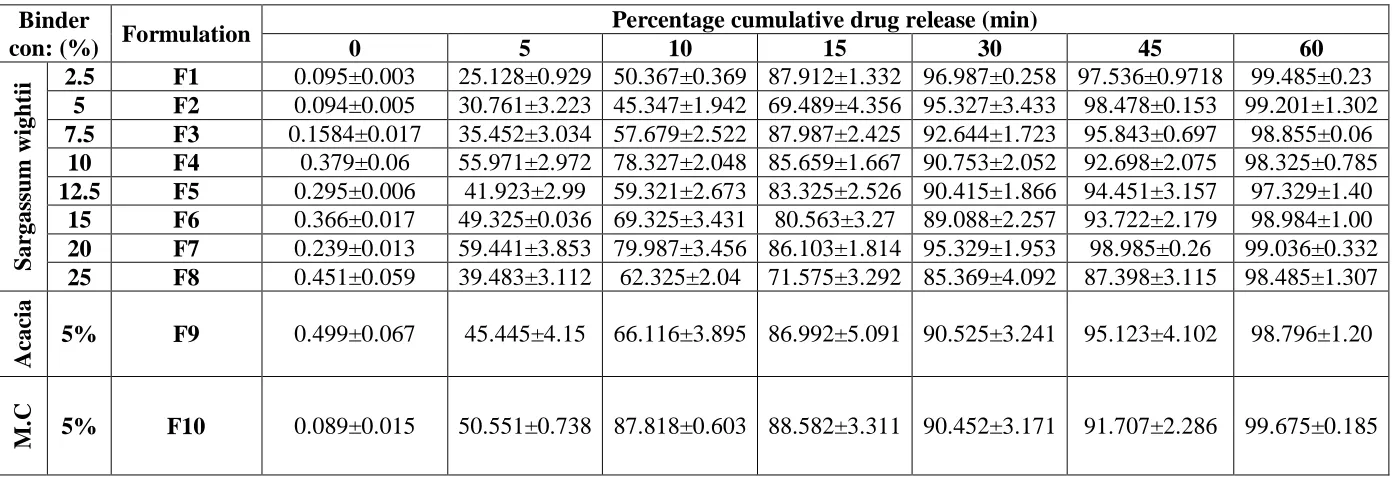
Table 5: Percentage cumulative drug release of Acyclovir Tablets.
Binder
con: (%) Formulation
Percentage cumulative drug release (min)
0 5 10 15 30 45 60
S
ar
gas
su
m
wigh
tii 2.5 5 F1 F2 0.095±0.003 0.094±0.005 25.128±0.929 50.367±0.369 87.912±1.332 96.987±0.258 97.536±0.9718 30.761±3.223 45.347±1.942 69.489±4.356 95.327±3.433 98.478±0.153 99.201±1.302 99.485±0.23
7.5 F3 0.1584±0.017 35.452±3.034 57.679±2.522 87.987±2.425 92.644±1.723 95.843±0.697 98.855±0.06
10 F4 0.379±0.06 55.971±2.972 78.327±2.048 85.659±1.667 90.753±2.052 92.698±2.075 98.325±0.785
12.5 F5 0.295±0.006 41.923±2.99 59.321±2.673 83.325±2.526 90.415±1.866 94.451±3.157 97.329±1.40
15 F6 0.366±0.017 49.325±0.036 69.325±3.431 80.563±3.27 89.088±2.257 93.722±2.179 98.984±1.00
20 F7 0.239±0.013 59.441±3.853 79.987±3.456 86.103±1.814 95.329±1.953 98.985±0.26 99.036±0.332
25 F8 0.451±0.059 39.483±3.112 62.325±2.04 71.575±3.292 85.369±4.092 87.398±3.115 98.485±1.307
Ac
ac
ia
5% F9 0.499±0.067 45.445±4.15 66.116±3.895 86.992±5.091 90.525±3.241 95.123±4.102 98.796±1.20
M
[image:11.595.130.469.302.485.2]
Fig. 6: In-vitro drug release study of Acyclovir Tablets (Sargassum wightii 2.5%- 10%).
Fig. 7: In-vitro drug release study of Acyclovir Tablets (Sargassum wightii 15%- 25%).
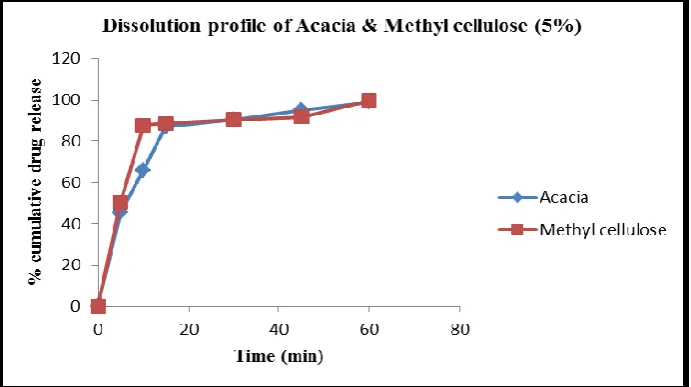
Fig. 8: In-vitro drug release study of Acyclovir Tablets (Acacia -5% and Methyl
[image:11.595.126.472.531.724.2]
1) General Appearance
All the formulated tablets for acyclovir using different binders were found to be circular in
shape and good physical appearance.
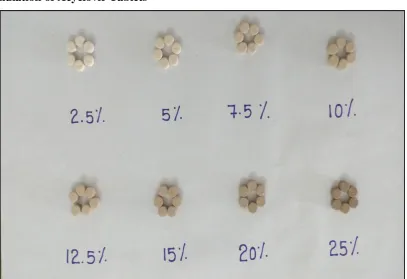
The tablets prepared with Sargassum wightii binder shows colour difference from light brown
to dark brown based on the binder concentration and had a slight fishy odour smell.
Tablets prepared with Acacia and Methyl cellulose was found to be white in colour with no
characteristic odour.
ii) Thickness
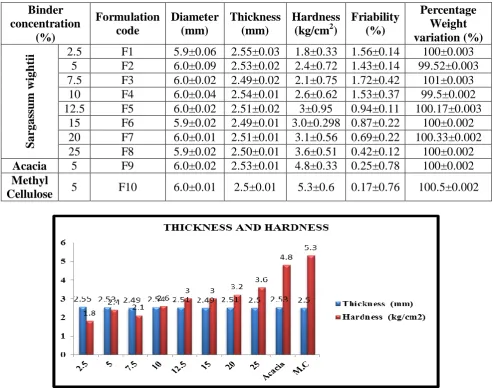
At a constant compression force, tablet thickness varies with changes in die fill, particle size
distribution and packing of the powder mix being compressed and with tablet weight, while
with a constant die fill thickness varies with variation in compression force. The thickness of
all formulated tablets was measured using Screw gauge. The tablets of all the formulations
prepared with Sargassum wightii showed thickness in the range of 2.49±0.01 mm –
2.55±0.03 mm as shown in Table: 3. For tablets prepared with Acacia was found to be:
2.53±0.01 and for Methyl cellulose it was found to be: 2.5±0.01. There was a slight variation
in the thickness of tablets.
iii) Hardness
Tablets require certain amount of strength and hardness to withstand mechanical shocks
during manufacture, packaging and shipping. The hardness was found to be in the range
1.8±0.33 to 3.6±0.51 kg/cm2 for tablets formed with Sargassum wightii as shown in Table: 3.
The tablets prepared with binder concentration 2.5 to 10% fails the test for hardness and
binder concentration from 12.5 to 25% passes the test for hardness. For Acacia the Hardness
was found to be 4.8±0.33 kg/cm2 and for Methylcellulose was found to be 5.3±0.6 kg/cm2
which passes the test for hardness. The formulationF5, F6, F7, F8, F9 and F10 were found to be
within the IP limit 3-6 kg/cm2 hence these tablets passes the test for hardness. It was observed
that hardness increases with increasing binder concentration.
iv) Friability test
Adequate tablet hardness and resistance to friability are necessary to prevent damage to the
tablet during manufacture, packing and transport. Percentage friability of tablets less than 1%
binder ranged from 1.72±0.42% to 0.42±0.12% as shown in Table : 3 The tablets prepared
with Sargassum wightii having concentration 2.5%, 5%, 7.5%, 10%, shows friability greater
than 1 % which fails the friability test and binder concentration 12.5%, 15%, 20%, 25%
shows friability less than 1%, which passes the friability test. The percentage friability of
Acacia was found to be 0.25±0.78% and for Methyl cellulose it was 0.17±0.76% which
passes the test for friability. The formulation F5, F6, F7, F8, F9 and F10 were found to be
within the IP limit less than 1% hence these tablets passes the test for friability. As the
concentration of binder increases the friability decreases.
v) Weight variation
The average weight of Acyclovir tablet was 100 mg. The weight variation was found to be in
the range of 99.5±0.002 to 101±0.003 mg for tablets prepared with Sargassum wightii binder
as shown in Table: 4. For tablets prepared with Acacia it was found to be: 100±0.002 and for
Methylcellulose it was found to be 100.01. The obtained results indicated that all tablets of
different formulations were within the IP limit ±7.5%. The tablets pass the test for weight
variation.
vi) Disintegration Time
Disintegration test is a measure of the time required under a given set of conditions for a
group of tablets to disintegrate into particles. The tablet disintegration test was used for
providing simple and useful means for monitoring and controlling the quality of tablets. It
also gives an insight of release pattern of formulation. For uncoated tablets the time
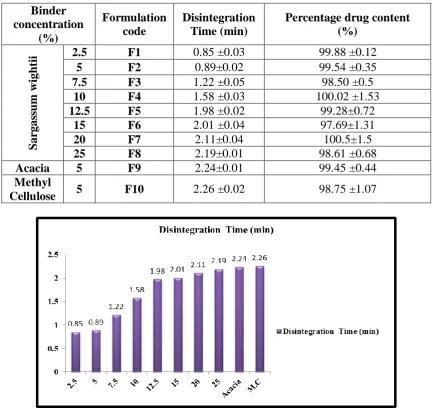
specification for disintegration is 15 min. From the result shown from Table: 4 the
disintegration time of Acyclovir Tablets range from 0.85±0.03 min sec to 2.19±0.01 min for
tablets prepared with Sargassum wightii depending on the concentration of binder. For tablets
prepared with Acacia the disintegration time is 2.24±0.01 min and for methyl cellulose it was
found to be 2.26 ±0.02 min. From the result it shows that all batches of tablets disintegrate
within 3 minutes and passes the disintegration test. As the concentration of binder increase
the disintegration decreases.
vii) Percentage drug content
The percentage drug content of Acyclovir tablets from each batch was uniform as shown in
Table 4 and ranged from 99.50±0.5% to a 100.5±1.5% for tablets prepared with Sargassum
wightii. For tablets prepared with Acacia it was found to be 99.45±45% and for Methyl
viii) In-vitro dissolution profile
The dissolution test measures the time required for a percentage of the drug substance in a
tablet to go into solution under a specified set of condition. It is one of the most important
quality control test performed on pharmaceutical dosage form. In – vitro dissolution profile of
different formulations were shown in Table 5. The formulation F1 shows a drug release from
0.095±0.003 to 99.485±0.23. F2 shows a drug release from 0.094±0.005 to 99.201±1.302. F3
shows a drug release from 0.1584±0.017 to 98.855±0.06. F4 shows a drug release from
0.379±0.06 to 98.325±0.785. F5 shows a drug release from 0.295±0.006 to 97.329±1.40. F6
shows a drug release from 0.366±0.017 to 98.984±1.00. F7 shows a drug release from
0.239±0.013 to 99.036±0.332. F8 shows a drug release from 0.451±0.059 to 98.485±1.307.
F9 shows drug release from 0.499±0.067 to 98.796±1.20 and F10 shows a drug release from
0.089±0.015 to 99.675±0.185. All the formulation shows a drug release near to 100
percentages at the end of 1 hour.
Accelerated stability study
Colour: Pale brown in colour.
Table 6: Result for Accelerated stability study of F7 formulation.
Formul ation code Diameter (mm) Thickness (mm) Hard ness (kg/cm2)
Friability (%) % weight variation Disinte gration time % drug content
F7 6.0±0.01 2.52±0.01 3.1±0.23 0.84±0.31 101±0.002 2.08±0.03 98.82±1.13
Table 7: Percentage cumulative drug release of stability samples of F7 formulation.
Time
(min) 0 5 10 15 30 45 60
Percentage cumulative drug release
0.219 52.531 78.358 84.189 95.11 96.548 99.98
The colour of F7 tablets which was kept for stability analysis was found to be pale brown in
colour which was same as that of initial sample.
From the Table 6 & 7 it was found that there was no any significant change in the hardness,
friability, thickness, Diameter, Disintegration time, Percentage drug content and percentage
CONCLUSION
The Sargassum wightii binder can be extracted by means of Soxhlet aqueous extraction
method.
The precompressional parameters of Acyclovir granules prepared with Sargassum wightii
Acacia and Methyl Cellulose were evaluated. Based on the Angle of repose, Carr’s index and
Hausner’s ratio the prepared granules show good flow property.
By comparing with granules formed with Acacia and Methyl cellulose, the overall powder
blend of Acyclovir tablet granules formed with Sargassum wightii were good and suitable for
compression.
The tablets of each batch containing 25 tablets were prepared by wet granulation method. The
tablets prepared with Sargassum wightii binder shows a colour variation from light brown to
dark brown based on the concentration of the binder and the tablets had a slight fishy odour
smell. The prepared tablets show a slight variation in the thickness.
The tablets prepared at a concentration from 2.5% to 10% fails the test for hardness and
tablets prepared at a concentration from 12.5% to 25% passes the test for hardness. Also the
tablets prepared with Acacia and methyl cellulose also passes the test for hardness which was
within the IP limit 3-6 kg/cm2.
The percentage friability of formulation F5, F6, F7, F8, F9 and F10 was within the IP limit of
1%. Hence the tablets prepared with Sargassum wightii at a concentration from 12.5% to
25% and also with Acacia and Methyl cellulose also passes the friability test.
All the formulation tested for weight variation test indicates that all tablets of different
formulation were within the IP limit ±7.5%. Hence the tablet passes the weight variation test.
The disintegration tests for all the formulation were performed and it was found that all the
tablets pass the disintegration test.
From the result of in-vitro dissolution test it was found that all the tablets shows a 100
percentage drug release at the end of 1 hour. There was a fast drug release had happened at
The percentage drug content of Acyclovir tablets of each formulation were uniform and
percentage drug content was almost 100 percentages.
Hence from the various evaluation test performed for Acyclovir tablets shows that as the
concentration of binder increase the hardness increase and friability decreases. Also as the
concentration of binder increase the disintegration time decreases. The binder concentration
Sargassum wightii can be used at a concentration from 12.5% to 25%.
The accelerated stability analysis of F7formulation formulated with Sargassum wightii binder
at a forced stability condition of 400C±20C /75% RH ±5% RH shows that there was no any
significant variation in the colour between the initial sample and third day sample.
The third day sample which is stability sample was evaluated for its diameter, thickness,
hardness, friability, percentage weight variation, disintegration time, percentage drug content,
and percentage cumulative drug release. From the results it was found that F7 formulation
was stable with no any significant changes with that of initial sample.
Hence as conclusion we can say that the Sargassum wightii binder is good for the preparation
of tablets with a concentration ranges from 12.5% to 25%.
ACKNOWLEDGEMENT
I thank to Mr. Dhanish Joseph, Assistant Professor, Dept. of Pharmaceutics, Nirmala College
of Pharmacy, Muvattupuzha for his immense help for my project work.
I am thankful to Dr. Sr. Tessey Joseph, HOD, Dept. of Botany, Nirmala College,
Muvattupuzha who helped me to identify the name of the sea weed.
REFERENCES
1. Hardik Patel, Viral Shah and Umesh Upadhyay. New pharmaceutical excipients in solid
dosage forms – A review. Int. J. of Pharm. & Life Sci, 2011 Aug; 2(8): 1006-1019.
2. Shilpa P Chaudhari and Pradeep S Patil. Pharmaceutical Excipients: A review. IJAPBC,
2012 Jan- Mar; 1(1): – Vol. 1(1): 21-34.
3. R. Rajeswari and K. Jeyaprakash. Phytochemical characterization and invitro antioxidant
efficacy of Sargassum wightii. WJPR, 2016; 5(8): 1182-1192.
4. N.Kaliaperumal, S.Kalimuthu, J.R. Ramalingam. Economically important seaweed.
5. Manisha Karpe, Nikhil Mali, Vilasrao Kadam. Formulation Development and Evaluation
of Acyclovir Orally Disintegrating Tablets. Journalof Applied Pharmaceutical Science,
2012; 2(3): 101-105.
6. Lachman L, Lieberman HA, Kanig JL. The theory and practice of industrial pharmacy.
3rd. Delhi: Varghese Publishing House, 2008; 293-343.
7. Indian Pharmacopoeia 2014. Volume 1. India: The Indian Pharmacopoeia commission,
177-183.
8. Charyulu Narayana R, Patel Kishan, Jose Jobin. Formulation and evaluation of acyclovir
matrix tablet using mucoadhesive polymer. Journal of Drug Delivery & Therapeutics,