DEVELOPMENT AND VALIDATION OF RP-LC METHOD FOR
DAPSONE IN PHARMACEUTICAL FORMULATIONS
T. Benjamin1* and Dr. D. Ramachandran2
1
Department of Chemistry, Noble College, Machilipatnam. Andhra Pradesh, India.
2
Department of Chemistry, Acharya Nagarjuna University, Nagarjuna Nagar, Guntur Andhra
Pradesh, India.
ABSTRACT
A new, simple, rapid, selective, precise and accurate isocratic reverse
phase high performance liquid Chromatography assay method has been
developed for estimation of Dapsone in tablet formulations. The
separation was achieved by using column YMC pack ODS AQ C18
(150×4.6mm, 3µm), in mobile phase consisted of acetonitrile and pH
4.5 ammonium acetate buffer, adjusted to pH 4.5 with the help of
dilute acetic acid in the ratio of (75:25, v/v). The flow rate was 1.0
mL/min-1 and the separated Dapsone was detected using UV detector
at the wavelength of 254 nm. Column temperature 25°C and sample
temperature ambient and injection volume 10µl. The retention time of
Dapsone, was noted to be 7.05 min respectively, indicative of rather shorter analysis time.
The method was validated as per ICH guidelines. The proposed method was found to be
accurate, reproducible, and consistent.
KEYWORDS: Liquid Chromatography; Dapsone, Validation.
1.0INTRODUCTION
Dapsone, also known as diaminodiphenyl sulfone (DDS),[1] is an antibiotic commonly used in
combination with rifampicin and clofazimine for the treatment of leprosy[2] It is a second-line
medication for the treatment and prevention of pneumocystis pneumonia and for the
prevention of toxoplasmosis in those who have poor immune function.[3] Additionally, it has
been used for acne, dermatitis herpetiformis, and various other skin conditions. Dapsone is
available both topically and by mouth.[4]
Volume 7, Issue 19, 1090-1099. Research Article ISSN 2277– 7105
Article Received on 02 October 2018,
Revised on 23 October 2018, Accepted on 13 Nov. 2018
DOI: 10.20959/wjpr201819-13765
*Corresponding Author
T. Benjamin
Department of Chemistry,
Noble College,
Machilipatnam. Andhra
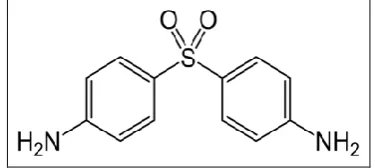
Fig. 4.01: Dapsone structural formula.
Literature survey reveals that few analytical methods have been reported for the estimation of
Dapsone in pharmaceutical dosage form including UV-Vis spectroscopy,[5] high performance
liquid chromatography (HPLC).[7-8] and TLC.[6] Although reports are available on stability
indicating HPLC methods, the information provided is incomplete as well as results are
contrast. Hence we tried to develop stability indicating HPLC method for Dapsone. The
present work describes a simple, stability indicating HPLC method for the determination of
Dapsone in bulk and tablet dosage form according to ICH guidelines.[9-10]
2.0 EXPERIMENTAL
2.1. Chemicals and Reagents
Analytical-grade Ammonium acetate, acetic acid, were from Merck Chemicals Mumbai,
India. Acetonitrile and Water, both HPLC-grades, were from Merck Chemicals. Mumbai,
India. Millex syringe filters (0.45 μm) were from Millex-HN, Millipore Mumbai, and India.
2.2. Instrumentation
Waters 2489 U.V-Visible detector/2695 Separation Module, equipped with Empower2
software, Bandelin ultrasonic bath, pH Meter (Thermo Orion Model), Analytical Balance
(Metller Toledo Model) Centrifuge Eppendorf 5810 were use in the present assay.
2.3 Preparation phosphate Buffer pH 2.5: Accurately measured quantity of 7.7 gm of
Ammonium acetate in 1000 ml of HPLC Grade water and pHwas adjusted to 4.5 with dilute
acetic solution and degassed. The solution was filtered through 0.45µ filter paper and
degassed.
2.4 Mobile phase preparation
2.5 Diluent preparation
Mix Acetonitrile and Water in the ratio of (50:50 %v/v) and Sonicated for about 5 minutes
for degas the diluent.
2.6 Standard preparation
Weighed accurately and transferred about 40mg of Dapsone working standard into a 200ml
volumetric flask and dissolved in 150ml diluent by sonicating 10 min. and was made up to
the volume with diluent. Further transfer 2ml of this solution into a 20ml and was made up to
the volume with diluent. The solution was filtered through 0.45 µm PVDF membrane filter.
(20µg/mL).
2.7 Sample preparation
Weighed accurately a quantity of the mixed contents of 5 tablets equivalent to about 200mg
of Dapsone and transferred into a 200ml volumetric flask. Added about 150ml of diluent and
sonicated for about 30min and diluted to the volume with diluent. The solution is centrifuged
at 400RPM for about 5 minutes. Further diluted 2ml of the above solution to 100ml with
diluent and mixed.
2.8 Chromatographic conditions
Chromatographic analysis was performed on YMC pack ODS AQ C18 (150×4.6mm, 3µm)
(Make: YMC) column. The mobile phase consisted of pH 4.5 ammonium acetate buffer and
Acetonitrile in the ratio of 75:25%v/v. The flow rate was 1.0 mL/min, column oven
temperature 25°C, the injection volume was 10μL, and detection was performed at 254 nm
using a photodiode array detector (PDA).
3.0 RESULTS AND DISCUSSION
Method development
Spectroscopic analysis of compound Dapsone showed that maximum UV absorbance (λmax)
at 254 nm respectively. To develop a suitable and robust LC method for the determination of
Dapsone, different mobile phases were employed to achieve the best separation and
resolution. The method development was started with Agilent Zorbax AQ C18 with the
following different mobile phase compositions like that Buffer and acetonitrile in the ratio of
40:50 v/v 50:50 v/v & 55:45. It was observed that when Dapsone was injected, Peak Tailing,
For next trial YMC pack ODS AQ C18 (150×4.6mm, 3µm) column used and the mobile
phase composition were changed slightly. The mobile phase composition was buffer and
acetonitrile in the ratio of 75:25 v/v. respectively as eluent at flow rate 1.0 mL/min. UV
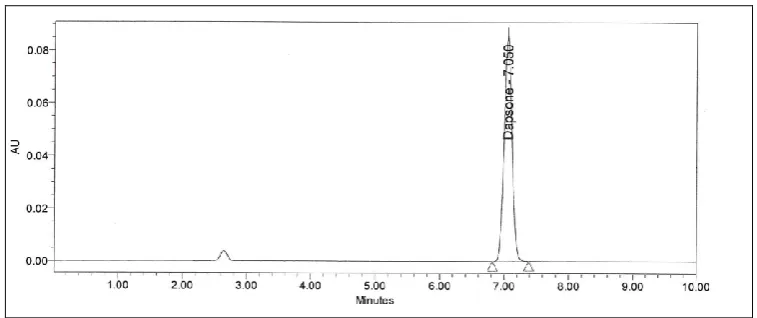
detection was performed at 254nm. The retention time of Dapsone is 7.05 minutes and the
peak shape was good.
The chromatogram of Dapsone standard using the proposed method is shown in (Fig: 1.2)
[image:4.595.108.487.242.401.2]system suitability results of the method are presented in Table-1.1.
Figure 1.2: Chromatogram showing the peak of Dapsone.
4.0 Method validation
The developed RP-LC method extensively validated for assay of Dapsone using the
following parameters.
4.1 Specificity
Preparation of blank solution
Mix Acetonitrile and Water in the ratio of (50:50 %v/v) and Sonicated for about 5 minutes
for degas the diluent.
Preparation of Placebo solution
Placebo solution was prepared in duplicate by weighing the equivalent amount of excipients
present in the finished drug product and analysed as per proposed method. Interference due to
placebo was evaluated for each of the placebo preparations.
Blank and Placebo interference
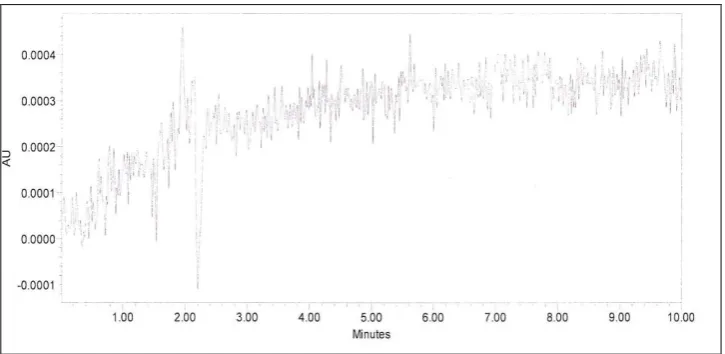
conditions and the blank and placebo chromatograms were recorded. Chromatogram of blank
solution (Fig: 1.3) showed no peak at the retention time of Dapsone peak. This indicates that
the diluent solution used in sample preparation do not interfere in estimation of Dapsone in
Dapsone tablets. Similarly chromatogram of placebo solution (Fig: 1.4) showed no peaks at
the retention time of Dapsone peak. This indicates that the placebo used in sample
[image:5.595.117.480.208.385.2]preparation do not interfere in estimation of Dapsone in Dapsone tablets.
[image:5.595.117.478.427.588.2]Fig: 1.3 Chromatogram showing the no interference of diluent for Dapsone.
Fig. 1.4: Chromatogram showing the no interference of placebo for Dapsone.
Table 1.1: System suitability parameters for Dapsone by proposed method.
Name of the Compound Retention Time Theoretical plates Tailing factor
Dapsone 7.05 15483 1.1
4.2 Method precision
The precision of test method was evaluated by doing assay for six samples of Dapsone tablet
preparation was calculated. The average content of the six preparations and % RSD for the
six observations were calculated. The data were shown in Table: 1.2.
Table: 1.2 Method precision data for Dapsone.
No. of injections Dapsone
Percentage assay
Preparation 1 98.9 Preparation 2 99.9 Preparation 3 100.7 Preparation 4 100.7 Preparation 5 101.7 Preparation 6 99. 0
Average 98.9
%RSD 0.5
4.3 Linearity of detector response
The linearity of an analytical method is its ability to obtain test results which has a definite
mathematical relation to the concentration of analyte. The linearity of response for Dapsone
was determined in the range of 5% to 150% (1, 5, 10, 15, 20, 25 and 30µg/ml for Dapsone).
The calibration curve of analytical method was assessed by plotting concentration versus
peak area and represented graphically. The correlation coefficient [r2] was found to be
1.000.Therefore the HPLC method was found to be linear standard curve were calculated and
given in Figure: 1.5 to demonstrate the linearity of the proposed method. From the data
obtained which given in Table: 1.3 the method was found to be linear within the proposed
range.
Table: 1.3: Linearity studies for Dapsone by proposed method.
S. No. Dapsone
Linearity concentration Concentration (g / ml) Average area response
1 5% 1 75059
2 25% 5 376926
3 50% 10 757263
4 75% 15 1113806
5 100% 20 1490162
6 125% 25 1857921
7 150% 30 2222507
Figure: 1.5 Calibration curve for Dapsone
4.4 Accuracy
The accuracy of the method was determined on three concentration levels by recovery
experiments. The recovery studies were carried out in triplicate preparations on composite
blend collected from 20 tablets of Dapsone, analyzed as per the proposed method. The mean
percentage recovery for 50%, 100%, 150% level was found to be 99.5, 99.3 and 98.5. %RSD
was found to be 0.2, 0.1 and 0.6 respectively. They are within the acceptance limits.
Therefore, the HPLC method for the determination of assay of Dapsone in formulation was
found to be accurate. The data obtained which given in Table: 1.4 the method was found to
be accurate.
Table: 1.4 Recovery studies for Dapsone by proposed method.
S. No. % Spike level Amount added (mg) Amount recovered (mg) % Recovery % Mean recovery 1. 50
20.69 20.04 99.4
99.5 2. 20.43 20.75 99.3
3. 20.04 20.65 99.7 1.
100
40.06 40.71 99.3
99.3 2. 40.15 40.74 99.3
3. 40.87 40.45 99.3 1.
150
60.02 60.97 99.3
98.5 2. 60.33 60.11 98.2
3. 60.49 60.07 98.8
4.5 Robustness
4.5.1 Effect of variation in flow rate
As the flow rate in the proposed method was 1ml/min, the flow rate was changed between 0.9
solution was injected and the chromatograms were recorded. The results were shown in
Table: 1.5.
Table: 1.5 System suitability data for Flow rate variation.
4.5.2 Effect of variation in pH
Prepared and injected standard and check standard solution as per the test method into
HPLC system with PH variation of ± 0.5 units and evaluated system suitability parameters.
The results were shown in Table: 1.6.
Table: 1.6 System suitability data for pH variation.
4.5.3 Effect of variation in mobile phase composition
Prepare two Isocratic programs, injected standard and check standard solutions as per the test
method and evaluated system suitability parameters. System suitability parameters are within
the specified limits as per test method. The results were shown in Table: 1.7.
Table: 1.7 System suitability data for Mobile phase variation.
System suitability parameters Parameters and Results (% Assay)
(0.9 ml/min) (1.1 ml/min) Dapsone %Diff
% RSD for area count of five
replicate injections of standard. 0.1 0.2 100.5 N/A Tailing factor 1.1 1.2 100.4 0.1 Theoretical plates 16031 15184 100.4 0.1
System suitability parameters Parameters and Results (% Assay)
(pH 4.0) (pH 5.0) Dapsone %Diff
% RSD for area count of five
replicate injections of standard. 0.2 0.2 100.5 N/A Tailing factor 1.2 1.2 100.3 0.3 Theoretical plates 17368 17524 99.8 0.7
System suitability Parameters and Results (% Assay)
Parameters
Mobile phase variation (67.5:32.5)
Mobile phase variation (77.5:22.5)
Dapsone %Diff
% RSD for area count of five replicate injections of standard.
0.1 0.4 101.2 N/A
5.0 CONCLUSION
An RP-HPLC method for estimation of Dapsone was developed and validated as per ICH
guidelines. A simple, accurate and reproducible reverse phase HPLC method was developed
for the estimation of Dapsone in bulk drugs and formulations. The optimized method consists
of mobile phase pH 4.5 ammonium acetate buffer and Acetonitrile in the ratio of 75:25%v/v
with YMC pack ODS AQ C18 150×4.6mm, 3µm column. The retention time of Dapsone
was found to be 7.05min. The developed method was validated as per ICH Q2A (R1)
guideline. The proposed HPLC method was linear over the range of 1.0µg/ml to 30.0µg/ml,
the correlation coefficient was found to be 1.000. Relative standard deviation for method
precision was found to be 0.5.
We have developed a fast, simple and reliable analytical method for determination of
Dapsone in pharmaceutical preparation using RP-LC. As there is no interference of blank and
placebo at the retention time of Dapsone. It is very fast, with good reproducibility and good
response. Validation of this method was accomplished, getting results meeting all
requirements. The method is simple, reproducible, with a good accuracy and Linearity. It
allows reliably the analysis of Dapsone in its different pharmaceutical dosage forms.
6.0 BIBLIOGRAPHY
1. Thomas L. Lemke Foye's Principles of Medicinal Chemistry. Lippincott Williams &
Wilkins, 2008; 1142: 2016-03-04.
2. The American Society of Health-System Pharmacists. Archived from the original on
2015-01-12. Retrieved Jan 12, 2015.
3. Zhu, YI; Stiller, MJ; et al. "Dapsone and sulfones in dermatology: overview and
update". Journal of the American Academy of Dermatology, 2001; 45(3): 420–34.
4. Joel E. Gallant Johns Hopkins HIV Guide 2012. Jones & Bartlett Publishers, 2008; 193:
2016-03-04.
5. Sarsam LA. Spectrophotometric and high performance liquid chromatographic methods
for the determination of dapsone in a pharmaceutical preparation, Rafidain journal of
sciences, 2013; 24(1): 128-145.
6. Salama N, Ries M, Toubar J, Hamide M, Walash M. Validated TLC and HPLC stability
indicating methods for the quantitative determination of dapsone, Journal of planar
7. Colome LM, Freitas GM, Bastiani JM, Pereira TCB, Bajerski L, Bender EA, Haas SE.
Validation of analytical method by HPLC for determination of dapsone in polymeric
nanocapsules based on crude rice brain oil. J App Pharm Sci, 2017; 7(07): 230-233.
8. Afshar M, Navidpour L, Beheshti-Maal L.An ecofriendly and stability indicating
RP-HPLC method for determination of dapsone: Application to pharmaceutical analysis,
Chiang Mai J Sci., 2016; 43(3): 620-629.
9. ICH guidelines, for stability testing of new drug substances and products, 2004;
Q1A(R2).
10.ICH guidelines for validation of analytical procedures: text and methodology, 2005;