A best practice framework for training UK construction site
managers.
HASSAN, Padzil F.
Available from Sheffield Hallam University Research Archive (SHURA) at:
http://shura.shu.ac.uk/19769/
This document is the author deposited version. You are advised to consult the
publisher's version if you wish to cite from it.
Published version
HASSAN, Padzil F. (2005). A best practice framework for training UK construction
site managers. Doctoral, Sheffield Hallam University (United Kingdom)..
Copyright and re-use policy
See
http://shura.shu.ac.uk/information.html
lFARK!NGCcflTRS_
JAW.PUS, ;C«'iA?.0 S"
5S^rFiaJDS1lVa
REFERENCE
Fines are charged at 50p per hour
1 4 JUL 2007
.1sneiTteiq o i t w o §
ProQuest Number: 10697071
All rights reserved
INFORMATION TO ALL USERS
The qu ality of this repro d u ctio n is d e p e n d e n t upon the q u ality of the copy subm itted.
In the unlikely e v e n t that the a u th o r did not send a c o m p le te m anuscript and there are missing pages, these will be note d . Also, if m aterial had to be rem oved,
a n o te will in d ica te the deletion.
uest
ProQuest 10697071
Published by ProQuest LLC(2017). C op yrig ht of the Dissertation is held by the Author.
All rights reserved.
This work is protected against unauthorized copying under Title 17, United States C o d e M icroform Edition © ProQuest LLC.
ProQuest LLC.
789 East Eisenhower Parkway P.O. Box 1346
A Best Practice
Framework for Training
UK Construction Site
Managers
Padzil Fadzil Hassan
A thesis submitted in partial fulfillment o f the requirement o f
Sheffield Hallam University for the degree o f Doctor o f
Philosophy
ABSTRACT
T raining h as long b een reco g n ised as one of th e fundam ental
p ro c e s s e s to a s s is t the UK co nstruction in d u stry m eet the
increasing th e dem and for ad eq u ately train e d and qualified
co n stru ctio n site m anagers. H ow ever, inadequate com m itm ent by
org an isatio n s
to
training,
coupled
with
th e
reco g n ised
fragm entation of the industry p e rp e tu a te s m ajor h u rd les to
achieving this objective.
W hilst the site m an ag er’s role has evolved o v er th e y e a rs through
ch an g es within th e industry, their training at th e in d u stry level
continue to be provided along the estab lish ed m ode o ffered by the
C h artered Institute of Building’s C ertificate and Diploma Site
M anagem ent training (CIOB C/DSM) and the N ational/S cottish
V ocational Qualifications Site Supervision and S ite M anagem ent
(NVQ/SVQ SS/SM) training schem es.
T his h av e led critics to
argue th at the difficulties of m eeting th e in d u stry 's n e e d for train ed
site m an ag ers are asso cia ted with inadequacies w ithin th e training
provisions o ffered by th e se schem es.
T his re s e a rc h w as und ertak en in recognition for th e n ee d for a
critical appraisal of th eir training provisions w ith a view for
im provem ents. It w as developed on the co n c ep ts of training b e st
practice which ad v o cates im proving th e training provisions
co n c u rren t with change through the p ro c e s s of re -le a rn in g the
whole training p ro cess.
T h e effec tiv en e ss of the training provisions o ffered by th e training
sch em es and the im pact of v ariab les on th e site m a n a g e rs ’ training
n ee d s w ere critically investigated.
‘G aps’ w ithin th e training
provisions w ere identified, ap p ro ach es to bridge th e s e ‘g a p s ’ w ere
in v estig ated and p ro p o sed for im provem ent.
Acknow ledgem ents
I am very thankful to my director of studies
Professor Alan Griffith
and my
supervisor
Dr. Paul Stephenson,
for all their guidance, advice and supervision.
Truly, this project would not have been successful without their valuable
guidance and support. Their confidence in my work at every stage of the
research has provided me with the impetus and inspiration to complete this
significant research.
I am totally indebted to University Teknologi MARA for their sponsorship and
support to make this research study possible.
My special thanks to all the industrial collaborators and participants to the
research, especially to
Dennis Wilkinson
the CIOB Education and Training
Manager for his cooperation and assistance rendered throughout the research.
Thank you too to all friends and family members for their wonderful contribution
and encouragement. Above all, to
Ahmad Mirza Hamzah, Nazira Hamzah
and
Fazidah Hassan
for their remarkable assistance rendered to me and my
family throughout the period of the research study.
I am also in dept of gratitude to my wife
Aizah Hamzah
who have been the
superb encouragement and real source of inspiration. Without her un-daunting
support, love and sacrifices together with the love from my children
Ahmad
Faisal, Ahmad Fahmi, Farah Aida
and
Farina,
the research would be truly
meaningless. My very special thank you to my mother,
Norliah Abu Bakar,
and father,
Hassan Ariffin
for all the care, support, love, encouragement and
prayers that brought me to this level of achievement.
TABLE OF CONTENTS
Abstract
iAcknowledgement
iiList of Tables
ixList of Figures
xiiiAbbreviations
xvCHAPTER 1: PROJECT INTRODUCTION
1.1 Aims o f the Chapter... 1
1.2 Statement of the Problem... 1
1.3 Purpose of the Research Study... 5
1.4 Aims and Objectives... 5
1.5 Scope of the Research... 6
1.6 Significance of the Research... 7
1.7 Guides to the Thesis... 8
CHAPTER 2: THE UK CONSTRUCTION INDUSTRY, SITE
MANAGEMENT & CONSTRUCTION SITE
MANAGERS
2.1 Introduction... 112.2 The U K Construction Industry... 12
2.2.1 Reforming the industry... 14
2.2.2 The industry’s workforce... 16
2.2.3 Training the workforce... 18
2.3 Construction Projects and the Historical Development o f Construction Site Managers... 20
2.3.1 Nature of construction projects... 20
2.3.2 Historical development of site managers... 22
2.4 Site Management and Role o f Managers in Construction... 24
2.4.1 Management... 24
2.4.2 Role and tasks of managers... 26
2.4.3 Site management... 28
2.5 Construction Site M anagers... 34
2.5.1 Importance of site managers in construction projects... 34
2.5.2 Studies on roles and tasks performed by site managers... 36
2.5.3 Application of the term ‘Construction Site Managers’... 42
2.5.4 Definition of construction site managers adopted for the research... 43
2.6 Chapter Summary... 45
CHAPTER 3: TRAINING & TRAINING BEST PRACTICE
3.1 Introduction... 473.2 Training, Education, Development and L earn in g ... 48
3.2.1 Education... 48
3.2.2 Training... 49
3.2.3 Development... 50
3.2.4 Learning... 51
3.2.5 Views taken by the research... 52
3.3 The Context o f Training... 53
3.3.1 Learning within organisational management... 53
3.3.2 Training and change... 54
3.3.3 The learning dimension in training... 55
3.4 Best Practice... 62
3.5 Training Best Practice... 66
3.5.1 The training process... 67
i. Training needs and Training Needs Analysis (TNA) 68 ii. Training Design... ... 71
iii. Training Implementation... 73
iv. Training evaluation... 75
3.5.2 Conceptual framework of training best practice drawn for the research... 79
3.6 Chapter Summary... 81
CHAPTER 4: PROVISIONS FOR TRAINING SITE MANAGERS
4.1 Introduction... 844.2 The Current Site Management Training Provisions... 85
4.2.1 Reports produced for the construction industry... 85
4.2.2 Construction Skills Certification Scheme (CSCS)... 91
4.3 Views on the Current Training Provisions... 105
4.3.1 Trends within the industry... 105
4.3.2 Career routes into site management... 106
4.3.3 The academic and vocational provisions... 107
4.3.4 Training... 108
4.3.5 Linking education and training to the job... 109
4.3.6 Career progression into site management... 110
4.3.7 The predominant 'mechanistic* management culture within construction... 110
4.4 Critical Evaluation o f the Current Site Management Training P ro v isio n s... m 4.4.1 Training offered within the industry... 113
4.4.2 Competency assessment and training evaluation... 117
4.4.3 Little/no time for training... 118
4.4.4 Support for site managers' career development... 118
4.4.5 Implications of new training initiatives and CSCS... 119
4.4.6 Other problems impacting on the training of site managers 119 4.5 Chapter Summary... 120
CHAPTER 5: RESEARCH DESIGN & METHODOLOGY
5.1 Introduction... 1225.2 The Research Process... 122
5.3 Validity and Reliability... 124
5.4 Conceptualising the Theoretical Framework... 125
5.4.1 The theoretical framework... 125
5.4.2 The research question... 129
5.5 Operationalising the Research... 131
5.5.1 Research hypotheses... 133
5.5.2 Research variables and their measurement... 136
i. Hypothesis 1... 137
ii. Hypothesis 2... 141
iii. Hypothesis 3... 145
5.5.3 The research model... 147
5.6 Data Collection... 147
5.7 Pilot Study... 151
CHAPTER 6: QUANTITATIVE DATA COLLECTION, ANALYSIS &
FINDINGS
6.1 Introduction... 155
6.2 Approach to analyse data... 156
6.3 Analyses and findings ... 161
6.3.1 Analysis of Sub-Hypothesis 1A ... 161
6.3.1.1 The site managers’ holistic training needs... 161
6.3.1.2 The roles and tasks of site managers... 165
6.3.1.3 Effectiveness of the current training provisions in meeting the site managers’ training needs... 169
6.3.1.4 CIOB C/DSM training... 170
6.3.1.5 NVQ/SVQ SS/SM training... 171
6.3.1.6 Findings drawn from the analysis... 172
6.3.2 Analysis o f Sub-Hypothesis IB ... 175
6.3.2.1 The importance of training to support the site managers’ career development needs... 175
6.3.2.2 CIOB C/DSM training... 179
6.3.2.3 NVQ/SVQ SS/SM training... 181
6.3.2.4 Findings drawn from the analysis... 183
6.3.3 Analysis o f Sub-Hypothesis 2A... 184
6.3.3.1 CIOB C/DSM TNA... 185
6.3.3.2 NVQ/SVQ SS/SM TNA... 187
6.3.3.3 Findings drawn from the analysis... 189
6.3.4 Analysis o f Sub-Hypothesis 2B ... 190
6.3.4.1 CIOB C/DSM training design... 191
6.3.4.2 NVQ/SVQ SS/SM training design... 193
6.3.4.3 Findings drawn from the analysis... 195
6.3.5 Analysis o f Sub-Hypothesis 2C ... 196
6.3.5.1 CIOB C/DSM training methods... 197
6.3.5.2 NVQ/SVQ SS/SM training methods... 198
6.3.5.3 Findings drawn from the analysis... 199
6.3.6 Analysis o f Sub-Hypothesis 2D... 200
6.3.6.1 CIOB C/DSM training evaluation... 200
6.3.6.2 NVQ/SVQ SS/SM training evaluation... 202
6.3.6.3 Findings drawn from the analysis... 204
6.4 Findings Culminating from the Quantitative Data Analysis 204
6.4.1 Improving the training provisions w ith better
understanding o f the holistic training needs o f site
6.4.2 Improving the training provisions with the adoption o f
best practice approaches within the training
processes...
6.5 Chapter Summary... 207
CHAPTER 7: QUALITATIVE DATA COLLECTION, ANALYSIS &
FINDINGS
7.1 Introduction... 2097.2 Structuring the Qualitative Enquiry... 210
7.2.1 Reaffirming the concepts... 210
7.2.2 The research questions... 211
7.2.3 Validity and reliability... 212
7.2.4 Sampling... 213
7.2.5 The research instrument... 214
7.2.6 Piloting the research... 215
7.2.7 Processing the data... 216
7.3 Analyses and Findings... 216
7.3.1 Contextualising the analysis... 217
7.3.2 Sub-hypothesis 3A... 221
7.3.2.1 Overcoming the differences in the perceptions on the importance of the objectives of the training 221 7.3.2.2 Improving the support for the site managers’ career development needs... 223
7.3.3 Sub-hypothesis 3B... 227
7.3.3.1 Improving the accuracy of the Training Needs Analysis (TNA)... 227
1 3 3 .2 Expanding the training design... 230
1 3 3 3 Expanding the training methods... 237
7.3.3.4 Expanding the approach to evaluate training 238 7.4 Interpreting D ata and Findings... 241
7.4.1 Sub-Hypothesis 3 A ... 242
7.4.1.1 The differences in the perceptions on the importance of the training objectives of the training needs for the CIOB C/DSM and NVQ/SVQ SS/SM training can be overcome to improve the frameworks for training site managers... 242
7.4.2 Sub-hypothesis 3B... 245
7.4.2.1 The accuracy of training needs analyses (TNAs) can be improved by adopting best practice approaches to improve the frameworks for training site managers... 246
7.4.2.2 The training designs can be improved by adopting training best practice approaches to improve the frameworks for training site 248 managers... 7.4.2.3 The training can be improved by adopting the best practice training methods to improve the frameworks for training site managers 252 7.4.2.4 The training evaluations can be improved by adopting the best practice training evaluation approaches to improve the frameworks for training 252 site managers... 7.4.3 Findings emergent from the analysis... 254
7.4.4 Confirming the best practice training framework... 260
7.4.4.1 Feedback... 261
7.4.5 Feedback analysis... 269
7.5 Chapter Summary... 271
CHAPTER 8: RESEARCH SUMMARY & CONCLUSIONS
8.1 Aims o f the Chapter... 2738.2 Summary o f Research... 273
8.2.1 The research process... 273
8.2.2 Summary of the main findings... 276
8.3 Discussions on the Research Findings... 279
8.4 Recommendations for Further Research... 287
8.4 Research C onclusion... 282
References...
1
Appendix A: Framework of the Quantitative Research Design XIX
Appendix B 1-3: Postal Survey Questionnaire... XXV
Appendix C 1-4: Internet Survey Questionnaire... XXXIX
LIST OF TABLES
Table 2.5.2.1
Table 2.5.2.2
Table 3.5.1.1
Table 4.2.1.1
Table 4.2.3.1
Table 4.4
Table 6.2a
Table 6.2b
Table 6.2c
Table 6.2d
Table 6.2e
Table 6.2f
Table 6.3.1.1a
Table 6.3.1.1b
Table 6.3.1.2a
Table 6.3.1.2b
Table 6.3.1.4a
Table 6.3.1.4b
Table 6.3.1.5a
Knowledge and skills of people in site management
Findings from studies on activities performed by site managers
Levels at which training evaluation objectives can be set
Key elements of reports produced for the construction industry relating to site management training and education
Edexcel qualifications in the National Qualifications Framework
Training provisions offered within the current site management training framework set against NVQ/SVQ Level 3 and 4 qualifications requirements
The survey respondents
CIOB C/DSM training respondents
NVQ/SVQ SS/SM training respondents
Breakdown of respondents based on size of firm
Breakdown of respondents types based on types o f project undertaken
Breakdown of respondents site managers based on their career progression paths
Importance of each training need (Median and ANOVA test results)
Influence of variables on the site managers’ training needs (Spearman correlation coefficient test results)
Importance of site managers’ roles and tasks (Median and ANOVA test results)
Influence of variables on the site managers’ roles and tasks (Spearman correlation coefficient test results)
Meeting the training needs (Null-hypothesis test results for CIOB C/SM training)
Effectiveness of the CIOB C/DSM training in meeting the site managers’ training needs (Median and ANOVA test results)
Meeting the training needs (Null-hypothesis test results for NVQ/SVQ SS/SM training)
38
39
77
87
95
114/5
158
158
158
158
158
158
162
164
167
167
171
171
Table 63.1.5b
Table 6.3.2.1a
Table 6.3.2.1b
Table 6.3.2.2a
Table 6.3.2.2b
Table 6.3.2.3a
Table 6.3.2.3b
Table 6.3.3.1a
Table 6.3.3.1b
Table 6.33.1c
Table 6.33.2a
Table 6.3.3.2b
Table 6.3.3.2c
Table 6.3.4.1a
Effectiveness of the NVQ/SVQ SS/SM training in meeting the site managers’ training needs (Median and ANOVA test results)
Importance of support to improve training effectiveness in meeting the site managers’ career development needs (Median and ANOVA test results)
Influence of variables on the site managers’ career development needs (Spearman correlation coefficient)
Validity of importance of the propositions for improving the effectiveness of CIOB C/DSM training provisions in meeting the site managers’ career development needs (Chi- square test results)
Significance of the propositions for improving the effectiveness of CIOB C/DSM training provisions in meeting the site managers’ career development needs (Median and ANOVA test results)
Validity of importance of the propositions for improving the effectiveness of NVQ/SVQ SS/SM training provisions in meeting the site managers’ career development needs (Chi- square test results)
Significance of the propositions for improving the effectiveness of NVQ/SVQ SS/SM training provisions in meeting the site managers’ career development needs (Median and ANOVA test results)
Accuracy of the CIOB C/DSM TNA (Median and ANOVA test results)
Validity of improving the accuracy of the CIOB C/DSM TNA with best practice training approaches (Chi-square test results)
Improving the accuracy of the CIOB C/DSM TNA (Median and ANOVA test results)
Accuracy of the NVQ/SVQ SS/SM TNA (Median and ANOVA test results)
Validity of improving the accuracy of the NVQ/SVQ SS/SM TNA with best practice training approaches (Chi- square test results)
Improving the accuracy of the NVQ/SVQ SS/SM TNA (Median and ANOVA test results)
Table 6.3.4.1b
Table 6.3.4.1c
Table 6.3.4.2a
Table 6.3.4.2b
Table 6.3.4.2c
Table 6.3.5.1a
Table 6.3.5.1b
Table 6.3.5.2a
Table 6.3.5.2b
Table 6.3.6.1a
Table 6.3.6.1b
Table 6.3.6.1c
Table 6.3.6.2a
Table 6.3.6.2b
Table 6.3.6.2c
Table 7.4.1
Validity of the different training structures for the CIOB C/DSM training (Chi-square test results)
Effectiveness o f the CIOB C/DSM training structures for developing site management competency (Median and ANOVA test results)
Effectiveness of the NVQ/SVQ SS/SM training against the elements of best practice training design (Median and ANOVA test results)
Validity of the different training structures for the NVQ/SVQ SS/SM training (Chi-square test results)
Effectiveness of the NVQ/SVQ SS/SM training structures for developing site management competency (Median and ANOVA test results)
Validity of expanding the CIOB C/DSM training with the best practice training methods (Chi-square test results)
Improving the CIOB C/DSM training with the best practice training methods (Median and ANOVA test results)
Validity of expanding the NVQ/SVQ SS/SM training with the best practice training methods (Chi-square test results)
Improving the NVQ/SVQ SS/SM training with the best practice training methods (Median and ANOVA test results)
Effectiveness of the CIOB C/DSM training evaluation (Median and ANOVA test results)
Validity of improving the CIOB C/DSM training with the best practice training evaluation approaches (Chi-square test results)
Extent to which the CIOB C/DSM training would improve by considering the best practice evaluation approaches (Median and ANOVA test results)
Effectiveness of the NVQ/SVQ SS/SM training evaluation (Median and ANOVA test results)
Validity of improving the NVQ/SVQ SS/SM training with the best practice training evaluation approaches (Chi-square test results)
Extent to which the NVQ/SVQ SS/SM training would improve by considering the best practice evaluation approaches (Median and ANOVA test results)
Framework for the Qualitative Data Analysis 1
193
193
194
194
195
197
198
198
199
200
201
202
202
203
203
Table 7.4.2 Framework for the Qualitative Data Analysis 2
Table 7.4.3 Framework for the Qualitative Data Analysis 3
Table 7.4.4 Framework for the Qualitative Data Analysis 4
247
250
LIST OF FIGURES
Figure 2.3.1 The inter-phasing systems within construction production
management 21
Figure 2.4.3.1 General pattern of construction management structures 30
Figure 2.4.3.2 Possible relationships in site management 30
Figure 2.5.2.1 Roles and tasks performed by site managers in construction
projects 40
Figure 3.3.3.1 The learning cycle 57
Figure 3.3.3.2 Mullins simplified view of the learning process 57
Figure 3.3.3.3 The individual's learning process 58
Figure 3.3.3.4 The Learning Curve 59
Figure 3.3.3.5 Single, double and triple-loop learning 60
Figure 3.5.1.1 The classical/traditional training process 67
Figure 3.5.1.2 Building-in training assessment model 78
Figure 3.5.2.1 Theoretical framework of training best practice 82
Figure 3.5.2.2 Literature review themes on training and best practice 83
Figure 4.2.1.1 Points of entry and career progression in the construction
industry 88
Figure 4.2.3.1 Ladder of education progression within the construction industry 94
Figure 4.2.3.2 Progression map for technicians 97
Figure 4.2.3.3 Primary routes between GNVQs in construction & built
environment, and other vocational awards 98
Figure 4.2.3.4 Framework for progression routes between academic &
vocational awards 99
Figure 4.2.3.5 The new CIOB Education Framework 101
Figure 4.2.3.6 CIOB’s integrated model of education and professional
requirements 102
Figure 4.2.3.7 Flowchart of a typical CIOB C/DSM scheme 104
Figure 4.3 Views on the existing provisions for educating and training site
managers 112
Figure 5.2 Flowchart of the research process 123
Figure 5.5.3 The research model to establish the best practice framework for
training site managers 148
Figure 6.3.1.1a Importance of each training need 163
Figure 6.3.1.1b Importance of training in meeting the site managers’ job needs 163
Figure 6.3.1.1c Importance of training in meeting the site managers’ career 163
development needs
Figure 6.3.1.1d Importance of training in meeting the organisation and project 163
needs
Figure 6.3.1.1e Importance of training in adhering to the industry’s requirements 163
Figure 6.3.1.2a Importance of managing resources 166
Figure 6.3.1.2b Importance of managing to achieve proj ect obj ectives 166
Figure 6.3.1.2c Importance of administrative and sundry duties 166
Figure 6.3.1.2d Importance of responsibilities to Third Parties 166
Figure 6.3.1.3a CIOB C/DSM training respondents 169
Figure 6.3.1.3b NVQ/SVQ SS/SM training respondents 169
Figure 6.3.1.3c Effectiveness of the CIOB C/DSM and NVQ/SVQ SS/SM in
ABBREVIATIONS
BTEC Business & Technology Education Council
CCC CRISP Consultancy Commission
CCF Construction Careers Forum
C/DSM Certificate/Diploma in Site Management
CGLI City and Guilds o f London Institute
cm
Construction Industry BoardCIC Construction Industry Council
cm
Construction Industry HandbookCIOB Chartered Institute o f Building
CISC Construction Industry Standing Council
C U B Construction Industry Training Board
CITOC Construction Industry training Officers Conference
CFR Construction Forecasting and Research
CPD Continuing Professional Development
CSCS Construction Skills Certification Scheme
DEL Department o f Employment and Learning
DETR i Department o f Environment, Transport and Regions
D/EE Department for Education and Employment
DoE Department o f Education
DTI Department o f Trade and Industry
F/AMACOTT Foundation/Advanced M odem Apprenticeships in Construction
FEFC Further Education Funding Council
FIDIC Federation Internationale des Ingenieurs-Conseils
GDP Gross Domestic Product
HNC Higher National Certificate
HND Higher National Diploma
ICE Institution o f Civil Engineers
ICT Information and Communication Technology
IPD Institute o f Personnel and Development
IT Information Technology
JCT Joint Contracts Tribunal
KPI Key Performance Indicator
LSC Learning Skills Council
M CG M ajor Contractors Group
MIM Malaysian Institute o f M anagement
NCVQ National Council for Vocational Qualifications
NTO National Training Organisation
N/SVQ National/Scottish Vocational Qualifications
NQF National Qualifications Framework
OSAT On-Site Assessment and Training
SMETS Site Management Education and Training Scheme
SS/SM Site Supervision/Site Management
TNA Training Needs Analysis
UCAS University & Colleges Admissions Service
CHAPTER ONE
Project Introduction
1.1
AIMS OF THE CHAPTER
The chapter is presented to familiarise the reader with the subject and the purpose o f the
research. It provides the overview o f the research topic and outlines the research
structure. The research aims and objectives are presented. The scope o f the research is
discussed and the research significance is underlined. The chapter concludes with the
chapter guides to the thesis.
1.2
STATEMENT OF THE PROBLEM
Training has long been recognised one o f the important processes w ithin the U K
construction industry that can assist construction organisations meet the demand for
highly able and skilled construction site managers. This belief stems from the
conviction that success o f construction projects are significantly contributed in-part b y
the competent and able site managers.
The industry is aware o f the prevailing problems o f shortage and the sharp increasing
demand for site managers, and is conscious that it is facing a daunting challenge to
endeavor to train more site managers needed by the industry. The response to the need
for continuing qualification-based training and education in site management at the
national level to support industry's needs was exemplified by the establishment o f the
well developed structured and integrated academic, vocational and professional
frameworks within the industry. The major training schemes provided at the industry
level led by the Construction Industry Training Board (CITB), Chartered Institute o f
construction companies through their in-house training programmes are well supported
by the numerous training colleges, institutions o f higher learning and vocational
institutes that exist throughout the country. Provisions to facilitate the mutual
recognition and accreditation o f the various academic, vocational and professional
qualifications within the construction sector have also been established. This has
allowed easy access and progression for site management education and training within
the industry. One has a choice o f easy access and to progress through either the craft or
academic route for a career in site management.
The construction industry has been facing the problem o f poor levels o f training. W ith
over 200,000 construction companies w ithin the industry and w hen construction site
managers are regarded as the key personnel within these organisations, statistics reveals
that the numbers that have been formally trained or involved in training has been and
continue to be very small. The fragmented nature o f the industry, the large proportion
o f micro-construction firms w ith little interest or support for training, w idespread self-
employment and sub-contracting practices that exist have been singled out as among the
m ajor factors that have inhibited training.
Notwithstanding the initiatives taken to promotion training and strengthen the academic,
vocational and professional provisions, critics have continually argued that some o f the
provisions offered have been inadequate and unable to m eet the training needs o f
construction site managers as a whole. Recurring problems o f skill gaps, training
standards that are lagging behind the advanced European countries, continuing reliance
on traditional construction and training practices, and the reluctance to change have
The role o f construction site managers has evolved over the years and more so since the
mid-1990’s as a result o f the reforms introduced to im prove the performance o f the
industry. M ore managers in construction are now progressing through the academic and
vocational route replacing the managers that have traditionally progressed through the
craft route. The expanding use o f new and m odem construction system and materials
requires the industry’s site managers to continually expand their skills and knowledge to
execute different tasks for different projects effectively. A dding on to the already
varied role o f site managers who have to comprehend w ith the numerous project
situations w ithin the industry, this has exacerbated to further complicate the problems o f
training the site managers.
Conversely, the response to change to suit the provisions for training the site managers
concurrent with the changes taking place does not appear to have taken place. Despite
the introduction o f some additional modules to the some o f the existing training
schemes and initiatives to promote more training at the industry level, the approach to
training has largely remained unchanged over the years. Traditional training approaches
and mechanisms are still in use.
W ithin the current circumstance when the industry is trying to change, m uch more
appears in need to be done to the current training provisions to overcome the persisting
problems o f poor training and deal with the increasing pressure for the industry to
produce more knowledgeable, highly skilled and capable construction site managers.
This research posits that this can only happen if the industry is willing to consider new
paradigms to approach training by embracing improved design, delivery and the
There has been little research done to investigate the current problems o f training the
industry’s site managers. It is central that questions of: “H ow should this problem be
approached?"; What are the underpinning factors that have rendered the current
provisions ineffective? “What are the factors that shape and influence the training
needs o f construction site managers within the industry?; and “What can be done to
improve the existing training fram ew ork? ”, and "How? ”; needs to be addressed if the
industry is to be successful in meeting this need.
In contending with the phenomenon o f changing role o f construction site managers and
practices within the construction industry, and after a thorough investigation, this
research believes that essential element o f confronting the problems o f training site
managers is for the industry to learn from other successful training initiatives, and this is
through the adoption o f best practice approach.
Much has been studied on the variables surrounding the site manager, the existing
education, training and development framework, and principles/guidelines to training
best practice. There appear to be a substantial gap between the variables and the actual
provisions to effectively train the industry’s site managers. A t present there is no way
o f knowing the extent o f influence that the variables have on the training needs o f the
site mangers, which is recognised as the fundamental determinant for any training
scheme. This research project aims to investigate, uncover and understand how they
impact on the training provisions, with a view o f improving the current training
provision through the development o f an improved operational training framework
1.3
PURPOSE OF THE RESEARCH STUDY
This research is undertaken in recognition o f the need for more research in this area o f
training the site managers. The purpose o f this research is to provide valuable industry-
based insights to the current problems o f training and to expand current knowledge o f
those factors that influence the design, delivery and outcomes o f site management
training. The contribution and added-value o f the research project is to offer better
options and strategies to augment the existing provision within the construction industry
w ith the potential for making the work and performance o f site managers more
effective.
Based upon the key influences, three major areas o f enquiry proposed were proposed for
the research:
a. W hat is the approach that can provide better understanding o f the holistic
training needs o f site managers?
b. W hat are the variables and their impact on the training needs o f site
managers?
c. W hat are the provisions that need to be introduced to improve the
existing training framework for training the industry’s construction site
managers?
1.4
AIMS AND OBJECTIVES
The research aims to make a substantial contribution to research relating to the training
o f construction site managers by offering an improved operational framework based on
line with the overall aims o f the research, the following objectives o f the research were
underlined:
• To precisely determine the variables and their impact on the training
needs p f site managers;
• To identify modifications and improvements to the existing training
provisions; and
• Suggest a framework for future training practice.
1.5 SC O PE O F T H E R ESEA R C H
The fragmented nature o f training provided to construction site managers within the
industry, which varies from the compulsory health and safety training to specialised
training schemes designed for construction organisations, was identified as a key factor
that has contributed to the problem. In contending with this phenomenon, this research
is focused at the site management training provisions offered b y CIOB Certificate and
Diploma in Site Management (CIOB C/DSM), and National Vocational Qualifications
Site Supervision and Site Management (NVQ SS/SM) training schemes. This was on
the premise these are training which are recognised at the industry level and available to
all site managers within the industry.
The research was developed on the concepts o f training best practice which was
developed through the process o f re-learning and adopting best practices from
successful examples. Augmented by the absence o f other recognised approaches for
dealing with training in-line with change and notwithstanding the peculiar nature o f
construction and the job o f the site managers which make them unique, this strategy was
processes are all similar regardless o f the type o f training, organisation or industry. This
was underlined in Chapter Three and Four o f the research.
To derive at the research findings, this research was developed within the context o f the
conceptual framework outlined and data derived from the prim ary and secondary data
drawn. Whilst the extent to which the research is applicable can be contingent upon
these parameters, the significance o f research o f this nature lies in its provisions for
offering indicators for subsequent research to generalise, identify key areas and pin-
down the key elements o f the phenomenon investigated. This would facilitate to further
augment the effective training o f site managers within the industry.
1.6
SIGNIFICANCE OF THE RESEARCH
It is anticipated that the research will be useful in assisting the U K construction industry
to improve training the construction site managers by providing valuable in-sights and
critique o f the current practice, and by expanding the knowledge-base o f the factors
which influence the design and delivery o f the training schemes. The study will offer
options and strategies to improve existing provisions and contribute to the opportunity
to improve the performance o f construction site managers.
The fragmented nature o f the construction industry is a common phenomenon in many
countries, especially those which have modeled their training approach on UK practice.
There could be much that can be learned from current and future practices in the UK
1.7
GUIDES TO THE THESIS
Chapters Two presents a synthesis o f the literature review. The nature o f the UK
construction industry is presented and this is followed by the discussions on issues
relating to the industry’s workforce to set the context o f the research. The unique nature
o f construction projects are outlined to provide the understanding o f the setting within
which site managers operate. Site management, the significant role and contribution o f
site managers to construction projects are discussed, and the definition o f site managers
for the research is presented.
Chapter Three presents the discussions on training and training best practice. Literature
and theories related to human and organisational development to underpin the
framework for understanding training is firstly discussed. The definitions o f education,
training, development and learning are underlined. This is followed by the discussions
on training, best practice and training best practice. The fundamentals from which
current concepts on training were developed are discussed critically together w ith the
factors that have contributed to the growing importance o f application o f training best
practice. The findings are summarised to establish the conceptual training best practice
framework for this research.
Chapter Four presents the background and the critical analysis o f the current provisions
offered for site management training within the construction industry which relates to
the training o f site managers. Key in-sights to the current training provisions, which
influence the design, delivery and outcomes o f site management training are underlined.
determine the validity and opportunities o f the current provisions in meeting the training
needs o f site managers. The chapter concludes by presenting the m erits o f the current
training provisions in meeting the training needs o f site managers and the justification
w hy more research is needed to investigate and improve the current training o f site
managers.
Chapter 5 presents the research design and methodology. It provides the critical
discussions on the approach selected to develop the research activities and the protocol
observed to maintain the research validity and reliability. The approach adopted to
conceptualise the research theoretical framework; the definitions, concepts and themes
drawn from the literature review; and the approach to operationalise the research is
critically discussed. The research problem, research questions and the research
variables are underlined. The research hypotheses, sub-hypotheses and research model
are presented. The pilot research study is also discussed together w ith justification on
the approach and the research instrument selected for the data collection.
Chapter Six presents the quantitative data analysis and findings for the site management
training provisions offered by the Chartered Institute o f Building Certificate/Diploma in
site Management (CIOB C/DSM) and National/Scottish Vocational Qualifications Site
Supervision and Site Management (NVQ/SVQ SS/SM) training schemes. The validity
o f the research Hypothesis 1 and 2 is tested together w ith the test on the significance o f
adopting the propositions within the sub-hypotheses for improving the training
provisions. The procedure for the hypothesis testing, process o f extrapolating data from
the survey questionnaires, the IT software used and the processes carried out to enable
the analysis are critically discussed. The rationale for the adoption o f the methods
and validate the results. The chapter concludes by confirming the validity o f
Hypothesis 1 and 2, and underlining the propositions carried forward for the
investigations in Hypothesis 3.
Chapter Seven presents the qualitative analysis o f data and findings, and the
identification the best practice framework for training site managers. The validity o f
Hypothesis 3 is tested. The approach on how the data drawn from the findings o f the
quantitative research findings was developed for Hypothesis 3 is critically discussed.
The approaches drawn for collecting and analysing data, the techniques adopted to
integrate the quantitative data into the analysis and the concepts underpinning the
research process is discussed. The justification for adopting certain selected procedures
within the processes observed to maintain the research validity and reliability is also
presented. The findings emergent from the analysis are further verified by
incorporating feedback from key parties related to the training at the industry level. The
chapter concludes by confirming the validity o f the best practice framework identified
by the research.
Chapter Eight is the final chapter o f the thesis and it presents the summary o f the
research work, covering all the phases o f the research process. The key research
findings are presented and discussed, and areas for further research are proposed. The
research viewpoint on the subject researched was reaffirmed at the conclusion o f the
CHAPTER TWO
The UK Construction Industry, Site Management and Construction
Site Managers
2.1
INTRODUCTION
This chapter is the beginning o f the literature review o f the research. It presents the
review o f literature on the nature o f the U K construction industry, site management and
construction site managers. The purpose o f this review was to examine pertinent
reports and literatures to set the context o f this research for the reader. Although much
o f the background covered is already well known and available in literature, the purpose
o f the inclusion o f some brief extracts in this literature is to emphasise their significance
in this research.
It begins by presenting the literature discussing the nature o f the industry and its
significance to the UK economy. The problems o f the industry’s under-achievements
together with the difficulties o f getting the industry to improve w ith changes that have
taken place were underlined. The nature, supply and the problems related to the
industry’s workforce and the subsequent measures taken to address this problem are
specially highlighted.
To establish the scope o f site management and to outline the management function o f
construction site managers, the nature o f construction projects and the historical
development o f site managers were firstly reviewed to provide the understanding o f the
setting within which site managers perform. Views from selected literature and
research related to construction management and site management were then critically
discussed to precisely determine who the site managers are, the scope o f their job, the
importance o f site managers in the running o f construction projects was also underlined.
The chapter concludes by ascertaining the role and tasks o f site managers in
construction projects and establishing the definition o f site managers for this research.
2.2
THE UK CONSTRUCTION INDUSTRY
The construction industry has always been o f enormous economic and social
significance to the U K economy and its people. Not only has it been responsible to
provide and maintain the nation’s needed infrastructure facilities, it employs about 1.6
million people, which is approximately 6.5% o f the UK workforce and creates an
average o f about 8 - 9% o f Gross Domestic Product (GDP) (Const. Statistics, 2004;
DTI, 2002a; DTI, 2003a). The industry is currently experiencing a period o f sustained
economic growth since the late 1980s, with most figures showing that construction
industry output has increased some 8% (CFR, 2002).
During the last two decades the industry has experienced cyclical fluctuations in output
and employment, being highly sensitive to the general economic climate. It was in
recession in the early 1990’s followed with recovery around 1994 - 95. However, since
then a more stable growth rate o f 2.5 - 4% has tended to prevail.
The main area o f construction activity w ithin the industry is building and civil
engineering and this includes everything from domestic repair to large and sophisticated
civil engineering projects such as the Channel Tunnel and the M illennium Dome
project. Nearly one half o f all the construction work is comprised o f repair,
maintenance and improvement works. The balance is new works w hich consists o f
industrial sub-sectors. Private commercial projects form the largest sector o f the
industry while public sector projects have gradually reduced since the early 1980’s.
The U K is regarded as one o f the five leading countries involved in international
contracting in Europe and has undertaken an average o f about £ 3 . 5 - 4 billion worth o f
international construction contracts annually since the early 1990’s (DTI, 1999).
However, the largest U K firm is relatively small in world terms w ith the highest placed
UK firm is eleventh in the league o f European contractors based on their annual
turnover in 2000 (Building Contracting, 2001). W ithin the global context, leading
international companies such as Japan’s Taisei, Shimizu and Kajima Corporations,
France’s Bouygues, and Bechtel o f the US dwarfs these companies.
There are approximately 200,000 construction firms within the industry. 96% o f
construction-related firms employ fewer than 10 people and craft workers can account
for as much as 60% o f the workforce (CIB, 2001). At its peak in 1996, about 47% o f
people working in the industry as a whole estimated are self-employed. W ith the
introduction o f sticker controls over self-employment, the share o f the self-employed in
the industry has gradually declined (FEFC, 1999).
Construction is in a period o f change with the introduction o f new technologies and new
construction processes driven by the reforms introduced to the industry in the mid
1990’s (DETR, 2000). Clients are more sophisticated, demanding and emphasising
even higher quality standards, construction within budget and tighter completion dates.
There is a growing trend among larger companies in the industry to increase the value
o f their business within the service sector through investments in property, private
the choice o f technologies through their demand for faster construction time, better
quality, cost and value for their buildings w ith reducing running costs. There is also a
shifting trend to partnering from more adversarial and competitive methods o f project
procurement.
2.2.1 Reforming the industry
A t its best, the construction industry it is capable o f delivering the m ost difficult and
innovative projects with outstanding quality, implemented w ith world-class
performance standards that can match any other construction industry in the world.
However, as a whole, it was found to be under-achieving and performance in some
areas o f the industry had not been effective.
Concerns for the weaknesses o f the industry led to the setting up o f an enquiry led by
Sir Michael Latham, which culminated in the Latham Report entitled ‘Constructing the
Team Report’ in 1994 (Latham, 1994). It pointed out issues and key weakness o f the
industry that was the cause o f dissatisfaction, and challenged the industry to reconsider
its existing practices and processes to improve performance. This led to the
establishment o f the Construction Industry Board (CIB) in 1995 as an initial initiative to
co-ordinate the industry’s activities and act as a forum for liaison for the representative
bodies o f the industry (CIB, 1999).
This was followed by the ‘Rethinking Construction Report’ or better known as the Egan
Report in 1998 (Egan, 1998) following two studies undertaken by the British Property
Federation and the Design Build Foundation (DTI, 2001c). K ey failings o f the industry
resolving defects, and in the delivery o f the final product o f the required value.
Correspondingly, more than a third o f clients are dissatisfied w ith consultant's
performance in co-coordinating teams, innovation, providing a speedy reliable service
and value for money.
W ith the reforms, construction was expected to undergo significant changes in its
process and technology within the next five to ten years (C U B , 2003). Various
initiatives such as “Rethinking Construction”, “Demonstration Project”, “Lean
Construction”, “Construction Best Practice” (DTI, 2002b) and K ey Performance
Indicators (KPI) (CIB, 1996) were introduced to encourage the industry to change.
These changes were expected to result in very significant consequences to the
workforce especially in terms o f different skill requirements as the industry attempt to
shift away from the reliance on traditional construction approaches. Construction
business management is expected to become more critical, in particular, through the
adoption o f new Information and Communication Technology (ICT) systems, and w ith
the push towards a more qualified workforce to ensure better quality assurances.
However, to date performance improvements brought by the reforms has been slow and
mixed. Construction News (2004a) reminded the industry the need to warm to the
global challenges whilst reports from CIB (2000) reveal that performance
improvements following the reforms have not been up to mark. For example, by 2000
the percentage o f construction project overruns have been reduced to only 9% on time,
70% o f projects were delivered within 5% o f the tender cost and 38% delivered w ithin
the 5% o f the tender programme. Real construction cost has fallen by only 1% in year-
on-year comparison between 1997, 1998 and 1999, a far cry from the 30% initial target
July, 2004 (Construction News, 2004c) they report that construction was well short o f
reaching safety targets with the low reduction in the number o f fatalities and injuries.
2.2.2 The industry’s workforce
Notwithstanding the great emphasis on the improvement and developm ent o f the
industry’s workforce within the reform programmes, reports (DTI, 1999; DTI, 2002;
DTI, 2003) have been consistent in reporting the construction in the U K has remained
fairly labour intensive and heavily craft based.
Problems o f skill gaps are persisting and spans across the different professions o f the
workforce. CITB (2000a) reports that most craft workers are likely to lack technical
and practical skills, while managers, site managers, administrators and professionals
m ostly lack management and team working skills. Agapiou et al (1995) and Mackenzie
et al (2000) observe that the traditional responses to shortage o f any type o f skilled
labour by employers have been to increase remuneration and/or poaching o f workers
from others. This has invariably contributed to the rise in cost o f construction. In many
instances, in the face o f inadequate supply o f skill labour projects have had to make do
w ith inferior labour.
M ackenzie at al (2000) attributes the causes o f labour and skill shortages in the U K
construction industry to a number o f inter-related factors. They are:
(i) the demographic decline in the number o f young people available to enter
the labour market;
(ii) the changing nature o f construction markets and the demand for new skills;
. (v) the fragmentation o f the industry;
(vi) the use o f specialist/labour-only sub-contractors; and
(vii) the decline in construction training and training resources.
Construction News (2004d) reports that managers in construction are overworked. The
DTI (2000) reports that people working in the construction industry are getting older
and tended to be white males. They are more likely to work in small firms or quite
likely to be self-employed. They work longer hours but are paid around the average
salary o f other industries. The probability o f them getting injured or killed at work is
higher due to poor consideration for health and safety at the workplace.
In contrast to the other European countries, there were signs o f an alarming gap between
skills o f the work force in the U K and those abroad (Building, 2001). Clarke and Wall
(1998) found that 70% to 80% o f the UK construction's workforce was estimated to
have no formal qualifications. At least 35% or workers are classified as labourers as
compared to 5% in Denmark, 7% in the Netherlands and 17.5% in Germany. They
report that on the Continent, unskilled workers are becoming more marginal as
employers increasingly employ skilled labourers who are encouraged to plan and
control their own workload without supervision. O n the contrary, in the UK, the
industry consists o f many small firms who are unable o r unwilling to invest in
developing their workers. Similarly, larger firms increasingly subcontract much o f their
jobs and this has led to neglect to the much needed development and training o f the
work force within the industry. Their follow up report (Clarke and Well, 2000) add that
the craft-based approach to construction with low levels o f m echanisation and pre
fabrication have resulted in lower productivity and slower construction process but
C U B (2003) forecast that over the next five years, the industry need to recruit and train
some 380,000 new people between 2002 and 2005. This means 76,000 new recruits
w ill be required each year and 65,000 thousand will be needed to replace those retiring
from the industry and the balance for the increase in construction employment. Site
managers, together with other professional workers and managers are among the
occupations that were forecasted to be in high demand for the future.
2.2.3 Training the workforce
A number o f researchers and parties alike have voiced the importance o f training the
industry’s workforce. The DoE (1977) recognises training as the process that can
systematically develop attitude, knowledge and skill required b y an individual in order
adequately to perform a given task or a job. Hequet (1993) adds that proper training
can lead to more satisfied employees and under certain circumstances can reduce
turnover; training drives up skills and this in turn drives up performance o f companies.
Langford et al (1995) and Fryer and Fryer (1997) emphasise that training is imperative
to the construction industry.
Built on this conviction, various initiatives have been introduced to promote training but
critics have been frequent in pointing out the failings.
Agapiou (1998) and Building (2001) found training on-offer within the industry still
very inadequate and resources allocated to training within the industry continue to be
very low. Arshad (1997) in his research recalls the study that a world-class organisation
allocates an average o f 15 days o f training a year per m an but U K construction
Contract Journal (2004) warns that the industry cannot sustain its current level o f
growth without leading deeper into skills crisis. The BEIC (2000) found that the net
cost o f training crafts people in the construction industry is relatively high compared to
other sectors. These reports have also been common in reporting that on-the-job
training is popular and is considered important by employers. W hilst they demand site-
proven skills, m any are reluctant to provide the required work experience for trainees.
Gann and Senker (1998) observe that construction trainees enrolling into the training
programmes have dropped steadily during the 1990's and only saw a rise in the late
1990s and early 2000s. Despite this rise, DTI (2002a) and the CITB (2003) confirm
that that the industry is still far short o f trained workforce. To exacerbate this problem,
CIOB (2003) reports that entrants to construction related professional courses have
continued to fall and have resulted in the closure o f a number o f departments in
universities offering construction related programmes.
Responding to these problems, CITB as the National Training Organisation (NTO)
responsible for training within the industry through their CITB Construction Skills
initiative has implemented strategies to address this problem (CITB, 2000b). This was
through; (i) encouraging partnership with the industry and training organisations to
promote career and training in the construction industry; (ii) facilitating and promoting
ownership o f on-site and off-the site training and assessment by employers, (iii)
encouraging lifelong learning activities, (iv) creating a grant scheme which rewards
achievements and competency through training, and; (v) encouraging non-traditional
There has been is little evidence to suggest that the initiatives taken to improve training
have brought significant success. Evidence o f inadequate training and the continuing
shortage o f trained manpower continue to be reported to suggest that much more needs
to be done to improve the situation.
2.3
CONSTRUCTION
PROJECTS
AND
THE
HISTORICAL
DEVELOPMENT OF CONSTRUCTION SITE MANAGERS
2.3.1 Nature of construction projects
Literatures by scholars on construction such as Fryer and Fryer (1997), Frein (1980),
Hillebrandt and Cannon (1989), Newcombe et al (1993) and Calvert et a l (1995)
conceive that each construction project is unique irrespective o f its nature, size and
volume. This is particularly in respect o f different combinations o f construction
techniques, the knowledge and skills required to construct and the varying patterns o f
relationships between organisations engaged to implement the project. The relatively
more continuous, stable and enduring relationships w ithin the various parties in other
manufacturing settings contrast greatly from construction projects. Common in their
literature were the conception that construction projects are characterised by their
temporary nature and the geographical dispersion o f sites o f production. Each project is
defined by the physical boundary within which a construction project takes place and
where the construction activities evolve. The large number o f separate but inter
dependent nature o f tasks within construction projects operates on a demanding time
scale and demands effective utilisation o f resources. As the project gains momentum,
money is spent at a very fast rate. This is exacerbated further by the harsh construction-
working environment and the numerous but short term collaborating parties w ithin each
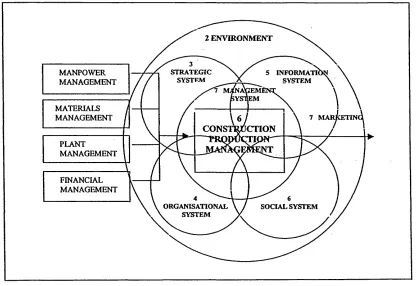
W alker (2002) stress that it is crucial to perceive construction projects and organisations
as ‘open systems’ which do not stand alone in isolation. This was illustrated by
Newcombe et al (1993) as shown in Fig. 2.3.1.
2 ENVIRO NM ENT
STRATEGIC SYSTEM
MANPOWER MANAGEMENT
5 INFORMATIi SYSTEM
MATERIALS MANAGEMENT
CONS' rcriO N
PLANT MANAGEMENT
FINANCIAL MANAGEMENT
ORGANISATIONAL . SYSTEM
[image:41.614.91.511.96.382.2]SOCIAL SYSTEM
Figure 2.3.1: The inter-phasing systems within construction
production management (Newcombe et al (1993)
As dynamic ‘open systems’, they are continually influenced by their internal sub
systems and interacting with the external environment o f which they are part.
Therefore, they need to be able to adjust by shaping and reshaping to adjust to the
changing environment in-order to sustain. It is within these influences that site
managers operate. They need to be continually sensitive and able to respond to the
array o f activities taking place within and surrounding the construction project. They
perform in an atmosphere o f uncertainty, take responsibility w ith a considerable amount
o f risk and live up to the pressures to keep abreast with changing demands and
2.3.2 H istorical developm ent o f site m anagers
In the medieval times, construction projects were relatively simple and tradesmen were
employed directly by employers to complete the job. As building works became more
complex towards the end o f the 18th century, the general supervision o f the various
trades and their organisation in construction projects began to be placed in the hands o f
master craftsmen, who, for their responsibility charged a fee, or took a profit on the total
value o f the work (Boyer, 1993).
This practice became popular with the increase in public sector activities at that time
and following the Industrial Revolution but diminished towards the late eighteenth and
early nineteenth century (Dolan, 1979). The growing national economy from the wealth
generated from the Industrial Revolution and rapid industrialisation that took place
generated huge demand for new buildings and built infrastructure. It was during this
period that the founding and the development o f general builders, specialist firms and
specialist professions in the construction industry began (Bowley, 1966).
The First W orld War, and the resulting activities that followed, contributed to further
accelerate demand for built infrastructure and alter the shape o f the construction
industry. More was demanded from builders, as projects grew even more complex.
There was already evidence that builders had practiced ‘contracting’ prior to this but the
demand for such services became popular and necessary during this period. Boyer
(1993) refers to this period as the emergence o f the general building contractor who
carries out the whole work involved in the contract and employs men o f every trade
The development o f new materials, technology, increasing use o f specialists and sub
contracting practices demanded that builders be more methodical in m anaging the
construction project. It was during this period that the practice o f site management and
the ‘modem construction firm’ was pioneered (Powell, 1980). The supervision and co
ordination o f the work o f each trade by the master craftsmen was taken over by the
person often referred to as the ‘general foreman’. The general foreman was the main
contractor’s key first line supervisor on site and at the time had total control over most
o f the construction resources on site. The general foreman had complete authority to
even dismiss any man or employ another without having to contend w ith contractual or
union issues.
This role started to change following the Second W orld War. Increased demand for
commercial and industrial infrastructure resulted in larger and far m ore complex
projects to match the advanced technological systems employed in buildings.
Rationalisation and high competition in the industry resulted in sharp undercutting o f
profits among builders, which meant that contractors have to adhere rigidly to the terms
and procedures o f the contract and control closely the production process to be
profitable.
The growth o f trade unionism and the establishment o f the ‘Em ployment Protection
Act’ contributed to alter further the structure o f employment and man