LINFENG LI
A Contingency Framework to
Assure the User-Centered Quality
and to Support the Design of
Anti-Phishing Software
ACADEMIC DISSERTATION To be presented, with the permission of
the board of the School of Information Sciences of the University of Tampere, for public discussion in the Auditorium Pinni B3107,
Kanslerinrinne 1, Tampere, on March 15th, 2013, at 12 oâclock.
Distribution Bookshop TAJU P.O. Box 617
33014 University of Tampere Finland
Tel. +358 40 190 9800 [email protected]
www.uta.fi/taju http://granum.uta.fi
Cover design by Mikko Reinikka
Acta Universitatis Tamperensis 1810 ISBN 978-951-44-9061-3 (print) ISSN-L 1455-1616
ISSN 1455-1616
Acta Electronica Universitatis Tamperensis 1286 ISBN 978-951-44-9062-0 (pdf )
ISSN 1456-954X http://acta.uta.fi
Tampereen Yliopistopaino Oy â Juvenes Print Tampere 2013
ACADEMIC DISSERTATION University of Tampere
School of Information Sciences Finland
Acknowledgements
This dissertation work took me lots of efforts and time, and it could not be
accomplished without supports from my supervisors, colleagues and family. I take
this opportunity to express how grateful I feel.
I have been very thankful to having two excellent supervisors, Eleni Berki and
Marko Helenius. You always gave me sufficient options when I met challenges on
my research or problems in my life. Your encouragement and guidance made me
confident of my doctoral research. As a foreign doctoral student of yours, my life
and experiences in Finland are very special and impressive. Moreover, the financial
supports from Tampere Doctoral Programme in Information Science and
Engineering (TISE), Internet of Things project (Tekes Finalnd) and University of
Tampere helped me concentrate on my doctoral research.
I cooperated very well with my colleagues, and many thanks are given to Saila
Ovaska and Reijo Savola who contributed a lot to my research as usability and
security experts. It is also very grateful to work with Timo Nummenmaa, and the
research tools you suggested helped my research very much. In addition, it is
appreciated to receive many valuable suggestions and comments from Elli
Georgiadou and Margaret Ross.
Finally, my special and deepest thanks are given to my family. Every time when I
had difficulties or tried to quit, my family encouraged me at all times so that I could
persevere with my research. I got married during my doctoral study. My wife, Nasa,
did lots of work for this home. You improved my life and made our life more
comfortable and colorful.
Dedicated to my family
Glossary
Anti-phishing Methods or solutions to prevent phishing attacks.
API Application Programming Interface: a specification that is used
to interact among different software components
Authentication An operation used by information systems to confirm the
identities of users who have been granted access to their data
and systems resources. Usually authentication of a user is
based on what the user knows, is or has.
Backdoor A type of online attack that circumvents the system protections
and provides access to infected computers for attackers to visit
data and use resources on the infected computers. After
targeted computers are compromised, backdoor remains
undetected. After backdoor is deployed, the intruders can then
silently monitor victimsâ activities or launch various attacks,
e.g. destroying or altering files, stealing information etc.
Contingency
approach
A research method, in which scholars are able to investigate a
research domain from different perspectives, due to the fact
that a single research method is not adequate to study the
uncertainty and unpredictable factors in the research domain.
Cross-site
scripting
A type of online attack that injects malicious web page scripts
or other codes into vulnerable web pages to collect victimsâ
personal information. These vulnerable web pages are usually
trusted by victims.
Delegation
Signer
In DNSSEC infrastructure, a type of domains whose public key
is stored in the caches of its parent DNS servers using
DNS poisoning A type of digital attack that aims to reroute a DNS request for a
address, and divert traffic to another computer.
DNS resolver The client-side of the DNS which is to initiate and sequence
the DNS queries.
DNSSEC A security infrastructure for DNS servers
DNS server Domain Name System server: a server that offers information
to map domain names and IP addresses.
DOM Document Object Model: a model of representing and
interacting with objects on web page documents.
Electronic token An electronic compact device in which secret or credential
information is stored. Users are able to use this device for
authentication.
Exploit An exploit is a piece of software, a chunk of data, or sequence
of commands that makes use of a weakness or vulnerability at
the target system in order to cause unintended behavior or
damage to occur at the target system.
Feature A feature can be a word or a phrase in a text. The features in a
text can be collected to classify the category of the text.
Feature size The number of features selected to be learned or examined by
content algorithms.
Hacker Someone who breaks into a computer system by circumventing
its security protections.
Hash A data transformation that is used to convert a variable-size
data input into a fixed-size string. The output string is called
hash value. In DNSSEC, it is a hash function, e.g. SHA-1.
Heuristic In the usability research field a heuristic is a list of pre-defined
detailed usability metrics and severity levels of usability
problems for assisting usability experts in their evaluations.
Hook A technique to read the system messages from the message
queue of Microsoft systems.
ICANN Internet Corporation for Assigned Names and Numbers, an
address
IP Internet Protocol, a protocol designed for the use in
interconnected systems of packet-switched computer
communication networks. This protocol defines the IP
datagram structure and how to route the datagram.
Key Signing Key In DNSSEC infrastructure, an authentication key that
corresponds to a private key to sign one or more other
authentication keys for a given zone.
MAC Message Authentication Code: in the cryptography, it is secret
information to authenticate a message and to provide integrity
and authenticity assurances on the message.
Malware Malicious program is intentionally developed to harm the
targeted computer system or steal victimsâ personal
information.
Man-in-the-Middle attacks
A type of attacks that an attacker intercepts the connection and
selectively modifies communicated data to masquerade as one
or more of the entities involved in a connection.
Misuse cases Use cases that attackers perform to abuse targeted information
systems.
Naive Bayesian A simple probabilistic classifier based on Bayesâ theorem with
independence assumptions. Naive is called because of the
strong independence assumptions.
Pharming A type of online threat that redirects victimsâ DNS requests to
malicious and fraudulent websites so as to mislead victims to
provide their online credentials on these websites.
Phishers Criminals who design and conduct phishing attacks.
Phishing A type of online attack to use information technology and
alluring information to mislead victims to provide their
personal information to its attackers.
Phishing-resistant system
An information system that is able to prevent users from being
Phishing scam A set of tricks designed by phishers to successfully conduct
phishing attacks.
PIN Personal Identification Number.
PKI Public-Key Infrastructure: an asymmetric-encryption-based
infrastructure to create, manage, distribute, use, store and
revoke public key certificates.
Risk A risk is an expectation of loss when a particular threat causes
harmful results of targeted computers or information systems.
Rootkit A stealthy type of software, often malicious, designed to hide
the existence of certain processes or programs from normal
methods of detection and enable continued privileged access to
a computer.
Short Message
Service
A text messaging service component of cell phones.
Social
engineering
A type of attack that takes advantage of cognitive bias in the
human decision-making process so as to convince victims to
believe in the information presented by the attackers.
Spam Unsolicited messages for advertisement or scams.
Spyware A type of malware that sends the information about the
contents, status, or operation of the computer to a remote
system or a user.
SSL Secure Sockets Layer Internet protocol: originally developed
by Netscape that uses connection-oriented end-to-end
encryption to guarantee the data confidentiality and data
integrity on the Internet.
SQL Structured Query Language.
SQL injection A type of online attack that exploits the vulnerabilities in the
web application program code accessing the database of an
online information system. It allows an entire SQL query or
portions of it as a parameter, issued through a field or fields of
TCP Transmission Control Protocol: a transport layer protocol on
the Internet for using a handshake mechanism to guarantee a
connection.
Threat A threat is a circumstance or an event which may potentially
harm a system and cause some security damage, including
destruction, data loss, financial loss etc.
TLS Transport Layer Security is an Internet protocol between
transport layer and application layer, and uses
connection-oriented end-to-end encryption to guarantee the data
confidentiality and data integrity on the Internet. SSL is the
predecessor of TLS. In TLS, the security has been improved.
URL Uniform Resource Locator: a means of identifying a resource
and locating the resource on the Internet.
User Account
Control
A security infrastructure built in Microsoftâs Vista and later
systems to manage the system administrative privileges.
Virus Program code that has a capability to replicate by itself
(Helenius 2002, p.12). A virus may contain one or more
payloads. A payload is a malicious operation contained in the
virus that is triggered under certain condition.
Vulnerability A vulnerability is a weakness which an attacker uses to attack
targeted software, computers or information systems.
Worms A worm is a virus that replicates itself from computer to
computer through a network. A worm may or may not contain
a payload. A payload is a malicious operation contained in the
virus that is triggered under certain condition.
Zone Signing
Key
In DNSSEC infrastructure, an authentication key that
Abstract
Anti-phishing software is widely used in online security and privacy. At the same
time, phishing attacks are becoming increasingly advanced. From a
software-engineering point of view, the growing sophistication of phishing attacks means that
anti-phishing software must be continually improved and constantly updated.
Software quality engineers assert that quality improvement is more effective at the
early lifecycle stages such as during requirements elicitation. Hence, in this study,
the investigation of end usersâ preferences and behaviors can help to deduce
usability and security requirements that are essential to the design quality of
anti-phishing software and anti-phishing-resistant systems. In so doing, this research studies
and analyzes current phishing scams, examines online service user interfaces that
are vulnerable to phishing attacks, and attempts to document and model human
online behavior.
Online user behavior, like human nature, is varied and unpredictable because of
unforeseen events and various other factors. In phishing attacks, these events and
factors are exploited. Thus, to provide good quality anti-phishing software and
phishing-resistant systems, exploited online user behavior needs to be researched.
Software quality engineers use contingency methodologies to analyze and model
unanticipated events and factors that are vital for designers of anti-phishing
technologies. Therefore, this thesis introduces a research framework consisting of
user-centered quality assurance theories, engineering methodologies, heuristic
evaluation, and usability experiments. In addition to a contingency approach to be
utilized as a guide in situations of high uncertainty, concluding remarks are made
regarding industrial field research findings on how to improve the design of
anti-phishing software and anti-phishing-resistant systems. Thus, as key novel contributions,
the thesis offers (i) a set of usability metrics for authentication mechanisms and (ii)
an improved understanding of online social behavior. Instead of establishing
sociological or psychological theory of online social behaviors, this knowledge may
online. Thus software development and deployment is driven with preventive rather
than reactive anti-phishing strategies in mind.
Keywords:
Security, privacy, software quality, phishing, identity theft, usability, authentication,
metrics, human behavior, contingency approach/strategy, heuristic evaluation,
Table of Contents
Acknowledgements... 3
Glossary ... 4
Abstract ... 9
1. Introduction ... 13
2. Phishing and Online Services ... 24
2.1 Phishing Scams ... 24
2.2 Online Services ... 28
2.2.1 User Login Authentications ... 28
2.2.2 Non-Login Personal Data for Web Applications ... 29
2.2.3 Secure Connection Indicators ... 29
2.2.4 Cookies ... 31
2.2.5 Public-Key Infrastructure for Online Services ... 32
2.3 Anti-phishing Software ... 34
2.3.1 Client-Side Anti-phishing Software ... 34
2.3.2 Server-Side Anti-phishing Software ... 35
3. Software Quality Assurance and Anti-phishing ... 40
3.1 Contingency Approach and Anti-phishing ... 40
3.2 Software Quality Assurance ... 42
3.3 Misuse-Case-Based Security Requirement Elicitation... 43
3.4 Software Usability and Anti-phishing ... 45
3.5 Performance Experiments and Anti-phishing ... 49
4. Authorâs Contributions ... 51
4.1 Misuse Cases and Performance Research to Assure the Quality of Anti-phishing Applications and Phishing-Resistant System Design ... 51
4.1.1 Paper 1 â Misuse Cases to Assure the Design Quality of Phishing-Resistant Information Systems... 52
4.1.2 Paper 2 â Design Reliable Performance Experiments for Text-Content-Filtering Algorithms ... 53
4.2.1 Paper 3 â How Users Are Disturbed by Phishing Emails ... 55
4.2.2 Paper 4 â Heuristic Evaluation of Anti-phishing
Toolbars ... 56
4.2.3 Paper 5 â Towards a contingency approach with
whitelist- and blacklist-based anti-phishing applications:
what do usability tests indicate? ... 61
4.2.4 Paper 6 â Overview of User-Centered Quality Assurance Methodologies for Anti-phishing Software and
Phishing-Resistant Systems ... 63
4.2.5 Paper 7 â New Usability Metrics for Authentication
Mechanisms... 66
5. Conclusions and Future Work... 70
1. Introduction
The Internet enriches peoplesâ lives with its variety of web-based services and
communication tools, while end users are required to provide personal information
to obtain better online services (Dhillon and Moores 2001). For example, we
purchase a variety of products from online retailers; we talk and participate in video
chats with our friends and families; and we play games online together with other
players globally. Such facilities bring convenience and pleasure to our daily lives.
However, web applications associated with usersâ personal information are also
misused by individuals, corporations, government agencies and organized criminals
(Garfinkel 1995, Warren and Hutchinson 2002, p.126, Semenov et al. 2011a, p.232).
Such attackers are not only interested in information society infrastructures but also
in personal private information and financial benefits. These attacks have been
analyzed and debated from the perspective of human morality and information
ethics. For example, Duquenoy and her colleagues (1999) discuss them with
Habermaâs theory of Discourse Ethics. They believe that these attacks are the main
ethical issue of the Internet, and those cyberspace ethics are different from
conventional ethics. They also advocate that cyberspace ethics should be regulated
internationally. Siponen (2004, p.287) also addresses information ethics and
concludes that the makers of malware (one type of artificial agent) should be blamed.
He further argues that it is not adequate to use human morality to ensure security
and privacy (Siponen 2003, p.243). It is, therefore, clear that users need protection
against such online attacks.
Although security researchers have made great efforts in the fight against attacks
such as SQL injections, cross-site scripting, worms and backdoor techniques
(Askola et al. 2008, Eronen et al. 2009, Christey 2011, F-secure 2012, Scarfone et al.
2012, Syroid 2012), online crimes have not ended. One of these types of online
crimes is phishing. So far, many researchers have given their definitions on phishing.
Dhamija and her colleagues (2006) define phishing as the practice of directing users
phishing attacks, but the technologies used for phishing are not presented. While
modeling phishing attacks, Jakobsson (2006) describes that phishing is the marriage
of technology and social engineering. However, this description does not mention
the consequences of phishing attacks. A more detailed definition (Zhang et al. 2007)
is next presented:
âPhishing is a type of semantic attack in which victims are sent emails that deceive them into providing account numbers, passwords, or other personal information to an attacker. Typical phishing emails falsely claim to be from a reputable business where victims might have an account. Victims are directed to a spoofed web site where they enter information such as credit card numbers or Social Security Numbers.â
This is a more detailed definition. According to this, phishing is classified as a
semantic attack. The purpose of this semantic attack is to collect victimsâ credential
information, and also, in this definition, emails are the only medium to deliver the
convincing and fraudulent information to the victims. However, emails are not the
only way to send phishing information, but also other media are being used, e.g. a
video clip (Tencent Service 2012), social media web sites (Chhabra et al. 2011,
Hong 2012). In addition, phishing attacks can also be carried out by the attackers
who are able to install the malware to monitor and collect victimsâ passwords and
usernames (APWG 2012). Based on my observations and research on phishing
attacks, I define phishing as follows:
âPhishing is a type of online attack to use information technology and alluring information to mislead victims to provide their personal information to its attackers.â
In this definition, it is emphasized that the purpose of phishing is to collect victimsâ
personal information, including usernames, passwords, personal email addresses,
personal identity numbers, or mobile phone numbers, and the list can go on.
Furthermore, according to this definition, a phishing attempt uses information
technology and alluring information to attack. Some information technology can be
employed by attackers to deliver phishing information, e.g. emails, social web sites,
or instant messengers. Some other advanced information technology can be used by,
information sent by phishers is to build the social relationship and the trust
relationship between phishing attackers and victims.
Phishing seriously challenges and collapses trust in electronic commerce and
e-service security (Litan 2004, Dinev 2006). In this sense, phishing is a severe threat
to e-commerce services and web application providers. According to the APWG
(2012), the number of phishing attack reports reached 53,939 in March 2012. The
loss to the economy reached $687 million in the first quarter of 2012 (RSA 2012).
Phishing prevention protects users against such attacks, through anti-phishing
software. In this thesis, anti-phishing software refers to a stand-alone application to
prevent phishing attacks, and it is also referred to as a phishing-resistant information
system or a phishing-resistant feature of an information system whose users
phishing attackers cannot deceive. For example, anti-phishing toolbars installed at
web browsers are one type of anti-phishing software, and a feature to verify users to
log in to an information system can also be called anti-phishing software. Different
anti-phishing software has been developed, but the quality of the software is not
satisfactory (e.g. Asokan et al. 2003, Wu et al. 2006b, Zhang et al. 2007, Wang et al.
2008, Shahriar and Zulkernine 2010). Therefore, it is needed to study how to design
high-quality anti-phishing software.
Various models and theories have been proposed to facilitate the design of
secure information system (e.g. Hutchinson and Warren 2000, Siponen et al. 2006,
Kajava et al. 2006, Siponen and Heikkar 2008, Veijalainen 2007, Veijalainen and
Hara 2011), but few studies have investigated how to improve the design of secure
information systems from the perspective of end users. I believe that, without
enough attention on end users, it is hard to design high-quality anti-phishing
software. There are two reasons for this. Firstly, in the information society
environment, different users may understand one type of technology differently.
This difference may bring different security and privacy risks such as abuse of the
technologies (Duquenoy 2007). This implies that anti-phishing, as one type of
technology in the information society environment, should be studied from the
perspective of end users. Secondly, it is imperative to put attention to usersâ
requirements when anti-phishing software is designed. Taking phishing into
consideration, the security and the privacy (as basic quality features) of information
systems need to be addressed and more systems stakeholders should be involved
stakeholder groups is needed. These stakeholder groups should include end users of
anti-phishing software, other people who are social connections of these end users,
the designers of anti-phishing software, the phishing scams, the existing
vulnerabilities of the current authentication methods and other information.
To understand these different stakeholder groups in the phishing context, the
research approach should be also carefully selected. As Jakobsson and Ratkiewicz
(2006, p.513) stated, âPhishing is a multi-faceted techno-social problem, and there is no known silver bullet.â This implies that, in order to design high-quality anti-phishing software, it is also needed to investigate anti-phishing and anti-anti-phishing
research domains from multiple perspectives. In this way, the different
user-centered quality views and requirements from different stakeholders can be
discovered. Since it is not possible to use the same research method to study
different stakeholders from different perspectives, I believe that a contingency
approach is more suitable than other research approaches when studying aspects of
the user-centered quality assurance and the design requirements of anti-phishing
software.
Therefore, the research scope of this thesis research covers two objectives, i) to
investigate phishing from multiple points of view and ii) to introduce a contingency
research framework to assure the user-centered quality and to support the design of
anti-phishing software.
Contingency theory was established by Fiedler (1963) to help management in an
uncertain and dynamic context. This theory was borrowed and expanded in the
studies of information system research and development. For example, a
contingency approach was used to discover the relationships between contextual
factors and decision process attributes leading to the strategic applications of
information systems (Sabherwal and King 1992). Saleem (1996) used a contingency
approach to compare different types of users and concluded that user expertise is a
useful criterion for selecting participants to serve on design teams and for
determining the appropriate extent of a participating userâs influence on system
design. With a contingency based approach, Land (1998) classified different
dominant systems and suggested that different types of systems require different
processes of requirements elicitation, design, development and implementation.
Similarly, Lin and his co-workers (2000) applied a simultaneous contingency
Wang and his colleagues (2012) employed a contingency method to compare online
decision aids with different user-system interaction modes.
Contingency approaches help information systems designers to solve
development problems and deal with dynamics and uncertainty (e.g., Naumann et al.
1980, Avison 1990, Tuunanen et al. 2007). One representative contingency
approach for information systems is Multiview methodology (Episkopou and
Wood-Harper 1985, Avison 1990, p.60). Instead of only addressing technologies, the
Multiview methodology, using different research methods and tools, investigates
social, human and organizational issues of information systems development.
A contingency approach is suitable for the research described in the present
thesis for a number of reasons. Firstly, the research of this thesis studies
anti-phishing from a design perspective. Secondly, anti-phishing (and anti-anti-phishing) is a
dynamic environment that is full of unpredictable events and factors. For example,
phishers may use different information technologies to circumvent security
protection. Anti-phishing researchers can hardly predict how next information
technologies will be abused by phishers. Users with different experiences of using
Internet may have their own understanding on how to protect online personal
information. It is also uncertain how anti-phishing software can be designed to
protect different users. In this thesis, the contingency approach taken to the problem
of phishing and the consequent anti-phishing software design is supported by
user-centered quality assurance theories, engineering methodologies, heuristic evaluation
and usability experiments. This research approach, that is considering solutions
depending on particular situations, is novel in the context of anti-phishing design
and has not been adopted as an analysis and design strategy proposed in the
anti-phishing research area earlier.
About the thesis authorâs previous research
The research topic of the thesis is divided into several subordinate research
questions. These research questions can be categorized into two groups based on the
methodologies used to improve the quality of anti-phishing software and
phishing-resistant systems. In this thesis, improvement was either based on the
software-engineering methodologies (research questions 1 and 2 in Table 1) or based on
end-user studies (research questions 3, 4, 5, 6 and 7 in Table 1). The various research
methods were used for different research questions. This also shows that a
contingency approach is a suitable and feasible research framework for this thesis.
Table 1. The research questions, methods and answers
Research 1: Question: How can an information system be designed, validated and documented against phishing with the misuse case
method?
Method: Theory-testing case-research (Järvinen 2012, p.58).
Answers: The design quality features of the misuse case method
can offer reliability to adequately prevent system users
from phishing. However, this method requires
designers with sufficient experience in system design
and system security.
Research 2: Question: How can a reliable performance evaluation on
spam/phishing content filtering be designed?
Method: Literature review (Järvinen 2010).
Answers: Feature selection methodology, feature size and misclassification cost factor are the key variables in the
design of content-filtering experiments.
Language issues, skewed corpora topics, and
intelligent adversaries are the barriers when designing
reliable performance evaluation on spam/phishing
content filtering.
Research 3: Question: How severe and annoying are malicious messages, and
why?
Method: Field methods, end-user survey (Järvinen 2012, p.54).
Answers: The survey showed that sophisticated spam/phishing
messages can cause time loss, disturbance and danger.
Further research is needed on software user
psychology, human-centered software design quality
criteria and the cognitive profiles of software/email
exploiter.
anti-phishing client-side applications?
Method: Evaluation of construction results (Järvinen 2012,
p.115).
Answers: Important usability issues were found from the tested
applications. A design method was determined
involving three key components (warnings, help
system and main user interface) on the anti-phishing
toolbar.
Research 5: Question: Can a blacklist-based anti-phishing toolbar help users
to identify more phishing pages than a whitelist-based
one?
Methods: Evaluation of construction results (Järvinen 2012,
p.115), action research (Järvinen 2012, p.125).
Answers: User behavior in a phishing context was observed.
There was no significant difference between
blacklist-based and whitelist-blacklist-based anti-phishing toolbars in the
extent to which they helped users to identify some
phishing pages. Users can identify more phishing
pages after sufficient education on phishing and
anti-phishing toolbars.
Research 6: Question: What do end users expect from anti-phishing software and phishing-resistant systems?
Method: Literature review (Järvinen 2010).
Answers: Previous research on anti-phishing was reviewed. The user requirements for the anti-phishing software and
phishing-resistant systems were collected. The
methodologies in the previous research were
addressed.
Research 7: Question: What are the usability metrics for designers of online
authentication mechanisms?
Method: Design research, building process (Järvinen 2012,
p.101).
analysis of existing authentication mechanisms and
anti-phishing research.
Introduction to the thesis publications
The author of the present thesis, who was also first author of the below-listed
publications, was the main researcher in charge of designing and conducting all the
research activities. The corresponding peer-reviewed publications are listed based
on the order of the research questions given in Table 1:
1. Li L., Helenius M., Berki E. (2007). Phishing-Resistant Information Systems:
Security Handling with Misuse Cases Design, Proceedings of Berki, E., Nummenmaa, J., Sunley, I., Ross, M. & Staples, G. (Eds) Software Quality in the Knowledge Society, SQM 2007. Tampere, Finland,1-2 August 2007, pp. 389-404.
2. Li L., Berki E., Helenius M. (2011). Evaluating the Design and the Reliability
of Spam/Phishing Content Filtering Performance Experiments, Proceedings of Dawson, R., Ross, M., Staples, G. (Eds), Global Quality Issues, SQM 2011, Leicestershire UK, 18 April 2011, pp.339â357.
3. Li L., Helenius M., Berki E. (2011). How and Why Phishing and Spam
Messages Disturb Us? Proceedings of Bradley G. (Ed) IADIS International Conference ICT, Society and Human Beings 2011, Rome, 20-26 July, 2011, pp.239â244.
4. Li L., Helenius M. (2007). Usability Evaluation of Anti-phishing Toolbars,
Journal of Computer Virology (3), pp.163â184.
5. Li L., Berki E., Helenius M., Ovaska S., (2012). Towards a contingency
approach with whitelist- and blacklist-based anti-phishing applications: what
do usability tests indicate? Submitted to: Behaviour & Information
Technology Journal, (accepted, to be published).
6. Li L. (2012). Overview of User-centered Quality Assurance Methodologies
for Anti-phishing Software and Phishing-resistant Systems, Proceedings of Berki, E., Valtanen, J., Nykänen P., Ross, M., Staples, G., Systä K. (Eds), Quality Matters, SQM 2012, Tampere, Finland, 20-23 August 2012, pp. 11-20.
7. Li L., Berki E., Helenius M., Savola R. (2012). New Usability Metrics for
P., Ross, M., Staples, G., Systä K. (Eds), Quality Matters, SQM 2012,, Tampere, Finland, 20-23 August 2012, pp. 239-250.
To investigate phishing and its dynamic evolution research domain with a
contingency approach, a research framework is required to look into the entities in
the phishing context. This research framework, as briefly explained earlier, consists
of various research methods: user-centered quality assurance theories (Papers 3 and
7 in the above list), engineering methodologies (Papers 1, 2 and 6), heuristic
evaluation (Paper 4) and usability experiments (Paper 5). Papers 1 and 7 concentrate
on phishing-resistant online services. In addition to the research framework, some
industrial field research findings are presented in these papers. The key novel
contributions are (i) a new set of usability metrics for online authentication
mechanisms (proposed in Paper 7) and (ii) a conclusion on the improved
understanding of the online user social behavior (in Paper 6). The contributions of
the papers are briefly introduced in the following sections.
We firstly designed a set of misuse cases (requirements) and tried it in the
context of a system of online phishing. Based on our observations in this research,
we emphasized the importance of user-centered quality assurance for
phishing-resistant systems, although misuse cases can help to elicit some anti-phishing
security requirements.
Further, an end-user survey was conducted to investigate how phishing/spam
messages disturb peopleâs daily lives. Upon analysis of the investigation results and
survey feedback, it can be concluded that a drastic and influential approach towards
the protection of email users needs to emerge by considering combining three
important issues: (i) software user psychology; (ii) human-centered software design
quality criteria and (iii) the cognitive profiles of software/email exploiters. In this
research, the first author analyzed the reported samples, and we jointly designed the
survey.
Another method employed in the papers was a literature review. This
summarized methods of designing a reliable performance experiment for
content-filtering algorithms. Many performance experiments for adaptive algorithms have
been conducted, but this was the first literature review to discuss the design of
performance experiments. Based on this research, we determined the strengths,
content-filtering methods and how to design a reliable performance experiment for
content-filtering algorithms.
With two usability research methods, a heuristic evaluation and a usability test,
we also inspected the usability problems of several selected anti-phishing toolbars
for web browsers. From these usability research experiments, a large amount of
hidden usability issues and security requirements were collected and reported, which
could provide valuable suggestions for the future design of anti-phishing software.
The first authorâs main tasks in these two usability evaluations included designing
the usability research, conducting the usability test and analyzing the usability
evaluation results.
Because of the evolvement of phishing attacks, the quality, usability in particular,
metrics for phishing prevention also need to be improved. Therefore, we conducted
another key joint research task which aimed at establishing a new set of usability
metrics for authentication mechanisms. In this research, nine new usability metrics
were described that can both facilitate the future usability evaluation of new
authentication mechanisms and act as a guide for designers of the next generation of
authentication mechanisms.
Based on these research findings, I was able to provide an overview of
user-centered quality assurance methodologies for anti-phishing and phishing-resistant
systems. This overview gathered and analyzed each methodology of our previous
user-centered quality assurance studies as a valuable reference for future relevant
research, particularly for security- and usability-critical software.
The thesis authorâs contributions in the thesis publications
I wrote most of the text of the following papers, and I was the main author. The
co-authors had an advisory role providing guidance, relevant references, supervising
and participating in the research process.
In Paper 1, I discovered and described the different types of phishing attacks, and
I classified and introduced their prevention methods. In addition, I together with
other co-authors considered and demonstrated the misuse cases in the design of an
online music purchase information system.
In Paper 2, I gathered and collected representative information on the existing
algorithms. I also highlighted the differences and the limitations of the design of the
existing performance experiments.
In Paper 3, I together with my co-authors designed the experiment. After the
participantsâ feedback was received, all authors together analyzed the feedback and
concluded the findings.
In Papers 4 and 5, I designed and developed the test subject, Anti-phishing
IEPlug. I also helped to invite many usability experts and ordinary end users to
participate in the heuristic evaluation and usability test. Besides that, I designed
most of the heuristic check list and usability test tasks, and observed and analyzed
the participantsâ behaviors and feedback. Together with other co-authors, we
collected valuable findings and composed the article.
In Paper 6, I, as the only author of the article, reviewed all the used research
methods on the user-centered quality assurance methodologies for anti-phishing
software and phishing-resistant systems. I also criticized each of these
methodologies and drew conclusions.
In Paper 7, I collected representative information of existing authentication
mechanisms, and analyzed these mechanisms based on their characteristics. The
analysis work was completed with the collaboration of other authors. Furthermore, I
was the main contributor of the design of the new usability metrics for
authentication mechanisms in the paper.
The structure of the thesis
The remaining chapters are presented as follows. Chapter 2 introduces phishing, its
prevention and online service user interfaces. Chapter 3 describes software quality
assurance metrics and methodologies. The authorâs contributions are briefly
explained in Chapter 4. Finally, Chapter 5 concludes with suggestions for quality
2. Phishing and Online Services
In designing anti-phishing software and phishing-resistant systems, it is imperative
to carefully examine phishing scams and online services exploited by phishers. In
this chapter, typical types of phishing scam are introduced based on our
observations of phishing samples reported in the media and participants who were
invited to our survey. I then describe the user interfaces and authentication
mechanisms of online service systems that are frequently involved in phishing
scams. Examples of phishing prevention systems are then presented.
2.1 Phishing Scams
In the following, typical phishing scams are described according to their popularity
and complexity. New phishing scams are introduced chronologically.
Plain-text phishing emails with no hyperlinks or personal information requested This type of phishing resembles regular emails. Instead of asking for personal
information, phishers usually present themselves as poor or unfortunate people
requiring help. For example, a phishing email may resemble a real inquiry for
solving life difficulties, but the phisher is able to confirm actively harvested email
addresses, build a relationship with the email recipient and take advantage of the
relationship to ask for more personal information. One typical example is in Table 2:
Table 2. Plain-text phishing email example with no hyperlinks or personal information requested
Return-Path: <[email protected]>
Received: from cd440732a.cable.wanadoo.nl (cd440732a.cable.wanadoo.nl [212.64.115.42]) by mwinf6208.orange.nl (SMTP Server) with SMTP id 0BB071C00084;
Mon, 7 Jan 2008 18:47:22 +0100 (CET)
X-ME-UUID: [email protected] From: "Elena" <[email protected]>
To: <[email protected]> Subject: Hi
Date: Mon, 07 Jan 2008 20:47:17 +0300
Message-Id: <[email protected]>
X-Greylist: Sender DNS name whitelisted, not delayed by milter-greylist-3.0 (apila.uta.fi [153.1.1.41]); Mon, 07 Jan 2008 20:08:40 +0200 (EET)
MIME-Version: 1.0
Content-Type: TEXT/PLAIN; charset=ISO-8859-1 Content-Transfer-Encoding: 8BIT
X-Spam-Status: LOW ; 39 X-Spam-Level: ***+++++++++ X-Spam-Report: AWL,BAYES_99
X-Scanned-By: MIMEDefang 2.62 on 153.1.1.42
Hi,
My name is Elena, I have 31 years old and I live in Russian province.
I have a 6-years daughter, her father abandoned us and we live with my mother. Recently my mother lost job due to old age and our situation became very difficult.
During the last months the prices for gas and electricity became very high in our region and we cannot use it to heat our home anymore.
The weather is minus 19 degree Celsius already and it become colder each day. We very afraid and we don't know what to do.
The only accessible way for us heat our home is to use portable oven which give heat with burning wood. We have a lot wood in our region and this oven will heat our home all winter for minimal charges.
I work in library and after my job I allowed to use computer. I finded your address in internet and may be you can help us.
We need portable wood burning oven, but we cannot buy it in our local market because it cost equivalent of 194 Euros and is very expensive for us. May be you have any portable oven which you donât use anymore, we will be very grateful to you if you can donate its to us and organize transport of its to our address. This ovens are different, usually they made from cast-iron and weight between 100-150kg.
I hope that you will write me back. I wish that the New Year will bring you happiness and good health. Elena.
Russia.
In this example the actual domain name of the senderâs email address displayed in
the field âMessage-Idâ is not the same as that in the field âFromâ. This difference
clearly shows that this is a phishing attempt. In any case, the purpose of this type of
collect as much information about the email recipient as possible, such as personal
characteristics and interests to build a relationship.
Phishing emails with personal information requested or with hyperlinks to phishing websites where no malware is hosted
This type of phishing pretends to be from acquaintances or services that the victims
may use. Similar to the previous type, this type of phishing email attempts to
mislead potential victims into certain urgent fabricated situations such as problems
with a server or with their personal lives. To solve these problems, victims are asked
to provide financial help or personal information. To convince them to provide
personal information, phishing emails use the same or similar visual effects of
authentic web services, and the contents of such emails are closely related to recent
well-known events or incidents. The role of the phishing web site is to provide the
same or similar visual effects of authentic web sites to deceive the victims and to
collect the private information of the victims.
Phishing emails with malware attachments or redirections to websites where malware is hosted
This type of phishing scam usually does not directly ask for financial assistance or
personal information. Instead, these phishing emails interest victims either because
of that they are sent from supposed acquaintances or because of their interesting
contents. Some content may be multimedia data recording a memorable time, or
some may contain no text other than a link from supposed acquaintances that require
the victims to click on it to find out more. No matter what contents are presented,
the two most basic goals are to intrigue the victims and to install malware on their
computers. The purpose of the malware at the phishing web sites is to stealthily
monitor and collect the private information of the potential victims.
Phishing scams through communication tools other than emails
Originally phishing scams were spread via emails. Now there are more choices and
greater convenience for online communications and business, e.g., social
networking and online instant messaging. To take advantage of this, phishers
designed scams on these new online services and platforms. Usually, the goals of
convincing victims of the authenticity of delivered phishing information or using
interesting phishing information to collect online credentials. However, phishing
scams that are not conveyed through emails are carried out differently. Instead of
sending fraudulent and alluring contents, the phishers must initially connect with
victims using online communication tools. To send information to specific users, it
is necessary to obtain registration details from the web services of online
communication tool providers. In this case, phishers either pretend to be
acquaintances of the victims or they take advantage of other malware or traditional
phishing scams to steal login credentials. Scams that aim to install malware on the
personal computers of victims are similar to traditional phishing scams, for example
when browsing interested websites where malware is hosted, or infection by
installing applications from unknown or un-authenticated publishers. Once malware
is installed on a victimâs computer, access rights to the account of the victim are
granted. Then the victimâs credentials can be compromised. Usually, the malware is
used to collect the credential information about online banking. Nowadays,
depending on the type of the malware, online credentials at the social media site
(Chhabra et al. 2011, Hong 2012) can be captured, or the operating systems on the
connected devices can be compromised (e.g. key loggers can be installed on the
operating system).
Phishing scams through mobile devices
Although deception cases through cell phones have been reported (Ryst 2006,
Swartz 2006), most of them spoof victims by recharging pre-paid subscriptions or
mislead victims into calling expensive phone services. As cell phones are becoming
equipped with more and more computation and communication power, these
enhancements are bringing with them more possibilities for phishing scams to be
launched. For example, the phone number shown to the victim can be modified into
some trusted number such as an emergency call number. Typically users do not
know that these emergency call numbers are not normally used for calls. Therefore,
end users can easily be cheated believing that the incoming calls are from the public
sectors. Once victims are convinced, typical phishing scams can be deployed.
According to Chen (2008), phishing cases using mobile devices may be categorized
into 12 main types. Even though phishing medium has moved to mobile devices, the
Phishing scams in multimedia
This type of phishing scam is usually conducted via non-email media, e.g., video
and audio clips. It appears to be more secure for victims, since these multimedia
features provide more evidence for them to distinguish between authentic and
fraudulent information. However, Tencent, one of the largest instant-messaging
providers in China, has reported that phishers have been able to take advantage of
multimedia and convince victims to offer financial support (Tencent Service 2012).
In this type of phishing scam, victims may receive a video clip in which their
acquaintances appear, but the audio is manipulated for phishing purposes. To make
this type of phishing successful, more effort is required to get to know the victims
and their relationships with their acquaintances. Thus, the phishing scams require
more long-term planning. Most likely, the victims have misused or lost their
credentials and personal information on multiple occasions before this type of
phishing scam is launched. For example, a phisher probably needs to know the
relationship between a victim and the person who the phisher pretends to be. This
required information can be collected, for example, via the victimâs online
communications. However, in order to have access to the communication history
records, certain access rights must be misused. In this case, the credential
information to provide access to the communication history must have already been
stolen by the phisher.
2.2 Online Services
Online services store usersâ credentials. At the same time, the security and usability
vulnerabilities of these online services are being exploited by phishing attackers. In
order to design better phishing prevention systems from the perspective of end users,
it is first necessary to understand how these vulnerabilities are exploited.
2.2.1 User Login Authentications
Many types of personal identities are presented online, and users of online services
private information online (Berki and Jäkälä 2009, Jäkälä and Berki 2004).
Traditionally, to log in to a web site, usersâ personal identities are provided at the
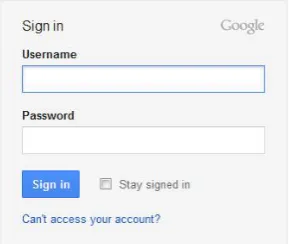
designated areas (Figure 1). These areas request the account names and passwords
of users. Undoubtedly, this method is vulnerable (Cranor and Garfinkel 2004, p.17).
If phishers steal this personal information without usersâ awareness, phishers are
then able to log in and abuse the victimsâ accounts.
[image:29.595.132.277.196.318.2]
Figure 1. The login area for Gmail users
2.2.2 Non-Login Personal Data for Web Applications
Besides login authentications, many forms of personal data other than login data are
given to web service providers. Non-login personal data are usually collected to
provide better services. However, users should be worried about the safety of these
personal data (Dhillon and Moores 2001). If these personal data are sold to phishers,
with detailed personal profile information, phishers are then able to conduct more
advanced and successful attacks. Recent reports in particular show that the
compromise of online game services by phishing or non-phishing scams can result
in the loss of usersâ personal data, which can be copied and misused by the
criminals (Zorz 2011).
2.2.3 Secure Connection Indicators
To indicate a secure online connection, a clearly designed symbol is placed on the
main web user interface. To take an example, in the early versions of Internet
Explorer and FireFox, i.e., earlier than Internet Explorer 6.0 and FireFox 2.0, a lock
the lock icon, the certificate for the visited web page displayed encryption and issuer
information. Though users were able to view this information to make informed
decisions on the web page, the visibility and understandability of the lock design
was prone to phishing. According to research findings (Balfanz et al. 2011, Li et al.
2012), Secure Sockets Layer (SSL) and Transport Layer Security (TLS) components
are important in building secure online communication channels, but for users these
security components must be applied effectively in a well-designed application
context.
Figure 2. The lock icon at the bottom-right corner of the user interface of Internet
Explorer 6.0
In later versions of web browsers, the lock icon became more informative. From
Internet Explorer 7.0, the lock icon has been placed on the address bar together with
information on the current web page (Figure 3). To notify visitors about the security
of web pages, Google Safe Browsing has been embedded into the FireFox browser
since version 3.0 (Figure 4). When a malicious web page is detected, Google Safe
Browsing stops downloading the malicious web page and instead shows a blocking
page. At the same time, the security indicator on the address bar turns red to warn
the user (Figure 5).
Figure 4. The web page security indicator provided by Google Safe Browsing on
the address bar of Firefox 6.0
Figure 5. Google Safe Browsing (integrated with Firefox 6.0) detects a fraudulent
web page
2.2.4 Cookies
Cookies are small sets of state information that record the browsing history and
online service preferences of certain websites (Barth 2011). When a user browses a
web page or plays a Flash video, the hosting website is able to send state
information to the clientâs browser and retrieve client-side state information.
Attackers may apply cross-site scripting (XSS) to steal or misuse cookies. For
example, attackers can upload the cross-site scripting codes to an XSS-vulnerable
web site. These codes are designed to download and collect the cookies stored at the
victimâs browser. Once a victim visits the web page with XSS codes, the cookies
can be stolen. With stolen cookies, attackers can initiate unauthorized actions on the
target website on which victims have established a private connection. For these
monitoring, rejecting and blocking cookies from websites (Surfthenetsafely 2011a,b,
S1tony 2011, Yardley 2007).
2.2.5 Public-Key Infrastructure for Online Services
To prevent eavesdropping and assure the authenticity of both parties on the Internet
(clients and servers), web browsers are equipped with public-key infrastructure (PKI)
and multiple secure online transmission protocols, including SSL and its successor
TLS. In these protocols there are two encryption keys defined and used in one
secure transportation event: one public key and one private key. Both parties in
PKI-based online communication have their own set of key pairs. Because SSL protocol
is vulnerable, e.g. to the man-in-the-middle attack (Turner and Polk 2011), TLS
protocol is more and more supported by the security professionals. Since the
research scope of this thesis is on the user-centered quality, in this part, the detailed
implementation of a secure transportation protocol is not covered. Instead, only the
human-computer interaction design of the secure transportation protocol is
discussed in this section.
The public keys of web sites are published by third-party organizations and
pre-stored to the caches of web browsers. When a user visits a web site using a SSL or
TLS connection, several steps are prepared before the actual communication starts,
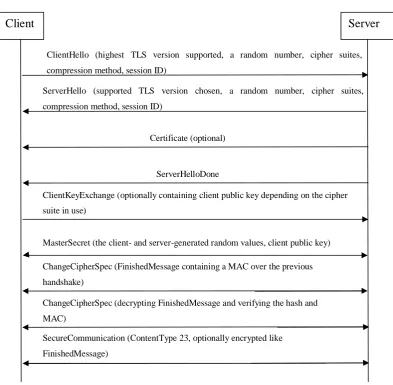
e.g., handshake and key pair exchanges (Figure 6). Taking the design of the TLS
protocol version 1.2 (Dierks and Rescorla 2008) as an example, the first step is
handshake acknowledgement, which is the same as the handshake step of other
regular Transmission Control Protocol (TCP) communications except that additional
information such as the secure transportation protocol version and the cipher suite is
included. After that, the client-side browser generates the clientâs key pair and
transfers the encrypted clientâs public key to the server side. Then, a master secret is
combined from a random number and the clientâs public key to generate all other
key data. Then a Finished message containing a message authentication code (MAC) over the previous handshake message is sent between the client and server side.
When the server and the client both verify the contents in the Finished message, they can start to use the pre-defined content type, either encrypted or plain-text, for
Figure 6. A TLS handshake example (Dierks and Rescorla 2008, Brown and
Housley 2010, Wikipedia 2012)
From the example of the TLS handshake, it is clear that the design is accomplished
from the point of view of service providers. For instance, web browsers do not warn
users if a secure transaction protocol is not used at a web site. In addition, the user
interface (e.g. Figure 2) of secure connections is not explicit and informative to
prevent from phishing attacks (Li et al. 2012). In this case, if a server is not an
authentic online service, the user is not informed about this during the handshake
process. Therefore, although the design helps to verify the authenticity of both
parties in communications, it is still vulnerable to man-in-the-middle attacks
(Asokan et al. 2003, p.33) and phishing attacks because of this lack of usability from
the perspective of a user attempting to identify the authenticity of an online service
(Garfinkel 2003, p.21).
SecureCommunication (ContentType 23, optionally encrypted like FinishedMessage)
ChangeCipherSpec (decrypting FinishedMessage and verifying the hash and MAC)
ChangeCipherSpec (FinishedMessage containing a MAC over the previous handshake)
MasterSecret (the client- and server-generated random values, client public key) ClientKeyExchange (optionally containing client public key depending on the cipher suite in use)
ServerHelloDone Certificate (optional)
ServerHello (supported TLS version chosen, a random number, cipher suites, compression method, session ID)
ClientHello (highest TLS version supported, a random number, cipher suites, compression method, session ID)
2.3 Anti-phishing Software
In this section, examples of popular anti-phishing software are described. Phishing
prevention systems are categorized, and their current advantages and disadvantages
are reviewed.
2.3.1 Client-Side Anti-phishing Software
Examples of anti-phishing applications on the client side are SpoofGuard (2001),
Netcraft (2005), Google Safe Browsing (2006), DOMAntiPhish (Rosiello et al. 2007)
and Anti-phishing IEPlug (2007). The main technologies in these applications are
text- or image-based content analysis (SpoofGuard), blacklist-based Uniform
Resource Locator (URL) analysis (Netcraft, Google Safe Browsing) and
whitelist-based URL analysis (DOMAntiPhish, Anti-phishing IEPlug). Text- or image-whitelist-based
analysis is adaptive in order to analyze content automatically. A text-based
self-adaptive filtering method is designed to classify the emails according to a trained
algorithm. To train the algorithm, it is necessary to prepare a set of test samples,
known as a corpus. These test samples are collected from real life and accurately
classified before the training starts. Sometimes, these corpora are pre-processed, e.g.,
by tokenization, which means to turn a sample document into a set of words, or by
lemmatization, which uniforms the different tenses or forms of words. When all the
words are tokenized and lemmatized, it is time to extract features, which means
looking for the most relevant terms in a document. Examples of feature-extracting
methods include information gain and mutual information (Zhang et al. 2004). After
that, the processed corpora and their classification are given to the filtering
algorithm. There are many classification algorithms for text filtering. These
algorithms look for the terms most likely to appear in the known categories, which
are defined and trained with training corpora. However, it is easy to misuse this
self-adaptive analysis capability if the software is not well trained (Fawcett 2003). For
example, phishers are able to use different languages, alternative words, or the news
topics to circumvent content filtering.
The quality issues for blacklist-based URL analysis are (i) how frequently the list
is updated and (ii) the quality of the list, including false positives or negatives and
are also needed to manually evaluate reported suspected URLs and to reliably and
efficiently release updated versions to end users. Whitelist-based detection is ideal
for personalization, but the phishing detection rate can be improved by assistance
from other content analysis algorithms. If the phishing detection is based on the
Document Object Model (DOM) structure of the given URL web pages, it can
easily be bypassed by using certain web page design techniques such as JavaScript.
In addition to the use of phishing content-filtering applications, access control on
personal computers has been strengthened on the client side. Since its Windows
Vista operating system, Microsoft (2011) has provided upgrades to its User Account
Control (UAC) to help users manage access rights by elevating privileges. When an
application attempts to perform critical system changes at application level, e.g.,
installation, un-installation, registry entry changes, driver changes and system
variable changes, the UAC checks the integrity and access privileges of the
application. If a user grants administrative privilege to the application, the changes
take place. Otherwise, the system change request is discarded. The UAC feature is
able to detect application publishers who are not registered and verified by
Microsoft. On mobile devices, trust computing also takes place. The Mobile Trust
Module 2.0 specification supported by multiple chip vendors is under development,
which may help to define a trusted module to monitor the authorization and integrity
of software deployed on mobile devices (Trusted Computing Group 2011a,b).
In addition to content filtering and upgrades to the UAC system, it is important to
prevent the installation of malicious programs on personal computers. For example,
on the client side, the âHax doorâ malware (Haxdoor, 2011), using rootkit
technology (Rootkit, 2011), is able to overwrite the original master boot record and
unload critical system binaries or services to silently âhookâ the system messages,
redirect URL requests or record personal data. In this case, it is necessary to equip
personal computers with superior anti-virus or anti-spyware software together with
client-side anti-phishing software.
2.3.2 Server-Side Anti-phishing Software
An example of anti-phishing and anti-spam software on the server side is
Bayesian classification to filter and detect untrustworthy email contents. The
Bayesian algorithm in SpamAssassin compares the frequency of terms between the
email being checked and previously detected malicious emails. If the comparison
shows that the terms appearing in the given email are very similar to those in the
detected malicious emails, the checked email is marked as spam or phishing.
Commtouch uses another technology to detect spam and phishing messages, called
Recurrent Pattern Detection (Commtouch 2011). Instead of checking
term-appearance frequency, this technology learns the message distribution and structure
patterns from message envelope, subjects, and so on. When malicious patterns are
collected from Internet traffic, the Commtouch center releases the collected patterns
to individual clients to detect malicious emails.
To verify the authenticity of received emails, Microsoft SenderID (2011) and
Open DomainKeys Identified Mail (2011) were developed. In general, if a mail
transfer agent receives an email, it will send a DNS request to a dedicated DNS
server where the trusted domains and IP addresses are stored. If the registered IP
address matches the senderâs IP address in the email, it is verified as being from an
authentic email sender. Otherwise, the email is indicated as a non-authenticated one.
Original DNS protocols are vulnerable to DNS poisoning, which is to send
malicious DNS responses to the resolver and pollute the cache of the resolver. In
addition to DNS poisoning, spoofing among autonomous systems also occurs
(Donnerhacke 2011, Israr et al. 2009). DNS poisoning is always employed by
phishers in pharming attacks (Helenius 2006). Therefore, it is necessary to consider
how to stop phishing that uses DNS poisoning techniques. Domain Name System
Security Extensions (DNSSEC 2011) is an infrastructure that is able to prevent DNS
poisoning and similar spoofing among autonomous systems. In DNSSEC, each
DNS lookup record is signed by the private key of a DNS server that responds to the
DNS lookup. If the signed DNS lookup record can be authenticated with the public
key of the DNS server, it proves that the DNS record is from an authentic DNS
server. DNS is a hierarchical distributed naming system. Therefore, DNSSEC must
build on a chain of trust in order to authenticate the public key of each DNS server.
The root zone is managed jointly by the U.S. Department of Commerce, the
Internet Corporation for Assigned Names and Numbers (ICANN, a private
non-profit organization to coordinate the global Internetâs systems of unique identifiers)
ICANN is responsible for vetting and processing changes to a Delegation Signer
record. Then, the Department of Commerce authorizes the changes to the root zone.
After that, VeriSign signs the new root zone and distributes the signed root zone to
the root servers. ICANN updates and publishes the Key Signing Key sets.
The public key of each DNS server is authenticated by locally calculating the
hash record of the public key of the DNS server where the DNS data is sent from,
and comparing this with the hash record in the DNS response. If these two hash
records are the same, it is proved to be authentic.
Another phishing-resistant design is OAuth (2011). This is a public protocol
designed to guarantee the authenticity of both parties during communication. An
authentication certificate is issued by a third party that is believed to be trustworthy
by both of other parties. OpenID is another standard that supports
inter-authentication among different parties in communication (Bellamy-McIntyre et al.
2011). Unlike OAuth, the ID issued through OpenID by the trusted third party is in
plain text rather than encrypted data. Therefore, an extension was created for
OpenID designed for phishing resistance.
To offer more phishing-resistant login authentication services, various new and
more secure login methods have been introduced. In general, these upgraded
methods focus on What you know and What you have factors (Helenius 2006). For example, Gmail has been upgraded to use a two-step authentication login method
(Figure 7), which sends a verification code from the Gmail server to a user-specified
mobile device via Short Message Service or generates a verification code via a
dedicated Google application on the mobile device in order to confirm the login
authentication (Gmail Blog 2011). This method offers users more channels to
identify themselves and confirm their login activities.
Another example of an upgraded login method is one-time user identity. This
method is usually employed by online banking or financial web services. To take
the Nordea Bank in Finland as an example, its customers c