Adapting Work to the Worker: The Evolving EU Legal Framework on Accommodating Worker Diversity
(2018) 18 International Journal of Discrimination and the Law 124.
Mark Bell
Abstract
The changing profile of the European workforce creates pressure to adapt the working environment in order to accommodate worker diversity, such as that related to disability, religious practice or caring responsibilities. There is an ongoing debate within equality law on the extent to which law should require employers to provide such accommodation. This article examines the rationales that justify legal
intervention and maps out various ways in which EU legislation already requires employers to accommodate worker diversity. It identifies three types of
accommodation duty: protective, substantive and procedural. The article argues that the debate can be enhanced by looking beyond the confines of equality law and drawing connections with a wider agenda for labour market reform. A better understanding of the different types of accommodation duty helps to expand the debate beyond a narrow focus on whether the duty of reasonable accommodation for workers with disabilities should be extended to other discrimination grounds.
Introduction
For many employers, managing a diverse workforce is an everyday reality. During recent decades, the composition of the EU labour market has changed significantly. Higher proportions of women and older people are participating in employment (European Commission, 2017: 166-167). The effects of migration, both in the past and in the present day, are increasing ethnic and religious diversity in many EU Member States (Eurostat, 2017). At times, these changes in the profile of the workforce pose challenges to the established ways in which work has been
organised. A culture of long and unpredictable working hours is difficult to reconcile with caring responsibilities. Workplace policies on dress and personal appearance may conflict with how some workers manifest their religious beliefs. Many employers are likely to encounter situations where a worker asks for a temporary or permanent adjustment to the organisation of work or some aspect of the working environment in order to accommodate their personal circumstances.
In EU law, there is a duty on employers to provide reasonable
accommodation for persons with disabilities,1 but other discrimination grounds are omitted. In contrast, some jurisdictions have duties of accommodation that apply to other grounds, such as religion in the USA,2 while in Canada there is a general duty of reasonable accommodation (Bribosia, Ringelheim and Rorive, 2013; Gibson, 2013; Vickers, 2016). Unsurprisingly, this has spawned an active and growing debate on whether EU law should expand the disability duty to other grounds (Alidadi, 2017; Benedi-Lahuerta, 2017; Sargeant, 2008; Waddington, 2011a).
encompass those situations where the employer is required, or encouraged, to make changes to the organisation of work (eg working time, allocation of job tasks) and the working environment (eg dresscodes), in connection with the needs of an individual worker. The article begins by reflecting on the justifications that underpin this
evolution in the legal duties of employers, identifying rationales within and beyond the arena of equality law. It then examines those legal instruments where
accommodation duties can be found. This reveals the different form that these duties take; the article identifies a difference between protective, substantive, and
procedural duties. The article contends that understanding the wider rationales for accommodating worker diversity, together with an appreciation of the variety of ways in which law can be used, facilitates a more nuanced conversation on the options for future legal reform.
I. Rationales for Accommodating Worker Diversity
Before examining in more detail the current provisions of EU law, this section reflects on the rationales that underpin the growth of worker accommodation duties in EU employment law. Given the constraints of space, this section can only identify some of the principal reasons that help to explain this trajectory. While acknowledging that this limits the depth of the analysis, even a brief review is valuable in placing the legislative provisions in a broader context. In particular, this section draws attention to the motivations for accommodating workers that stretch beyond the confines of equality and their connection to wider goals of employment law and policy.
Freedom of contract traditionally implied that the terms and conditions under which a job was performed were a matter for agreement between the employer and the worker. It is normally compatible with freedom of contract for one party to seek the agreement of the other to vary the existing terms. Given the inequality of bargaining power that frequently characterises the employment relationship, the employer is often in a commanding position when considering whether to accept or reject a worker’s request to vary contractual terms (Collins, 2005: 115). In other words, a worker might ask her employer if she can reduce her working hours, but typically it would be at the discretion of the employer whether or not to grant this request.
Of course, the freedom to determine the terms and conditions of the contract of employment has long been constrained by a combination of legislation and/or collective agreements. To take one example, the Working Time Directive3 imposes minimum standards on issues like daily rest, weekly rest, and paid annual leave. Yet, so long as the contract complied with such standards, then traditionally law did not give a worker the right to compel her employer to adjust terms and conditions in response to her individual needs. An illustration of this perspective can be found in former case-law under the European Convention on Human Rights (ECHR) on whether the freedom to manifest religious beliefs implied a duty on an employer to accommodate a worker’s request to adjust his working schedule in order to
participate in religious worship. This was rejected in terms that focused upon the freedom of contract. The worker was viewed as having voluntarily accepted the contractual obligations on working time, so there was no duty on the employer to make any changes in response to the individual needs of the worker.4
substantive equality; respecting the dignity of the worker; and widening labour market participation.
a. Promoting Substantive Equality
The creation of legal duties to accommodate workers is commonly linked to the pursuit of equality. This is motivated by the barriers that arise for individuals and groups because established workplace practices tend to reflect the norms of dominant groups in society. The organisation of working time, for example, was typically underpinned by an assumption that the worker was available to work full-time. The employer could determine the length of the working day and the worker had to fit to these requirements. Evidently, this erected an obstacle to those workers, predominantly women, who combine work with caring responsibilities and where there is a need to finish work at a time that fits with the availability of other caring services (eg childcare). Applying the existing norm to all workers (eg full-time hours) may entail identical treatment, but in practice it can marginalise women and
minorities. Fredman (2011: 30) has argued that accommodating difference is a core facet of the concept of substantive equality. The understanding that equality includes the need to respond to difference has been brought to the fore as anti-discrimination legislation expanded to include a wider range of protected characteristics. In
particular, equality for people with disabilities would be completely hollow if it did not include the need to make changes to how work is organised in order to remove barriers to labour market participation (Fredman, 2005: 203; Lawson, 2008: 235; Quinn, 2007: 245; Waddington, 2007: 631). The duty to provide reasonable
accommodation has been a prominent feature of disability rights legislation since the Americans with Disabilities Act 1990 (Degener, 2005, 89). This was cemented in the 2006 UN Convention on the Rights of Persons with Disabilities (CRPD), where the denial of reasonable accommodation is recognised as a form of discrimination.5
It is not only in the context of disability where the need for accommodation has been viewed as being part and parcel of achieving substantive equality. This is also a prominent dimension of claims for religious equality. Frequently, disputes are concerned with the obstacles that the worker encounters in reconciling the practice of her religious beliefs with standard working conditions (Alidadi, 2017: 14). In
Thlimmenos,6 the European Court of Human Rights (ECtHR) recognised that a failure to take into account religious difference can constitute unlawful discrimination. The case concerned a rule that those with a conviction for a serious crime could not take up the profession of chartered accountancy. This had the effect of excluding Mr. Thlimmenos, who had a criminal record arising from his conscientious objection (as a Jehovah’s Witness) to wearing military uniform. Although the rule applied
irrespective of religious belief, the Court acknowledged that this did not entail
equality in practice: ‘the right not to be discriminated against in the enjoyment of the rights guaranteed under the Convention is also violated when States without an objective and reasonable justification fail to treat differently persons whose situations are significantly different.’7 In other cases, the ECtHR has focused upon the
This arose after she was disciplined by her employer for wearing a religious symbol in breach of the company’s uniform code, but was unsuccessful in domestic legal proceedings challenging the company’s actions as religious discrimination. While the Court did not examine whether this was also a breach of Article 14 ECHR, the
rationale of the judgment appears consistent with a concept of substantive equality: ‘a healthy democratic society needs to tolerate and sustain pluralism and diversity’.9 While the ECtHR often seems reluctant to impose duties to accommodate religious diversity (Vickers, 2016: ch 4), the principle that Articles 9 and 14 ECHR can
demand adjustments to occupational rules or policies in the labour market has been established. Furthermore, the reasoning in Thlimmenos on accommodating
difference is not confined to the ground of religion and has been applied in other contexts.10
b. Respecting the Dignity of the Worker
Rationales for accommodation duties based on the pursuit of equality are typically targeted at workers who experience barriers related to discrimination grounds. In contrast, a justification founded on respect for the dignity of the worker can extend to the entire workforce and a broader range of circumstances. A starting point is the Declaration of Philadelphia on the aims and purposes of the International Labour Organisation (ILO) and its fundamental principle that ‘labour is not a commodity’.11 Recognising that workers are more than cogs in a machine implies that they should be treated differently to other factors of production. The human nature of labour reveals that the performance of work is affected by the personal characteristics of the worker, as well as her life beyond the workplace. Unlike other factors of production (eg machinery or information technology), workers are not standard template commodities, nor are they automatons. The decommodification of labour seems to go hand in hand with a willingness to adapt work in response to the
circumstances of the individual worker. Alidadi (2017: 19) sees accommodation as a means of recognising the human nature of work:
The employee is not just a member of the labour force, bartering time and labour for a salary, but a real live individual with human dignity and individual identity traits which deserve respect and, if needed, accommodation.
This train of thought can also be found in ethical perspectives on the dignity of human work. For example, Catholic social teaching has emphasized the need for humanity in work (Kohler, 2017: 72):
it should be recognized that the error of early capitalism can be repeated wherever man is in a way treated on the same level as the whole complex of the material means of production, as an instrument and not in accordance with the true dignity of his work … (John Paul II, 1981, II.7)
At its core, the humanisation of work challenges the relationship of subordination between the employer and the worker (Bogg, 2009: 738; Somek, 2011: 182). It moves away from an assumption that workers have to fit within the template job package designed by the employer. Instead, it is open to the idea that there should be space for adaptation of the needs of the business to those of the worker.
This is applied to working life in Article 31(1), which states ‘every worker has the right to working conditions which respect his or her health, safety and dignity’. The
reference to dignity in this part of the Charter could, potentially, embrace a very wide range of worker protection issues, but Bogg (2014: 855) argues that its core meaning should be understood as an opposition to ‘the idea of treating workers in ways that are expressive of disrespect to their personhood’. The coupling of dignity with
occupational health and safety in Article 31 can also be connected to legislation that pre-dated the Charter. The 1989 ‘Framework Directive’ on health and safety sets out a catalogue of ‘general principles of prevention’ that should guide employer action. This includes the principle of:
adapting work to the individual, especially as regards the design of work places, the choice of work equipment and the choice of working and production methods …13
This was also reiterated in the Working Time Directive, which includes reference to ‘the general principle of adapting work to the worker’.14 This principle is, therefore, identified as a central means of ensuring the protection of health and, more
generally, the dignity of the worker. It offers a clear justification for the idea that employers should make adjustments in response to the needs of individual workers.
c. Widening Labour Market Participation
Beyond the principled arguments based upon equality and human dignity, there are also pragmatic policy objectives that have favoured obliging employers to
accommodate worker diversity. Since the mid-1990s, EU employment policy has been focused upon raising employment participation rates (Ashiagbor, 2005). One means of achieving this goal is ensuring more flexibility in the organisation of work in order to remove barriers to participation (Collins, 2005: 113). This has been a
justification for measures to encourage the growth of part-time employment. The preamble of the EU Directive on Part-Time Work refers to promoting ‘a more flexible organisation of work in a way which fulfils both the wishes of employees and the requirements of competition’.15 In a similar vein, it is possible to see how other types of workplace adjustment are consistent with the objective of widening labour market participation. For example, older workers may be encouraged to extend their working lives if it is possible to reduce their working hours (Sargeant, 2008: 172). More
broadly, Collins (2005: 107) identified a growing view within EU employment policy that allowing all workers flexibility to combine work with private life favours
competitiveness, productivity and the growth of good quality jobs. This view chimes with the rise of the ‘business case’ for diversity, which reflects a belief that there is an economic rationale for companies to recruit and retain workers with diverse personal characteristics (ILO, 2016: 22).16
The idea that adapting work to the worker is a means of achieving both
economic and social objectives is even more prominent in the recent proclamation of the European Pillar of Social Rights.17 The Pillar describes itself as a ‘guide towards efficient employment and social outcomes’.18 Once again, raising labour market participation is placed at the heart of policy:
A recurring theme in the Pillar’s response to this problem is flexibility in order to remove barriers to labour market participation. Principle 9 recognises the right to ‘flexible working arrangements’ for parents and people with caring responsibilities. Principle 10(b) states that ‘workers have the right to a working environment adapted to their professional needs and which enables them to prolong their participation in the labour market’. Principle 17 includes the right of people with disabilities to ‘a work environment adapted to their needs’. Taken together, these provisions indicate that the idea of adapting work to the worker is increasingly viewed as a mainstream policy response to the aim of raising employment participation rates.
II. Duties in EU Law to Accommodate Worker Diversity
The previous section identified several reasons that justify a role for law in requiring, or encouraging, employers to accommodate the needs of the individual worker. This section examines the extent to which current legal instruments already impose such duties. The constraints of space mean that it is not possible to provide an exhaustive analysis of how each of these provisions has been interpreted and applied (see further Waddington, 2007). The goal of this inquiry is to map out the contours of current obligations and to identify any differences in their nature. It examines legal duties found in occupational safety and health (OSH) legislation; anti-discrimination legislation; and legislation on reconciling work and caring responsibilities.
a. Particular Risk Groups and Occupational Safety and Health Legislation
The 1989 Framework Directive recognised that there were ‘particularly sensitive risk groups’ that needed heightened protection in the workplace.20 This became the rationale for legislation on the protection of pregnant workers, workers who have recently given birth and those who are breastfeeding (hereafter the Pregnant
Workers Directive).21 This Directive includes a duty on employers to assess risks to health affecting such workers and, if necessary, to avoid such risks by ‘temporarily adjusting the working conditions and/or working hours of the worker’.22 If this is not feasible, then the worker should be moved to another job or, as a last resort, granted leave for the entire period necessary to protect her health.23 In Høj Pedersen,24 the EU Court of Justice (CJEU) confirmed that it is not compatible with the Directive if domestic legislation permits an employee to be placed on leave for reasons other than the worker’s safety or prior to examining the possibility of adjustment to her existing job or transfer to another position. In relation to night work, there is an
obligation to ensure that pregnant workers are entitled to transfer to daytime work if a medical certificate states that this is necessary for the worker’s health.25 If transfer to daytime work is not feasible, then the worker must be granted leave from work.26
fully matured’.30 This implies that the employer may need to make adjustments in order to protect young workers from risks that are specific to them.
These instruments illustrate circumstances where EU legislation requires employers to make changes to standard working arrangements in response to the particular characteristics of the worker: pregnancy and maternity in one case, and young age in the other. These ‘protective’ duties are not expressly subject to any reasonableness threshold. That said, it may be open to domestic legislation to place some constraints on the extent of the employer’s duties. In relation to the 1989 Framework Directive, the CJEU held that it did not necessarily require Member States to impose no-fault liability upon employers and that it was compatible with the Directive for an employer’s duties to be limited to ‘reasonably practicable’ steps to protect workers’ safety.31 These duties are anticipatory in nature. Unlike most of the provisions discussed below, the worker does not need to initiate the process of seeking adjustments. The onus is on the employer to identify any risks to health and then to take the measures necessary in response. Nevertheless, the CJEU has recognised that the protective duty can be triggered by a request from the worker. In
Otero Ramos,32 the CJEU held that if a breastfeeding worker makes a request for temporary leave, and provides evidence to show that other measures to protect her health and safety were impracticable, then the burden of proof shifts to the employer to establish that alternatives to granting her leave ‘were technically or objectively feasible and could reasonably be required’.33 Notably, this judgment reinforced the link between these duties and anti-discrimination legislation. The Court held that a failure to conduct an individualised risk assessment for a worker who was
breastfeeding also constituted direct discrimination contrary to the Recast Gender Equality Directive.34
b. Anti-Discrimination Legislation
i. Reasonable Accommodation for Persons with Disabilities
Article 5 of the Employment Equality Directive35 creates an obligation to provide reasonable accommodation. It states that:
employers shall take appropriate measures, where needed in a particular case, to enable a person with a disability to have access to, participate in, or advance in employment, or to undergo training, unless such measures would impose a disproportionate burden on the employer.
The reasonable accommodation duty is reactive rather than anticipatory. Employers must take appropriate measures ‘where needed in a particular case’, which indicates that the duty is tailored to the individual. Normally, this will be triggered by a request from the individual, but the duty may also arise where the employer acquires
sufficient knowledge of the individual’s situation meaning that the employer is aware of the need for accommodation.36 The Directive does not provide an exhaustive list of what constitutes ‘appropriate measures’, but the preamble includes examples: ‘adapting premises and equipment, patterns of working time, the distribution of tasks or the provision of training or integration resources’.37 In Ring and Skouboe Werge, the Court held that a transfer from full-time to part-time work could be an appropriate measure. It found that the Directive envisages ‘not only material but also
The duty to provide reasonable accommodation is not unlimited; it is subject to the threshold of disproportionate burden. Recital 21 in the preamble of the
Directive states that: ‘account should be taken in particular of the financial and other costs entailed, the scale and financial resources of the organisation or undertaking and the possibility of obtaining public funding or any other assistance.’ This makes it clear that the monetary cost of making a workplace adjustment is an admissible consideration. It draws attention, however, to the possibility that such financial costs may be offset by support available from the state.39 This can take various forms, such as subsidies to help with the costs of adjustments. Many states also have supported employment programmes to promote (re)integration into the labour market. These often include the provision of a (publicly-funded) job coach to assist the worker in understanding her job tasks.
Recital 21 refers to ‘financial and other costs’, so it is not limited to a narrow
consideration of the economic impact on the employer of providing the
accommodation. ‘Other costs’ are not defined, but they could include possible impacts upon other workers. This may be relevant where an employer needs to manage the range of accommodation needs that can arise in a diverse workforce. For example, a worker with a disability may seek to be exempted from performing night work if the consequent fatigue impacts negatively upon an existing
impairment.40 Yet night work can also be difficult for workers with caring
responsibilities and providing an exemption to one worker could have the effect of increasing the frequency of this shift for other workers. The reference to ‘other costs’ in Recital 21 indicates there may be situations where an excessive impact on other workers gives rise to a disproportionate burden.
ii. The Prohibition of Indirect Discrimination
EU anti-discrimination legislation only expressly applies a duty of accommodation to persons with disabilities. Advocate-General Kokott has argued that the omission of the other grounds means that the concept of reasonable accommodation should not be applied elsewhere.41 Others have drawn attention to the prohibition of indirect discrimination, which applies to all grounds covered by EU legislation. It is argued that the measures necessary to comply with the prohibition of indirect discrimination can, in practice, entail the accommodation of worker diversity (Howard, 2013: 360; Waddington, 2011a: 192).42
A common definition of indirect discrimination can be found across EU anti-discrimination legislation. To take the example of the Gender Equality Recast Directive, this states:
where an apparently neutral provision, criterion or practice would put persons of one sex at a particular disadvantage compared with persons of the other sex, unless that provision, criterion or practice is objectively justified by a legitimate aim, and the means of achieving that aim are appropriate and necessary.43
A key distinction between the duty to provide reasonable accommodation and the prohibition of indirect discrimination is that the former is directed towards the needs of an individual worker, whereas the latter is targeted at practices that create
worker bringing a claim of indirect discrimination needs to be able to point to a group of persons who are, or would be, placed at a disadvantage by the employer’s
practice. Khaitan (2015: 77) argues that ‘it is difficult to imagine a case where a failure to provide reasonable accommodation will not also amount to indirect discrimination … This failure will always result in a protected group being
disproportionately disadvantaged or even entirely excluded’. That seems true for those reasonable accommodation claims where the employer’s failure will affect more than one individual. For example, most claims for religious accommodation relating to dresscodes or working time schedules will also impact on other adherents with similar practices. A different outcome may arise where the worker’s religious practice is unusual (even amongst those of the same faith). In this scenario, the worker may struggle to establish that her employer’s refusal to provide an accommodation places a group of persons at a particular disadvantage.45
Although some types of accommodation will be unique to the individual worker, there is often proximity between avoiding indirect discrimination and
providing accommodation. This is evident in the English case of Hardy and Hansons plc v Lax.46 A female worker requested that she be permitted to transfer to part-time work or a job-share when she returned to work after a period of maternity leave. This was rejected by the employer, who later dismissed her as redundant. It was
accepted in the case that refusing to consider the possibility of a job-share arrangement gave rise to indirect sex discrimination because ‘it would be to the detriment of a considerably larger proportion of women than men’.47 In such a case, the effect of the prohibition of indirect discrimination is that the employer should consider an adjustment to the existing working conditions. The Court of Appeal held that the employer would have to demonstrate that a refusal to accept the request was ‘reasonably necessary’ and that this would entail ‘a fair and detailed analysis of the working practices and business considerations involved’.48
The CJEU has also indicated that the prohibition of indirect discrimination can require the employer to consider making adjustments to existing working conditions.
Achbita concerned a Muslim worker who was dismissed by her employer (G4S) because she wished to wear a headscarf.49 In considering whether this gave rise to indirect discrimination on grounds of religion, the CJEU accepted that it was
legitimate for an employer to adopt a policy prohibiting the wearing of visible signs of political, philosophical or religious beliefs, at least in respect of workers who come into contact with customers. It qualified this, however, by requiring the national court to consider:
whether, taking into account the inherent constraints to which the undertaking is subject, and without G4S being required to take on an additional burden, it would have been possible for G4S, faced with such a refusal, to offer her a post not involving any visual contact with those customers, instead of dismissing her.50
It remains doubtful whether reassignment to ‘back-office’ duties can be construed as an appropriate measure in response to religious diversity in the workplace. Far from using accommodation as an instrument to embrace diversity, such a measure seems to marginalise the workers affected. Being unable to have contact with customers might have negative implications for future career development. It also raises the spectre of religious minorities being segregated into less visible parts of the undertaking. Notwithstanding the profound difficulties with the type of
from the judgment that an employer should consider measures that could reconcile the worker’s religious practice with the company’s policies, at least prior to any
decision to dismiss. Undoubtedly, this is a much weaker type of accommodation duty than that which applies in respect of persons with disabilities. Nevertheless, it
indicates that the concept of accommodation plays a role when analysing the
possible justifications for practices that otherwise constitute indirect discrimination. In this guise, Khaitan (2015: 78) views reasonable accommodation as a type of remedy for discrimination; by making an adjustment to the policy or practice, the employer addresses the disadvantage that would otherwise be caused to the affected worker.
This approach is also potentially reflected in two judgments of the CJEU on legislative rules that permitted the dismissal of workers due to sickness absence.51 While the Court accepted the legitimacy of national measures that permitted the dismissal of workers due to excessive levels of sickness absence, it held that such measures could constitute indirect discrimination on grounds of disability.
Specifically, the Court held that workers with disabilities could be placed at a particular disadvantage by such rules because they are exposed to the risk of
absences related to disability, in addition to the risk of sickness absence unrelated to disability, which all workers face.52 The Court left the ultimate determination of the proportionality of the legislative rules for determination by the national court. It would appear possible that the indirect discrimination could have been remedied by
providing an adjustment to the standard thresholds on excessive sickness absence to take into account the extent to which any absences were disability-related.
In summary, it is not contended that indirect discrimination is the same or even equivalent to a duty of accommodation (Bribosia and Rorive, 2013: 39). Alidadi (2012: 693) has identified the benefits that flow from the intuitive clarity of a right to accommodation, as opposed to the more convoluted chain of reasoning that takes us from prohibiting indirect discrimination through to providing an accommodation. Yet there are situations where, in the absence of any other legal protection, indirect discrimination may be one vehicle through which an accommodation claim can be advanced.
c. Reconciliation of Work and Caring Responsibilities
It is well-established that achieving substantive equality for women in the labour market demands measures to address the reconciliation of working life with caring responsibilities (Caracciolo di Torella and Masselot, 2010; Waddington, 2011b: 110). Various instruments play a part in this agenda, such as the Gender Equality Recast Directive or the Pregnant Workers Directive, both of which include important
protections for workers who take maternity leave. One dimension of reconciliation measures can be described as the accommodation of those who need to change their existing working conditions, either temporarily or permanently, in order to allow them to combine working with caring. In existing EU legislation, this is most visibly reflected in the Parental Leave Directive, which includes the following provision:
In comparison to the duty of reasonable accommodation for persons with disabilities, this is a much weaker provision. First, the exercise of this right is initiated by the worker. It is confined to the specific moment in time when the worker returns from parental leave as opposed to any other occasion when the worker needs a
workplace adjustment because of parental responsibilities. In Rodríguez Sánchez, the CJEU held that it cannot be relied upon by a worker returning from maternity leave, nor in connection with any broader right to flexible working that may be found within domestic legislation.54 Secondly, the obligation on the employer is procedural rather than substantive. The employer must be able to show that a balancing
exercise was conducted where the needs of the business and the individual were weighed, prior to the communication of a decision on the request. That could imply a duty on the employer to give some reasons if the request is rejected (in order to establish that both parties’ interests were duly considered). This is, however, a much lighter obligation than the need to show disproportionate burden in relation to denial of a disability accommodation request. Thirdly, the provision is limited to requests relating to working time (hours and patterns thereof). This is narrow in comparison to the wide range of measures that can be considered for the accommodation of
disability. There is also an implication that adjustments are designed to be temporary in nature.
The ‘right to request’ found in the Parental Leave Directive is akin to an earlier provision found in the Part-Time Work Directive.55 Given that women are heavily over-represented in part-time work, often for reasons relating to caring
responsibilities, it is also worth taking this into account. Clause 5(3) states: As far as possible, employers should give consideration to:
(a) requests by workers to transfer from full-time to part-time work that becomes available in the establishment;
(b) requests by workers to transfer from part-time to full-time work or to increase their working time should the opportunity arise …
This applies to all workers irrespective of the reason that motivates the request to change to or from part-time work. It is not limited to a specific point in time, so it is considerably more flexible than the duty in the Parental Leave Directive. The duty is
procedural in nature, but there is no express obligation on the employer to take into account the needs of the worker when considering the request, nor is there an explicit requirement for the employer to give a definitive response to the request.
Significantly, the Commission has proposed to replace the Parental Leave Directive with a Directive on Work-Life Balance for Parents and Carers.56 Article 9 on ‘flexible working arrangements’ states:
1. Member States shall take the necessary measures to ensure that workers with children up to a given age, which shall be at least twelve, and carers, have the right to request flexible working arrangements for caring purposes. The duration of such flexible working arrangements may be subject to a reasonable limitation.
2. Employers shall consider and respond to requests for flexible working
a serious illness or dependency of a relative’.57 The request can extend beyond changes to working hours. Flexible working arrangements are defined as
adjustments to ‘working patterns, including the use of remote working arrangements, flexible working schedules, or a reduction in working hours’.58 It moves away from the idea that adjustments have to be for a set period of time, but instead gives
workers also the right to request to return to ‘the original working pattern whenever a change of circumstances so justifies’.59
The duty remains procedural in nature. The preamble clarifies that ‘the
ultimate decision as to whether or not to accept a worker’s request for flexible working arrangements should lie with the employer’.60 While that constrains the scope for judicial scrutiny of the employer’s decision, it should be possible for a worker to bring legal proceedings where an employer fails to consider a request. In relation to a failure by the employer to justify a refusal, it might be open to a court to look beyond the mere absence of justification and to review justifications that fail to show that the needs of the worker were taken into account (as required by Article 9(2)). This remains weaker than the duty of reasonable accommodation for workers with disabilities, but requiring an employer to undertake a fair process when handling requests for flexible working arrangements could nudge employers towards greater accommodation of parents and carers.
Legal instruments on the reconciliation of work and caring responsibilities are gradually recognising that it is not enough merely to grant workers periods of leave, such as maternity, parental or family emergency leave. The EU’s objective of
increasing participation in the labour market implies that imaginative solutions must be found to allow workers to combine working life with caring responsibilities on an ongoing basis. Significantly, the Commission’s proposal for a Directive on Work-Life Balance is the first legislative text that seeks to implement the commitments found in the European Pillar of Social Rights. Principle 9 states that: ‘Parents and people with caring responsibilities have the right to suitable leave, flexible working arrangements and access to care services.’ This goes beyond the EUCFR where there is no
reference to flexible working in Article 33 on family and professional life. Placing the right to flexible working arrangements in the Pillar does not have any immediate legal effects; the Pillar is not a binding legal document. Nevertheless, the characterisation of flexible working as one of the core EU social rights symbolises a shift in the conception of the rights of workers.
III. Identifying Types of Accommodation Duty
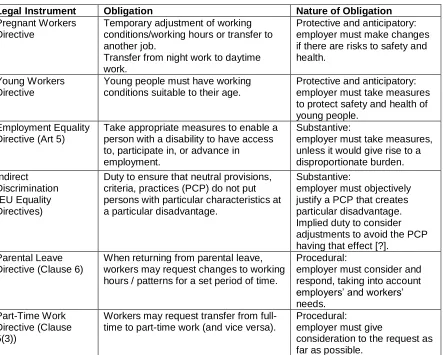
Taking an overview of the instruments considered above, three types of
Table 1: Existing Duties to Make Adjustments for Workers
Legal Instrument Obligation Nature of Obligation
Pregnant Workers Directive
Temporary adjustment of working conditions/working hours or transfer to another job.
Transfer from night work to daytime work.
Protective and anticipatory: employer must make changes if there are risks to safety and health.
Young Workers Directive
Young people must have working conditions suitable to their age.
Protective and anticipatory: employer must take measures to protect safety and health of young people.
Employment Equality Directive (Art 5)
Take appropriate measures to enable a person with a disability to have access to, participate in, or advance in
employment.
Substantive:
employer must take measures, unless it would give rise to a disproportionate burden. Indirect
Discrimination (EU Equality Directives)
Duty to ensure that neutral provisions, criteria, practices (PCP) do not put persons with particular characteristics at a particular disadvantage.
Substantive:
employer must objectively justify a PCP that creates particular disadvantage. Implied duty to consider adjustments to avoid the PCP having that effect [?].
Parental Leave Directive (Clause 6)
When returning from parental leave, workers may request changes to working hours / patterns for a set period of time.
Procedural:
employer must consider and respond, taking into account employers’ and workers’ needs.
Part-Time Work Directive (Clause 5(3))
Workers may request transfer from full-time to part-full-time work (and vice versa).
Procedural:
employer must give
consideration to the request as far as possible.
First, a protective duty is one grounded in OSH law. This is premised on the general principle of adapting work to the individual. It means that employers must take the initiative to identify if workers face specific risks and then make temporary or
permanent adjustments in order to prevent the risk. This is an employer-led process, but it does not exclude the possibility for workers to raise concerns with their
employer about possible risks to their health. Although this model is explicitly applied by EU law in relation to pregnancy, maternity and young age, the general duty to protect workers’ health could also entail adjustments linked to other discrimination grounds.
A second category can be described as a substantive duty. The employer has an obligation to make workplace adjustments in order to achieve the end result of removing or mitigating barriers that the worker experiences to her participation or advancement in the job. Although not explicit in EU legislation, a substantive duty of accommodation will often entail an obligation to engage in dialogue with the worker in order to understand her needs and what measures may be appropriate in
response. It is not an absolute duty; the needs of the worker can be outweighed by the costs to the employer of taking the necessary measures. Evidently, the
accommodate. Nevertheless, this is a cumbersome and uncertain route for workers who need an accommodation.
The third category places a procedural duty on the employer. The worker is given a statutory right to request a workplace adjustment, although this may be circumscribed to certain types of adjustment and only at certain intervals in the employment relationship. The employer has a duty to consider the worker’s request and the law may require an explanation of the ultimate decision. Managerial
prerogative is preserved with regard to how the employer weighs the competing considerations. Collins (2005: 119) draws a distinction between duties that only aim to require the employer to bargain in good faith (eg to hear and consider the worker’s request) and those that go a step further by requiring the employer to identify an objective ground for rejecting any request. The latter is not as demanding as the substantive duty; it is limited to verifying that the employer’s reason for rejecting the request meets a plausible business need. EU law on reconciling work and caring responsibilities has so far confined itself to facilitating the bargaining process through a right to request; it has not explored the option of demanding a certain level of coherence in the employer’s response.
This article has concentrated on understanding the principal differences between duties of accommodation as they emerge from their description in
legislation. A question that demands further research is how courts understand their role in applying these duties. Disputes over an employer’s refusal to provide an accommodation raise questions such as what constitutes the essential functions of a job or (ultimately) how much money should the employer be willing to invest in an accommodation. These kinds of choices touch on the delicate balance between the judicial role and managerial prerogative, and specifically the extent to which judges should be willing to substitute decisions of employers with their own evaluation of what steps should have been taken in the specific factual circumstances of the dispute. Cabrelli (2011: 170) has identified a range of standards of review that can be adopted by adjudicators when scrutinising managerial decision-making, ranging from irrationality to proportionality. Given the relatively limited body of CJEU case-law on accommodation duties, this remains an issue yet to be fully explored.
Nevertheless, it is important to be cognisant that differences in how accommodation duties function go beyond the bare language found in legislation.
IV. Conclusion
The instruments examined in this article have shown a gradual turn in EU
employment law towards requiring, or encouraging, employers to accommodate worker diversity. Collins (2005: 115) has described this as ‘a transformative break with the legal tradition of the contract of employment’ insofar as it departs from the position where this was largely the prerogative of the employer. The pursuit of substantive equality has been the most prominent driver of such reforms, but there are other imperatives that support this trajectory, such as respect for the dignity of the worker or the Union’s desire to continue raising the rate of employment
participation. Identifying the spectrum of reasons that support accommodating worker diversity allows the dots to be joined between anti-discrimination legislation and other branches of employment law. In this regard, the general principle of
Looking at the existing and proposed duties in EU law, an understanding of their diversity allows us to appreciate that law reform is more complex than a simple question of whether to extend the disability duty to other discrimination grounds. The absence of legal regulation does not prevent workers from seeking to vary their terms and conditions with the consent of the employer, but legal intervention has the potential to strengthen the worker’s bargaining power when seeking change (Collins, 2005: 119). This article has shown various ways in which the law can aid the worker in this process, including requiring the employer to conduct a risk assessment (and to make changes in response); requiring an employer to engage in a dialogue and to explain a refusal to accommodate; and requiring an employer to accommodate the worker, subject to disproportionate financial or other costs. The perspective of bargaining power does, however, expose the tendency of accommodation duties to focus on the worker as a lone individual. With the exception of OSH legislation, it is notable that existing EU instruments on accommodating workers ascribe little (if any) role for collective actors. This is an oversight that neglects the ‘real world’ dynamics of a worker asking her employer for a change to her terms and conditions. A right for workers’ representatives to participate in the process could aid workers’ bargaining position. Workers’ representatives may have access to sources of training and advice that improves their knowledge of the legal obligations on the employer. They may also possess memory of accommodations that the employer has already granted in the past to other workers.
Looking ahead, section I identified rationales that favour a continued evolution in worker accommodation duties and this trajectory is reflected in the European Pillar of Social Rights. Although debates within equality law tend to centre on the possible extension of the disability duty to other discrimination grounds, this seems an
unlikely legislative development within EU law, at least in the near future. Taking a wider view of the rationales for worker accommodation, and the range of legal
instruments that can further this objective, allows the identification of other pathways for legal reform, where progress may be more achievable. In this regard, the
procedural duties emerging in the law on reconciling work and caring responsibilities hold considerable promise. Fundamentally, they value dialogue between the
employer and the worker as a practical means of trying to resolve workplace
Bibliography
Alidadi K (2012) Reasonable accommodations for religion and belief: adding value to art.9 ECHR and the EU's anti-discrimination approach in employment? European Law Review 37: 693-715.
Alidadi K (2017) Religion, Equality and Employment in Europe – The Case for
Reasonable Accommodation. Oxford: Hart Publishing.
Ashiagbor D (2005) The European Employment Strategy: labour market regulation and new governance. Oxford: Oxford University Press.
Benedi-Lahuerta S (2017) Taking EU Equality Law to the Next Level: In Search of Coherence. European Labour Law Journal 7: 348-367.
Bogg A (2009) Of Holidays, Work and Humanisation: a Missed Opportunity?
European Law Review 34: 738-753.
Bogg A (2014) Article 31. In: Peers S, Hervey T, Kenner J, Ward A (eds) The EU Charter of Fundamental Rights: A Commentary. Oxford: Hart Publishing, pp. 833-868.
Bribosia E, Ringelheim J and Rorive I (2010) Reasonable Accommodation for Religious Minorities: a Promising Concept for European Anti-Discrimination Law?
Maastricht Journal of European and Comparative Law 17: 137-161.
Bribosia E and Rorive I (2013) Reasonable Accommodation Beyond Disability in Europe? Luxembourg: Office for Official Publications of the European Union. Cabrelli D (2011) The Hierarchy of Differing Behavioural Standards of Review in Labour Law. Industrial Law Journal 40: 146-180.
Caracciolo di Torella E and Masselot A (2010) Reconciling Work and Family Life in EU Law and Policy. Basingstoke: Palgrave MacMillan.
Collins H (2005) The Right to Flexibility. In: Conaghan J and Rittich K (eds) Labour Law, Work, and Family. Oxford: Oxford University Press, pp. 99-124.
Degener T (2005) Disability Discrimination Law: a Global Comparative Approach. In: Lawson A and Gooding C (eds) Disability Rights in Europe – From Theory To
Practice. Oxford: Hart Publishing, pp. 87-106.
European Commission (2017) Employment and Social Developments in Europe – Annual Review 2017. Luxembourg: Publications Office.
Eurostat (2017) Migration and Migrant Population Statistics. Available at:
http://ec.europa.eu/eurostat/statistics-explained/index.php/Migration_and_migrant_population_statistics#Migration_flows (accessed 12 April 2018).
Fredman S (2005) Disability Equality: A Challenge to the Existing Anti-Discrimination Paradigm? In: Lawson A and Gooding C (eds) Disability Rights in Europe: From Theory to Practice. Oxford: Hart Publishing, pp. 199-218.
Fredman S (2011) Discrimination Law. 2nd edn, Oxford: Oxford University Press. Gibson M (2013) The God “Dilution” Religion, Discrimination and the Case for Reasonable Accommodation. Cambridge Law Journal 72: 578-616.
Howard E (2013) Reasonable Accommodation of Religion and Other Discrimination Grounds in EU Law. European Law Review 38: 360-375.
ILO (2016) Promoting Diversity and Inclusion Through Workplace Adjustments: a Practical Guide. Geneva: ILO.
John Paul II (1981) Laborem Exercens – Encyclical Letter On Human Work.
Khaitan T (2015) A Theory of Discrimination Law. Oxford: Oxford University Press. Kohler T (2017) The Significance of Religion for US-American Labor and Social Legislation. In: Becker U, Krebber S, Seifert A (eds) The Significance of Religion for Today’s Labour and Social Legislation. Tübingen: Mohr Siebeck, pp. 59-79.
Lawson A (2008) Disability and Equality Law in Britain – the Role of Reasonable
Adjustment. Oxford: Hart Publishing.
Lewis J and Campbell M (2008) What’s in a Name? ‘Work and Family’ or ‘Work and Life’ Balance Policies in the UK Since 1997 and the Implications for the Pursuit of Gender Equality. Social Policy & Administration 42: 524-541.
Quinn G (2007) Disability Discrimination Law in the European Union. In: Meenan H (ed) Equality Law in an Enlarged European Union – Understanding the Article 13
Directives. Cambridge: Cambridge University Press, pp. 231-277.
Richey C (2017) Manual on Employment Discrimination and Civil Rights Actions in the Federal Courts Volume 1 (Release 39). 2nd edn,Eagan: Thomson Reuters. Sargeant M (2008) Age Discrimination and the Need for Reasonable
Accommodation. International Journal of Discrimination and the Law 9: 163-180. Somek A (2011) Engineering Equality – An Essay on European Anti-Discrimination
Law. Oxford: Oxford University Press.
Vickers L (2016) Religious Freedom, Religious Discrimination and the Workplace.
2nd edn,Oxford: Hart Publishing.
Waddington L (2007) Reasonable Accommodation. In: Schiek, D, Waddington L, Bell M (eds) Cases, Materials and Text on National, Supranational and International Non-Discrimination Law. Oxford: Hart Publishing, pp. 629-756.
Waddington L (2011a) Reasonable Accommodation: Time to Extend the Duty to Accommodate Beyond Disability?’ NTM/NJCM Bulletin 36: 186-198.
Waddington L (2011b) Carers, Gender and Employment Discrimination: What Does EU Law Offer Europe’s Carers? In: Moreau M (ed) Before and After the Economic Crisis: What Implications for the ‘European Social Model’? Cheltenham: Edward Elgar, pp. 101-128.
Regius Professor of Laws, Trinity College Dublin, University of Dublin.
1 Art 5, Council Directive (EC) 2000/78 establishing a general framework for equal treatment in
employment and occupation [2000] OJ L303/16 (hereafter the Employment Equality Directive).
2 42 U.S.C. §2000e(j). See further: Richey, 2017: para 1.35.
3 European Parliament and Council Directive (EC) 2003/88 concerning certain aspects of the
organisation of working time [2003] OJ L299/9.
4 para 9 (‘The Law’), X v UK, app. 8160/78 (European Commission on Human Rights, 12 March
1981). See further, Vickers, 2016: ch 4.
5 Art 2 CRPD.
6Thlimmenos v Greece, app. 34369/97 (ECtHR, 6 April 2000). 7 Ibid para 44.
8 paras 94-95, Eweida v UK Application 48420/10 (ECtHR, 15 January 2013). 9 Ibid para 94.
10 eg para 101, Horváth and Kiss v Hungary (ECtHR, 29 January 2013).
11 Annex I(a), Declaration concerning the Aims and Purposes of the International Labour
Organisation, 10 May 1944.
12 See also the Preamble.
13 Art 6(2)(d), Council Directive (EC) 89/391 on the introduction of measures to encourage
improvements in the safety and health of workers at work [1989] OJ L183/1.
14 Art 13, Directive 2003/88. See further, Bogg, 2009: 745.
15 Recital 5, Council Directive (EC) 97/81 concerning the framework agreement on part-time work
16 There is, however, a critique of the business case for diversity and limitations that it may entail: eg
Lewis and Campbell, 2008: 536-537.
17
https://ec.europa.eu/commission/priorities/deeper-and-fairer-economic-and-monetary-union/european-pillar-social-rights/european-pillar-social-rights-20-principles_en (accessed 12 April 2018).
18 Recital 12, Preamble. 19 Recital 11, Preamble. 20 Art 15, Directive 89/391.
21 Council Directive (EC) 92/85 on the introduction of measures to encourage improvements in the
safety and health at work of pregnant workers and workers who have recently given birth or are breastfeeding [1992] OJ L348/1.
22 Art 5(1). 23 Art 5(2)-(3).
24 para 58, Case C-66/96, Handels- og Kontorfunktionærernes Forbund i Danmark, acting on behalf of
Høj Pedersen, and others [1998] ECR I-7327.
25 Art 7(1). This protection applies also to a period following childbirth to be determined by national
OSH authorities.
26 Art 7(2).
27 Council Directive (EC) 94/33 on the protection of young people at work [1994] OJ L216/12. 28 Art 1(3).
29 Art 6(2). 30 Art 7(1).
31 para 51, Case C-127/05, Commission v UK [2007] ECR I-4619.
32 Case C-531/15, Otero Ramos v Servicio Galego de Saúde, Instituto Nacional e la Seguridad
Social, EU:C:2017:789.
33 Ibid para 75. 34 Ibid para 63. 35 Directive 2000/78.
36 Para 38, Opinion of AG Sharpston, Case C-270/16, Ruiz Conejero v Ferroser Servicios Auxiliares
SA and Ministerio Fiscal, EU:C:2017:788.
37 Recital 20.
38 para 55, Cases C-335/11 and 337/11, HK Danmark, acting on behalf of Jette Ring v Dansk
almennyttigt Boligselskab; HK Danmark, acting on behalf of Lone Skouboe Werge v Dansk Arbejdsgiverforening, acting on behalf of Pro Display A/S, EU:C:2013:222.
39 Art 5 also refers to the need to consider the support available from national disability policy. 40 eg where night work accentuated difficulty in living with depression: ADJ-557, 23 March 2017
(Workplace Relations Commission, Ireland).
41 para 110, Case C-157/15, Achbita, Centrum voor gelijkheid van kansen en voor racismebestrijding
v G4S Secure Solutions NV, EU:C:2016:382
42 para 125, Opinion of AG Sharpston, Case C-188/15 Bougnaoui and Association de défense des
droits de l’homme (ADDH) v Micropole SA, EU:C:2016:553.
43 Art 2(1)(b), European Parliament and Council Directive (EC) 2006/54 on the implementation of the
principle of equal opportunities and equal treatment of men and women in matters of employment and occupation (recast) [2006] OJ L204/23.
44 The number of those who might benefit from the accommodation can be relevant to the
assessment of whether it gives rise to a disproportionate burden.
45 eg this was a stumbling block in the English courts for a Christian worker who wished to wear a
cross outside her work uniform: Eweida v British Airways plc [2010] IRLR 322 (CA).
46 [2005] IRLR 726 (CA). 47 Ibid para 13.
48 Ibid para 32.
49 Case C-157/15, Achbita. 50 Ibid para 43.
51 Cases C-335/11 and 337/11, Ring and Skouboe Werge; Case C-270/16, Ruiz Conejero v Ferroser
Servicios Auxiliares SA and Ministerio Fiscal, EU:C:2018:17.
52 Ibid para 39, Ruiz Conejero.
53 Clause 6(1), Council Directive (EU) 2010/18 implementing the Revised Framework Agreement on
54 paras 48, 65-66, Case C-351/14, Rodríguez Sánchez v Consum Sociedad Cooperativa Valenciana,
EU:C:2016:447.
55 Directive 97/81.
56 Commission, ‘Proposal for a Directive of the European Parliament and of the Council on work-life
balance for parents and carers and repealing Council Directive 2010/18/EU’ COM (2017) 253.
57 Ibid Art 3(c). 58 Ibid Art 3(f). 59 Ibid Art 9(3). 60 Ibid Recital 21.
61 eg requests for changes to working time in order to facilitate the worker undertaking further training