THE KNOWLEDGE, ATTITUDE AND PRACTICE OF
SELF-MEDICATION AMONG PHARMACY STUDENTS
Kiron S. S.*1, Athira S. R.2 and Arya K. S.2
1
Professor and HOD of Pharmacy Practice, Academy of Pharmaceutical Sciences, Pariyaram Kannur, Kerala.
2
Pharm D Intern, Academy of Pharmaceutical Sciences, Pariyaram Kannur, Kerala.
ABSTRACT
Background: Self-medication is the use of drugs with therapeutic
value but without professional advice or prescription. It has also been defined as the use of nonprescription medicines. Aim: This study was undertaken to determine the knowledge, attitude and practice of self-medication among pharmacy students. Methods: Prospective, observational study conducted at Academy of Pharmaceutical Sciences, Pariyaram, Kannur (DIST) duration was 4 months. Questionnaire includes two parts; the first part contained questions on demographic information and the second part contained questions on core issues such as health seeking behavior, names, sources and factors of drugs used for self medication. Prior to the survey students were explained about the purpose of the study and Written informed consent were obtained.
Results: Majority of the respondent use analgesic as the main class of drug for self medication, fever and headache were the major complaints. 67.2% respondent took self medication sometimes were more prone to ADR (8.3%). Main source of self medication were pharmacy shop 99.7% and friend /family 99.49%. 68.42 % of the respondents had a positive attitude towards self-medication and favored self-medication states that it was acceptable. 87.7% respondent were aware about OTC and generic drugs and 53.9% aware about the side effect of drug administrated. Conclusion: The prevalence of self medication practices is alarmingly high among pharmacy students and majority of have a positive attitude towards self medication. In this situation proper statutory drug control and interventions to improve knowledge of self medication is needed.
Volume 7, Issue 16, 736-745. Research Article ISSN 2277– 7105
*Corresponding Author
Kiron S. S.
Professor and HOD of
Pharmacy Practice,
Academy of
Pharmaceutical Sciences,
Pariyaram Kannur, Kerala. Article Received on 04 July 2018,
Revised on 24 July 2018, Accepted on 14 August 2018,
KEYWORDS: Self medication, Prescription, Prospective, Observational.
INTRODUCTION
It is common for human to feel unwell, and they have an inherent tendency to use herbs, potions, medications, etc. for treating themselves. Now a day’s people throughout the world act on their own for their health; they practice self-care.[1] Self-medication is the use of drugs with therapeutic value but without professional advice or prescription. It has also been defined as the use of nonprescription medicines.[2] In several studies it has been found that inappropriate self-medication results in wastage of resources, increases resistance of antibiotics, wastage of money and generally serious health hazards such as adverse drug reactions, prolonged suffering and drug dependence.[3] Drugs that are prone to self-medication include analgesics, antibiotics and cough syrups, among others. The most common indications for self-medication were to relieve the symptoms of headache, cough, cold, throat, stomachache and fever.[4] Studies suggests that medication knowledge of medical students might contribute to increase self-medication.[1,5,6] Users should aware about the drugs used are those indicated for conditions that are self recognizable; how to take or use the drugs; the effects and possible side-effects of the drugwell as ways of monitoring these side effects; possible interaction with other drug; duration of the drugs etc.[7]
AIM AND OBJECTIVE
This study was undertaken to determine the knowledge, attitude and practice of self-medication among pharmacy students of the Academy of Pharmaceutical Sciences, Pariyaram, Kannur (DIST).
1. To measure college students’ knowledge of drug safety.
2. To evaluate students’ attitudes toward medication consultation. 3. To evaluates the factors affecting self medication.
4. To assess self-care behaviors with regard to nonprescription medicines, medication consultation with pharmacists, and appropriate use of medicines among college students.
METHODOLOGY
study duration was 4 months from January to April 2018, 2 month for questionnaire validation and lasting 2 month for collection of data. The study includes all pharmacy students who were willing to participate in the study were enrolled.
Study Design: It was a prospective, observational study for identifying Knowledge, Attitude
and Practice of Self-Medication among pharmacy students in Pharmacy College. Questionnaire was in two parts. The first part contained questions on demographic information of the respondents such as age, gender, class level in the university, etc. The second part contained questions on core issues which dwelt on socio-economic variables such as health seeking behavior, names and sources of drugs used for self medication, type of ailment treated through self-medication, factors influencing self medication practices and strategies that may help reduce self-medication practices among the respondents. Students were given a questionnaire during a regular class period. Prior to the survey all the students were explained about the operational terms such as self medication, antibiotics etc, type and purpose of the study in brief and informed that participation is voluntary and their collected information will not be shared and it would be anonymous. Written informed consent was obtained from each volunteer prior to the study.
Statistics: The data were managed and analyzed through IBM SPSS 21version. Descriptive
analyses were done by the calculation of percentages and frequencies.
RESULTS AND DISCUSSION
DEMOGRAPHIC
Table No: 1 Total number of respondents from each batch.
Batch Total respodent Male Female
First Year Pharm D 28 4 24 Second Year Pharm D 27 5 22 Third Year Pharm D 26 5 21 Fourth Year Pharm D 28 6 22 Fifth Year Pharm D 26 4 26 Sixth Year Pharm D 13 5 8 First Year B Pharm 55 5 50 Second Year B Pharm 55 4 51 Third Year B Pharm 56 4 52 Fourth Year B Pharm 58 6 52 First Year M Pharm 13 0 13 Second Year M Pharm 12 2 12
Table No. 2: Socio demographic factors of respondent.
Socio‐Demographic Factors No: of Students
(N=399) Percentage (%)
Gender Male 50 12.53
Female 349 87.4
University class
Distinction 51 12.8 First class 128 32.1 Second class 93 23.3
Failed 44 11
N A 83 20.8
Accommodation Hostler 182 45.6
Day Scholar 217 54.4
Practice
In the study the prevalence of self medication among pharmacy students was 99.74% which included 349 of females and 49 of males. The different studies confirm in India regarding the prevalence of self medication were 57.05% in West Bengal,[10] Karnataka 88.18%,[5] and 78.6% in Mangalore.[11] But the studies conducted in other developing countries shows, the prevalence of self medication was low 25.4% in Ethiopia,[12] 55% in Egypt[8] and 55.3% in Karachi.[13]
self medication sometime, 131 (32.8%) rarely and no one always. In 399 respondent 33(8.3%) were hit with ADR and there is a strict correlation between ADR occurred versus frequency of self medication taken by using spearman’s correlation method (p=0.000). According to study data it give the impression that students who took self medication sometimes were more prone to ADR while comparing with rarely taking student.
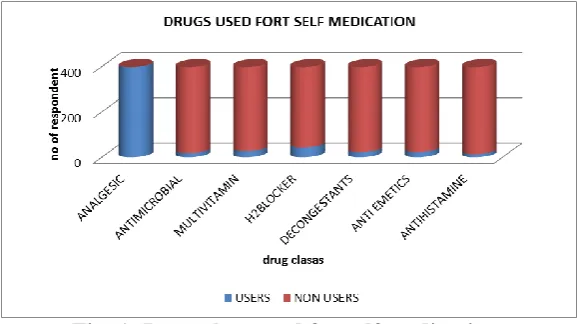
Majority (398 (99.7 %)), of the respondents indicated that they used analgesic drugs for self-medication which is shore up by the study done by Vedrana AV(2001)[14], Hughes CM(2001)[15] and Henry James (2006)[1]; while 43 (10.8%) declared to taken H2blockers as
[image:5.595.153.442.389.551.2]self-medication in present study (Figure No: 1). The prominent disease conditions that predisposed respondents to self-medication practices with analgesic were revealed by the respondents as fever 338 (99.7%) and headache 103 (25.8%) it may be due to hectic academic schedule; others due to menstrual problems 119(29.8%) and body pain 85 (21.3%). Other complaints like cough102 (25.5%), diarrhea151 (37.8%), acidity 151 (37.8%) and so many different reasons for self medication (Table No-3).
Fig. 1: Drug class used for self medication.
Table No. 3: Complaints for self medication.
Complaints No of respondent
Fever 339
Cough 102
Student respondent to the different sources of self medication like pharmacy shop, primary health care center, medical representatives and friends/family were they get drugs. According to the availability or wish 398 (99.7%) were chosen pharmacy shop. 397(99.49%) who choose friend /family respondent carries the risk of exposure to expired medicine, medicine meant for someone else or drugs that may have been originally prescribed for a different problem. Respondents also got drugs from primary health center 18(4.5%) and medical representative 16(4%). The issue of long waiting queues at clinics or hospitals was also raised by 99% of the respondents as one of the reasons for seeking self-care in order to meet up with their tight academic schedule. However, this could also mean that health services need to be improved so that treatment becomes more accessible and the patient’s waiting time is minimized. None of the students taking a non prescription drug along with other prescribed medicines and the entire respondent are fear to have self medication for chronic disease.
Table No. 6: Selection of self Medication based on.
Selection No of respondent Percentage (%)
Previous doctor prescription 83 20.8
Own experience 116 29.1
Recommendation by community pharmacist 165 41.4 Class room teaching 189 47.4 Opinion from family members 73 18.3
Internet 181 45.4
189 (47.4%) of students took self medication according to the knowledge from class room teaching and also from senior students because they have more clinical topics in pharmacotherapeutics, pharmacology and pharmacy practice in final years. 73(18.3%) took the opinion from family members while taking self medication, especially first year students (Table No-6). 83(20.8%) students took self medication with a previous doctor prescription and 116 (29.1%) according to their own experience. This has implications, because many diseases have similar symptoms and a person using previous experience may be exposed to the dangers of misdiagnosis and consequently wrong treatment.
Attitude
with juniors as they were exposed to knowledge about diseases and drugs. Similar observation was made by Shivaraj.B.Patil et al.[5] In Pharm D student shows more positive attitude while comparing with B. Pharm as they are exposed to clinic practice in hospital.
Knowledge
A total of 366 participants read the package insert and search internet for drug information’s. From these 176 (44.1%) fully understood the content, 126 (31.6%) partially understood and 64 (16%) not at all. Mostly senior Pharm D students (5th year and sixth year) had a fair knowledge about the drug information while comparing with B Pharm students and Junior Pharm D students, due to their clinical practice in hospital like patient counseling, ward rounds, drug information services and ADR reporting. Most of the respondent 350 (87.7%) were aware about OTC and generic drugs and 215 (53.9%) aware about the side effect of drug administrated and 183 (45.9%) not aware.181 (45.36%) are aware about the problems of self medication like antibiotic resistance, drug dependence, organ damage, drug interaction, ADR and incorrect self diagnosis but they still indulged in this activity. Studies conducted in Southern Spain[16] and on students in Croatia[17] where 41% and 38% people respectively took antibiotics without consulting a doctor. In our study only 4.5%, of students had taken antibiotics without proper clinical evaluation, 181 (45.36%) students were aware about antibiotic resistance.
Table No. 4: Awareness about various aspects of self Medication.
Knowledge Aware (%) Not Aware (%)
Aware about the Problem of Self Medication 181 (45.36%) 218 (54.6%)
Aware about Drug Information Leaflet
176(44.1%): Fully Understood
64(16%) 126(31.6%): Partially
Understood
Aware about Side Effect of Drug Taken 215 (53.9%) 183 (45.9%)
Aware about OTC and Generic 350 (87.7%) 49(32.8%)
Table No. 5: Five points considered while choosing drug.
Points Considered Number of Respondent Percentage (%)
Indication 398 99.7
Side effect 139 34.8 Drug interaction 30 7.5 Frequency and duration 85 21.3 Route of administration 42 10.5
Brand 10 2.5
First year students of both Pharm D and B Pharm are rarely taking drugs and they have a negative attitude towards self medication. The knowledge of pharmacology and applied therapeutics subjects taught in second year probably has led to a false sense of confidence in self-diagnosis and self-management leading them to self-prescribe irrationally. Perwez Khanam and Dana Haj-Ali[18] also conclude the same result in nursing students of King Saud Bin Abdulaziz University for Health Sciences, Al Ahsa. There is a need for a review of educational programs especially the teaching of clinical pharmacology to include topics on self- medication and judicious use of medicines398 (99.7%) students consider the indication while taking self medication but only 139 (34.8%) consider side effects and 30 (7.5%) drug interaction respectively (Table no-5).
CONCLUSION
Majority of the respondent use analgesic as the main class of drug for self medication, fever and headache were the major complaints. 67.2% respondent took self medication sometimes are more prone to ADR (8.3%). Main source of self medication were pharmacy shop 99.7%, and friend /family 99.49%. 68.42% of the respondents had a positive attitude towards self-medication and favored self-self-medication saying that it was acceptable. Most of the respondent 87.7% were aware about OTC and generic drugs and 53.9% aware about the side effect of drug administrated.
LIMITATION OF STUDY
The study could have been more generalized if it was multicentre involving other pharmacy colleges also.
The limitation of this survey based study is its small sample size. However, such study
involving large sample size can be carried out.
The main limitation of this study is that the data collected were self-reported which may
introduce some bias in the behavioral pattern of the respondents.
ACKNOWLEDGMENTS
The authors thank to the all students and, teaching and non teaching staff of academy of pharmaceutical sciences Pariyaram, Kannur, Kerala.
FINANCIAL DISCLOSURE: This work was not financially supported by any means.
CONFLICTS OF INTEREST STATEMENT: All authors have declared no potential
conflicts of interest regarding this study.
REFERENCE
1. Henry James Evaluation of the Knowledge, Attitude and Practice of Self-Medication among First-Year Medical Students. Med Princ Pract, 2006; 15: 270–275.
2. KP Osemene and A Lamikanra A Study of the Prevalence of Self-Medication Practice among University Students in Southwestern Nigeria. Tropical Journal of Pharmaceutical Research, August 2012; 11(4): 683-689.
3. Rohit K Verma, Lalit Mohan, Manisha Pandey. Evaluation of self medication among professional students in North India: proper statutory drug control must be implemented, 2010; 1(3): 60-64.
4. Mehul Agrawal et al. A Questionnaire Based Study Regarding the Knowledge, Attitude and Practice of Self-Medication Among Second Year Undergraduate Medical Students. International Journal of Pharmacology and Clinical Sciences, Mar 2017; 1(6): 1-5.
5. Shivaraj.B.Patilet. Self-Medication Practice and Perceptions among Undergraduate Medical Students: A Cross-Sectional Study. Journal of Clinical and Diagnostic Research, 2014 Dec; 8(12): HC20-HC23.
7. Fei-Yuan Hsiao. Survey of Medication Knowledge and Behaviors among College Students in Taiwan. American Journal of Pharmaceutical Education, 2006; 70(2): 1-7. 8. Thadani S, Salman MT, Ahmad A. Knowledge, Attitude and Practice of Self-medication
Among Second Year Undergraduate Medical Students. J Rational Pharmacother Res., 2013; 1(3): 131-4.
9. Mehul Agrawal et al. A Questionnaire Based Study Regarding the Knowledge, Attitude and Practice of Self-Medication Among Second Year Undergraduate Medical Students. International Journal of Pharmacology and Clinical Sciences, Mar 2017; 1(6): 1-5.
10.Pandya RN, Jhaveri KS, Vyas FI, Patel VJ. Prevalence, pattern and perceptions of self-medication in medical students. Int J Basic Clin Pharmacol, 2013; 2: 275- 80.
11.Hughes CM, McElnay JC, Fleming GF: Benefits and risks of self medication. Drug Saf, 2001; 24: 1027–1037.
12.World Health Organization: Guidelines for the Regulatory Assessment of Medicinal Products for use in Self-Medication. Genebra: WHO; 2000.
13.Vedrana AV, Vladimir T, Zdravko L: Content of home pharmacies and self-medication practices in households of pharmacy and medical students in Zagreb, Croatia: fi ndings in 2001 with a reference to 1977. Croat Med J., 2005; 46: 74–80.
14.Zafar, S et al. Self-medication amongst university students of Karachi: prevalence, knowledge and attitudes. Journal of the Pakistan Medical Association, 2008; 58(4): 214-217.
15.Hughes CM, McElnay JC, Fleming GF: Benefits and risks of self medication. Drug Saf, 2001; 24: 1027–1037.
16.Vaananen MH, Pietila K, Airaksinen M. Self-medication with antibiotics—does it really happen in Europe? Health Policy, 2006; 77: 166-71.
17.Vucic VA, Trkulja V, Lackovic Z. Content of home pharmacies and self-medication practices in households of pharmacy and medical students in Zagreb, Croatia: findings in 2001 with a reference to 1977. Croat Med J, 2005; 46: 74-80.