STABILITY INDICATING RP-HPLC METHOD DEVELOPMENT AND
VALIDATION FOR ESTIMATION OF SAROGLITAZAR IN BULK
AND TABLET DOSAGE FORM
P. Sripriya*, G. Naga Sowjanya, A. Ajitha, and V. Uma Maheswara Rao
Department of Pharmaceutical analysis and QualityAssurance CMR College of Pharmacy,
Kandlakoya (v), Medchal road, Hyderabad-501401, T.S.
ABSTRACT
A simple, precise, rapid and reproducible stability indicating RP
-HPLC method was developed and validated for the estimation of
Saroglitazar in pharmaceutical dosage forms. Chromatography was
performed on a ODS C18 (ODS) column (250 mm X 4.6 mm i.d.
Particle size 5) Acetonitrile: Triethylamine buffer pH4.6:Methanol (70:20:10 v/v) as a mobile phase at a flow rate of 1 ml/ min. The
detection was carried out at 292 nm using analytical Tech. PDA 996
Detector. The obtained calibration curve was linear in the
concentration range of 10-50µg/ml. The limit of detection and
quantification was found to be 1.81 g/ml and 5.5 g/ml respectively. It was found that the amount of Saroglitazar present in the Tablet
formulation was 100%. The method was validated statistically using
SD, %RSD and SE and the values are found to be within the limits.
The recovery studies were performed and the percentage recovery was found to be 100 %.
KEYWORDS: Saroglitazar, RP-HPLC, PDA detection, Isocratic Elution;Tablet dosage forms.
INTRODUCTION
Saroglitazar is Used mainly for treatment of type -2 diabetes mellitus and dyslipidemia.
Saroglitazar IAPUC name is (2S
)-2-Ethoxy-3-[4-(2-{2-methyl-5-[4-(methylsulfanyl)phenyl]-1H-pyrrol-1-yl}ethoxy)phenyl] propanoic acid and molecular formula is C25H29NO4S.[1-7]
Volume 4, Issue 8, 2361-2372. Research Article ISSN 2277– 7105
Article Received on 20 June 2015,
Revised on 11 July 2015, Accepted on 03 Aug 2015
*Correspondence for Author P. Sripriya Department of Pharmaceutical analysis and QualityAssurance
CMR College of Pharmacy, Kandlakoya
(v), Medchal road,
Hyderabad-501401, T.S.
Fig.1 Chemical Structure of Saroglitazar
Literature survey revealed that numerous methods have been reported for estimation of
Saroglitazar in pharmaceutical formulations. Present study involves the development of
HPLC method[8-12] using simple mobile phase which is sensitive and rapid for quantification of Saroglitazar in tablet dosage forms as well as subsequent validation of developed method
according to ICH guide lines. The important features and novelty of the proposed method
included sonication of sample at ambient temperature treatment with sonication of small
amount of powder sample at ambient temperature.
EXPERIMENTAL
Chemicals and reagents
HPLC grade Acetonitrile and water was purchased from SD fine Chemicals (Mumbai, India).
Saroglitazar standard sample was provided by sura Labs Pvt (Hyderabad, India). Saroglitazar
commercial Tablet formulation (Cadia healthcare limited-Gujarat) was procured from local
market. The tablet dosage forms obtained was containing 4 mg of Saroglitazar for oral
administration.
Instrumentation and analytical conditions
The HPLC system (WATERS 2695) consisted of a pump.The Analytical column,a ODS
C18(250mm4.6mmi.d.,5 particle size) was operated at 30ºC temperature (20 1c).
Isocratic elution with Acetonitrile: Triethylamine buffer pH4.6: Methanol (70:20:10) % v/v )
was used at a flow rate of 1ml/ min. The mobile phase was prepared freshly and degassed by
sonicating for 5 min before use (Soltec, Soluzioni tecnologiche, Luglio, Italy). The UV
spectrum of Saroglitazar for selecting the working wavelength detection was taken using UV
Stock and working standard solutions
Accurately weighed and transferred 100 mg of Saroglitazar working standard into a 100ml of
clean dry volumetric flasks, added about 70ml of Diluents and sonicated to dissolve it
completely and made volume up to the mark with the same solvent. (Stock solution)
Further pipetted 0.3 ml of the above Saroglitazar stock solutions into a 10ml volumetric flask
and diluted up to the mark with diluents.
The solution was further diluted with mobile phase in 10ml volumetric flask to obtain five
working standards in the concentration of 10-50 g/ ml of Saroglitazar. All the solutions were prepared. Before being subjected to analysis, all the working standard solutions were filtered
through 0.45 µ filter.
Before injecting solutions, the column was equilibrated for at least 60 min with the mobile
phase flowing through the system. The calibration curve was plotted with the five
concentrations of the 10-50 g/ ml working standard solutions. Chromatogram was recorded for each dilution. Calibration solutions were prepared daily and analyzed immediately after
preparation.
Assay of sample preparation
The contents of twenty commercial tablets (labeled concentration 4 mg of Saroglitazar were
weighed and their mean mass was determined. After grinding the tablets into a fine powder in
a glass mortar, an accurately weighed quantity of the tablet powder equivalent to 100 mg of
Saroglitazar was quantitatively transfer into a 100ml clean dry volumetric flask and added
about 70mL of diluent. The solution was sonicated for 10 min, made volume up to the mark
with same solvent mixed well and filtered through 0.45 µ filter. Further pipetted 0.3ml of
Saroglitazar above sample stock solution into a 10ml volumetric flask and diluted up to the
mark with diluent. The theoretical Saroglitazar concentration after dilution was 30g/ ml (100% of Saroglitazar). An aliquot of this solution was a filtered through 0.45 µ filterprior to
the injection into the HPLC system. Peak area of Saroglitazar was measured for the
determinations.
Validation procedure
The objective of method validation is to demonstrate that the method is suitable for its
intended purpose as it is stated in ICH guidelines. The method was validated for linearity,
and system suitability.
Standard plots were constructed with five concentrations in the range of 10 - 50 g/ ml of Saroglitazar prepared in to test linearity. The peak area of Saroglitazar was plotted against the
concentration to obtain the calibration graph. The linearity was evaluated by linear regression
analysis that was calculated by the least square regression method. The precision of the assay
was studied with respect to both repeatability and intermediate precision. Repeatability was
calculated from five replicate injections of freshly prepared Saroglitazar test solution in the
same equipment at a concentration of 100% of the intended test concentration value on the
same day. The experiment was repeated by assaying freshly prepared solution at the same
concentration additionally on two consecutive days to determine intermediate precision. Peak
area of Saroglitazar was determined and precision was reported as % R.S.D. Method
accuracy was tested (% recovery and % R.S.D. of individual measurements) by analyzing
samples of Saroglitazar at three different levels in pure solutions using three preparations for
each level. The results were expressed as the percentage of Saroglitazar recovered in the
samples.
Sample solution short term stability was tested at ambient temperature (20 1C) for three days. In order to confirm the stability of both standard solutions at 100% level and tablet
sample solutions, both solutions protected from light were re injected after 24 and 48 hrs at
ambient temperature and compared with freshly prepared solutions.
RESULTS AND DISCUSSION Screening and optimization
Selection of the detection wavelength
The UV spectra of Saroglitazar in Acetonitrile: Triethylamine buffer pH4.6:Methanol
(70:20:10 v/v) mixtures of Water and Acetonitrile in the region between 200 and 400 nm. It
shows that at 292 nm, Saroglitazar have maximum absorbance. Hence max of Saroglitazar in mobile phase was selected as an optimum detection wavelength for the quantification of
Saroglitazar.
Optimization of the chromatographic conditions
Proper selection of the stationary phase depends upon the nature of the sample, molecular
weight and solubility. The drug Saroglitazar is a non polar. Non polar compounds preferably
compound is very attractive with reverse phase columns. So the elution of the compound
from the column was influenced by polar mobile phase. Mixture of Acetonitrile:
Triethylamine buffer pH4.6:Methanol was selected as mobile phase and the effect of
composition of mobile phase on the retention time of Saroglitazar was thoroughly
investigated. Acetonitrile: Triethylamine buffer pH4.6: Methanol (70:20:10) were optimized
to give symmetric peaks with short run time (Fig 2). A short run time and the stability of peak
asymmetry were observed in the ratio of Acetonitrile: Triethylamine buffer pH4.6:Methanol.
It was found to be optimum mobile phase concentration.
Chromatographic Conditions Optimized Method Parameters
Optimized Chromatographic conditions
Mobile phase ratio : Acetonitrile: Triethylamine buffer pH4.6: Methanol
(70:20:10)
Column : ODS C18 (4.6×250mm) 5µ
Column temperature : 30ºC
Wavelength : 292nm
Flow rate : 1ml/min
Injection volume : 10µl
Run time : 5minutes
Validation of methods Linearity
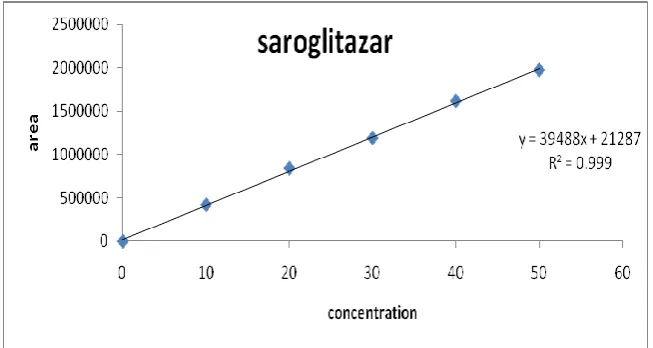
Five point’s calibration graphs were constructed covering a concentration range 10-50g/ ml
(Three independent determinations were performed at each concentration. Linear
relationships between the of peak area signal of Saroglitazar & the corresponding drug
concentration was observed as shown in Fig . The standard deviations of the slope and
[image:6.595.135.462.252.426.2]intercept were low. The determination coefficient (r2) exceeded 0.9999.The statistical analysis of calibration is shown in table 1.
Fig 3 Calibration Graph of Saroglitazar
Precision
The validated method was applied for the assay of commercial tablets containing 4 mg of
Saroglitazar Sample was analyzed for six times after extracting the drug similar procedure
and assay sample preparation of the experimental section. The results presented in good
agreement with the labeled content. Assay results, expressed as the percentage of label claim,
was found to be 100 1.02 for showing that the content of Saroglitazar in tablet formulations confirmed to the content requirements (95 - 105 %) of the label claim. Low values of
standard deviation denoted very good repeatability of the measurement.
Thus showing that the equipment used for the study worked correctly for the developed
analytical method and being highly repetitive. For the intermediate precision a study carried
out by the same analyst working on the same day and on three consecutive days (n2) indicated a R.S.D. of 0.0455 and 0.03995% respectively. Both values were far below to 2%,
the limit percentage indicated a good method precision. The results of analysis are shown in
Accuracy
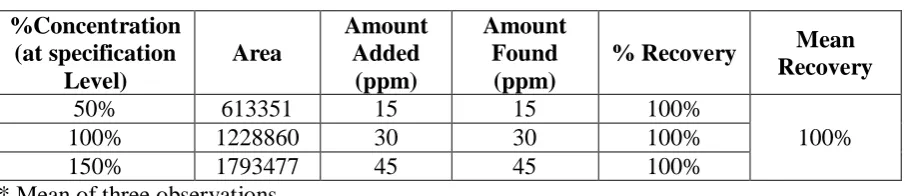
The data for accuracy were expressed in terms of percentage recoveries of Saroglitazar in the
real samples. These results are summarized in table 1. The mean recovery data of Saroglitazar
in real sample were within the range of 98-102%. Mean % R.S.D. 100%, satisfying the
acceptance criteria for the study. It is proves that there is no interference due to excipients
used in tablet formulation .Hence the accuracy of the method was conformed.
Table 1 Accuracy study for Saroglitazar (n 9) %Concentration (at specification Level) Area Amount Added (ppm) Amount Found (ppm)
% Recovery Mean
Recovery
50% 613351 15 15 100%
100%
100% 1228860 30 30 100%
150% 1793477 45 45 100%
* Mean of three observations
Stability: The stability of saroglitazar in standard and sample solutions are determined by storing the solutions at ambient temperature (20 1C). The solutions were checked in triplicate after 3 successive days of storage and the data were compared with freshly prepared
samples. In each case, it has noticed the solutions were stable for 48 hrs, as during this time
the results did not decrease below 94%. This denotes that Saroglitazar is stable in standard
and sample solutions for at least 2 days at ambient temperature.
System suitability
The system suitability parameter like capacity factor, asymmetric factor, tailing factor, HETP
and No. of theoretical plates also calculated. It was observed that all the values are within the
[image:7.595.73.526.227.325.2]limits (table 2).
Table 2: Summary for RP-HPLC Method
Parameter Acceptancecriteria Results obtained
For saroglitazar
System suitability
Theoretical Plates-NLT 2000 5342
Tailing factor-NMT 2 1.39
Retention time- NLT 2 2.4
Precision %RSD- NLT 2 0.11
Linearity Correlation Coefficient NLT 0.999 0.999
Accuracy Percentage Recovery 98-102% 100
Limit of detection 1.81µg/ml
The statistical evaluation of the proposed method revealed its good linearity, reproducibility
and its validation parameters for different parameters and let us to the conclusion that it could
be used for the rapid and reliable determination of Saroglitazar in tablet formulation.
Forced Degradation Studies
Sample Preparations To Perform Forced Degradation Studies
Acid degradation: Accurately weighed 10mg of equivalent weight of Saroglitazar sample into a 10ml clean dry volumetric flask and added about 3mL of 0.1N Hcl and kept side for
3hours and then 3mL of 0.1N NaOH solution is added to neutralize the solution and then
made the volume up to mark by using Diluent and sonicated to dissolve it completely.
Further pipetted 0.3 ml of above stock solution into a 10ml volumetric flask (it contains
[image:8.595.147.453.339.506.2]Saroglitazar) and diluted up to the mark with diluent.
Figure 4: showing acid degradation for saroglitazar
Alkaline degradation
Accurately weighed 10 mg equivalent weight of Saroglitazar sample into a 10mL clean dry
volumetric flask and added about 3mL of 0.1N NaOH and kept side for 3hours and then
added 3mL of 0.1N Hcl solution to neutralize the solution and made the volume up to mark
by using Diluent and sonicated to dissolve it completely.
Further pipetted 0.3ml of above stock solution into a 10ml volumetric flask (it contains
Figure 5 showing Alkaline degradation for saroglitazar
Peroxide degradation
Accurately weighed 10 mg equivalent weight of Saroglitazar sample into a 10mL clean dry
volumetric flask and added about 3mL of Hydrogen peroxide solution and kept side for
3hours and made the volume up to mark by using Diluent and sonicated to dissolve it
completely.
Further pipetted 0.3ml of above stock solution into a 10ml volumetric flask (it contains
Saroglitazar) and diluted up to the mark with diluent.Fig 6.
Figure 6 showing peroxide degradation for saroglitazar
Thermal degradation
Accurately weighed 10 mg equivalent weight of Saroglitazar sample into a 10mL clean dry
volumetric flask and exposed to heat at 80-90ºc for 3hours and then made the volume up to
[image:9.595.149.448.480.636.2]Further pipetted 0.3ml of above stock solution into a 10ml volumetric flask (it contains
[image:10.595.147.451.107.253.2]Saroglitazar) and diluted up to the mark with diluent.Fig 7.
Figure 7 showing Thermal degradation for saroglitazar
Photolytic degradation
Accurately weighed 10 mg equivalent weight of Saroglitazar sample into a 10mL clean dry
volumetric flask and exposed to sunlight for 3hours and made the volume up to mark by
using Diluent and sonicated to dissolve it completely.
Further pipetted 0.3ml of above stock solution into a 10ml volumetric flask (it contains
[image:10.595.145.455.444.590.2]Saroglitazar) and diluted up to the mark with diluent. Figure: 8
Figure 8: showing Photolytic degradation for saroglitazar
Table 3: Results for degradation studies
S. No Type of degradation Concentration of
sample (µg/ml) Area of sample Assay content (% w/w)
1 Acid (0.1N HCl) 30 µg/ml 1206721 100%
2 Base (0.1N NaOH) 30 µg/ml 1214352 100%
3 Peroxide (3% H202) 30 µg/ml 1145269 94%
4 Thermal (at 600 c) 30 µg/ml 1195615 99%
SUMMARY AND CONCLUSION SUMMARY
RP-HPLC method was developed for estimation of Saroglitazar in bulk and Pharmaceutical
dosage form. Chromatographic separation was, carried out on a ODS C18 (4.6×250mm) 5µ
column with mobile phase comprising mixture of Acetonitrile: Triethylamine buffer pH4.6:
Methanol (70:20:10) at a flow rate of 1.0ml/min, the detection was carried out at 292nm
CONCLUSION
The proposed RP-HPLC method was found to be precise, specific, accurate, rapid and
economical for estimation of Saroglitazar in bulk and in its Pharmaceutical dosage form. The
sample recoveries in all formulations were in good agreement with their respective Label
Claims and the % RSD values were with in 2 and the method was found to be precise. This
method can be used for routine determination of Saroglitazar in bulk and in Pharmaceutical
dosage forms.
ACKNOWLEDGEMENT
The authors wish to thankful to SURA Labs pvt ltd Dilshuknagar Hyderabad.for providing
the gift sample of saroglitazar. The authors are also thankful toPrincipal and Management of
CMR College of Pharmacy-Hyderabad, for providing all necessary facilities.
REFERENCES
1. Available from : http//www.en.wikipedia.org/wiki/Saroglitazar.
2. Available from: http//www.pubmed.pharmacol.com/Saroglitazar.
3. Available from: http//www.Rx list .com/Saroglitazar.
4. A.BraithWait and F.J.Smith, Chromatographic Methods, 5thedition, Kluwer Academic
Publisher, 1996: 1-2.
5. Agarwal R, The first approved agent in the Glitazar's Class: Saroglitazar, PubMed.gov.
6. Andrea Weston and Phyllisr. Brown, HPLC Principle and Practice, 1st edition, Academic press, 1997; 24-37.
7. Breaux J and Jones K: Understanding and implementing efficient analytical method
development and validation. Journal of Pharmaceutical Technology 2003; 5: 110-114.
8. British journal medicine & medical research, 2015; 5(2): 134-159 article no BJMMR
2015.16.
9. B.Siddartha method development and validation for the estimation of saroglitazar in bulk
pharmaceutical sciences. 2014; 3(9): 567-575.
10.Code Q2B, Validation of Analytical Procedures; Methodology. ICH Harmonized
Tripartite Guidelines, Geneva, Switzerland, 1996; 1- 8.
11.Dr. Kealey and P.J Haines, Analytical Chemistry, 1stedition, Bios Publisher, 2002: 1-7.
12. Code Q2A, Text on Validation of Analytical Procedures. ICH Tripartite
Guidelines,Geneva, Switzerland, 27 October, 1994; 1 - 5.
13.Code Q2B, Validation of Analytical Procedures; Methodology. ICH Tripartite