ISSN Online: 2152-7393 ISSN Print: 2152-7385
DOI: 10.4236/am.2019.109053 Sep. 24, 2019 743 Applied Mathematics
The Computational Complexity
of Untrapped Choice Procedures
Mustapha Balewa Sanni
1,21Université Nationale des Sciences, Technologies, Ingénierie et Mathématiques (UNSTIM) d’Abomey, Abomey, Benin
2Institut National Supérieur de Technologie Industrielle (INSTI) de Lokossa, Lokossa, Benin
Abstract
In this paper, we define two versions of Untrapped set (weak and strong Un-trapped sets) over a finite set of alternatives. These versions, considered as choice procedures, extend the notion of Untrapped set in a more general case (i.e. when alternatives are not necessarily comparable). We show that they all coincide with Top cycle choice procedure for tournaments. In case of weak tournaments, the strong Untrapped set is equivalent to Getcha choice proce-dure and the Weak Untrapped set is exactly the Untrapped set studied in the litterature. We also present a polynomial-time algorithm for computing each set.
Keywords
Choice Procedure-Pseudo Tournament-Untrapped Set-Computational Complexity
1. Introduction
A common way to model a decision maker’s preferences is to consider a binary relation R over a set A of alternatives (teams, projects, candidates, goods, etc. …). In many different contexts (Sports league, Social Choice Theory, Economics, Operational Research, etc …), the binary relation R is used to make a choice between alternatives of A. Very often this relation is assumed to be complete and asymmetric (we say that R is a tournament) or sometimes complete (R is said to be a weak tournament). The general case concerning incomplete binary relations has received less attention (see [1] [2] [3]). Incomplete preferences have been increasingly recognized as important [4] [5]. The origin of these preferences is twofold: a lack of information about the alternatives or a lack of information of the decision maker about her own tastes on the alternatives [6] [7].
How to cite this paper: Sanni, M.B. (2019) The Computational Complexity of Un-trapped Choice Procedures. Applied Ma-thematics, 10, 743-752.
https://doi.org/10.4236/am.2019.109053 Received: September 15, 2018
Accepted: September 21, 2019 Published: September 24, 2019
Copyright © 2019 by author(s) and Scientific Research Publishing Inc. This work is licensed under the Creative Commons Attribution International License (CC BY 4.0).
http://creativecommons.org/licenses/by/4.0/
DOI: 10.4236/am.2019.109053 744 Applied Mathematics
From the binary relation defined on A, many mechanisms (procedures) are defined in order to choose the set of ‘‘best alternatives’’ also called choice sets. Some familiar choice procedures studied in the literature are the Top cycle
choice procedure [8], the Copeland choice procedure [9], the Uncovered choice procedure [10], etc. … These choice procedures have been extensively analysed (in terms of mathematical characterizations) for tournaments and weak tourna-ments [see [11] [12]]. Sanni [13] has studied axiomatic characterizations of some pseudo tournaments i.e. reflexive and non necessary complete binary relations.
Recent work has addressed the computational complexity of many choice procedures (see for example: [14] [15]) and the literature is full of choice proce-dures that are difficult to compute [15] [16]. It is assumed that if computing a choice set is infeasible, the applicability of the corresponding solution concept is seriously undermined [17]. Most of the familiar procedures mentioned above are demonstrated to be tractable [17] i.e. belonging to class P of problems which can be solved by an algorithm whose running time is polynomial in the size of the problems instance. These procedures are then considered useful because if the computation of a choice set is intractable, the associated choice procedure is virtually rendered useless for large problem instances.
In this article, we consider the Untrapped choice procedure (UT) defined by Duggan [18] for (weak) tournaments. The resulting set is composed of alterna-tives x that are not directly beaten or that beat indirectly some other alternatives (especially alternatives that directely beat x). Duggan [18] proves that this choice procedure coincides with the Topcycle choice procedure in the case of tourna-ments and is nested between the Getcha and the Gocha choice procedures for weak tournaments. UT strongly depends on the asymmetric part of the binary relation considered.
We particularly focus, in this paper, on pseudo tournaments and we deduce another notion of the Untrapped (Strong Untrapped: SUt) choice procedure di-rectely dependent on the pseudo tournament R studied. We also discuss the computational complexity of identifying the choice set for each of the choice procedures studied.
The rest of this article is structured as follows. Concepts that are used throughout this paper are given in Preliminaries (Section 2). Section 3 introduc-es the two extensions of the Untrapped choice procedurintroduc-es which are compared with two extensions of the Top cycle choice procedure. Computational complex-ity of Untrapped choice procedures is then explored in Section 4. Section 5 ends with an overview of the results.
2. Preliminaries
A represents a finite set of alternatives and R a binary relation defined on A (i.e.
R is a subset of A A× ). If
( )
x y, ∈R we write xRy. If B is a non empty subsetof A, R B represents the restriction of R on B, i.e. R B=
{
( )
x y, ∈ ×B B xRy/}
.DOI: 10.4236/am.2019.109053 745 Applied Mathematics xRy⇒yRx , ∀x y, ∈A . Relation R is asymmetric if xRy⇒not yRx
(
)
,,
x y A
∀ ∈ with x≠ y . It is antisymmetric if xRy and yRx⇒ =x y ,
,
x y A
∀ ∈ . It is transitive if (xRy and yRz) ⇒ xRz, ∀x y z, , ∈A. It is
complete if xRy or yRx, ∀x y, ∈A. A tournament is a complete and
anti-symmetric relation1. A weak tournament is a complete relation. A pseudo tour-nament is any reflexive binary relation (the relation may be complete or not)2.
Three other binary relations (I: indifference relation, P: strict preference rela-tion and J: incomparability relation) are defined from R as follow: ∀x y, ∈A,
xIy ⇔ (xIy and yRx), xPy ⇔ (xRy and not yRx
(
)
) and(
)
xJy⇔not xRy and not yRx
(
)
. It can be noticed that I is reflexive andsym-metric, P is asymmetric (P is also called the asymmetric part of R) and J is sym-metric. xPy (resp. xIy) can be interpreted as x beats or is better than (resp. x
is indifferent to) y.
A circuit is any subset
{
x x1, 2,,xk}
of A (with k≥2 ) such that1 2 k
x Rx RRx and x Rxk 1 . The subset {x x1, 2,,xk
}
is a P-circuit if1 2 k
x Px PPx and x Pxk 1. A is acyclic (resp. P-acyclic) if it contains no circuit
(resp. no P-circuit).
The transitive closure *
R of R is defined as follows: ∀x y, ∈A xR y, * if and
only if ∃ ∈k with k≥1, ∃x x1, 2,,xk∈A, such that ∀ ∈i
{
1, 2,,k−1}
,1
i i
x Rx+ , x1=x et xk = y. In other words *
xR y if and only if there exists at
least a path of length k from x to y (we also say that y is reachable from x). The transitive closure *
P of P can also be defined in the same way (we then say that y is P-reachable from x).
The predecessor with respect to R (resp. with respect to P) of an alternative
x∈A is the set Pred x
( ) {
= y∈A yRx/}
(resp. PredP( ) {
x = y∈A yPx/}
).We also define the set Cl x
( )
(resp. ClP( )
x ) as( )
{
}
*/
Cl x = y∈A yR x (resp.
( )
{
*}
/
P
Cl x = y∈A yP x ). So y∈ClP
( )
x ) if y is P-reachable from x.A choice procedure is a function C that maps each pseudo tournament R to a nonempty subset C R
( )
of A called the choice set.If R is a tournament (resp. a weak tournament) the choice procedure is called a tournament solution (resp. a generalized or weak tournament solution) (see
[15]).
We say that a choice procedure C is contained in a choice procedure C′ if
( )
( )
C R ⊆C R′ for every pseudo tournament R defined on A (we write C⊆C′).
Many tournament or generalized tournament solutions have been studied in the litterature. A well known one is the TopCycle choice procedure [8] [10]) de-fined by the concept of dominant set.
Definition 1. A non empty subset D of A is said to be a dominant set for a tournament R in A if xRy, ∀ ∈x D, ∀ ∈y A D\ .
1Tournaments are always supposed to be asymmetric. We suppose without lost of generality that
tournament may be reflexive.
2Pseudo tournaments should not be confound with partial tournaments for which binary relations
DOI: 10.4236/am.2019.109053 746 Applied Mathematics D is a minimal dominant set if D is dominant and if no subset of D is domi-nant.
The Top Cycle choice procedure of a tournament R on A is defined as
( )
TC R =D, where D is the unique minimal dominant set for the tournament R.
It is easy to show that TC R
( )
={
x∈A xR y/ ∗ ,∀ ∈y A}
. It is also obvious that theasymmetric part of the transitive closure *
R is without circuit and because R*
is complete we have TC R
( )
=M R( )
* . An attractive property of TC is that any alternative that beats another alternative in the TopCycle is indirectly beaten by the latter.The notion of (minimal) dominant set has been extended to the case of weak tournaments in two directions.
Definition 2. Let R be a weak tournament on A. A non empty subset D of A is a dominant (resp. undominated) set for R in A if not yRx
(
)
(resp. not yPx(
)
),x D
∀ ∈ , ∀ ∈y A D\ .
D is a minimal dominant (resp. minimal undominated) set if D is dominant (resp. undominated) and if no subset of D is dominant (resp. undominated).
Contrary to the minimal undominated set, the minimal dominant set is unique. Schwartz [8] [19] then defined two choice procedures [Getcha and Go-cha3 choice procedures] as follow:
Definition 3. Let R be a weak tournament defined on A.
The Getcha choice procedure of R is defined as Getcha R
( )
=D, where D isthe (unique) minimal dominant set for R in A.
The Gocha choice procedure is defined by: Gocha R
( )
=
Di, where Di isa minimal undominated set.
Both Gocha and Getcha choice procedures coincide with the TopCycle (TC)
when the binary relation R is a tournament. It is easy to show that
( )
( )
Gocha R ⊆Getcha R . Moreover we have [20], Gocha R
( )
=M P( )
* and( )
( )
*Getcha R =M R .
For pseudo tournaments, we adopt the same definition for dominant and un-dominated sets. It is then easy to see that the dominant set is no more unique, so we have the following definition.
Definition 4. Let R be a pseudo-tournamenton A4.
The Gocha choice procedure is defined as the union of all minimal undomi-nated sets for R in A.
The Getcha choice procedure is defined as the union of all minimal dominant sets for R in A.
Lemma 1. Let D be a minimal dominant (resp. minimal undominated) set for
R in A. For all x y, ∈D, we have xR y* (resp. xP y* ).
Proof. We give the proof for the case of the minimal dominant set. The proof for minimal undominated set is similar.
Consider D a minimal dominant set for R in A. Suppose there exists x y, ∈D,
3Getcha set (resp. Gocha set) is also called Smith set (resp. Schwartz set) in the litterature.
4Sanni (2010) has defined two extensions of the Gocha procedure and two extensions of the Getcha
DOI: 10.4236/am.2019.109053 747 Applied Mathematics
such that
(
*)
not xR y . Since y∈D, there exists y1∈D such that y Ry1 . We
also have not xRy
(
1)
[otherwise *xR y, a contradiction to not xR y
(
*)
]. Sothere exists y2∈D such that y Ry2 1. We have not xRy
(
2)
. Similarly, thereex-ist y y3, 4,,yn∈D such that y Ryi+1 i and not xRy
(
i+1)
for all{
1, 2, , 1}
i∈ n− . Now consider the set
{
*}
,
U= z∈D zR y . For all z∈U and
0
z ∉U, we have not z Rz
(
0)
. So U is a dominant set for R in A. This contradictsthe minimality of D because x∈D but x∉U .
The result of Deb [20] for pseudo tournaments is then generalized as follow. Proposition 1. For a pseudo tournament R defined on A, we have:
1)
( )
( )
*Getcha R =M R
2)
( )
( )
*Gocha R =M P .
Proof. Consider
( )
*x∈M R and suppose x∉Getcha R
( )
. There exists1
y ∈A such that y Rx1 . If y1∈Getcha R
( )
, then*
1 1
y Rx⇒y R x and since
( )
*x∈M R , we have xR y* (which is not possible). So y1∉Getcha R
( )
. Thereexists y2∈A such that y Ry2 1.
For the same reasons y2∉WGe R
( )
. Consider the set{
}
* 1
,
U = z∈A zR y , we
have UWGe R
( )
=φ. Moreover for all z∈U and for all z′∈A U\ , we have(
)
not z Rz′ . So the set U contains a dominant set for R in A which contains a
mi-nimal weak dominant set (which is not possible).
Now let x∈Getcha R
( )
and suppose there exists y∈A such that * yR x.( )
x∈Getcha R implies that there exists a minima dominant set D such that
x∈D . Then we have y∈D [otherwise ∃x x1, 2,,xn∈A such that
1 2 n
y=x Rx RRx =x (which is not possible)]. so x y, ∈D and according to
the previous lemma, we also have * xR y.
Example. Let R be the pseudo tournament defined on A=
{
a b c d e f g, , , , , ,}
by aPb, aIc, bPc, cPd, cPe, dPe, eIf , ePg and gPd. We also have xRx, ∀ ∈x A. The graph of R is represented by:
We have Gocha R
( ) { }
= a f, , Getcha R( ) {
= a b c, ,}
, SUt R( ) {
= a b c f g, , , ,}
and WUt R
( ) {
= a f g, ,}
.3. Untrapped Choice Procedures
We study in this section two choice procedures (strong and weak Untrapped choice procedures) for pseudo tournaments. These choice procedures generalize the concept of Untrapped choice procedure defined by Duggan [19] for weak tournaments.
Definition 5. Let R be a pseudo tournament on A. We say that x weakly (resp. strongly) traps y with respsect to R and we write xTy (resp xTy ) if xPy and
if
(
*)
not yP x (resp. if xRy and if not yR x
(
*)
).DOI: 10.4236/am.2019.109053 748 Applied Mathematics
[because if x Tx1 2Txn and x Txn 1, we get x Px P1 2 Pxn and x Pxn 1, which
implies *
2 1
x P x: this is not possible since x Tx1 2]. So, we can define the set of its
maximal elements. This leads to two choice procedures called weak Untrapped (resp. strong Untrapped) choice procedure, denoted by WUt (resp. SUt) and
defined as follow: WUt R
( )
={
x∈A not yTx/(
)
,∀ ∈y A}
(resp.( )
{
/( )
,}
SUt R = x∈A not yTx ∀ ∈y A ).
It is easy to see that an element x of A is in WUt R
( )
5 if and only if not yPx(
)
or *
xP y, ∀ ∈y A.
So any alternative x which is not directly beaten or which beats indirectly some other alternatives (specially alternatives that beat directly x) is in the weak Untrapped set.
It is also easy to see that an element x of A is in SUt if and only if
(
)
not yRx or *
xR y, ∀ ∈y A.
We can say that an alternative x strongly traps another alternative y (xTy ) if xPy and if not yR x
(
*)
). So( )
x∈SUt R if and only if not yPx
(
)
or * xR y,y A
∀ ∈ .
When relation R is a tournament (resp. weak tournament) Duggan [19], shows that WUt R
( )
=SUt R( )
=TC R( )
(resp( )
( )
( )
Gocha R ⊆WUt R ⊆Getcha R ). It is obvious that for weak tournaments,
we have SUt R
( )
=Getcha R( )
.The following proposition gives inclusion relations between the different choice procedures mentionned above.
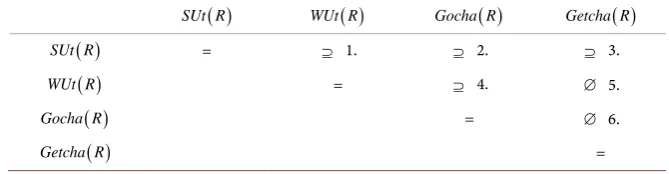
Proposition 2. For a pseudo tournament R defined on A, we have the follow-ing relations (Table 1).
Legend: The symbol ⊇ (resp.=, ∅) indicates that the choice set in column
is always contained in (resp. is equaled to, intersects) the choice set in row.
Proof. See Appendix.
The previous proposition can be summarized by the following Hasse diagram.
We can then notice that WUt is nested between Gocha and Getcha
(Gocha⊆WUt⊆Getcha) and that Getcha⊆SUt. Missing arrows between two
choice sets indicates that the two always intersect and none is included in the other.
Lemma 2.
1) x∈SUt⇔Pred x
( )
⊆Cl x( )
2) x∈WUt⇔PredP
( )
x ⊆ClP( )
x5Duggan [19] also shows that WUt R
( )
is the union of all maximal sets of all maximal acyclicDOI: 10.4236/am.2019.109053 749 Applied Mathematics
Table 1. Comparison of choice procedures. ( )
SUt R WUt R( ) Gocha R( ) Getcha R( )
( )
SUt R = ⊇ 1. ⊇ 2. ⊇ 3.
( )
WUt R = ⊇ 4. ∅ 5.
( )
Gocha R = ∅ 6.
( )
Getcha R =
Proof.
1) (⇒): Let x∈SUt R
( )
.• If Pred x
( )
= ∅ then Pred x( )
⊆Cl x( )
.• If Pred x
( )
≠ ∅ then for y∈Pred x( )
, yRx. And since x∈SUt R( )
, wethen have *
xR y; which implies that y∈Cl x
( )
.( ⇐ ): Let x∈A such that Pred x
( )
⊆Cl x( )
and suppose that( )
x∉SUt R ; then ∃ ∈y A such that yTx . i.e. ∃ ∈y A such that yRx and
(
*)
not xR y . But yRx⇒ ∈y Pred x
( )
(⊆Cl x( )
); which means y∈Cl x( )
, i.e. *xR y: a contradiction.
2) Similar to the previous one.
4. Computational Complexity
In this section we analyze the computational complexity of the weak (resp. strong) Untrapped set. The following algorithm (based on the previous lemma) describes how to get WUt R
( )
for a given pseudo tournament R defined on afinite set A. This algorithm can be considered for SUt R
( )
if PredP( )
x (resp.( )
P
Cl x )) is replaced by Pred x
( )
(resp. Cl x( )
)).Let us mention that deciding whether an alternative is contained in a choice set is computationally equivalent to finding the set [18].
Algorithm 1. Untrapped set for all x in A do
if PredP
( )
x ⊆ClP( )
x then( )
x WUt R∈
end if return WUt R
( )
end for
It has been shown that the transitive closure of each x∈A is computable in
polynomial time. The same holds for the computation of predecessors of x (see
[21] page 137), we can then conclude that deciding whether an alternative is contained in the weak (resp. strong) Untrapped set is in P (class of problems that can be solved in polynomial time).
5. Conclusions
DOI: 10.4236/am.2019.109053 750 Applied Mathematics
tournaments (complete binary relations). This notion depends on the asymme-tric part of the given binary relation. In this paper, we have introduced two ver-sions of the Untrapped choice procedures which have been extended to pseudo tournaments (reflexive and non necessarily complete binary relations). The weak Untrapped (WUt) choice procedure also depends on the asymmetric part of the pseudo tournament while the strong Untrapped choice procedure (SUt) is di-rectly defined by the given pseudo tournament.
We have shown that each of the new choice procedures coincides with the fa-miliar Topcycle choice procedure for tournaments. In case of weak tournaments, the strong Untrapped set is equivalent to Getcha choice procedure and the Weak Untrapped set is exactly the Untrapped set studied by Duggan [18]. We know (see [18]) that for a weak tournament R, we have
( )
( )
( )
(
( )
)
Gocha R ⊆WUt R ⊆Getcha R =SUt R . When R is a pseudo
tourna-ment, we’ve seen (from proposition 2) that the three choice procedures (WUt,
Getcha and Gocha) are all contained in SUt.
In terms of computational complexity, we present an algorithm to compute both the strong and the weak Untrapped choice procedure. This algorithm al-lows us to show that deciding whether an alternative is contained in the strong (or in the weak) Untrapped set is in P (class of problems that can be solved in polynomial time).
Conflicts of Interest
The author declares no conflicts of interest regarding the publication of this pa-per.
References
[1] Eliaz, K. and Ok, E.A. (2006) Indifference or Indecisiveness? Choice-Theoretic Foundations of Incomplete Preferences. Games and Economic Behavior, 56, 61-86. https://doi.org/10.1016/j.geb.2005.06.007
[2] Tapk, I.G. (2007) Revealed Incomplete Preferences under Status-Quo Bias. Mathe-matical Social Sciences, 53, 274-283.
https://doi.org/10.1016/j.mathsocsci.2006.12.003
[3] Gorno, L. (2018) The Structure of Incomplete Preferences. Economic Theory, 66, 159-185.https://doi.org/10.1007/s00199-017-1057-9
[4] Urena, R., Chiclana, F., Morente-Molinera, J.A. and Herrera-Viedma, E. (2015) Managing Incomplete Preference Relations in Decision Making: A Review and Fu-ture Trends. Information Sciences, 302, 14-32.
https://doi.org/10.1016/j.ins.2014.12.061
[5] Zhi, H. and Chao, H. (2018) Three-Way Concept Analysis for Incomplete Formal Contexts. Mathematical Problems in Engineering, 2018, Article ID: 9546846.
https://doi.org/10.1155/2018/9546846
[6] Hill, B. (2016) Incomplete Preferences and Confidence. Journal of Mathematical Economics, 65, 83-103.https://doi.org/10.1016/j.jmateco.2016.05.007
DOI: 10.4236/am.2019.109053 751 Applied Mathematics https://doi.org/10.1007/s00287-017-1023-8
[8] Schwartz, T. (1972) Rationality and the Myth of the Maximum. Nous, 7, 97-117.
https://doi.org/10.2307/2216143
[9] Copeland, A. (1951) A Reasonable Social Welfare Function. Seminar on Applications of Mathematics to Social Sciences, University of Michigan, Ann Arbor (Mimeographed Notes).
[10] Miller, N.R. (1980) A New Solution Set for Tournaments and Majority Voting: Further Graph-Theoretical Approaches to the Theory of Voting. American Journal of Political Science, 24, 68-96.https://doi.org/10.2307/2110925
[11] Laslier, J.-F. (1997) Tournament Solutions and Majority Voting. No. 7, Springer Verlag, Berlin.https://doi.org/10.1007/978-3-642-60805-6
[12] Peris, J.E. and Subiza, B. (1999) Condorcet Choice Correspondences for Weak Tournaments. Social Choice and Welfare, 16, 217-231.
https://doi.org/10.1007/s003550050141
[13] Sanni, M. (2010) Etude des procedures de choix fondees sur des relations binaires. PhD Thesis, Universite de Paris Dauphine, Paris.
[14] Aziz, H., Brandt, F., Elkind, E. and Skowron, P. Computational Social Choice: The First Ten Years and Beyond. In: Steffen, B. and Woeginger, G., Eds., Computing and Software Science, Vol. 10000 of Lecture Notes in Computer Science (LNCS), Springer, Berlin, forthcoming.
[15] Brandt, F., Brill, M. and Harrenstein, B. (2016) Tournament Solutions.
[16] Aziz, H., Brill, M., Fischer, F., Harrenstein, P., Lang, J. and Seedig, H.G. (2015) Possible and Necessary Winners of Partial Tournaments. Journal of Artificial Intel-ligence Research, 54, 493-534.https://doi.org/10.1613/jair.4856
[17] Brandt, F., Brill, M. and Harrenstein, P. (2018) Extending Tournament Solutions.
Social Choice and Welfare, 51, 193-222.https://doi.org/10.1007/s00355-018-1112-x [18] Duggan, J. (2007) A Systematic Approach to the Construction of Non-Empty
Choice Sets. Social Choice and Welfare, 28, 491-506.
https://doi.org/10.1007/s00355-006-0176-1
[19] Brandt, F., Brill, M. and Harrenstein, P. (2014) Extending Tournament Solutions. 28th AAAI Conference on Artificial Intelligence, Québec City, 27-31 July 2014. [20] Deb, R. (1977) On Schwartz’s Rule. Journal of Economic Theory, 16, 103-110.
https://doi.org/10.1016/0022-0531(77)90125-9
DOI: 10.4236/am.2019.109053 752 Applied Mathematics
Appendix
Proof of Proposition 2
1) WUt R
( )
⊆SUt R( )
.Let R be a pseudo tournament defined on A. x∈WUt R
( )
⇒ ∀ ∈y A,(
)
not yPx or xP y* ⇒ ∀ ∈y A, not yPx
(
)
or xR y* ⇒ ∈x SUt R( )
.2) Gocha R
( )
⊆SUt R( )
.According to proof 4. and 1., we have respectively Gocha R
( )
⊆WUt R( )
and( )
( )
WUt R ⊆SUt R .
3) Getcha R
( )
⊆SUt R( )
.Let R be a pseudo tournament defined on A and let x∈Getcha R
( )
.Suppose x∉SUt R
( )
. Then ∃ ∈y A such that yTx i.e. yPx and(
*)
not xR y . A contradiction since x∈Getcha R
( )
and Getcha R( )
=M R( )
* . 4) Gocha R( )
⊆WUt R( )
.Let R be a pseudo tournament defined on A and let x∈Gocha R
( )
.Suppose x∉WUt R
( )
. Then ∃ ∈y A such that yTx . i.e. yPx and(
*)
not xP y : which is not possible since x∈Gocha R
( )
and( )
( )
*Gocha R =M P .
5) WUt R
( )
∅Getcha R( )
.Let’s show that any minimal weak dominant set intersects the weaak Un-trapped set.
Consider a minimal weak dominant set D′ and suppose that
( )
WUt R D′ = ∅. Then for x∈D′ we have x∉WUt R
( )
. So ∃ ∈y WUt R( )
such that yPx. Which is not possible because y∉D′ and x∈D′.
The above example shows that none of Getcha and WUt choice procedure is included in the other.
6) Gocha R
( )
∅Getcha R( )
.Note that every weak dominant set is a weak undominated set. So every mi-nimal weak dominant set contains at least one mimi-nimal weak undominated set. We then have Gocha R