ISSN Online: 2333-9721 ISSN Print: 2333-9705
DOI: 10.4236/oalib.1105245 Mar. 20, 2019 1 Open Access Library Journal
Fixed Point Results for K-Iteration Using
Non-Linear Type Mappings
Anju Panwar
1, Ravi Parkash Bhokal
2*1Department of Mathematics, M. D. U. Rohtak, Haryana, India 2Government College, Dujana, Jhajjar (Haryana), India
Abstract
In this paper we establish convergence and stability results using general con-tractive condition, quasi-nonexpansive mapping and mean non expansive mapping for K-iteration process. We shall also generalize the K-iteration process for a pair of distinct mappings and with the help of example we claim that the generalized iteration process has better convergence rate than the K-iteration process for single mapping and some of the existing iteration processes. Suitable examples are given in the support of main results.
Subject Areas
Mathematical Analysis
Keywords
K-Iteration Process, Opial’s Condition, Mean Non-Expansive Mapping, Quasi Non-Expansive Mapping
1. Introduction and Preliminary Definitions
Let
(
X d,)
be a metric space and T X: →X be a self map defined on X. Let( ) {
:}
F T = ∈z X Tz z= denote the set of fixed point of T. For x0∈X, the
se-quence
{ }
xn n∞0= defined by
1 , 0,
n n
x+ =Tx n≥ (1.1)
is called the Picard iteration.
For x0∈X, the sequence
{ }
xn n 0∞
= defined by
(
)
1 1 , 0,
n n n n n
x+ = −
α
x +α
Tx n≥ (1.2)where
{ }
αn n∞0= is a sequence in
[ ]
0,1 such that n 0αn∞
= = ∞
∑
is called the*Corrosponding author. How to cite this paper: Panwar, A. and
Bhokal, R.P. (2019) Fixed Point Results for K-Iteration Using Non-Linear Type Mappings. Open Access Library Journal, 6: e5245.
https://doi.org/10.4236/oalib.1105245
Received: February 13, 2019 Accepted: March 17, 2019 Published: March 20, 2019
Copyright © 2019 by author(s) and Open Access Library Inc.
This work is licensed under the Creative Commons Attribution International License (CC BY 4.0).
http://creativecommons.org/licenses/by/4.0/
DOI: 10.4236/oalib.1105245 2 Open Access Library Journal Mann iteration process [1].
In 2013, Khan [2] produced a new type of iteration process by introducing the concept of the following Picard-Mann hybrid iterative process for a single map-ping T. For the initial value x0∈X, the sequence
{ }
xn n 0∞
= defined by
1
n n
x+ =Ty ,
(
1)
, 0,n n n n n
y = −
α
x +α
Tx n≥ (1.3)where
{ }
αn n∞0= is a sequence in
[ ]
0,1 .Khan [2] showed that the rate of convergence of Picard-Mann hybrid iterative process is more than the Picard iteration scheme, Mann iteration scheme [1] and Ishikawa iterative schemes [3].
In this direction Gursoy and Karakaya [4], gave new iteration process as follows: For the initial value x0∈X , the sequence
{ }
xn n 0∞
= defined by
(
)
(
)
1
1 ,
1 ,
n n n n n
n n n n n
n n
z x Tx
y Tx Tz
x Ty
β β
α α
+
= − +
= − +
=
(1.4)
where
{ }
αn n∞0= ,
{ }
βn n 0∞
= is a sequence in
[ ]
0,1 is known as Picard-S iterative process. By giving appropriate example, Gursoy and Karakaya [4] proved that their iterative process has better convergence rate than Picard, Mann, Ishikawa, Noor and Normal-S iterative processes.Karakaya et al. in their paper [5], introduced a new hybrid iterative process as
(
)
(
)
0
1 ,
1 ,
1
n n n n n n n n n n
x X
y T x Tx
x T y Ty
β
β
α
α
+
∈
= − +
= − +
(1.5)
where
{ }
αn n∞0= ,
{ }
βn n 0∞
= is a sequence in
[ ]
0,1 .With the help of suitable example it was claimed by Karakaya et al. [5], that their iteration process converges faster than the iteration process of Gursoy and Karakaya [4].
In 2016, Thakur et al. [6] introduced a new iteration scheme called Thakur New Iteration Scheme as for the initial value x0∈X, the sequence
{ }
xn n 0∞ = defined by
(
)
(
)
1
1 ,
1 ,
n n n n n n n n n n n n
z x Tx
y T x z
x Ty
β
β
α
α
+
= − +
= − +
=
(1.6)
where
{ }
αn n 0∞
= ,
{ }
βn n 0∞
= is a sequence in
[ ]
0,1 .In [6] it was claimed that the Thakur New Iteration Scheme has higher con-vergence rate than the iteration process of Karakaya et al. [7].
DOI: 10.4236/oalib.1105245 3 Open Access Library Journal For the initial value x0∈X , the sequence
{ }
xn n 0∞
= defined by
(
)
(
)
1
1 ,
1 ,
n n n n n n n n n n n n
z x Tx
y T Tx Tz
x Ty
β
β
α
α
+
= − +
= − +
=
(1.7)
where
{ }
αn n∞0= ,
{ }
βn n 0∞
= is a sequence in
[ ]
0,1 .In the present work we shall generalize some convergence and stability results for K-iteration process. We shall also prove convergence and stability results for more general form of K-iteration process and K-iteration process for a pair of two distinct mappings.
Definition 1.1 [3]: Let X be a real Banach space. The mapping T X : →X
is said to be asymptotically quasi-nonexpansive if F T
( )
≠ ∅ and there exists a sequence{ }
µ
n ⊂[
0,∞)
with µ →n 0 as n→ ∞ such that(
1)
n
n
T x q− ≤ +µ x q− (1.8)
for all x X q F T∈ , ∈
( )
and n≥0.Definition 1.2 [9]: Let X be a real Banach space. The mapping T X : →X
is said to be mean non-expansive if there exists two non negative real numbers ,
a b such that a b+ ≤1 and for all x y X, ∈ , Tx Ty− =a x y b x Ty− + −
Definition 1.3 [10]: Let
{ }
zn n∞=0 be any sequence in X. Then the iterative process xn+1 = f T x(
, n)
which converges to a fixed point q, is said to be stablewith respect to the mapping T if for ϕn = zn+1− f T z
(
, n)
,n=0,1,2,, we havelimn→∞ϕn=0 if and only if limn→∞zn=q.
Definition 1.4 [7]: A space X is said to satisfy Opial’s condition if for each sequence
{ }
xn n∞=0 in X such that xn converges weakly to x we have for ally X∈ , x y≠ following holds:
1) liminfn→∞ x xn− <liminfn→∞ xn−y ,
2) limsupn→∞ x xn− <limsupn→∞ xn−y .
Lemma 1.5 [11]: Let
{ }
an n∞=0 and{ }
bn n∞=0 be non-negative real sequences satisfying the inequality:(
)
1 1
n n n n
a+ ≤ −b a b+ ,
where bn∈
( )
0,1 , for all n N∈ , n1bn∞
= = ∞
∑
and n 0n
b
a → as n→ ∞, then
limn→∞an =0.
Lemma 1.6 [12]: Let δ be a real number such that 0≤ <δ 1, and
{ }
n n∞=0 be a sequence of positive numbers such that limn→∞n=0. Then for any se-quence of positive numbers{ }
an n∞=0 satisfying an+1≤δan+n,n=0,1,2,, wehave limn→∞an =0.
Lemma 1.7 [13]: Let X be a real Banach space and
{ }
gn be any sequence inX such that 0<gn <1 for all n N∈ . Let
{ }
an n 0∞
= and
{ }
bn n 0∞ = be non-negative real sequences satisfying limsup n
n→∞ a c
≤ , limsup n n→∞ b c
≤ and
(
)
limsup n n 1 n n
DOI: 10.4236/oalib.1105245 4 Open Access Library Journal
2. Main Results
Theorem 2.1: Let X be a Banach space and T X : →X be a mapping satisfying
the condition
Tx q− ≤
δ
x q− (2.1)where q F x X∈ , ∈ and 0≤ <δ 1. Let
{ }
0
n n
x ∞
= be the sequence defined by the K-iterative process given by (1.7). Then the sequence
{ }
xn n∞=0 converges strongly to q F T∈( )
.Proof: From (1.7) and (2.1) we have,
1
n n n
x+ − =q Ty q− ≤
δ
Ty q− (2.2)And
(
)
(
)
(
)
(
)(
)
(
)
(
)
(
)
(
)
2
1 1 1 1 1 1
n n n n n
n n n n
n n n n
n n n n
n n n n
n n n n
y q T Tx Tz q
Tx Tz q
Tx q Tz q
Tx q Tz q
Tx q Tz q
x q z q
α α
δ α α
δ α α
δ α α
δ α α
δ α α
− = − + −
≤ − + −
≤ − − + −
≤ − − + −
≤ − − + −
≤ − − + −
(2.3)
Again using (1.7) and (2.1) we get,
(
)
(
)
(
)
1 1 1
n n n n n n n n n n n n n
z q x Tx q
x q Tx q
x q x q
β
β
β
β
β
β δ
− = − −
≤ − − + −
≤ − − + −
+
(2.4)
Using (2.4) in (2.3) we get,
(
)
(
)
(
)
(
)
(
)
(
)
2 2 2
1 1
1 1
1 1
n n n n n n n n n
n n n n n n
n n n
y q x q x q x q
x q x q
δ α α β α β δ
δ α α β α β δ
δ α β δ
− ≤ − − + − − + −
≤ − + − + −
≤ − − −
(2.5)
Using (2.5) in (2.2) we get,
(
)
(
)
3
1 1 1
n n n n
x+ −q ≤δ −α β −δ x −q
Since 0≤ <
δ
1,α
n∈[
0,1)
and n 0αn∞
= = ∞
∑
. Hence by using lemma (1.6),we have
1
lim n 0.
n→∞ x+ −q =
Hence the sequence
{ }
xn n∞=0 converges strongly to q.Corollary 2.2: (Akewe and Okeke [14]) Let X be a Banach space and :
T X →X be a mapping satisfying the condition
Tx q− ≤
δ
x q−where q F x X∈ , ∈ and 0≤ <δ 1. Let
{ }
xn n∞0= be the sequence defined by the Picard-Mann hybrid iterative process given by (1.3). Then the sequence
{ }
xn n∞0DOI: 10.4236/oalib.1105245 5 Open Access Library Journal Remark 2.3: Theorem 2.1 gives generalization to many results in the literature by considering a wider class of contractive type operators and more general iter-ative process, including the results of Chidume [15], Bosede and Rhoades [16] and Akewe and Okeke [14].
Theorem 2.4: Let X be a Banach space and T X : →X be a mapping
satis-fying the condition
Tx q− ≤
δ
x q−where q F x X∈ , ∈ and 0≤ <δ 1. Let
{ }
xn n∞0= be the sequence defined by the K-iterative process given by (1.7). Then the iteration process (1.7) is T-stable.
Proof: By theorem 2.1, the sequence
{ }
xn n∞=0 converges strongly to q. Let{ }
un n∞=0,{ }
vn n∞=0 and{ }
wn n∞=0 be real sequences in X. Letϕ
n = un+1−Tv nn , =0,1,2,, where(
1)
n n n n n
w = −
β
u +β
Tu ,(
)
(
1)
n n n n n
v =T −α Tu +α Tw ,
1
n n
u+ =Tv ,
and let limn→∞ϕn=0.
We shall prove that limn→∞un=q.
Now,
1 1
n n n n n n
u q u Tv Tv q
v q
ϕ δ
+ − = + − + −
≤ + − (2.6)
(
)
(
)
(
)
(
)(
)
(
)
(
)
(
)
(
)
2
1 1 1 1 1 1
n n n n n
n n n n
n n n n
n n n n
n n n n
n n n n
v q T Tu Tw q
Tu Tw q
Tu q Tw q
Tu q Tw q
Tu q Tw q
u q w q
α α
δ α α
δ α α
δ α α
δ α α
δ α α
− = − + −
≤ − + −
≤ − − + −
≤ − − + −
≤ − − + −
≤ − − −
+
(2.7)
Again using (1.7) and (2.1) we get,
(
)
(
)
(
)
(
)
(
)
1 1 1
1 1
n n n n n n n n n n n n n n n
w q u Tu q
u q Tu q
u q u q
u q
β β
β β
β β δ
β δ
− = − + −
≤ − − + −
≤ − − + −
≤ − − −
(2.8)
Using (2.8) in (2.7) we get,
(
)
(
(
)
)
(
)
(
)
2 2
1 1 1
1 1
n n n n n n
n n n
v q u q u q
u q
δ α α β δ
δ α β δ
− ≤ − − + − − −
≤ − − − (2.9)
Using (2.9) in (2.6) we get,
(
)
(
)
3
1 1 1
n n n n n
DOI: 10.4236/oalib.1105245 6 Open Access Library Journal Since 0≤ <δ 1 and since 0≤α βn, n≤1 we have by lemma (1.6)
lim n .
n→∞u =q
Conversely let limn→∞un =q. We shall show that limn→∞ϕn=0.
Now
1
1
1
n n n
n n
n n
u Tv
u q Tq Tv
u q v q
ϕ
δ
+ + +
= −
≤ − + −
≤ − + −
(2.11)
Substituting (2.9) in (2.11),
(
)
(
)
3
1 1 1
n un q n n un q
ϕ ≤ + − +δ −α β −δ − (2.12)
Since limn→∞un=q , we have from (2.12) limn→∞ϕn=0 . Hence the
K-iteration scheme is T-stable.
From theorem 2.4, we have the following corollary.
Corollary 2.5: Let X be a Banach space and T X : →X be a mapping
satis-fying the condition
Tx q− ≤
δ
x q− ,where q F x X∈ , ∈ and 0≤ <δ 1. Let
{ }
xn n∞=0 be the sequence defined by the Picard-Mann hybrid iterative process given by (1.3). Then the iteration process (1.3) is T-stable.Example 2.6: Let X =
[ ]
0,1 and consider the mapping 2x
Tx= . The clearly
the mapping T satisfies the inequality (2.1). Now F T
( )
=0. Now we claim thatthe K-iteration scheme (1.7) is T-stable. Let us take αn=βn=12 and consider
the sequences xn =yn =zn =n1. Then clearly limn→∞xn =0.
Now
(
)
(
)
(
)
(
)
(
)
(
)
(
)
(
)
1 1
1
1
1
1
1
2 1
2 1
4 1
8 8
1 1
8 8 8
1 1
8 8 16
1 1 1 1 1
1 16 32 64
n
n n n n
n n n n
n
n n n n
n
n n n n
n
n n n n n n n n
n
n n n n n n n n
n
y
x Ty x
T Tx Tz
x
Tx Tz
x
x z
x
x x Tx
x
x x x
x
n n n n
ϕ
α α
α α
α α
α α β α β
α α β α β
+ +
+
+
+
+
+
= − = −
− +
= −
− +
= −
−
= − +
− −
= − + +
− −
= − + +
= − + + =
+
DOI: 10.4236/oalib.1105245 7 Open Access Library Journal
(
)
(
)
1 7 7 1
8 1 8 1
n n
n n n
− −
= =
+ + (2.13)
Taking limit n→ ∞ in (2.13), we have limn→∞ϕn =0. Hence the K-iteration process is T-stable.
Now we shall prove the convergence and stability results for asymptotically quasi-nonexpansive mapping by considering the more general form of K-iteration process as:
(
1)
nn n n n n
z = −β x +β T x ,
(
)
(
1)
n n n
n n n n n
y =T −α T x +α T z ,
1 n
n n
x+ =T y , where n=0,1, 2,, (2.14)
Theorem 2.7: Let H be a non-empty closed convex subset of a Banach space X
and T H: →H be asymptotically quasi-nonexpansive mapping with real
se-quence
µ
n⊆[
0,∞)
. Let{ }
xn n 0∞
= be the sequence defined by the K-iterative process given by (2.14) and satisfies the assumption that n 0α β µn n n
∞
= = ∞
∑
.Then the sequence
{ }
xn n∞0= converges strongly to some fixed point q of the mapping T.
Proof: From the iterative process (2.14) we have,
(
)
(
)
(
)
(
)
(
)
1 1
1 1
1
n
n n n n n
n
n n n n
n n n n n
n n n
z q x T x q
x q T x q
x q x q
x q
β β
β β
β β µ
β µ
− = − + −
≤ − − + −
≤ − − + + −
≤ + −
(2.15)
and
(
)
(
)
(
) (
)
(
) (
)
(
)
(
)
(
) (
)
1
1 1
1 1
1 1
n n n
n n n n n
n n
n n n n n
n n
n n n n n
n n
n n n n n
y q T T x T z q
T x T z q
T x q T z q
T x q T z q
α α
µ α α
µ α α
µ α α
− = − + −
≤ + − + −
≤ + − − + −
≤ + − − + −
(
) (
)(
)
(
)
(
) (
)
(
) (
)
(
)
(
) (
)
2
2
2
1 1 1 1
1 1
1 1 1
1 1
n n n n n n n
n n n n n
n n n n n n n
n n n n n
x q z q
x q z q
x q x q
x q
µ α µ α µ
µ α α
µ α α β µ
µ α β µ
≤ + − + − + + −
≤ + − − + −
≤ + − − + + −
≤ + −
−
(2.16)
Again using (2.14) we have,
(
)
(
) (
)
1
3 1
1 1
n
n n
n n
n n n n n
x q T y q
y q
x q µ
µ α β µ
+ − ≤ −
≤ + −
≤ + − −
DOI: 10.4236/oalib.1105245 8 Open Access Library Journal By repeating the above process, we have the following inequalities
(
) (
3)
1 1 1
n n n n n n
x+ −q ≤ +µ −α β µ x −q
(
) (
3)
1 1 1 1 1
1 1
n n n n n n
x −q ≤ +µ− −α β µ− − − x− −q
(
) (
3)
1 1 2 1 2 2 2 2
n n n n n n
x− −q ≤ +µ− −α β µ− − − x− −q
(
) (
3)
1 1 0 1 0 0 0 0
x q− ≤ +µ −α β µ x −q So we can write,
(
)
3( 1)(
)
1 1 0 0 0 1
n n
n j j j j
x q µ + x q α β µ
+ − ≤ + −
∏
= −Since 1− ≤x e−x for all x 0,1∈
[ ]
. Now 1 1j j j α β µ
− < , so we can write,
(
)
( ) ( )(
)
( ) 01 3 1
1 0 0
3 1
0 0
1 e
1 e
j j j
n j j j j
n n
n
x q x q
x q
α β µ
α β µ
µ
µ =
− − +
+
−
+ ∑
− ≤ + −
≤ + − (2.18)
Taking limit n→ ∞ in (2.18), we have limn→∞ x qn− =0, that is the se-quence
{ }
xn n∞=0 converges strongly to fixed point q of the mapping T.Theorem 2.8: Let H be a non-empty closed convex subset of a Banach space X
and T H: →H be asymptotically quasi-nonexpansive mapping with real
se-quence
µ
n⊆[
0,∞)
. Let{ }
xn n 0∞
= be the sequence defined by the K-iterative process given by (2.14) and satisfies the assumption that n 0α β µn n n
∞
= = ∞
∑
.Then the iterative process (2.14) is T-stable.
Proof: Let
{ }
un n∞=0⊂X be any arbitrary sequence. Let the sequence gener-ated by the iterative process (2.14) is xn+1= f T x(
, n)
converging to the fixedpoint q.
Let ϕn = un+1−f T x
(
, n)
.We shall prove that limn→∞ϕn=0 if and only if limn→∞un=q.
First suppose limn→∞ϕn=0. Now we have
(
)
(
)
(
)
(
(
)
)
(
)
(
) (
)
1 1
3
, ,
1 1
1 1
n n n n
n n n n n
n n n n n n n n n n n n n n
u q u f T u f T u q
T T T u T u T u q
x q
ϕ β β α α
ϕ µ α β µ
+ − = + − + −
= + − + − + −
≤ + + − −
(2.19)
where
α β
n, n∈[ ]
0,1 , limn→∞ϕn=0 and limn→∞µn=0.Now using (2.19) together with lemma (1.5), we have limn→∞ u qn− =0 that is limn→∞un=q.
Conversely let limn→∞un =q. we have
(
)
(
)
(
) (
)
1
1
3 1
, ,
1 1
n n n
n n
n n n n n n
u f T u
u q f T u q
u q u q
ϕ
µ α β µ
+
+
+
= −
≤ − + −
≤ − + + − −
Taking limit n→ ∞ both sides of (6) we have limn→∞ϕn =0. Hence (2.14) is T-stable.
DOI: 10.4236/oalib.1105245 9 Open Access Library Journal by modifying the K-iteration process for two mappings as:
(
1)
n n n n n
z = −
β
x +β
Sx ,(
)
(
1)
n n n n n
y =T −α Sx +α Tz ,
1
n n
x+ =Ty , where n=0,1, 2,, (2.20)
Lemma 2.9: Let H be a non-empty closed convex subset of a Banach space X
and S T H, : →H be two mean non-expansive mapping such that
( )
( )
F F T= F S ≠
φ
. Let{ }
xn n 0∞
= be the sequence defined by the K-iterative process given by (2.20). Then limn→∞ x qn− exists for some q F∈ .
Proof: We have
(
)
(
)
(
)
(
)
(
)
(
)
1 1
1 1
1 1
1 1
n n n n n
n n n n
n n n n n
n n n n
n
z q x Sx q
x q Sx q
x q a x q b x q
x q a b x q
x q
β β
β β
β β
β β
− = − + −
≤ − − + −
≤ − − + − + −
≤ − − + + −
≤ −
(2.21)
Again using (2.20) and (2.21)
(
)
(
)
(
)
(
)
(
(
)
)
(
) (
(
)
)
(
)
2 2
2 2
1
1 1
1
1 ?
n n n n n
n n n n n n n n
n n n n
n n n n
y q T Sx Tz q
a Sx Tz q b Sx Tz q
a b Sx Tz q
Sx q Tz q
α α
α α α α
α α
α α
− = − + −
≤ − + − + − + −
≤ + − + −
≤ − − + −
(
)
(
)
(
)
(
)(
)
(
)
(
)
1 1 2 2
1 1 2 2
1 1 1
n n n n n n
n n n n
n n n n
n
a x q b x q a z q b z q
a b x q a b z q
x q z q
x q
α α
α α
α α
≤ − − + − + − + −
≤ − + − + −
≤ − − + −
≤ −
+
(2.22)
Again using (2.20) and (2.22)
(
)
1
2 2
2 2
n n
n n
n n
n
x q Ty q
a y q b y q
a b y q
y q x q
+ − ≤ −
≤ − + −
≤ + −
≤ −
≤ −
(2.23)
This shows that
{
xn−q}
is non-increasing and bounded sequence for q F∈ . Hence limn→∞ x qn− exists.Lemma 2.10: Let 𝐻𝐻 be a non-empty closed convex subset of a Banach space
𝑋𝑋 and S T H, : →H be two mean non-expansive mapping such that
( )
( )
F F T= F S ≠
φ
. Let{ }
xn n 0∞
= be the sequence defined by the K-iterative process given by (2.20). Also consider that
DOI: 10.4236/oalib.1105245 10 Open Access Library Journal Proof: Let q F∈ . In lemma (2.9) we have proved the existence of
limn→∞ x qn− . Let limn→∞ x q cn− = . (2.24)
W.L.O.G. let c>0.
Now from (2.20) and (2.24) we have,
limsup n limsup n
n→∞ z −q ≤ n→∞ x q− =c (2.25)
Now
(
11 1)
1n n n
n n
Sx q a x q b x q
a b x q x q
− ≤ − + −
≤ + − ≤ −
Implies that limsup n limsup n
n→∞ Sx q− ≤ n→∞ x q− =c (2.26)
Now
(
)
(
)
(
)
(
)
(
)
(
(
)
)
(
) (
(
)
)
1 2 2
2 2
2 2
2 2
1
1 1
1
n n n n
n n n n n n
n n n n n n n n n n n n
x q Ty q a y q b y q
a b y q y q
T Sx Tz q
a Sx Tz q b Sx Tz q
a b Sx Tz q
α α
α α α α
α α
+ − ≤ − ≤ − + −
≤ − ≤ −
≤ − + −
≤ − + − + − + −
≤ + − + −
+
(
)
(
)
(
)
(
)
(
)(
)
(
)
(
)
1 1 2 2
1 1 2 2
1 1 1 1
n n n n
n n n n n n
n n n n
n n n n n n n n n
Sx q Tz q
a x q b x q a z q b z q
a b x q a b z q
x q z q
x q x q z q
α α
α α
α α
α α
α α
≤ − − + −
≤ − − + − + − + −
≤ − + − + −
≤ − − + −
≤ − − − + −
+
1
n n
n n n
x q x q
z q x q
α
+ − − −
⇒ = − − −
and hence
1
1 n n
n n n n
n
x q x q
x q x q z q x q
α
+ +
− − −
− − − ≤ = − − −
which implies that xn+1− ≤q z qn− (2.27)
Taking limit inferior in (2.27) we obtain
liminfc≤ n→∞ zn−q (2.28)
From (2.20) and (2.28) we have
(
)
(
) (
)(
)
lim lim 1
lim 1
n n
n n n n n
n n n n n
c z q
x Sx q
Sx q x q
β β
β β
→∞
→∞
→∞
= −
= − + −
= − + − −
(2.29)
DOI: 10.4236/oalib.1105245 11 Open Access Library Journal
2 2
n n n n
Tx q a x q b x q− ≤ − + − ≤ x q−
limsup n limsup n n→∞ Tx q n→∞ x q c
⇒ − ≤ − ≤ (2.30)
Using the conditions of the lemma in (2.30), we can write
(
) (
)(
)
lim n n 1 n n
n
C β Tx q β x q
→∞
= − + − − (2.31)
Using (2.24), (2.30), (2.31) along with the lemma (1.7), we have limn→∞ Tx xn− n =0.
Theorem 2.11: Let H be a non-empty closed convex subset of a Banach space
X satisfying Opial’s condition and S, T and
{ }
xn n∞0= be same as defined in the lemma (2.10) .Then the sequence
{ }
xn n∞=0 converges weakly to some q F∈ .Proof: From lemma (2.10) we have, limn→∞ Tx xn− n =0.
Since X is uniformly convex and hence it is reflexive so there exists a subse-quence
{ }
xnm of{ }
xn such that{ }
xnm converges weakly to some q1∈F. Since H is closed so q1∈H . Now we claim the weak convergence of{ }
xn to1
q . Let it is not true, then there exists a subsequence of
{ }
xni of{ }
xn whichconverges weakly to q2 and let q1≠q2. Also q2∈F. Now from lemma (2.9) 1
limn→∞ x qn− and limn→∞ x qn− 2 both exist. Using Opial’s condition we have,
1 1 2
2 2
1 1
lim lim lim
lim lim
lim lim
m m
i
i
n n n
n n n
n n n n n n n n
x q x q x q
x q x q
x q x q
→∞ →∞ →∞
→∞ →∞
→∞ →∞
− ≤ − < −
= − =
≤
− −
−
<
This is a contradiction, so we must have q1=q2. Thus the sequence
{ }
xn n 0∞ = converges weakly to some q F∈ .
Theorem 2.12: Let H be a non-empty closed compact subset of a Banach space X and S, T and
{ }
xn n∞=0 be same as defined in the lemma (2.10). Then the sequence{ }
xn n∞=0 converges strongly to some q F∈ .Proof: Since H is compact and hence it is sequentially compact. So there exists a subsequence
{ }
xni of{ }
xn which converges to q H∈ .Now
2 2
i i i i
i i i i
i i i
n n n n
n n n n
n n n
x Tq x Tx Tx Tq
x Tx a x q b x q
x Tx x q
− = − + −
≤ − + − + −
≤ − + −
(2.32)
Taking limit n→ ∞ in (2.32) we have, Tq q= that is q F∈ . We have
ear-lier proved that limn→∞ x qn− exists for q F∈ . Hence the sequence
{ }
xn n 0∞ = converges strongly to some q F∈ .
DOI: 10.4236/oalib.1105245 12 Open Access Library Journal
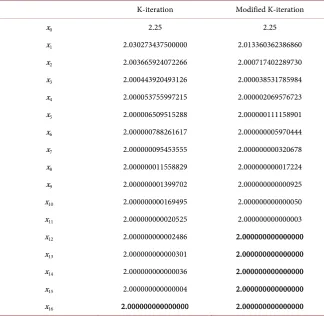
Table 1. Iterative values of K-iteration process and Modified K-iteration process. K-iteration Modified K-iteration
x0 2.25 2.25
x1 2.030273437500000 2.013360362386860
x2 2.003665924072266 2.000717402289730
x3 2.000443920493126 2.000038531785984
x4 2.000053755997215 2.000002069576723
x5 2.000006509515288 2.000000111158901
x6 2.000000788261617 2.000000005970444
x7 2.000000095453555 2.000000000320678
x8 2.000000011558829 2.000000000017224
x9 2.000000001399702 2.000000000000925
x10 2.000000000169495 2.000000000000050
x11 2.000000000020525 2.000000000000003
x12 2.000000000002486 2.000000000000000
x13 2.000000000000301 2.000000000000000
x14 2.000000000000036 2.000000000000000
x15 2.000000000000004 2.000000000000000
x16 2.000000000000000 2.000000000000000
Example 2.13: Let S T, : 0,3
[ ] [ ]
→ 0,3 be two mappings defined by( )
22
x
T x = + and s x
( ) (
= +x 2)
12 . Let α βn, n be the sequences defined by1 4
n n
α =β = . Let the initial approximation be x0 =2.25. Clearly S, T has
unique common fixed point 2. The convergence pattern of K-iteration process and modified K-iteration process is shown in Table 1.
Clearly we can conclude from Table 1, that the modified K-iteration process has better rate of convergence than the k-iteration process.
Conflicts of Interest
The authors declare no conflicts of interest regarding the publication of this paper.
References
[1] Mann, W.R. (1953) Mean Value Methods in Iteration. Proceedings of the American Mathematical Society, 4, 506-510.
https://doi.org/10.1090/S0002-9939-1953-0054846-3
[2] Khan, S.H. (2013) A Picard-Mann Hybrid Iterative Process. Fixed Point Theory and Applications, 2013, 69. https://doi.org/10.1186/1687-1812-2013-69
DOI: 10.4236/oalib.1105245 13 Open Access Library Journal
https://doi.org/10.1090/S0002-9939-1974-0336469-5
[4] Gursoy, F. and Karakaya, V. (2014) A Picard-S Hybrid Type Iteration Method for Solving a Differential Equation with Retared Arguments. 1-16.
[5] Karakaya, V., Bouzara, N.E.H., Dogan, K. and Atalan, Y. (2015) On Different Re-sults for a New Two Step Iteration Method under Weak Contraction Mapping in Banach Spaces. 1-10. arXiv:1507.00200v1
[6] Thakur, B.S., Thakur, D. and Postolache, M. (2016) A New Iterative Scheme for Numerical Reckoning Fixed Points of Suzuki’s Generalized Non-Expansive Map-pings. Applied Mathematics and Computation, 275, 147-155.
https://doi.org/10.1016/j.amc.2015.11.065
[7] Opial, Z. (1967) Weak Convergence of the Sequence of Successive Approximations for Non-Expansive Mappings. Bulletin of the American Mathematical Society, 73, 595-597. https://doi.org/10.1090/S0002-9904-1967-11761-0
[8] Hussain, N., Ullah, K. and Arshad, M. (2018) Fixed Point Approximation of Suzuki Generalized Non-Expansive Mapping via New Faster Iterative Process. arxiv 1802.09888v
[9] Zhang, S.S. (1975) About Fixed Point Theory for Mean Non Expansive Mappings in Banach Spaces. Journal of Sichuan University, 2, 67-78.
[10] Harder, A.M. (1987) Fixed Point Theory and Stability Results for Fixed Point Itera-tion Procedure. University of Missouri-Rolla, Missouri.
[11] Weng, X. (1991) Fixed Point Iteration for Local Strictly Pseudo-Contractive Map-ping. Proceedings of the American Mathematical Society, 113, 727-731.
https://doi.org/10.1090/S0002-9939-1991-1086345-8
[12] Berinde, V. (2002) On the Stability of Some Fixed Point Procedures. Buletinul ştiinţific al Universitatii Baia Mare, Seria B, Fascicola matematică-informatică, 18, 7-14.
[13] Sahu, J. (1991) Weak and Strong Convergence to Fixed Points of Asymptotically Non-Expansive Mappings. Bulletin of the Australian Mathematical Society, 43, 153-159. https://doi.org/10.1017/S0004972700028884
[14] Akewe, H. and Okeke, G.A. (2015) Convergence and Stability Theorems for the Pi-card-Mann Hybrid Iterative Scheme for a General Class of Contractive-Like Oper-ators. Fixed Point Theory and Applications, 2015, 66.
[15] Chidume, C.E. (2014) Strong Convergence and Stability of Picard Iteration Se-quence for General Class of Contractive-Type Mappings. Fixed Point Theory and Applications, 2014, 233. https://doi.org/10.1186/1687-1812-2014-233