The Analysis of Stiffness for Rubbery Metallic
Material Based on Mesoscopic Features
Hong Zuo1*, Hongbai Bai2, Yuhong Feng3
1MOE Key Laboratory for Strength and Vibration, School of Aerospace, Xi’an Jiaotong University, Xi’an, China; 2Department of
Gun Engineering, Ordnance Engineering College, Shijiazhuang, China; 3School of Material Science & Engineering, Xi’an Jiaotong
University, Xi’an, China. Email: [email protected]
Received November 23rd, 2010; revised December 15th, 2010; accepted May 17th, 2011.
ABSTRACT
In this article, deformation and mechanical response of a rubbery metallic material were investigated. First, the mesoscopic structural properties of the material and its evolution during part producing were analyzed and described in detail. Then the inherence relationship between the macroscopic mechanical properties and mesoscopic structural characteristics were studied, in which the related mesoscopic structural characteristics were limited in the basic unit (mm) scale such as the radius of metal wire and unit coil, etc. Furthermore, according to the mesoscopic properties of the material, a curved beam unit based on the mesoscopic scale and shape factor was introduced to bridge the me-chanical response and the mesoscopic parameters such as the beam orientation and spatial distribution. In the end, a mesoscopic stiffness model was proposed, from which the macroscopic mechanical properties of material could be de-duced from the mesoscopic characteristic size, shape and the mechanical properties of base metallic material.
Keywords: Rubbery Metallic Material, Stiffness Model, Mesoscopic Characteristic
1. Introduction
In recent years, a kind of rubbery metallic material (RMM) has been applied as some kinds of seal material, heat shield material, filters, gaskets and aircraft engine mounts in a large number of industrial fields where crude rubber material have been usually served, owing to its excellent applicability of environment and longer life. Among these applications, the most exciting lies in its application in aerospace as a vibration absorber since the space environment needs the absorber possesses a wide range of temperature adaptability and more than several years life, while crude rubber cannot competent for. Ex-cept of this, this material also has lower density and ex-cellent mechanical properties. Considering the mechani-cal behavior such as the stiffness and deformation re-sponding for the applied loads play an important role during the damping material design and application, it should be further investigated.
Although RMM has been applied as a damping part in the aerospace for a longtime, there still need sufficient investigation in several fields such as its application and mechanical behavior. According to the studies from open literature, we only find that fewer tests conducted by
and co-workers [6-8] reported that RMM dampers in parallel with a squirrel cage allow wider control of the support stiffness. They showed RMM could work even at cryogenic temperatures. They also conducted the endur-ance tests on these dampers over six months and showed little to no change in the damping characteristics. They reports the dynamic characteristics of the material are dependent on the radial strain amplitude and axial strain (compression), and they also suggested the effect of axial thickness of the mesh have to be studied.
It is well-known that material mechanical response is usually influenced by many factors, e.g., the parameters from forming procedures, mechanical properties and size of the base mater. However, there are few investigations in this field were obtained from the open literatures till now. Especially, there has no study focused on the mesoscopic characteristic and stiffness response was proposed. Thus, the purpose of the present study is to investigate the relationship between the mesoscopic fea-tures of the material and macroscopic stiffness behavior during the material subjected to a compressed loading along the direction of its stamping axis during forming.
In this paper, through investigating the evolution rule of several mesoscopic feature parameters such as shape, size and spatial distribution of base mater coil before and after stamping during part producing, a mesoscopic stiffness model which could represent the mesoscopic properties and macroscopic mechanical properties of the material was proposed based on the mechanical analysis.
2. Mesoscopic Characteristics of RMM
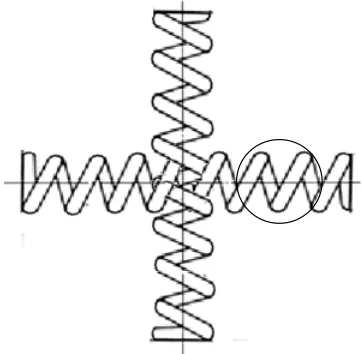
Before discussing mesoscopic characteristics of RMM, the detailed produced procedures should be expatiated firstly as follows: first, the metal wire with its base mate-rial as stainless steel,the refractory alloy or low tem-perature alloy was wrapped to spring line. Then, the spring line was knitted to body as roughcast of RMM with different style, e.g., the three-dimension knitted method or the wool clew circled method. Third, the roughcast was molded to the designed part through cold stamping. Whereas, it is the excellent environmental adaptability of the base metal endow RMM with good temperature adaptability and longer life same as base material. On the other hand, this forming procedure for roughcast could be also thought as three steps of three-dimensional molding, i.e., the first step is to create a “line” as the filamentous spring with equal pitch. The next step is to knit a “plane” through a crossed or slanted knitting technique by spring “line”, similarly to the blanket knitting (Figure 1). The last step is to create “body” through different techniques such as the “plane” piling up.
Expect for the physical properties such as the
me-chanical properties, the friction coefficient, and the ex-tent of temperature adaptability of the base material, the mesoscopic characteristic parameters of RMM usually contains the geometric size of the mesoscopic structure and the characteristics of base material, for example, the diameter of the metallic wire ds, the diameter of spirals
j
d , the nominal included angle of the definite metallic wire with the plane of the compressed surface , and the relative density of RMM .
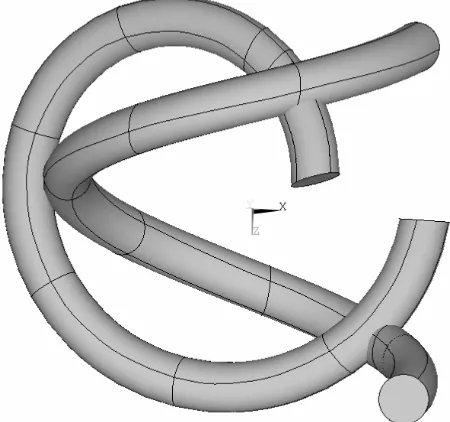
According to the procedures of weave and cold stamped extent, the relationship between the relative density of RMM and mesoscopic structure feature pa-rameter (the diameter of metallic wire, the diameter of spirals and the compressed extent) could be derived ac-cording to several proper assumptions: the homogeneous assumption, the self-similar deformation assumption in the mesoscopic view and the well-proportional deforma-tion assumpdeforma-tion during cold stamping stage. Examining the mesoscopic structure features of the material before cold stamping, it will be found that the typical meso- scopic structure appears as an element cubic composed with two crossed circles of metallic wire. This can be thought as a self-similar elementary material unit for RMM, as shown in Figure 2. According to the definition of relative density for porous material the ratio of the volume of related base material with the porous material, the relative density of a RMM is expressed as follows according to the spatial arrangement of metallic wire (Figure 3):
2 2 3
π 1
2
j s
j s d d
d d
(1)
where dj denotes the pitch diameter of the spiral, ds the diameter of the metallic wire, and the included
[image:2.595.332.513.516.693.2]Figure 2. The mesoscopic feature of metallic wire on the side surface.
Figure 3. The spatial configuration of metallic wire.
angle of metallic wire. For the original roughcast before cold stamping, μ is the compressed ratio during cold stamping and can be related to the included angle of me-tallic wire in one circle wires, tan π. μ = 1 corresponds to the no cold stamping body while μ < 1 corresponds to the stage of cold stamping. For example, for the case of no cold stamping, = arctan(1/π) (about 17.66˚) based on the assumption that two circle wires crossed in a cubic body, and the relative density
0
can be expressed as follows:
2 2
0 3
π 1
2
j s
j s d d
d d
(2)
During cold stamping, compression deformation along the axis of cold stamping happened. And on the direc-tions perpendicular to this axis, no deformation take placed from the macroscopic view since the rigid
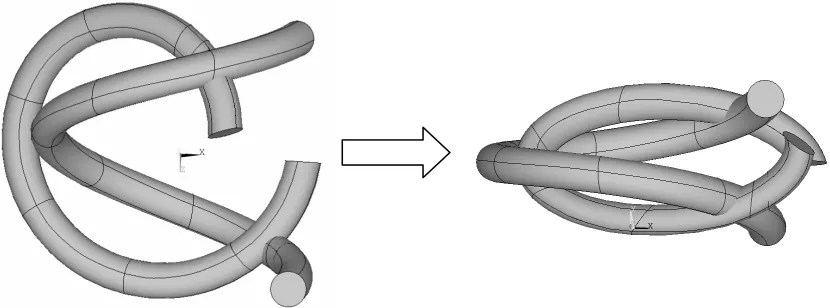
con-straint of material by the die. Therefore, the mesoscopic deformation and shape change of metallic wire during the macroscopic uniaxial compressed deformation can be described as follows. First, the included angle between the metallic wire and compressed plane decreased gradually with the macroscopic deformation increased. Next, the metallic wire deformed in a compound of twisting and bending, as shown in Figure 4. It is obvious that the influence of this complex deformation on the relative density of material is smaller than the decrease of included angle. Thus, it is reasonable to evaluate the change of relative density only through the change of included angle.
Suppose dj and ds were given, the relative density
0
of material was determined by Equation (2). For example, if dj is taken as 1.0 mm, and ds 0.1 mm before cold stamping, then 0 is determined as 0.128.
In general, it is difficult to calculate the relative density through Equation (1) since the compressed ratio is not easily determined after cold stamping. However, the relative density of the material before cold stamping can be obtained by experimental measurement. Therefore, we can determine the included angle corresponding to the material after cold stamping through relative density. Based on the definition of included angle of wire in the material unit and the homogeneous assumption, the self-similar assumption and the proportional deformation assumption above (referred to Figure 5), the nominal included angle of wire for material is defined by means of the relation of included angle of wire with other pa-rameters in Equation (1),
2 2 3
π 1 arctan
2
j s
j s d d
d d
(3)
For example, with the same values of dj and ds, if is increased to 0.2, then, will decrease to 3.54˚. In this case, the volume ratio μ of compressed model and original model is nearly 0.19 from the geometrical rela-tion of and dj.
3. The Stiffness Model
[image:3.595.60.285.262.473.2]X Y
Z α
(a)
X
Y
Z
(b)
F
f
α
(c)
dj/2
f
[image:4.595.66.277.84.708.2](d)
Figure 4. The small curve beam model.
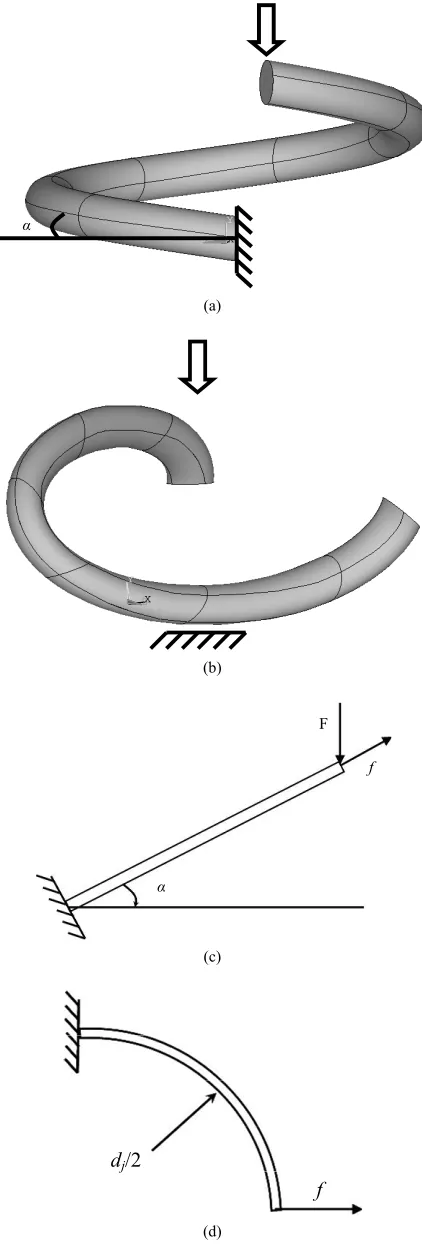
[image:4.595.310.540.497.571.2]length of quarter of the wire circle and can be thought as a basic element comprising the representative unit of the material according the space distribution (referred to Figure 3). Thus, the stiffness of the unit is thought as the basic element stacked in series by four layers and in each layer there are two basic elements arranged parallel. Now let’s check the deformation of this basic unit when the compressed loading subjected, we can find that this basic unit can be thought as part of a curve cantilever beam illustrated in Figure 4. The constraint of curved cantile-ver beam is as follows: the fixed constraint with six freedoms at one end, and two forces stressed on the other end of the cantilever, one is the pressure force along the orientation of stamping direction, and the other is the constraint force by the die around. In practice, this con-straint force in the units witch don’t contact with the die can be though as the frictional force owing to the relative sliding in the surface of adjacent metallic wires (shown in Figure 4). Thus, according to the basic deformation analysis, the stiffness of the curve beam is derived as follows:
1
4 2
3
cos 3 2 2 sin 2
2 4 π 8
16 s e
j j s
d f
k
G E
d d d
(4)
Where G and E are the shear module and Young’s module of the metallic wire respectively, is the in-cluded angle calculated by relative density of RMM, and f is the friction coefficient of base material.
A representative unit in the material is composed by 8 basic elements (curved beams) with same deformation manner. According to the contribution of this element to the representative unit stiffness, the stiffness of one rep-resentative unit is calculated here:
1
4 2
3
cos 3 2 2 sin 2
2 4 π 8
32 s
j j s
d f
K
G E
d d d
(5)
where
2 2 3
π 1
arctan 2
j s
j s d d
d d
. From the expression of the stiffness of the unit, as soon as dj and ds were given, for a metal wire with a definite E, G and f, the stiffness of metallic rubber is then a function of .
4. Discussion
According to the mesoscopic stiffness model proposed above, the effect of each mesoscopic characteristic pa-rameter such as dj, ds and on the macroscopic material stiffness could be further discussed.
4.1. The Influence of dj and ds
X
Y
[image:5.595.91.506.87.241.2]Z
Figure 5. The mesoscopic deformation process in RMM.
[image:5.595.309.537.267.441.2]control parameter during material production. Although it is well-known that it has a considerable effect on the total stiffness of material, however this effect and its variation were never exactly evaluated analytically in the past. In general, the diameter of metallic wire ds is about tenth of pitch diameter of spiral, thus the value of
djds
usually is estimated as dj approximately when evalu-ating the influence of dj. Therefore, through the expres-sion of Equation (5), the magnitude of stiffness of the material is determined in inverse proportion to the fourth power of dj approximately. The effect of the pitch di-ameter of spiral dj on the stiffness according to the relative experiments [9] was illustrated in Figure 6. In the figure, the experimental result expressed as a solid curve while the predicted result was denoted as a dashed curve. From the figure, the variation of the stiffness vs. increase of dj is consistent with the prediction by Equation (5).Figure 6. The influence of the diameter of the spiral of wire.
The diameter of metallic wire ds is another mesoscopic material feature which influences the mechanical proper-ties of the material and is determined during the material design. From Equation (5), the stiffness of the material RMM is in a direct proportion to the fourth power of ds, and this can be compared with the experimental result illustrated in Figure 7. As seem as in the Figure 6, the experimental result of stiffness expressed as a solid curve while the predicted result was denoted as a dashed curve. From the figure, the increase trend of stiffness with ds is measure also the direct proportion to the fourth power of ds, the same as the predicted by the proposed model.
If we introduce another parameter r to denote the ratio of the diameter of spiral
d j
d and the diameter of wire ds, then, Equation (5) is expressed as follows
Figure 7. The influence of the diameter of metallic wire.
3
32 r r 1 N K
d d
. (6)
1 2
cos 3 2 2 sin 2
2 4 π 8
f N
G E
. (7)
[image:5.595.309.537.469.638.2]le
he influence of me pic Here, N expresses the mechanical properties of mate-rial and the intensity of cold stamping, while dr ex-presses the mesoscopic size properties of the original roughcast material. It is obviously from Equation (6) that a sing parameter, the ratio of diameter of spiral and wire dr can represent t sosco properties quantitively.
4.2. The Influence of
Remember that there exist inherent relation between the macroscopic feature
an
and the mesoscopic pa-rameter , referenced to Equation (3) owing to the cold stamped processing of the material. According to the producti procedure of RMM, the magnitude of relative density
on
of the material is controlled by the intensity of compressed deformation along the direction of com-pressed force, and has nothing to do with the deformation along other directions. Now, let’s consider the other ex-pression of Equation (5) as follows
1 2
1 3 2 1
2 4 π 4 4
cos
M K
G E E
fL
, (8)
where
3
32d dr r1 1
M and considering tan1 .
rm ctice,
Here, L is a coefficient and can be dete ined by Equation (3). In pra the included angle is very small (< 5˚), thus cos is equal to 1 approximately, thus, the flexibility of RMM (1/K) is decreased inverse proportionally with the relative density increased. However, on the other hand, if the included angle is very small, the intervention between contacted wires is inten-sively. Thus assumption of freedom deformation for curve cantilever is no longer active, and this influen
4.3. The Influence of Friction Coefficient of
ith the frictio ic wires f increased.
The main co
l R roportional to the fourth power of
ce should be investigated further.
Metallic Wires f
During the material deformed under compressed loading, its mesoscopic deformation experienced several stages. After the early stage where no relative slide of contacted wires, the influence of friction coefficient of metallic wires f on the stiffness of the material emerged in the deformation later. It is obviously from Equation (5) that the friction coefficient of metallic wires will affect the value of the stiffness of material. The relationship of the friction coefficient of metallic wires f and the total stiff-ness of material shows the larger friction coefficient will induce the higher stiffness of the material. The flexibility of RMM is decreased proportionally w n coefficient of metall
5. Conclusions
From the mesoscopic stiffness model proposed in this study, the influence of mesoscopic structure features and material properties on the macroscopic stiffness of the material have been evaluated quantitatively. According to this model, it is possible to design the macroscopic prop-erty of the material at early producing stage.
nclusions of this study are presented below:
1) The variation law of stiffness of the materia MM
is in inverse p dj
ap-pr
al po
oximately.
2) The stiffness of the materi RMM is in direct pro-rtion to the fourth power of ds, although the value of s
d is smaller than the value of dj.
3) The larger relative density of material and the larger friction coefficient of metallic wires will strengthen the
aterial.
the Natural Science Foundation of Shanxi (2005A19).
100, macroscopic stiffness of the m
6. Acknowledgements
This work was supported by the National Defense Foun-dation, the Natural Science Foundation of Xi’an Jiaotong University and
REFERENCES
[1] D. W. Childs, “The Space Shuttle Main Engine High- Pressure Fuel Turbopump Rotordynamic Instability Prob-lem,” ASME Journal of Engineering for Power, Vol. No. 1, 1978, pp. 48-57. doi:10.1115/1.3446326
[2] E. Rivin, “Vibration Isolation of Precision Machinery,”
SV, Sound and Vibration, Vol. 13, No. 8, 1979, pp. 18-23. [3] A. B Barnes, “Improvement in Machinery for Woven
Wire Mesh,” Wire Industry, Vol. 51, No. 605, 1984, pp.
Propulsion Conference, Orlando, Florida,
Aerospace Power, Vol. 12, No. 2, 1997, pp.
t the ASME Turbo Expo, New Orleans, 4-7
actions of the ASME,
nal
403-404.
[4] A. Okayasu, T. Ohta, et al., “Vibration Problems in the LE-7 Liquid Hydrogen Turbo Pump,” Proceedings of the
26th AIAA Joint 1990, pp. 1-5.
[5] X. Wang and Z. Zhu, “Ring-Like Metal Rubber Damper,”
Journal of
143-145.
[6] E. M. Al-Khateeb and J. M. Vance, “Experimental Evaluation of a Metal Mesh Bearing Damper in Parallel with a Structural Support,” ASME Paper 2001-GT-0247,
Presented a
June 2001.
[7] M. Zarzour and J. M. Vance, “Experimental Evaluation of a Metal Mesh Bearing Damper,” Journal of Engineering for Gas Turbines and Power, Trans
Vol. 122, No. 2, 2000, pp. 326-329.
International Journal of Mechanics and Materials in
De-[9] H. Zuo, Y. H. Chen, H. B. Bai and H. Sun, “The Com-pression Deformation Mechanism of a Metallic Rubber,”