ISSN Online: 2327-4379 ISSN Print: 2327-4352
DOI: 10.4236/jamp.2019.79147 Sep. 29, 2019 2148 Journal of Applied Mathematics and Physics
Approximate Solution Method of the Seventh
Order KdV Equations by Decomposition
Method
Nawal Abdullah Alzaid
1, Bashayr Ali Alrayiqi
21Department of Mathematics, Faculty of Science, University of Jeddah, Jeddah, KSA
2Department of Mathematics, College of Science and Arts, King Abdulaziz University, Rabigh, KSA
Abstract
In this paper, Adomian decomposition method (ADM) is implemented to approximate the solution of the Korteweg-de Vries (KdV) equations of se-venth order, which are Kaup-Kuperschmidt equation and sese-venth order Ka-wahara equation. The results obtained by the ADM are compared with the exact solutions. It is found that the ADM is very efficient and convenient and can be applied to a large class of problems. The conservation properties of solution are examined by calculating the first three invariants.
Keywords
Adomian Decomposition Method, Kaup-Kuperschmidt Seventh-Order KdV Equation, Seventh-Order Kawahara Equation, Conservation Laws
1. Introduction
The general seventh-order KdV equation (gsKdV) reads
3 3 2
0,
t x x x xx xxx xx xxx
x xxxx xxxxx xxxxxxx
u au u bu cuu u du u eu u
fu u guu u
+ + + + +
+ + + = (1)
where a, b, c, d, e, f and g are nonzero parameters. One of the well-known par-ticular cases of Equation (1) is called seventh order Kaup Kuperschmidt equa-tion (KK) [1] which can be shown in the form
3 3 2
2016 630 2268 504 252
147 42 0,
t x x x xx xxx xx xxx
x xxxx xxxxx xxxxxxx
u u u u uu u u u u u
u u uu u
+ + + + +
+ + + = (2)
Another form of the seventh-order KdV equation is called seventh order Ka-wahara equation [2] which can be shown in the form
How to cite this paper: Alzaid, N.A. and Alrayiqi, B.A. (2019) Approximate Solution Method of the Seventh Order KdV Equa-tions by Decomposition Method. Journal of Applied Mathematics and Physics, 7, 2148-2155.
https://doi.org/10.4236/jamp.2019.79147
Received: June 14, 2019 Accepted: September 26, 2019 Published: September 29, 2019
Copyright © 2019 by author(s) and Scientific Research Publishing Inc. This work is licensed under the Creative Commons Attribution International License (CC BY 4.0).
DOI: 10.4236/jamp.2019.79147 2149 Journal of Applied Mathematics and Physics
6 0,
t x xxx xxxxx xxxxxxx
u + uu u+ −u +αu = (3)
where
α
is a nonzero constant. These equations were introduced initially by Pomeau et al. [3] for discussing the structural stability of KdV equation under a singular perturbation. These equations play an important role in mathematical physics, engineering and applied sciences for investigating travelling solitary wave solutions.The Adomian decomposition method (ADM) was first proposed by George Adomian in the 1980’s [4] [5] [6] [7]. This technique has been shown to solve effectively, easily, and accurately a large class of linear and nonlinear, ordinary or partial, deterministic or stochastic differential equations with approximates which converge rapidly to accurate solutions. This method is well-suited to physi-cal problems since it makes the unnecessary linearization, perturbation problem being solved, sometimes seriously. Conservation laws (CLaws) are of basic im-portance in the study of evolution equations because they provide physical, con-served quantities for all solutions u x t
( )
, , and they can be used to check the ac-curacy of numerical solution methods [8] [9] [10] [11] [12]. The paper is ar-ranged in the following manner: in Section 2, we present the ADM; Section 3 presents the CLaws for (KK) and Kawahara seventh-order KdV equations [13] [14]; in Section 4, the ADM is implemented to some problems in addition to studying the properties of CLaws; finally, a brief conclusion is given in Section 5.2. The Method of Solution
Consider the (gsKdV) equation in an operator form
( ) ( ) ( ) ( )
( ) ( )
( )
( )
7( )
0,t
x
L u a Ku b Mu c Nu d Pu e Qu
f Ru g Vu L u
+ + + + +
+ + + =
(4)
where the notations 3
x
Ku u u= , 3
x
Mu u= , Nu uu u= x xx, Pu u u= 2 xxx,
xx xxx
Qu u u= , Ru u u= x xxxx and Vu uu= xxxxx symbolize the nonlinear terms,
respectively. Also, the notation Lt t ∂ =
∂ and
7
7x 7
L x ∂ =
∂ symbolize the linear
differential operators. Assuming 1
t
L− the inverse of operator of
t
L exists and conveniently by
( )
1
0
. d
t
t
L− = t
∫
(5)Thus, applying the inverse operator 1
t
L− to (4) yields
( ) ( )
( )
( )
( )
( )
( )
( )
( )
(
)
1 1 1 1
1 1 1 1
7
,
.
t t t t
t t t t x
u x t h x aL Ku bL Mu cL Nu dL Pu eL Qu fL Ru gL Vu L L u
− − − −
− − − −
= − − − −
− − − − (6)
The standard ADM [15] defines the solution u x t
( )
, by the decomposition series( )
( )
0
, n , ,
n
u x t ∞ u x t =
=
∑
(7)
DOI: 10.4236/jamp.2019.79147 2150 Journal of Applied Mathematics and Physics
and Vu can be decomposed into infinite series of polynomial given by
2
0 ,
x n
n Ku u u ∞ A
=
= =
∑
(8)0 ,
x xx n
n Mu u u ∞ B
=
= =
∑
(9)
0 ,
xxx n
n Nu uu ∞ C
=
= =
∑
(10)
0 ,
xxx n
n
Pu uu ∞ D
=
= =
∑
(11)0 ,
xxx n
n Qu uu ∞ E
=
= =
∑
(12)0 ,
xxx n
n Ru uu ∞ F
=
= =
∑
(13)0 ,
xxx n
n Vu uu ∞ G
=
= =
∑
(14)where An, Bn, Bn, Dn, En, Fn and Gn are the so-called Adomian
poly-nomials of u u0, , ,1 un defined by equation
( )
0 0
1 d , , 0.
! d
n
i
n n i
i
P N u x t n
n λ λ λ
∞
= =
= ≥
∑
(15)The components u x tn
( )
, can be determined sequentially by the standard recursion scheme as:( )
( )
( )
( )
( )
( )
( )
( )
( )
(
)
0
1 1 1 1 1
1
1 1 1
7
, ,
, 0.
n t n t n t n t n t n
t n t n t x n
u x t h x
u aL A bL B cL C dL D eL E
fL F gL G L L u n
− − − − − + − − − = = − − − − − − − − ≥ (16)
3. Conservation Laws
The conservation properties of the solution are examined by calculating the Claws. 1) For KK equation Equation (2), the conservative quantities I ii
(
=1,2,3)
can be written as1
3 2
2
4 2 2
3
d ,
1 d , 8
3 1 d ,
4 48
x
x xx
I u x
I u u x
I u uu u x
∞ −∞ ∞ −∞ ∞ −∞ = = − = − +
∫
∫
∫
(17)
2) For seventh-order Kawahara equation Equation (3), the conservative quan-tities I ii
(
=1,2,3)
can be written as( )
( )
( )
1 2 2
2 2 2
3 3
d , d ,
1 1 1 d ,
2 x 2 xx 2 xxx
I u x
I u x
I u u u α u x
DOI: 10.4236/jamp.2019.79147 2151 Journal of Applied Mathematics and Physics
Since the conservation constants are expected to remain constant during the run of the algorithm to have accurate numerical scheme, conservation constants will be monitored. As various problems of science were modeled by non linear partial differential equations and since therefore the seventh order KdV equation is of high importance, the following examples have been considered.
4. Numerical Examples
Example 1. Consider the seventh-order (KK) equation Equation (2) with initial condition
( )
,0 1 2 1 2tanh2( )
,3 2
u x = k − k kx
By ADM the recursive relations are
( )
( )
( )
( )
( )
( )
( )
( )
(
)
2 2 2
0
1 1 1 1
1
1 1 1 1
7
1 1 tanh ,
3 2
2016 630 2268 504
252 147 42 , 0.
n t n t n t n t n
t n t n t n t x n
u k k kx
u L A L B L C L D
L E L F L G L L u n
− − − −
+
− − − −
= −
= − − − −
− − − − ≥
The first few components are thus determined as follows:
( )
( )
( )
( )
(
)
( )
2 2 2
0 9
1 3
16 2 2
2 4
1 1 tanh ,
3 2
4 sinh , 3cosh
8 2cosh 3
, 9cosh
u k k kx
k t kx
u
kx
k t kx
u
kx
= −
− =
−
=
and so on. Consequently, the solution in a series form is given by
( )
, 0 1 2u x t =u u u+ + +
and in a closed form
( )
, 1 2 1 2tanh2 4 63 2 3
u x t = k − k k x + k t
.
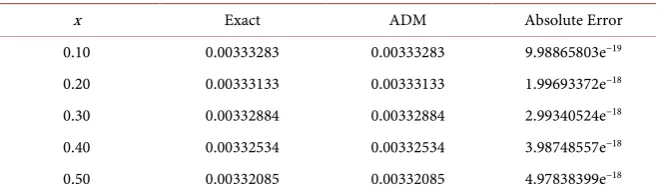
[image:4.595.210.541.623.720.2]The results produced by the proposed method with only few components (n = 5) are compared with the exact solution and listed in Table 1, also the Claws for the seventh-order (KK) equation are given in Table 2. The profile of the solitary wave at t=0.3 is displayed in Figure 1.
Table 1. Comparison between exact solution u x t
( )
, and approximate solution usingADM where k=0.1.
x Exact ADM Absolute Error
0.10 0.00333283 0.00333283 9.98865803e−19
0.20 0.00333133 0.00333133 1.99693372e−18
0.30 0.00332884 0.00332884 2.99340524e−18
0.40 0.00332534 0.00332534 3.98748557e−18
DOI: 10.4236/jamp.2019.79147 2152 Journal of Applied Mathematics and Physics
Table 2. Computed quantities I I I1, ,2 3 for the seventh-order KK equation by ADM.
I1 I2 I3
t/x 0.1 0.3 0.5 0.1 0.3 0.5 0.1 0.3 0.5
0.1 3.333e−4 9.996e−4 1.665e−3 3.703e−9 1.108e−8 1.840e−8 3.316e−11 9.910e−11 1.639e−10
0.2 3.333e−4 9.996e−4 1.665e−3 3.703e−9 1.108e−8 1.840e−8 3.316e−11 9.910e−11 1.639e−10
0.3 3.333e−4 9.996e−4 1.665e−3 3.703e−9 1.108e−8 1.840e−8 3.316e−11 9.910e−11 1.639e−10
0.4 3.333e−4 9.996e−4 1.665e−3 3.703e−9 1.108e−8 1.840e−8 3.316e−11 9.910e−11 1.639e−10
0.5 3.333e−4 9.996e−4 1.665e−3 3.703e−9 1.108e−8 1.840e−8 3.316e−11 9.910e−11 1.639e−10
Figure 1. Comparison between exact solution u x t
( )
, and approximate solution using ADM.Example 2. Consider the seventh-order Kawahara equation Equation (3) with initial condition
( )
,0 sech6( )
,u x =
ω
kxBy ADM the recursive relations are
( )
( )
(
)
(
)
(
)
6 0
1 1 1 1
1 3 5 7
sech ,
6 , 0.
n t n t x n t x n t x n
u kx
u L A L L u L L u L L u n
ω
α
− − − −
+ =
= − − + − ≥
The first few components are thus determined as follows:
( )
( )
(
( )
(
( )
( )
( )
)
)
( )
(
(
( )
( )
( )
)
)
6 0
6 6
1 13
6 4 4 6
2 2 2 12 6
2 20
2 12 4
2 12 2
sech ,
1 12 sinh 23328 cosh cosh
215488 cosh 648 cosh ,
1 12 108783285811200 cosh cosh
175649727052800 cosh
138322888704000 cosh ,
u kx
u tk kx k kx
kx
k kx k kx
u t k k kx
kx
k kx
k kx
ω
ω α
α
ω α
α α =
=
− − +
=
−
+ +
DOI: 10.4236/jamp.2019.79147 2153 Journal of Applied Mathematics and Physics
and so on. Consequently, the solution in a series form is given by
( )
, 0 1 2u x t =u u u+ + +
and in a closed form
( )
6(
(
)
)
0, sech
u x t =ω k x x t− .
[image:6.595.208.540.207.330.2]The results produced by the proposed method with only few components (n = 5) are compared with the exact solution and listed in Table 3, also the Claws for the seventh-order Kawahara equation are given in Table 4. The profile of the so-litary wave at t=0.3 is displayed in Figure 2.
Table 3. Comparison between exact solution u x t
( )
, and approximate solution usingADM where α=2500769 , ω=59136186625 , 5
1538
k= and x0=180000591361.
x Exact ADM Absolute Error
0.10 0.14648359 0.14648359 1.24475423e−11
0.20 0.14639977 0.14639977 2.70176889e−11
0.30 0.14617341 0.14617341 4.13404041e−11
0.40 0.14580523 0.14580523 5.52856164e−11
0.50 0.14529642 0.14529642 6.87280812e−11
Table 4. Computed quantities I I I1, ,2 3 for the seventh-order Kawahara equation by ADM.
I1 I2 I3
t/x 0.1 0.3 0.5 0.1 0.3 0.5 0.1 0.3 0.5
0.1 1.465e−2 4.390e−2 7.300e−2 2.146e−3 6.424e−3 1.066e−2 −3.245e−4 −9.697e−4 −1.602e−3
0.2 1.465e−2 4.391e−2 7.304e−2 2.146e−3 6.428e−3 1.067e−2 −3.245e−4 −9.708e−4 −1.606e−3
0.3 1.465e−2 4.392e−2 7.308e−2 2.145e−3 6.430e−3 1.068e−2 −3.244e−4 −9.716e−4 −1.609e−3
0.4 1.464e−2 4.393e−2 7.311e−2 2.145e−3 6.432e−3 1.069e−2 −3.242e−4 −9.721e−4 −1.612e−3
0.5 1.464e−2 4.393e−2 7.313e−2 2.143e−3 6.433e−3 1.070e−2 −3.239e−4 −9.722e−4 −1.614e−3
[image:6.595.259.487.472.705.2]DOI: 10.4236/jamp.2019.79147 2154 Journal of Applied Mathematics and Physics
5. Conclusion
In this paper, the ADM was used to solving seventh order KdV equations with initial conditions. We have found out that this method is applicable and efficient technique. All the numerical results obtained by using ADM show very good agreement with the exact solutions for a few terms. The conservation laws are used to assess the accuracy and the efficiency of the method. We have noticed that the method accomplished the aim of preserving conserved quantities, as we saw all invariants were almost constant.
Conflicts of Interest
The authors declare no conflicts of interest regarding the publication of this pa-per.
References
[1] Fan, E. and Hona, Y.C. (2002) Generalized Tanh Method Extended to Special Types of Nonlinear Equations. Zeitschrift fur Naturforschung A, 57, 692-700.
https://doi.org/10.1515/zna-2002-0809
[2] Wazwaz, A.M. (2011) Soliton Solutions for Seventh-Order Kawahara Equation with Time-Dependent Coefficients. Modern Physics Letters B, 25, 643-648.
https://doi.org/10.1142/S0217984911026012
[3] Pomeau, Y., Ramani, A. and Grammaticos, B. (1988) Structural Stability of the Korteweg-de Vries Solitons under a Singular Perturbation. Physica D: Nonlinear Phenomena, 31, 127-134.https://doi.org/10.1016/0167-2789(88)90018-8
[4] Adomian, G. (1988) A Review of the Decomposition Method in Applied Mathe-matics. Journal of Mathematical Analysis and Applications, 135, 501-544.
https://doi.org/10.1016/0022-247X(88)90170-9
[5] Adomian, G. (1991) Solving Frontier Problems Modelled by Nonlinear Partial Dif-ferential Equations. Computers and Mathematics with Applications, 22, 91-94.
https://doi.org/10.1016/0898-1221(91)90017-X
[6] Adomian, G. (1986) A New Approach to the Heat Equation: An Application of the Decomposition Method. Journal of Mathematical Analysis and Applications, 113, 202-209.https://doi.org/10.1016/0022-247X(86)90344-6
[7] Adomian, G. (1983) Stochastic Systems. Academic Press, New York.
[8] Olver, P.J. (2012) Applications of Lie Groups to Differential Equations. Springer Science and Business Media, Berlin, 107.
[9] Bluman, G.W., Cheviakov, A.F. and Anco, S.C. (2010) Applications of Symmetry Methods to Partial Differential Equations. Springer, New York.
https://doi.org/10.1007/978-0-387-68028-6
[10] Kashkari, B.S. and Bakodah, H.O. (2013) New Modification of Laplace Decomposi-tion Method for Seventh-Order KdV EquaDecomposi-tion. AIP Conference Proceedings, 1558, 2435-2439.https://doi.org/10.1063/1.4826033
[11] Bakodah, H.O. and Banaja, M.A. (2013) The Method of Lines Solution of the Regu-larized Long-Wave Equation Using Runge-Kutta Time Discretization Method. Ma-thematical Problems in Engineering, 2013, Article ID: 804317.
https://doi.org/10.1155/2013/804317
DOI: 10.4236/jamp.2019.79147 2155 Journal of Applied Mathematics and Physics
Width Wave Equation Using the Method of Lines. Mathematical Problems in En-gineering, 2015, Article ID: 804317.https://doi.org/10.1155/2015/274579
[13] Yao, R.-X. and Li, Z.-B. (2004) Conservation Laws and New Exact Solutions for the Generalized Seventh Order KdV Equation. Chaos, Solitons and Fractals, 20, 259-266.https://doi.org/10.1016/S0960-0779(03)00373-4
[14] Yao, R.-X., Xu, G.-Q. and Li, Z.-B. (2004) Conservation Laws and Soliton Solutions for Generalized Seventh Order KdV Equation. Communications in Theoretical Physics, 41, 487-492.https://doi.org/10.1088/0253-6102/41/4/487
[15] Adomian, G. (1984) A New Approach to Nonlinear Partial Differential Equations. Journal of Mathematical Analysis and Applications, 102, 420-434.