A Verified Algorithm Enumerating Event
Structures
?Juliana Bowles and Marco B. Caminati
School of Computer Science, University of St Andrews Jack Cole Building, North Haugh, St Andrews KY16 9SX, UK
{jkfb|mbc8}@st-andrews.ac.uk
Abstract. An event structure is a mathematical abstraction modeling concepts as causality, conflict and concurrency between events. While many other mathematical structures, including groups, topological spaces, rings, abound with algorithms and formulas to generate, enumerate and count particular sets of their members, no algorithm or formulas are known to generate or count all the possible event structures over a finite set of events. We present an algorithm to generate such a family, along with a functional implementation verified using Isabelle/HOL. As byproducts, we obtain a verified enumeration of all possible preorders and partial orders. While the integer sequences counting preorders and partial orders are already listed on OEIS (On-line Encyclopedia of Integer Sequences), the one counting event structures is not. We therefore used our algorithm to submit a formally verified addition, which has been successfully reviewed and is now part of the OEIS.
1
Introduction
Event structures [18, 19] model distributed systems, representing sequential-parallel behaviour, concurrency and non-determinism in a natural way. Event structures feature simple notions, namely, a set of events and binary relations over events. Amongst the relations we havecausality, a partial order describing how the events are causally related, andconflict specifying which events are in conflict. In addition, a natural condition makes sure that conflict propagates over causality, i.e., events caused by conflicting events are still conflicting. Being expressed in terms of such basic concepts as partial orders and binary relations, this model has fruitful connections with combinatorics [2], topology [20], category theory [4], graph theory [2], and other causal models such as Petri nets [20].
For the same reason, basic problems regarding event structures, such as checking if a given structure is a valid event structure, whether it can be completed to a valid event structure, and event structure composition can be processed through a variety of computational tools [5,6, 3]. However, the generation of all the possible event structures over a finite set ofN events is not straightforward. Currently, it is not even known how many distinct event structures there are,
?
given a finite set of events. We will refer to these two problems asenumeration andcounting, respectively. Given that the enumeration of partial orders is a hard problem, and that even the most elaborate of the known techniques for counting partial orders pass through some form of enumeration [15], the counting and enumeration problem for event structures inherit a similar amount of hardness: indeed, we are not aware of any theoretical results to count event structures which would avoid enumerating partial orders. Hence, the counting problem for the event structures motivates the enumeration problem. The naive approach consisting of generating all the possible relations and checking them for compliance to the definition of event structures is prohibitively inefficient, even for very low values
ofN. This paper presents a novel, recursive enumerating and counting algorithm
which does better than that, based on an original theoretical result characterising event structures (Lemma2); as a further contribution, the paper shows how it can be formalised and proved to be correct in the theorem prover Isabelle. The paper is organised as follows: Section2 presents the definition of event structure, and the problem through a formal description and a simple example. Section3 describes our algorithm, and the lemma on which it is based. Section4introduces the Isabelle formalisation of the involved structures, the Isabelle implementation of the algorithm, and its correctness theorems. Section5discusses improvements to the algorithm, and provides performance data and numerical results, while Section6 concludes.
2
Description of the Problem
We recall that a pre-order on a set is a relation which is reflexive on that set and transitive, and that a partial order over a set is an antisymmetric pre-order over that set.
Definition 1. An event structureis a tripleE= (Ev,→∗,#)whereEv is a set
of events and→∗,#⊆Ev×Ev are binary relations called causalityand conflict,
respectively. Causality→∗ is a partial order over Ev. Conflict#is symmetric
and irreflexive, and propagates over causality, i.e., e#e0∧e0 →∗e00 ⇒e#e00 for
all e, e0, e00∈Ev. An event emay have an immediate successor e0 according to
the order→∗: in this case, we can writee→e0. The relation given by→is called
immediate causality.
We will introduce a functionenumerateEstaking one natural numberN as an argument, and returning a list containing, without repetitions, each possible event structure over a set ofN distinct events. The events are represented by the first N natural numbers: 0, . . . , N−1. Each entry of the output list is a pair (O, C) of relations over the set{0, . . . , N−1}, the causality and the conflict, respectively. Finally, each relation will be represented by a set of ordered pairs, i.e., elements of the Cartesian product{0, . . . , N−1} × {0, . . . , N−1}, as customarily done in set theory. This implies that, given an event structure (E,→∗,#), and two
eventse0,e1, we can write (e0, e1)∈→∗ and (e0, e1)∈# in lieu ofe0→∗e1and
Based onenumerateEs, we also introduce a second functioncountEstaking the same argument, and returning a natural number counting the distinct elements of the listenumerateEs N.
As an example, let us illustrate the output of our algorithm for the case N = 2: in other words, we only have two events, 0 and 1, and we want to know all the possible valid event structures defined on these two events.
enumerateEs2returns the list
” [ ({( 0 , 0 ) , ( 0 , 1 ) , ( 1 , 1 )}, { }) , ({( 0 , 0 ) , ( 1 , 0 ) , ( 1 , 1 )}, { }) , ({( 0 , 0 ) , ( 1 , 1 )}, {( 0 , 1 ) , ( 1 , 0 )}) , ({( 0 , 0 ) , ( 1 , 1 )}, { }) ] ” : : ((nat×nat) set×(nat×nat) set) list .
It has four entries (what follows the character ] on the last line is not part of the list, but only specifies the type of the list itself), so, naturally, countEsreturns4.
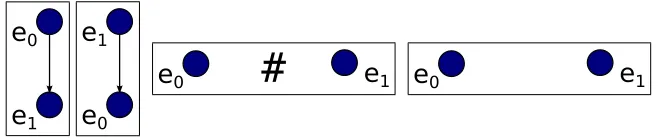
Note that the first element of each pair of the list above is a partial order on {0,1}, and hence contains at least (0,0) and (1,1) due to reflexivity. The first two pairs describe two isomorphic event structures (Figure1, on the left): they can be obtained one from the other by swapping the numerical labels of their events. Since in this case the two events are related by causality, no conflict is possible, in light of propagation property in Definition1: hence, the only possibility is the empty conflict relation, which corresponds to the second element of the first two pairs of the list above being the empty set.
The remaining two pairs of list above describe two event structures (Figure1, on the right) with the same causality relation: no event is caused by the other (i.e., each event is in causal relation only with itself); in this situation, the definition of event structure allows only two possibilities. That is, either there are no conflicts, or the two events are mutually in conflict.
e
0e
1e
1e
0 [image:3.612.145.474.443.512.2]e
0#
e
1e
0e
1Fig. 1.The event structures over two events (arrows represent immediate causality)
3
Description of the Algorithm
3.1 Computation of Posets
To enumerate all posets over{0, . . . , N −1}, we represent them through their adjacency matrices. An adjacency matrixAfor a relationRover {0, . . . , N−1} is a square boolean matrix of dimension N such that Ai,j = 1 if and only if (i−1)R(j−1). There is clearly a one-to-one correspondence between such matrices and all the possible relations over{0, . . . , N−1}, therefore they can be used to represent such relations. Hence, we will say that a square boolean matrix is reflexive (respectively, transitive) when the corresponding relation is reflexive (respectively, transitive). This representation is useful in our case, because there is a simple result expressing the property that a relation is transitive and reflexive as simple conditions on the rows and columns of its adjacency matrix.
Lemma 1. Assume a square, boolean matrixB of orderN+ 1 is partitioned as follows:
B=
"
A α
τβ 1
#
,
whereαandβ are column vectors of orderN. ThenBis reflexive and transitive if and only ifAis reflexive and transitive and,∀i, j∈ {1, . . . , N}, 1.(Ai,j∧βi)→βj, and 2. (αi∧(¬Ai,j))→βj, and 3. (Ai,j∧αj)→αi.
We omit the straightforward proof here, and note that Lemma1 gives a way to compute recursively all transitive and reflexive matrices, by reducing this task to computing all pairs of column vectors (α, β) satisfying the conditions (2), (1), (3). We will find that those conditions admit a computable functional translation into Isabelle/HOL, thereby allowing the recursive computation of all transitive and reflexive matrices of a given (finite) dimensionN. Doing this corresponds to enumerating all the preorders over{0, . . . , N−1}, which can be easily used to enumerate all the partial orders over the same set (see Section4.2).
3.2 Computation of Allowed Conflicts
LetP be a partial order, and denote withF(P) the set of all allowed conflicts
for P. We introduce a result permitting the recursive computation of F. To
be able to proceed, we need some basic definitions: we denote with P −A the sub-relation of P obtained by removing all the pairs of P whose first or second element is in the set A. This can be formally obtained, for example, by writing P\(A×ranP)\(domP\A), where \ is the infix symbol for set-theoretical difference. In the following definitions, we will denote with dom and ran the domain and range of a relation;℘and×will denote the powerset operator and the infix operation symbol for Cartesian product, respectively.
We note that the→operator is defined on any relation and yields a function, hence it can be iterated (e.g., (P→)→always exists). Another widely used notation for P→(A) isP[A].
Definition 3. Given a finite partial order P,P is the transitive reduction of P (also known as the covering relation ofP):(x, z)∈P if and only if(x, z)∈ P\ {(x, x)}and∀y.(x, y)∈P∧(y, z)∈P →y=x∨y=z.
In other words, the covering relation ofP only considers the immediate strict successors according to P; in yet other words,P is the smallest relation from whichP can be reconstructed by reflexive and transitive closure operations [1].
Definition 4. P−1 is the inverse of the relationP. WhenP is a partial order,
m∈domP is a minimal element forP if (x, m)∈P →x=m.
That is,mis minimal when there are no elements smaller thanm. We recall that for finite partial orders there is always at least one minimal element. This permits to always apply the following lemma, which is the basis for our algorithm.
Lemma 2. LetP be a finite partial order, andmbe a minimal element for P. Then
F(P) = [
c∈F(P−{m})
f(P, m, c), (1)
wheref(P, m, c) is defined as
c∪({m} ×Y)∪(Y × {m}).
Y ∈((P− {m})→)→
℘
domP\ [
M∈P→{m}
domP\c→{M}
. (2)
Lemma2is useful for our purposes because it reduces the computation of F(P) to the evaluation of the function c 7→ f(P, m, c), with c ranging over F(P− {m}). SinceP− {m}is still a finite partial order, and of strictly smaller cardinality than P as soon as m ∈domP (e.g., when m is minimal), we can proceed by recursion. This is also because f is in turn directly computable from its three arguments: it only involves set-theoretical operations, which are straightforward to compute in HOL.
c∈F(p), and to extend it toc∪({m} ×Y)∪(Y × {m}), whereY :=p[X]: the thesis is that by varyingX andc, we obtain all the allowed conflicts for P.
It should also be noted that Lemma2holds upon replacing P→{m} with any X such that P→{m} ⊆ X ⊆ P→{m}, but fails to hold in general if X ⊂P→{m}. Therefore, the lemma gives an optimal set on which to perform the aforementioned recursion.
Proof (of Lemma 2).We prove separately thatF(P)⊆S
c∈F(P−{m})f(P, m, c)
and that F(P)⊇S
c∈F(P−{m})f(P, m, c). Proof of F(P)⊆S
c∈F(P−{m})f(P, m, c): assumeC ∈F(P); then, (P, C) is
an event structure, and therefore (p := P− {m}, c := C− {m}) also is, so that c ∈ F(p). Now, consider Y := C→{m}. Given the identity C =
(C− {m})∪ {m} ×C→{m} ∪ C−1→
{m} × {m}, which becomes C = c∪ {m} ×Y ∪Y × {m} due to symmetry ofC, it suffices to show thatY ∈
p→→℘domP\S
M∈P→{m}domP\c→{M}
. ButP→(Y) =p→(Y) =
Y due to the monotonicity ofC overP, hence this amounts to showing that
Y ⊆domP\ [
M∈P→{m}
domP\c→{M}. (3)
WhenP→{m}=∅, this reduces to showing the trivialityY ⊆domP. We can therefore assumeP→{m} 6=∅, causing (3) to becomeY ⊆T
M∈P→{m}c→{M}
via De Morgan rules. The latter inclusion is obvious from the propagation property ofC.
Proof of F(P)⊇S
c∈F(P−{m})f(P, m, c): considerc∈F(P− {m}), andX ⊆
domP\S
M∈P→{m}domP\c→{M}.SetY := (P− {m}) →
(X). We need to prove thatC:=c∪{m}×Y∪Y×{m}is a valid conflict forP. The symmetry ofC is immediate from that ofc and from the symmetry of its definition. The irreflexivity ofC follows from that ofcand from the fact thatm /∈Y. It only remains to show that C propagates over P. To this end, consider x1, x2, y and assume that both (x1, x2)∈ P and (x1, y) ∈C. We want to
prove that (x2, y)∈C. Ifx2=m, thenx1=x2and the thesis is immediate.
Ifx1=m6=m2, theny∈Y andX ⊆TM∈P→
{m}c→{M}.Moreover, there
existsM ∈P→{m} such that (M, x2)∈P− {m}. Since (P− {m}, c) is an
event structure,c→{x2} ⊇c→{M} 3y.
Note that provingF(P)⊆S
c∈F(P−{m})f(P, m, c) did not require any
hypothe-sis onm.
4
Implementation and Formalisation
The code1 consists of Isabelle/HOL functions computing the wanted objects
(preorders, posets, conflicts and event structures) and of Isabelle/HOL proofs that they compute the right objects.
1
In the case of event structures, this concretely means that we first introduce formal definitions for each side of Equation 1: the one for the left-hand side (conflictsFor) is close to the pen-and-paper Definition1, while the one for the right-hand side (conflictsFor2) is recursive and allows us to compute the wanted results. Afterwards, we prove equality (1) itself. This separation is needed because the pen-and-paper definitions of the mathematical objects we are interested in describe them, but usually do not provide a way of constructing them [8].
In the next subsection, we give the Isabelle/HOL translations of the mathemat-ical definitions about event structures, includingconflictsFor; in the following ones, we introduce, respectively, the recursive construction forconflictsFor2and the Isabelle theorem translating equation (1), i.e., the equivalence of conflictsFor andconflictsFor2. We end the section by putting all together into the computable functions enumerateEsandcountEs.
4.1 Formalisation of the Notion of Event Structure
The definition of conflictsForis, as expected, straightforward: de fin iti on ”c o n f l i c t s F o r Or =
{C| C. isLes Or C & Field C ⊆ Field Or}” ,
where{C| C. . . .} is Isabelle’s syntax for set comprehension. We recall that the field of a relation is the union of its domain and range (the domain, range and field of a partial order coincide, anyway). Note that we do not need to specify the set of events appearing in Definition1because, since we are encoding relations as set of pairs, and since the partial order is reflexive, the set of events can be always reconstructed by taking the field of it. However, since the conflict relation is not reflexive, we must impose that its field is indeed a subset of the set of events: in fact, one can find examples of valid event structures where the conflict relation field ranges from the empty set to the set of all the events.
isLesis a boolean predicate telling whether two relations form an event struc-ture, and is a likewise straightforward rendition of Definition1 in Isabelle/HOL: de fin iti on ”isLes Or C == i s M o n o t o n i c O v e r C Or &
sym C & irrefl C & isPo Or” ,
whereisPo Oris true exactly whenOris a partial order, and is merely a shortcut for the three conditions of reflexivity, transitivity and antisymmetry, already present (as symmetry and irreflexivity are) in Isabelle/HOL standard library. The only condition we had to specify, because not already present in Isabelle’s library, isisMonotonicOver C Or, telling us whether the propagation condition in Definition1is respected; the Isabelle definition is also close to the pen-and-paper version:
de fin iti on ”i s M o n o t o n i c O v e r C Or =
∀ x y. (x,y) ∈ Or −→ C‘ ‘{x} ⊆ C‘ ‘{y}” ,
de fin iti on ”posOver X={P. Field P=X & isPo P}” . de fin iti on ”esOver X={(P, C)| P C. P∈posOver X &
C∈ c o n f l i c t s F o r P}” .
4.2 Construction of Posets
We start by recursively constructing all the possible preorders over{0, . . . , N−1} by applying Lemma 1. This requires expressing conditions (2), (1) and (3) in that lemma into computable equivalents, which is done respectively bycond1Comp, cond2Comp, andcond3Compdefined as follows.
de fin iti on ”cond1Comp matr col =
a l l S u b L i s t s (if (f i l t e r p o s i t i o n s id col = [ ] ) then [True. i<−[0..<size (matr! 0 ) ] ] else
rowAnd (map (nth matr) (f i l t e r p o s i t i o n s id col) ) ) ”
de fin iti on ”cond2Comp matr row = ( (set o concat) (map (f i l t e r p o s i t i o n s id)
(sublist matr (set (f i l t e r p o s i t i o n s id row) ) ) ) ) ⊆ (set (f i l t e r p o s i t i o n s id row) ) ”
de fin iti on ”cond3Comp matr col = (set o concat) (map (f i l t e r p o s i t i o n s id)
(sublist (List.transpose matr)
(set (f i l t e r p o s i t i o n s id col) ) ) ) ⊆ (set (f i l t e r p o s i t i o n s id col) ) ”
Here,filterpositions f lreturns a list of all the indices such that the cor-responding entries of lsatisfyf.allSubLists l returns all the possible boolean lists obtained fromlby leaving the Falses fixed and assigning arbitrary values to the other entries.rowAnd Atakes the logical “and” of all the rows of the matrixA. sublist l Ireturns the sublist of l obtained by taking only the entries whose indices are in the setI. We had to constructfilterpositions,allSubListsand rowAnd in a computable way, while sublist is pre-defined in Isabelle libraries. concatconcatenates a list of lists, whilesetconverts a list to a set.
Now, we refer to Lemma1to define a function enumerating all preorders on {0, . . . , N−1}, by enumerating all transitive and reflexive square matrices of orderN:
fun e n u m e r a t e P r e o r d e r s where ”e n u m e r a t e P r e o r d e r s 0 = [ [ [ ] ] ] ” |
”e n u m e r a t e P r e o r d e r s (Suc n) = concat (map (split auxFun) [ (matr,col) . matr<−e n u m e r a t e P r e o r d e r s n,
col<−filter (cond3Comp matr)
wheresplituncurries its argument, and where list comprehension notation has been used.2auxFunis an auxiliary function defined as:
de fin iti on ”auxFun matr col = map (a p p e n d A s C o l u m n (col@[True] ) )
(map ( l. matr@[l] ) (filter (cond2Comp matr) (cond1Comp matr col) ) ) ” ,
and making use of cond1Comp and of cond2Comp, along with the function appendAsColumn c A, which appends to the matrix A the column c; filter f l returns the list of entries of lwhich verifyf, while@ is the infix operator for list concatenation. To go from the enumeration of preorders to that of partial orders, we pass through the enumeration of strict preorders and of strict partial orders as intermediate steps. First, we can enumerate strict preorders as follows: de fin iti on ”e n u m e r a t e S t r i c t P r e o r d e r s N =
map (setDiag False) (e n u m e r a t e P r e o r d e r s N) ” ,
wheresetDiag a Asets to aall the diagonal entries of the matrixA. Now, we can obtain the enumeration of all strict partial orders:
de fin iti on ”e n u m e r a t e S t r i c t P O s N = filter ( adjMatr. s y m m e t r i c E n t r i e s adjMatr = { }) (e n u m e r a t e S t r i c t P r e o r d e r s N) ” ,
where symmetricEntries A is a computable function returning the pairs of indices corresponding to the symmetric entries of the matrix A (we omit its definition here). Finally, we can enumerate all partial orders by:
de fin iti on ”e n u m e r a t e P o N =
map (a d j 2 P a i r L i s t o (setDiag True) ) (e n u m e r a t e S t r i c t P O s N) ” ,
whereadj2PairListconverts back from the adjacency matrix to the corre-sponding order relation, expressed as a list of pairs over the set{0, . . . , N −1}.
4.3 Construction of Event Structures
The definition of conflictsFor2
function c o n f l i c t s F o r 2 where ”c o n f l i c t s F o r 2 P=
(let (M,p)=R e d u c e d R e l a t i o n P in if M=None then [{ }] else concat [remdups (g e n e r a t e C o n f l i c t s (set P) (the M) c) .
c<−c o n f l i c t s F o r 2 p] ) ”
reproduces the right-hand side of equation (1) in Isabelle: the union becomes concat,f becomesgenerateConflicts, and the quantifier for the union operation is represented by c<−conflictsFor2 p. First, ReducedRelation P takes care of finding a minimal elementm for the partial order P, which is needed to build 2 Such a notation has the form, in the simplest but typical case, [g x. x<−l,Q x],
P− {m}appearing in (1), and returns bothmandP− {m} as an ordered pair. This is slightly complicated by the fact that, although we will always use it on partial order arguments,conflictsFor2has to always terminate, even whenPis not necessarily a partial order. And, whenPis not a partial order, we no longer know what to return asm; to work around this problem,ReducedRelationreturns a pair (M, p), whereM has anoption type. This means that we can describe the cases when a minimal element for P is not defined by assigning to M the valueNone, whilst in the other cases we can extract fromMthe actual valuemof the minimal element using the operatorthe. Only in this latter caseP− {m} has a definite value, which gets passed (with the namep) toconflictsFor2for recursion. Otherwise, the list containing only the empty conflict relation ([{}]) is returned immediately.
generateConflicts is the Isabelle version of the function f appearing in Lemma2:
de fin iti on ”g e n e r a t e C o n f l i c t s P m c = [c∪({m}×Y)∪(Y×{m}) . Y <−
map (Image {z∈P. fst z6=m & snd z6=m}) (map set (sublists
(if P‘ ‘{m}−{m}={}
then s o r t e d _ l i s t _ o f _ s e t (Domain P) else s o r t e d _ l i s t _ o f _ s e t
(T
{c‘ ‘{M} |M. M ∈ next P {m} }) ) ) ) ] ” ,
wherenext P{m}is the set of the immediate successors of mand corresponds to P→{m}appearing in expression (2). While equation (2) andgenerateConflicts’s definition have the same structure, there are some minor differences. First, generateConflictsreturns a list of relations, while f returns a set of relations. In general, it is easier to prove theorems about sets than about lists but, on the other hand, it is easier and more efficient to compute using lists, rather than sets. For the same reason, the argument ofconflictsFor2is a list of pairs representing a relation, while the argument ofF appearing in (1) is a set of pairs. Since lists contain more information than the corresponding finite sets, this is not a problem. The Isabelle functionsetgoes from a list to a set, whilesorted_list_of_setgoes the other way around. When passing from a set representation of relation to a list-based one, the → operator (Definition2) becomes themap operator, the powerset operator℘becomes sublists. Another difference with expression (2) is that it differentiates two cases for computational reasons: whenP‘‘{m}−{m}6={}the argument of ℘occurring in (2) can be simplified to the intersection appearing after sorted_list_of_set. In Isabelle, P‘‘A is the infix notation for Image P A, whereImageis the operator→(Definition2). Now we can construct all the event structures overNelements:
de fin iti on ”e n u m e r a t e E s N=
concat (map (λ P. (map (λx. (set P, x) ) (c o n f l i c t s F o r 2 P) ) ) (e n u m e r a t e P o N) ) ” ,
Listing 1.1.Definition ofcountEs
de fin iti on ”countEs N=listsum (map (size o c o n f l i c t s F o r 2) (e n u m e r a t e P o N) ) ” .
Note that we chose a combination oflistsumandsizeinstead of directly applying sizeto a suitable concatenation of list, due to better performance. However, this slightly complicates the proofs of the results we will see in Section4.4.
4.4 Correctness Proof in Isabelle
Our way of formally verifying the correctness of our algorithm is to prove Isabelle theorems stating the equivalence between conflictsForand conflictsFor2, be-tweenesOverandenumerateEs, betweencard o esOverandcountEs. This spawns a series of intermediate lemmas to be proven, stating thatenumerateStrictPOs, enumeratePo,enumeratePreorders all return the expected entities. Additionally, all the functions converting from one representation to another (e.g., from a list of pairs to the corresponding adjacency matrix, and the other way around) need to be proven correct. Here, we describe the milestones in this chain of proofs.
To prove the correctness of the functionenumeratePreorders(Section4.2), we formally proved Lemma1, and then formally proved the correspondence between cond1Compand condition (2), betweencond2Compand condition (1), and between cond3Compand condition (3). This allowed us to prove the following theorem: theorem c o r r e c t n e s s T h m: assumes ”N>0” shows
”set (e n u m e r a t e P r e o r d e r s N) = {a| a. N=size a & i s R e c t a n g u l a r N a & transMatr a N & reflMatr a N}” ,
which says that the set of matrices obtained via the computable function enumeratePreordersmatches the set of all transitive and reflexive matrices. Note that, since we are encoding a matrix in Isabelle as a list of rows, we have to make sure that each row has the same size. This is the goal of isRectangular. The theorem above also has a version expressed in the language of list of pairs, without using matrices:
theorem ”set (map (set o a d j 2 P a i r L i s t) (e n u m e r a t e P r e o r d e r s N) ) = {r| r. trans r & refl_on {0 . .<N} r}” .
The correctness theorem for partial orders generation is: theorem p o C o r r e c t n e s s: assumes ”N>0” shows
”set (map set (e n u m e r a t e P o N) ) = posOver {0 . .<N}” .
The theorem above is the first component of the proof of the correctness for enumerateEs. The other component is the correctness proof for conflictsFor2; this is attained by formally proving Lemma2and then applying it to the recursive definition of conflictsFor2. The result is:
theorem c o n f l i c t C o r r e c t n e s s: assumes ”trans (set Or) ” ”reflex (set Or) ” ”antisym (set Or) ” shows
Putting togetherconflictCorrectnessandpoCorrectness, we obtain theorem e s C o r r e c t n e s s: assumes ”N>( 0 : :nat) ” shows
”set (e n u m e r a t e E s N)= (esOver {0 . .<N}) ” .
5
Performance and Results
Since we enumerate, and not only count, all the event structures, we face a fundamental complexity problem: the enumeration of event structures entails that of posets, and the latter has exponential complexity [13].
However, some considerations led us to attain for our algorithm some perfor-mance improvements which, although marginal in the general case, turned out to be significant for the computations related to the small values ofN that we were able to obtain. Originally, the definition forconflictsFor2was more naive than the one we introduced in Section4.1:
function c o n f l i c t s F o r 2 v 0 where ”c o n f l i c t s F o r 2 v 0 Or= (let (M,or)=R e d u c e d R e l a t i o n Or in if M=None then [{ }]
else let m=the M in concat [ (g e n e r a t e C o n f l i c t s (set Or) m c) . c<−c o n f l i c t s F o r 2 v 0 or] ) ” .
The key difference is that we did not take care of removing duplicate entries in the recursive generation of the wanted event structures. At a purely mathematical level, this does not matter much since we eventually convert the obtained list to a set: see, e.g., the statement of esCorrectness, Section4.4. From an algorithmic point of view, however, this does matter, since keeping duplicate entries represents a computational burden which gets amplified through recursion. It should also be noticed that, with the definition above, the definition of countEsneeded to be different, since we do not want to count duplicates, and therefore was based on a card o setoperation, rather than on a combination oflistsum and of size, as in Listing1.1. The problem coming from duplicates is typical of formal enumerations and counting algorithms [12]. Therefore, a second attempt was tried:
function c o n f l i c t s F o r 2 v 1 where ”c o n f l i c t s F o r 2 v 1 Or= (let (M,or)=R e d u c e d R e l a t i o n Or in if M=None then [{ }] else let m=the M in (remdups o concat)
[ (g e n e r a t e C o n f l i c t s (set Or) m c) . c <− c o n f l i c t s F o r 2 v 1 or] ) ” ,
longer obvious that the output of conflictsFor2has no repetitions, we need to formally prove this; once we do that, we can prove correctness forcountEs: theorem assumes ”N>0” shows ”card(esOver{0 . .<N})=countEs N” .
Orthogonal to the optimisation coming from a thoughtful placement of remdups, there is another one, which we proceed to explain. Lemma 2 holds for anymchosen among the minimal elements of the partial orderP; this reflects in the definition of conflictsFor2, whereReducedRelationperforms this choice to compute the recursion step. The selected minimal element, the M, is passed togenerateConflicts, where it is used as a pivot to generate the new conflict relations. While this generation is always correct as long as the Mis indeed a minimal element, the efficiency of the corresponding computation does vary according the the choice of the pivot. Indeed, there is a noticeable difference in performance between choosing the pivot without a criterion and with a reasonable one, as we proceed to illustrate. The finalReducedRelationdoes use a criterion: de fin iti on ”R e d u c e d R e l a t i o n P=(let minRel=
List.filter (λ(x,y) . x ∈/ (snd‘ ( (set P)−{(x,x)}) ) ) P in let Minimals=remdups (map fst minRel) in
let M u l t i p l i c i t i e s=
map (λz. (size(Next P [z] ) ,z) ) Minimals in
let s u i t a b l e V a l s=Maxs(set (map fst M u l t i p l i c i t i e s) ) in let somePivot=optApp snd (List.find (λ(x,y) .x∈s u i t a b l e V a l s)
M u l t i p l i c i t i e s) in (somePivot, filter
(λ(x,y) . x =6 the somePivot & y 6= the somePivot) P) ) ” .
Next P[z]computesP→{z}, so thatMultiplicitiescontains each minimal ele-ment ofPalong with the number of its immediate successors. This is used to select (through the function Maxs) one minimal element having the highest number of immediate successors (optAppand List.findbreak possible ties in case such an element is not unique). Finally, the picked valuem(in the form of the somePivot) and the reduced relationP− {m}are returned as a pair. The idea here is that, since in the definition of generateConflictsthere is an intersection over all the immediate successors of the pivot, by maximising the number of successors, the resulting intersection will tend to be smaller. And this is desirable, because an expensive operation of powerset will be taken on the resulting intersection. On the other hand, the original implementation of ReducedRelationwas the most naive possible with no particular criterion for the selection of the pivot:
de fin iti on ”R e d u c e d R e l a t i o n V 0 P=(let min=
(List.find (λx. x ∈/ (snd‘ ( (set P)−{(x,x)}) ) ) (map fst P) ) in (min, filter (λ(x,y) . x 6= the min & y 6= the min) P) ) ”
discarding the first one, and were taken on the same machine (dual core Intel Core 2 @ 2.40GHz).
Table 1. Seconds to compute countEs5
conflictsFor2v0 conflictsFor2v1 conflictsFor2
222 10 2
Table 2. Seconds to compute countEs6
ReducedRelationV0 ReducedRelation
94 79
Finally, we present in table5the results (forN ∈ {0, . . . ,7}) of counting all the preorders, partial orders and event structures through the verified algorithms we presented.countEs7took about 55 hours to compute.
Table 3.Counting results
N preorders partial orders event structures N preorders partial orders event structures
0 1 1 1 4 355 219 916
1 1 1 1 5 6942 4231 41099
2 4 3 4 6 209527 130023 3528258
3 29 19 41 7 9535241 6129859 561658287
6
Conclusions
We provided an original algorithm to enumerate and count event structures, and formally proved its correctness along with the correctness of its implementation. An immediate application of our work was the realisation that the integer sequence counting the event structures is not listed on the OEIS [16], and has no trivial or immediate link to known sequences; this was confirmed by OEIS’ Superseeker service, which “will try hard to find an explanation for your sequence” [16]. We therefore submitted it to the OEIS; it passed the review process and is now published athttp://oeis.org/A284276. Although there is existing work on the verified enumeration and counting of mathematical objects [11,7, 12], this is the first mechanically certified addition to the OEIS we are aware of. Another immediate consequence upon looking at the obtained sequence is that even the counting problem is likely to be as hard as that of counting posets, given the fact that no advanced result permitting to detach the numbering of event structures from that of posets is known, and given the fast growth of the sequence, testified by the last column of table5. In the process, we also supplied formal correctness theorems for two existing OEIS sequences (A000798andA001035).
References
[1] A. V. Aho, M. R. Garey, and J. D. Ullman. “The transitive reduction of a directed graph”. In:SIAM Journal on Computing 1.2 (1972), pp. 131–137.
[2] M. R. Assous et al. “Finite labelling problem in event structures”. In:Theoretical computer science 123.1 (1994), pp. 9–19.
[3] P. Baldan, A. Corradini, and U. Montanari. “Contextual Petri nets, asymmetric event structures, and processes”. In:Information and Computation 171.1 (2001), pp. 1–49.
[4] J. K. F. Bowles. “Decomposing interactions”. In:International Conference on Algebraic Methodology and Software Technology. Springer. 2006, pp. 189–203. [5] J. K. F. Bowles and M. B. Caminati. “Mind the gap: addressing behavioural
incon-sistencies with formal methods”. In:2016 23rd Asia-Pacific Software Engineering Conference (APSEC). IEEE Computer Society. 2016.
[6] R. Bruni, H. Melgratti, and U. Montanari. “Event structure semantics for nominal calculi”. In:CONCUR 2006–Concurrency Theory. 2006, pp. 295–309.
[7] F. Butelle et al. “Formal proof of SCHUR conjugate function”. In:International Conference on Intelligent Computer Mathematics. Springer. 2010, pp. 158–171. [8] M. B. Caminati et al. “Sound auction specification and implementation”. In:
Proceedings of the Sixteenth ACM Conference on Economics and Computation. ACM. 2015, pp. 547–564.
[9] M. Costa-Gomes et al.Choice, Deferral and Consistency. Discussion Paper Series, Department of Economics 201416. Department of Economics, University of St. Andrews, 2014.
[10] A. Distler, M. Shah, and V. Sorge. “Enumeration of AG-groupoids”. In: In-ternational Conference on Intelligent Computer Mathematics. Springer. 2011, pp. 1–14.
[11] R. Genestier, A. Giorgetti, and G. PETIOT. “Sequential generation of structured arrays and its deductive verification”. In:TAP 2015, 9th Int. Conf. of Tests and Proofs. Vol. 9154. 2015, pp. 109–128.
[12] F. Kamm¨uller. “Mechanical analysis of finite idempotent relations”. In: Funda-menta Informaticae 107.1 (2011), pp. 43–65.
[13] D. J. Kleitman and B. L. Rothschild. “Asymptotic enumeration of partial orders on a finite set”. In: Transactions of the American Mathematical Society 205 (1975), pp. 205–220.
[14] A. Lochbihler. “Formalising FinFuns–generating code for functions as data from Isabelle/HOL”. In:International Conference on Theorem Proving in Higher Order Logics. Springer. 2009, pp. 310–326.
[15] G. Pfeiffer. “Counting transitive relations”. In:Journal of Integer Sequences 7.2 (2004), p. 3.
[16] N. Sloane. “The On-Line Encyclopedia of Integer Sequences”. In:Annales Math-ematicae et Informaticae. Vol. 41. 2013, pp. 219–234.
[17] A. Vera-L´opez and J. Arregi. “Conjugacy classes in unitriangular matrices”. In: Linear Algebra and its Applications 370 (2003), pp. 85–124.
[18] G. Winskel and M. Nielsen. “Models for Concurrency”. In:Handbook of Logic in Computer Science, Vol. 4,Semantic Modelling. 1995. Chap. 1, pp. 1–148. [19] G. Winskel. “Event structures”. In:Petri nets: Applications and relationships to
other models of concurrency (1987), pp. 325–392.