infrastructure [4], [5] which all of arriving packets will be forwarded. The research related to QoS in managing network virtual resources has been limited.
[15], [16] have been proposed the concept of the link sharing and packet scheduling algorithm on a physical link. The methods enable a physical link into several logical links to transmit traffics with different priority. GA has been used as a technique for constrained optimization and it can be improved with enclosing information about the scheduling problem represented by the use of heuristics. Scheduling problems introduced by [17]–[19] showed that the GA produced much better results in terms of quality of solutions in a multiprocessors and parallel system. The population size and the number of generations depend on the number of tasks.
The scheduling problems in virtual networks arrived when the packets received from many nodes in aggregated or tunneled packets. The scheduling of integrated best effort and real-time traffics in a virtual network and the complex real-time scheduling based on Genetic Algorithms have been discussed in [5] and [14], respectively.
D. Problem Statement
Today many providers use NV technologies to support their business and deploy their services to the customers. If the providers could not guarantee QoS, they may miss critical customers who could result in lost revenue, service level agreement (SLA) penalties, lost business, and further damage to the quality reputation [1].
A router which is specialized in forwarding and routing packets from source to destination has a particular queue length and capacity. These packets have varying packet sizes according to the protocol used by them. We want all of packets on virtual networks could reach the destination host by using network virtualization technologies. Due to aggregated and tunneled traffics come from virtual nodes to a router, typical queuing disciplines such as first-in first out (FIFO), weighted fair queuing (WFQ), and weighted round robin (WRR) have some problems [5], [9], [10].
We will use GA in maintaining packets arrived into a router to help us manage and improve our virtual network resources.
E. Contribution
Maintaining network resources on virtual network infras-tructure are terribly important. Our research proposed a case study of managing queues on virtual networks based on GA. In addition, we also defined a WFQ-like model in implementing GA-based queuing discipline.
Finally, we evaluated our GA-based queuing model and performance to get an optimal arrangement of packets in slots of the queue and a minimal number of queue length on typical router technology. It is crucial to use minimal queues as possible on a router to reduce costs in using network resources such as memory and process time.
II. GENETICALGORITHM
The usual form of GAs was described by Goldberg [20]. GA is a method for solving both constrained and uncon-strained optimization problems that is based on a mechanism
of natural selection on natural genetics. Among the evolution-ary techniques, GAs are the most extended group of methods representing the application of evolutionary tools that rely on the use of a selection, crossover, mutation operators, and replacement by generations of new individuals [21].
GA is one of the heuristic methods based on the fittest individual surviving in a population. It is a tremendous tool for solving a variety of optimization problems that are not well suited for standard optimization algorithms. Figure 1 below outlines a tree structure of natural techniques among other well-known search procedures [11], [21].
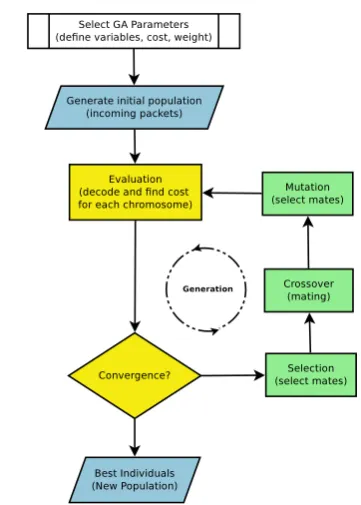
The GA uses three main types of operations, i.e. selection, crossover, and mutation at each step to create the next generation from the current population. The flowchart of GA procedure is shown in Figure II while the following terminologies describing the GA’s concepts are shown below:
1) Population is a set of chromosomes (individuals). 2) Chromosome expresses a possible solution to the
problem as a string (a set of bits).
3) Fitness functionresults a fitness value from a chromo-some as an input and returns a higher value for better solutions.
4) Selection method determines how the individuals, called parents, are selected for breeding from the initial population that contribute to the new population at the next generation.
5) Crossover operationdetermines how parents combine to produce offspring (children) for the next generation. 6) Mutation operationapply random changes to
[image:2.595.330.511.436.689.2]individ-ual parents to form children.
Fig. 2. Flowchart of Generation Algorithm
Search Techniques
Calculus
Based Random Enumeratives
Direct Indirect
Fibonacci Newton Greedy
Guided GuidedNon
Las Vegas Tabu Search Simulated Annealing Evolutionary Algorithms Neural Networks Genetic Programming Evolutionary Strategis Evolutionary Programming Genetic Algorithms Guided Non Guided Dynamic Programming Branch & Bound Back Tracking Hopfield Kohonen Maps Multilayer Perceptrons Paralel GAs Sequential GAs Automatic Parallelism (compiler) One population, Parallelevals + Crossover + Mutation Coarse Grain PGAs Fine Grain PGAs Homogeneous Heterogeneous Hardware Platform Software (Search) Hardware Platform Software (Search)
[image:3.595.99.497.49.324.2]Generational Steady-State Messy
Fig. 1. The tree structure of well-known search procedures and techniques [21]
The GA commonly starts with an initial population, i.e. an initial set of random solutions, which are represented by chromosomes and repeatedly modifies a population of individual solutions. The chromosomes evolve through suc-cessive iterations, called generations. During each genera-tion, the solutions represented by the chromosomes of the population are evaluated using some measures of fitness. At each step, the GA selects individuals at random from the current population to be parents and uses them to produce the offspring (children) for the next generation towards an optimal solution as a better new population.
III. CASESTUDY
[image:3.595.328.529.457.525.2]We are interested in network virtualization technology used in Future Internet, the replacement of current Internet technology. A research on implementation of GA as one of the alternative algorithms for managing virtual network resources is a challenging issue. We are proposing a new queue management for optimizing and managing packets arrived on a router queue. Our research uses a simulation to examine our model.
Fig. 3. Forwarding packets and queue management in a router
We use common queue models as well as Cisco’s queue model and Java Genetic Algorithm Project as shown in Figure 3 and mentioned in [22], respectively. Java Genetic Algorithm Package (JGAP) developed by JGAP Project is
a Genetic Algorithms and Genetic Programming component provided as a Java framework. It is also important to know some terms of the genetic algorithm compared with other classical optimization algorithms as shown in Table I.
TABLE I
COMPARISON OFNATURALEVOLUTION ANDGENETICALGORITHM TERMINOLOGY[21]
Natural Evolution Genetic algorithm Chromosome String
Gene Character (or Feature) Allele Feature value Locus String position Genotype Structure or coded string Phenotype Parameter set, a decoded structure
A virtual network has virtual nodes overlaid on the phys-ical nodes. We illustrated the virtual network and its queue model as shown in Figure 4. Packets transmitted by any sources will be classified and processed by GA. It defines and arranges the packets to get an optimal condition based on fitness value. Fitness value is needed to decide when a router has an optimal condition, called a solution.
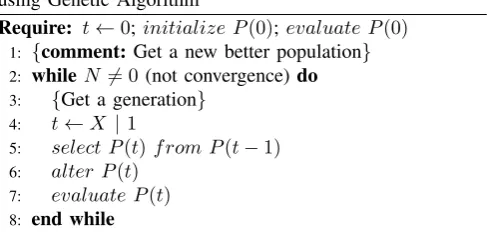
We use the GA’s pseudo-code, as shown in Algorithm 1, to impelement our case study. The algorithm consists of initialization, iterative variation and selection. Over iterations of random variation and selection, the population can be made to converge to optimal solutions by examining fitness values. The effectiveness of GA depends on the variation and selection operators as applied to a chosen representation and initialization.
A. Genetic Information
[image:3.595.53.287.631.701.2]Fig. 4. Queue model in a virtual network
Algorithm 1 A Pseudo-code for Optimizing Scheduling using Genetic Algorithm
Require: t←0;initialize P(0);evaluate P(0) 1: {comment:Get a new better population} 2: whileN 6= 0(not convergence)do
3: {Get a generation} 4: t←X |1
5: select P(t)f rom P(t−1)
6: alter P(t)
7: evaluate P(t)
8: end while
positive integers that represent the packet IDs transmitted to a router. Each locus of the chromosome represents a packet sequence in a router. Locus is a unique position on a set of all the genes of a specific individual.
In our case study, chromosomes are exposed to multiple genetic operators that represent mating and mutation. Af-terwards, they are chosen for the next generation during a natural selection phase based upon their fitness. Given a list of n slots and m packets, chromosomes are or-dered list of pairs of slots (si) and packets (pj) defined
as (s1,p1),(s2,p2),(s3,p3),..,(sn−1,pm−1),(sn,pm) where 1≤
si≤nand1≤pj≤m. Slots and packets could be vary in
size during their transmission and process in a router. A slot can transmit at least one packet at a time. In our illustration as shown in Table II, a slot can process 3 packets at once as long as the slot capacity is available.
B. Initialization
We initialize the population by generating a random pro-cedure in an appropriate range of values. These values are chosen based on some experimentation and can vary based on the specific problem. In our case study, we use a population size of 250 and a total number of 5000 evolutions. Thus, the
population initially consists of 250 chromosomes as potential solutions.
C. Fitness Function
The fitness function interprets a measure of how optimal that solution is relative to other potential solutions. The objective of our case is to produce superior solutions by examining the fitness function. The fitness function is the most important part in GA to determine which populations potentially make into the next evolution. The fitness function for our case study can be shown in Equation 1.
Fi=
n X
i=1
Si !
×Ns (1)
where:
Fi = fitness value of thei-th chromosome
Si = available capacity of thei-th slot
Ns= the number of slot needed by a router
Our solution is to reduce processing and transmitting packets by regulating the use of slot numbers in queues as small as possible. GA will evaluate the packets and put them in the slots. A solution can be reached after GA has the
TABLE II EXAMPLE OFCHROMOSOMES
Packets Slots
1 1
2 1
3 2
4 2
5 2
6 3
7 4
fewest number of slots as shown in Equation 2.
Solution= min (Fi) (2)
IV. RESULT ANDDISCUSSION
GA will process the population repeatedly until the con-vergent value is reached. Our research used a simula-tion method that was performed with Java’s technology
version1.6.020, OpenJ DK64−BitServerV M19.0−b09
on Intel Core i5 processor and running on Linux Ubuntu 10.10 with kernel 2.6.35-24. In all the simulations, the crossover probability and mutation probability are set to 0.90 and 0.05, respectively. Those are typical option values used in GA.
Each experiment is terminated when all the chromosomes have converged to the same value (solution). We determine the termination criteria defined by the number of evolutions and the loop will end when the highest number of evolutions is reached or when the optimal number of slots needed is reached. We evaluated our problems by running simulations with these criteria and results, as shown in Table III.
TABLE III
THE RESULTS OF SIMULATION FOR ARRANGEMENT AND OPTIMIZING QUEUE
Ev Pop Pckt SS FV NS
2,250 50 125 4 306.199 49
3,750 50 150 6 4,569.923 94
1,750 100 150 4 503.058 58
750 100 150 4 430.430 47
4,750 100 300 6 1,188.395 94
9,750 100 300 10 135,123.753 201
≥10,000 300 300 4 436,992.673 298
≥10,000 300 300 6 656.789 79
5 300 300 15 575.915
2750 300 1000 15 1953.040 109
AVG 4,575.50 170.00 307.50 6.30 58,238.10 106.20 SD 3,924.08 113.53 255.51 3.59 139,575.45 82.51 Note:
Ev = Evolution Pop = Population Pckt = Number of Packets SS = Slot Size
FV = Fitness value NS = Number of slots
To yield a solution in the simulation, we define initial values to the parameters. We set initial values of the evolution value, the population size, packet size, and slot size to 0-12000, 50-300, 125-1000, and 4-15, respectively.
Our experiment results still show unstable values in the evolution and fitness values that have the standard deviation 3,924.08 and 139,575.45 respectively. Those values indicate high variations in the evolution and fitness values to get a solution. These problems are subjects to discuss for getting a better fitness function.
V. CONCLUSION ANDFUTUREWORKS
This paper presented a genetic algorithm for evaluating and solving queue management to reduce cost of network resources especially on a router such as memory and time processes. Our results showed that the fitness function should be precisely well-defined for getting better result in perform-ing queue management.
By defining a crossover probability and mutation proba-bility to 0.90 and 0.05, our experiments result the average
(AVG) and standard deviation (SD) of fitness values and slots needed are 58,238.10 & 139,575.45 and 106.20 & 82.51, respectively. These values are subject to define in the future works by defining a better fitness function.
In the future, we will continue the research by evaluating the fitness function and implementing dynamic slot size to get complexity and performance of a router in a real implementation. We also would compare our results with current queue managements implementing on a router such as FIFO/FCFS and WFQ. It is important to compare with other queue management on a router to achieve results of proposing an alternative queue management on a router. Finally, we will use GA as a classifier for arrived packets on a router to identify the priority of process.
ACKNOWLEDGMENT
The authors would like to thank the reviewers for construc-tive comments and suggestions, the members of Okamura Laboratory, Department of Advanced Information Technol-ogy, Kyushu University, Japan and the members of NCC Laboratory, Department of Computer Science, Bogor Agri-cultural University (IPB), Indonesia for valuable help and support in discussion.
REFERENCES
[1] Sukoco, H., Y. Hori, Hendrawan, and K. Sakurai,Towards a Fairness Multimedia Transmission Using Layered-Based Multicast Protocol, IE-ICE TRANSACTIONS on Information and Systems Vol.E93-D No.11, pp.2953-2961, Special Section on Architectures, Protocols, and Ap-plications for the Future Internet, ISSN: 1745-1361, 0916-8532, Nov. 2010.
[2] Turner, J.S. and D.E. Tylor,Diversifying the Internet, In Proceedings of the IEEE Global Telecommunications Conference (GLOBECOM’05), Vol.2, DOI:10.1109/GLOCOM.2005.1577741, Dec. 2005.
[3] Anderson, T., L. Peterson, S. Shenker, and J. Turner,Overcoming the Internet impasse through virtualization, IEEE on Computer, Vol.38 No.4, pp.34-41, DOI 10.1109/MC.2005.136, ISSN: 0018-9162, April 2005.
[4] Chowdhury, N.M.M.K and R. Boutaba, A Survey of Network Virtualization, Computer Networks, Elsevier, Vol.54 pp.862-876, DOI:10.1016/j.comnet.2009.10.017, 2010.
[5] Garg, R. and H. Saran, Scheduling Algorithms for Bounded Delay Service in Virtual Networks, In Proceedings of the IEEE Global Telecommunications Conference (GLOBECOM’99), Vol.2, pp.1318-1322, DOI:10.1109/GLOCOM.1999.829986, ISBN: 0-7803-5796-5, August 2002.
[6] Vicente, J., Genesis: Toward Programmable Virtual Networking, In Proceedings of OPENSIG’98 Workshop on Open Signaling for ATM, Internet and Mobile Networks, DOI:10.1.1.70.8838, October 1998. [7] Florissi, D., The NetScript Approach to Programmable Networks, In
Proceedings of OPENSIG’98 Workshop on Open Signaling for ATM, Internet and Mobile Networks, October 1998.
[8] Nakao, A. Network Virtualization as Foundation for Enabling New Network Architectures and Applications, Invited Letter on Special Edition on New Generation Network towards Innovative Future Society, IEICE Transactions on Communication, Vol.E93-B No.3, pp.454-457, DOI:10.1587/transcom.E93.B.454, March 2010.
[9] Demers, A., S. Keshav, and S. Shenker,Analysis and Simulation of a Fair Queueing Algorithm, In Proceedings of ACM Symposium on Communications Architectures and Protocols (SIGCOMM’89), pp.3-12, DOI:10.1145/75246.75248, ISBN:0-89791-332-9, October 1990. [10] Garg, R. and X. Chen, RRR: Recursive Round Robin Scheduler,
In Proceedings of the IEEE Global Telecommunications Confer-ence (GLOBECOM’98), Vol.1, pp. 422-432, DOI: 10.1109/GLO-COM.1998.775767, ISBN: 0-7803-4984-9, 1998.
[11] Haupt, R.L. and S.E. Haupt,Practical Genetic Algorithm, 2nd Ed. ISBN 0-471-45565-2, John Wiley & Sons, Inc, 2004.
[13] Ahn, C. W. and R.S. Ramakrishna,A Genetic Algorithm for Short-est Path Routing Problem and the Sizing of Populations, IEEE Transactions on Evolutionary Computation, Vol.6 No.6, pp.566-579, DOI:10.1109/TEVC.202.804323, December 2002.
[14] Montana, D., M. Brinn, S. Moore, and G. Bidwell, Genetic al-gorithms for Complex, Real-Time Scheduling, In Proceedings of IEEE on Systems, Man, and Cybernetics, Vol.3 pp.2213-2218, DOI:10.1109/ICSMC.1998.724984, ISBN: 0-7803-4778-1, October 1998.
[15] Floyd, S. and V. Jacobson,Link Sharing and Resource Management Models for Packet Networks, IEEE/ACM Transactions on Networking, Vol.3 No.4, August 1995.
[16] Zhang, H. and J.C.R. Bennett, Hierarchical Packet Fair Queue-ing Algorithms, In Proceedings of ACM SIGCOMM’97, pp.143-156, September 1997.
[17] Ahmad, I., Y.K. Kwok, and M.Y. Wu, Analysis, Evaluation, and Comparison of Algorithms for Scheduling Task Graphs on Parallel Processors, In Proceedings of the International Symposium on Parallel Architectures, Algorithms and Networks, pp.207, ISBN: 0-8186-7460-1, IEEE Computer Society Washington, DC, USA, 1996.
[18] Kwok, Y.K., and I. Ahmad, Static Scheduling Algorithms for Al-locating Directed Task Graphs to Multiprocessors, ACM Computing Surveys, Vol. 31, Issue. 4, December 1999, ISSN: 0360-0300, ACM New York, NY, USA, 1999.
[19] Kaur, K., A. Chhabra, and G. Singh, Heuristics Based Genetic Algorithm for Scheduling Static Tasks in Homogeneous Parallel System, the International Journal of Computer Science and Security (IJCSS), Vol.4, Issue 2, pp.183 - 198, May 2010. ISSN (Online): 1985-1553, CSC Journals, 2010.
[20] Goldberg, D.E., Genetic Algorithms in Search, Optimization and Machine Learning, ISBN-10: 0201157675, ISBN-13: 9780201157673, Addison-Wesley, 1989.
[21] Sivanandam, S.N. and S.N. Deepa,Introduction to Genetic Algorithms, Chap.2 pp.15-27, ISBN 978-3-540-73189-4, Springer-Verlag, 2008. [22] JGAP Project, Java Genetic Algorithms Package, Available at
![Fig. 1.The tree structure of well-known search procedures and techniques [21]](https://thumb-us.123doks.com/thumbv2/123dok_us/1294659.658738/3.595.99.497.49.324/fig-tree-structure-known-search-procedures-techniques.webp)