Proceedings of the 23rd Conference on Computational Natural Language Learning, pages 890–899 890
Alleviating Sequence Information Loss with Data Overlapping and Prime
Batch Sizes
No´emien Kocher♦ Christian Scuito♠ Lorenzo Tarantino♠ Alexandros Lazaridis♥ Andreas Fischer♦,♣ Claudiu Musat♥
♦
School of Engineering and Architecture of Fribourg, Switzerland, HES-SO, iCoSys Institute ♠
Ecole Polytechnique F´ed´erale de Lausanne (EPFL) ♥Swisscom ♣University of Fribourg
{noemien.kocher|sciutochristian|lorenzotara7}@gmail.com
{alexandros.lazaridis|claudiu.musat}@swisscom.ch, [email protected]
Abstract
In sequence modeling tasks the token order matters, but this information can be partially lost due to the discretization of the sequence into data points. In this paper, we study the imbalance between the way certain to-ken pairs are included in data points and oth-ers are not. We denote this a token order imbalance (TOI) and we link the partial se-quence information loss to a diminished per-formance of the system as a whole, both in text and speech processing tasks. We then pro-vide a mechanism to leverage the full token order information—Alleviated TOI—by iter-atively overlapping the token composition of data points. For recurrent networks, we use prime numbers for the batch size to avoid re-dundancies when building batches from over-lapped data points. The proposed method achieved state of the art performance in both text and speech related tasks.
1 Introduction
Modeling sequences is a necessity. From time se-ries (Connor et al.,1994;Lane and Brodley,1999) to text (Sutskever et al.,2011) and voice (Robin-son,1994;Vinyals et al.,2012), ordered sequences account for a large part of the data we process and learn from. The data are discretized and become, in this paradigm, a list oftokens.
The key to processing these token sequences is to model the interactions between them. Tradition-ally (Rosenfeld,2000) this has been achieved with statistical methods, like N-grams.
With the advances in computing power and the rebirth of neural networks, the dominant paradigm has become the use of recurrent neural networks (RNNs) (Mikolov et al.,2010).
The dominance of RNNs has been recently challenged with great success by self-attention based models (Vaswani et al., 2017). Instead
Contiguous tokens
Data-point
[image:1.595.319.514.222.299.2]Order knowledge lost
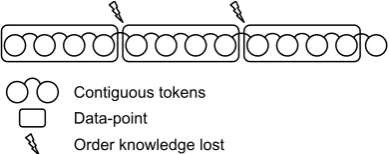
Figure 1: The common way of building data points given a dataset of contiguous tokens. Here we illus-trate a dataset with a contiguous list of 13 tokens, from which we build 3 data points of 4 tokens each. This process keeps the order of the tokens inside the data points, but loses the order information from token pairs that happen to fall between adjacent data points.
of modeling the sequence linearly, Transformer-based models use learned correlations within the input to weight each element of the input sequence based on their relevance for the given task.
Series discretization. Both RNNs and self-attention models take as inputdata points—token sequences of a maximum predefined length—and then create outputs for each of them. These tend to be much shorter in size, compared to the size of the full dataset. While for humans time seems to pass continuously, this discretization step is important for the machine understanding of the sequence.
A side effect of this step is a partial loss of the token order information. As portrayed in Figure1, we notice that the token order information within a data point are kept. On the other hand, the knowl-edge about the token order at the boundaries of data points is lost. We name the situation Token Order Imbalance (TOI).
As the discretization in Figure1 is the current standard of sequence processing, we denote this as standard Token Order Imbalance (TOI). We hy-pothesize that this loss of information unnecessar-ily affects the output of the neural network models.
en-sure that all token sequences are taken into ac-count, i.e. every token pair is included in a data point and does not always fall between two data point boundaries. Thus, all sequence information is available for subsequent processing. The pro-posed method, denoted Alleviated TOI, employs a token offset in the data point creation to cre-ate overlapped data point sequences in order to achieve this effect.
Batch Creation with Alleviated TOI. A sec-ond contribution is a strategy for batch creation when using the proposed Alleviated TOI method. We have observed an unintended data redundancy within batches introduced by the overlapped data point sequences. A strategy for avoiding this data redundancy is surprisingly simple but effective: Always use a prime number for the batch size. The intuition behind the prime batch size is that it en-sures a good distribution of the batches over the entire dataset. If used naively, the Alleviated TOI policy leads to very similar data points being se-lected in a batch, which hinders learning. By de-coupling the batch size and the token offset used in the token creation, this negative effect is effec-tively removed.
We then compare the Alleviated TOI with the Standard TOI and show that, on the same dataset and with the same computation allocated, the Al-leviated TOI yields better results. The novel TOI reduction method is applicable to a multitude of sequence modeling tasks. We show its benefits in both text and voice processing. We employ several basic and state of the art RNNs as well as Trans-formers and the results are consistent—the addi-tional information provided by the Alleviated TOI improves the final results in the studied tasks.
For text processing we focus on a well-studied task—language modeling—where capturing the sequence information is crucial. Using Alleviated TOI (P) with the Maximum Over Softmax (MoS) technique on top of a recurrent cell (Yang et al., 2017) we get the new state of the art on the Penn-Tree-Bank dataset without fine-tuning with 54.58 perplexity on the test set. We also obtain results comparable to the state of the art on speech emo-tion recogniemo-tion on the IEMOCAP (Busso et al., 2008) dataset1.
The paper continues with an overview of the re-lated work in Section 2, a description of the
al-1To make our results reproducible, all relevant source
codes are publicly available athttps://github.com/ nkcr/overlap-ml
leviated TOI mechanism in Section 3 and a de-tailed description of the batch generation in Sec-tion 4. The experimental design follows in Sec-tion 5and the results are detailed and interpreted in Section6.
2 Related work
At the core of our work is the idea that the way that data samples are provided for training a model can affect speed or capabilities of the model. This field is broad and there are several distinct approaches to achieve it. Notable examples include curricu-lum learning (Bengio et al.,2009) and self-paced learning (Kumar et al., 2010), where data points for training are selected based on a metric of eas-inessorhardness. In Bayesian approaches (Klein et al.,2016), the goal is to create sub-samples of data points, whose traits can be extrapolated as the full dataset.
Our work thus differs from the aforementioned methods in the fact that we focus on exploit-ing valuable but overlooked information from se-quences of tokens. We change the way data points are generated from token sequences and extend the expressivity of a model by providing an augmented, and well sorted, sequence of data points. This method has a related effect of a randomized-length backpropagation through time (BPTT) (Merity et al., 2017), which yields dif-ferent data points between epochs. It also re-sembles classical text data-augmentation methods, such as data-augmentation using thesaurus (Zhang and LeCun,2015).
is a common technique in speech processing and more specifically in automatic speech recognition (ASR) (Chiu et al.,2018;Xiong et al.,2016;Kim and Stern, 2016). We hypothesize that extending the current overlapping technique to a higher level, that is using a sliding overlapping window over the already extracted features, will be proven benefi-cial. We believe this to have a positive impact on speech processing tasks such as speech emotion recognition (SER). This is because the emotional load in an spoken utterance expands over larger windows than frame-, phoneme- or syllable-based ones (Frijda,1986).
We investigate the proposed method using a simple LSTM model and a small-size Transformer model on the IEMOCAP dataset (Busso et al., 2008), composed of five acted sessions, for a four-class emotions four-classification and we compare to the state of the art (Mirsamadi et al.,2017) model, a local attention based BiLSTM. Ramet et al. (2018) showed in their work a new model that is competitive to the one previously cited, following a cross-valiadation evaluation schema. For a fair comparison, in this paper we focus on a non-cross-valiation schema and thus compare our results to the work ofMirsamadi et al.(2017), where a sim-ilar schema is followed using as evaluation set the fifth session of IEMOCAP database. It is note-worthy that with a much simpler method than pre-sented inRamet et al.(2018), we achieve compa-rable results, underscoring the importance of the proposed method for this task as well.
3 Alleviated Token Order Imbalance
Let a token pair denote an ordered pair of tokens— for instance token A followed by token B, as in the sequence ”ABCDEF G...”. When splitting a token sequence into data points”D1, D2, ..”, if the split is fixed, as inD1 always being equal to ”ABC”,D2always being equal to”DEF”, etc., then the information contained in the order of to-kensC andD for instance is partially lost. This occurs as there is no data point that contains this token pair explicitly. We call the”CD”token pair asplit token pairand its tokens,CandD, are de-noted assplit tokens.
In its most extreme form, split token pair order information is lost completely. In other cases, it is partially taken into account implicitly. In recurrent cells, for instance, the internal state of the cell al-lows for the order information of split tokens pairs
1 3
N=3
5 7
9 11
2 4
6 8
[image:3.595.320.515.58.195.2]10
Figure 2: Illustration of an Alleviated TOI (3) made from a single contiguous list of 13 tokens. With a Standard TOI andN=3 (ie. 3 tokens per data point), a contiguous list of 13 tokens would produce 4 data points, which is illustrated by the first overlapped se-quence. Here, an Alleviated TOI (3) splits the contigu-ous list of tokens 3 times with each time a different off-set (0,1,2 respectively). This finally leads to a list of 11 data points coming from the 3 appended overlapped sequences.
to be used. This is due to the serial processing of the data points containing the split tokens.
As some token pairs are taken into account fully, others partially and others not at all, we de-note this situation astoken order imbalance(TOI). In this paper, we propose to alleviate the TOI by means of overlapping sequences of data points. The aim is to avoid the loss of information be-tween the last token of a data point and the first token of its subsequent data point. Instead of split-ting the sequence of tokens only once, we repeat this process multiple times using different offsets. Each time we subdivide the sequence of tokens with a new offset, we include the links that were missing in the previous step. Finally, the over-lapping sequences of data points are concatenated into a single sequence, forming the final dataset.
Figure2illustrates an Alleviated TOI (3), which means the sequence of data points is split three times instead of only once, producing 3 over-lapped sequences that will then be concatenated.
Our Alleviated TOI (P) method is detailed in the pseudo-code below, where olp_sequence holds
an overlapped sequence and P is the number of times we subdivide the sequence of tokens with a different offset:
Let N = Number of tokens per data point P = Number of overlapped sequences Step = N / P
olp_sequence = create data points from Dataset with offset (i * Step) Add olp_sequence to DataPoints RETURN DataPoints
When we apply an Alleviated TOI (P), this means that we are going to create P times a se-quence of data points with different offsets. There-fore, the final dataset will be the concatenation ofP repetitions of the original dataset, with data points shifted by a specific and increasing offset at token level for each repetition.
For example, given a sequenceS1withN = 70
tokens per data point and an Alleviated TOI (P) withP = 10, the step size will be NP = 7tokens. Therefore, starting from the sequenceS1, nine
ad-ditional sequences of data points will be created: S2 starting from token 7, S3 starting from token
14,S4starting from token 21 and so on untilS10.
When using Alleviated TOI (P), withPsmaller than the data point size, within an epoch, a split token pair—that is a token pair that is split in the original data point splitting—becomes part of a data pointP−1times. A token pair that is never split will be part of the data pointP times.
We can thus define atoken order imbalance ra-tiothat describes the imbalance between the num-ber of times we include split token pairs and the number of times we include pairs that are not split:
(P−1)/P
We notice that the higherP, the closer the ratio becomes to 1. We hypothesize that the closer the ratio becomes to 1, the better we leverage the in-formation in the dataset. We thus expect that for higher values of P the Alleviated TOI (P) method will outperform versions with lower values, with Alleviated TOI (1) being the Standard TOI, which is now prevalent.
We quantify the additional computational cost of Alleviated TOI (P). Since our method only re-sults inP (shifted) repetitions of the dataset, each epoch using the augmented dataset would take
∼P times longer than an epoch over the original dataset. Therefore, we ensure fair comparison by allowing baseline models to train forPtimes more epochs than a model using Alleviated TOI (P).
4 Batch Creation with Alleviated TOI
Series discretization may also occur at higher lev-els than data points, in particular when build-ing batches for mini-batch trainbuild-ing of neural
net-Dataset
Data-points
Batches
N=2
K=2
Figure 3: Three levels of data representation used to create distributed batches. The dataset is a sequence of tokens on which data points are built by splitting the sequence into subsequences of N tokens. Batches of K data points are then built by subdividing the sequence of data points into K equal parts. Here, the first part contains the first two data points, the second part the following two, and the last data point is dropped. Each batch then uses one element of each part.
works. We can distinguish two types of batches, i.e. sequential anddistributed batches. The for-mer keep the data point sequences intact, thus cre-ating split token pairs only between two consecu-tive batches. The latter distribute data points from different parts of the dataset to approximate the global distribution, thus creating split token pairs between all data points in batches.
In principle, our proposed method alleviates the TOI in both cases, since multiple overlapping se-quences of data points are generated. However, we have observed an unintended interference with the batch creation in the case of distributed batches. In this section we explain the problem in detail and propose a simple but effective solution—choosing a prime batch size.
Figure3illustrates the three levels of data rep-resentation in the case of distributed batches. Data points are built fromN consecutive tokens to cap-ture the sequential information. Batches are then built from K parts of the data point sequence to capture the global distribution. An example of this approach is the batching procedure used in Zoph and Le (2016); Merity et al. (2017); Yang et al.(2017);Zołna et al.(2017) for word language modeling, where the basic token is a word.
The batching mechanism can be seen as build-ing a 2-dimensional matrix, where each row con-tains a batch. Consider a sequence of M data points and a batch size of K. In order to build batches, the data points are split intoKparts, rep-resented as MK ×1column vectors. They are con-catenated to form a MK ×K matrix, such that the rows correspond to batches.
Alleviated TOI 2
Alleviated TOI 5
batch size
n
u
m
b
a
tc
h
Alleviated TOI 7 Alleviated TOI 10
(a) Matrix of batches with batch size of 20
Alleviated TOI 2
Alleviated TOI 5
batch size
n
u
m
b
a
tc
h
Alleviated TOI 7 Alleviated TOI 10
[image:5.595.86.517.64.207.2](b) Matrix of batches with batch size of 19
Figure 4: Illustrations of the 2D matrix of batches with differentP-values of Alleviated TOI (P). On the left we used a batch size of 20 and on the right we used a prime batch size of 19. Each data point is a pixel and each row is a batch. The grayscale value models the proximity of the data points with respect to the dataset. Therefore, two pixels with similar color represents two data points that are close in the dataset. The illustrations demonstrate how different values ofP affect the content of the batches, which can lack a good distribution over the dataset. Ideally, each row should contain a gradient of different grayscale values. We can observe how using a prime batch size affects the distribution of data points within the batches, where the matrices on the right offer a better distribution. This effect is especially well visible for the Alleviated TOI 10.
q
1 2 3 ...
1’ 2’ 3’ ... P*M/K
[image:5.595.118.246.350.430.2]K
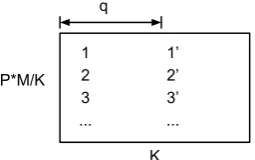
Figure 5: Data point repetition with period q for M
data points, K batches, and Alleviated TOI (P). Data point 1’ is the same as data point 1 with a token offset.
P Periodq Repetitions
2 10 2
5 4 5
7 20 1
10 2 10
Table 1: Data point repetition with periodqfor batch sizeK= 20and Alleviated TOI (P).
dataset to a total of P ·M data points, adding additional data points with token offsets. There-fore, the PK·M ×K matrix used for batch creation may contain repeated data points within the same batch as illustrated in Figure5. Arepeated data point differs from the previous data point only marginally due to the token offset. This redun-dancy can be problematic, as the batches are not well-distributed over the entire dataset anymore.
With respect to the batch matrix, a repeated data point occurs iffPK·M·q =n·Mwithperiodq < K andq, n∈N. This is equivalent to
P
K ·q =n, q < K, q, n∈N
independent of the number of data points M. A repetition thus occurs iff the greatest common di-visor (GCD) of P andK is larger than 1. Oth-erwise, for GCD(P, K) = 1a data point repeats only after periodq =K, i.e. there is no repetition within the same batch.
Table1lists exemplary periods for a batch size ofK = 20and different values ofP for the Al-leviated TOI (P). The worst case isP = 10with 10 repetitions of the same data point within the same batch and the best case is P = 7, which avoids any redundancy because the GCD ofP and K is 1. Figure 4 illustrates the repetition with grayscale values, where similar grayscale values indicate that two data points are close within the original data points sequence.
In general, while we aim for large values of P for reducing the TOI, a simple solution for avoid-ing redundancy within batches is to choose a prime number for the batch sizeK.
5 Experimental Setup
[image:5.595.118.245.499.576.2]speech related tasks. We thus run the Allevi-ated TOI (P) with language modeling (text) and emotion recognition (speech). The text datasets used are Penn-Tree-Bank (PTB) (Marcus et al., 1993) as preprocessed in Mikolov et al. (2011), Wikitext-2 (WT2), and Wikitext-103 (WT103) (Merity et al., 2016). The speech dataset is the IEMOCAP database (Busso et al., 2008), a col-lection of more than 12 hours of recorded emo-tional speech of 10 native-English speakers, men and women. The audio data is filtered down to 5.5 hours containing only angry, happy, neutral and
sadutterances.
5.1 TOI in Language Modelling
For language modeling, we use three different methods:
• A simple LSTM that does not benefit from extensive hyper-parameter optimization.
• An Average Stochastic Gradient Descent Weight-Dropped LSTM (AWD-LSTM) as described in Merity et al. (2017), with the same hyper-parameters.
• The latest State-of-the-Art model: Mixture of Softmaxes (MoS) (Yang et al.,2017).
We compare our results against the original pro-cess of building data points, i.e. Standard TOI, and use the same computation load allocated for each experiment. We use the same set of hyper-parameters as described in the base papers, except for the batch size with Alleviated TOI (P), where we use a prime batch size in order to prevent any repetitions in batches, as described in Section 4. That is, on the PTB dataset, we use a sequence length of 70 for all the models. For the Simple LSTM and AWD-LSTM, we use a batch size of 20 and a hidden size of 400. AWD-LSTM and MoS are trained on 1000 epochs, and the Simple LSTM on 100 epochs. For the MoS model, embedding size used is 280, batch size 12, and hidden size 980. All the models use SGD as the optimizer.
We set up experiments to compare 4 different token order imbalance setups: Extreme TOI, Inter-batch TOI, Standard TOI, and Alleviated TOI (P).
Extreme TOI The Extreme TOI setup builds
batches using a random sequence of data points. This removes any order inside the batches (i.e. among data points within a batch), and among batches.
Inter-batch TOI In the Inter-batch TOI setup, batches are built using an ordered sequence of data points, but the sequence of batches is shuffled. This keeps the order inside batches, but removes it among batches. Looking at the 2D matrix of batches, in Figure 4, this results in shuffling the rows of the matrix.
Standard TOI In the Standard TOI setup, the process of building batches is untouched, as de-scribed in section3. This keeps the order inside, and among batches.
Alleviated TOI (P) In the Alleviated TOI (P) setup, we apply our proposed TOI reduction by creating P overlapped data point sequences (see Sections3and4). This strategy not only keeps the order inside and among batches, but it also restores the full token order information in the dataset.
5.2 TOI in Speech Emotion Recognition
For Speech Emotion Recognition (SER) we use two different models: the encoder of the Trans-former (Vaswani et al.,2017) followed by convo-lutional layers, and the simple LSTM used in text domain case. Since the Transformer is stateless and uses self-attention instead, we are able to in-vestigate the effect of Alleviated TOI (P) indepen-dently of LSTM cells.
As with language modeling, we set up experi-ments to compare the 4 different token order im-balance strategies: Extreme TOI, Inter-batch TOI, Standard TOI, and Alleviated TOI (P).
We apply the methodology used in text on the SER task, using the simple LSTM and a window size of 300 frames. In this case, a data point, in-stead of being a sequence of words, is a sequence of frames coming from the same utterance. Each frame is described by a 384-dimensional features vector. OpenSMILE (Eyben et al., 2013) is used for extracting the features. We opt for the IS09 features set (Schuller et al.,2009) as proposed by Ramet et al.(2018) and commonly used for SER.
Experiment PTB WT2 WT103
Extreme TOI 63.49 73.52 36.19 Inter-batch TOI 64.20 72.61 36.39 Standard TOI 58.94 65.86 32.94
[image:7.595.81.282.63.184.2]Alleviated TOI 2 57.97 65.14 32.98 Alleviated TOI 5 57.14 65.11 33.07 Alleviated TOI 7 57.16 64.79 32.89 Alleviated TOI 10 56.46 64.73 32.85
Table 2: Perplexity score (PPL) comparison of the AWD model, on the three datasets, with batch sizes
K= 20(PTB),K= 80(WT2) andK= 60(WT103), with different levels of Token Order Imbalance (TOI). With Alleviated TOI (P), we use a prime batch size of
K= 19(PTB),K= 79(WT2) andK= 59(WT103).
6 Experimental Results
6.1 Language Modelling
Table 2 compares the 4 token order imbalance strategies using the AWD model and three text datasets. We use the test perplexity after the same equivalent number of epochs. The different Alle-viated TOI (P) experiments use a different number of overlapped sequence: An Alleviated TOI (P) means building and concatenating P overlapped sequences. Our results indicate that an Alleviated TOI (P) is better than the Standard TOI, which is better than an Extreme or Inter-batch TOI. We note a tendency that higher values ofPlead to better re-sults, which is in accordance with our hypothesis that a higher TOI ratio (P −1)/P improves the results.
Comparison with State of the Art and Simple LSTM. With the MoS model and an Alleviated TOI, we improve the current state of the art with-out fine tuning for the PTB dataset with 54.58 per-plexity on the test set. Table3demonstrates how models can be improved by applying our Allevi-ated TOI method on 2 latest state-of-the-art mod-els: AWD-LSTM (Merity et al.,2017) and AWD-LSTM-MoS (Yang et al., 2017), and the Simple LSTM model. We compare the results with the same hyper-parameters used on the original pa-pers with the only exception of the batch size, that must be prime. To ensure fairness, we allocate the same computational resources for the base model as well the model with Alleviated TOI, i.e. we train with the equivalent number of epochs.
Model test ppl
AWD-LSTM (Merity et al.,2017) 58.8 AWD-LSTM + Alleviated TOI 56.46 AWD-LSTM-MoS (Yang et al.,2017) 55.97 AWD-LSTM-MoS + Alleviated TOI 54.58
Simple-LSTM 75.36
Simple-LSTM + Alleviated TOI 74.44
Table 3: Comparison between state-of-the-art models (Merity et al.,2017; Yang et al.,2017) and a Simple LSTM, and the same models with Alleviated TOI. The comparison highlights how the addition of Alleviated TOI is able to improve state-of-the-art models, as well as a simple model that does not benefit from extensive hyper-parameter optimization.
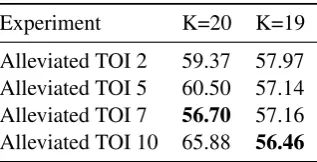
Experiment K=20 K=19
Alleviated TOI 2 59.37 57.97 Alleviated TOI 5 60.50 57.14 Alleviated TOI 7 56.70 57.16 Alleviated TOI 10 65.88 56.46
Table 4: Perplexity score (PPL) comparison on the PTB dataset and the AWD model. We use two differ-ent values for the batch sizeK— the original one with
K = 20, and a prime one withK = 19. The results directly corroborate the observation portrayed in Fig-ure4, where the obtained score is related to the diver-sity of grayscale values in each row.
[image:7.595.306.525.64.169.2] [image:7.595.337.496.280.361.2]Experiment WA UA
Extreme TOI (15k steps) 0.475 0.377 Inter-batch TOI (15k steps) 0.478 0.386 Standard TOI (15k steps) 0.486 0.404 Alleviated TOI (15k steps) 0.553 0.489
[image:8.595.84.279.62.156.2]Alleviated TOI (60 epochs) 0.591 0.523
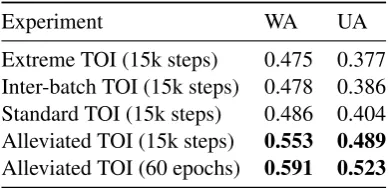
Table 5: Token order imbalance (TOI) comparison for the IEMOCAP dataset on a SER task usingangry,
happy, neutral andsad classes with a simple LSTM
model.
6.2 Speech Emotion Recognition Results
The results on the IEMOCAP database are eval-uated in terms of weighted (WA) and unweighted accuracy (UA). The first metric is the accuracy on the entire evaluation dataset, while the second is the average of the accuracies of each class of the evaluation set. UA is often used when the database is unbalanced, which is true in our case, since the
happyclass has a total duration that is half of the second smallest class in speech duration.
Table5shows that our proposed method brings value in the speech related task as well. When choosing the Extreme TOI instead of the Standard TOI approach we observe a smaller effect than in text related task: this is due to the different nature of the text datasets (large ”continuous” corpuses) and the IEMOCAP one (composed of shorter ut-terances). The fact that we can still observe im-provements on a dataset with short utterances is a proof of the robustness of the method.
A greater effect is obtained when we increase the size of the dataset with the proposed Allevi-ated TOI (P) approach: Due to the increasing off-set at each overlapped sequence, the data fed into the model contains utterances where the emotions are expressed in slightly different ways. For this reason, the performance notably increases.
Table 6reports the result of a final experiment that aims to investigate the effect of Alleviated TOI (P) independently of LSTM cells. For each Alleviated TOI (P) setup and Standard TOI de-scribed in Table6, we repeat the training and eval-uation for each of the following window sizes: 100, 200, 300, 400 and 500 frames. The pre-viously described Transformer model is used in these experiments. The results reported in Table6 are the mean ±the standard deviation computed for different P-values of Alleviated TOI (P).
Experiment WA (60 epochs) UA (60 epochs)
Alleviated TOI 1 0.591±0.012 0.543±0.021 Alleviated TOI 2 0.594±0.007 0.549±0.016 Alleviated TOI 3 0.605±0.018 0.563±0.024 Alleviated TOI 5 0.608±0.015 0.562±0.028 Alleviated TOI 10 0.617±0.015 0.571±0.024
Local attention 0.635 0.588
Table 6: Token order imbalance (TOI) comparison for the IEMOCAP dataset on a SER task usingangry,
happy, neutral and sadclasses for 60 epochs using the
Transformer model.
The last line of Table6refers toMirsamadi et al. (2017) results. We want to highlight the fact that the goal of these experiments is to show the di-rect contribution of the Alleviated TOI technique for a different model. For this reason we use a smaller version of the Transformer in order to re-duce the computational cost. We believe that with a more expressive model and more repetitions, the proposed method may further improve the results. The results from Table6demonstrate that, as we increase the value ofP, more significant improve-ments are achieved. This is in accordance with our hypothesis that a higher TOI ratio(P−1)/P im-proves the results.
7 Conclusions
In this work, the importance of overlapping and to-ken order in sequence modelling tasks were inves-tigated. Series discretization is an essential step in machine learning processes which nonetheless can be responsible for the loss of the continuation of the tokens, through the token order imbalance (TOI) phenomenon. The proposed method, Alle-viated TOI, has managed to overcome this draw-back and ensures that all token sequences are taken into account. The proposed method was validated in sequence modelling tasks both in the text and speech domain outperforming the state of the art techniques.
References
Yoshua Bengio, J´erˆome Louradour, Ronan Collobert, and Jason Weston. 2009. Curriculum learning. In Proceedings of the 26th annual international
con-ference on machine learning, pages 41–48. ACM.
Narayanan. 2008. Iemocap: interactive emotional dyadic motion capture database. Language
Re-sources and Evaluation, 42:335–359.
Chung-Cheng Chiu, Tara N Sainath, Yonghui Wu, Ro-hit Prabhavalkar, Patrick Nguyen, Zhifeng Chen, Anjuli Kannan, Ron J Weiss, Kanishka Rao, Eka-terina Gonina, et al. 2018. State-of-the-art speech recognition with sequence-to-sequence models. In 2018 IEEE International Conference on
Acous-tics, Speech and Signal Processing (ICASSP), pages
4774–4778. IEEE.
Jerome T Connor, R Douglas Martin, and Les E Atlas. 1994. Recurrent neural networks and robust time series prediction. IEEE transactions on neural
net-works, 5(2):240–254.
Mingzhou Ding, Steven L Bressler, Weiming Yang, and Hualou Liang. 2000. Short-window spectral analysis of cortical event-related potentials by adap-tive multivariate autoregressive modeling: data pre-processing, model validation, and variability assess-ment.Biological cybernetics, 83(1):35–45.
Guozhu Dong and Jian Pei. 2007. Sequence data min-ing, volume 33. Springer Science & Business Me-dia.
Florian Eyben, Felix Weninger, Florian Gross, and Bj¨orn Schuller. 2013. Recent developments in opensmile, the munich open-source multimedia fea-ture extractor. In Proceedings of the 21st ACM
International Conference on Multimedia, MM ’13,
pages 835–838, New York, NY, USA. ACM.
Nico H. Frijda. 1986. The Emotions. Cambridge Uni-versity Press.
Chanwoo Kim and Richard M Stern. 2016. Power-normalized cepstral coefficients (pncc) for robust speech recognition. IEEE/ACM Transactions on
Audio, Speech and Language Processing (TASLP),
24(7):1315–1329.
Aaron Klein, Stefan Falkner, Simon Bartels, Philipp Hennig, and Frank Hutter. 2016. Fast bayesian op-timization of machine learning hyperparameters on large datasets.CoRR, abs/1605.07079.
M Pawan Kumar, Benjamin Packer, and Daphne Koller. 2010. Self-paced learning for latent variable mod-els. InAdvances in Neural Information Processing
Systems, pages 1189–1197.
Terran Lane and Carla E Brodley. 1999. Temporal se-quence learning and data reduction for anomaly de-tection. ACM Transactions on Information and
Sys-tem Security (TISSEC), 2(3):295–331.
Mitchell P. Marcus, Mary Ann Marcinkiewicz, and Beatrice Santorini. 1993. Building a large annotated corpus of english: The penn treebank.Comput.
Lin-guist., 19(2):313–330.
Stephen Merity, Nitish Shirish Keskar, and Richard Socher. 2017. Regularizing and optimizing LSTM language models.CoRR, abs/1708.02182.
Stephen Merity, Caiming Xiong, James Bradbury, and Richard Socher. 2016. Pointer sentinel mixture models. CoRR, abs/1609.07843.
Tom´aˇs Mikolov, Anoop Deoras, Stefan Kombrink, Luk´aˇs Burget, and Jan ˇCernock`y. 2011. Empirical evaluation and combination of advanced language modeling techniques. InTwelfth Annual Conference of the International Speech Communication
Associ-ation.
Tom´aˇs Mikolov, Martin Karafi´at, Luk´aˇs Burget, Jan ˇ
Cernock`y, and Sanjeev Khudanpur. 2010. Recurrent neural network based language model. InEleventh annual conference of the international speech
com-munication association.
Seyedmahdad Mirsamadi, Emad Barsoum, and Cha Zhang. 2017. Automatic speech emotion recogni-tion using recurrent neural networks with local at-tention. 2017 IEEE International Conference on
Acoustics, Speech and Signal Processing (ICASSP),
pages 2227–2231.
Patrick Ng. 2017. dna2vec: Consistent vector repre-sentations of variable-length k-mers. arXiv preprint
arXiv:1701.06279.
Gaetan Ramet, Philip N. Garner, Michael Baeriswyl, and Alexandros Lazaridis. 2018. Context-aware at-tention mechanism for speech emotion recognition. 2018 IEEE Spoken Language Technology Workshop
(SLT), pages 126–131.
Anthony J. Robinson. 1994. An application of recur-rent nets to phone probability estimation. Trans.
Neur. Netw., 5(2):298–305.
Ronald Rosenfeld. 2000. Two decades of statistical language modeling: Where do we go from here?
Proceedings of the IEEE, 88(8):1270–1278.
Bj¨orn Schuller, Stefan Steidl, and Anton Batliner. 2009. The interspeech 2009 emotion challenge.
In Tenth Annual Conference of the International
Speech Communication Association.
Ilya Sutskever, James Martens, and Geoffrey E Hin-ton. 2011. Generating text with recurrent neural networks. InProceedings of the 28th International
Conference on Machine Learning (ICML-11), pages
1017–1024.
Ashish Vaswani, Noam Shazeer, Niki Parmar, Jakob Uszkoreit, Llion Jones, Aidan N Gomez, Łukasz Kaiser, and Illia Polosukhin. 2017. Attention is all you need. InAdvances in Neural Information
Pro-cessing Systems, pages 5998–6008.
Acoustics, Speech and Signal Processing (ICASSP), pages 4085–4088.
Wayne Xiong, Jasha Droppo, Xuedong Huang, Frank Seide, Mike Seltzer, Andreas Stolcke, Dong Yu, and Geoffrey Zweig. 2016. Achieving human parity in conversational speech recognition. arXiv preprint
arXiv:1610.05256.
Zhilin Yang, Zihang Dai, Ruslan Salakhutdinov, and William W. Cohen. 2017. Breaking the softmax bot-tleneck: A high-rank RNN language model. CoRR, abs/1711.03953.
Xiang Zhang and Yann LeCun. 2015. Text understand-ing from scratch.arXiv preprint arXiv:1502.01710.
Konrad Zołna, Devansh Arpit, Dendi Suhubdy, and Yoshua Bengio. 2017. Fraternal dropout. stat, 1050:31.
Barret Zoph and Quoc V Le. 2016. Neural architecture search with reinforcement learning. arXiv preprint