Intelligence
A new upper bound is presented for the computational complexity of the parsing problem for TAGs, under the constraint that input is read from left to right in such a way that errors in the input are observed as soon as possible, which is called the "correct-prefix property." The former upper bound, O(n9), is now improved to O(n6), which is the same as that of practical parsing algorithms for TAGs without the additional constraint of the correct-prefix property.
1. Introduction
Traditionally, parsers and recognizers for regular and context-free languages process input from left to right. If a syntax error occurs in the input they often detect that error immediately after its position is reached. The position of the syntax error can be defined as the rightmost symbol of the shortest prefix of the input that cannot be extended to be a correct sentence in the language L.
In formal notation, this prefix for a given erroneous input w ~ L is defined as the string va, where w = vax, for some x, such that vy E L, for some y, but vaz ~ L, for any z. (The symbols v, w . . . . denote strings, and a denotes an input symbol.) The occurrence of a in w indicates the error position.
If the error is detected as soon as it is reached, then all prefixes of the input that have been processed at preceding stages are correct prefixes, or more precisely, they are prefixes of some correct strings in the language. Hence, we speak of the correct-prefix property. 1
An important application can be found in the area of grammar checking: upon finding an ungrammatical sentence in a document, a grammar checker may report to the user the presumed position of the error, obtained from a parsing algorithm with the correct-prefix property.
For context-free and regular languages, the correct-prefix property can be satis- fied without additional costs of space or time. Surprisingly, it has been claimed b y Schabes and Waters (1995) that this property is problematic for the mildly context- sensitive languages represented by tree-adjoining grammars (TAGs): the best practical parsing algorithms for TAGs have time complexity Cg(n 6) (Vijay-Shankar and Joshi [1985]; see Satta [1994] and Rajasekaran and Yooseph [1995] for lower theoretical upper bounds), whereas the only published algorithm with the correct-prefix property--that by Schabes and Joshi (1988)--has complexity O(n9).
In this paper we present an algorithm that satisfies the correct-prefix property and operates in Cq(n 6) time. This algorithm merely recognizes input, but it can be extended
* DFKI, Stuhlsatzenhausweg 3, D-66123 Saarbriicken, Germany. E-mail: [email protected]
Computational Linguistics Volume 25, Number 3
to be a parsing algorithm w i t h the ideas f r o m Schabes (1994), w h i c h also suggest h o w it can be e x t e n d e d to h a n d l e substitution in addition to adjunction. The c o m p l e x i t y results carry o v e r to linear i n d e x e d g r a m m a r s , c o m b i n a t o r y categorial g r a m m a r s , and h e a d g r a m m a r s , since these formalisms are equivalent to TAGs (Vijay-Shanker a n d Weir 1993, 1994).
We p r e s e n t the actual algorithm in Section 3, after the necessary notation has b e e n discussed in Section 2. The correctness proofs are discussed in Section 4, a n d the time c o m p l e x i t y in Section 5. The ideas in this p a p e r give rise to a n u m b e r of questions for f u r t h e r research, as discussed in Section 6.
2. Definitions
O u r definition of TAGs simplifies the explanation of the algorithm, b u t differs slightly from s t a n d a r d t r e a t m e n t such as that of Joshi (1987).
A tree-adjoining g r a m m a r is a 4-tuple (~,
NT, L
A), w h e r e ~ is the set of t e r m i n a l s , I is the set of initial trees, a n d A is the set of a u x i l i a r y trees. We refer to the trees in I U A as e l e m e n t a r y trees. The setNT,
the set of nonterminals, does not p l a y a n y role in this paper.We refer to the root of an e l e m e n t a r y tree t as
Rt.
Each auxiliary tree has exactly one distinguished leaf, w h i c h is called the foot. We refer to the foot of an auxiliary tree t asFt.
We use variables N a n d M to r a n g e o v e r n o d e s in e l e m e n t a r y trees. We a s s u m e that the sets of n o d e s belonging to distinct e l e m e n t a r y trees are pairwise disjoint.
For each leaf N in an e l e m e n t a r y tree, except w h e n it is a foot, w e define
label(N)
to be the label of the n o d e , w h i c h is either a terminal f r o m ~ or the e m p t y string e. For all other nodes,label
is u n d e f i n e d .For each n o d e N that is not a leaf or that is a foot,
Adj(N)
is the set of auxiliary trees that can be adjoined at N, plus possibly the special e l e m e n t nil. For all other nodes,Adj
is u n d e f i n e d . If a setAdj(N)
contains nil, t h e n this indicates that adjunction at N is not obligatory.For each n o n l e a f n o d e N w e define
children(N)
as the ( n o n e m p t y ) list of d a u g h t e r nodes. For all other nodes,children
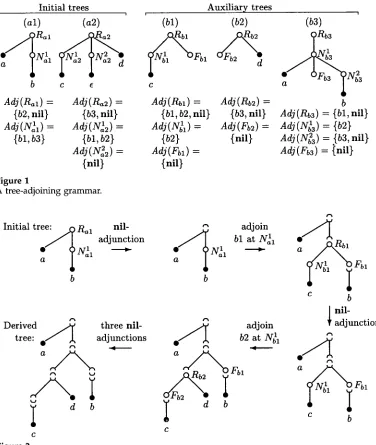
is u n d e f i n e d . An e x a m p l e of a TAG is given in Figure 1.The language described b y a TAG is given b y the set of strings that are the yields of d e r i v e d trees. A d e r i v e d tree is o b t a i n e d from an initial tree b y p e r f o r m i n g the following operation o n each n o d e N, except w h e n it is a leaf: The tree is excised at N, a n d b e t w e e n the t w o halves a fresh instance of an auxiliary tree, w h i c h is t a k e n from the set
Adj(N),
is inserted, or the e l e m e n t nil is t a k e n fromAdj(N),
in w h i c h case no n e w n o d e s are a d d e d to the tree. Insertion of the n e w auxiliary tree, w h i c h from n o w on will be called a d j u n c t i o n , is d o n e in such a w a y that the b o t t o m half of the excised tree is c o n n e c t e d to the foot of the auxiliary tree. The n e w n o d e s that are a d d e d to the tree as a result are recursively subjected to the same operation. This process ends in a complete d e r i v e d tree once all n o d e s h a v e b e e n treated.b
e
e
Adj(Ral) =
Adj(R,~2) =
{62, nil}
{b3, nil}
A d j ( N : , ) = A d j ( g : ~ ) =
{bl,b3} {bl,b2}
[image:3.468.39.415.64.509.2]Adj ( Y2~) = {nil}
Figure 1
A tree-adjoining grammar.
C
Adj(nbl) = Adj(Rb2) =
{bl, b2, nil}
{b3, nil}
Ady(NdI) = Adj(Fb~) =
{b~}
{nil}
Adj(Fb~) =
{nil}
Initial t r e ~ / ~ Ral
b
nil-
adjunction
'~ adjoin
e a q bl at N~I
b
o . ~ adjoin
b2 at Nil
sl
C
¢-~
Derived o / ~ tree:
three nil- adjunctions
4
¢.%
e
Figure 2
Derivation of the string
acdb.
"a" oFb3 N:3
b
Adj(Rb3)= {bl, nil}
A d j ( N ~ ) = (b2} A ~ j ( N ~ ) = {b3, n i l }
Adj(Fb3)
= (nil}a
c b
J nil-
adjunction
a ~ F b l
c
b
In order to avoid cluttering the picture with details, we have omitted the names of nodes at which (nil-)adjunction has been applied. We will reintroduce these names later. A further point worth mentioning is that here we treat the nodes in preorder: we traverse the tree top-down and left-to-right, and perform adjunction at each node the first time it is encountered. 2 Any other strategy would lead to the same set of derived trees, but we chose preorder treatment since this matches the algorithm we present below.
Computational Linguistics Volume 25, Number 3
3. The Algorithm
The i n p u t to the recognition algorithm is given b y the string a l a 2 . . • an, w h e r e n is the length of the input. Integers i such that 0 < i < n will be u s e d to indicate "positions" in the i n p u t string. W h e r e w e refer to the i n p u t b e t w e e n positions i a n d j w e m e a n the string ai+l . . . aj.
The algorithm operates b y m e a n s of least fixed-point iteration: a table is g r a d u a l l y filled with elements d e r i v e d f r o m other elements, until n o m o r e n e w ones can be found. A n u m b e r of "steps" indicate h o w table elements are to be d e r i v e d f r o m others. 3
For the description of the steps w e use a p s e u d o f o r m a l notation. Each step consists of a list of a n t e c e d e n t s a n d a consequent. The a n t e c e d e n t s are the conditions u n d e r w h i c h an incarnation of the step is executed. The c o n s e q u e n t is a n e w table e l e m e n t that the step then a d d s to the p a r s e table, unless of course it is a l r e a d y present. A n a n t e c e d e n t m a y be a table element, in w h i c h case the condition that it represents is m e m b e r s h i p in the table.
The m a i n table elements, or items, are 6-tuples [h, N --* c~ • t , i, j, fl, f2]. Here, N is a n o d e f r o m some e l e m e n t a r y tree t, a n d o~fl is the list of the d a u g h t e r n o d e s of N. The d a u g h t e r s in o~ together generate the i n p u t b e t w e e n positions i a n d j. The w h o l e e l e m e n t a r y tree generates i n p u t f r o m position h onwards.
Internal to the e l e m e n t a r y tree, there m a y be adjunctions; in fact, the traversal of the tree (implying (nil-)adjunctions at all nodes) has b e e n c o m p l e t e d u p to the e n d of c~. F u r t h e r m o r e , tree t m a y itself be an auxiliary tree, in w h i c h case it is adjoined in a n o t h e r tree. Then, the foot m a y be d o m i n a t e d b y one of the d a u g h t e r s in a, a n d the foot generates the part of the i n p u t b e t w e e n positions f l a n d f2. W h e n the tree is not an auxiliary tree, or w h e n the foot is not d o m i n a t e d b y one of the d a u g h t e r s in c~, t h e n f l a n d f2 b o t h h a v e the d u m m y v a l u e " - "
W h e t h e r t is an initial or an auxiliary tree, it is p a r t of a d e r i v e d tree of w h i c h e v e r y t h i n g to the left of the e n d of c~ generates the i n p u t b e t w e e n positions 0 a n d j. The traversal has b e e n c o m p l e t e d u p to the e n d of c~.
See Figure 3 for an illustration of the m e a n i n g of items. We a s s u m e Rt a n d Ft
are the root a n d foot of the e l e m e n t a r y tree t to w h i c h N belongs; Ft m a y not exist, as explained above. R is the root of some initial tree. The solid lines indicate w h a t has b e e n established; the d a s h e d lines indicate w h a t is m e r e l y predicted. If Ft ex- ists, the subtree b e l o w Ft indicates the l o w e r half of the d e r i v e d tree in w h i c h t was adjoined.
The s h a d e d areas labeled b y I, II, a n d III h a v e not yet b e e n traversed. In particular it has not yet b e e n established that these parts of the d e r i v e d tree together generate the i n p u t b e t w e e n positions j a n d n.
For technical reasons, w e a s s u m e an additional n o d e for each e l e m e n t a r y tree t, w h i c h w e d e n o t e b y T. This n o d e has o n l y one daughter, viz. the actual root n o d e Rt.
We also a s s u m e an additional n o d e for each auxiliary tree t, w h i c h w e d e n o t e b y 3_. This is the u n i q u e d a u g h t e r of the actual foot n o d e Ft; w e set children(Ft) = _1_.
In summary, an item indicates h o w a part of an e l e m e n t a r y tree contributes to the recognition of some d e r i v e d tree.
Figure 4 illustrates the items n e e d e d for recognition of the d e r i v e d tree f r o m the r u n n i n g example. We h a v e simplified the n o t a t i o n of items b y replacing the n a m e s of leaves (other than foot nodes) b y their labels.
0 h i f 1 f2 j
Figure 3
An item [h, N -* a . fl, i, ], fl, f2].
0
1: [0, T - + , R a l , 0 , 0 , - , - ] =
T 2: [0, R~I -+ • a N~I, 0, 0 , - , - ] =
I , 23 3: [0, Ral -+ a • N~I, 0, 1, - , - ] = ~Rnl 4: [1, T --+ • Rbl, 1, 1, - , -] =
~4T
212~ 1 5 : [ I ' R b I - + • N d l F b l ' 1 ' 1 ' - ' - ] = 6: [1, T - + •Rb2, 1,1,--,--] = 21 7: [1, Rb2 -+ • Fb2 d, 1, 1, - , - ] = ~Rbl 8: [1, Fb2 -+ • 3-, 1, 1 , - , - ] = g~/ Rbl 9: [1, Nil --+ • c, 1, 1 , - , - 1 ---- a 1 ; ~ 2 0 10: [1,NIl -+ c •, 1 , 2 , - , - ] =Nbl:4 / ~Fbl 11: [1, Ub2 -+ 3_ •, 1,2,1,21 = 6,T14 yFbl 12: [1, Rb2 --~ Fb2 • d, 1, 2, 1, 2] = ~Rb2 16119 13: [1, Rb2 --+ Fb2 d •, 1, 3, 1, 2] =
Rb2
7~,12~3 u 7~lN// 14: [1, T __+ Rb2 •, 1,3, 1,21 = 52 I 8 15a: [N~I -+ c •, 1, 3 , - , -1 = 15: [1, Rbl ~ N~I " Fbl, 1, 3, --, -1 = yFb2 d b 16: [1, Fbl -+ • 3_, 3, 3, --, --1 = 8-!-111 17: [0, N i l --+ • b, 3, 3, , ] =
1 Nbl 18: [0, Nail -+ b •, 3, 4, - , - ] =
19: [1,Ybl ~ ± •, 3,4,3,4] = 20: [1, Rbl --+ N i l Fbl •, 1, 4, 3, 4] =
C 21: [1, T --+ Rbl •, 1, 4, 3, 4] =
a c d b 22a: [Nil -+ b •, 1, 4 , - , - ] = 22: [0, R~I --+ a N~I •, 0 , 4 , - , - ] = 1 2 3 4 23: [0, 7- -+ Ral ", 0, 4 , - , - ] =
( I n i t ) ( P r e d 2)1 ( S c a n 1)2 ( P r e d 1)3 ( P r e d 2)4 ( P r e d 1)5 ( P r e d 2)6 ( P r e d 2)7 ( P r e d 3)8 + 5 ( S c a n 1)9
( C o m p 1)10 + 8 + 5 ( C o m p 2111 + 7 ( S c a n 1)12 ( C o m p 2)13 + 6 ( n d j 0)14 + 10
(Adj 2)15a + 5
( P r e d 2)15 ( P r e d 3)16 + 3 ( S c a n 1)17
( C o m p 1)18 + 16 + 3 ( C o m p 2)19 + 15 ( C o m p 2)20 + 4 ( A d j 0)21 + 18 ( A d j 2)22a + 3 ( C o m p 3)22 + 1
Figure 4
The items needed for recognition of a derived tree.
[image:5.468.34.211.55.233.2] [image:5.468.43.429.267.570.2]Computational Linguistics Volume 25, Number 3
R
L . ... x
0 n
[image:6.468.49.184.55.322.2]Init Figure 5
The initialization.
h i fl f2 J j+l Scan 1
Figure 6
The first scanner step.
3.1 Initializer
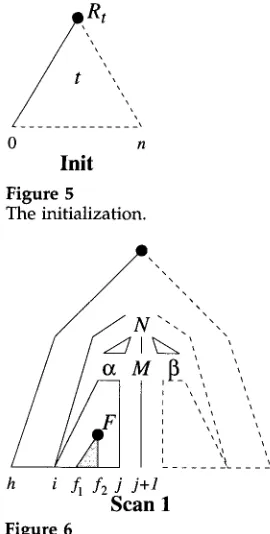
The initializer step predicts initial trees t starting at position 0; see Figure 5.
t ¢ I
[0, 7----~ . R t , O, O, , ] (Init)
For the r u n n i n g example, item 1 in Figure 4 results from this step.
3.2 Scanner
The scanner steps try to shift the dot r i g h t w a r d in case the next n o d e in line is labeled w i t h a terminal or ¢, which m e a n s the n o d e is a leaf b u t not a foot. Figure 6 sketches the situation w i t h respect to the input positions m e n t i o n e d in the step. The depicted structure is part of at least one derived tree consistent w i t h the input b e t w e e n positions 0 a n d j + 1, as explained earlier.
[h, N
Mg, i, j, A, ;Ca],
label(M) = aj+l
[h, N --* ccM . fl, i, j + l, A , f2 ] (Scan 1)
[h, N - - * c ~ , M f l , i, j, f l , f2], label(M) = ¢
[h, N --* a M . fl, i, j, A, f2] (Scan 2)
",,,
",,,,
h i h i j
Pred 1 Pred 2
Figure 7
The three predictor steps.
i!~, "', "',,"
/ ///,~,,:,,',
,,',,
/ // / / J M ' i ~,', ,,, ,/ / / / / I ~ ,i <, ,,', ,
/
// //~ '__~_, i~ ~,;, ,,
,,
/ f f t~___:~L~_~__',
h i j
Pred 3
3.3 Predictor
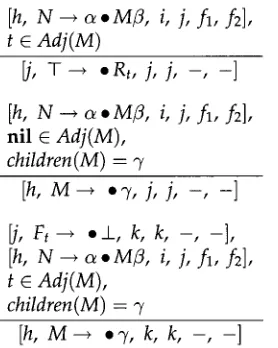
The first predictor step predicts a fresh occurrence of an auxiliary tree t, indicated in Figure 7. The second predicts a list of daughters "7 lower d o w n in the tree, abstaining from adjunction at the current n o d e M. The third predicts the lower half of a tree in which the present tree t was adjoined.
[h, N --~ a . Mfl, i, j, fl, f2],
t E Adj(M) (Pred 1)
~', T ~ . R , , j, j, - , -]
[h, N - - + a . M f l , i, j, A, f2],
nil E Adj(M), children(M) = "7
(Pred 2)
[h,M--+ *"7, j, j, - , -]
~, ~ , ~
. ± ,
k, k,
- , -],
[h, N ---+ a . Mfl, i, j, fl, f2], t E Adj(M),
children(M) = "7
(Pred 3)
[h, M--+ ."7, k, k, - , -]
For the r u n n i n g example, Pred 1 derives item 4 from item 3 a n d item 6 from item 5. Pred 2 derives, a m o n g others, item 5 from item 4. Pred 3 derives item 9 from items 8 a n d 5, a n d item 17 from items 16 a n d 3.
3.4 Completer
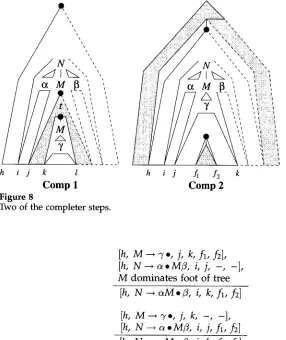
The first completer step completes recognition of the lower half of a tree in which an auxiliary tree t was adjoined, a n d asserts recognition of the foot of t; see Figure 8. The second a n d third completer steps complete recognition of a list of daughter nodes '7, and initiate recognition of the list of nodes fl to the right of the mother n o d e of %
[h, M - - * ' 7 . , k, l,f~,fd], t E Adj(M),
~, Ft--~ ,_L, k, k, - , -], [h, N - + a . M f l , i, j, f~, f2]
[image:7.468.40.408.57.228.2] [image:7.468.152.291.315.489.2]Computational Linguistics Volume 25, Number 3
L
h i j k l
[image:8.468.51.337.59.399.2]Comp 1 Figure 8
h
i j
Two of the completer steps.
f2
k
Comp 2
[h,
M--*3"°, j, k, fl, f2],
[h,
N --~ c~oMfl, i, j, - , -],
M dominates foot of tree
[h,
N - - , c ~ M ° f l , i, k, fl, f2]
(Comp 2)[h, M--~',/., j, k, - , -],
[h,
N---~c~°Mfl, i, j, fl, f2]
[h, N -* c~M ° fl, i, k, A, f2] ( C o m p 3)
See Figure 4 for use of these three steps in the running example.
3.5 Adjunctor
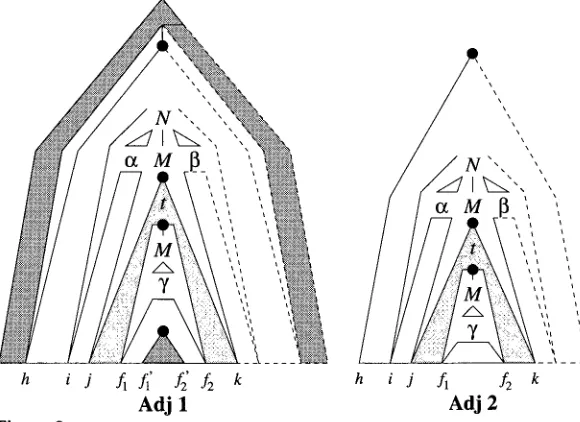
The adjunctor steps p e r f o r m the actual recognition of an adjunction of an auxiliary tree t in another tree at some n o d e M. The first adjunctor step deals with the case in which the other tree is again adjoined in a third tree (the t w o darkly s h a d e d areas in Figure 9) and M dominates the foot node. The second adjunctor step deals with the case in which the other tree is either an initial tree, or has its foot elsewhere, i.e., not d o m i n a t e d b y M.
The t w o respective cases of adjunction are realized b y step Adj 0 plus step Adj 1, and b y step Adj 0 plus step Adj 2. The auxiliary step Adj 0 introduces items of a s o m e w h a t different form than those considered u p to now, viz. [M ~ 3' o, j, k, f~, f~]. The interpretation is suggested in Figure 10: at M a tree has b e e n adjoined. The ad- joined tree and the lower half of the tree that M occurs in together generate the input from j to k. The depicted structure is part of at least one derived tree consistent with the input b e t w e e n positions 0 and k. In the case in which M dominates a foot node, as suggested in the figure, f~ and fd have a value other than " - "
~, T---~ R t . , j, k, fl, f2],
[h,
M--*3",, f~, f2, f~, fd],
t E Adj(M)
h i j f ~ f ( f ; f 2
[image:9.468.37.327.60.271.2]Adj 1 Figure 9
~ M 3 ' ,
h i fl 4 k
Adj 2
The two adjunctor steps, implicitly combined with Adj 0.
[M--* 7°, j,
k,f~,fd],
M dominates foot of tree
t',
[h,
F t, --+ ± o ,f~, f~, f~, f~],
[h, N--+ c~oMfl, i, j, - , -]
[h, N - - . c ~ M ° f l , i, k, f~, f~]
(Adj 1)[M ~ - y o , j, k, - , -],
[h, N - - * c ~ . M f l , i, j, f~, f~]
[h, N
--~ a M . fl, i, k, f~, f~]
(Adj 2)For the running example, Adj 0 derives the intermediate item 15a from items 14 and 10 and from this and item 5, Adj 2 derives item 15. Similarly, Adj 0 and Adj 2 together derive item 22. There are no applications of Adj 1 in this example.
An alternative formulation of the adjunctor steps, without Adj 0, could be the following:
~, T--* R t . , j, k, fl, d2],
[h,
M ~ , ,
fl, fa, f~, fd],
t C Adj(M),
M dominates foot of tree t',
[h, Ft, ~ ± . , f~, fd, f~, f~l,
[h, N--~ c~ °Mfl, i, j, - , -1
[h,
N --* a M ° fl, i, k, f~, fd]
(Adj 1')~, T"+ at°, j, k, f~, fal,
[h,
M - - ~ 7 , , fl, f2, - , -1,
t 6 Adj(M),
[h,
N---~a,Mfl, i, j, f~, fd]
Computational Linguistics Volume 25, Number 3
M
J f l ' ~ ' k
Figure 10
An item [M --~ 3' ", j, k, fi, fd].
That this formulation is equivalent to the original combination of the three steps Adj 0, Adj 1, and Adj 2 can be argued in two stages.
First, the
h in [h, M --~ "7 ,, A , f2, f~, f~]
or[h, M --+ 31 ,, A , f2,
- , -] occurring as second antecedent of Adj I t or Adj 2 ~, respectively, can be replaced by a fresh variable h ~ without affecting the correctness of the algorithm. In particular, the occurrence of h in the second antecedent of Adj 1 ~ is redundant because of the inclusion of the fifth antecedent [h,Ft, --+ J-,, f~, f~, f~, f~].
Note that, conversely, this fifth antecedent is redundant with respect to the second antecedent, since existence of an item [h, M --+"7 ", fl, f2, f~, fd],
such that M dominates the foot of a tree t', implies the existence of an item [h,Ft, ~ _L ,, f~, f~, f~, f~].
For further explanation, see Section 4.Second, the first three antecedents of Adj 1 ~ and Adj 2 ~ can be split off to obtain Adj 0, Adj 1, and Adj 2, justified by principles that are the basis for optimization of database queries (Ullman 1982).
The rationale for the original formulation of the adjunction steps as opposed to the alternative formulation by Adj 1 ~ and Adj 2 ~ lies in the consideration of time complexity, as will be discussed in Section 5.
4. Properties
The first claim we make about the algorithm pertains to its correctness as a recognizer:
Claim
After completion of the algorithm, the item [0, T --* a t e , 0, n, - , -], for some t E L
is in the table if and only if the input is in the language described by the grammar.
Note that the input is in the language if and only if the input is the yield of a derived tree.
The idea behind the proof of the "if" part is that for any derived tree constructed from the grammar we can indicate a top-down and left-to-right tree traversal that is matched by corresponding items that are computed by steps of the algorithm. The tree traversal and the corresponding items are exemplified by the numbers 1 . . . . ,23 in Figure 4.
[image:10.468.50.172.58.206.2]0 h i d
[image:11.468.36.375.54.235.2](a)
Figure 11
Pred 1 preserves the invariant.
0 h i d
(b)
Claim
The algorithm satisfies the correct-prefix property, provided the g r a m m a r is reduced.
A TAG is reduced if it does not contain a n y elementary trees that cannot be part of a n y derived tree. (One reason w h y an auxiliary tree might not be a part of a n y derived tree is that at some node it m a y have obligatory adjunction of itself, leading to "infinite adjunction.")
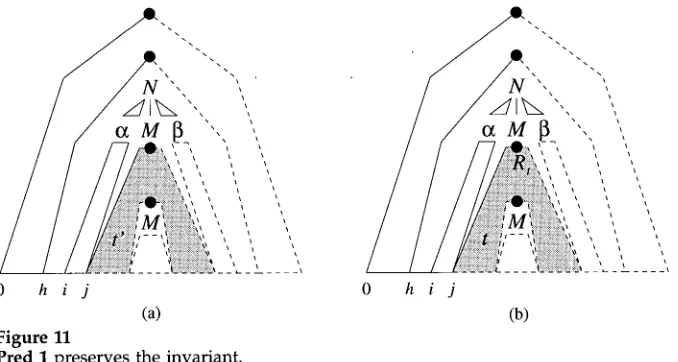
Again, the proof relies on the invariant sketched in Figure 3. The invariant can be proven correct b y verifying that if the items in the antecedents of some step satisfy the invariant, then so does the item in the consequent.
A slight technical problem is caused b y the obligatory adjunctions. The shaded areas in Figure 3, for example, represent not merely subtrees of elementary trees, b u t subtrees of a derived tree, which m e a n s that at each node either adjunction or nil- adjunction has been performed.
This issue arises w h e n we prove that Pred 1 preserves the invariant. Figure 11(a) represents the interpretation of the first antecedent of this step, [h, N --+ e~ • M f l , i, j, f l ,
f2]; w i t h o u t loss of generality we only consider the case that fl = f2 = - . We m a y assume that below M some subtree exists, and that at M itself either adjunction w i t h auxiliary tree t ~ or nil-adjunction has been applied; the figure shows the former case.
In order to justify the item from the consequent, ~, T --* • Rt, j, j, - , - ] , we construct the tree in Figure 11(b), which is the same as that in Figure 11(a), except that t ~ is replaced b y auxiliary tree t, which has been traversed so that at all nodes either adjunction or nil-adjunction has been applied, including the nodes introduced recursively t h r o u g h adjunctions. Such a finite traversal m u s t exist since the g r a m m a r is reduced.
Computational Linguistics Volume 25, Number 3
M
J fl' f2' kO
"" """
/
",i ",
h fl' .f2' h i j
(a) (b) (c)
Rt~"""
' '!\
0 h i j fl fl" f2' f2 k
Figure 12
Adj 1 preserves the invariant.
(d)
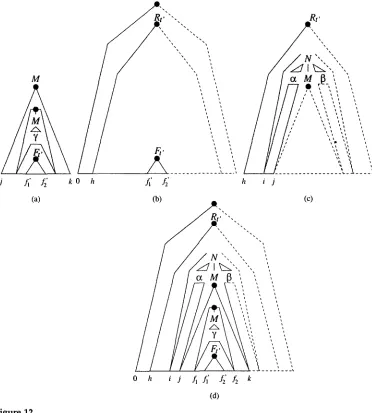
The combined information from these three items ensures the existence of the derived tree depicted in Figure 12(d), which justifies the consequent of Adj 1, viz.
[h, N --* a M . fl, i, k, f~, fd].
The other steps can be proven to preserve the invariant in similar ways.
N o w the second claim follows: if the input up to position j has been read resulting in an item of the form [h, N --* aa * fl, i, j, fl, f2], then there is a string y such that a l . . . ajy is in the language. This y is the concatenation of the yields of the subtrees labeled I, II, and III in Figure 3.
[image:12.468.56.428.62.475.2]into an actual algorithm (Shieber, Schabes, and Pereira 1995). This can be done in such a w a y that the order of the time complexity is determined by the maximal number of different combinations of antecedents per step. If we restrict ourselves to the order of the time complexity expressed in the length of the input, this means that the complexity is given by
O(nP),
where p is the largest number of input positions in any step.However, a better realization of the algorithm exists that allows us to exclude the variables for input positions that occur only once in a step, which we will call irrelevant input positions. This realization relies on the fact that an intermediate step
I
m a y be applied that reduces an item I with q input positions to another item
I'
with q' < q input positions, omitting those that are irrelevant. That reduced item I' then takes the place of I in the antecedent of the actual step. This has a strong relationship to optimization of database queries (Ullman 1982).For example, there are nine variables in Comp 1, of which
i,fl,f2,f~,f~
are all irrelevant, since they occur only once in that step. An alternative formulation of this step is therefore given by the combination of the following three steps:[h, M ~ ' ) , . ,
k, l, f{, f~]
[h, M - - * ' y . , k, l, ?, ?]
(Omit 5-6)
[h, N ---* c~. Mfl, i, j, A,
f2][h, N--* o~ . M f l , ?, j, ?,
?](Omit 3-5-6)
[h,
M--~'y ., k, 1,
?, ?],t E Adj(M),
~,Ft---+
- ± , k, k , - , -],[h, N--* o~. Mfl,
?, j, ?, ?1~, F t - - ~ l . , k, l, k, I]
(Comp
1')The question marks indicate omitted input positions. Items containing question marks are distinguished from items without them, and from items with question marks in different fields.
In Comp 1' there are now only four input positions left. The contribution of this step to the overall time complexity is therefore O(n 4) rather than C9(n9). The contribu- tion of Omit 5-6 and Omit 3-5-6 to the time complexity is O(n5).
Computational Linguistics Volume 25, Number 3
In terms of the size of the grammar G, the complexity is (Q(IG[2), since at most two elementary trees are simultaneously considered in a single step. Note that in some steps we address several parts of a single elementary tree, such as the two parts represented by the items [h, Ft, ---+ 3_., fi, f~, f~, f~] and [h, N ~ c~, Mfl, i, j, - , -] in Adj 1. However, the second of these items uniquely identifies the second field of the first item, and therefore this pair of items amounts to only one factor of IG] in the time complexity.
The complexity of (.9(n 6) that we have achieved depends on two ideas: first, the use of Adj 0, Adj 1, and Adj 2 instead of Adj 1 / and Adj 2 I, and second, the exclusion of irrelevant variables above. Both are needed. The exclusion of irrelevant variables alone, in combination with Adj 1 t and Adj 2 t, leads to a complexity of O(n8). Without excluding irrelevant variables, we obtain a complexity of 0(//9) due to Comp 1, which uses nine input positions.
The question arises where the exact difference lies between our algorithm and that of Schabes and Joshi (1988), and whether their algorithm could be improved to obtain the same time complexity as ours, using techniques similar to those discussed above. This question is difficult to answer precisely because of the significant difference between the types of items that are used in the respective algorithms. However, some general considerations suggest that the algorithm from Schabes and Joshi (1988) is inherently more expensive.
First, the items from the new algorithm have five input positions, which implies that storage of the parse table requires a space complexity of O(n5). The items from the older algorithm have effectively six input positions, which leads to a space complexity of 0(/76).
Second, the "Right Completor" from Schabes and Joshi (1988), which roughly corresponds with our adjunctor steps, has nine relevant input positions. This step can be straightforwardly broken up into smaller steps that each have fewer relevant input positions, but it seems difficult to reduce the maximal number of positions to six.
A final remark on Schabes and Joshi (1988) concerns the time complexity in terms of the size of the grammar that they report, viz. O(]GI2). This w o u l d be the same upper bound as in the case of the new algorithm. However, the correct complexity seems to be O(]G]3), since each item contains references to two nodes of the same elementary tree, and the combination in "Right Completor" of two items entails the simultaneous use of three distinct nodes from the grammar.
6. Further R e s e a r c h
The algorithm in the present paper operates in a top-down manner, being very similar to Earley's algorithm (Earley 1970), which is emphasized by the use of the "dotted" items. As shown by Nederhof and Satta (1994), a family of parsing algorithms (top- down, left-corner, PLR, ELR, and LR parsing [Nederhof 1994]) can be carried over to head-driven parsing. An obvious question is whether such parsing techniques can also be used to produce variants of left-to-right parsing for TAGs. Thus, one may conjecture, for example, the existence of an LR-like parsing algorithm for arbitrary TAGs that operates in (_9(n 6) and that has the correct-prefix property.
Note that LR-like parsing algorithms were proposed by Schabes and Vijay-Shanker (1990) and Nederhof (1998). However, for these algorithms the correct-prefix property is not satisfied.
be the case w h e n a TAG contains many, almost identical, e l e m e n t a r y trees. It is not clear w h e t h e r this case occurs often in practice.
Therefore, further research is n e e d e d not only to precisely define a d v a n c e d parsing algorithms for TAGs w i t h the correct-prefix property, b u t also to d e t e r m i n e w h e t h e r there are a n y benefits for practical grammars.
Acknowledgments
Most of the presented research was carried out within the framework of the Priority Programme Language and Speech Technology (TST) while the author was employed at the University of Groningen. The TST-Programme is sponsored by NWO (Dutch Organization for Scientific Research). An error in a previous version of this paper was found and corrected with the help of Giorgio Satta.
References
Earley, Jay. 1970. An efficient context-free parsing algorithm. Communications of the ACM, 13(2):94-102, February.
Joshi, Aravind K. 1987. An introduction to tree adjoining grammars. In Alexis Manaster-Ramer, editor, Mathematics of Language. John Benjamins Publishing Company, Amsterdam, pages 87-114. Lang, Bernard. 1988. The systematic
construction of Earley parsers:
Application to the production of C9(n 6) Earley parsers for tree adjoining
grammars. Unpublished paper, December. Nederhof, Mark-Jan. 1994. An optimal
tabular parsing algorithm. In Proceedings of the 32nd Annual Meeting, pages 117-124, Las Cruces, NM, June. Association for Computational Linguistics.
Nederhof, Mark-Jan. 1998. An alternative LR algorithm for TAGs. In COLING-ACL '98 36th Annual Meeting o/the Association/or Computational Linguistics and 17th
International Conference on Computational Linguistics, volume 2, pages 946-952, Montreal, Quebec, Canada, August. Nederhof, Mark-Jan and Giorgio Satta. 1994.
An extended theory of head-driven parsing. In Proceedings o/the 32nd Annual Meeting, pages 210-217, Las Cruces, NM, June. Association for Computational Linguistics.
Rajasekaran, Sanguthevar and Shibu
Yooseph. 1995. TAL recognition in O(M(n2) ) time. In Proceedings of the 33rd Annual Meeting, pages 166-173,
Cambridge, MA, June. Association for Computational Linguistics.
Satta, Giorgio. 1994. Tree-adjoining grammar parsing and Boolean matrix multiplication. Computational Linguistics, 20(2):173-191.
Schabes, Yves. 1994. Left to right parsing of lexicalized tree-adjoining grammars. Computational Intelligence, 10(4):506-524. Schabes, Yves and Aravind K. Joshi. 1988.
An Earley-type parsing algorithm for tree adjoining grammars. In Proceedings o/the 26th Annual Meeting, pages 258-269, Buffalo, NY, June. Association for Computational Linguistics.
Schabes, Yves and Stuart M. Shieber. 1994. An alternative conception of
tree-adjoining derivation. Computational Linguistics, 20(1):91-124.
Schabes, Yves and K. Vijay-Shanker. 1990. Deterministic left to right parsing of tree adjoining languages. In Proceedings o/the 28th Annual Meeting, pages 276-283, Pittsburgh, PA, June. Association for Computational Linguistics.
Schabes, Yves and Richard C. Waters. 1995. Tree insertion grammar: A cubic-time, parsable formalism that lexicalizes context-free grammar without changing the trees produced. Computational Linguistics, 21(4):479-513.
Shieber, Stuart M., Yves Schabes, and Fernando C. N. Pereira. 1995. Principles and implementation of deductive parsing. Journal o/Logic Programming, 24:3-36. Sippu, Seppo and Eljas Soisalon-Soininen.
1988. Parsing Theory, Vol. h Languages and Parsing. Volume 15 of EATCS Monographs on Theoretical Computer Science.
Springer-Verlag.
Ullman, Jeffrey D. 1982. Principles o/Database Systems. Computer Science Press.
Computational Linguistics Volume 25, Number 3
1985. Some computational properties of tree adjoining grammars. In Proceedings of the 23rd Annual Meeting, pages 82-93, Chicago, IL, July. Association for Computational Linguistics.
Vijay-Shanker, K. and David J. Weir. 1993. Parsing some constrained grammar
formalisms. Computational Linguistics, 19(4):591-636.
![Figure 3 An item [h, N -* a . fl, i, ], fl, f2].](https://thumb-us.123doks.com/thumbv2/123dok_us/1274971.655656/5.468.43.429.267.570/figure-an-item-h-n-a-fl-fl.webp)
![Figure 10 An item [M --~ 3' ", j, k, fi, fd].](https://thumb-us.123doks.com/thumbv2/123dok_us/1274971.655656/10.468.50.172.58.206/figure-an-item-m-j-k-fi-fd.webp)