571
©IJRASET: All Rights are Reserved
Performance Measurement of Wireless
Network Parameters
Muhammad Adeel Mannan1, Afzal Hussain2, Faizan Hussain3
1, 2
Assistant Professor & 3Student, Hamdard Institute of Engineering and Technology (FEST) , Hamdard University, Karachi, Pakistan
Abstract: This research is based on the issues that are faced by the users while using Wi-Fi services. Now a day's it's very important to examine the performance of different wireless networks based upon several parameters. The work discuss in this paper is to evaluate the influence of Wi-Fi service parameters including TCP throughput, basic connectivity, reliability, and response time on the performance of a wireless network. The objective would be smart (specific, measurable, achievable, realistic and timely). The research design clarifies the planned approach for data collection, followed by statistical analysis and recommendations.
Keywords:Wi-Fi services, TCP throughput, reliability, response time, Internet.
I. INTRODUCTION
In today’s environment, networking is one of the most important dimensions of IT and the whole infrastructure of IT is based on the network. If a network is well managed then it serves as a base for a good communication. The network is used within organizations, for the internet, for file sharing, emailing, downloading, uploading and all such tasks. So, we must have a good network. Although the technology involved in networks are growing day by day from wired to the wireless environment. That includes from dial-up or Ethernet LAN to Wi-Fi or WiMAX. The performance factors or quality measures of a network is very important while studying networks. In this research study, we will be analysing the following factors that affect the action or presentation of the wireless network which is mentioned below;
1) Basic Connectivity: It shows how quick the connection establishes.
2) TCP Throughput: How fast the link can be made, how much it affects the propagation delay or delay in transmission.
3) Response Time: How much time does it take to complete the transmission. From data sending and receiving a request and response to that request.
4) Reliability: It shows that how much a network is reliable in terms of data transfer. Whether it securely and accurately transmits the data or the data is lost in the middle of transmission.
This paper will be conducted on the above-mentioned factors for wireless network (Wi-Fi). It will also be analysed that which factor has a higher impact on the performance and quality of Service to end users, and how much an organization or an individual is concerned about it. The problem for this particular technique is to evaluate the influence of independent variables such as transmission control protocol TCP throughput, basic connectivity, reliability, and response time on the performance of a wireless network that is the dependent variable.
A. The basic agenda and objective of the presented paper are to assess and evaluate the performance of a wireless network.
B. To analyse which independent variable influences the performance level of the wireless network the most.
C. To analyse how the network should be prioritized in order to support triple play (voice, data, video) services efficiently.
D. To analyse the level of concern of an individual or an organization towards the performance of wireless networking.
II. LITERATUREREVIEW
572
©IJRASET: All Rights are Reserved
management view the key problem with Wi-Fi networks is a low capability relatively of the shared radio channel. In an environment of work, it is used to as fast Ethernet connection or connectivity in which a vast amount of data is switched among the end of terminals. A second critical issue and problem is the presentation or reduction of performance in terms of data transfer with the help of using the TCP protocol in wireless network situations, states, and scenarios. Certainly, the environment of the radio channel and the access to the shared source effect variable packet scheduling or delay in terms of efficiency and rate of loss, which are the main causes of the TCP jamming control machine. Nonetheless, most of the Internet user applications use TCP for authenticating data transfer and the degradation of TCP routine and performance is alleged by the end-user as a QoS degradation of the wireless network approach [2][3]. Bandwidth is the one component of what a person observes as the speed of a network according to the conditions. Unconsciousness is another component or element that adds to network speed and efficiency. The term latency denotes to several kinds of suspensions which suffered in the processing of data in the network. A low latency network connection or interaction usually practices small delay in times, while a high latency connection generally undergoes from long delays in time and synchronization [4]. The common and communal wireless encryption-standard Wired Equivalent Privacy has been representing simply to be precious even when correctly synchronized and configured. Wi-Fi Protected Access encryption which became present in devices in 2003 aimed to solve this issue or problem [5][6]. The main subject with wireless network security is its basic access to the network compared to old-style wired networks such as Ethernet [7].
III. RESEARCHMETHODOLOGYANDDESIGN
The research design for this paper is fundamental or casual in nature. Although this design discusses in this research is used on a partial gage which allows the researchers to separate reasons and belongings. In other confrontations, fundamental strategies let us control connection or which the variable is producing another variable in order to change. The variable which affects the change is known as the autonomous, free or independent variable and the one that changes with the effect of the change in the independent variable is called needy, dependent or hooked on the variable. If the response time enhances the performance, the previous variable is free or independent and the last is dependent. Instrumental or fundamental design includes trials which are laid down to size the change in free or independent and hooked, needy or dependent variables. These are other variables which affect the association among independent and dependent variables, that is, either they affect free variable or the hooked variable. Such variables are overruling or controlling variables and should be measured by the researcher which is rather problematic. The researcher has to regulate which design is most suitable for the research. The dependent variable selected for this particular research project is the performance of the wireless network that has already been defined and explained in the literature section of this proposed paper. Four independent variables are selected for this proposed paper whose impact is to be measured through the data collection and application of statistical tools upon the gathered data. Those four independent variables include basic connectivity, TCP throughput, Response time, and reliability.
IV. CONCEPTUALFRAMEWORK
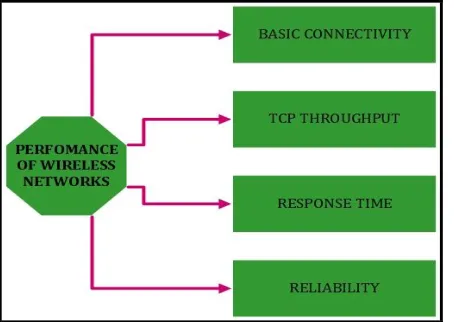
[image:2.612.201.428.555.716.2]The rectangular boxes above represent the independent variables of this research project, while the circular box represents the dependent variable of this research project. Collectively the above diagram is suggesting that the independent variables such as the basic connectivity, TCP throughput, Response time, and Reliability are making an impact upon the dependent variable that is the performance of the wireless network.
573
©IJRASET: All Rights are Reserved
V. SAMPLINGTECHNIQUE
The specimen method applied for the purpose of data collection in this paper is a type of non-probability sampling [8]. Non-probability sampling relies on the personal judgment of the researcher rather than the chance to select sample elements. Non- probability sampling might produce good estimates of the population features and characteristics. But they do not allow for objective evaluation of the precision of the sample standards, values or results. The estimations got are not statistically projectable or presentable to the populace. The type of non-probability specimen used in this paper is disapproving or judgmental sampling. A disapproving specimen is a form of ease sampling in which the populace features are chosen on the base of the judgment of the investigator [9]. The researcher or investigator chooses the features to be included in the sample because they trust that they are symbolic of the populace of interest or else suitable. The judgmental specimen is low in cost, useful and quick, nonetheless, it does not allow direct simplifications to a specific populace. The judgmental specimen is subjective and its value is influenced by completely on the investigator’s decision. It might be beneficial if wide populace inferences are not required.
VI. STATISTICALANALYSIS
The scale that is used in this paper is Likert scale and the 10-option scale is used following are some hypothesis and their results:
A. Hypothesis 1
1) Ho: There is no influence of the Basic Connectivity on the action or performance of the wireless network.
2) Ha: There is the influence of the Basic Connectivity on the action or performance of the wireless network.
[image:3.612.213.402.322.447.2]3) Question Asked: Do you agree that the proper connectivity enhances the performance of the wireless network?
Fig. 2 Hypothesis 1
4) The conclusion of Hypothesis 1: The Z – calculated value is greater than the Z – Arranged value and the p-value is less than α = 0.05, hence the value lies in the considerate or critical area, so we reject the null hypothesis and we accept the alternative hypothesis.
B. Hypothesis 2
1) Ho: There is no relationship between a TCP output and a performance or action of the wireless network.
2) Ha: There is a relationship between a TCP output and a performance or action of the wireless network.
3) Question: Do you agree that there is a relationship between a TCP output and a performance or action of a wireless network.
Fig. 3 Hypothesis 2
[image:3.612.204.416.556.695.2]574
©IJRASET: All Rights are Reserved
C. Hypothesis 3
1) Ho: There is no influence of the Reliability on the performance of the wireless network.
2) Ha: There is the influence of the Reliability on the performance of the wireless network.
[image:4.612.179.433.129.317.2]3) Question: Do you agree that wireless network is more reliable than other network setups?
Fig. 4 Hypothesis 3
4) The conclusion of Hypothesis 3: The Z – calculate value is greater than the Z – Tabulated value and the p-value is less than α = 0.05, hence the value lies in the critical or considerate region, so we reject the null hypothesis and we accept the alternate hypothesis.
The Z – calculated value is greater than the Z – Tabulated value and the p-value is less than α = 0.05, hence the value lies in the critical or considerate region, so the researcher discard the null hypothesis and we accept the alternate hypothesis. The above conclusions of hypothesis 1, 2 and 3 are merely based upon the statistical practice of Z – test. According to what, if the Z – calculated value is larger than the Z- tabulated value, the value of Z- calculated then lies in the critical or considerate region and once it lies in the critical region, the null hypothesis is always rejected and we accept the alternate hypotheses. In our research, since the confidence level is 95 %, so the critical region consists of the remaining 5 %. At a 95 % level of confidence, the tabulated value of Z is 1.64. So, in this case, if the Z – calculated value is more than 1.64, the null hypothesis is rejected.
Fig. 5 Graphical Representation
VII. CONCLUSION
[image:4.612.187.433.455.644.2]575
©IJRASET: All Rights are Reserved
VIII. LIMITATIONANDRECOMMENDATION
Statistical approach and analysis were performing the research on the topic of celebrity image. Out of these various limitations, few of them are listed below in bullets.
A. The population and the sample size were only selecSted from the Karachi users.
B. The sample size for the research was 150; it could have been a far bigger figure than this 150 if I had more time.
The recommendations can be many since the topic of the Wireless connectivity is itself very deep and the in-depth analysis of every possible element associated with this topic is hard to capture in a single research. From this research discussed in this paper, the following are my recommendations for people who wish to take this topic of celebrity image for their research projects:
1) Expand your horizons by reaching in more than one city of Pakistan.
2) Work out on a larger number of sample size than 100.
3) Interview the IT officers in various reputable organizations and quote those interviews in your research if you have enough resources to do so.
4) The other researchers could also take a company that is strongly associated with wireless networking and include that company as a part of a case study in their research.
5) I researched on 4 variables. People can further add the variables.
REFERENCES
[1] D. Blinn, T. Henderson, and D. Kotz, “Analysis of a Wi-Fi hotspot network,” … Present. 2005 Work. …, pp. 1–6, 2005. [2] "Wi-Fi", En.wikipedia.org, 2018. [Online]. Available: https://en.wikipedia.org/wiki/Wi-Fi. [Accessed: 29- Nov- 2018].
[3] S. U. Sharma and Y. B. Gandole, “Understanding Network Latency in Thin Client Environment,” Int. J. Eng. Sci. Innov. Technol., vol. 2, no. 1, pp. 22–25, 2013.
[4] J. Bilger, H. Cosand, N. Singh, and J. Xavier, "Security and Legal Implications of Wireless Networks, Protocols, and Devices 2. Introduction to Wireless Networking," pp. 1–52, 2005.
[5] K. Tan, J. Song, Q. Zhang, and M. Sridharan, "A compound TCP approach for high-speed and long-distance networks," Proc. - IEEE INFOCOM, 2006. [6] J. Muscatello and J. Martin, “Wired and Wireless Networks.” pp. 1–17, 2005.
[7] "Non-Probability Sampling", Explorable.com, 2018. [Online]. Available: https://explorable.com/non-probability-sampling. [Accessed: 29- Nov- 2018]. [8] I. Etikan, “Comparison of Convenience Sampling and Purposive Sampling,” Am. J. Theor. Appl. Stat., vol. 5, no. 1, p. 1, 2016.