Master thesis
Demand-based learning in higher education from an
organizational perspective
An assignment at KPMG
Name: Kevin Buijserd Student number: 0071390
Date: 20/08/2009
K P M G PA G E 3
Demand-based learning in higher education from an
organizational perspective
Author
Kevin Buijserd
Programme: Information Technology & Management Student Number: 0071390
E-mail: [email protected]
Graduation committee
Romana Aziz
Department: Information Systems & Change Management E-mail: [email protected]
Elfi Furtmueller
Department: Information Systems & Change Management E-mail: [email protected]
Edward Veen
K P M G PA G E 4
Management summary
This research aims to create an assessment model which helps higher educational institutions in implementing demand-based learning. The main question in this research is: According to which assessment model can KPMG advise educational institutions at implementing demand-based learning? To answer this question, three sub-questions are posed in the first section of the research. Through answering each of these questions, the assessment model at the end of this thesis could be formed. Different sources were used to answer each sub-question. A start was also made with the validation of the model, by conducting case studies at three different educational institutions.
To develop the assessment model, the research starts out with defining what demand-based learning is. This is the result to the first sub-question. Different types of presentations and documents are used together with a formal literature review to come up with a definition:
Demand-based learning aims to offer flexibility to students which in turn should enhance students‟ perceived quality of the educational institution. The research showed that the flexibility to make adjustments to the individual‘s curriculum is what most educational institutions value as important in demand-based learning. Flexibility in study pace was also seen as important, while flexibility in study location received little attention.
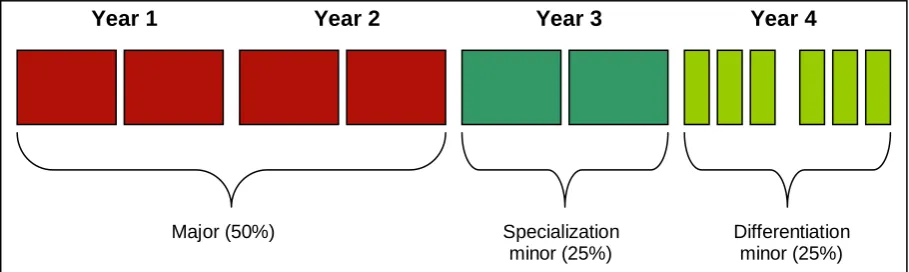
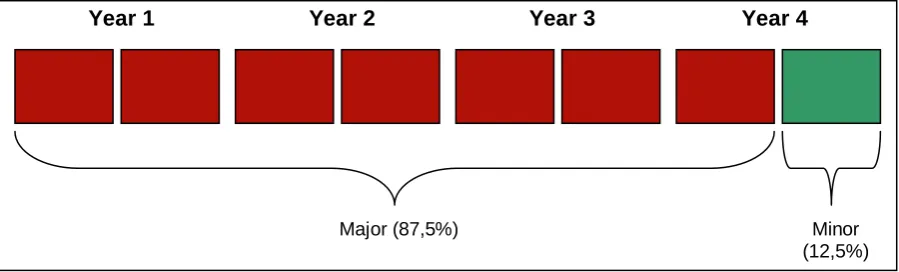
The answer to the second sub-question is an impact study on demand-based learning and flexibility in organizations. Organizations were found to be limited in the level of flexibility they can offer. This level of flexibility is constrained by cost effectiveness of the organization, elements of education and quality and regulations and market demand. Case studies later showed that while the offered level of flexibility is subject to constraints, the required level of flexibility by students was also smaller than expected. For educational institutions the desired level of flexibility offered to students is indirectly established within the organization‘s vision on demand-based learning. This vision is made explicit within an educational model, which shows how different programs are built up and what types of freedom lie with the student. Demand-based learning also requires alignment of standards, rules and policies to improve interchangeability of students between different faculties within an organization. Applications and infrastructure play an important role in this for they are the main facilitators of student support processes in modern education. Case studies also showed that the introduction of educational and organizational standards can ease the introduction of support applications. The educational model determines how students can flow through an educational institution. This flow of students sets requirements for different support processes in the organization. These process requirements may also impose new application requirements. Demand-based learning can also have considerable effects on organizational culture, where roles change and different departments are forced to work together towards a common goal.
K P M G PA G E 5 approach to an implementation process, as opposed to handling the different issues as they come up over time in the project.
K P M G PA G E 6
Table of contents
LIST OF FIGURES 8
LIST OF ACRONYMS 9
PREFACE 10
PART I: INTRODUCTION 11
1. Research approach 12
1.1 Initial reason for this research 12
1.2 Terminology 12
1.3 Questions 13
1.4 Structure 14
1.5 Scope 14
1.6 Research Methodology 15
1.7 Impact and relevance 17
2. Organization 19
2.1 Brief history 19
2.2 Mission statement 19
2.3 Key figures 19
2.4 Competitors 19
2.5 Services 20
PART II: EXPLORING DEMAND-BASED LEARNING 21
3. Literature review 22
3.1 Search terms 22
3.2 Search process 23
3.3 Concept matrix 24
3.4 Concept map 28
3.5 Discussion 30
4. Answering sub-question 1: What is demand-based learning? 32
4.1 Modern education 32
4.2 Change in the field of education 32
4.3 Demand-based learning according to educational institutions 33
4.4 Demand-based learning according to KPMG 33
4.5 Related elements and concepts 34
4.6 Discussion 35
PART III: ORGANIZATIONAL IMPLICATIONS 36
5. Implications 37
5.1 Flexibility 37
5.2 Standards 40
5.3 Processes 41
5.4 Information technology 43
K P M G PA G E 7
5.6 Discussion 46
PART IV: ASSESSMENT MODEL 48
6. Assessment model 49
6.1 Design framework 49
6.2 Organization 50
6.3 Processes & Services 54
6.4 People & Culture 57
6.5 Technology and infrastructure 60
7. Model validation 62
7.1 Interviews 62
7.2 Problems 64
7.3 Workshop 66
7.4 Discussion 67
PART V: PRACTICE 69
8. Reflection and evaluation 70
8.1 Evaluating the research approach 70
8.2 Conclusions 72
8.3 Limitations 73
8.4 Future research 73
9. References 75
PART VI: APPENDICES 80
Appendix A: Contact information internal experts 81
Appendix B: Interview format external experts 82
Appendix C: Educational Models 84
C1. Simple major-minor structure 84
C2. Complex major-minor structure 84
C3. Major-minor structure, multiple minors 85
C4. Major-minor bachelor, master with flexible courses 85
Appendix D: Non-scientific sources 86
K P M G PA G E 8
List of figures
FIGURE 1: OUTLINE OF THE REPORT 14
FIGURE 2: SCHEMATIC LITERATURE REVIEW 24
FIGURE 3: CONCEPT MAP 29
FIGURE 4: CONCEPTS IMPORTANT TO DEMAND-BASED LEARNING 34
FIGURE 5: CONSTRAINTS ON FLEXIBILITY 39
FIGURE 6: EDUCATIONAL TIME PERIODS 40
FIGURE 7: EDUCATIONAL AND SUPPORTING PROCESSES IN DBL 41
FIGURE 8: PROGRAM DEVELOPMENT 49
FIGURE 9: MODEL LAYOUT 50
FIGURE 10: EDUCATIONAL MODEL IN ORGANIZATION 1 62
FIGURE 12: FIRST STEPS TOWARDS IMPLEMENTING DEMAND-BASED LEARNING 67
FIGURE 13: SIMPLE MAJOR-MINOR STRUCTURE 84
FIGURE 14: COMPLEX MAJOR-MINOR STRUCTURE 84
FIGURE 15: MAJOR-MINOR STRUCTURE, MULTIPLE MINORS 85
K P M G PA G E 9
List of acronyms
DBL Demand-Based Learning
IEM Industrial Engineering & Management
IT&M Information Technology & Management
KNMG Koninklijke Nederlandsche Maatschappij tot bevordering der Geneeskunst
NIVRA Nederlands Instituut Van RegisterAccountants
K P M G PA G E 1 0
Preface
This thesis is the final project in the Information Technology and Management track of Industrial Engineering and Management at the University of Twente. To write my thesis I approached KPMG in November of 2008. After completing my final courses I started at KPMG in March 2009. At this time I was looking to do an assignment in the area of information management. KPMG approached me with a similar type of assignment in the field of education. As a student I have always been on the receiving end of education and this assignment allowed me to take a closer look at the organization of education. To make this research a success a high level of written information was used and different KPMG experts were interviewed. Several higher educational institutions were also approached for an interview and a workshop was held for several stakeholders from different schools.
Several people have contributed to the success of this project. This project would probably not have been as successful without their involvement and support. First of all I would like to thank Edward Veen. Edward has been my main supervisor at KPMG during the project. His experience in the field of education has contributed widely to the contents of this report. He also helped me find my way around the organization and its people, which was not always easy. Romana Aziz also contributed to this project as supervisor at the University of Twente. She critically looked after the way in which my research was organized and this greatly improved its overall presentation. My second supervisor, Elfi Furtmueller also provided a lot of feedback on my work and her positive comments were very motivating. I would also like to thank Jacob de Boer who allowed me to participate in the workshop sessions. These sessions were very helpful and they also gave me the feeling that I could contribute to some of KPMG‘s activities.
I would also like to thank Ronald Koorn, Matthijs Elfers, Erik Rutkens and Ramon Hendriks. As KPMG colleagues they all invested a portion of their valuable time in helping me with this project and I am thankful for that. The interviewees at the different schools who took their time to let me interview them, thank you. Finally I would also like to thank everyone at ITA De Meern for making my time there interesting and enjoyable. One of the goals of writing my thesis at KPMG was to get a good feel for what the job of an IT Consultant entitles. To this end several colleagues took their time to contribute to this and provided me with a clear image of what it is to be an advisor working for KPMG.
K P M G PA G E 1 1
Part I: Introduction
Part I describes the context of the research. In this part an introduction to the organization and topic of the research will be given. Part I also describes the research approach which was used to answer the main- and sub-questions posed.
Contents:
1. Research approach 12
1.1 Initial reason for this research 12
1.2 Terminology 12
1.3 Questions 13
1.4 Structure 14
1.5 Scope 14
1.6 Research Methodology 15
1.7 Impact and relevance 17
2. Organization 19
2.1 Brief history 19
2.2 Mission statement 19
2.3 Key figures 19
2.4 Competitors 19
K P M G PA G E 1 2
1. Research approach
This chapter introduces the reader to the topic of this thesis. Furthermore it elaborates on the research approach that was used throughout this thesis. It shows which research questions were posed and which techniques were use to answer these questions in the chapters ahead. It also explains how these techniques work and why they were chosen.
1.1 Initial reason for this research
KPMG advises educational institutions on their organizational development and information management. In the past years several developments have had changing effects in higher education. Most importantly; changes in regulation, demand, and society and new technological possibilities (Burbules & Callister 2000). These developments are pushing educational institutions to respond and adapt. One of the results is that these institutions are moving from traditional ways of teaching towards new teaching models. Technology is an important enabler in this development. A distinction is made between automation and facilitation. Higher educational institutions do already automate through the use of support applications such as Blackboard, Moodle and Teletop. New teaching models aim to deliver the ‗anytime, anyplace, anywhere‘ perspective on learning. The role of technology in this perspective is very different than in the traditional perspective.
Different educational institutions in The Netherlands are at different stages in implementing new teaching models. One observation by KPMG is that educational institutions are in fact able to form a vision on the future and where they want to be within a certain time span. However, when it comes to implementing such a vision, difficulties arise. Causes of this can range from differences between professionals and management, immaturity in the information landscape or skipping certain steps in development (de Boer, 2008).
KPMG wishes to develop a framework that can support higher educational institutions in modernizing their educational models. Through this framework educational institutions should be better capable at translating their vision to a design plan and into an implementation framework.
This tool should assess different dimensions that are relevant in educational models, for example processes, information flows, and the roles of students and professors. Educational standards and flexibility will also be discussed as they are found to important later on. By comparing the results of such a tool with the vision an institution has on demand-based learning, further steps for implementing this vision can be determined.
1.2 Terminology
K P M G PA G E 1 3 producing on stock, while pull manufacturing refers to producing to customer order (Hopp & Spearman, 2000).
‗Vraagsturing‘ has also been seen in the field of health care (van Heffen & Kerkhoff, 1997). Here the concept is about empowerment of patients, who attain more freedom in their choices as to where, when and how they get treated. Within education the concept has similar meaning. Demand-based learning is concerned with empowering students by offering them more freedom regarding their education. While demand-based learning remains a wooly concept at this point, exploring aspects and implications of demand-based learning has been part of this research.
Elements of demand-based learning are more and more put on the agenda‘s of major Dutch educational institutions. According to Frijns and van de Hurk (2007) demand-based learning often implies restructuring processes, changing roles and needs and changes in IT. This marks the complexity of demand-based learning for organizations.
1.3 Questions
Several sub-questions were setup to answer the main question. Answering the main question will in turn help to accomplish the research goal. A short discussion of these questions is given below.
1.3.1 Research goal
To draw up an assessment model on the basis of literature, practice material and KPMG expert opinions, which can be used by KPMG to advise educational institutions at implementing a demand-based learning model.
1.3.2 Questions Main question
According to which assessment model can KPMG advise educational institutions at implementing demand-based learning?
Sub-question
In order to answer the main question the following sub-questions are important; 1. How is demand-based learning defined in literature and practice?
2. What does demand-based learning imply for the organization, actors, processes and logistical elements?
3. Which elements should be considered in a DBL implementation project?
Sub-question 1 is relevant because a general scan on literature showed that demand-based learning has not been widely documented so far. One hypothesis for this is that educational topics are often documented in similar type journals while literature on organizational change usually comes from organization and management journals. Demand-based learning concerns elements from both fields and is therefore not one of the mainstream areas of research.
K P M G PA G E 1 4 The answers to sub-question 3 are the basic elements for the assessment tool which will be developed.
1.4 Structure
The structure of the report mostly follows the research questions. The outline of the report is schematically shown in figure 1. Chapter 4, 5 and 6 contain the answer to respective sub-questions 1, 2 and 3.
Figure 1: Outline of the report
The results of the literature review are a concept matrix and a concept map. These two things try to summarize different concepts and their meanings as described in literature. The definition on DBL is given in chapter 4 by using elements from both the literature review and different types of practical material that were used in the respective chapter. The definition from chapter 4 is carried over to chapter 5 and is used to see how DBL impacts educational institutions. This results in a set of general effects on the organization, which are used in chapter 6 to form different sections in the assessment model. Case studies are used to start model validation in chapter 7. Chapter 8 evaluates the research approach using Hevner‘s (2004) criteria for design science. This chapter also contain conclusions, limitations and future research.
1.5 Scope
Three subtypes of Dutch educational institutions exist. The first subtype consists of MBO institutions, which are aimed at teaching professions. The second and third subtypes are
Chapter 3: Literature review
Chapter 4:
Definition: demand-based learning
Chapter 5:
Implications on the organization
Chapter 6: Elements for DBL implementation
Chapter 7: Model validation
Part II
Part III
Part IV
Chapter 8: Conclusions
Chapter 2: Organization Chapter 1:
Research approach
K P M G PA G E 1 5 HBO/ROC institutions and universities. One difference between MBO and HBO/ROC and universities is competence-based versus demand-based learning. Competencies are general professional areas of interest.
A second difference between the first and the second and third subtypes is the role of research. While MBO institutions are not involved in research, HBO/ROC institutions and universities are. Because of these differences this research mainly aims at HBO/ROC institutions and universities. However results can partially be generalized to MBO institutions.
This research does not aim to prescribe how demand-based learning should look. This remains a choice made by organizations themselves. The assessment model which will be developed however aims to guide organizations in making these choices in a more considerate way.
1.6 Research Methodology
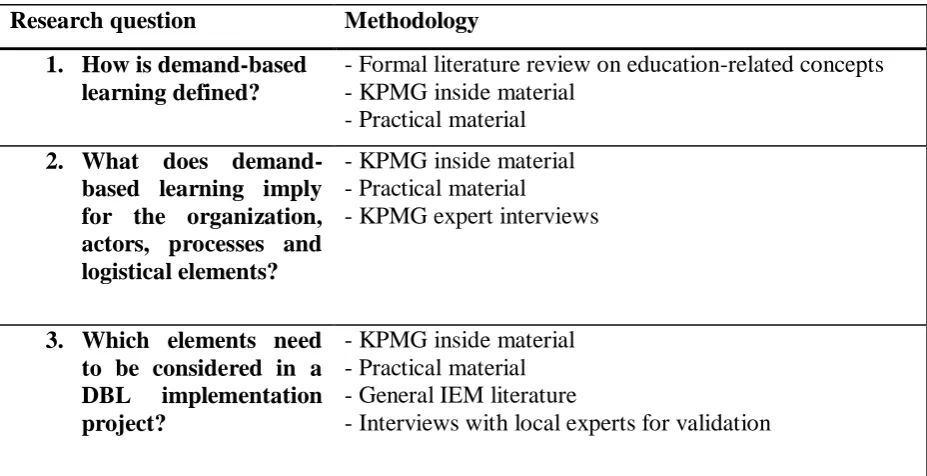
To answer each of the research questions several different approaches were used. These approaches will be discussed below. A short overview of methodologies used for answering each sub-question is presented in table 2.
Research question Methodology
1. How is demand-based learning defined?
- Formal literature review on education-related concepts - KPMG inside material
- Practical material
2. What does demand-based learning imply for the organization, actors, processes and logistical elements?
- KPMG inside material - Practical material
- KPMG expert interviews
3. Which elements need to be considered in a DBL implementation project?
- KPMG inside material - Practical material - General IEM literature
[image:15.595.66.530.354.592.2]- Interviews with local experts for validation
Table 2: Research approaches
K P M G PA G E 1 6 implications described in chapter 5 can be placed under the different dimensions of the Klaverblad model. After doing this several non-described areas in the Klaverblad model remained. These ‗empty fields‘ were filled in using general Industrial Engineering & Management (IEM) literature. Together with findings from chapter 5 these formed a holistic assessment model for implementing demand-based learning. Local expert interviews were conducted to determine the model‘s validity. At the end of the report limitations, recommendations for further research and conclusions are presented.
1.6.1 Formal literature review
The formal literature review process (Webster & Watson, 2002) was used to explore the literature on education and education related organizational developments. The formal literature review process aims to eliminate three undesirable elements of research selection:
Random sampling (selecting first articles found)
Biased sampling (selecting articles that support your case)
Convenience sampling (selecting articles that are most accessible to you)
It tries to achieve this through the following elements; Clearly defined (and justified) choice of search engines Clearly defined (and justified) choice of keywords Clearly defined selection criteria
Clearly defined prioritization criteria
Evaluation (critical analysis) and synthesis of papers
Part of the formal literature review is forward and backward searching. Backward searching is looking up papers that are referenced by other papers that have been found. Forward searching is looking up papers that cite the papers that have been found.
The formal literature review provides a way through which one can systematically search literature on a relevant topic (Webster & Watson, 2002). Conducting the literature review in a formal way offers two different advantages.
First, the reader gains insight into how the search process was set up and is able to reproduce this search process. By giving insight into the search process the reader will be able to judge its general quality.
Second, by conducting the review process in a systematic way, chances of leaving out highly relevant research papers from the review are minimized. In order to present a quality thesis on a topic such as demand-based learning, high quality and highly cited research should have been explored. The systematic literature review allows the author to support any claims about the current level of the research already conducted in a specific area.
The literature review was used to answer sub-question 1. The results of this review are presented in part II of this thesis, as they have been an important component in defining demand-based learning.
1.6.2 KPMG inside material
K P M G PA G E 1 7 1.6.3 Practical material
Different educational institutions have already made attempts to implement demand-based learning in their organization. Some have been more successful than others. Various institutions have given presentations on their results so far. These presentations are available for public view. Most of these presentations were acquired using non-scientific search engines and through references of KPMG experts. Practical material was used in answering all three sub-questions.
1.6.4 Focus sessions with KPMG experts
KPMG employs several different experts on the topic of demand-based learning. Their expertise mainly derived from the participation of both general and demand-based learning specific projects at different educational institutions. These experts also worked closely with vendors of student support applications. Their knowledge on the subject was regarded as highly relevant and focus sessions were held to incorporate this knowledge into this thesis. Focus sessions with KPMG experts mainly contributed to answering sub-question two. Contact information for each of the interviewees can be found under Appendix A. A formal interview format for these sessions was not included; the sessions took place mostly in an informal and conversational setting.
1.6.5 General Industrial Engineering & Management literature
Implementing demand-based learning is regarded as an organizational change and topics such as change management, project governance and business models are highly relevant to this change. Organizational literature used throughout different courses at both the TBK bachelor track as well as the IEM master track was therefore also used in this research. This literature was not derived from the formal literature review.
1.6.6 Interview with local experts
To validate the quality of the model, several interviews with local experts were held. These interviews were aimed at the elicitation of problems during the implementation of demand-based learning. Interviews with local experts add an extra dimension of information used to create and validate the model. By using both written material and interviews the external validity of the model will improve greatly. Contact information for each of the interviewees together with the formal interview format can be found under Appendix B.
1.7 Impact and relevance
1.7.1 Practical relevance
The framework can be used to systematically assess the quality of a DBL design in educational institutions. We define quality of DBL design as: The extent to which attention has been paid to relevant elements relating to DBL and the extent to which an organization has addressed these elements in its DBL design and implementation plan. This will allow for identifying possible areas of improvement. Addressing potential design problems and inconsistencies will prevent such issues from arising during the actual implementation, where they can cause significant delays and potentially harm the project‘s chances on success.
1.7.2 Theoretical relevance
K P M G PA G E 1 8 This thesis should provide an organizational view on how DBL could be implemented by organizations.
K P M G PA G E 1 9
2. Organization
This chapter describes the organization and the context in which this thesis was written. The chapter starts with a short history of how the company came to be. After that several key figures are presented. The chapter ends with a description of services Delivered.
2.1 Brief history
KPMG is a combination of several different accountancy firms. In 1911 William Barclay Peat & Co. merges with Marwick, Mitchell & Co. to form Peat Marwick International (PMI). In 1979 the Dutch accountancy firm Klynveld Kraayenhof & Co. merged with Deutsche Treuhandgesellschaft and McLintock Main Lafrentz & Co., which formed KMG. Together PMI and Peat Marwick International form KPMG in 1987.
2.2 Mission statement
The mission statement as found on KPMG‘s webpage is:
“Outstanding professionals, working together to deliver value. We offer Audit, Tax and Advisory services. Three complementary areas of knowledge and insight that enable us to meet the needs of our clients. We turn knowledge into value for the benefit of our clients, our people and the capital markets.”
2.3 Key figures
KPMG delivers global services in the areas of Audit, Tax and Advisory in over one hundred forty-four countries. Worldwide KPMG employs more than 137.000 employees. In 2008 the company realized a turnover of 22,7 billion US dollars. The member firms of KPMG International are divided into three regions: EMA (Europe, Middle-East and Africa), the Americas and Asia Pacific.
In The Netherlands KPMG employs over 3.900 employees in seventeen offices throughout the country. Annual turnover in 2008 was 715 million Euros combined over tax, advisory and audit. The company‘s national headquarter is located in Amstelveen.
2.4 Competitors
KPMG is one of the ‗big four‘, which constitutes of KPMG, Deloitte, Ernst & Young, and PriceWaterhouseCoopers. These are currently the largest four accountancy and professional services firms in the world. Table 1 shows revenues and employees during the fiscal year of 2008 for each of these companies.
Firm Revenues Employees Fiscal Year
K P M G PA G E 2 0
KPMG $22.7bn 137,000 2008
Table 1: „big four‟ figures
2.5 Services
For each of the three areas KPMG specializes in, the company is active in different branches. Some examples are consumer goods & retail, financial services, private equity, transport & distribution and education. Most of the work carried out by KPMG is staged in a multi-disciplinary setting where experts from different departments work together to successfully assist KPMG‘s clients.
Part of the advisory group is KPMG IT (ITA) Advisory. ITA provides advice for specific improvements of existing information and communication technology (ICT) applications and assists the client in further development of the ICT function. In a digital world, ICT is crucial for the improvement of business processes. ITA assists organizations with managing the risks of IT applications. A thorough review and evaluation of the ICT application forms the basis for specific recommendations. In addition to providing support to auditors in their audit activities, the ITA services include IT assessments, the evaluation of the quality of existing and new systems, risk analyses, information security and reports about it, the drafting of continuity plans and assessment of internet applications.
ITA advises educational institutions on different aspects of their IT. Examples of where ITA offers expertise in this branch are;
Mergers and cooperation
K P M G PA G E 2 1
Part II: Exploring demand-based learning
This chapter explores demand-based learning using various internal and external sources. Part of this is a formal literature review which will be presented in chapter 3.
Contents:
3. Literature review 22
3.1 Search terms 22
3.2 Search process 23
3.3 Concept matrix 24
3.4 Concept map 28
3.5 Discussion 30
4. Answering sub-question 1: What is demand-based learning? 32
4.1 Modern education 32
4.2 Change in the field of education 32
4.3 Demand-based learning according to educational institutions 33
4.4 Demand-based learning according to KPMG 33
4.5 Related elements and concepts 34
K P M G PA G E 2 2
3. Literature review
Reviewing scientific literature on the topic serves three purposes. First of all it gives insights into what had already been done in the field of research. Second, conducting a literature review can provide insights on what scientific research regards as demand-based learning. Third, an initial literature scan showed that different authors include different concepts in their definitions.
An initial scan through some of the projects done by KPMG involving DBL showed that DBL is concerned with the student and his or her educational needs. DBL tries to satisfy educational needs by offering education that is tailored to the individual. This can be done to differing extents. Difficulties arise when trying to explain how one student‘s study demand should differ from that of another. At the same time, to what extent can education actually be individualized? Different interpretations make it difficult for educational institutions to see what demand-based learning really is, and how they should respond to it.
This chapter contains findings on literature and other theoretical materials. One of the main conclusions is that demand-based learning includes elements of e-learning, distance learning and blended learning. These concepts have been extensively described in scientific literature, mainly from the perspective of teachers and students. Flexibility in course programs is mentioned by only a few authors. There is however a fair amount of practical documents available, like presentations, KPMG inside material and practical websites. This shows that organizations are indeed implementing DBL.
3.1 Search terms
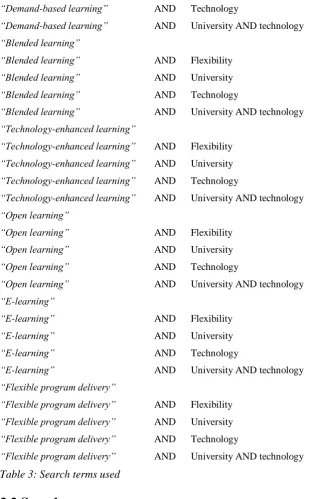
The review process consists out of several iterations. Because the literature review has an explorative purpose a wide range learning related concepts was used. For each concept a basic search in both Scopus and ISI was performed. The search terms were also expanded using the following terms: flexibility, technology, university and university technology. This resulted in the set of search terms listed in table 3.
“Distance learning”
“Distance learning” AND Flexibility
“Distance learning” AND University
“Distance learning” AND Technology
“Distance learning” AND University AND technology
“Flexible learning”
“Flexible learning” AND Flexibility
“Flexible learning” AND University
“Flexible learning” AND Technology
“Flexible learning” AND University AND technology
“Demand-based learning”
“Demand-based learning” AND Flexibility
K P M G PA G E 2 3 “Demand-based learning” AND Technology
“Demand-based learning” AND University AND technology
“Blended learning”
“Blended learning” AND Flexibility
“Blended learning” AND University
“Blended learning” AND Technology
“Blended learning” AND University AND technology
“Technology-enhanced learning”
“Technology-enhanced learning” AND Flexibility
“Technology-enhanced learning” AND University
“Technology-enhanced learning” AND Technology
“Technology-enhanced learning” AND University AND technology
“Open learning”
“Open learning” AND Flexibility
“Open learning” AND University
“Open learning” AND Technology
“Open learning” AND University AND technology
“E-learning”
“E-learning” AND Flexibility
“E-learning” AND University
“E-learning” AND Technology
“E-learning” AND University AND technology
“Flexible program delivery”
“Flexible program delivery” AND Flexibility
“Flexible program delivery” AND University
“Flexible program delivery” AND Technology
[image:23.595.71.390.68.568.2]“Flexible program delivery” AND University AND technology
Table 3: Search terms used
3.2 Search process
K P M G PA G E 2 4 Forward and backward references were also found and included in the selection of relevant papers. The extended search also includes two papers that were found using a search engine at the University of Utrecht. Other scientific references used originate from courses that were taught during the Information Technology &Management (IT&M) master track. This material was mostly used as foundation for more general statements within the assessment model in chapter 6. The literature review process has been schematically shown in figure 2.
Figure 2: Schematic literature review
3.3 Concept matrix
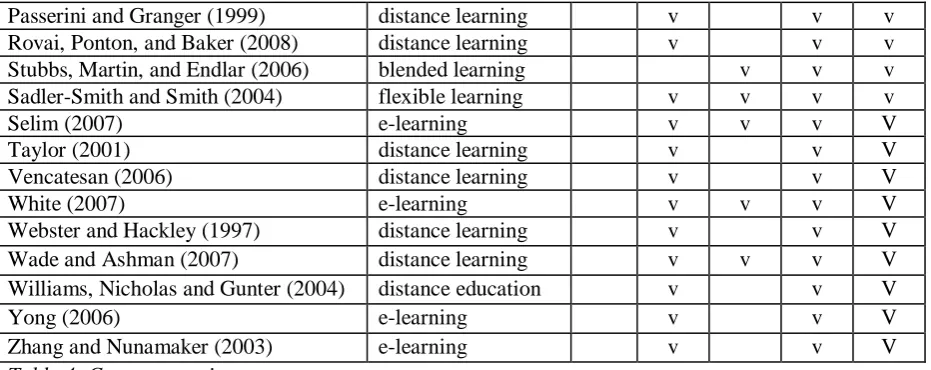
All papers found during the literature were compared on a number of dimensions important to flexibility, technology and education. Some of these dimensions show similarity with the names of the concepts mentioned in the previous paragraph. For example for the reader it may seem clear that distance learning embraces the concept of remote education. However several authors use overlapping definitions of the different concepts. Making a comparison for each concept over different dimensions is therefore a useful effort.
K P M G PA G E 2 5 this. Most distance learning efforts described were part of an institutional program to offer education to students not able to attend traditional lectures.
Author(s) C on ce p t Fle xi b ili ty in p rogr am R em ot e ed u cat ion B le n d ed le ar n in g G en er al te ch n ol ogi es A d van ce d te ch n ol ogi es
Akkoyunlu and Yılmaz-Soylu (2007) blended learning v v v
Alonso, López, Manrique and Viñes (2005)
e-learning v v v v
Bo-Anders and Jonsson (2004) e-learning v v v v
Bouhnik and Marcus (2006) distance learning, e-learning
v v v
Cartwright and Menkens (2002) distance learning v v v
Carchiolo, Longheu, Malgeri and Mangioni (2007)
web-based learning, e-learning
v v v
Chan and Law (2008) blended learning, open learning
v v v
Clarke, Butler, Schmidt-Hansen and Somerville (2004)
distance learning v v v
Collis and Moonen (2004) Flexible learning v v v v v
Davis and Fill (2007) blended learning v v
Dorrian and Wache (2009) distance learning, flexible learning
v v v v
Dernt and Motschnig-Pitrik (2005) blended learning v v v
Dearnley (2003) open learning v
Eynon (2008) e-learning v v v
Faulhaber (1996) distance learning v v v
Forman, Nyatanga and Rich (2002) e-learning v v v v
Gannon Cook, Ley, Crawford and Warner (2009)
e-learning, distance learning
v v
Garrison, Kanuka (2004) blended learning v v v
Green (2005) flexible learning v v v
Hayes and Jamrozik (2000) distance learning v v v
Heilesen and Josephsen (2007) e-learning v v v
Henrich and Sieber (2009) blended learning, e-learning
v v v v
Hill (2006) flexible delivery v v v v v
Hodgins (2007) distance learning v v v v
Katz (2002) distance learning v v v
Kirkwood and Price (2005) flexible learning v v v
Mahdizadeh, Biemans and Mulder (2008)
e-learning v v v
Marshall and Mitchel (2005) e-learning v v v
Martin and Treves (2007) e-learning v v v v
Mor and Winters (2007)
technology-enhanced learning
v v v
Normand, Littlejohn and Falconer (2008)
flexible learning v v v v v
K P M G PA G E 2 6
Passerini and Granger (1999) distance learning v v v
Rovai, Ponton, and Baker (2008) distance learning v v v
Stubbs, Martin, and Endlar (2006) blended learning v v v
Sadler-Smith and Smith (2004) flexible learning v v v v
Selim (2007) e-learning v v v V
Taylor (2001) distance learning v v V
Vencatesan (2006) distance learning v v V
White (2007) e-learning v v v V
Webster and Hackley (1997) distance learning v v V
Wade and Ashman (2007) distance learning v v v V
Williams, Nicholas and Gunter (2004) distance education v v V
Yong (2006) e-learning v v V
[image:26.595.67.533.70.255.2]Zhang and Nunamaker (2003) e-learning v v V
Table 4: Concept matrix
For each of the papers several properties are defined;
Whether the concept includes flexibility within program Whether the concept allows remote education or not, Whether the concept includes blended learning,
Whether the concept includes the use of general technologies, Whether the concept includes the use of advanced technologies.
3.3.1 Flexibility in program
An overview of flexibility in education has been given by Collis and Moonen (2004). Collis and Moonen describe flexibility over a number of dimensions ranging from flexibility in content, study location, course enrollments and tempo both within courses and curriculum.
An important aspect of demand-based learning is to provide such flexibility to students. Summarizing findings by Collis and Moonen, three dimensions seem to be prevalent. These are flexibility in study pace, flexibility in study location and flexibility in courses. Hill (2006) defines the same dimensions but uses the simpler terms ‗what‘, ‗where‘ and ‗when‘. These elements will be further reviewed later on.
Flexibility in program is defined as flexibility in curriculum and flexibility in study pace. Flexibility in curriculum involves the delivery of teaching programs tailored to the individual student and the degrees of freedom through which this is done. Flexibility in study pace relates to enrollment times and the ability to accelerate or slow down a student‘s study planning. These dimensions relate to ‗how‘ and ‗what‘ such as proposed by Hill (2006). For every paper in the review, references to program flexibility by the author were listed. Only four authors in the review made notion of flexibility within and between programs. This indicates at a deficiency in the literature.
3.3.2 Remote education
K P M G PA G E 2 7 Remote education can be realized in a number of ways. Most authors that mention remote education as part of their view on technology and education see a dominant role for video or streaming-video to allow for a rich transfer of knowledge (Hayes & Jamrozik, 2000; Clarke, Butler, Schmidt-Hansen & Somerville, 2004).
Interaction between student and teacher is also mentioned by several authors (Bouhnik & Marucs, (2005); Henrich & Sieber, (2008)); Clarke, Butler, Schmidt-Hansen and Somerville, 2004) as a critical component in remote learning. An interesting distinction is made by (Moore & Kearsly, 1996). They define three types of interaction that are critical in remote education. The three types are; interaction between students, interaction between student and teacher and interaction between student and course materials. Each type of interaction could have different effects on learners or the effectiveness of a course.
3.3.3 Blended learning
According to Akkoyunlu and Yılmaz-Soylu (2007) blended learning combines various models of traditional and distance education and makes use of all types of technology, which refers to a hybrid form of education. This means that part of the course can be followed physically away from the university, while the other part cannot. Authors do not prescribe which parts of courses should be on- and offline. Some examples are given, for instance by Dearnly (2003) who describes a form of blended learning where physical lectures only fill the role of troubleshooting sessions.
Blended learning is used by authors as a single concept, but also as part of other concepts, for example e-learning. Most Dutch educational institutions currently apply some form of blended learning. The relation between on- and offline parts of the course widely differ however.
3.3.4 Technologies used
The review also identifies which technologies are mentioned as part of the concept that is presented by the respective author. It was found that not all authors actually defined what technologies were most prevalent in their concept. Mahdizadeh, Biemans and Mulder (2008) conducted a survey on the use of technology in education in a large Dutch university. Some of these technologies were found to be used on a wide scale already. These are;
Online course materials and literature, Course information,
PowerPoint presentation, E-mail and mailing lists, Course calendar and schedule, Announcements (news),
This group of technologies is referred to as ‗general technologies‘. There were also several technologies that were used to much lesser extent;
Online simulation programs and software, Computer-based assessment,
Online discussion,
Videoconferencing and net-meeting, Recorded lectures,
K P M G PA G E 2 8 Voice conferencing.
This group of technologies is referred to as ‗advanced technologies‘. These technologies can be seen as more advanced, but also as more intrusive to the ways in which teaching in organized (for example videoconferencing means teaching is no longer done physically and can also change how interaction takes place). This intrusive nature changes the way in which teaching takes place. Not all teachers and professors are open to innovation however and this might also be the reason why general technologies are used much more often: general technologies can be used without making large changes in the way the education takes place.
Wide differences exist between authors and what they perceive as essential technologies. One of the main conclusions is that technology should fit the way in which education is set-up and not the other way around (Bouhnik & Marcus, 2006; Akkoyunlu & Yılmaz-Soylu, 2007; Eynon, 2008). Most authors also consent on this.
For each paper studied, we identified which of the two groups of technologies were referred to within that paper. All papers made some reference to the use of general technologies. Furthermore, most of the papers also referred to several of the advanced technologies. Few papers also mentioned the use of backend applications such as those used for student administration. None of the articles made reference to connectivity, specific levels of application integration or information flow requirements in a demand-based learning environment. This again points to a deficiency in literature.
3.4 Concept map
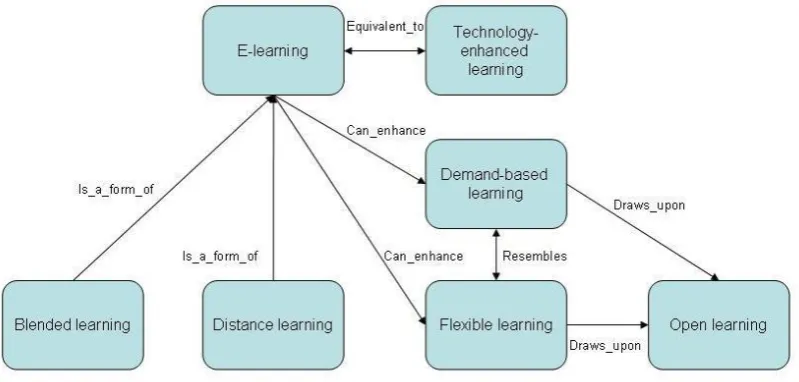
The review provides several insights on the different concepts that are used and how they relate to each other. These relationships are modeled using a concept map which is shown in figure 3 on the next page. Within figure 3 e-learning can be seen as a central element. Zhang and Nunamaker (2003) define e-learning as follows: “e-Learning refers to any type of
learning situation when instructional content is delivered electronically via the Internet when and where people need it.” Another definition is given by the Commission of European Communities1 as “the use of new multimedia technologies and the Internet to improve the
quality of learning by facilitating access to resources and services, as well as remote exchange and collaboration”. E-learning is also a topic which numerous articles have been written on. This could explain why e-learning is defined as such a general concept in literature.
3.4.1 Blended learning E-learning
Blended learning is a combination of traditional learning and distance learning. Technology plays an important role in offering blended learning courses to students. For blended learning authors agree that changes in the content of education are essential for this concept to be successful. Such changes should address the fact that blended learning usually involves less contact hours and that parts of course content are transferred online. By Zhang and Nunamaker‘s definition, e-learning can be seen as generalization of blended learning.
3.4.2 Distance learning E-learning
In much the same rhetoric distance learning can be defined as a specific form of e-learning. Most authors do agree that distance learning is about the physical separation of the student
K P M G PA G E 2 9 from the institution and the facilitating role that technology has in this format. As with blended learning, distance learning authors also agree that changes in the content of education are required for this concept to be successful.
Figure 3: Concept Map
3.4.3 E-learning Technology enhanced learning
Technology-enhanced learning can be seen as some combination of technology that is used to enhance education. This remains a vague description however. Few articles were found that used the concept of technology enhanced learning and only one article made it into the final selection of most relevant papers. This shows that technology enhanced learning is not a well documented concept. This could be explained by the overlap the concept seems to have with e-learning. This becomes especially apparent when looking at the definition of e-learning given by the Commission of European Communities in paragraph 4.4.
3.4.4 E-learning Demand-based learning
The relation between e-learning and demand-based learning is that e-learning can provide best practices and specific uses of technology that can enhance certain aspects of demand-based learning. E-learning environments also increase student responsibilities. Many of the e-learning articles that were found only described the concept on an individual classroom level. From an organizational perspective such papers add only moderate value.
3.4.5 E-learning Flexible learning
E-learning techniques can enhance flexible learning. The electronic delivery of course materials can for example allow students to study at their own pace. This adds flexibility to the learning process. The same as in 4.4.4 applies however; most e-learning articles only described the concept on an individual classroom level. At this level only aspects relating to individual courses can be made more flexible. From an organizational perspective these papers add moderate value.
3.4.6 Demand-based learning Flexible learning
K P M G PA G E 3 0 aimed at empowering the student by allowing them to make more choices in their education. Several papers that described flexible learning addressed only the spatial dimension. In that sense flexible learning also has some overlap with distance learning and blended learning. However not much literature has been written on flexibility in course programs and study pace in general. Future articles on flexible learning could address these dimensions more elaborately than they are currently doing.
3.4.7 Demand-based learning Open learning
Open learning is an educational principle based on self-determined, independent and interest-guided learning. Demand-based learning draws upon this principle by offering education more tailored to the individual student. The general notion is that students interested in their education will show a lower default rate than students who are not interested in their education. Default rates are directly related to the perceived level of educational quality and institutions aim to keep defaults at a minimum.
3.4.8 Flexible learning Open learning
As flexible learning much resembles demand-based learning, flexible learning too draws upon open learning principles.
3.5 Discussion
From an organizational perspective not much has been written about demand-based learning, which shows that a literature deficit is currently present in this area. No best practices are available on an organizational level. One of the reasons for this may be that demand-based learning remains very much an experimental area. Demand-based learning can be marked as an organizational change or perhaps even a strategic change. From this perspective scientific material written on the topic should come from organizational and business journals. Both Scopus and ISI showed little relevant papers from such journals. On an educational level however several elements of demand-based learning have been described in different concepts such as distance learning, blended learning and flexible learning.
This may be a result of the number of researchers being involved in education and teaching compared to the number of researchers involved in organizational change in education. Several papers that were found were written by teachers and professors that had introduced for example distance learning in their own course, and decided to write down their experiences.
Other then providing an overview of scientific literature, the result of this review is a set of key papers which will be used as a reference in the next chapters. Most useful are the articles by the following authors: Chan and Law (2008), Hill (2006), Normand, Littlejohn and Falconer (2008), Selim (2007) and White (2007). The article by Collis and Moonen (2004) provided a good basis for analysis of flexibility in higher education, which will be used in part III.
K P M G PA G E 3 1 giving a definition on DBL. By scanning through project documents and presentations chapter 4 provides the practical view upon DBL.
K P M G PA G E 3 2
4. Answering sub-question 1: What is demand-based learning?
This chapter will first look at some of the factors behind developments in modern education which fuel demand-based learning efforts. After that, findings from chapter 3 are combined with findings from non-scientific material. Finally an explanation is given as what is currently regarded as demand-based learning.
4.1 Modern education
Geerlings, Mittendorff and Nieuwenhuis (2004) make a distinction between the traditional approach to education and modern approaches. They compare the traditional approach with the industrial age corresponding with a push-production way of product delivery. According to them, typical properties of this educational model are rigid course planning, efficiency and a result-orientation. Freire (1994, quoted in Selim, 2007) states that the traditional view on education assumes that the instructor owns the knowledge and deposits it into the passive students who attend the class.
In modern education this vision no longer applies. Here students are becoming central to the educational process. At the same time students have more control over their education. A central notion to modern education is that students have specific interests in certain topics. Allowing students to pursue such interests increases the overall perceived quality of education.
4.2 Change in the field of education
The traditional view on education has been changing during the last part of 20th century. From a pedagogical perspective modern education is about pro-active learning. This means active involvement of students in education and implies a changing role for both students and teachers. KPMG sees an increase in educational institutions trying to modernize their educational structures.
The field of education is not characterized by fast moving innovative organizations. Changes in education in the last ten years have included changes in the use of technology. One such change is the introduction of web-based initiatives. These initiatives are often not systemic, but the result of random acts of innovation, initiated by risk-taking individual academics (Taylor, 2001). In a survey conducted by Mahdizadeh, Biemans and Mulder (2008) the use of technology in courses lectured at the University of Wageningen was measured. Their conclusion was that technology at the University of Wageningen was not well-integrated in the learning processes. The survey showed a high correlation between the adoption of different technologies and teachers‘ perceived attitudes towards such technologies.
K P M G PA G E 3 3
4.3 Demand-based learning according to educational institutions
Guidelines for higher education were set during the Bologna summit in 1999. One of the results from this summit has been the Bachelor Master structure which is currently used in most colleges and universities. Most of the Bologna guidelines were aimed at standardizing the educational format in European higher education. Educational institutions use these guidelines as a basis for setting up their educational model.
In most cases this means that educational institutions cluster up their course offerings in modules of different size. Freedom is introduced when picking certain course modules. The content and size of such modules differs per organization. The rules and support mechanisms that guide students in choices for these modules also differ. Most organizations seem to agree however that 100% flexibility in the choice of courses is not desirable for several different reasons. Organizations do recognize that demand-based learning is an institutional effort that focuses on empowering the student.
4.4 Demand-based learning according to KPMG
According to KPMG demand-based learning has been implemented in different organizations in different ways. Such implementations have not gone without effort. Currently none of the demand-based learning models seems to be superior to the others. This also implies that different DBL models can actually be successful.
KPMG recognizes that for all educational processes increased requirements on the availability and quality of (student) information exist. Such information is needed for monitoring on both central and de-central levels in the organization. To facilitate such requirements this requires changes in applications (Hofland, Hoogstra, Smit & Manschot, 2009). Demand-based learning also requires changes in supporting processes:
Financial administration: the role of financial administration changes from registration to a strategic part of doing business.
HRM: HRM changes from personnel and salary registration to formation planning, performance management and.
The result of a KPMG project evaluation conducted at a higher educational institution showed that a lot of its employees viewed the DBL project as an IT project. In reality this is not the case. Demand-based learning requires changes in the educational model and processes. This in return also affects roles and functions, together making this more an organizational change than an IT change.
K P M G PA G E 3 4
4.5 Related elements and concepts
As stated before, the main drivers behind demand-based learning are changes in learning demand. Demand-based learning is regarded as an institutional change because it moves the focal point of education onto the student (Normand, Littlejohn & Falconer, 2008). DBL means giving the student more freedom of choice in his or her learning program.
To this end distance learning literature has already pioneering with flexibility in study location. Types of flexibility in education were shortly discussed in paragraph 4.3.1. Location independent education offers options for curriculum flexibility as well. This is why flexible program delivery is not new to institutions teaching distance education programs (Evans, 1999). Distance education can be offered on a course or program basis however, which is not the case with DBL.
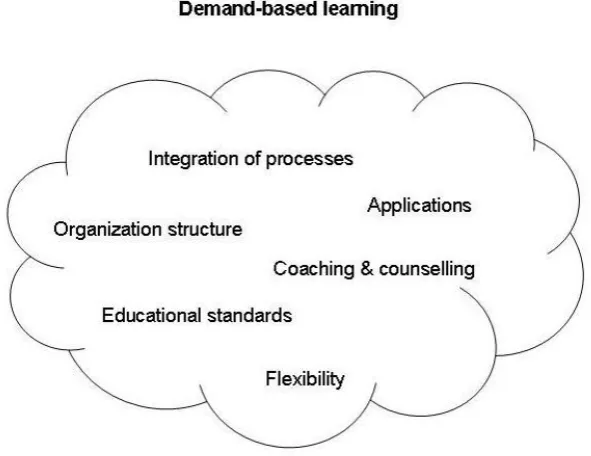
[image:34.595.147.443.402.630.2]The general notion is that demand-based learning contains a set of core concepts over which decisions regarding the organization and its processes need to be made. Organizations seem to agree on which concepts these are, but not on how the organization should give meaning to these concepts. Some of these concepts are schematically shown in figure 4 and result from the different presentations and other written documents that were reviewed before writing this chapter. Table 6 in Appendix D gives an overview of this material. As most of these sources are not available to public they have not been included under references. All of the concepts in figure 4 are important for demand-based learning.
Figure 4: Concepts important to demand-based learning
K P M G PA G E 3 5 Several important notes are made while comparing the concepts within this cloud with some of the concepts that were mentioned in the concept map in chapter 3. While applications, flexibility and coaching and counseling were clearly mentioned in literature, standards, integration and organizational structure were only mentioned by few authors. In most of the reviewed project documents and presentations these dimensions were specifically mentioned as important. This is an interesting difference between literature and practice: While literature mostly looks at location flexibility and accompanying concepts such as distance learning and e-learning, schools seem much more concerned with flexibility in curriculum and the degrees of freedom students have in selecting what they want to learn.
4.6 Discussion
This chapter showed what the different views on demand-based learning were from literature, from KPMG and from educational institutions. Summarizing, DBL empowers the student in how, what and where choices regarding study and study program. Differences between literature and practice were also touched upon.
This section deserves a preliminary definition on DBL by the author, which will be used further on in this research. DBL is concerned with delivering a level of flexibility in study curriculum and study pace on an organizational level, such that student‟s learning requirements are optimally fulfilled. This definition fits more with the practical view on DBL than what has been found in literature. The definition regards location flexibility as less important. The author thinks that suitability of courses for location flexible teaching differs on a per-course basis. This suitability should be therefore determined on a course-level by a domain expert.
The changes that are required by an organization to facilitate DBL are influenced by the choices an organization makes regarding its DBL model. Flexibility and level of flexibility offered are key elements within this model.
K P M G PA G E 3 6
Part III: Organizational implications
The implications of demand-based learning for organizations can differ widely. The independent variable is the difference between the current situation and the desired situation. Current situation and desired situation will be different per organization. In this chapter the impact of demand-based learning on educational institutions and how they organize education is explored. Implications that derive from general organizational change are not included here but will be added as part of the assessment model in chapter 6.
Contents:
5. Implications 37
5.1 Flexibility 37
5.2 Standards 40
5.3 Processes 41
5.4 Information technology 43
5.5 Stakeholders 45
K P M G PA G E 3 7
5. Implications
Introducing a demand-based learning model into an educational organization has several implications. Understanding these implications and how they relate to other areas in the organization is important to prevent complications during and after implementation.
The previous chapter mentioned flexibility as an important enabler for DBL. The concept of flexibility will be further explored in this chapter. The use of educational standards will also be introduced in this chapter. A description will be given that shows how seemingly distant concepts such as standards and flexibility interrelate. As students are offered more flexibility, their flow through the organization becomes more organic. The chapter also gives a thorough description as to how this will affect processes and information flow.
The chapter will finish of with a stakeholder analysis. The reason for placing the stakeholder analysis at the end of this chapter is that within this analysis it is not only important to identify who the stakeholders are, but also how they are affected. To see how each stakeholder is affected one should first know how the program affects the general organization.
5.1 Flexibility
Flexible delivery in education is concerned with ‗what‘, ‗how‘ and ‗where‘ (Hill, 2006). This is a very gross distinction, however relating this to the different dimensions of flexibility by Collis and Moonen (2004), three broad categories of flexibility can be defined. These are flexibility in study pace, flexibility in study location and flexibility in study program.
5.1.1 Flexibility in study location
Flexibility in study location is concerned with when and where students can follow courses. Synchronous and asynchronous distance learning programs offer high degrees of location flexibility. In synchronous distance learning teleconferencing techniques are often used to lecture students in an online classroom. Asynchronous distance learning often involves recorded lectures and offers more freedom to the student as to when he or she can study the material. Both types of distance learning involve the use of digitalized study material and online feedback (Zhang & Nunamaker, 2003). Not all courses and programs are suited to be taught through distance learning. Especially courses that require high student-student and student-teacher interaction are less suited (Moore, 1989; Alonso, López, Manrique & Viñes, 2005; Henrich & Sieber, 2009). The use of message boards can partially negate the effects of lack of interaction however.
5.1.2 Flexibility in study pace
K P M G PA G E 3 8 organization must decide how it will deal with such overlap. For example, is presence at both overlapping courses mandatory?
5.1.3 Flexibility in curriculum
Flexibility in curriculum is concerned with the amount of times students can enroll in study programs and the extent to which students are free to replace courses in their programs. The main inhibitor for curriculum flexibility is the overlap between desired courses and the level of knowledge required to enroll in these courses. Flexibility in curriculum can be implemented in several different ways. For example students may have the option to select a number of predefined course packages. The educational institution determines which packages contain what courses. The student is free to choose several of these packages, which will form his personal study program. Distinguishing between a set of mandatory courses and a set of electable courses in a learning program is another way of providing curriculum flexibility.
Several factors prevent an organization from offering full flexibility on each of the three dimensions. These are cost effectiveness, teaching and quality and regulations and market demand.
5.1.4 Cost effectiveness
Over the past years cost cutting has put considerable constraints on educational institutions. A condition to DBL is therefore that costs remain maintainable (M. Elfers, personal communication, April 24, 2009). Teaching selected courses multiple times a year to facilitate a just-in-time way of education will benefit flexibility within a curriculum, but it will also set back its cost effectiveness. Flexibility could also mean that students can review their individual study plan on a periodical basis. Planning and scheduling processes should be optimized for this. For educational institutions cost effectiveness also means looking at rate of return. This is done by assessing the total portfolio of courses that is offered, the costs associated with these courses and the level of interest in such courses by students. Courses with few enrolments may not be as cost effective. The tradeoff is that excluding such courses from the organizational course portfolio means that several students can no longer attend these courses.
5.1.5 Teaching and quality
Distance learning applications and the use of technology can increase the amount of flexibility within courses without exponentially raising costs. This can be done for example by asynchronous teaching, using pre-recorded lectures and teaching material. The lack of teacher-student and student-student interaction has been deemed valuable in the past however (Alonso et al., 2005), and may negatively affect the quality of education.
Certain courses may require the knowledge of other courses to successfully complete them. Other courses may complement each other. This forces a trade-off between how flexible students can select their courses and how well they are educated in relevant areas at the end of a program. This is another area where flexibility can affect quality.
5.1.6 Regulations and market demand
K P M G PA G E 3 9 program that they enroll in. Professional institutes such as NIVRA2 may also put constraints on the content of courses and programs. Although flexibility is an important aspect of DBL, the offered level of flexibility should be in line with market demands and regulations.
The interaction between the concept of flexibility and each of these constraining dimensions is schematically presented in figure 5. Individually these dimensions also influence each other directly. The figure is shortly discussed below.
Figure 5: Constraints on flexibility
The relationship with the different types of flexibility and the other three constraining dimensions has been discussed above. In short, teaching and quality constrain the level of flexibility because certain types of programs have specific attendance and content requirements which guarantee a certain level of educational quality. Regulations and market demand are formed by a set of demands from government, students and the labor market. Such demands make sure that students are actually able to participate in the field they studied in. Finally, cost effectiveness is an important topic for any educational institution. There is a maximum level of flexibility an institution can offer, considering its budget and educational model.
The three areas that influence flexibility also interact with each other. (1) Teaching and quality and regulations and market demands have a certain overlap. Government regulations are in part imposed to guarantee the quality in educat