Abstract—The aim of this project is to develop an online
casebook on Industrial Accident Analysis for facilitating the learning and teaching processes of occupational ergonomics. The online casebook contains self-checking, included case description, case analysis, and exercises for assessing students’ effectiveness of learning in the course of surfing. Learning tools like a comprehensive ergonomics glossary, real life case studies, and some related web resources are also provided. To evaluate the effectiveness of this online courseware, a questionnaire addressing the anticipated benefits is designed. The results of questionnaire showed that users achieved an above the average satisfaction level for the use of the courseware, and it also indicated that the courseware did bring certain educational benefits to the users. It is hoped that the online casebook would help students to have an indepth learning of the techniques used for preventing and investigating industrial accidents. It is also hoped that engineers and occupational health and safety professionals could find this courseware helpful in providing them a range of information for accident analysis and helping them to acquire knowledge on occupational health and safety.
Index Terms—education, industrial accident, system
usability scale (SUS), web-based training
I. INTRODUCTION
CCUPATIONAL health and safety is a discipline with a broad scope involving many specialized fields [1]. The International Labour Organization [1] stated that the aims of occupational health and safety should be at the prevention among workers of adverse effects on health caused by their working conditions, and the protection of workers in their employment from risks resulting from factors adverse to health. Industrial accidents can cause serious injury or wrongful death, and also can be extremely costly and have undesirable impacts on the morale, image, and productivity in an organization. In recent years, the Hong Kong government has shifted the emphasis from law enforcement to promoting safety management. However, it seems that many organizations do not have an effective safety management since there are still many industrial accidents
Manuscript received February 09, 2011. The work described in this paper was supported by Quality Enhancement Fund 8710208 of the City University of Hong Kong, SAR Government of Hong Kong.
Alan H. S. Chan is with the Department of Manufacturing Engineering and Engineering Management, City University of Hong Kong (corresponding author. phone: +852 27888439; fax: +852 2788 8423; e-mail: [email protected]).
K.L. Chan is with the Department of Manufacturing Engineering and Engineering Management, City University of Hong Kong.
K. Chen is with the Department of Manufacturing Engineering and Engineering Management, City University of Hong Kong.
that cause serious injuries and deaths. It was reported by the Hong Kong Labour Department [2] that there were 13,600 industrial accidents, causing a fatality of 22 in 2009. The importance of knowledge and skills in industrial accident analysis should always be included and emphasized in engineering education, as accident investigation helps to find out the causes of any accident or incident for developing prompt arrangements and preventing future recurrence. Obviously, identification of the root causes requires a higher level of knowledge, vision, and analytical power of the investigator.
With an understanding of the importance of ensuring occupational health and safety, City University of Hong Kong has provided Occupational Health and Safety Management as a core course for students of industrial engineering, manufacturing engineering, and industrial design programs. In the course, techniques that are used to prevent and investigate industrial accidents are provided. Students would be able to develop the skills required for accident prevention and analysis after taking the course. In recent years, the course has been increasingly changing its teaching style from typical use of text based materials to an intensive use of computer aids like PowerPoint presentation. However, the use of computer aids for teaching is just not enough. A course conducted in classroom usually covers a considerable amount of material, but with no complementary time for discussion of real life case studies. It is envisaged that with the use of web based learning kit performing in an interactive environment, the learning and teaching processes will be much improved and more educational benefits would be achieved.
In today’s educational context, the idea of using of the Internet or Web based training for education delivery is not new. Wyld and Eklund [3] pointed out that the Internet has begun to have a significant role in education and change the nature of teaching and learning, since it provides learners with a wide range of learning opportunities and experiences. Jain et al. [4] also highlighted that knowledge-based, generative, and intelligent instructional environments are just beginning to appear on the Internet, and Web was described as a widely accessible source, an information bank, and a method of transmitting knowledge to students.
Web-based learning, as described by Jolliffe et al. [5], is the delivery of and access to a co-ordinated collection of learning materials over an electronic medium using a Web server to deliver the materials, a Web browser to access them and the TCP/IP (Transmission Control Protocol/Internet Protocol) and HTTP (HyperText Transfer Protocol) protocols to mediate the exchange. The advantages of Web-based Training (WBT) have been recognised in the
An Online Casebook on Industrial Accident
Analysis
Alan H.S. Chan, K.L. Chan and K. Chen
literature. Hannum [6] stated that WBT has many different advantages and one of the advantages is the cross-platform compatibility of the software. Another well-known advantage of WBT is that it provides an interactive learning environment. Past studies have indicated that interactive learning style could facilitate the learning process. Steed [7] noted that the interactive nature of the presentation, combining multimedia (text, graphics, audio and video) in an interactive environment enables the development of courses that simulate real-life scenarios and provide immediate feedback. Learners retain more course material offered on Web than in classroom. The study of De Leeuwe et al. [8] found that animations are clearly preferred above static figures, and the learning-access-level of the learning materials are rated significantly higher when the learning materials are illustrated by animations. It is thus expected that the replacement of static materials with animated displays in the web teaching and learning could enrich the course materials to be more illustrative and interactive. It is also envisaged that the interactive web based training should provide alternative better means, and adds zest to the current seemingly monotonous teaching process. Therefore, in this project, an online casebook is developed for improving the learning and teaching of Occupational Safety and Health Management.
The aim of this project was to produce a coherent and intriguing World Wide Web online casebook, which has genuine occupational accident cases for arousing students’ learning interests and facilitating students’ transfer of learning from knowledge in industrial safety to real-life situations in the health and safety profession. There were two major objectives for achieving the project aim. The first objective was the systematic sourcing and compilation of teaching materials, all the facts and information for selected real life cases for inclusion in the online casebook. The second objective was to develop the software aspect of this online casebook for delivering teaching materials and accident techniques in an interactive mode.
II. NAME, TYPE, AND LOCATION OF CLIENT In this project, the clients are basically the undergraduates and postgraduates who take the courses of work design and ergonomic workplace design in the City University of Hong Kong. The clients are expected to participate in the classroom lectures before using the courseware. This online casebook was developed with the aim of supplementing and enhancing their learning process outside the classrooms.
III. EDUCATIONAL NEEDS
The courseware is accessed with a web browser on an Intranet or the World Wide Web (http://personal.cityu.edu.hk/~meachan/IAA). It incorporates with a combination of text, sound, video, graphics, animation, and database. The materials and topics in the courseware are major health and safety issues in local industries. The systematic approach for preventing and analyzing industrial accidents was adopted for training in the
courseware. The web page is developed with six main components, namely analysis model, nature of accident, self-checking, glossary, safety cost estimation, and industrial accident analysis. The self-checking component allows users to acquire the knowledge, principles, and analysis assessment in a methodical manner. Besides, a comprehensive glossary containing all the related terms is compiled and appropriate web links with related sites are availed to the students. This online casebook is expected to allow students to learn more efficiently and understand better the subjects through series of self paced activities. It also enables students to evaluate themselves on the effectiveness of learning through series of three levels of quizzes.
IV. METHODOLOGY
To achieve the project aim, the following processes were done.
A. Review and Selection
After the identification of the project aim and objectives, the pre-development stage was begun. Related knowledge like web page design theory, computing language, computer graphics formats, modern training approaches, proper software, appropriate technologies for broadcasting, and concepts of occupational health and safety were reviewed intensively. The necessary skill, concepts and formats of each of these components were selected after the review.
With the use of Synchronized Multimedia Integration Language (SMIL), the web site was able to define and synchronize multimedia elements like video, sound, and still images for web presentation and interaction. Shin and Shin [9] stated that SMIL offers an integrating format representing how various media objects are positioned spatially and combined temporally using a collection of XML elements and attributes for multimedia delivery over the Web. Each media object is accessed with a unique Uniform Resource Locator (URL), which means that presentations can be made of objects arriving from more than one place, and that objects can easily be reused in multiple presentations.
B. Self-Learning Teaching Material Compilation and Case Studies Preparation
In this stage, a systematic preparation, compilation and collation of teaching materials were done. The three levels of quizzes and real life case studies were also developed. In the courseware, most of the interfaces were designed based on the materials found in the common occupation safety and health textbooks, websites, magazines, and newspapers.
C. Production
The concepts, technologies, and programming skills selected in the first phase were applied on the materials of the online casebook. The computer-based training (CBT) and web-based training (WBT) guidelines were reviewed and applied into the design. Web-based training (WBT) is an approach for distance learning in which CBT is transformed by the technologies and methodologies of the World Wide Web, the Internet and intranets [12]. In particular, the practical guide developed by Cook and Dupras [13] was taken as a reference for developing effective web-based learning. It is born in mind that effective webpages should be clear, concise, and consistent [14].
D. Project Construction
In this phase, the ideas and design from the preceding phase was transferred to the web pages with the JAVA script, HTML (HyperText Markup Language), CGI, MYSQL, and Flash.
Gillani and Relan [15] noted that JavaScript works quite effectively when it is embedded into HTML codes. Objects on the page, for example, buttons and texts, can respond to user action directly because the codes that run the document are downloaded into the client’s computer rather than coming from the server’s script. Schaller et al. [16] stated that Flash allows developers to go far beyond the text and image foundations of the Web to create sophisticated applications, full-fledged games, rich multimedia, and complex interactivity. The materials were then uploaded to the server for public browsing. The documents and guidelines for successors for further development of the web were also prepared.
E. Operation and Maintenance of WebPages
Operation and maintenance are very important for developing informative learning websites. Operation refers to the frequently updating of the website while maintenance means the provision of supports. The maintenance of websites involves revising, editing existing web pages to keep them up to date, checking and correcting errors, and adding new web pages periodically. Since a web page needs continuous updating and reviewing, the structure of the pages was designed for easy updating and information addition.
V. RESULTS
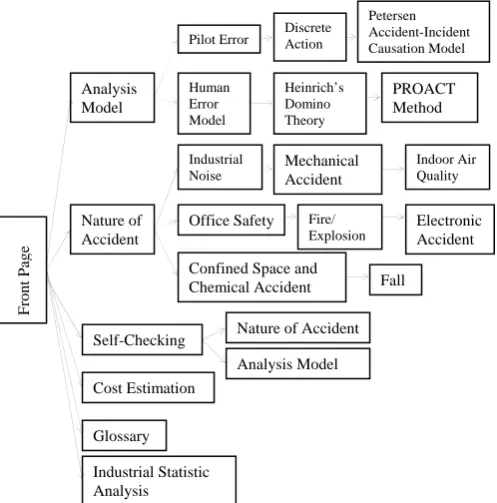
An online casebook is developed with six main components, viz. Analysis Model, Nature of Accident, Self-Checking, Glossary, Cost Estimation, and Industrial Statistic Analysis. Figure 1 shows the structure of the online
casebook on Industrial Accident Analysis. The effectiveness of this online casebook is also evaluated by distributing a questionnaire to users.
[image:3.595.306.555.105.357.2]
Fig. 1. Structure of the Online casebook on Industrial Accident Analysis
A. Analysis Model
Accident investigation is one of the important elements of a safety management system, as it helps to find out the causes of any accident or incident for developing prompt arrangements and preventing future recurrence. In this online courseware, some analysis models are provided for helping in the Industrial Accident Analysis. The analysis models are Pilot Error, Discrete Action, Petersen Accident-Incident Causation Model, Human Error Model, Heinrich’s Domino Theory, and PROACT Method.
B. Nature of Accidents
In this component, eight major health and safety issues in local industries are included, which are Industrial Noise, Mechanical Accident, Indoor Air Quality (IAQ), Office Safety, Fire/Explosion, Electronic Accident, Confined Space and Chemical Accident, and Falls. For each of the topics, case studies are provided. Khan [17] noted that case studies of real situations can be used in a Web-based course to engage learners in the problem-solving tasks in which they can be asked to identify and solve problems.
C. Self-Checking
According to Sadik [18], self-test is an interactive component in each lesson provided to stimulate learners’ thought and action, motivate them to learn and help them to know whether they understand the main concepts and ideas in the lesson. In this online casebook, a Self-Checking component is developed and two major parts are involved - Analysis Model and Nature of Accidents. It attempts to test
Analysis Model
Nature of Accident
Cost Estimation
Glossary Self-Checking
Industrial Statistic Analysis
Human Error Model
Discrete Action Pilot Error
Petersen Accident-Incident Causation Model
PROACT Method
Industrial Noise
Indoor Air Quality Mechanical
Accident
Confined Space and Chemical Accident
Fire/ Explosion
Nature of Accident
Electronic Accident
Fall
Analysis Model
Front Pa
g
e
Heinrich’s Domino Theory
users’ general qualitative concepts and terminology and further strengthens their understanding of the subjects.
In the Analysis Model component, three case studies are provided. For each case, a multiple choice test is provided.
For the Nature of Accidents part, eight topics are provided - Industrial Noise, Mechanical Accident, Indoor Air Quality (IAQ), Office Safety, Fire/Explosion, Electronic Accident, Confined Space and Chemical Accident, and Falls. Users are required to answer questions after reading the related case studies for different topics. There are three catalogues in each topic. The first catalogue provides case description, and completed case analysis. It also provides a series of simple true/false statements with immediate feedback and score counting, and matching games with immediate feedback. For the second catalogue, multiple choice questions, shooting game or hooking game are set and arranged in order of increasing difficulty. In the third catalogue, it presents the case background information, few analyses for the case, and the highest level of multiple choice, or fill in the blank. Users can check the suggested answer after completing the tasks. In this catalogue, students can learn through action and examine their ability of application of knowledge and principles in modern industrial accident investigation and analysis.
D. Accessories
The Accessories component includes all the supplementary tools and learning aids for better understanding of the course materials. It includes the Glossary, Cost Estimation and Industrial Statistic Analysis. The Glossary is an online database containing more than 3000 Occupational Health and Safety terms with brief explanations. In the Cost Estimation component, introduction and concept of cost estimation are provided. Different cost estimation models are also introduced. The advantages and limitation of each model are discussed. From this component, user can learn how to calculate the industrial accident cost through different models which are suitable for Hong Kong. For the Industrial Statistic Analysis component, the reason of analysis of the industrial accident statistic is mentioned. The definitions and detail information of occupational disease, occupational and industrial accidents are also provided. Past analysis of industrial accident statistic in Hong Kong is provided as an example. The Industrial Statistic Analysis can serve as a reference for safety program planners to develop or to design a new safety training program for workers.
VI. EDUCATIONAL BENEFITS
For evaluating the effectiveness of this online courseware, a questionnaire addressing the anticipated benefits was developed. The questionnaire consisted of the ten questions of System Usability Scale (SUS) and four additional questions. Each question is a statement and answers are given on a five-point scale from “Strongly Disagree” to “Strongly Agree”. In a study of Tullis and Stetson [19], five questionnaires for assessing the usability of a website were compared. It was found that the SUS questionnaire yielded among the most reliable results across sample sizes [20].
The survey was conducted with a group of 92 students who had attended the classroom lectures on the topics of Analysis
Model and Nature of Accidents. They were asked to try using the courseware for 90 minutes and answer the questions of the survey. Seventy users (76%) completed and returned the questionnaires. The results revealed that an overall SUS score of 75.5 was obtained with the use of the courseware, indicating that an above the average satisfaction level was achieved by the users. The average scores of the additional questions numbered 11, 12, 13 and 14 were 4.2, 3.9, 3.3, and 3.0 respectively, indicating that in general the following educational benefits were brought to the students:
1) Students can understand and learn more effectively and efficiently the ergonomics issues of industrial accident analysis.
2) Students can learn the techniques of industrial accident analysis through a systematic and comprehensive task analysis procedure.
3) Through action learning, students can learn in a flexible and interactive environment of the concepts and principles of industrial accident analysis with some structured real life cases.
Question 14 asked participants whether students thought they could evaluate the effectiveness of their learning process through the series of self-conducting checkpoints and quizzes. The equal to average score showed a neutral response and implied that there are still rooms for improving the design for allowing the participants to evaluate their learning effectiveness. In view of the increasing awareness of the importance of health and safety issues in Hong Kong, this online casebook is not only useful to those studying occupational health and safety but also benefits all other related professionals who are responsible for preventing industrial accidents and protecting workers in their employment from risks. The development of this online casebook was acclaimed of supporting the University’s mission of providing its students with quality higher education and simultaneously responding to local and regional needs.
VII. RECOMMENDATION
REFERENCES
[1] International Labour Organization. (1996). “Introduction to Occupational Health and Safety”, Your health and safety at work: A
collection of modules. Available: http://actrav.itcilo.org/actrav-english/telearn/osh/intro/inmain.htm
[2] Hong Kong Labour Department. (2010). “Summary of Occupational Safety and Health Statistics 2009”. Available:
http://www.oshc.org.hk/tchi/resource/health.asp?#
[3] S. Wyld and J. Eklund, "A case study of communication technology within the elementary school", Australian Journal of Educational Technology, vol. 13, issue 2, pp. 144-164, 1997.
[4] A. Jain, K. Kensk and D. Noble, “An interactive web-based teaching tool for simplified 3D analysis of solar rhythms”, Automation in Construction, vol. 8, issue 2, pp. 181-194, 1998.
[5] A. Jolliffe, J. Ritter and D. Stevens, The online learning handbook: developing and using web-based learning, London: Kogan Page, 2001. [6] W. Hannum, “Web-based Training: Advantages and Limitations”, in B.H. Khan, Ed., Web-based training, New Jersey: Educational Technology Publications, 2001, pp. 13-20.
[7] C. Steed, Web-based Training, UK: Gower, 1999.
[8] M.F.J. De Leeuwe, S.J. Portier and R.L. Martens, “Using animations in an interactive learning environment: Does it help?”, in B.P.L.M. den Brinker, P.J. Beek, A.N. Brand, F.J. Maarse and L.J.M. Mulder, Eds, Cognitive ergonomics, clinical assessment, and computer-assisted learning, Lisse, The Netherlands: Swets & Zeitlinger, 1999, pp. 247-256.
[9] D. Shin and D. Shin, “Design and implementation of the SMIL (Synchronized Multimedia Integration Language) player”, IEEE Transactions on Consumer Electronics, vol. 48, issue 3, pp. 575-578, 2002.
[10] L. Welling and L. Thomson, PHP and MySQL Web development, 2nd ed., Indiana: Sams Publishing, 2003.
[11] M.E. Davis and J.A. Philips, Learning PHP and MySQL, CA: O'Reilly Media, Inc., 2006.
[12] R. Zhang, B. Zhang, J. Zhu and H. Huang, "Development of Multi-video Based Virtual Classroom and Its Application in English as Second Language Learning", 2008 International Symposium on Computer Science and Computational Technology, vol. 1, pp.175-179, 2008.
[13] D.A. Cook and D.M. Dupras, “A Practical Guide To Developing Effective Web-based Learning”, Journal of General Internal Medicine, vol. 19, issue 6, pp. 698-707, 2004.
[14] S. Krug, Don’t make me think! A common sense approach to web usability, Indianapoils: New Riders, 2000.
[15] B.B. Gillani and A. Relan, “Incorporating Interactivity and Multimedia into Web-Based Instruction”, in B.H. Khan, Ed., Web-based instruction, New Jersey: Educational Technology Publications, Inc., 1997, pp. 231-238.
[16] D.T. Schaller, S. Allison-Bunnell, A. Chow, P. Marty and M. Heo, “To flash or not to flash? Usability and user engagement of HTML vs. Flash”, in D. Bearman and J. Trant, Eds., Proceedings of Museums and the Web 2004, 2004, pp. 197-208.
[17] B.H. Khan, Web-based training, New Jersey: Educational Technology Publication, Inc., 2001.
[18] A. Sadik, “The design elements of web-based learning environments”, The International Journal of Instructional Technology & Distance Learning, vol. 1, no. 8, pp. 27-42, 2004.
[19] T.S. Tullis and J.N. Stetson, “A Comparison of Questionnaires for Assessing Website Usability”, in Proceedings of the 13th International Usability Professionals Association (UPA) 2004 Conference, Minneapolis, USA, June 2004.
[20] K. Finstad, “The System Usability Scale and Non-Native English Speakers”, Journal of Usability Studies, vol. 1, issue 4, pp. 185–188, 2006.
[21] R.S. Grabinger and J.C. Dunlap, “Rich environments for active learning: a definition”, in D. Squires, G. Conole and G. Jacobs, Eds., The changing face of learning technology, Cardiff: University of Wales Press, 2000, pp. 8–38.