Abstract--This study considers the application of a genetic algorithm (GA) to the basic vehicle routing problem with tow-dimensional loading constraints (2L-CVRP). Vehicle routing problem encompasses a whole class of complex optimization problems that target the derivation of minimum total cost routes for a number of resources (vehicles, etc.) located at a central depot in order to service effi ciently a number of demand customers. Several practical issues in the industry involving both production and transportation decisions are modeled as VRP instances and the hard combinatorial problems in the strong sense (NP-hard). 2L-CVRP is a generalization of the Capacitated Vehicle Routing Problem, in which customer demand is formed by a set of rectangular, weighted items.
In this paper, computational results are given for the pure GA which is put forward. As compare with the mathematic method, we can find the advantage of using GA to solve the problem especially in large size problems.
Index Terms— Vehicle routing problem; 2-dimesional Bin packing problem; Genetic algorithm; Capacity.
I. INTRODUCTION
he 2L-CVRP is a particula rly important proble m. Its importance can be attributed to the fact that it is an interesting problem both fro m the theoretical and the practical points of view. Regarding the theoretical viewpoint, since 2L-CVRP is, in a sense, composed of two NP-hard optimization proble ms (CVRP and 2L- BPP), it is also a challenging NP-hard proble m of high co mple xity. As far as its practical importance is concerned, the 2L-CVRP has an obvious commercial value. [1]
To the best of our knowledge, only two algorith m methodologies have been proposed for the 2L-CVRP. L. Caccetta, S.P. Hill [2] has developed an exact methodology which uses a branch-and-cut algorithm to deal with the routing characteristics of the problem and a branch-and-bound procedure to guarantee feasible loadings of the items into the vehicles.
Manuscript received May, 2011; revised Jan , 2012.
Yuxi Shen is a member of master laboratory with The Graduate School of Information, Production and Systems, Waseda University. Fukuoka 808-0135 Japan, (e-mail: [email protected])
Dr.Tomohiro Murata is a professor with The Graduate School of Information, Production and Systems, Waseda University. Fukuoka 808-0135 Japan, (e-mail: [email protected])
This e xact solution methodology is applied to proble m instances with no more than 30 customers and 90 ite ms. In practical conditions, the scale of the problem tends to be larger.
A variety of real life applicat ions in the d istribution or collection manage ment context involves the transportation of rectangular shaped items that cannot be stacked, due to their weight or fragility (household appliances, delicate pieces of furniture, artworks, etc.).[3] So it can be widely used in manufacturing and service operations manage ment applications:
--Pick-up schedule in logistic problems
--Min imization of the distribution costs in a multi-fac ility production system
--Routing proble ms for auto mated pick and place machines
--Ya rd tra ile r routing problem at a maritime container terminal
We find the traditional heuristic algorith m; such as MIP will cost very long time to solve the NP -hard prob le m, but the search mechanis m in the GA corresponds to chromosome evolution, comp rising reproduction, crossover, and mutation during imitated breeding process. [4] Typically, determin ing search direction solely re lies on probability settings regarding chromosome mutation and crossover for generating offspring during the breeding process. Additionally, as is we ll know, the structure of the initia l chro mosome population (name ly, initia l solution population) significantly impacts the resolution capability of the GA. So we developed a new method by using GA that can effectively shorten the operation time.
II. PROBLEM DESCRIPTION
With paper surveys, we have studied two kind o f place ment version: The Unrestricted loading and the Sequential loading. [5] For the Sequential loading there is an additional constraint: the loading of the ite ms must ensure that whenever a customer i is visited, no ite m of customer j which v isited after customer i , can be p laced between ite ms of customer i and the rear part (loading door) of the same vehicle. [6] The sequence constraint arises in practice, when it is not feasible to move ite ms inside the vehicle, due to their weight or fragility. The problem can be defined as follow: Definite parameters
• i : The number of depots ( i = 1,…,n)
• Dij : Distance between depot i and j where i, j ϵ N
Pick-up Scheduling of Two-dimensional
Loading in Vehicle Routing Problem by using
GA
Yuxi Shen, Tomohiro Murata
Fig.1. Problem definition.
• D: The weight capacity of each vehicle
• Dt: The total weight of each vehicle in the meantime.
Dt = Dt + di
• K: The number of vehicles
• If ( Dt ≤ D and Wt ≤ W , Ht ≤ H) ; K++
• A : The volume capacity of each vehicle 1) All the items accessible from a single side for the rectangular loading surface ;
2) And width and height are equal to W and H ,
A = WH is the total area of the loading surface
3) The total width and height of items in each vehicle in the meantime :Wt = Wt + wil , Ht = Ht + hil
• Each item will be denoted by a pair of indices (i,l) . 1) Each depot i ( i =1,…,n) is associated with a set of mi
rectangular items whose total weight is equal to di;
2) Each item has specific width and height equal to wil
and hil ( l = 1,…, mi ).
3) The total width and height of items in each vehicle in the meantime :
W
t= W
t+ w
il, H
t= H
t+ h
ilFig.2. Define the parameters of each item.
Objective Function:
N i N j i o j v s V k ijk ki
x
C
K
C
d
C
0 , 1
)
(
min
(
C
v express the cost of each vehicle.)And there is some special constrains for the problem:
(1) x
ijk= 1, if vehicle k travels directly from
customer i to customer j (i, j
ϵ
N); 0 otherwise
(2) d
i< D ( i = 1,…,n)
(3) 0 < x
il< W – w
iland 0 < y
il< H – h
il( l = 1,…,
m
i).
(4) x
il+w
il<x
jl’or x
il’+w
il’<x
jlor y
il+h
il<y
jl’or
y
il’+h
il’<y
jlIII. SOLVING METHOD
Step 1: Consider the condition of one vehicle with no capacity and time limited.
So the problem become very similar as the travelling salesman proble m (TSP) [7] that was first formulated as a mathe matica l proble m in 1930 and is one of the most intensively studied problems in optimization.
1) Formulate GAs for TSPs :
The evaluation function for the two dimensional TSP is the sum of Euclidean distances between each two cities in the problem. The fitness value can be defined as this:
`
i Ni
i i i
i
a
b
b
a
Fitness
1 2 1 21
)
(
)
(
Where
a
i,b
i are the coordinates of city i. [8]2) Crossover and mutation:
We considered a condition showed as Fig.3:
2 1 2 1
6
5
4
5
6
2
4
1
3
3
2
1
4
1
3
5
6
2
6
5
4
3
2
1
C
C
Crossover
After
P
P
Fig.3. An example of the traditional crossover.
After crossover, we noticed that city 3 appeared tw ice in child 1 and the same as city 6. So the t raditional crossover principle is not suitable for this case. Then I decided to use greedy crossover that invented by Mr.Gre fenstette in 1985. [9] This method selects the 1st city of a parent, compares the cities leaving that city in both parents, and chooses the closer one to e xtend the route. If one city has already appeared in the route, we choose the other city. If both cities have already appeared, we randomly select a non-selected city.
For the same reason we do not use the traditional mutation method. We randomly select two cit ies in a chro mosome and change their values. Then, we still have legal routes after the mutation.
3) Selection:
We considered two kind of search algorith m of selection. First one is the roulette-wheel selection that the proportion of the wheel is assigned to each of the possible selection based on their fitness value.
The other is chc selection which developed by L.J. Eshelman in 1991. [10] We use this selection to ensure the best one always survives in the next generation.
Fig.4. Compare CHC with roulette-wheel selection.
We can see how fast the chc selection did in the population converge from Fig.4. [12] The performance of chc selection is much better than the roulette-wheel selection in this case. So we decided to use chc for our selection.
4) Solutions:
Two parents are selected from population by binary tournament method. And, these two parents are chosen randomly. Then we calculate the fitness value, the one with the better fitness value is selected as the 1st parent we need. The process is repeated to obtain a second parent.
Children are produced by the two parent using the cros sover method that we mentioned as above.
The steps of the pure GA can be described as follows: Generate the initial population
Evaluate the fitness value of every individual in the population
Repeat
Select two parents from the population randomly by u sing two binary tournaments
Produce two children from the selected parents Do crossover and mutation
Evaluate the fitness of the new offspring If entry criteria are satisfied by chosen offspring Choose population member to be replaced End if
Until stopping criterion is satisfied
So the main purpose here is to shorten the total distance that the vehicle travelled, because the cost is all produced by the distance.
Step 2: Add a we ight and space capacity to the vehicle, and consider the load and unload in no time limited condition:
Here, the problem can be described as, one vehicle started from the warehouse, then visited several customers and pick-up their items. (Fig.5)When either the weight or space capacity is reached, the vehicle returns to the start point and unload all the items. Then restarted and continue to pick-up
other customers’ items, until all the customers’ items are gathered to the warehouse.
Fig.5. One vehicle with unload conditions.
So we need to consider the replace ment proble m here. As how to make good use of each vehicle’s space to decrease the circle that the vehicle travels in order to save the cost.
In order to effective ly reduce the number of possible packing methods, we decided to use a traditional place ment heuristic called bottom-left-condition (BL algorithm). The orthogonal packing pattern fulfills the BL a lgorith m if no rectangle can be shifted further to the bottom or to the left.
Alternatively, a packing pattern can be represented by a permutation
.j
i
- Index of the rectangle (r
ij ).
= (i
1 . . .i
n ,) - Permutation.This decoding of the genotype needs more e ffort than the conversion of the natural representation into the packing patterns. So the aim is to create a faster decoding algorithm.
Procedure 1: Place
r
(1) into the left lower corner of the board.Procedure i: Shift
r
(1) alternately, beginning fro m the upper right corner of the board, as far as possible to the bottom and then as far as possible to the left.For the genetic a lgorith m, an eva luation of the pac king pattern is necessary. This is represented by an appropriate fitness-function
F:
---> R+ with the propertyf(
i) > f(
j)if
i is a 'better' packing pattern than
j .The computation of the natural approach of the fitness -function is inversely proportional to the height of the packing pattern: f(
) = 1/h
BL ('
).If two packing method have the same height and fitness-values. There a lso has a condition that one of them is better than the other. (Fig.6)
Fig.6. T wo packing method with the same height and fitness-values that one is better obviously.
The comparison suggests the following fitness -function; f (
) = Area (Contiguous Remainder (
) )= 1() (2)
(
(
)
(i))
k
i i
y
board
height
x
x
i
With
1(i),
(i),
2(i),
(i)
.
i
x
y
x
y
k
Step 3: Muti-vehicles with time limit:
Now, we will give the last constraints to solve the reality problem. [13] Here we have a fleet of vehicles, each have the same we ight and space capacity, and also have the same speed. (We didn’t consider the effect to the speed that how many items have been loaded on the vehicles). [14]
Additionally, we add a t ime-limit for each case, so that each vehicle travels with its own circ le and limited travelling distance. [15] [16] (we suppose there always have enough vehicles in the warehouse).
[image:4.596.298.555.159.266.2]As the imagination showed in Fig.7, our decision parameter beca me the vehicle nu mber we used and the distance.
Fig.7. Muti-vehicles with capacity and time limit.
IV. EXPERIMENT AND EVALUATION
The heuristics defined above were coded in java and, using a Core(TM)2 Duo CPU E7200@ 2.53GHz x 2 with 2 GB RAM in Windows XP. They were applied to the CVRP problems. In a word, these experiments reveal relatively slight differences, and the GA re mained effective with each of the variants that were tried.
The benchmark instances used in this paper and other papers are availab le at (http://www.or.de is.unibo.it/research.html). There are 36 instances and these instances are divided into five classes, by the number and the size of items:
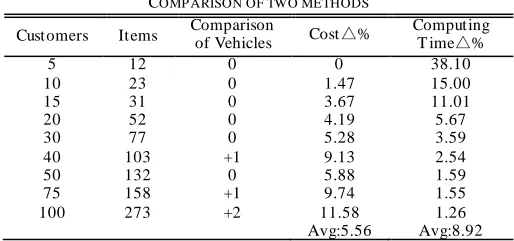
We can see the result showed in TABLE I, we did 10 independent runs by increas ing the customer and ite m number by using GA.
T ABLEI
THE COMP UTATION RESULT BY USING GA.
Then we used LINGO to solve the MIP (mixed integer programming) model and got the result of the total cost and computing time (TABLE II).
T ABLEII
THE COMP UTATION RESULT RAN BY MIP.
Fro m co mparing with the optima l solution, we ca lculate the Cost △% by
Cost△%=(Average Cost by GA –Optimal cost)/ Optima l cost;
to show how many percentage the cost will increase when we use GA, and we calculate the Computing Time△% by
Co mputing Time△% = Co mputing Time(GA)/ Co mputing Time(MIP);
T ABLEIII COMP ARISON OF TWO METHODS
Customers Items Comparison of Vehicles Cost△% Computing T ime△%
5 12 0 0 38.10
10 23 0 1.47 15.00
15 31 0 3.67 11.01
20 52 0 4.19 5.67
30 77 0 5.28 3.59
40 103 +1 9.13 2.54
50 132 0 5.88 1.59
75 158 +1 9.74 1.55
100 273 +2 11.58 1.26
Avg:5.56 Avg:8.92
We can see the data fro m TA BLE III that the cost that we will ta ke by using GA is only 4.8% mo re than the best solution, and the computing time only ta ke 7.81% in average compare with the mathemat ic method. In addit ion, when the customer nu mber increased to 20 and the item nu mber grown to 52, the computing time will have a great distinction by
Custo
mers Items
Vehicle hired
(Avg) Average Cost
Computing time(s)
5 12 2 543.92 8
10 23 2 906.13 12
15 31 3 1138.03 37
20 52 5 1831.45 89
30 77 7 3290.25 213
40 103 12 5601.21 470
50 132 15 8013.34 532
75 158 18 12281.32 1180
100 273 28 15020.12 2470
Customers Items Vehicle
hired T otal Cost
Computing T ime(s)
5 12 2 543.92 21
10 23 2 893.01 80
15 31 3 1097.72 336
20 52 5 1764.65 1570
30 77 7 3098.67 5938
40 103 11 5132.73 18500
50 132 15 7714.22 33563
75 158 17 11253.12 75986
[image:4.596.47.259.250.324.2] [image:4.596.299.554.341.446.2] [image:4.596.298.555.580.701.2]using these two methods, it reduced rapidly fro m 11.22% to 4.92%. And if we ca lculate the co mputing time △% fro m 20 customers to 100, the result is only 3.23% in average.(Fig.10) But we find the result is not good enough when the customer number reached 40, 75 and 100, Cost△% increased to nearly 10%. That will cost a lot in the reality conditions. So we we re thinking about if we can find a way to ma ke some change of our chro mosome design or solve method, that can reduce Cost△% lower than 5%.
With paper surveys, we find two-po int crossover may work well than one-point crossover in so me conditions. In the Two-point crossover, the ranking replace ment method was replaced by a worst fitness/unfitness replace ment method, in which the population me mber with the worst un fitness was chosen for replace ment, unless all population me mbers had zero unfitness, in which case the me mber with worst fitness was chosen for replacement. The child solution replaced the chosen me mber even if it was worse, as this caused a much larger nu mber of ch ild solutions to enter the population and gave rise to a better performance of the GA co mpared with only allo wing the child to enter if it was better than the population me mber chosen for replacement as we used One-point crossover in the preceding experiment of the text. Here we got the result by GA using the Two -point crossover. (TABLE IV)
T ABLEIV
RESULT OF GA BY USING TWO-P OINT CROSSOVER
Meanwhile, Cost△% also reduced within the decrease of vehicle nu mber. The average of Cost△% down to 4.31% fro m 5.56%(TABLE V). In addit ion, the Co mputing Time △% almost rema ins the same(reduced fro m 8.92% to 8.23% ,, that reveals after the e xperiment by using two-point crossover, GA re ma ins effic ient in the co mputing time co mparison. We can get the result more closely with the mathe matic method and we can a lways find the best vehicle nu mber for the final solution until 75 customers. Actually, 75 customers ’ proble m is large enough to serve the reality trade problems.
T ABLEV
COMP ARISON WITH MIP BY USING TWO-P OINT CROSSOVER
Customers Items Comparison of Vehicles Cost△% Computing T ime△%
5 12 0 0 33.33
10 23 0 1.98 15.00
15 31 0 2.85 11.61
20 52 0 3.67 4.20
30 77 0 4.35 3.32
40 103 0 5.36 2.44
50 132 0 5.49 1.77
75 158 0 6.36 1.31
100 273 +1 8.71 1.10
Avg:4.31 Avg: 8.23
We can compare the figures in the two tables; the cost of these two solving methods appears very close when the
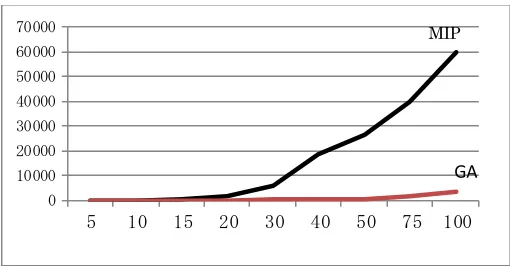
[image:5.596.306.561.106.241.2]customer number is small. And when the customer and items’ number is increased, the total cost that calculated by the mathe matic mode l can get the best solution for sure, but the computing time is much longer than GA. (Fig.8)
Fig.8. Contrast of computing time between GA and MIP.
And the average cost we ca lculated by GA is a lmost the same when contrasted with the best solution when customer and item nu mber is lo w. Even the customers’ number increased, GA only cost 5% more than the optima l solution. It will be acceptable in most reality conditions.
V. CONCLUSIONS
In this research a comb ination of Bin Pac king Proble m and Vehic le Routing Proble m in distribution logistics is considered, known as the two-dimensional loading vehicle routing problem. In the fie ld of co mbinatoria l optimizat ion, loading and routing problems have been studied intensively but separately.
A meta-a lgorith m of GA has been discussed here performed we ll, a lthough it does not equal the mathemat ic model that ran by MIP in terms of solution quality, but it only takes 8.92% in average of the co mputing t ime when we ma ke a tradeoff between these two algorithms.
Then we improved our method for changing Two-point crossover instead of One-point crossover. Fina lly we were able to get an acceptable result that can accurately calculate the vehicle nu mbers up to 75 customers and only consume 4.31% cost in average and g reatly reduced the computing time(8.23%). In this sense, genetic algorith m appeared very high-efficiency in solving the NP-hard problem.
REFERENCES
[1] Asvin Goel a,b,, Volker Gruhn b A General Vehicle Routing Problem European Journal of Operational Research 191 (2008) 650 –660. [2] Caccetta, S.P. Hill Mathematical and Computer Modeling, Volume 33,
Issues 4-5, February-March 2001, Pages 517-532
[3] Chi-Guhn Lee, Marina A. Epelman b, Chelsea C. White III c, Yavuz A. Bozer b A shortest path approach to the multiple-vehiclerouting problem with split pick-ups T ransportation Research Part B 40 (2006) 265–284
[4] Guenther Fuellerera, Karl F. Doernera, Richard F. Hartla, Manuel Iorib,Ant colony optimization for the two-dimensional loadingvehicle routing problem. Computers & Operations Research 36 (2009) 655 – 673.
[5] Stephen C.H. Leung, Xiyue Zhou, Defu Zhang, Jiemin Zheng Extended guided tabu search and a new packing algorithm for the two-dimensional loading vehicle routing problem. Computers & Operations Research, Volume 38, Issue 1, January 2011, Pages 205-215
[6] Manuel Iori y, Juan Jose Salazar Gonzalez z,Daniele Vigo y An exact approach for the vehicle routing problem with two-dimensional loading constraints December 7, 2004; Revised July 1, 2005.
0 10000 20000 30000 40000 50000 60000 70000
5 10 15 20 30 40 50 75 100 GA MIP
Customers Items Vehicle
hired (Avg) Average Cost
Computing time(s)
5 12 2 543.92 7
10 23 2 911.08 12
15 31 3 1129.01 39
20 52 5 1829.37 66
30 77 7 3233.51 197
40 103 11 5408.01 452
50 132 15 8138.11 594
75 158 17 11968.57 993
[image:5.596.36.299.369.474.2] [image:5.596.40.298.635.748.2][7] R. Radharamanan, L.I. Choi Computers & Industrial Engineering, Volume 11, Issues 1-4, 1986, Pages 236-240
[8] Andreas Bortfeldt A genetic algorithm for the two-dimensional strippacking problem with rectangular pieces European Journal of Operational Research 172 (2006) 814–837
[9] Ravindra K. Ahuja, James B. Orlin, Ashish T iwari A greedy genetic algorithm for the quadratic assignment problem Computers & Operations Research, Volume 27, Issue 10, September 2000, Pages 917-934.
[10] Topon Kumar Paul, Hitoshi Iba Gene selection for classification of cancers using probabilistic model building genetic algorithm Biosystems, Volume 82, Issue 3, December 2005, Pages 208 -225 [11] D. Greiner, G. Winter, J.M. Emperador Optimising frame structures
by different strategies of genetic algorithms Finite Elements in Analysis and Design, Volume 37, Issue 5, May 2001, Pages 381-402 [12] Stefan Jakobs On genetic algorithms for the packing of polygons
European Journal of Operational Research 88 (1996) 165-181. [13] Iori M, Gonzalez JJS, Vigo D. An exact approach for the vehicle
routing problem with two-dimensional loading constraints. T ransportation Science 2007; 41(2):253–64.
[14] Nagy G,SalhiS. Heuristic algorithms for single and multiple depot vehicle routing problems with pick-ups and deliveries. European Journal of Opera-tonal Research 2005; 162(1):126–41.
[15] Enrique Alba, Bernabé Dorronsoro Computing nine new best-so-far solutions for Capacitated VRP with a cellular Genetic Algorithm. Information Processing Letters 98 (2006) 225–230.