Multi-Model and Crosslingual Dependency Analysis
Johannes Heinecke, Munshi Asadullah Orange Labs
2 avenue Pierre Marzin F - 22300 Lannion, France
{johannes.heinecke,munshi.asadullah}@orange.com
Abstract
This paper describes the system of the team Orange-Deski˜n, used for theCoNLL 2017 UD Shared Task. We based our ap-proach on an existing open source tool (BistParser), which we modified in or-der to produce the required output. Ad-ditionally we added a kind of pseudo-projectivisation. This was needed since some of the task’s languages have a high percentage of non-projective dependency trees. In most cases we also employed word embeddings. For the 4 surprise lan-guages, the data provided seemed too lit-tle to train on. Thus we decided to use the training data of typologically close lan-guages instead. Our system achieved a macro-averaged LAS of 68.61% (10th in the overall ranking) which improved to 69.38% after bug fixes.
1 Introduction
For our work in our lab (Orange-Deski˜n) we needed a robust dependency analysis for written French with the highest Labeled Attachment Score (LAS)1 possible, using a wide range of
depen-dency relations. Having worked in the past on rule based dependency analysis, it became obvi-ous that we need to adopt a more modern ap-proach to dependency analysis. Thus during the last year we tried several freely available open source tools available (e.g. MaltParser2, Google’s
SyntaxNet3, Standford Dependency Tools4,
Bist-1Since we are interested in semantic relations a good CLAS score (Nivre and Fang,2017) is even more relevant.
2http://www.maltparser.org/
3https://www.tensorflow.org/versions/
r0.11/tutorials/syntaxnet/
4https://nlp.stanford.edu/software/
stanford-dependencies.shtml
Parser5and HTParser6), trained on different
Tree-banks (notably French Sequoia (Candito et al., 2014) and Universal Dependencies (McDonald et al.,2013)). All combinations of tools and tree-banks had some advantages and some inconve-niences. For instance, the underlying linguistic models of the treebanks are not the same or some tools would not acceptCONLLUinput but only raw
text and apply their own segmentation and POS tagging.
In a next step we enriched the French treebanks with additional information like lemmas, morpho-logical features and more fine-graded XPOS in addition to the about 20 UPOS categories of the treebanks (UD-French v1.2 does not contain nei-ther lemmas nor morphological features) and con-ducted a new training/test/evaluation cycle. Since the initial results for French were encouraging we tried the same approaches with other languages, such as the languages proposed forCoNLL 2017 UD Shared Task(Zeman et al., 2017). However, for participation at the shared task, we relied ex-clusively on the data provided by Universal De-pendencies (Nivre et al., 2016, 2017b), also for French in spite of our previous work.
For the shared task we have trained models sep-arately for each language. So strictly speaking, this is not a multilingual but a monolingual multi-model approach.
2 System Description
2.1 Software
For the shared task, we used an (older) ver-sion of BistParser for all treebanks (ud-treebanks-conll2017). BistParser (Kiperwasser and Gold-berg, 2016) is a transition based parser (Nivre (2008), and which uses the arc-hybrid transition 5https://github.com/elikip/bist-parser 6https://github.com/elikip/htparser
system (Kuhlmann et al., 2011)) with the three “basic” transitions LEFT ARC, RIGHT ARC and SHIFT. Since the shared task requires that
out-put dependency trees have exactly one root, we modified BistParser accordingly by deleting the additional ROOT node added to each sentence in
the original version of this parser. BistParser uses a bidirectional LSTM neural network. Currently BistParser uses forms and XPOS for both learning and predicting. We have started implementing the use of feature column as well, but this has not been used for theCoNLL 2017 UD Shared Task.
Some of the languages in the shared task have a large percentage of non-projective sen-tences. We thus decided to implement a pseudo-projectivisation (K¨ubler et al.,2009, p. 37) of the input sentences before training or predicting. The output sentences are than de-projectivised. Some-times of course, the de-projectivisation can fail, especially if there are other dependency relation errors. Our tests showed, however, that the overall result for most languages is still better than with-out any pseudo-projectivisation.
Finally we implemented filters which ignore the special CONLLU lines for multi-word tokens
(2-3 ...) and elliptic insertions (4.1 ...) and reinsert those lines after predicting.
In order to reduce memory usage during train-ing and prediction, we modified BistParser and the underlying CNN library7to load word
embed-dings only for the words present in the training or test data. For the same reason we modified Bist-Parser to read sentences one by one, to predict, and to output the result, instead of reading the entire test file at once8.
2.2 Training Data
We trained our models using all treebanks pro-vided by theCoNLL 2017 UD Shared Task. Since for some of the languages there were no devel-opment treebanks available, we split the training treebank in order to get a small development cor-pus (10% of the training corcor-pus is split to test dur-ing development). This posed a certain problem for treebanks like Kazakh and Uyghur, which are hopelessly small (31 and 100 sentences respec-tively). Eventhough both languages are geneti-7https://github.com/clab/cnn-v1, CNN has meanwhile evolved to Dynet (https://github.com/ clab/dynet)
8The code is available at https://github.com/
CoNLL-UD-2017/Orange-Deskin
cally and typologically very close to Turkish (3685 sentences), we finally trained on those small tree-banks for time constraints (with more time avail-able we would have experimented with various other parameters and a cross-lingual approach).
In most cases, adding word embeddings im-proved the LAS considerably. We downloaded the language specific corpora provided9 by the task
organisers and calculated our own word embed-dings with Mikolov’sword2vec(Mikolov et al., 2013)10, which gave better results than the
100-dimensional word embeddings provided. In order to get the best results, we cleaned the text cor-pora (e.g. deleting letter-digit combinations and separating punctuation symbols such as commas, question marks etc. by a white space from the pre-ceding token). For those languages which use an alphabet which has case distinction (Latin, Cyril-lic and Greek) we put everything in lowercase. Fi-nally we trained word embeddings with 300 and 500 dimensional vectors respectively. For all other parameters ofword2vecwe used the default set-ting, apart from the lower frequency limit, which we increased to 15 words.
The word embeddings were calculated on a server with a 32 core CPU running Ubuntu 14.0411. For the biggest text corpora like English
(9 billion words), German (5,9 billion words), Indonesian (5 billion words) French (4,8 billion words) training for 500 dimensional word vectors took up to 6 hours (English).
A similar approach to word2vec is fastText The fundamental difference is the adoption of the “subword model” described in Bojanowski et al. (2016). A subword model is described as a open model allowing each word to be represented not only by the word itself but also the subword com-ponents of the word in combination. Subword components can be n-grams with varying values forn, stems, root words, prefixes, and suffixes or any other possible formalism. As a matter of fact,
word2veccan been seen as the minimum config-uration of fastText where only the words are con-sidered. FastText has been demonstrated (Joulin et al.,2016) to perform rather well in two different tasks i.e. sentiment analysis and tag prediction. For theCoNLL 2017 UD Shared Task we finally
9https://lindat.mff.cuni.cz/
repository/xmlui/handle/11234/1-1989
10https://code.google.com/archive/p/
word2vec/
used word2vec, since the results were similar, but fastText was taking significantly more time to train.
3 Training and development
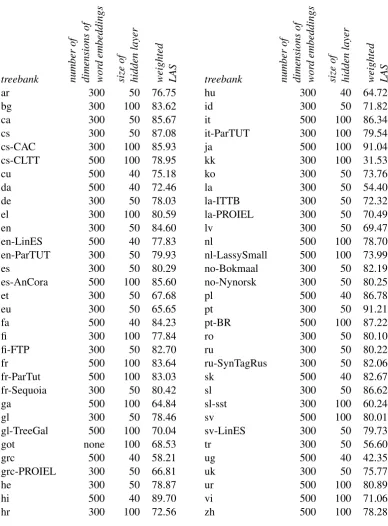
We trained all treebanks without any word embed-dings, with 300 and with 500 dimensional word embeddings. For BistParser, the only other param-eter we changed was the size of the first hidden layer (default 100) which we set to 50 (or lower, especially for languages whose treebanks are very small). Every sentence of the training treebanks was pseudo-projectivised before training. Using the weighted LAS, we then chose the best com-bination of parameters for each language. Since the python version of CNN (used by our adapta-tion of BistParser) does not support GPU, training was slow12. Thus we stopped training usually
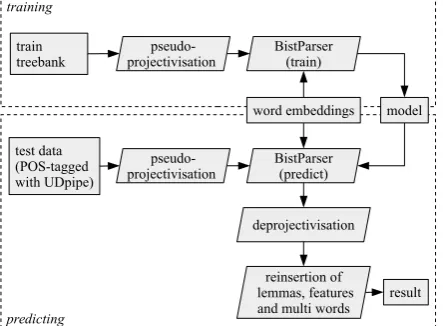
af-ter 15 epochs unless the inaf-termediary results were promising enough to continue. Figure1shows the system architecture. The upper part represents the data flow for the training, the lower part represents the predicting phase.
We did all training on two Ubuntu 16.04 servers13 with 64 GB RAM. As said above, the
version of the CNN library we used, does not run on GPU, so all training was single threaded. The training processes used up to 15 GB RAM, and took between 1 minute (Kazakh) and 53 hours (Czech). depending on the size of the treebank. This corresponds to 0.5 to 3 seconds per sentence during training. Training for the surprise guages (using treebanks of typologically close lan-guages, cf. section, 4), took significantly longer (up to 90 hours for Czech).
Training was on the gold values (form, lemma, XPOS, UPOS, deprel, head) of the training tree-banks14, however, both, the development set (on
the Tira-platform) and the final test set use the UD-Pipe output e.g. lemma, XPOS or UPOS (Straka et al.,2016) which may be erroneous. So we ex-pected a certain drop of LAS for the tests. In order to be prepared, we tried to add erroneous lemmas and UPOS in the training data. This, however, did not produce better results, so we abandoned the 12The successor of CNN, Dynet, supports GPU, but since BistParser learns on a phrase by phrase base, no gain in time can be observed.
13Intel Xeon CPU E5-1620 v4 at 3.50GHz and Intel Core i7-6900K CPU at 3.20GHz respectively.
[image:3.595.307.529.66.229.2]14Apart from numerous punctuation symbols with wrong heads, we found several bad annotations for words as well in different languages.
Figure 1: Schema of the system architecture
idea. Knowing that training takes a certain time we did not POS-tag the training treebanks with UDpipe to have similar “noise” than the test tree-banks. The final results obtained with the devel-opment corpora (or split from train corpora when there were no development corpora) are shown in table 1. We did not (yet) use the morphological features (column 6). First tests on French showed that a slight increase in LAS is possible, so we will work on this in the future.
With 16GB RAM on the virtual machine pro-vided by Tira (Potthast et al.,2014)15the 56
devel-opment corpora (on the Tira platform) were pro-cessed in about 130 minutes.
4 Surprise languages
The biggest challenge were the 4 surprise lan-guages. Having only between 20 and 109 sen-tences to train on (even less if we wanted to split it into a train and development corpus) did not help (see table2for some details). Since the word em-bedding files where also rather small we chose not to train on the languages themselves, but to keep all of the provided sentences for the development corpus. So we first tried three similar approaches in order to be able to predict dependency relations for these languages:
1. lumping together 2000 sentences of 11 typo-logically different languages (German, Irish, Russian, Spanish, Turkisch, Arabic, Persian, Indonesian, Basque, Finnish and Estonian) 2. lumping together 5000 sentences of 11
typo-logically different languages (as above) 15The tests are run on the Tira platform (http://www.
treebank number
of
dimensions
of
wor
d
embeddings
size
of
hidden
layer
weighted LAS
ar 300 50 76.75
bg 300 100 83.62
ca 300 50 85.67
cs 300 50 87.08
cs-CAC 300 100 85.93 cs-CLTT 500 100 78.95
cu 500 40 75.18
da 500 40 72.46
de 300 50 78.03
el 300 100 80.59
en 300 50 84.60
en-LinES 500 40 77.83 en-ParTUT 300 50 79.93
es 300 50 80.29
es-AnCora 500 100 85.60
et 300 50 67.68
eu 300 50 65.65
fa 500 40 84.23
fi 300 100 77.84
fi-FTP 300 50 82.70
fr 500 100 83.64
fr-ParTut 500 100 83.03 fr-Sequoia 300 50 80.42
ga 500 100 64.84
gl 300 50 78.46
gl-TreeGal 500 100 70.04
got none 100 68.53
grc 500 40 58.21
grc-PROIEL 300 50 66.81
he 300 50 78.87
hi 500 40 89.70
hr 300 100 72.56
treebank number
of
dimensions
of
wor
d
embeddings
size
of
hidden
layer
weighted LAS
hu 300 40 64.72
id 300 50 71.82
it 500 100 86.34
it-ParTUT 300 100 79.54
ja 500 100 91.04
kk 300 100 31.53
ko 300 50 73.76
la 300 50 54.40
la-ITTB 300 50 72.32
la-PROIEL 300 50 70.49
lv 300 50 69.47
nl 500 100 78.70
nl-LassySmall 500 100 73.99 no-Bokmaal 300 50 82.19 no-Nynorsk 300 50 80.25
pl 500 40 86.78
pt 300 50 91.21
pt-BR 500 100 87.22
ro 300 50 80.10
ru 300 50 80.22
ru-SynTagRus 300 50 82.06
sk 500 40 82.67
sl 300 50 86.62
sl-sst 300 100 60.24
sv 500 100 80.01
sv-LinES 300 50 79.73
tr 300 50 56.60
ug 500 40 42.35
uk 300 50 75.77
ur 500 100 80.89
vi 500 100 71.06
[image:4.595.104.493.141.668.2]zh 500 100 78.28
3. lumping together 2000 sentences of 23 typo-logically different languages (as above and Chinese, Japanese, Korean, Vietnamese, Ro-manian, Latin, Greek, Ancient Greek, He-brew, Urdu and Hungarian)
[image:5.595.324.511.63.129.2]hsb sme kmr bxr sentences 109 20 65 20 words 460 147 242 153 has XPOS no yes yes no has features yes yes yes yes Table 2: Statistics on the data of the surprise lan-guages
In all three cases we replaced the forms of all closed word classes (i.e. all but nouns, adjectives and verbs) with the corresponding UPOS in the training and in the test corpus (for theCoNLL 2017 UD Shared Task we inserted the original forms again after predicting the dependency relations. The “mix” is then trained with a hidden layer size of either 100 or 50, but without word embeddings. We initially tested these models using the test cor-pus for the Tamil treebank (UD v2.0). Using the “mix” with 23 languages (3) resulted in the best weighted LAS, 35.2% (35.3% if using a hidden layer size of 50). The weighted LAS for the sur-prise languages is shown in table3.
[image:5.595.91.273.462.545.2]language hidden layer size 50 100 Upper Sorbian (hsb) 59.5% 63.2% Northern Sami (sme) 49.2% 47.5% Kurmanji (kmr) 28.9% 29.2% Buryat (bxr) 25.3% 26.3% Table 3: Weighted LAS of the surprise languages using a model trained on 23 languages
By replacing words of the closed word classes by their UPOS we tried to get similar corpora for training (on languages other than the surprise language) and predicting (surprise languages), as-suming that the syntactical structures are simi-lar enough, especially if we use only typologi-cally close languages (see below). This technique avoids also the problem of different alphabets for typologically close languages, since we use UPOS and not character chains.
Eventhough these results were encouraging, we hoped an increase of the weighted LAS should still be feasible. Especially since some of the surprise
Upper Sorbian Northern Sami
cs (100) 69.5% fi (100) 52.9%
cs (50) 67.5% fiu16(100) 51.7%
pl (50) 56.9% fiu (50) 49.7% pl (100) 51.9% fi (50) 50.8% Table 4: Weighted LAS using typologically close languages (with hidden layer size)
languages are typologically (very) close to lan-guages within the Universal Dependency corpus: Upper Sorbian is a slavonic language very close to Czech (and slightly less close to Polish). North-ern Sami shares quite a lot of typological features with the Finnic branch of the Fenno-Ugric lan-guages (here Finnish and Estonian), and Kurmanji shares at least some typolological feature with Per-sian (both are from the Iranian subgroup of the Indo-European language family. However Buryat, a Mongolian language, is not typologically close to any of the shared task’s languages. Even though Turkish seems close enough, to our surprise Hindi was finally the best guess. With Urdu, which is very similar to Hindi apart from the fact that it uses the Arabic alphabet instead of Devanagari, the LAS was less good.
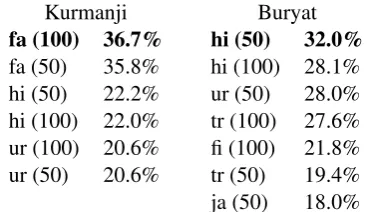
As for the language mix, we replaced the forms of the closed word classes in the training corpora by the corresponding UPOS (except nouns, verbs and adjectives) and trained the modified treebanks (cf. tables4and5, best configuration in bold).
Kurmanji Buryat
fa (100) 36.7% hi (50) 32.0%
fa (50) 35.8% hi (100) 28.1% hi (50) 22.2% ur (50) 28.0% hi (100) 22.0% tr (100) 27.6% ur (100) 20.6% fi (100) 21.8% ur (50) 20.6% tr (50) 19.4% ja (50) 18.0% Table 5: Weighted LAS using typologically close languages (with hidden layer size)
[image:5.595.323.507.497.603.2]treebank development results final
test
results differ
ence
ar 76.75 67.26 -9.49
ar-pud (unavailable for dev.) 44.77
bg 83.62 85.06 1.44
bxr (surprise lg) 32.00 25.25 -6.75
ca 85.67 86.24 0.57
cs 87.08 84.33 -2.75
cs-CAC 85.93 83.98 -1.95 cs-CLTT 78.95 72.99 -5.96 cs-pud (unavailable for dev.) 79.49
cu 75.18 64.26 -10.92
da 72.46 73.54 1.08
de 78.03 73.38 -4.65
de-pud (unavailable for dev.) 69.75
el 80.59 80.69 0.10
en 84.60 77.51 -7.09
en-LinES 77.83 73.36 -4.47 en-ParTUT 79.93 75.78 -4.15 en-pud (unavailable for dev.) 79.67
es 80.29 83.03 2.74
es-AnCora 85.60 85.57 -0.03 es-pud (unavailable for dev.) 78.78
et 67.68 58.98 -8.70
eu 65.65 65.29 -0.36
fa 84.23 80.87 -3.36
fi 77.84 73.97 -3.87
fi-FTP 82.70 78.64 -4.06 fi-pud (unavailable for dev.) 77.52
fr 83.64 80.58 -3.06
fr-ParTut (*) 83.03 77.26 (tested with fr) fr-pud (unavailable for dev.) 74.63
fr-Sequoia 80.42 81.54 1.12
ga 64.84 63.10 -1.74
gl 78.46 79.66 1.20
gl-TreeGal (*) 70.04 22.46 (tested with gl)
got 68.53 57.97 -10.56
grc 58.21 54.10 -4.11
grc-PROIEL 66.81 65.50 -1.31
he 78.87 58.07 -20.8
hi 89.70 87.09 -2.61
hi-pud (unavailable for dev.) 51.02
hr 72.56 77.11 4.55
treebank development results final
test
results differ
ence
hsb (surprise lg) 69.50 58.25 -11.25
hu 64.72 64.59 -0.13
id 71.82 73.64 1.82
it 86.34 86.65 0.31
it-ParTuT 79.54 (withdrawn) it-pud (unavailable for dev.) 84.89
ja 91.04 73.37 -17.67
ja-pud (unavailable for dev.) 76.74
kk 31.53 21.31 -10.22
kmr (surprise lg) 36.70 38.31 1.61
ko 73.76 67.76 -6.00
la 54.40 43.16 -11.27
la-ITTB 72.32 76.42 4.10 la-PROIEL 70.49 60.44 -10.05
lv 69.47 61.52 -7.95
nl 78.70 70.33 -8.37
nl-LassySmall 73.99 77.58 3.59 no-Bokmaal 82.19 83.79 1.60 no-Nynorsk 80.25 81.69 1.44
pl 86.78 81.71 -5.07
pt 91.21 76.40 -14.81
pt-BR 87.22 87.07 -0.15
pt-pud (unavailable for dev.) 69.00
ro 80.10 81.34 1.24
ru 80.22 76.28 -3.94
ru-pud (unavailable for dev.) 69.58
ru-SynTagRus 82.06 87.10 5.04
sk 82.67 75.97 -6.7
sl 86.62 82.38 -4.24
sl-sst (*) 60.24 40.25 (tested with sl) sme (surprise lg) 52.90 33.08 -19.82
sv 80.01 78.85 -1.16
sv-LinES 79.73 74.28 -5.45 sv-pud (unavailable for dev.) 70.82
tr 56.60 55.21 -1.39
tr-pud (unavailable for dev.) 34.36
ug 42.35 34.24 -8.11
uk 75.77 62.30 -13.47
ur 80.89 77.93 -2.96
vi 71.06 39.12 -31.94
zh 78.28 59.33 -18.95
[image:6.595.74.522.74.722.2]average 74.40 68.61
an idea what to do. If we took UPOS for verbs, nouns, and adjectives, this meant that the whole training (and test) corpus would only contain one single verb (namelyVERB), noun (NOUN) and ad-jective (ADJ). Tests showed, that the parser got confused, since it encountered the same verb, noun or adjective in very different syntactic contexts. Of course, this applies also to prepositions or adverbs but keeping the open word classes gave the best development results.
As expected, Upper Sorbian and Norther Sami give quite acceptable results using models trained on Czech and Finnish respectively. Due to the fact that the provided treebanks for Kazakh and Uyghur are both very small we tried to apply the same approach of using the training corpus of a ty-pologically close language (here Turkish). How-ever, the results were disappointing. Thus, we continue to use the models trained on very small corpora for these two languages in the shared task. Possibly the fact that the raw text corpus used to calculate word embeddings for Kazakh and Uyghur are much bigger than those of the sur-prise languages allowed to produce usable word embeddings. If so, this would mean that word em-beddings play a very prominent role in data driven dependency parsing.
5 Results of the Shared Task
Our final macro-averaged LAS F1 score on the CoNLL 2017 UD Shared Task test data (Nivre et al.,2017a) was 68.61%, (10th out of 33)17. The
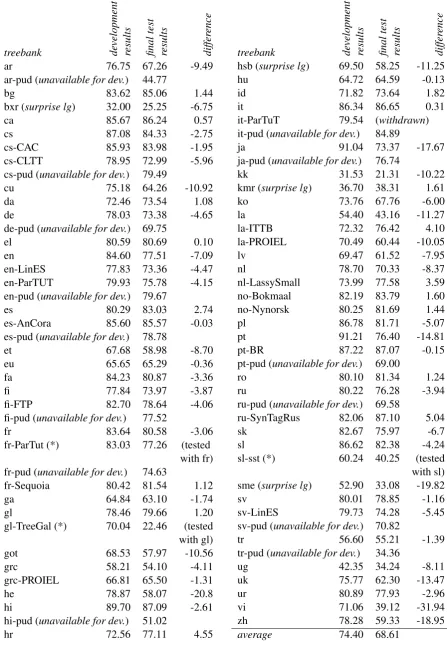
details show that our approach worked well for the bigger treebanks and the surprise languages (where we ended up as 8th). In general, the results per language are slightly lower than those we had during training on the development corpora (cf. ta-ble1). This is due to the fact we did our training on forms, lemmas, UPOS and XPOS of the train-ing corpus, which are gold. In the test data, lem-mas, UPOS and XPOS (if present), however, are predicted by UDpipe, and do contain some errors with respect to the gold standard.
After the end of the test phase, we discovered a bug in our chain, which concerned languages, which have only UPOS data. In this case the UPOS information was totally discarded by error. Thus all training and testing are done only on the
17http://universaldependencies.org/
conll17/results.html
forms18.
Further we made en error uploading the models for the gl TreeGal, fr parTutandsl sst
treebanks. During the tests the models trained on the basicgl,frandsltreebanks were used instead. After the test phase we corrected these errors. Fortunately, their impact was not that hard. Apart from the result forgl TreeGaland
sl sst, which went up to 66.13% (from 22.46%) and to 47.68 (from 40.25) respectively once the correct model was used, the results for the other corpora changed only slightly, the global results could have been 69.38%. All results are shown in table 6. The column on the right shows the difference between the results of the development corpora and test data. For some languages, the test results are unexpectedly lower than the results on the development corpora. For gl TreeGal,
fr parTut and sl sst, this is due to errors when installing our system on the Tira-platform. The lower performance on languages like Chinese, Ukrainian, Vietnamese or Latin (both ITTB and PROIEL) seems to be caused by the nature of the test corpora themselves. Systems of other partici-pants seem to drop in performance as well; for all these languages our system is still around the 10th position of the global ranking. Perhaps a cause may be the fact that the XPOS we use (predicted by UDpipe) contain more errors than average for the Chinese, Ukrainian or Vietnamese treebanks than for languages where our test score is closer to the development score.
Acknowledgments
We would like to thank the developpers of Bist-Parser, Eliyahu Kiperwasser and Yoav Goldberg, and the developper of the CNN library (Chris Dyer) for making them available as open source on GitHub. Finally we would like to thank our colleague Ghislain Putois for help on all aspects on neural networks.
References
Piotr Bojanowski, Edouard Grave, Armand Joulin, and Tomas Mikolov. 2016. Enriching word vectors with subword information. CoRRabs/1607.04606.
http://arxiv.org/abs/1607.04606.
Marie Candito, Guy Perrier, Bruno Guillaume, Corentin Ribeyre, Kar¨en Fort, Djam´e Seddah, and ´Eric de la Clergerie. 2014. Deep syntax annotation of the sequoia french treebank. InProc. of LREC 2014. Reykjav´ık, Iceland.
Armand Joulin, Edouard Grave, Piotr Bojanowski, and Tomas Mikolov. 2016. Bag of tricks for ef-ficient text classification. CoRR abs/1607.01759.
http://arxiv.org/abs/1607.01759.
Eliyahu Kiperwasser and Yoav Goldberg. 2016. Easy-first dependency parsing with hierarchical tree lstms. TACL 4:445–461.
https://transacl.org/ojs/index.php/tacl/article/view/798.
Sandra K¨ubler, Ryan McDonald, and Joakim Nivre. 2009. Dependency Parsing. Morgan and Claypool Publishers.
Marco Kuhlmann, Carlos G´omez-Rodr´ıguez, and Giorgio Satta. 2011. Dynamic programming al-gorithms for transition-based dependency parsers. In Proceedings of the 49th Annual Meeting of the Association for Computational Linguis-tics: Human Language Technologies - Volume 1. Association for Computational Linguistics, Stroudsburg, PA, USA, HLT ’11, pages 673–682.
http://dl.acm.org/citation.cfm?id=2002472.2002558.
Ryan McDonald, Joakim Nivre, Yvonne Quirmbach-Brundage, Yoav Goldberg, Dipanjan Das, Kuzman Ganchev, Keith Hall, Slav Petrov, Hao Zhang, Oscar T¨ackstr¨om, Claudia Bedini, N´uria Bertomeu, and Castell´o Jungmee Lee. 2013. Universal dependency annotation for multilingual parsing. InProc. of ACL 2013.
Tomas Mikolov, Kai Chen, Greg Corrado, and Jef-frey Dean. 2013. Efficient estimation of word rep-resentations in vector space. CoRRabs/1301.3781.
http://arxiv.org/abs/1301.3781.
Joakim Nivre. 2008. Algoritms for deterministic in-cremental dependency parsing. Computational Lin-guistics34(4):513–553.
Joakim Nivre, ˇZeljko Agi´c, Lars Ahrenberg, et al. 2017a. Universal dependencies 2.0 CoNLL 2017 shared task development and test data. LIN-DAT/CLARIN digital library at the Institute of For-mal and Applied Linguistics, Charles University.
http://hdl.handle.net/11234/1-2184.
Joakim Nivre, Marie-Catherine de Marneffe, Filip Gin-ter, Yoav Goldberg, Jan Hajiˇc, Christopher Man-ning, Ryan McDonald, Slav Petrov, Sampo Pyysalo, Natalia Silveira, Reut Tsarfaty, and Daniel Zeman. 2016. Universal Dependencies v1: A multilingual treebank collection. In Proceedings of the 10th International Conference on Language Resources and Evaluation (LREC 2016). European Language Resources Association, Portoroˇz, Slovenia, pages 1659–1666.
Joakim Nivre and Chiao-Ting Fang. 2017. Univer-sal dependency evaluation. In Proceedings of the NoDaLiDa 2017 Workshop on Universal Depen-dencies (UDW 2017). Association for Computa-tional Linguistics, Gothenburg, Sweden, pages 86– 95.http://www.aclweb.org/anthology/W17-0411. Joakim Nivre et al. 2017b. Universal Dependencies
2.0. LINDAT/CLARIN digital library at the Insti-tute of Formal and Applied Linguistics, Charles Uni-versity, Prague. http://hdl.handle.net/11234/1-1983. Martin Potthast, Tim Gollub, Francisco Rangel, Paolo Rosso, Efstathios Stamatatos, and Benno Stein. 2014. Improving the reproducibility of PAN’s shared tasks: Plagiarism detection, author iden-tification, and author profiling. In Evangelos Kanoulas, Mihai Lupu, Paul Clough, Mark Sander-son, Mark Hall, Allan Hanbury, and Elaine Toms, editors, Information Access Evaluation meets Mul-tilinguality, Multimodality, and Visualization. 5th International Conference of the CLEF Initiative (CLEF 14). Springer, Berlin Heidelberg New York, pages 268–299. https://doi.org/10.1007/978-3-319-11382-1 22.
Milan Straka, Jan Hajiˇc, and Jana Strakov´a. 2016. UD-Pipe: trainable pipeline for processing CoNLL-U files performing tokenization, morphological anal-ysis, POS tagging and parsing. In Proceedings of the 10th International Conference on Language Resources and Evaluation (LREC 2016). European Language Resources Association, Portoroˇz, Slove-nia.