Alternative Electric Energy Source Selection in
Construction Projects: A Case Study in Turkey
Farrokh Rostami Kia, Alper Çabuk, A.Emre Cengiz, Amir Taghizadeh Vahed, Sunay Mutlu
ABSTRACT: The objectives of this study are to find the best way to calibrate data that are collected from the energy maps of Turkey and take advantage of alternative electric energy source in construction projects. To achieve these goals, renewable energy maps of Turkey were collected. Four types of energy maps such as solar, wind, geothermal, and wave energy were utilized. Cost effectiveness was proposed for the construction projects that have a total cost of more than a million dollars. Thus it is considered that alternative energy maps in the study could be utilized for construction projects instead of spending too much money using the traditional methods for on-site energy generation. This study is just a research that aims to figure out renewable energy availabilities on construction site(s) and it is also proposing that construction projects need much more research about green energy; thereby the real engineering methods will find their meanings.
KEY WORDS: Construction, Cost Effectiveness, GIS, Renewable Energy.
I. INTRODUCTION
Construction is a very costly sector, so that the cost of a shopping center can reach to 740 US$ per square meter [1]. Each decision in the beginning of the construction project will affect the entire project path and sometimes could be irreversible. It can be stated that management is a necessity for the construction sector. Construction management includes planning, scheduling, analyzing, coordinating and controlling construction activities to accomplish specific objectives of management such as minimizing costs and
maximizing customer satisfaction by using appropriate materials, equipment, labor and resources. Beside these conventional roles, managing energy resources has attracted attention to a new member of construction management practice. Recently, fossil energies are suffering from big shortages of resources, high costs and unstable unit prices. Energy consumption in construction site can be huge with regard to the scope of the project. However, the energy consumption of a construction project is not determined accurately because of the decentralized nature of construction and subcontracting activities. Although the construction industry had no management system to achieve the control of all the construction projects in the past, it now needs an effective management. It is acknowledged by many people in the construction sector that construction management can also solve the energy-related problems and it can be environmentally friendly without sacrificing the productivity.
The main idea of this paper is to examine renewable energy potential of construction projects instead of fossil energy resource application in order to propose cost effective and environmental friendly solutions. In this context, green energy for on-site electricity generation was proposed. But, it is a major issue the fact that each construction project has its specific characteristics. Landscape, geographical coordinates, distance from urban area, project budget and scale are essential factors, which identify the fundamental properties of the construction project.
Electricity in a construction site is usually provided by fossil fuels. It is well known that fossil energy resources suffer from a serious shortage. In addition, this source of energy causes air emissions with effects in global climate changes. These negative impacts of fossil fuels usage make the tendency to renewable energy resources essential. On the other hand, renewables are forms of clear, all free and sustainable energy. The definition of sustainable energy is the combination of providing infinite energy to all people and protecting the environment for the next generations. In the light of this definition, it is considered that renewable energy systems (RES) are new forms of energy capable to respond to the needs of current and future populations. Manuscript received March 17, 2011; revised March 31, 2011.
Farrokh Rostami Kia is a graduate student of Construction Engineering Management, Anadolu University, Eskisehir, Turkey (phone: 0090-534-3675269; fax: 0090-222-2348091; e-mail: [email protected]).
Alper Çabuk is the head of Satellite and Space Sciences Research Institute, Anadolu University, Eskisehir, Turkey (e-mail: [email protected]).
A.Emre Cengiz is a graduate student of Satellite and Space Sciences Research Institute, Anadolu University, Eskisehir, Turkey (e-mail: [email protected]).
Amir Taghizadeh Vahed ia a graduate student of Mine Engineering, METU University, Ankara, Turkey (e-mail: [email protected]).
II. SCOPE OF THE STUDY
First step of this study is to locate the project coordinates on the map, while the next step is to search suitable areas for renewable energy resources. Renewable energy sources are i) solar, ii) wind, iii) geothermal and iv) sea wave energy. It is necessary to check project locations on those maps one by one in order to get the best opportunity. Also, more than one energy type may be appropriate for some locations. Thus in such conditions the available density and their economic aspects must be taken into consideration. This process can be done manually or using some available technology such as the Geographical Information System (GIS). The observational methodology is utilized in this study. The final step is the decision part, which summarizes the whole study and gives direction to the project. Usage of affordable energy sources is a major goal in the decision making process. In order to describe the above detailed steps, a case study has been presented (i.e. Ataturk International airport project which is located in Turkey).
III. RENEWABLE ENERGY MAPS
[image:2.595.309.552.51.182.2] [image:2.595.310.546.369.513.2]Turkey is located in a relatively advantageous geographical position for various renewable energy types. Fig. 11 represents the Europe Global Horizontal Irradiation Map. According to this map, Turkey is one of the most capable countries to take advantage of the solar energy resource. In Fig. 2, we see the map of the solar energy index of Turkey, revealing the capacity of the solar energy in each area in different colors. Green, yellow and red colors represent areas that have 1.250-1.850 kWh/m2-annual radiation values for solar energy plants. It can be inferred that most of Turkey’s area has the possibility of harvesting the solar energy.
Fig. 1 Europe Global Horizontal Irradiation Map [2]
Fig. 2 Turkey Global Horizontal Irradiation Map [2]
Fig. 4 shows the scattering of wind velocity in Turkey at 10 m altitude. Nowadays tourist industry is frequently thriving in these areas. Hence projects for big hotels construction are abundant. Thus they could target this category. Fig. 3a illustrates wave energy map of Turkey. Wave power is the transport of energy by ocean surface waves and electricity generation is possible from that energy. As can be seen from the map, Turkey is just capable of producing 40 kW/m power. But generally Turkey’s wave power capacity is about 20 kW/m. Fig. 3b is demonstrating the geothermal energy distribution in Turkey. Red dots on the map represent areas with high capacity of producing electricity by converting the geothermal energy source.
Fig. 4 Scattering of wind potential of Turkey for 10 m high [3]
IV. GIS
GIS is a computer-based tool for storing, analyzing and representing various types of data, which can solve the spatial-related problems. It is also a decision support system for the users. GIS can store, group, analyze and bring together the data. Through this, the information becomes more accessible. Indeed, old information is put into a new context. It is possible to use GIS in the explanation of strategies for implantation and management
[image:2.595.48.285.440.603.2] [image:2.595.51.545.657.777.2]of rural electrification with renewable energy [4].
GIS is a valuable tool for evaluation and development of the application of renewable energy resources in large regions. However, it is an adequate tool for analyzing the spatial variability of resources. Indeed, this equipment is used for resolving problems of management and planning of installation programs of decentralized systems, which are characterized by a great spatial dispersion [4].
V. GIS AND RENEWABLE ENERGIES
The use of GIS in renewable energy began in the 1990’s, which went through considerable progress and as a result, various decision support tools were developed [4]. GIS applications developed since then can be classified in four groups.
a) Integration of renewable energy types on a large scale and at a regional level. [5]
b) Assessment of distributed energy generation that connects to the electric network. [6]
c) Decentralized production systems and autonomous production of electricity. (Voivontas, 2001) d) GIS as a decision support tool for renewable
energy management and planning in semi-arid rural environments. (Tiba et al., 2010).
VI. FINANCIAL ASPECTS
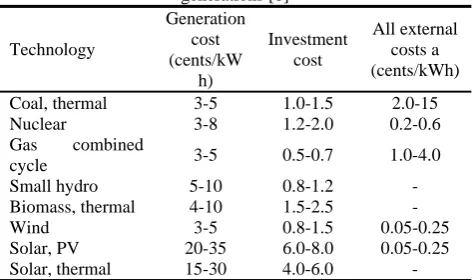
[image:3.595.307.549.358.504.2]Production of electrical energy from renewable resources is supported all over the developed world. Thus systems with low power consumption are used widely in many countries. However those electricity producers purchase this energy at a minimum charge and taxes [7]. Table 1 represents generation, investment and external costs for various power generation technologies.
Table 1
Generation, investment and external costs for various power generations [8] Technology Generation cost (cents/kW h) Investment cost All external costs a (cents/kWh) Coal, thermal 3-5 1.0-1.5 2.0-15
Nuclear 3-8 1.2-2.0 0.2-0.6
Gas combined
cycle 3-5 0.5-0.7 1.0-4.0
Small hydro 5-10 0.8-1.2 -
Biomass, thermal 4-10 1.5-2.5 -
Wind 3-5 0.8-1.5 0.05-0.25
Solar, PV 20-35 6.0-8.0 0.05-0.25 Solar, thermal 15-30 4.0-6.0 -
a
Estimated cost to society and environment.
Application of renewable resources as a law has been increasing during the last decade in Turkey. This law has reduced the tax cost for the inexhaustible energy consumers. The law was enacted on 18th May 2005, with the official number of 5346. According to World Wind Energy Association (WWEA) statements the price determined as the purchase guarantee for wind energy in the renewable energy law should be raised to the level in the European Wind Markets [9].
VII. CASE STUDY
Based on official data, the population of Istanbul is about 13 million. The capacity of Ataturk airports is low and the high demand of international travelers is the reason for the construction of a new terminal building.
The new airport project has been subjected to a competition. The winner of the competition will be provided with an area of 179000 m2 for the construction of the terminal building itself. In addition to the terminal building, there will be also a parking project, to be conducted in a 86000 m2 area. The airport extension project has a 9 months deadline until reception. The total cost of the project is about 191.148 million US dollars. The construction of this project is expected to a nearly 3,000,000 kWh of industrial electricity consumption. Turkey’s industrial electricity unit price is 0.146 $/kWh. Multiplying 3 million kWh by 0.146 $/kWh gives us a value of 438,000 US dollars just for supplying electricity of construction progress.
Actual amount of Ataturk airport daily electricity usage is about 44MW. However the new terminal will raise the consumption level with 80% of its present capacity that is 35.2MW. Adding this amount of electricity power will raise total electricity capacity to 85MW in near future.
Table 2
Ataturk airport electricity usage and charge Ataturk Airport Current installed power 44 MW Ataturk Airport demanded electricity 35.2 MW Ataturk Airport daily electricity usage (50%
active) 17.6 MW h
Ataturk Airport daily electricity charge 61,952 US$ Ataturk Airport monthly electricity charge 1,858,560 US$ Ataturk Airport yearly electricity charge 22,612,480
US$ Construction process’s electricity charge 405,900 US$
Table 2 represents the annual electric cost of the airport, which will raise up to 22,612,480 US$. Additional, there will be a construction operation electricity cost of 438,000 US$.
[image:3.595.49.286.470.610.2]Analyzing green energy maps (e.g., Fig. 2~3) it can be seen that Istanbul has a significant capacity of wind and solar PV energy generation. Indeed Fig. illustrates the geographical distribution of the alternative wind energy production sites in Istanbul. According to the Fig. , Ataturk airport is located near large wind turbines. Table 3 summarizes the properties of Silivri, Catalca and GaziOsmanPasa (GOP) turbines.
Table 3
Wind power projects in Turkey [9]
Site name Number of turbines Installe d capacity (MW) Turbine capacity (MW)
Istanbul-Silivri 2 0.85 600
Istanbul-GaziOsmanPasa 12 24.00 2000
[image:3.595.309.548.682.772.2]Table 3 shows Ataturk airport location. It is located near sites rich in green energy resources. Thus, manufacturing of new turbines in location like Ataturk airport will be appropriated.
In next phases, the airport will be needed 85 MW to provide its daily electric consumption. Surveys performed at the site show that this amount of electricity could be provided by installing a wind turbine farm near the airport in Trakya region, which is around Catalca region ( Fig. 5).
Fig. 5 Geographical distribution of the alternative wind energy production sites in Istanbul [10]
Table 4
Wind farm cost and installation profile Turbines farm location Trakya
region around Catalca Turbines Model T 1000 – 48 B 1000 KW /
h Needed Turbines numbers 44 turbines Each turbine installation fee 1,700,000 US$ Total turbines installation fee 74,800,000 US$
Switch gear plant and
integration cost 5,333,333 US$ Construction cost 7,000,000 US$ 5 year maintaining cost 6,333,333 US$ Yearly operating expenses 2,333,333 US$ Total cost of the
investment budget 95,800,000 US$ *tax was imported in all of numbers.
Annual electricity charge using the urban electricity network is 22,612,480 US$, and the total installing cost of the turbines is 95,800,000 US$. Another major parameter is the plant’s life. An estimated turbine lifetime is around 20 years.
The equation below shows the number of years for the return of the turbine’s capital cost.
(1)
a: total cost of turbine farm installation. (US$) b: construction electricity consumption charge. (US$) c: yearly electricity charge using urban electricity network. (US$)
d: number of years for turbines capital cost return. (year)
Investment return date in this project will be as short as 4 years and 2 months. Turbines lifetime is 20 years, and the time for capital cost return is 4 years and two months. Thus, 15 years and 10 months is the time for profit Airport. Airport annual profit determines with equation below:
(2) e: Turbines Yearly operating expenses (US$)
f: Airport annual profit (US$)
US$
[image:4.595.326.537.267.393.2]The airport annual profit is 20,279,147 US$ for its next 15 years and 10 month. Figure 6 illustrate a comparison of the costs of using wind energy as an alternative energy to the urban electric network.
Fig. 6 Application cost of electric network Vs. manufacturing cost of Wind Turbines.
VIII. CONCLUSION
[image:4.595.48.289.360.566.2]REFERENCES
[1] The Ministry of Public Works Settlement. (2010, February 13th ). Architectural and engineering services unit approximate building cost used in the calculation of the cost of papers. Available: : http://www.bayindirlik.gov.tr/turkce/dosya/yfk/m2maliyetler 2010.doc
[2] G. S. s. r. o. GeoModel. (2010, March 10). Available: http://solargis.info/doc/index.php?select=71
[3] G. D. o. E. P. R. EIE. (2009, February 23). Turkey’s wind map. Available: http://www.eie.gov.tr
[4] C. Tiba, et al., "A GIS-based decision support tool for renewable energy management and planning in semi-arid rural environments of northeast of Brazil," Renewable Energy, vol. 35, pp. 2921-2932, 2010.
[5] E. Georgopoulou, et al., "Design and implementation of a group DSS for sustaining renewable energies exploitation," European Journal of Operational Research, vol. 109, pp. 483-500, Sep 1 1998.
[6] C. E. Noon and M. J. Daly, "GIS-based biomass resource assessment with BRAVO," Biomass and Bioenergy, vol. 10, pp. 101-109, 1996.
[7] I. E. A. IEA., "Energy policies of IEA countries, Turkey 2005 Review.," 2005.
[8] K. Kaygusuz, "Wind energy status in renewable electrical energy production in Turkey," Renewable and Sustainable Energy Reviews, vol. 14, pp. 2104-2112, 2010.
[9] Ö. Güler, "Wind energy status in electrical energy production of Turkey," Renewable and Sustainable Energy Reviews, vol. 13, pp. 473-478, 2009.