Wide-Coverage Deep Statistical Parsing
Using Automatic Dependency
Structure Annotation
Aoife Cahill
∗ Dublin City UniversityMichael Burke
∗∗,† Dublin City UniversityIBM Center for Advanced Studies
Ruth O’Donovan
∗∗ Dublin City UniversityStefan Riezler
‡Palo Alto Research Center
Josef van Genabith
∗∗,† Dublin City UniversityIBM Center for Advanced Studies
Andy Way
∗∗,† Dublin City UniversityIBM Center for Advanced Studies
A number of researchers have recently conducted experiments comparing “deep” hand-crafted wide-coverage with “shallow” treebank- and machine-learning-based parsers at the level of dependencies, using simple and automatic methods to convert tree output generated by the shallow parsers into dependencies. In this article, we revisit such experiments, this time using sophisticated automatic LFG f-structure annotation methodologies with surprising results. We compare various PCFG and history-based parsers to find a baseline parsing system that fits best into our automatic dependency structure annotation technique. This combined system of syntactic parser and dependency structure annotation is compared to two hand-crafted, deep constraint-based parsers, RASP and XLE. We evaluate using dependency-based gold standards
∗Now at the Institut f ¨ur Maschinelle Sprachverarbeitung, Universit ¨at Stuttgart, Germany. E-mail: aoife. [email protected].
∗∗National Centre for Language Technology, Dublin City University, Dublin 9, Ireland.
†IBM Dublin Center for Advanced Studies (CAS), Dublin 15, Ireland.
‡Now at Google Inc., Mountain View, CA.
Computational Linguistics Volume 34, Number 1
and use the Approximate Randomization Test to test the statistical significance of the results. Our experiments show that machine-learning-based shallow grammars augmented with so-phisticated automatic dependency annotation technology outperform hand-crafted, deep, wide-coverage constraint grammars. Currently our best system achieves an f-score of 82.73% against the PARC 700 Dependency Bank, a statistically significant improvement of 2.18% over the most recent results of 80.55% for the hand-crafted LFG grammar and XLE parsing system and an f-score of 80.23% against the CBS 500 Dependency Bank, a statistically significant 3.66% improvement over the 76.57% achieved by the hand-crafted RASP grammar and parsing system.
1. Introduction
Wide-coverage parsers are often evaluated against gold-standard CFG trees (e.g., Penn-II WSJ Section 23 trees) reporting traditional PARSEVAL metrics (Black et al. 1991) of labeled and unlabeled bracketing precision, recall and f-score measures, number of crossing brackets, complete matches, and so forth. Although tree-based parser evalua-tion provides valuable insights into the performance of grammars and parsing systems, it is subject to a number of (related) drawbacks:
1. Bracketed trees do not always provide NLPapplications with enough information to carry out the required tasks: Many applications involve a deeper analysis of the input in the form of semantically motivated information such as deep dependency relations, predicate–argument structures, or simple logical forms.
2. A number of alternative, but equally valid tree representations can potentially be given for the same input. To give just a few examples: In English, VPs containing modals and auxiliaries can be analyzed using (predominantly) binary branching rules (Penn-II [Marcus et al. 1994]), or employ flatter analyses where modals and auxiliaries are sisters of the main verb (APtreebank [Leech and Garside 1991]), or indeed do without a designated VPconstituent at all (SUSANNE [Sampson 1995]). Treebank bracketing guidelines can use “traditional” CFG categories such as S, NP, and so on (Penn-II) or a maximal projection-inspired analysis with IPs and DPs (Chinese Penn Treebank [Xue et al. 2004]).
3. Because a tree-based gold standard for parser evaluation must adopt a particular style of linguistic analysis (reflected in the geometry and nomenclature of the nodes in the trees), evaluation of statistical parsers and grammars that are derived from particular treebank resources (as well as hand-crafted grammars/parsers) can suffer unduly if the gold standard deviates systematically from the (possibly) equally valid style of linguistic analysis provided by the parser.
Cahill et al. Statistical Parsing Using Automatic Dependency Structures
structures, providing a more normalized representation abstracting away from the particulars of surface realization or CFG-tree representation, which enables meaningful cross-parser evaluation.
A related contrast holds between shallow and deep grammars and parsers.1 In addition to defining a language (as a set of strings), deep grammars relate strings to in-formation/meaning, often in the form of predicate–argument structure, dependency re-lations,2or logical forms. By contrast, a shallow grammar simply defines a language and may associate syntactic (e.g., CFG tree) representations with strings. Natural languages do not always interpret linguistic material locally where the material is encountered in the string (or tree). In order to obtain accurate and complete predicate–argument, dependency, or logical form representations, a hallmark of deep grammars is that they usually involve a long-distance dependency (LDD) resolution mechanism.
Traditionally, deep grammars are hand-crafted (cf. the ALVEY Natural Language Tools [Briscoe et al. 1987], the Core Language Engine [Alshawi and Pulman 1992], the Alpino Dutch dependency parser [Bouma, van Noord, and Malouf 2000], the Xerox Lin-guistic Environment [Butt et al. 2002], the RASPdependency parser [Carroll and Briscoe 2002] and the LinGO English Resource Grammar [Flickinger 2000; Baldwin et al. 2004]). Wide-coverage, deep-grammar development, particularly in rich formalisms such as LFG (Kaplan and Bresnan 1982; Bresnan 2001; Dalrymple 2001) and HPSG (Pollard and Sag 1994), is knowledge-intensive, time-consuming and expensive, constituting an instance of the (in-)famous “knowledge acquisition bottleneck” familiar from other areas in traditional, rule-based AI and NLP. Very few hand-crafted deep grammars (Briscoe and Carroll 1993; Bouma, van Noord, and Malouf 2000; Riezler et al. 2002) have, in fact, been successfully scaled to unrestricted input.
The last 15 years have seen extensive efforts on treebank-based automatic gram-mar acquisition using a variety of machine-learning techniques (e.g., Gaizauskas 1995; Charniak 1996; Collins 1999; Johnson 1999; Charniak 2000; Bikel 2002; Bod 2003; Klein and Manning 2003). These grammars are wide-coverage and robust and in contrast to manual grammar development, machine-learning-based grammar acquisition in-curs relatively low development cost. With few notable exceptions,3 however, these treebank-induced wide-coverage grammars are shallow: They usually do not attempt to resolve LDDs nor do they associate strings with meaning representations.
Over the last few years, addressing the knowledge acquisition bottleneck in deep constraint-based grammar development, a growing body of research has emerged to au-tomatically acquire wide-coverage deep grammars from treebank resources (TAG [Xia 1999], CCG [Hockenmaier and Steedman 2002], HPSG [Miyao, Ninomiya, and Tsujii 2003], LFG [Cahill et al. 2002b, 2004]). To a first approximation, these approaches can be classified as “conversion”- or “annotation”-based. TAG-based approaches convert
1 Our use of the terms “shallow” and “deep” parsers/grammars follows Kaplan et al. (2004) where a “shallow parser” does not relate strings to meaning representations. This deviates from a more common use of the terms where, for example, a “shallow parser” refers to (often finite-state-based) parsers (or chunkers) that may produce partial bracketings of input strings.
2 By dependency relations we mean deep, fine-grained, labeled dependencies that encode long-distance dependencies and passive information, for example. These differ from the types of unlabeled dependency relations in other work such as (McDonald and Pereira 2006).
Computational Linguistics Volume 34, Number 1
treebank trees into (lexicalized) elementary or adjunct trees. CCG-based approaches convert trees into CCG derivations from which CCG categories can be extracted. HPSG-and LFG-based grammar induction methods automatically annotate treebank trees with (typed) attribute-value structure information for the extraction of constraint-based grammars and lexical resources.
Two recent papers (Preiss 2003; Kaplan et al. 2004) have started tying together the research strands just sketched: They use dependency-based parser evaluation to compare wide-coverage parsing systems using hand-crafted, deep, constraint-based grammars with systems based on a simple version of treebank-based deep grammar acquisition technology in the conversion paradigm. In the experiments, tree output generated by Collins’s Model 1, 2, and 3 (1999) and Charniak’s (2000) parsers, for example, are automatically translated into dependency structures and evaluated against gold-standard dependency banks.
Preiss (2003) uses the grammatical relations and the CBS 500 Dependency Bank described in Carroll, Briscoe, and Sanfilippo (1998) to compare a number of parsing systems (Briscoe and Carroll 1993; Collins’s 1997 models 1 and 2; and Charniak 2000) using a simple version of the conversion-based deep grammar acquisition process (i.e., reading off grammatical relations from CFG parse trees produced by the treebank-based shallow parsers). The article also reports on a task-based evaluation experiment to rank the parsers using the grammatical relations as input to an anaphora resolution system. Preiss concluded that parser ranking using grammatical relations reflected the absolute ranking (between treebank-induced parsers) using traditional tree-based metrics, but that the difference between the performance of the parsing algorithms narrowed when they carried out the anaphora resolution task. Her results show that the hand-crafted deep unification parser (Briscoe and Carroll 1993) outperforms the machine-learned parsers (Collins 1997; Charniak 2000) on the f-score derived from weighted precision and recall on grammatical relations.4 Kaplan et al. (2004) compare their deep, hand-crafted, LFG-based XLE parsing system (Riezler et al. 2002) with Collins’s (1999) model 3 using a simple conversion-based approach, capturing dependencies from the tree output of the machine-learned parser, and evaluating both parsers against the PARC 700 Dependency Bank (King et al. 2003). They conclude that the hand-crafted, deep grammar outperforms the state-of-the-art treebank-based shallow parser on the level of dependency representation, at the price of a small decrease in parsing speed.
Both Preiss (2003) and Kaplan et al. (2004) emphasize that they use rather basic versions of the conversion-based deep grammar acquisition technology outlined herein. In this article we revisit the experiments carried out by Preiss and Kaplan et al., this time using thesophisticatedandfine-grainedtreebank- and annotation-based, deep, probabilis-tic LFG grammar acquisition methodology developed in Cahill et al. (2002b), Cahill et al. (2004), O’Donovan et al. (2004), and Burke (2006) with a number of surprising results:
1. Evaluating against the PARC 700 Dependency Bank (King et al. 2003) using a retrained version of Bikel’s (2002) parser, the best automatically induced, deep LFG resources achieve an f-score of 82.73%. This is an improvement of 3.13 percentage points over the previously best published results established by Kaplan et al. (2004) who use a hand-crafted,
wide-coverage, deep LFG and the XLE parsing system. This is also a
Cahill et al. Statistical Parsing Using Automatic Dependency Structures
statistically significant improvement of 2.18 percentage points over the most recent improved results presented in this article for the XLE system.
2. Evaluating against the Carroll, Briscoe, and Sanfilippo (1998) CBS 500 gold-standard dependency bank using a retrained version of Bikel’s (2002) parser, the best Penn-II treebank-based, automatically acquired, deep LFG resources achieve an f-score of 80.23%. This is a statistically significant improvement of 3.66 percentage points over Carroll and Briscoe (2002), who use a hand-crafted, wide-coverage, deep, unification grammar and the RASPparsing system.
Evaluation results on a reannotated version (Briscoe and Carroll 2006) of the PARC 700 Dependency Bank were recently published in Clark and Curran (2007), reporting f-scores of 81.9% for the CCG parser, and 76.3% for RASP. As Briscoe and Carroll (2006) point out, these evaluations are not directly comparable with the Kaplan et al. (2004) style evaluation against the original PARC 700 Dependency Bank, because the annotation schemes are different.
The article is structured as follows: In Section 2, we outline the automatic LFG f-structure annotation algorithm and the pipeline parsing architecture of Cahill et al. (2002b), Cahill et al. (2004), and Burke (2006). In Section 3, we present our experiment design. In Section 4, using the DCU 105 Dependency Bank as our development set, we evaluate a number of treebank-induced LFG parsing systems against the automatically generated Penn-II WSJ Section 22 Dependency Bank test set. We use the Approximate Randomization Test (Noreen 1989) to test for statistical significance and choose the best parsing system for the evaluations against the wide-coverage, hand-crafted RASPand LFG grammars of Carroll and Briscoe (2002) and Kaplan et al. (2004) using the CBS 500 and PARC 700 Dependency Banks in Section 5. In Section 6, we discuss results and issues raised by our methodology, outline related and future research and conclude in Section 7.
2. Methodology
In this section, we briefly outline LFG and present our automatic f-structure annotation algorithm and parsing architecture. The parsing architecture enables us to integrate PCFG- and history-based parsers, which allows us to compare these parsers at the level of dependency structures, rather than just trees.
2.1 Lexical Functional Grammar
Computational Linguistics Volume 34, Number 1
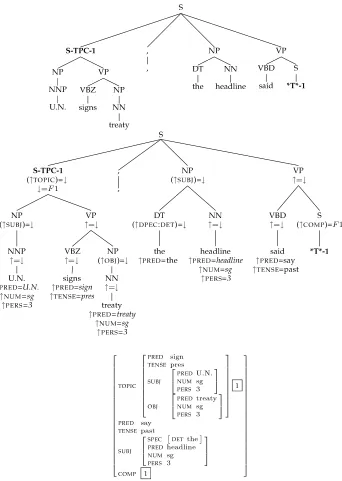
Figure 1
C- and f-structures for the sentenceU.N. signs treaty.
approximate to basic predicate-argument-adjunct structures or dependency relations.5 Figure 1 shows the c- and f-structures for the stringU.N. signs treaty. Each node in the c-structure is annotated with f-structure equations, for example (↑ SUBJ)= ↓. The uparrows (↑) point to the f-structure associated with the mother node, downarrows (↓) to that of the local node. In a complete parse tree, these↑and↓meta variables are instantiated to unique tree node identifiers and a set of constraints (a set of terms in an equality logic) is generated which (if satisfiable) generates an f-structure.
2.2 Automatic F-Structure Annotation Algorithm
Deep grammars can be induced from treebank resources if the treebank encodes enough information to support the derivation of deep grammatical information, such as predicate–argument structures, deep dependency relations, or logical forms. Many second generation treebanks such as Penn-II provide information to support the compi-lation of meaning representations, for example in the form of traces relating displaced linguistic material to where it should be interpreted semantically. The f-structure anno-tation algorithm exploits configurational and categorial information, as well as traces and the Penn-II functional tag annotations (Table 1) to automatically associate Penn-II CFG trees with LFG f-structure information.
Given a tree, such as the Penn-II-style tree in Figure 2, the algorithm will traverse the tree and deterministically add f-structure equations to the phrasal and leaf nodes of the tree, resulting in an f-structure annotated version of the tree. The annotations are then collected and passed on to a constraint solver which generates an f-structure (if the constraints are satisfiable). We use a simple graph-unification-based constraint solver (Eisele and D ¨orre 1986), extended to handle path, set-valued, disjunctive, and existential constraints. Given parser output without Penn-II style annotations and traces, the same algorithm is used to assign annotations to each node in the tree, whereas a separate module is applied at the level of f-structure to resolve any long-distance dependencies (see Section 2.3).
Cahill et al. Statistical Parsing Using Automatic Dependency Structures
Table 1
A complete list of the Penn-II functional labels.
Tag Description
Form/function discrepancies
-ADV clausal and NPadverbials -NOM non NPs that function as NPs
Grammatical role
-DTV dative
-LGS logical subjects in passives -PRD non VPpredicates
-PUT locative complement of put -SBJ surface subject
-TPC topicalized and fronted constituents -VOC vocatives
Adverbials
-BNF benefactive
-DIR direction and trajectory -EXT extent
-LOC location -MNR manner
-PRP purpose and reason -TMP temporal phrases
Miscellaneous
-CLR closely related to verb -CLF true clefts
-HLN headlines and datelines -TTL titles
The f-structure annotation algorithm is described in detail in Cahill et al. (2002a), McCarthy (2003), Cahill et al. (2004), and Burke (2006). In brief, the algorithm is modular with four components (Figure 3), taking Penn-II trees as input and automatically adding LFG f-structure equations to each node in the tree.
Lexical Information. Lexical information is generated automatically by macros for each of the POS classes in Penn-II. To give a simple example, third-person plural noun Penn-II POS-word sequences of the form NNS wordare automatically associated with the equations (↑PRED) = word, (↑NUM) = pl and (↑PERS) = 3rd, where word is the lemmatizedword.
Computational Linguistics Volume 34, Number 1
Figure 2
Trees for the sentenceU.N. signs treaty, the headline saidbefore and after automatic f-structure annotation, with the f-structure automatically produced.
Figure 3
Cahill et al. Statistical Parsing Using Automatic Dependency Structures
Table 2
Sample from an NPAnnotation matrix.
Left context Head Right context
DT: (↑SPEC DET)=↓ NN, NNS, NNP, NNPS, NP: RRC, SBAR: (↑RELMOD)=↓ CD: (↑SPEC QUANT)=↓ ↑=↓ PP:↓∈(↑ADJUNCT) ADJP, JJ, NN, NNP :↓∈(↑ADJUNCT) NP :↓∈(↑APP)
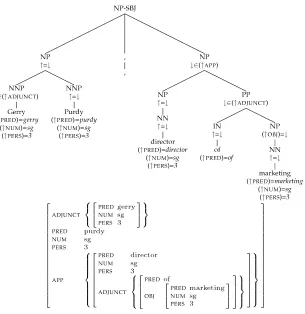
functional tag labels (Table 1) are used by the f-structure annotation algorithm. For each Penn-II mother (i.e., phrasal) category anAnnotation matrixexpresses generalizations about how to annotate immediate daughters dominated by the mother category relative to their location in relation to the local head. To give a (much simplified) example, the head finding rules for NP s state that the rightmost nominal (NN, NNS, NNP, . . . ) not preceded by a comma or “-”6 is likely to be the local head. The Annotation ma-trix for NPs states (inter alia) that heads are annotated ↑=↓, that DTs (determiners) to the left of the head are annotated (↑SPEC DET) =↓, NPs to the right of the head as ↓∈(↑ APP) (appositions). Table 2 provides a sample extract from the NPAnnotation matrix. Figure 4 provides an example of the application of the NPand PPAnnotation matrices to a simple tree.
For each phrasal category, Annotation matrices are constructed by inspecting the most frequent Penn-II rule types expanding the category such that the token occurrences of these rule types cover more than 85% of all occurrences of expansions of that category in Penn-II. For NP rules, for example, this means that we analyze the most frequent 102 rule types expanding NP, rather than the complete set of more than 6,500 P enn-II NPrule types, in order to populate the NPAnnotation matrix. Annotation matrices generalize to unseen rule types as, in the case of NPs, these may also feature DTs to the left of the local head and NPs to the right and similarly for rule types expanding other categories.
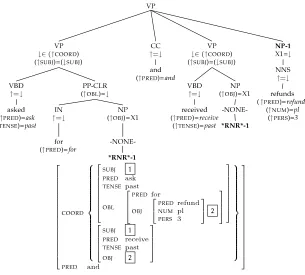
Coordination. In order to support the modularity, maintainability, and extendability of the annotation algorithm, the Left–Right Annotation matrices apply only to local trees of depth one, which do not feature coordination. This keeps the statement of Annotation matrices perspicuous and compact. The Penn-II treatment of coordination is (inten-tionally) flat. The annotation algorithm has modules for like- and unlike-constituent coordination. Coordinated constituents are elements of a COORDset and annotated↓∈ (↑ COORD). The Coordination module reuses the Left–Right context Annotation ma-trices to annotate any remaining nodes in a local subtree containing a coordinating conjunction. Figure 5 provides a VP-coordination example (with right-node-raising).
Catch-All and Clean-Up.The Catch-All and Clean-Up module provides defaults to cap-ture remaining unannotated nodes (Catch-All) and corrects (Clean-Up) overgeneraliza-tions resulting from the application of the Left–Right context Annotation matrices. The Left–Right Annotation matrices are allowed a certain amount of overgeneralization as this facilitates the perspicuous statement of generalizations and a separate statement of exceptions, supporting the modularity and maintainability of the annotation algorithm. PPs under VPs are a case in point. The VP Annotation matrix analyses PPs to the right of the local VPhead as adjuncts:↓ ∈(↑ADJUNCT). The Catch-All and Clean-Up module
Computational Linguistics Volume 34, Number 1
Figure 4
Automatically annotated Penn-II tree (fragment) and f-structure (simplified) forGerry Purdy, director of marketing.
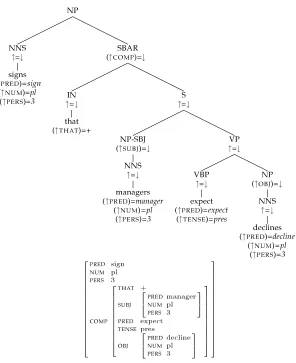
uses Penn-II functional tag (Table 1) information (if present), for example -CLR (closely related to local head), to replace the original adjunct analysis by an oblique argument analysis: (↑OBL)=↓. An example of this is provided by the PP-CLR in the left VP-conjunct in Figure 5. In other cases, argument–adjunct distinctions are encoded configurationally in Penn-II (without the use of -CLR tags). To give a simple example, the NP Anno-tation matrix indiscriminately associates SBARs to the right of the local head with (↑ RELMOD) =↓. However, some of these SBARs are actually arguments of the local NPhead and, unlike SBAR relative clauses which are Chomsky-adjoined to NP(i.e., relative clauses are daughters of an NPmother and sisters of a phrasal NPhead), SBAR arguments are sisters of non-phrasal NPheads.7In such cases, the Catch-All and Clean-Up module rewrites the original relative clause analysis into the correct complement argument analysis (↑COMP)=↓. Figure 6 shows theCOMP f-structure analyses for an example NPcontaining an internal SBAR argument (rather than relative clause) node.
Traces. The Traces module translates traces and coindexed material in Penn-II trees representing long-distance dependencies into corresponding reentrancies at f-structure. Penn-II provides a rich arsenal of trace types to relate “displaced” material to where it
Cahill et al. Statistical Parsing Using Automatic Dependency Structures
Figure 5
Automatically annotated Penn-II tree (fragment) and resulting f-structure forasked for and received refunds.
should be interpreted semantically. The f-structure annotation algorithm coverswh- and wh-less relative clause constructions, interrogatives, control and raising constructions, right-node-raising, and general ICH (interpret constituent here) traces. Figure 5 gives an example that shows the interplay between coordination, right-node-raising traces and the corresponding automatically generated reentrancies at f-structure.
2.3 Parsing Architecture
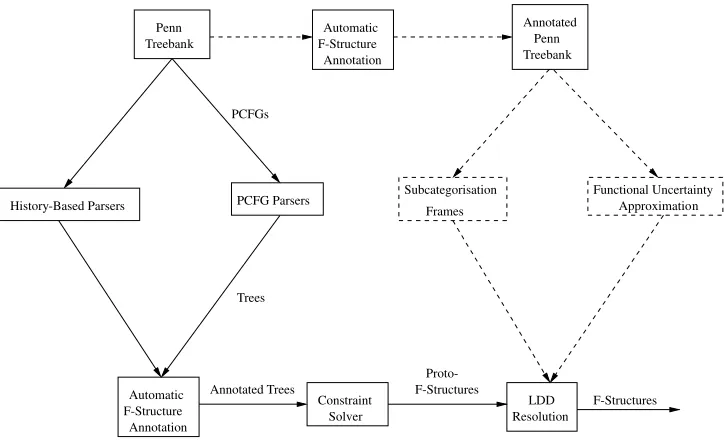
Thepipelineparsing architecture of Cahill et al. (2004) and Cahill (2004) for parsing raw text into LFG f-structures is shown in Figure 7. In this model, PCFGs or history-based lexicalized parsers are extracted from the unannotated treebank and used to parse raw text into trees. The resulting parse trees are then passed to the automatic f-structure annotation algorithm to generate f-structures.8
Compared to full Penn-II treebank trees, the output of standard probabilistic parsers is impoverished: Parsers do not normally output Penn-II functional tag an-notations (Table 1) nor do they indicate/resolve long-distance dependencies, recorded
Computational Linguistics Volume 34, Number 1
Figure 6
Automatically annotated Penn-II tree (fragment) and f-structure forsigns that managers expect declines.
in terms of a fine-grained system of empty productions (traces) and coindexation in the full Penn-II treebank trees. The f-structure annotation algorithm, as described in Section 2.2, makes use of Penn-II functional tag information (if present) and relies on traces and coindexation to capture LDDs in terms of corresponding reentrancies at f-structure.
Penn-II functional labels are used by the annotation algorithm to discriminate between adjuncts and (oblique) arguments. PP-sisters to a head verb are analyzed as arguments iff they are labeled -CLR, -PUT, -DTV or -BNF, for example. Conversely, functional labels (e.g., -TMP) are also used to analyze certain NPs as adjuncts, and
-LGSlabels help to identify logical subjects in passive constructions. In the absence of functional labels, the annotation algorithm will default to decisions based on simple structural, configurational, and CFG-category information (and, for example, conserva-tively analyze a PP sister to a head verb as an adjunct, rather than as an argument).
Cahill et al. Statistical Parsing Using Automatic Dependency Structures
Figure 7
Treebank-based LFG parsing architecture.
masking and un-masking operation where functional tags are joined with their local CFG category label to form a new (larger) set of (monadic) CFG category labels (e.g.,
PP-CLRgoes toPP CLR) for training and parsing (for Bikel, the parser head-finding rules are also adjusted to the expanded set of categories). After parsing, the Penn-II functional tags are unmasked and available to the f-structure annotation algorithm.
The Traces component in the f-structure annotation algorithm (Figure 3) translates LDDs represented in terms of traces and coindexation in the original Penn-II treebank trees into corresponding reentrancies at f-structure. Most probabilistic treebank-based parsers, however, do not indicate/resolve LDDs, and the Traces component of the an-notation algorithm does not apply. Initially, the f-structures produced for parser output trees in the architecture in Figure 7 are therefore LDD-unresolved: They are incomplete (or proto) f-structures, where displaced material (e.g., the values ofFOCUS,TOPIC, and TOPICRELattributes [wh- andwh-less relative clauses, topicalization, and interrogative constructions] at f-structure) is not yet linked to the appropriate argument grammati-cal functions (or elements of adjunct sets) for the governing logrammati-cal PRED. A dedicated LDD Resolution component in the architecture in Figure 7 turns parser output proto-f-structures into fully LDD-resolved proper proto-f-structures, without traces and coindexa-tion in parse trees.
Computational Linguistics Volume 34, Number 1
Figure 8
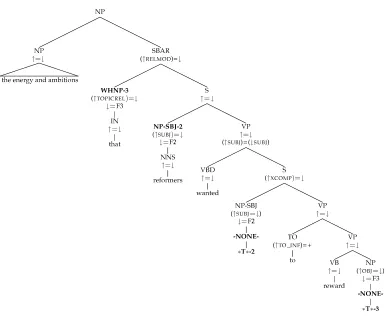
Penn-II treebank tree with LDD indicated in terms of traces (empty productions) and coindexation and f-structure annotations generated by the annotation algorithm.
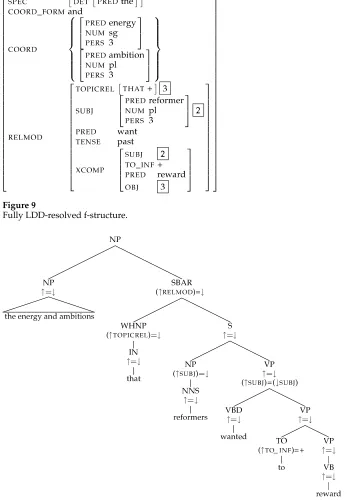
Now consider the corresponding “impoverished” (but otherwise correct) parser output tree (Figure 10) for the same string: The parser output does not explicitly record the control relation nor the LDD.
Given this parser output tree, prior to the LDD resolution component in the parsing architecture (Figure 7), the f-structure annotation algorithm would initially construct the partial (proto-) f-structure in Figure 11, where the LDD indicated by theTOPICREL func-tion is unresolved (i.e., the value ofTOPICRELis not coindexed with theOBJgrammatical function of the embedded verb reward). The control relation (shared subject between the two verbs in the relative clause) is in fact captured by the annotation algorithm in terms of a default annotation (↑SUBJ) = (↓SUBJ) on sole argument VPs to the right of head verbs (as often, even in the full Penn-II treebank trees, control relations are not consistently captured through explicit argument traces).
Cahill et al. Statistical Parsing Using Automatic Dependency Structures
Figure 9
[image:15.486.51.398.69.569.2]Fully LDD-resolved f-structure.
Figure 10
Impoverished parser output tree: LDDs not captured.
Computational Linguistics Volume 34, Number 1
Figure 11
Proto-f-structure: LDDs not captured.
Following Cahill et al. (2004), in our parsing architecture (Figure 7) we model LFG LDD resolution using automatically induced finite approximations of functional-uncertainty equations and subcategorization frames from the f-structure-annotated Penn-II treebank (O’Donovan et al. 2004) in an LDD resolution component. From the fully LDD-resolved f-structures from the Penn-II training section treebank trees we learn probabilistic LDD resolution paths (reentrancies in f-structure), conditional on LDD type (Table 3), and subcategorization frames, conditional on lemma (and voice) (Table 4). Table 3 lists the eight most probable TOPICREL paths (out of a total of 37 TOPICRELpaths acquired). The totality of these paths constitutes a finite subset of the reference language definde by the full functional uncertainty equation (↑TOPICREL) = (↑[COMP|XCOMP]∗[SUBJ|OBJ]). Given an unresolved LDD type (such as TOPICREL in the parser output for the relative clause example in Figure 11), admissible LDD res-olutions assert a reentrancy between the value of the LDD trigger (here, TOPICREL) and a grammatical function (or adjunct set element) of an embedded local predicate, subject to the conditions that (i) the local predicate can be reached from the LDD trigger using the LDD path; (ii) the grammatical function terminates the LDD path; (iii) the grammatical function is not already present (at the relevant level of embedding in the local f-structure); and (vi) the local predicate subcategorizes for the grammatical function in question.9 Solutions satisfying (i)–(iv) are ranked using the product of LDD path and subcategorization frame probabilities and the highest ranked solution (possibly involving multiple interacting LDDs for a single f-structure) is returned by the algorithm (for details and comparison against alternative LDD resolution methods, see Cahill et al. 2004).10
For our example (Figure 11), the highest ranked LDD resolution is for LDD path (↑TOPICREL) = (↑XCOMPOBJ) and the local subcat frameREWARD ↑SUBJ,↑OBJ. This
9 Conditions (i)–(iv) are suitably adapted for LDD resolutions terminating in adjunct sets.
Cahill et al. Statistical Parsing Using Automatic Dependency Structures
Table 3
Most frequentwh-TOPICRELpaths.
wh-TOPICREL Probability wh-TOPICREL Probability
subj .7583 xcomp .0830
obj .0458 xcomp:obj .0338
xcomp:xcomp .0168 xcomp:subj .0109
comp .0097 comp:subj .0073
Table 4
Most frequent semantic forms for active and passive (p) occurrences of the verbwantand
reward.
Semantic form Probability
want([subj,xcomp]) .6208
want([subj,obj]) .2496
want([subj,obj,xcomp]) .1008
want([subj]) .0096
want([subj,obj,obl]) .0048
want([subj,obj,part]),p) .5000
want([subj,obl]),p) .1667
want([subj,part]),p) .1667
want([subj]),p) .1667
reward([subj,obj]) .8000
reward([subj,obj,obl]) .2000
reward([subj]),p) 1.0000
(together with the subject control equation described previously) turns the parser-output proto-f-structure (in Figure 11) into the fully LDD resolved f-structure in (Figure 9).
The full pipeline parsing architecture with the LDD resolution (rather than the Traces component for LDD resolved Penn-II treebank trees) component (and the LDD path and subcategorization frame extraction) is given in Figure 7.
The pipeline architecture supports flexible integration of treebank-based PCFGs or state-of-the-art, history-based, and lexicalized parsers (Collins 1999; Charniak 2000; Bikel 2002) and enables dependency-based evaluation of such parsers.
3. Experiment Design
In our experiments we compare four history-based parsers for integration into the pipeline parsing architecture described in Section 2.3:
r
Collins’s 1999 Models 311r
Charniak’s 2000 maximum-entropy inspired parser12Computational Linguistics Volume 34, Number 1
r
Bikel’s 2002 emulation of Collins Model 213r
a retrained version of Bikel’s (2002) parser which retains Penn-II functional tagsInput for Collins’s and Bikel’s parsers was pre-tagged using the MXPOST POS tag-ger (Ratnaparkhi 1996). Charniak’s parser provides its own POS tagtag-ger. The combined system of best history-based parser and automatic f-structure annotation is compared to two probabilistic parsing systems based on hand-crafted, wide-coverage, constraint-based, deep grammars:
r
the RASPparsing system (Carroll and Briscoe 2002)r
the XLE parsing system (Riezler et al. 2002; Kaplan et al. 2004)Both hand-crafted grammars perform their own POS tagging, resolve LDDs, and associate strings with dependency relations (in the form of grammatical relations or LFG f-structures).
We evaluate the parsers against a number of gold-standard dependency banks. We use the DCU 105 Dependency Bank (Cahill et al. 2002a) as our development set for the treebank-based LFG parsers. We use the f-structure annotation algorithm to automatically generate a gold-standard test set from the original Section 22 treebank trees (the f-structure annotated WSJ Section 22 Dependency Bank) to choose the best treebank-based LFG parsing systems for the PARC 700 and CBS 500 experiments. Following the experimental setup in Kaplan et al. (2004), we use the Penn-II Section 23-based PARC 700 Dependency Bank (King et al. 2003) to evaluate the treebank-induced LFG resources against the hand-crafted XLE grammar and parsing system of Riezler et al. (2002) and Kaplan et al. Following Preiss (2003), we use the SUSANNE Based CBS 500 Dependency Bank (Carroll, Briscoe, and Sanfilippo 1998) to evaluate the treebank-induced LFG resources against the hand-crafted RASPgrammar and parsing system (Carroll and Briscoe 2002) as well as against the XLE system (Riezler et al. 2002).
For each gold standard, our experiment design is as follows: We parse automati-cally tagged input14sentences with the treebank- and machine-learning-based parsers trained on WSJ Sections 02–21 in the pipeline architecture, pass the resulting parse trees to our automatic f-structure annotation algorithm, collect the f-structure equations, pass them to a constraint-solver which generates an f-structure, resolve long-distance dependencies at f-structure following Cahill et al. (2004) and convert the resulting LDD-resolved f-structures into dependency representations using the formats and software of Crouch et al. (2002) (for the DCU 105, PARC 700, and WSJ Section 22 evaluations) and the formats and software of Carroll, Briscoe, and Sanfilippo (1998) (for the CBS 500 evaluation). In the experiments we did not use any additional annotations such as -A (for argument) that can be generated by some of the history-based parsers (Collins 1999) as the f-structure annotation algorithm is designed for Penn-II trees (which do not contain such annotations). We also did not use the limited LDD resolution forwh -relative clauses provided by Collins’s Model 3 as better results are achieved by LDD
13 This was developed at the University of Pennsylvania by Dan Bikel and is freely available to download fromhttp://www.cis.upenn.edu/∼dbikel/software.html.
Cahill et al. Statistical Parsing Using Automatic Dependency Structures
Table 5
Results of tree-based evaluation on all sentences WSJ section 23, Penn-II.
Parser Labeled f-score (%)
PCFG 73.03
Parent-PCFG 78.05 Collins M3 88.33 Charniak 89.73
Bikel 88.32
Bikel+Tags 87.53
resolution on f-structure (Cahill et al. 2004). A complete set of parameter settings for the parsers is provided in the Appendix.
In order to evaluate the treebank-induced LFG resources against the PARC 700 and the CBS 500 dependency banks, a certain amount of automatic mapping is re-quired to account for systematic differences in linguistic analysis, feature geometry, and nomenclature at the level of dependencies. This is discussed in Sections 5.1 and 5.2. Throughout, we use the Approximate Randomization Test (Noreen 1989) to test the statistical significance of the results.
4. Choosing a Treebank-Based LFG Parsing System
In this section, we choose the best treebank-based LFG parsing system for the compar-isons with the hand-crafted XLE and RASPresources in Section 5. We use the DCU 105 Dependency Bank as our development set and carry out comparative evaluation and statistical significance testing on the larger, automatically generated WSJ Section 22 Dependency Bank as a test set. The system based on Bikel’s (2002) parser retrained to retain Penn-II functional tags (Table 1) achieves overall best results.
4.1 Tree-Based Evaluation against WSJ Section 23
For reference, we include the traditional CFG-tree-based comparison for treebank-induced parsers. The parsers are trained on Sections 02 to 21 of the Penn-II Treebank and tested on Section 23. The published results15on these experiments for the history-based parsers are given in Table 5. We also include figures for a PCFG and a Parent-PCFG (a PCFG which has undergone the parent transformation [Johnson 1999]). These PCFGs are induced following standard treebank preprocessing steps, including elimination of empty nodes, but following Cahill et al. (2004), they do include Penn-II functional tags (Table 1), as these tags contain valuable information for the automatic f-structure anno-tation algorithm (Section 2.2). These tags are removed for the tree-based evaluation.
The results show that the history-based parsers produce considerably better trees than the more basic PCFGs (with and without parent transformations). Charniak’s (2000) parser scores best with an f-score of 89.73% on all sentences in Section 23. The
Computational Linguistics Volume 34, Number 1
vanilla PCFG achieves the lowest f-score of 73.03%, a difference of 16.7 percentage points. The hand-crafted XLE and RASPgrammars achieve around 80% coverage (measured in terms of complete spanning parse) on Section 23 and use a variety of (longest) fragments combining techniques to generate dependency representations for the remaining 20% of Section 23 strings. By contrast, the treebank-induced PCFGs and history-based parsers all achieve coverage of over 99.9%. Given that the history-based parsers score considerably better than PCFGs on trees, we would also expect them to produce dependency structures of substantially higher quality.
4.2 Using DCU 105 as a Development Set
The DCU 105 (Cahill et al. 2002a) is a hand-crafted gold-standard dependency bank for 105 sentences, randomly chosen from Section 23 of the Penn-II Treebank.16This is a relatively small gold standard, initially developed to evaluate the automatic f-structure annotation algorithm. We parse the 105 tagged sentences into LFG f-structures with each of the treebank-induced parsers in the pipeline parsing and f-structure annotation architecture. The f-structures of the gold standard and the f-structures returned by the parsing systems are converted into dependency triples following Crouch et al. (2002) and Riezler et al. (2002) and we also use their software for evaluation. The following dependency triples are produced by the f-structure in Figure 1:
subj(sign∼0,U.N.∼1) obj(sign∼0,treaty∼2) num(U.N.∼1,sg)
pers(U.N.∼1,3) num(treaty∼2,sg) pers(treaty∼3,3) tense(sign∼0,present)
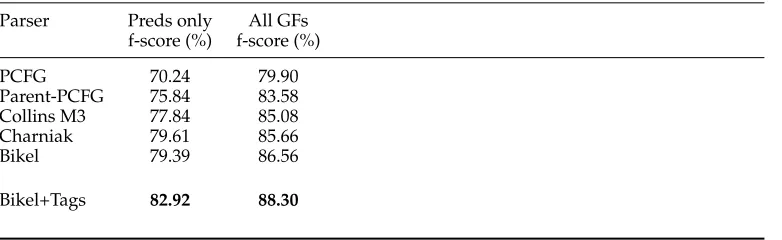
We evaluate preds-only f-structures (i.e., where paths in f-structures end in aPRED value: the predicate-argument-adjunct structure skeleton) and all grammatical func-tions (GFs) including number, tense, person, and so on. The results are given in Table 6. With one main exception, Tables 5 and 6 confirm the general expectation that the better the trees produced by the parsers, the better the f-structures automatically generated for those trees. The exception is Bikel+Tags. The automatic f-structure an-notation algorithm will exploit Penn-II functional tag information if present to generate appropriate f-structure equations (see Section 2.2). It will default to possibly less reliable configurational and categorial information if Penn-II tags are not present in the trees.
In order to test whether the retention of Penn-II functional labels in the history-based parser output will improve LFG f-structure-history-based dependency results, we use Bikel’s (2002) training software,17 and retrain the parser on a version of the Penn-II treebank (Sections 02 to 21) with the Penn-II functional tag labels (Table 1) annotated in such a way that the resulting history-based parser will retain them (Section 2.3). The retrained parser (Bikel+Tags) then produces CFG-trees with Penn-II functional labels and these are used by the f-structure annotation algorithm. We evaluate the f-structure dependencies against the DCU 105 (Table 6) and achieve an f-score of 82.92% preds-only
16 It is publicly available for download from:http://nclt.computing.dcu.ie/gold105.txt.
Cahill et al. Statistical Parsing Using Automatic Dependency Structures
Table 6
Treebank-induced parsers: results of dependency-based evaluation against DCU 105.
Parser Preds only All GFs f-score (%) f-score (%)
PCFG 70.24 79.90
Parent-PCFG 75.84 83.58 Collins M3 77.84 85.08 Charniak 79.61 85.66
Bikel 79.39 86.56
[image:21.486.54.438.262.486.2]Bikel+Tags 82.92 88.30
Table 7
Treebank induced parsers: breakdown by dependency relation of preds-only evaluation against DCU 105.
Dep. Percent of total F-score (%)
Parent-PCFG Collins M3 Charniak Bikel Bikel+Tags
ADJUNCT 33.73 71 72 76 73 79
APP 0.68 61 0 55 70 65
COMP 2.31 60 61 66 61 73
COORD 5.73 64 73 77 67 76
DET 9.58 91 93 96 96 96
FOCUS 0.04 100 100 0 100 100
OBJ 16.42 82 84 86 85 90
OBJ2 0.07 80 57 50 57 50
OBL 2.17 58 24 27 23 63
OBL2 0.07 50 0 0 0 67
OBL AG 0.43 40 96 96 92 92
POSS 2.88 80 83 82 82 79
QUANT 1.85 70 67 69 70 70
RELMOD 1.78 50 78 67 78 73
SUBJ 14.74 80 81 83 85 85
TOPIC 0.46 85 87 96 96 89
TOPICREL 1.85 61 80 80 79 74
XCOMP 5.20 90 92 79 93 93
and 88.3% all GFs. A detailed breakdown by dependency is given in Table 7. The system based on the retrained parser is now much better able to identify oblique arguments and overall preds-only accuracy has improved by 3.53% over the original Bikel experiment and 3.31% over Charniak’s parser, even though Charniak’s parser performs more than 2% better on the tree-based scores in Table 5 and even though the retrained parser drops 0.79% against the original Bikel parser on the tree-based scores.18
Inspection of the results broken down by grammatical function (Table 7) for the preds-only evaluation against the DCU 105 shows that just over one third of all depen-dency triples in the gold standard are adjuncts. SUBJ(ects) andOBJ(ects) together make up a further 30%.
Computational Linguistics Volume 34, Number 1
Table 7 shows that the treebank-based LFG system using Collins’s Models 3 is unable to identify APP(osition). This is due to Collins’s treatment of punctuation and the fact that punctuation is often required to reliably identify apposition.19 None of the original history-based parsers produced trees which enabled the annotation algo-rithm to identify second oblique dependencies (OBL2), and they generally performed considerably worse than Parent-PCFG when identifyingOBL(ique) dependencies. This is because the automatic f-structure annotation algorithm is cautious to the point of undergeneralization when identifying oblique arguments. In many cases, the algorithm relies on the presence of, for example, a -CLR Penn-II functional label (indicating that the phrase is closely related to the verb), and the history-based (Collins M3, Charniak, and Bikel) parsers do not produce these labels, whereas Parent-PCFG (as well as PCFG) are trained to retain Penn-II functional labels. Parent-PCFG, by contrast, performs poorly for oblique agents (OBL AG, agentiveby-phrases in passive constructions), whereas the history-based parsers are able to identify these with considerable accuracy. This is be-cause Parent-PCFG often erroneously finds oblique agents, even when the preposition is notby, as it never has enough context in which to distinguishbyprepositional phrases from other PPs. The history-based parsers produce trees from which the automatic f-structure annotation algorithm can better identifyRELMODandTOPICREL dependen-cies than Parent-PCFG. This, in turn, leads to improved long distance dependency resolution which improves overall accuracy.
The DCU 105 development set is too small to support reliable statistical significance testing of the performance ranking of the six treebank-based LFG parsing systems. In order to carry out significance testing to select the best treebank-based LFG parsing system for comparative evaluation against the hand-crafted deep XLE and RASPre-sources, we move to a larger dependency-based evaluation data set: the gold-standard dependency bank automatically generated from WSJ Section 22.
4.3 Evaluation against WSJ Section 22 Dependencies
In an experimental setup similar to that of Hockenmaier and Steedman (2002),20 we evaluate each parser against a large automatically generated gold standard. The gold-standard dependency bank is automatically generated by annotating theoriginal1,700 treebank trees from WSJ Section 22 of the Penn-II Treebank with our f-structure an-notation algorithm. We then evaluate the f-structures generated from the tree output of the six parsers trained on Sections 02 to 21 resulting from parsing the Section 22 strings against theautomaticallyproduced f-structures for theoriginalSection 22 Penn-II treebank trees. The results are given in Table 8.
Compared to Table 6 for the DCU 105 gold standard, most scores are up, particularly so for the history-based parsers. This trend is possibly due to the fact that the WSJ
19 The annotation algorithm relies on Penn-II-style punctuation patterns where anNPapposition follows a nominal head separated by a comma ([NP[NPBush ] , [NPthe president ] ]), all three sisters of the same mother node, while the trees produced by Collins’s parser attach the comma low in the tree ([NP[NP Bush,] [NPthe president ] ]). Although it would be trivial to carry out a tree transformation on the Collins output to raise the punctuation to the expected level, we have not done this here.
Cahill et al. Statistical Parsing Using Automatic Dependency Structures
Table 8
Results of dependency-based evaluation against the automatically generated gold standard for WSJ Section 22.
Parser Preds only All GFs f-score (%) f-score (%)
PCFG 70.76 80.44
Parent-PCFG 74.92 83.04 Collins M3 79.30 86.00 Charniak 81.35 86.96
Bikel 81.40 87.00
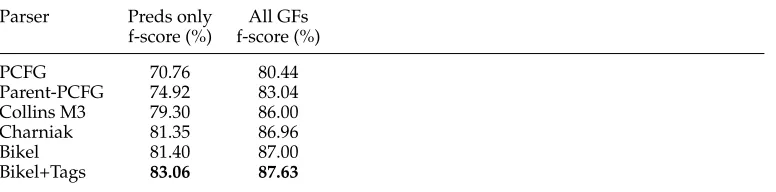
Bikel+Tags 83.06 87.63
Section 22 gold standard is generated automatically from the original “perfect” Penn-II treebank trees using the automatic f-structure annotation algorithm, whereas the DCU 105 has been created manually without regard as to whether or not the f-structure annotation algorithm could ever generate the f-structures, even given the “perfect” trees.
The LFG system based on Bikel’s retrained parser achieves the highest f-score of 83.06% preds-only and 87.63% all GFs. Parent-PCFG achieves an f-score of 74.92% only and 83.04% all GFs. Table 9 provides a breakdown by feature of the preds-only evaluation.
[image:23.486.53.440.440.665.2]Table 9 shows that, once again, the automatic f-structure annotation algorithm is not able to identify any cases of apposition from the output of Collins’s Model 3 parser. Apart from Bikel’s retrained parser, none of the history-based parsers are able to identify
Table 9
Breakdown by dependency of results of preds-only evaluation against the automatically generated Section 22 gold standard.
Dep. Percent of total F-score (%)
Parent-PCFG Collins M3 Charniak Bikel Bikel+Tags
ADJUNCT 33.77 70 75 78 78 80
APP 0.74 61 0 77 77 71
COMP 1.35 60 72 70 70 80
COORD 5.11 74 78 82 82 81
DET 10.72 88 91 92 92 91
FOCUS 0.02 27 67 88 88 71
OBJ 16.17 80 85 87 87 88
OBJ2 0.07 15 30 32 32 71
OBL 1.92 50 19 21 21 73
OBL2 0.07 47 3 3 3 69
OBL AG 0.31 50 90 89 89 85
POSS 2.47 86 91 91 91 91
QUANT 2.12 89 89 93 93 92
RELMOD 1.84 51 71 72 72 69
SUBJ 15.45 75 80 81 81 82
TOPIC 0.44 81 85 84 84 76
TOPICREL 1.82 61 72 74 75 69
Computational Linguistics Volume 34, Number 1
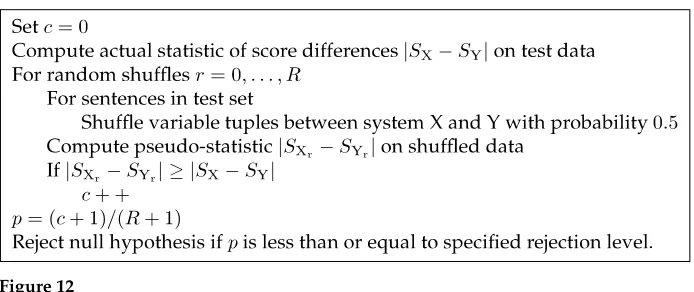
Figure 12
Approximate Randomization Test for statistical significance testing.
OBJ2,OBLor OBL2 dependencies very well, although Parent-PCFG is able to produce trees from which it is easier to identify obliques (OBL), because of the Penn-II functional -CLR label. The automatic annotation algorithm is unable to identifyRELMOD depen-dencies satisfactorily from the trees produced by parsing with Parent-PCFG, although the history-based parsers score reasonably well for this function. Whereas Charniak’s parser is able to identify some dependencies better than Bikel’s retrained parser, overall the system based on Bikel’s retrained parser performs better when evaluating against the dependencies in WSJ Section 22.
In order to determine whether the results are statistically significant, we use the Ap-proximate Randomization Test (Noreen 1989).21 This test is an example of a computer-intensive statistical hypothesis test. Such tests are designed to assess result differences with respect to a test statistic in cases where the sampling distribution of the test statistic is unknown. Comparative evaluations of outputs of parsing systems according to test statistics, such as differences in f-score, are examples of this situation. The test statistics are computed by accumulating certain count variables over the sentences in the test set. In the case of f-score, variable tuples consisting of the number of dependency-relations in the parse for the system translation, the number of dependency-dependency-relations in the parse for the reference translation, and the number of matching dependency-relations between system and reference parse, are accumulated over the test set.
Under the null hypothesis, the compared systems are not different, thus any vari-able tuple produced by one of the systems could just as likely have been produced by the other system. So shuffling the variable tuples between the two systems with equal probability, and recomputing the test statistic, creates an approximate distribution of the test statistic under the null hypothesis. For a test set of S sentences there are 2S different ways to shuffle the variable tuples between the two systems. Approximate randomization produces shuffles by random assignments instead of evaluating all 2S possible assignments. Significance levels are computed as the percentage of trials where the pseudo statistic, that is the test statistic computed on the shuffled data, is greater than or equal to the actual statistic, that is the test statistic computed on the test data. A sketch of an algorithm for approximate randomization testing is given in Figure 12.
Cahill et al. Statistical Parsing Using Automatic Dependency Structures
Table 10
Comparing parsers evaluated against Section 22 dependencies (preds-only):p-values for approximate randomization test for 10,000,000 randomizations.
PCFG Parent-PCFG Collins M3 Charniak Bikel Bikel+Tags
PCFG - - -
-Parent-PCFG <.0001 - - - -
-Collins M3 <.0001 <.0001 - - -
-Charniak <.0001 <.0001 <.0001 - - -Bikel <.0001 <.0001 <.0001 .0003 - -Bikel+Tags <.0001 <.0001 <.0001 <.0001 <.0001
-Table 10 gives thep-values (the smallest fixed level at which the null hypothesis can be rejected) for comparing each parser against all of the other parsers. We test for sig-nificance at the 95% level. Because we are doing a pairwise comparison of six systems, giving 15 comparisons, thep-value needs to be below .0034 for there to be a significant difference at the 95% level.22 For each parser, the values in the row corresponding to that parser represent the p-values for those parsers that achieve a lower f-score than that parser. This shows that the system based on Bikel’s retrained parser is significantly better than those based on the other parsers with a statistical significance of>95%. For the XLE and RASPcomparisons, we will use the f-structure-annotation algorithm and Bikel retrained-based LFG system.
5. Cross-Formalism Comparison of Treebank-Induced and Hand-Crafted Grammars
From the experiments in Section 4, we choose the treebank-based LFG system using the retrained version of Bikel’s parser (which retains Penn-II functional tag labels) to compare against parsing systems using deep, hand-crafted, constraint-based grammars at the level of dependencies. We report on two experiments. In the first experiment (Section 5.1), we evaluate the f-structure annotation algorithm and Bikel retrained parser-based LFG system against the hand-crafted, wide-coverage LFG and XLE pars-ing system (Riezler et al. 2002; Kaplan et al. 2004) on the PARC 700 Dependency Bank (King et al. 2003). In the second experiment (Section 5.2), we evaluate against the hand-crafted, wide-coverage unification grammar and RASPparsing system of Carroll and Briscoe (2002) on the CBS 500 Dependency Bank (Carroll, Briscoe, and Sanfilippo 1998).
5.1 Evaluation against PARC 700
The PARC 700 Dependency Bank (King et al. 2003) provides dependency relations (including LDD relations) for 700 sentences randomly selected from WSJ Section 23 of the Penn-II Treebank. In order to evaluate the parsers, we follow the experimental setup of Kaplan et al. (2004) with a split of 560 dependency structures for the test set and 140 for the development set. The set of features (Table 12, later in this article) evaluated in the experiment form a proper superset of preds-only, but a proper subset of all
Computational Linguistics Volume 34, Number 1
Figure 13
PARC 700 conversion software.
grammatical functions (preds-only⊂PARC⊂all GFs). This feature set was selected in Kaplan et al. because the features carry important semantic information. There are sys-tematic differences between the PARC 700 dependencies and the f-structures generated in our approach as regards feature geometry, feature nomenclature, and the treatment of named entities. In order to evaluate against the PARC 700 test set, we automatically map the f-structures produced by our parsers to a format similar to that of the PARC 700 Dependency Bank. This is done with conversion software in a post-processing stage on the f-structure annotated trees (Figure 13).
The conversion software is developed on the 140-sentence development set of the PARC 700, except for the Multi-Word Expressions section. Following the experimental setup of Kaplan et al. (2004), we mark up multi-word expression predicates based on the gold-standard PARC 700 Dependency Bank.
Multi-Word Expressions The f-structure annotation algorithm analyzes the internal structure of all noun phrases fully. In Figure 14, for example,BTis analyzed as anADJUNCTmodifier of the headsecurities, whereas PARC 700 analyzes this and other (more complex) named entities as multi-word expression predicates. The conversion software transforms the output of the f-structure annotation algorithm into the multi-word expression predicate format.
[image:26.486.63.398.481.638.2]Feature Geometry In constructions such as Figure 2, the f-structure annotation algo-rithm analyzessayas the main PRED with what is said as the value of aCOMP argument. In the PARC 700, these constructions are analyzed in such a way that what is said/reported provides the top level f-structure whereas other material (who reported, etc.) is analyzed in terms ofADJUNCTs modifying the top level f-structure. A further systematic structural divergence is provided by the analysis
Figure 14
Cahill et al. Statistical Parsing Using Automatic Dependency Structures
of passive oblique agent constructions (Figure 14): The f-structure annotation algorithm generates a complex internal analysis of the oblique agent PP, whereas the PARC analysis encodes a flat representation. The conversion software adjusts the output of the f-structure annotation algorithm to the PARC-style encoding of linguistic information.
Feature Nomenclature There are a number of systematic differences between feature names used by the automatic annotation algorithm and PARC 700: For example, DETisDET FORMin the PARC 700,COORDisCONJ,FOCUSisFOCUS INT. Nomen-clature differences are treated in terms of a simple relabeling by the conversion software.
Additional Features A number of features in the PARC 700 are not produced by the au-tomatic annotation algorithm. These include:AQUANTfor adjectival quantifiers, MOD for NP-internal modifiers, and STMT TYPEfor statement type (declarative, interrogative, etc.). Additional features (and their values) are automatically gen-erated by the mapping software, using categorial, configurational, and already produced f-structure annotation information, extending the original annotation algorithm.
XCOMP Flattening The automatic annotation algorithm treats both auxiliary and modal verb constructions in terms of hierarchically cascadingXCOMPs, whereas in PARC 700 the temporal and aspectual information expressed by auxiliary verbs is represented in terms of a flat analysis and features (Figure 15). The conversion software automatically flattens the f-structures produced by the automatic anno-tation algorithm into the PARC-style encoding.
For full details of the mapping, see Burke et al. (2004).
In our parsing experiments, we used the most up-to-date version of the hand-crafted, wide-coverage, deep LFG resources and XLE parsing system with improved results over those reported in Kaplan et al. (2004): This latest version achieves 80.55% f-score, a 0.95 percentage point improvement on the previous 79.6%. The XLE parsing system combines a large-scale, hand-crafted LFG for English and a statistical disam-biguation component to choose the most likely analysis among those returned by the symbolic parser. The statistical component is a log-linear model trained on 10,000 partially labeled structures from the WSJ. The results of the parsing experiments are presented in Table 11. We also include a figure for the upper bound of each system.23 Using Bikel’s retrained parser, the treebank-based LFG system achieves an f-score of 82.73%, and the hand-crafted grammar and XLE-based system achieves an f-score of 80.55%. The approximate randomization test produced a p-value of .0054 for this pairwise comparison, showing that this result difference is statistically significant at the 95% level. Evaluation results on a reannotated version (Briscoe and Carroll 2006) of the PARC 700 Dependency Bank were recently published in Clark and Curran (2007), reporting f-scores of 81.9% for the CCG parser, and 76.3% for RASP. As Briscoe and
23 The upper bound for the treebank-based LFG system is determined by taking the original Penn-II WSJ Section 23 trees corresponding to the PARC 700 strings, automatically annotating them with the
Computational Linguistics Volume 34, Number 1
Figure 15
DCU 105 and PARC 700 analyses for the sentenceUnlike 1987, interest rates have been falling this year.
Carroll point out, these evaluations are not directly comparable with the Kaplan et al. (2004) style evaluation against the original PARC 700 Dependency Bank, because the annotation schemes are different. Kaplan et al. and our experiments use a fine-grained feature set of 34 features (Table 12), while the Briscoe and Carroll scheme uses 17 features.
[image:28.486.50.431.618.664.2]A breakdown by dependency relation for each system is given in Table 12. The treebank-induced grammar system can better identify DET FORM,SUBORD FORM, and
Table 11
Results of evaluation against the PARC 700 Dependency Bank following the experimental setup of Kaplan et al. (2004).
-Cahill et al. Statistical Parsing Using Automatic Dependency Structures
Table 12
Breakdown by dependency relation of results of evaluation against PARC 700.
Dep. Percent of deps. F-score (%)
Bikel+Tags XLE
ADEGREE 6.17 80 82
ADJUNCT 14.32 68 66
AQUANT 0.06 78 61
COMP 1.23 80 74
CONJ 2.64 73 69
COORD FORM 1.20 83 90
DET FORM 4.61 97 91
FOCUS 0.02 0 36
MOD 2.74 74 67
NUM 19.82 91 89
NUMBER 1.42 89 83
NUMBER TYPE 2.10 94 86
OBJ 8.92 87 78
OBJ THETA 0.05 43 31
OBL 0.83 55 69
OBL AG 0.22 82 76
OBL COMPAR 0.07 38 56
PASSIVE 1.14 80 88
PCASE 0.25 79 68
PERF 0.41 89 90
POSS 0.98 88 80
PRECOORD FORM 0.03 0 91
PROG 0.97 89 81
PRON FORM 2.54 92 94
PRON INT 0.03 0 33
PRON REL 0.57 74 72
PROPER 3.56 83 93
PRT FORM 0.22 80 41
QUANT 0.34 77 80
STMT TYPE 5.23 87 80
SUBJ 8.51 78 78
SUBORD FORM 0.93 47 42
TENSE 5.02 95 90
TOPIC REL 0.57 56 73
XCOMP 2.29 80 78
PRT FORMdependencies24and achieves higher f-scores forOBJandPOSS. However, the hand-crafted parsing system can better identifyFOCUS,OBL(ique) arguments,PRECO -ORD FORMandTOPICRELrelations.
5.2 Evaluation against CBS 500
We also compare the hand-crafted, deep, probabilistic unification grammar-based RASP parsing system of Carroll and Briscoe (2002) to our treebank- and retrained Bikel
Computational Linguistics Volume 34, Number 1
Figure 16
CBS 500 conversion software.
parser-based LFG system. The RASPparsing system is a domain-independent, robust statistical parsing system for English, based on a hand-written, feature-based unification grammar. A probabilistic parse selection model conditioned on the structural parse context, degree of support for a subanalysis in the parse forest, and lexical informa-tion (when available) chooses the most likely parses. For this experiment, we evaluate against the CBS 500,25 developed by Carroll, Briscoe, and Sanfilippo (1998) in order to evaluate a precursor of the RASPparsing resources. The CBS 500 contains dependency structures (including some long distance dependencies26) for 500 sentences chosen at random from the SUSANNE corpus (Sampson 1995), but subject to the constraint that they are parsable by the parser in Carroll, Briscoe, and Sanfilippo. As with the PARC 700, there are systematic differences between the f-structures produced by our methodology and the dependency structures of the CBS 500. In order to be able to evaluate against the CBS 500, we automatically map our f-structures into a format similar to theirs. We did not split the data into a heldout and a test set when developing the mapping, so that a comparison could be made with other systems that report evaluations against the CBS 500. The following CBS 500-style grammatical relations are produced from the f-structure in Figure 1:
(ncsubj sign U.N.) (dobj sign treaty)
Some mapping is carried out (as in the evaluation against the PARC 700) on the f-structure annotated trees, and the remaining mapping is carried out on the f-f-structures (Figure 16). As with the PARC 700 mapping, all mappings are carried out automatically.
The following phenomena were dealt with on the f-structure annotated trees:
Auxiliary verbs (xcomp flattening) XCOMPS were flattened to promote the main verb to the top level, while maintaining a list of auxiliary and modal verbs and their relation to one another.
Treatment of topicalized sentences The predicate of the topicalized sentence became the main predicate and any other top level material became an adjunct.
Multi-word expressions Multi-word expressions (such as according to) were not marked up in the parser input, but captured in the annotated trees and the annotations adjusted accordingly.
Treatment of the verbsbeandbecome Our automatic annotation algorithm does not treat the verbsbeandbecomedifferently from any other verbs when they are used transitively. This analysis conflicted with the CBS 500 analysis, so was changed to match theirs.
Cahill et al. Statistical Parsing Using Automatic Dependency Structures
Table 13
Results of dependency evaluation against the CBS 500 (Carroll, Briscoe, and Sanfillipo 1998).
Bikel+Tags RASP p-Value F-score 80.23 76.57 <.0001
The following are the main mappings carried out on the f-structures:
Encoding of Passive We treat passive as a feature in our automatic f-structure annota-tion algorithm, whereas the CBS 500 triples encode this informaannota-tion indirectly. Objects of Prepositional Phrases No dependency was generated for these objects, as
there was no corresponding dependency in the CBS 500 analyses.
Nomenclature Differences There were some trivial mappings to account for differ-ences in nomenclature, for example OBL in our analyses became IOBJ in the mapped dependencies.
Encoding ofwh-less relative clauses These are encoded by means of reentrancies in f-structure, but were encoded in a more indirect way in the mapped dependencies to match the CBS 500 annotation format.
To carry out the experiments, we POS-tagged the tokenized CBS 500 sentences with the MXPOST tagger (Ratnaparkhi 1996) and parsed the tag sequences with our Penn-II and Bikel retrained-based LFG system. We use the evaluation software of Carroll, Briscoe, and Sanfilippo (1998)27to evaluate the grammatical relations produced by each parser. The results are given in Table 13.
Our LFG system based on Bikel’s retrained parser achieves an f-score of 80.23%, whereas the hand-crafted RASPgrammar and parser achieves an f-score of 76.57%. Crouch et al. (2002) report that their XLE system achieves an f-score of 76.1% for the same experiment. A detailed breakdown by dependency is given in Table 14. The LFG system based on Bikel’s retrained parser is able to better identify MOD(ifier) de-pendency relations, ARG MOD (the relation between a head and a semantic argument which is syntactically realized as a modifier, for example by-phrases), IOBJ (indirect object) and AUXiliary relations. RASPis able to better identifyXSUBJ (clausal subjects controlled from without), CSUBJ (clausal subjects), and COMP (clausal complement) relations. Again we use the Approximate Randomization Test to test the parsing results for statistical significance. Thep-value for the test comparing our system using Bikel’s retrained parser against RASPis<.0001. The treebank-based LFG system using Bikel’s retrained parser is significantly better than the hand-crafted, deep, unification grammar-based RASPparsing system with a statistical significance of>95%.
6. Discussion and Related Work
At the moment, we can only speculate as to why our treebank-based LFG resources outperform the hand-crafted XLE and RASPgrammars.
In Section 4, we observed that the treebank-induced LFG resources have consid-erably wider coverage (>99.9% measured in terms of complete spanning parse) than
Computational Linguistics Volume 34, Number 1
Table 14
Breakdown by grammatical relation for results of evaluation against CBS 500.
Dep. Percent of deps. F-score (%)
Bikel+Tags RASP
DEPENDANT 100.00 80.23 76.57
MOD 48.96 80.30 75.29
NCMOD 30.42 85.37 72.98
XMOD 1.60 70.05 55.88
CMOD 2.61 75.60 53.08
DETMOD 14.06 95.85 91.97
ARG MOD 0.51 80.00 64.52
ARG 43.70 78.28 77.57
SUBJ 13.10 79.84 83.57
NCSUBJ 12.99 87.84 84.32
XSUBJ 0.06 0.00 88.89
CSUBJ 0.04 0.00 22.22
SUBJ OR DOBJ 18.22 81.21 83.84
COMP 12.38 76.73 71.87
OBJ 7.34 76.05 69.53
DOBJ 5.11 84.55 84.57
OBJ2 0.25 48.00 43.84
IOBJ 1.98 59.04 47.60
CLAUSAL 5.04 77.74 75.37
XCOMP 4.03 80.00 84.11
CCOMP 1.01 69.61 75.14
AUX 4.76 94.94 88.27
CONJ 2.06 68.84 69.09
the hand-crafted grammars (∼80% for XLE and RASPgrammars on unseen treebank text). Both XLE and RASPuse a number of (largest) fragment-combining techniques to achieve full coverage. If coverage is a significant component in the performance difference observed between the hand-crafted and treebank-induced resources, then it is reasonable to expect that the performance difference is more pronounced with increasing sentence length (with shorter sentences being simpler and more likely to be within the coverage of the hand-crafted grammars). In other words, we expect the hand-crafted, deep, precision grammars to do better on shorter sentences (more likely to be within their coverage), whereas the treebank-induced grammars should show better performance on longer strings (less likely to be within the coverage of the hand-crafted grammars).
In order to test this hypothesis, we carried out a number of experiments:
First, we plotted the sentence length distribution for the 560 PARC 700 test sen-tences and the 500 CBS 500 sensen-tences (Figures 17 and 18). Both gold standards are approximately normally distributed, with the CBS 500 distribution possibly showing the effects of being chosen subject to the constraint that the strings are parsable by the parser in Carroll, Briscoe, and Sanfilippo (1998). For each case we use the mean,µ, and two standard deviations, 2σ, to the left and right of the mean to exclude sentence lengths not supported by sufficient observations: For PARC 700,µ=23.27,µ−2σ=2.17, and
µ+2σ=44.36; for CBS 500, µ=17.27, µ−2σ=1.59, and µ+2σ=32.96. Both the PARC 700 and the CB 500 distributions are positively skewed. For the PARC 700,µ−2σ