A Survey on Scheduling and Optimization
Techniques for Static Segment of FlexRay Protocol
M. Amerion, M. Ektesabi
Abstract - FlexRay is getting popular among car makers to be used as a communication backbone for in-vehicle networking systems. It serves both time-triggered as well as event-triggered applications by maintaining static and dynamic segments in its communication cycle. There are many works on the scheduling of the signals that are motivated by different vehicular applications. In this survey the focus is on the scheduling and optimization of the static segment of the FlexRay protocol that supports periodic tasks. Various approaches and their properties are reviewed including bin packing, genetic algorithm, linear integer programming, non-linear integer programming, mixed-linear integer programming as well as the constraint programming algorithms.
Keyword__in-vehicle communication system, FlexRay protocol, Scheduling, Optimization technique, Static Segment.
I- INTRODUCTION
With rapid growth in technology and the necessity of meeting requirements for advanced applications in modern cars, various electronic control units (ECU) and intelligent systems are deployed in new vehicle. These complex systems vary from safety related systems of the car such as Supplemental Restraint System (SRS) – airbag, Steering-By-Wire (SBW), Adaptive Cruise Control (ACC), Traction Control System (TCS), Anti-lock Braking System (ABS), Electronic Stability Program (ESP), to the comfort applications like infotainment systems. Each system is comprised of several ECUs that are interconnected through the in-vehicle networking system. These networking systems must meet the stringent real-time constraints of vehicular applications as missing a deadline can easily lead to an accident. There are several protocols defined for in-vehicle communication system such as Local Interconnected Network (LIN), controller Area Network (CAN), Media Oriented Systems Transport (MOST), J1939 and a new one that recently has become popular in car industry known as FlexRay.
The FlexRay technology has recently emerged and already been used in modern cars. It exhibits redundancy, determinism, fault tolerance, scalability, high speed, and reliable data exchange between network nodes. It has been developing by FlexRay Consortium between 2000 and 2010. The core members of this consortium are the leading companies like BMW AG, Robert Bosch GmbH DaimlerChrysler AG, General Motors Corporation, Freescale Halbleiter, Deutschland GmbH, Philips GmbH, and Volkswagen AG[1].
M. Amerion and M. Ektesabi are with Swinburne University of Technology, Melbourne, Australia. Email: [email protected]
Having two 10Mbit/s channels and flexible configuration options from linear bus to star and hybrid topologies, FlexRay enables carmakers to develop novel applications for future cars generally in combination with existing in-car communication systems such as LIN, CAN, and MOST. Fig. 1 depicts a hybrid topology of the FlexRay where channel A is using bus topology, while channel B is designed as star[1]. A FlexRay node as it is shown in Fig. 1 comprised of one host, one communication controller, one power supply, and two so-called bus drivers.
A bus driver consists of a receiver and a transmitter that connects the communication controller to the network channel. The communication controller is responsible for implementation of the stack protocol of the FlexRay communication system, and the application software is executed in host which is an electronic component of the ECU.
FlexRay is a protocol that supports Time Division Multiple Access (TDMA) technology. The TDMA architecture that is used in FlexRay network guarantees that each node will have access to the medium in each communication cycle which is crucial for safety-critical systems[2]. This technology was used for the first time in aircrafts to ensure more stable systems and to reduce the data transmission errors between nodes. A communication network in TDMA is divided into multiple time slots where each node connected to the network can have one or more time slots during which can send and receive the data[1].
The basis for the medium access within FlexRay protocol is its communication cycle which can be described by timing hierarchy. As Fig.2 [1] depicts, a timing hierarchy is consisting of four different levels from low to high.
At the lowest level are the micro-ticks that are derived directly from the communication controller’s oscillator. Thus different nodes may have different time durations depending on the microcontroller on each node. The next is the macro-tick level. The duration of each macro-macro-tick is an integer number of micro-ticks.
The highest level in this hierarchy is the communication cycle level. It is divided to four different segments, static segment, dynamic segment, symbol window and network idle time (NIT). Each FlexRay communication cycle has a fixed duration that is executed repeatedly during its operation. The number of iterations can be from 0 to 63 which is counted by
Fig.1. A FlexRay node mounted on a dual channel hybrid topology of FlexRay network [1]
Fig.3.The FlexRay communication cycle repetition [3]
triggered task scheduling which simplifies the networking system.
FlexRay enables carmakers to have a unified approach in developing in-vehicle communication system and avoids using different protocols on a same system that requires gateways to translate from one protocol to the other.
As for the scheduling of the messages in FlexRay different techniques are defined each of which has its own advantages and disadvantages, but the main objective of those techniques is to maximize the utilization of the bandwidth and increase the extensibility in the system. The timing analysis of such systems is studied with respect to various metrics such as the messages worst-case response time, priority, deadline, and jitter.
This paper focuses on the static segment of the FlexRay protocol which is responsible to deliver a deterministic service to the periodic tasks, the architecture of which is illustrated in Fig. 4 [9]. The more applications are configured in a car the more data transmission is required. Most of such applications are time-triggered; therefore the scheduling optimization of the static (ST) segment in order to maximize the number of free slots is essential as it will help to make the system flexible against the increasing number of messages and also provides the system with more space for additional nodes. In this survey, different approaches that are existed to schedule and optimize the ST segment are reviewed and compared against each other.
Fig.4. Structure of the static segment [9]
II- SCHEDULING TECHNIQUES
A. Bin Packing Algorithm and Heuristic
Bin packing problem considers a set of items and a set of boxes as bins. The solution needs to put all items into as little as possible number of bins. The bin packing with respect to the static segment of FlexRay is used to minimize the number of slots that are allocated to ECUs, hence maximizing the utilization of the bus which in turns increases the extensibility of the system by providing more space for additional nodes. Martin L. et al. [4] have presented a two dimensional bin packing technique for scheduling of the static segment of FlexRay. Each slot is considered as a bin with payload of W
(width of the bin) and H number of communication
cycles(height of the bin). The length of each message M is equal or less than W and the number of repetition for each message are less than H. They have transformed every slot into a rectangular bin, so the rectangular elements of different size are packed into the minimum number of bins. The authors have introduced a fast greedy heuristic algorithm as well as an integer linear programming (ILP) approach for optimization of this bin packing. The FlexRay parameters are configured as 62 slots in static segment each of which can carry 42 bytes of data, and the duration of the communication cycle is 5ms. With respect to the number of used slots, the ILP solution is always better compared to that of heuristic, however the runtime of the ILP is significantly longer[4]. The CPLEX and OPT4J solvers are used for the ILP and heuristic respectively in this paper.
B. Genetic Algorithm
A scheduling method based on genetic algorithm is presented in [5]. The application is described as a task graph representing the set of task servicing nodes as well as the messages. Each task is assigned to a processor with a worst case execution time. Two objectives are to be achieved, the first one is to schedule the set of tasks in such a way that all tasks meet their deadline and the second goal is to optimize the scheduling in order to reduce the costs of the hardware. Some timing constraints such as response time, freshness time, synchronous input/output, and the redundancy of slots are considered. Also, selection, crossover, and mutation operations of a genetic algorithm are discussed in their work. Shan D. et al has extended this work in [6] and presented a hybrid genetic algorithm to schedule the static segment of the FlexRay. They used bin packing approach combined with genetic algorithm to achieve the minimum number of used slots. The authors applied Worst-Fit algorithm [6] for bin packing in order to initialize the population and then assigned the tasks to the nodes accordingly. The next step in their proposed algorithm is to compute the fitness of population placed into the bins, if the result is satisfactory then the hybrid generic algorithm is stopped otherwise the selection, crossover, and mutual operations are applied to generate a new population until the best fitness is achieved. As for the experimental results, they have considered various configurations for FlexRay network in terms of the number of nodes and slots and also the size of messages. The algorithms are developed in C language.
C. Linear Integer Programming
number of frame identifiers is limited and they are uniquely assigned to ECUs. The authors assumed that several nodes are communicating over FlexRay; each node transmits a set of periodic messages where each message has a period and a deadline in such a way that maximum period of a message is equal to its deadline. Also they have considered the slot size so that the full message can fit into. It is concluded that the allocation of frame identifiers as well as the relative jitter for each message depends on the number of repetitions for each message.
Fig.5. Experiencing jitter in each repetition [3]
Assigning a proper value for repetition of each message helps to minimize both allocations of FIDs as well as the jitter. In this work the algorithm for scheduling of the ST segment is developed in C++ and the optimization of repetitions is implemented in GNU Linear Programming Kit (GLPK).
In order to verify the proposed algorithm, the authors have considered 41 periodic messages that are transmitted through three ECUs connected to the network with 16 ST slots. They have examined the algorithm with and without jitter for each message. They achieved the minimum number of frame identifiers to be allocated to the messages hence increasing the number of free static slots.
D. Non-Linear Integer Programming
In the work by Klaus Schmidtet al. [7] the authors have identified and solved two scheduling sub-problems of the static segment of FlexRay and introduced the associated performance metrics. The first sub-problem is defined to address the requirements of the FlexRay protocol which needs the signals to be packed into messages of equal size with minimum required bandwidth. The second sub-problem is to schedule the messages where the authors took the advantage of nonlinear integer programming to maximize the utilization of the bandwidth and calculated the optimal message set. The solution to the second sub-problem suggests that the periodic message in static segment of FlexRay must be transmitted with minimum jitter. To address this issue the authors have proposed a software architecture that supports the jitter free transmission of periodic messages in FlexRay static segment. They have considered a single channel FlexRay network that connects several nodes. As mentioned before a FlexRay node consists of a host and a communication controller which are connected to each other through an interface. Each static slot in FlexRay communication cycle is associated with a frame identifier (FID) and is assigned to a host. The messages to be transmitted are assigned to FIDs in such a way that each message cannot have more than one FID. The authors proposed that there can be one periodic scheduling table (PST) per FID for each host. In each communication cycle the PST determines which message to be transmitted through the controller-host interface.
As for the scheduling of the static segments, Schmidt and et
al have splitthe problem in two sub-problems. First, they investigated the signal framing considering two aspect of which such that in one hand the size of the static slots should be identical and in the other hand the signals should be assigned to the message frames due to which the communication cycle faces the minimum framing overhead while the maximum number of bits are used for messages in each slot. Second, they investigated the message scheduling. They have pointed out three issues to be addressed in their scheduling approach. First, the frame identifiers are uniquely assigned, so the message scheduling can take place independently for each node. Second, in order to guarantee the efficient usage of the static segment, each message schedule needs the minimum number of frame identifiers. Last, the messages in static segment must be scheduled with minimum jitter. The authors have benchmarked their work against Society of Automotive Engineers (SAE) where 22 signals having period time of 5ms are distributed over 6 nodes. GLPK is used to get the experimental results and for each data point 100 samples are evaluated[7].
E. Mixed-Linear Integer Programming
Haibo Z. et al. in[8] have investigated the scheduling of the static segment from the application designer points of view with respect to the latency and extensibility of the system. The ST segment of FlexRay is suitable for periodic tasks and safety-critical systems which need a tight timeline and deterministic framework. In this segment a scheduling table is maintained that stores the specifications of nodes as well as the slots that are assigned to those nodes. Having such scheduling table will avoid any conflict in transmission of signals as each node can only use the bus during its own time slot. In the other hand each node keeps its own local time and runs accordingly. The free slots can be used for future extensions and are determined based on the virtual global table which is resulted from composition of local scheduling tables. The global and local schedulers should coordinate in such a way to guarantee the time determinism of the system and to improve the performance of the whole system in terms of latency[8].
In their work the approach for optimizing the ST segment of FlexRay is based on the MILP (mixed-integer linear programming). The possible advantages of MILP solutions can be as following [8]:
- If MILP solver finds an optimum solution then it can be guaranteed that the solution is optimal.
- It allows evaluating the quality of the solutions having a boundary for the cost of the optimal solution.
- MILP is easier comparing to heuristic methods.
- It has reasonable time and space complexity for computing the solution.
- In terms of reusability the formulation offered by MILP is easier to be adopted by the designers.
a task). They have included the deadline and priority constraints in order for their MILP formulation to optimize the scheduling in system level with the definition of optimality in activation of tasks and signals. They have shown how their approach can find the optimal solution for actual vehicles.
The authors have argued that, in order to take the most advantages of the FlexRay network there should be synchronization between signals and tasks besides packing of the signal into the frames. There are two options for a designer to leverage the most benefits of the FlexRay communication system. First option is to be compliant with AUTOSAR (AUTomotive Open System ARchitecture) standard which the authors here have chosen this option. There are two standards existing in accordance with real time operating systems and task scheduling. Both of the time-triggered OSEKTime as well as the OSEK standard which is fully preemptive and priority-based, are listed by AUTOSAR as the architecture for automotive communication systems. The second option is to synchronize the task in order to meet the constraints of the AUTOSAR standards. Two modes of synchronization such as asynchronous scheduling and synchronous scheduling are discussed. The advantage of the synchronous schedulers over the asynchronous ones is that they make it possible to predict which job produces the data that is going to be wrapped into frames for transmission and what job is going to receive that data. In addition, the synchronous transmission of data guarantees time determinism.
In order to validate the method, they have considered the application cycle of 8ms, communication cycle with length of 1ms, and 22 slots with size of 35us that transmits 200bits of data. The experimental results are achieved through using CPLEX 11.0 and the problems are modelled on AMPL.
F. Constraints Programming
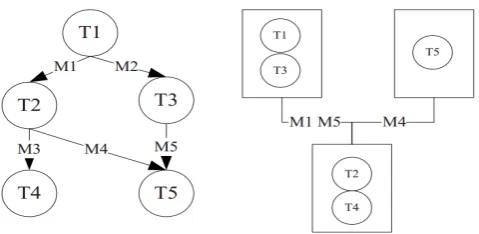
The static segment of a FlexRay communication cycle is divided into several identical slots. Each ECU can be assigned one or more slots but each slot can be dedicated to only one ECU. If a slot is assigned to a particular ECU then it is assigned to the same ECU for each and every communication cycle. These are the constraints that Zheng Sun and et al In [9] have considered in their constraint programming approach to optimize the scheduling of the static segment of the FlexRay. The objective of the optimization is to minimize the usage of static slots so that the number of free slots is maximized and the system can be more extensible in future if needed. In their work, the system model presented in [10] is used to draw the task graph and to represent the flow of the signals between tasks. In this model the vertices represent the tasks and the edges represent the signals. If there is a data dependency between two tasks then there is a direct edge
[image:5.595.319.559.109.226.2]from one task to the other. It means the child node denoting the successor task should wait for its parent node before starting its execution[9] as it is shown in Fig. 5.
Fig. 5. Illustrating a system graph model
The FlexRay bus configuration is characterized by (H, Lcomm,nslot,lslot,bslot) where H is the application cycle or hyper
period that is the least common multiple of all tasks in an application, Lcomm is the length of the FlexRay communication cycle, nslot is the number of equal slots in static segment, lslot is the length of each slot, and bslot is the number of bits in each slot[10]. There are around 70 parameters in FlexRay protocol to be configured that need to be set with proper values in order to meet the application constraints. The parameters that are considered in Zheng Sun and et al work have been selected according to the Zeng Haibo and et al system model. They have considered the bit rate of 10Mbit/s, the length of communication cycle of 8000us, only one communication channel, number of slots in static segment from 2 to 1023 the length of which can be calculated as the length of communication cycle divided by the number of static slots, and number of bits in a slot equal or smaller than the size of the largest message that is to be transferred. There are some more assumptions as following:
- Each slot can transmit multiple messages and each message can include one or more signalsat a time. - The priority of tasks is assigned according to their
period i.e. rate monotonic algorithm is used for scheduling of the tasks.
- Maintaining an input/output buffer through which the periodic tasks obtain their input from the buffer and put their output signal into.
At the end they have concluded that the relation between number of ECUs and the number of used slots is direct. The more ECU the system uses the more static slots are occupied. However, the parameter settings as well as the number of the messages sent on a bus can affect the usage and allocation of the static slots in FlexRay networking system.
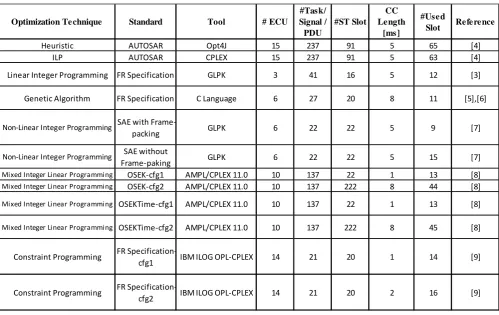
TABLE I
EXPERIMENTAL RESULTS OF DIFFERENT SCHEDULING AND OPTIMIZATION TECHNIQUES
III- COMPARISON OF THE OPTIMIZATION TECHNIQUES
In a hard real-time system the accuracy not only depends on the outcome of the system, but it is also determined by addressing the timing constraints of the system. Missing a deadline in a hard real-time system can lead to a catastrophe. Safety critical systems are classified as hard real-time where occurring a failure during their execution puts the human life at risk. A safety critical system must have some characteristics such as being deterministic, predictable, fault-tolerant, high-duty fault-tolerant, and also it should be maintainable[11].
The FlexRay protocol follows different policies to access the medium in its static and dynamic segments. As for the the dynamic segment it uses FTDMA (flexible time division/multiple access), and for the static segment it uses GTDMA (global time division/multiple access) where allows the system to allocate several static slots to the same ECU during the same communication cycle. The size of the static slot is globally configured for the network which can be set equal to the size of the longest message that is going to be passed through the bus. Even if the ESU has no data to send during its time slot, the size of the static slot does not change and in this case the payload field will have no data[11]. There can be different methods to optimize the size of the communication cycle as well as the size of the ST slot in order to increase the number of unused slots which in turn increases the bandwidth utilization of the communication system.
As it is shown in Table I, the optimization methods can be defined in compliance with various standards such as
AUTOSAR, SAE, OSEK, OSEKTime and some are based on the FlexRay protocol specification. In [4] the authors proposed both heuristic and MILP techniques aiming the optimal scheduling of ST segment with minimum number of used slots assuming that the signals are already packed into PDUs. In [7] the presented work not only reduces the number of unused slots but also defines a formula that minimizes the jitter in transmission of messages. The authors in [8] have formulated the optimization at system-level by considering the synchronization in their scheduling. They also considered end-to-end deadlines as well as the constraints of information passing between signals and tasks.
The study shows that ILP problems require significant amount of resources in terms of time and memory space, however allocated number of slots is always less comparing with heuristic approach. The heuristic method is considerably faster in scheduling of the tasks[4]. Klaus Schmidt and et al in [7] suggested that the frame-packing is essential for increasing the bandwidth utilization as well as for the schedulability of the system. They have also noted that the higher number of ECUs connected to the network, the less number of messages can be scheduled. In [6] it is found that the genetic algorithm can achieve an optimal solution for scheduling of the static segment, however the resulting solution is not stable. In contrast, the bin packing technique is rather stable however in terms of optimization it misses the deadline for some tasks. They introduced the hybrid genetic algorithm that is the combination of bin packing and genetic algorithm as the most optimal solution for scheduling of the static segment of FlexRay.
Optimization Te chnique Standard Tool # ECU
#Task/ Signal / PDU
#ST Slot
CC Length
[ms]
#Used
Slot Reference
Heuristic AUTOSAR Opt4J 15 237 91 5 65 [4]
ILP AUTOSAR CPLEX 15 237 91 5 63 [4]
Linear Integer Programming FR Specification GLPK 3 41 16 5 12 [3]
Genetic Algorithm FR Specification C Language 6 27 20 8 11 [5],[6]
Non‐Linear Integer Programming SAE with Frame‐
packing GLPK 6 22 22 5 9 [7]
Non‐Linear Integer Programming SAE without
Frame‐paking GLPK 6 22 22 5 15 [7]
Mixed Integer Linear Programming OSEK‐cfg1 AMPL/CPLEX 11.0 10 137 22 1 13 [8]
Mixed Integer Linear Programming OSEK‐cfg2 AMPL/CPLEX 11.0 10 137 222 8 44 [8]
Mixed Integer Linear Programming OSEKTime‐cfg1 AMPL/CPLEX 11.0 10 137 22 1 13 [8]
Mixed Integer Linear Programming OSEKTime‐cfg2 AMPL/CPLEX 11.0 10 137 222 8 45 [8]
Constraint Programming FR Specification‐
cfg1 IBM ILOG OPL‐CPLEX 14 21 20 1 14 [9]
Constraint Programming FR Specification‐
IV- CONCLUSION
FlexRay as a time-triggered deterministic protocol that supports fault tolerant and redundancy is getting popular among car makers to be used as the backbone for in-vehicle networking system. Its communication cycle maintains the static segment to serve the periodic tasks and uses the dynamic segment to serve the aperiodic tasks. Proper scheduling of the safety critical systems plays a vital role in preventing the system from possible crashes, so there are tremendous of researches in this regard and the main goal is to decrease the number of used slots and increase the utilization of the system. This work has focused on the scheduling and optimization of the static segment of FlexRay protocol. Various techniques for scheduling of ST segment are reviewed and compared. The study suggests that MILP obtains the optimal solution with minimum number of used slots; however it has longer runtime and consumes more memory space. The heuristic is fast enough for the system to achieve schedulability however it decreases the bandwidth utilization. The solution that is achieved through the genetic algorithm is not stable however its combination with bin packing can result into an optimal solution.
REFERENCES
[1] "FlexRay Communication System Protocol Specification Version 2.1 Revision A," ed, p. 245.
[2] W.-C. C. Chau-Chung Song, Chen-Fu Feng, Der-CherngLiaw, "Study of a vehicular drive-by-wire system based on FlexRay protocol," presented at the SICE Annual Conference, 2010.
[3] K. Schmidt, E. G. Schmidt, and Ieee, "Optimal Message Scheduling for the Static Segment of FlexRay," in 2010 Ieee 72nd Vehicular Technology Conference Fall, ed, 2010. [4] M. G. Martin Lukasiewycz, JurgenTeich, Paul Milbredt,
"FlexRay Schedule Optimization of the Static Segment," in ACM, 2009.
[5] N. M. Shan Ding, HiroykiTomiyama, Hiroaki Takada, "A GA-Based Scheduling Method for FlexRay Systems," in ACM, Jersey City, New Jersey, USA, 2005.
[6] S. Ding, X. Yin, H. Xu, S. Zhang, and C. Northeastern Univ, A Hybrid GA-based Scheduling Method for Static Segment in FlexRay Systems, 2010.
[7] K. Schmidt and E. G. Schmidt, "Message Scheduling for the FlexRay Protocol: The Static Segment," Ieee Transactions on Vehicular Technology, vol. 58, pp. 2170-2179, Jun 2009. [8] H. Zeng, M. Di Natale, A. Ghosal, and A. Sangiovanni-Vincentelli, "Schedule Optimization of Time-Triggered Systems Communicating Over the FlexRay Static Segment," Ieee Transactions on Industrial Informatics, vol. 7, pp. 1-17, Feb 2011.
[9] H. L. Zheng Sun, Min Yao, Nan Li, "Scheduling Optimization Techniques for FlexRay," presented at the 2010 IEEE/ACM International Conference on Green Computing and Communications & 2010 IEEE/ACM International Conference on Cyber, Physical and Social Computing, 2010.
[10] H. Zeng, W. Zheng, M. Di Natale, A. Ghosal, P. Giusto, A. Sangiovanni-Vincentelli, and Ieee, "Scheduling the Flex Ray Bus Using Optimization Techniques," in Dac: 2009 46th Acm/Ieee Design Automation Conference, Vols 1 and 2, ed, 2009, pp. 874-877.