Reliable Energy-Efficient Routing Algorithm for
Vehicle-Assisted Wireless Ad-Hoc Network
Rumana Khanam
DDIPG Student, Department of electronics and communication, University institute of technology-RGPV, Bhopal, India
Abstract: All the devices can be connected that provide utility from internet connection by the development of fifth generation (5G) wireless network. A fuzzy engine is typified by the inference system that includes the system rule base, input membership functions that fuzzify the input variables and the output variable de-fuzzification process. The Dynamic cluster head selection algorithm (D-LEACH) is used. The average energy consumption is obtained from the proposed dynamic cluster head using fuzzy interference system. Also a comparison is made for energy consumption with and without the D-LEACH algorithm.
I. INTRODUCTION
In India with increase in the population of the cities, the load on the road has also increased and hence the number of road accidents. Thus for the prevention of such crashes vehicular communication is used, which is a technology based on network. Car to car communication provides safe and comfortable driving scenario to the vehicles connected to this network. It provides us with various services like details about the traffic jam ahead and accident warning. Thus if the person driving a car is issued a warning beforehand then the number of collisions can be reduced to 60%. The vehicles can communicate with each other with the help of sensors present in it which are responsible of generating multiple messages.
To further improve the driving safety and to prevent the crashes between the cars there are various types of vehicular communication schemes available. These schemes are as follows:-
A. Vehicle to vehicle communication
B. Vehicle to infrastructure communication[1]
.
To have a good communication between the vehicles it requires a powerful next generation communication network. This network could be provided by making combination of DSRC with WIFI, LTE, WIMAX communication technologies which have been developed by wireless communication research community[2].
All the devices can be connected that provide utility from internet connection by the development of fifth generation (5G) wireless network. This can be accomplished by using internet of things (IOT) technology by implementing machine to machine and machine to human communication. By 2021 the number of connected vehicle will be 28 million, out of which more than 15 million will be M2M and consumer electronic devices[3]. An important feature of IOT is that it does not require any infrastructure to directly connect one device with the other devices. An attempt has been made by researchers to design optimal routing path in an energy-efficient manner.
A routing protocol for improving energy efficiency in wireless sensor networks was developed by using an enhanced energy efficient routing protocol the approval of wireless sensor network will increase to great extent. For choosing the cluster heads (CHs), the base station are used as the main controller in maximum hierarchal routing protocol that are cluster based[4]. The large numbers of applications are developed by using vehicle sensors to control environment and traffic. With the risk of overloading, the transmission of collected data is done by cellular network which are given in Vehicle-to-vehicle and vehicle-to-roadside multi-hop communications for vehicular sensor networks[5]
.
Delay constrained energy- efficient cluster-based multihop routing in wireless sensor network was developed. . In terms of energy consumption and end to end delay, this proposed system shows much better results as compared to similar works[6]. In wireless sensor network to increase the lifespan of the network the two major requirements are energy balancing and energy efficiency. To solve this problem two algorithms have been developed: balanced energy consumption and hole alleviation, and energy- aware balanced energy consuming and hole- alleviating algorithm. This distribution results in better network lifespan, end to end delay cost and balanced consumption of energy[7]
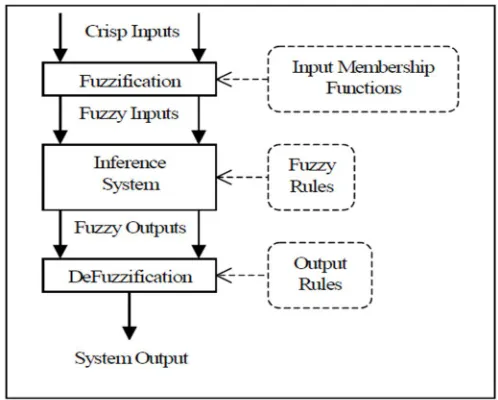
crisp input values are shown as the membership function, of the fuzzy set. The triangular membership functions are semantically represents the variables universe of discourse and it can be defined over the range of the values of fuzzy input. By using the fuzzy rules that are of the form if then rules the fuzzy output can be determined by the inference system once the fuzzification process is finished. The translation of fuzzy output into a crisp value is accomplished by the de-fuzzification process.
II. METHODOLOGY
[image:2.612.186.435.206.406.2]A routing protocol can become more robust and be optimized over a number of metrics by combining the metrics link strength, energy available at a link vertex, and number of hops in a path into single decision. The fuzzy logic sytem is used to decide whether to comtinue with a network broadcast with the catching parameters which are associated with the fuzzifier and are used to convert them into fuzzy sets.
Figure 2.1: Fuzzy Logic System
The main architecture of a fuzzy system is as follows and is presented in fig 2.1 1) Fuzzification: it changes each of the input logical values to a fuzzy set.
2) Defuzzification: each of the obtained fuzzy results is written as a real value.
3) Inference: here fuzzified values are processed. The operation is implemented on the rule base. It includes obtaining membership function for input values, implementing fuzzy logic and obtaining fuzzy output.
4) Rule base: it includes the rules and fuzzy statement if then.
A. Cluster Head Selection Using Fuzzy System
In the proposed model cluster head selection computed using fuzzy logic. It consists of a fuzzifier, fuzzy rules, fuzzy inference engine and a defuzzifier. Input variables used are sensor node parameters such as power available in sensor node, memory and processing speed. Membership function and fuzzy rules are applied to the sensor node parameters.
The membership functions developed and their corresponding linguistic states represented in fuzzy logic are used to select cluster heads among the sensor nodes present in a cluster. The parameters of sensor nodes such as power, memory, processing speed are considered in cluster head selection. The membership function for various parameters of sensor node from xbow mica2 such as power, memory and processing speed and cluster head coefficient (Ch-coeff) are given.
Table 2.1: Rules for Fuzzy System
Distance Degree Priority
Low Low Low
Medium Low Low
High Low Medium
Low Medium Low
Medium
Medium
Medium
High Medium Medium
Low High Medium
Medium High High
High High High
III. ALGORITHMUSED:
A. Dynamic cluster head selection algorithm:
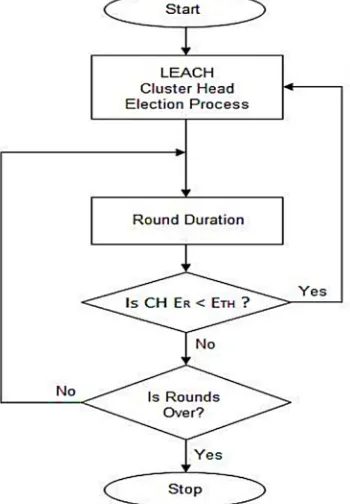
The Dynamic cluster head selection algorithm (D-LEACH) is a modified version of the LEACH protocol and it considers the residual energy available in the nodes before cluster head selection process is initiated in LEACH.
Figure 3.1: Dynamic Cluster Head Election Algorithm
The cluster heads are selected from the set of given nodes N based on probability in the first round and at the end of first round, the residual energy available in the cluster heads are compared with a threshold value. If cluster heads are found to have energy above the threshold, the cluster head selection process is ignored and the existing cluster heads are allowed to continue as cluster head with the same member nodes in the next round. The whole process is repeated until the end of all rounds.
This D-LEACH algorithm reduces the number of cluster heads selected and thereby reduced overhead in selection process and minimized energy dissipation in all nodes.
The Dynamic cluster head selection algorithm is shown in Figure 3.1.
Assuming the total number of sensor nodes in the network as N and the probability of cluster heads selected from the set of N nodes as PCH, the expected number of Cluster head selected per round E(CH) in Static LEACH is given by
N
P
CH
static
CH
(3.2)R
N
P
CH
Leach
CH
(3.3)Assuming the threshold for residual energy as ETh, residual energy in nodes as ER, and the probability of nodes having energy greater than threshold as P(ER>ETh), then the new number of cluster heads selected (CHNew) in D-LEACH satisfying the condition ER>ETh is given by
R
N
P
E
E
P
CH
DLeach
(
R
Th)
CH
(3.4)In the set-up phase of D-LEACH protocol, each node decides whether or not become a cluster-head in the first round based on probability, and from second round based on the residual energy of a node. This decision is made by the node n choosing a random number between 0 and 1. If the number is less than a threshold T (n) and residual energy greater than pre-set value, the node becomes a cluster-head for the current round. The threshold for the D-LEACH is set as:
G n n E and G n if p r p p n T R 0 ) ( ) 1 mod ( 1 )
( (3.5)
IV. RESULT AND ANALYSIS
[image:4.612.172.445.564.716.2]Simulation was carried out in MATLAB and the performance of D-LEACH protocol is analyzed by comparing it with static cluster LEACH and LEACH protocols. The simulation parameters are shown in table 4.1.
Table 4.1: Simulation Parameter Network Parameters
Length of Network 500 m
Width of Network 500 m
Round Duration 10 Sec
Initial Energy in each node 0.1 J
Total Number of Nodes 100
Probability of CH Selection 0.4
Data Rate 1 Kbps
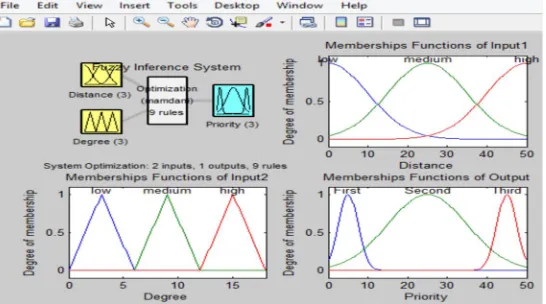
Fuzzy inference system optimization with two inputs and one output memberships’ functions is shown in figure 4.1. First parabolic input membership functions defined is distance; second triangular membership input functions defined is degree and membership functions of output is defined is priority for D-leach with fuzzy inference system algorithm.
Since the task of the FLC controller is steering the node’s sensor towards the highest reported concentration in our MATLAB FLC module, the center of gravity method is used to get a crisp output to control the next moving direction. The FLC controller uses other nodes current location to find out all expansion cells the node has and uses the moving direction generated by the FLC to define the expansion cell located on the path of the moving direction as the nodes optimal deployment location.
A. Simulation Results In Graphical Form
We applied our suggested model to measure the concentration of Radon and found that our model gives satisfactory simulation results. Table 4.2 shows the maximum concentration of Radon measured by the sensors situated at different locations.
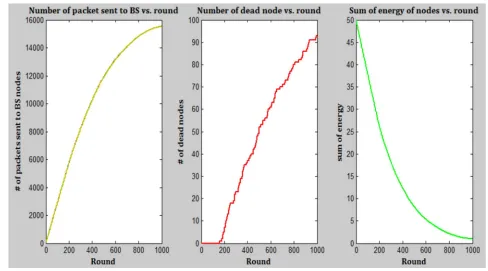
[image:5.612.121.493.140.367.2]Number of packet sent to base station, number of dead node vs round and sum of energy vs round is shown in figure 4.2. 1) Round = 250
Figure 4.2: Number of Packet Sent in 250 Rounds
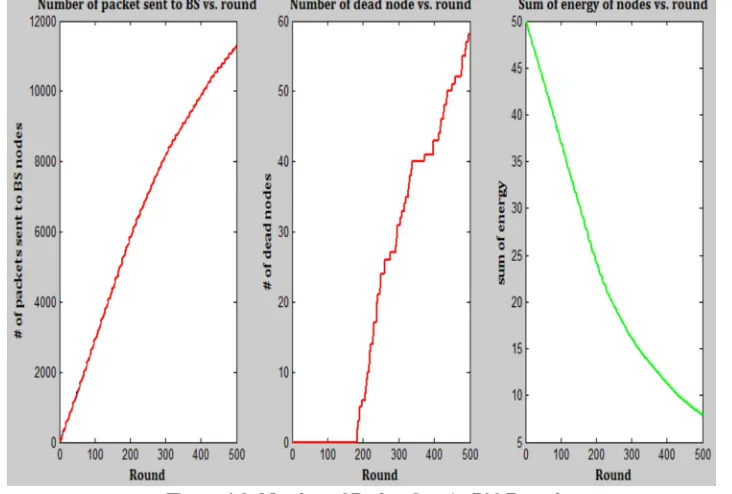
250 rounds vs packets sent to base station (BS) is represented by figure 4.2 (a). It is clearly that the increase round than increase packet sent to BS station but decrease the sum of energy of nodes is shown in figure 4.2 (c). 250 round vs number of dead node is represented by figure 4.2 (b). Number of dead node is depending on the number of packet send.
2) Round = 500: 500 rounds vs packets sent to base station (BS) is represented by figure 4.3 (a). It is clearly that the increase round than increase packet sent to BS station but decrease the sum of energy of nodes is shown in figure 4.3 (c). 500 round vs number of dead node is represented by figure 4.3 (b). Number of dead node is depending on the number of packet send.
[image:5.612.125.491.471.718.2]3) Round = 700: 700 rounds vs packets sent to base station (BS) is represented in figure 4.4(a). It is clear from the figure that as the number of round increases the number of packet sent to the base station also increases but the sum of energy of the nodes decreases as shown in figure 4.4 (c).
Figure 4.4: Number of Packet Sent in 700 Round
4) Round = 1000
Figure 4.5: Number of Packet Sent in 1000 Round
[image:6.612.59.547.414.685.2]5) Round = 1200
Figure 4.6:Number of Packet Sent in 1200 Round
The figure 4.6 shows 1200 rounds vs the number of packets sent.
Table 4.2: Packet Sent to Base Station Node
Round 250 500 700 1000 1200
Packet sent 7100 11300 14000 15500 15800
As shown in table 4.2 the packet sent to base station node are obtained from the proposed dynamic cluster head using fuzzy interference system. From the analysis of the results, it is found that the proposed dynamic cluster head using fuzzy interference system gives a higher packet sent to base station 15800 in 1200 rounds and lower packet sent to base station 7100 in 250 rounds. Sensors facilitate the instrumenting and controlling of factories, offices, homes, vehicles, cities and the ambiance, especially as commercial off-the-shelf technology becomes available. With sensor network technology ships, aircraft and buildings can “self-detect” structural faults.
B. Comparison Of Results
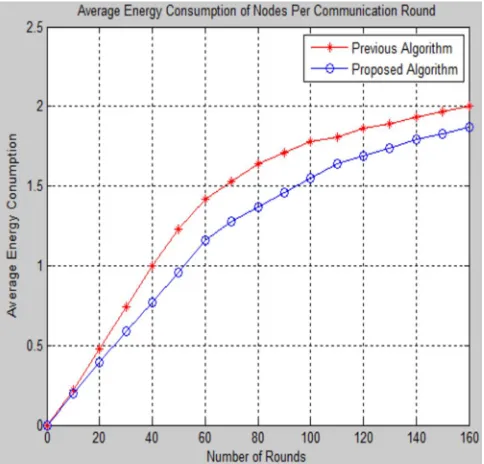
As shown in table 4.3 the average energy consumption is obtained from the proposed dynamic cluster head using fuzzy interference system. From the analysis of the results, it is found that the proposed dynamic cluster head without using fuzzy interference system gives higher average energy consumption.
Table 4.3: Comparison Result for Average Energy Consumption (J)
Rounds Previous Algorithm (Without Fuzzy System)
Avg. energy (J)
Proposed Algorithm (With Fuzzy System)
Avg. energy (J)
0 0.0 0.0
10 0.22 0.20
20 0.48 0.39
30 0.74 0.59
40 1.00 0.77
50 1.23 0.96
60 1.42 1.16
70 1.53 1.28
80 1.64 1.37
90 1.71 1.46
100 1.78 1.55
110 1.81 1.64
120 1.86 1.69
130 1.89 1.74
140 1.93 1.79
150 1.97 1.83
[image:7.612.134.480.470.724.2]Figure 4.7 shows the graphical illustration of the performance of different rounds discussed in this research work in term of average energy consumption. From the above graphical representation it can be inferred that the proposed dynamic cluster head using fuzzy interference system gives the best performance for rounds 160
.
Figure 4.7: Average energy consumption of nodes per communication round
V. CONCLUSION
In this paper we investigated the dynamic cluster head routing protocol by considering the energy consumption by the nodes. In the proposed model cluster head selection is computed using fuzzy logic. It consists of a fuzzifier, fuzzy rules, fuzzy inference engine and a defuzzifier. Besides, a comparison of energy consumption is made between the algorithm without using fuzzy system and an algorithm with fuzzy system. The results are presented to show that as the number of round increases the consumption of total energy is greatly reduced. In this research work thegraphical representation of different rounds in terms of dead nodes is also made.
REFERENCES
[1] J. Luo and J, “-P. Hubaux, A survey of inter-vehicle communication,” EPFL Tech. Rep. IC/2004/24, March, pp. 1–12, 2004.
[2] K. Dar, M. Bakhouya, J. Gaber, M. Wack, and P. Lorenz, “Wireless communication technologies for ITS applications [Topics in Automotive Networking,”
IEEE Commun. Mag., vol. 48, no. 5, pp. 156–162, 2010.
[3] J. Ye, X. Ge, G. Mao, and Y. Zhong, “5G Ultradense Networks with Nonuniform Distributed Users,” IEEE Trans. Veh. Technol., vol. 67, no. 3, pp. 2660–
2670, 2018.
[4] M. T. Rahama, M. Hossen, and M. M. Rahman, “A routing protocol for improving energy efficiency in wireless sensor networks,” 2016 3rd Int. Conf. Electr.
Eng. Inf. Commun. Technol. iCEEiCT 2016, pp. 0–5, 2017.
[5] A. Bazzi, B. M. Masini, A. Zanella, and G. Pasolini, “Vehicle-to-vehicle and vehicle-to-roadside multi-hop communications for vehicular sensor networks: Simulations and field trial,” 2013 IEEE Int. Conf. Commun. Work. ICC 2013, pp. 515–520, 2013.
[6] T. T. Huynh, A. V. Dinh-Duc, and C. H. Tran, “Delay-constrained energy-efficient cluster-based multi-hop routing in wireless sensor networks,” J. Commun.
Networks, vol. 18, no. 4, pp. 580–588, 2016.
[7] N. Jan et al., “A Balanced Energy-Consuming and Hole-Alleviating Algorithm for Wireless Sensor Networks,” IEEE Access, vol. 5, no. c, pp. 6134–6150,