
A method to design and implement enterprise
performance management
Master thesis
Ruben Span
Towards an Enterprise
Towards an Enterprise Performance
Management Solution
A method to design and implement enterprise performance management
Master Thesis
Nieuwegein, July 2009
Author
Ruben A.V. Span
Master Business Information Technology, School of Management and Governance [email protected]
Graduation committee
Romana Aziz
Department University of Twente, Information Systems & Change Management E-mail: [email protected]
Pascal van Eck
Department University of Twente, Computer Science E-mail: [email protected]
Mike van Alst Principal consultant IT-Eye E-mail: [email protected]
IT-Eye B.V. Edisonbaan 14a 3439 MN Nieuwegein
University of Twente PO box 217
Page | 5
Management summary
Motive for the research
Fundeon came to life after the merger of Bouwradius and SBW. Because of this new situation, difficulties arose managing the new company`s performance. IT-Eye was approached to help solving these problems. Unfortunately, IT-Eye did not have a (standard) approach to attack these problems. It soon became clear that companies generally lack guidance when applying enterprise performance management (EPM) to improve their alignment of business processes with their business strategy and to enhance their ability of measuring performance. In addition, also literature did not provide an all-encompassing methodological approach for EPM design and implementation.
Main recommendations
To help solving the indicated problems, this research proposes a method to help designing and implementing EPM. This method consists of phases, steps, activities supporting these steps, and methods and techniques. Although the proposed method can be made more pragmatic, it gives some guidance when applying EPM. This includes the statement that EPM must be designed and implemented in an iterative way, having a steering committee managing the company`s strategy for EPM. Amongst others, this EPM strategy contains decisions about the inclusion of business process redesign and changes in the organizational structure.
Motivation
The method was developed by combining literature with an analysis of current practices. The latter was done by conducting five interviews with experts in the field. The resulting solution design was evaluated with the help of an interactive workshop at Fundeon. To increase the justification of the proposed solution, the research process by itself was also evaluated.
Consequences
The method can be used as guidance to solve the current problems at Fundeon.
The method must be applied in practice to validate its usefulness.
Deliverables should be appointed to each of the steps and/or phases of the method to
increase its usefulness.
The development of the method is an iterative process, which requires an extension of the
analysis of current practices.
The evaluation should be done on a larger scale, including participants from different
branches and backgrounds.
An EPM maturity model should be made to help analyzing the business and to serve as a tool
Page | 7
Preface
Dear reader,
Thank you for taking the time to view the result of months of hard labor. Several nights, weekends and drinks were sacrificed in other to make it to the end of my study period. I must admit that some hurdles had to be taken to come this far. For example the search for two good supervisors took quite some time. Fortunately, it all turned out well by having Romana Aziz and Pascal van Eck as my supervisors from the University of Twente. I would like to thank them for their support and useful feedback during the whole project.
When I started the project, I hoped to quickly produce a method to attack the problems at Fundeon and then apply the method in practice. During my literature review it soon became clear that this plan was impossible to execute. Similar projects can take up to two years, where I had only six months without a clear starting point. Also the development of the method itself appeared to be much more complicated then I thought at the beginning of the project. Therefore my research had to be limited to building the method and testing it via the help of an interactive workshop at Fundeon. Hereby I would like to thank the people at Fundeon for their helpful input during this workshop.
Without the help of IT-Eye, this project would not have been possible. Mike van Alst, thank you for being my external supervisor and helping me during the process. Special thank goes to Tim Pinchetti for being my unofficial second supervisor at IT-Eye giving me useful feedback. I would like to thank the rest of IT-Eye for giving me this opportunity, supporting me and providing a good atmosphere to work in.
Of course, also family and friends must be thanked for being there when I needed it. Finally, I would like to thank the experts I have interviewed. I want to thank them for their time, openness and interesting views on performance management. Their input was crucial for this project`s success.
I hope that you, as a reader, will gain some useful insights when reading this master thesis. Good luck applying enterprise performance management in practice, and may the method be with you!
Best regards,
Ruben Span
Page | 9
Table of Contents
List of Figures... 13
List of Tables ... 14
Acronyms ... 15
1 Introduction ... 17
1.1 Problem description ... 17
1.2 Problem statement ... 18
1.3 Objective ... 18
1.4 Relevance ... 18
2 Research design ... 21
2.1 Research questions... 21
2.2 Research methodology ... 21
2.3 Study propositions: a conceptual framework ... 22
2.4 Data sources of evidence ... 23
2.5 Research procedures: case study protocol ... 24
2.6 Multiple-case design: five experts ... 24
2.6.1 Respondent 1... 24
2.6.2 Respondent 2... 24
2.6.3 Respondent 3... 25
2.6.4 Respondent 4... 25
2.6.5 Respondent 5... 25
3 Literature review ... 27
3.1 Definition of Enterprise Performance Management ... 28
3.2 Enterprise performance management system models ... 29
3.2.1 Performance measurement system models ... 29
3.2.2 EPM functions ... 36
3.3 Factors influencing the method ... 38
3.3.1 Critical success factors ... 38
3.3.2 EPM view ... 39
3.4 EPM method: system design and implementation frameworks ... 41
3.4.1 Enterprise performance management system frameworks ... 41
3.4.2 Performance measurement system development frameworks... 48
3.4.3 Comparison of frameworks ... 54
Page | 10
4 Current practices... 59
4.1 Enterprise performance management system models ... 60
4.1.1 EPM system models related to interviews ... 60
4.1.2 EPM system models from software vendors... 62
4.1.3 Comparison of models ... 64
4.2 Factors influencing the method ... 67
4.2.1 Critical success factors ... 67
4.2.2 EPM View ... 68
4.3 EPM method ... 70
4.3.1 Phases and steps ... 70
4.3.2 Activities ... 71
4.3.3 Roles & responsibilities ... 71
4.3.4 Methods & techniques ... 72
4.4 Conclusion and discussion of current practices ... 74
5 Solution design... 75
5.1 Enterprise performance management system model ... 76
5.2 Factors influencing the method ... 78
5.2.1 Critical success factors ... 78
5.2.2 EPM view ... 79
5.3 EPM method ... 80
5.3.1 Overview of the developed method ... 81
5.3.2 Phases & steps ... 82
5.3.3 Supporting activities ... 87
5.3.4 Methods & techniques ... 90
5.3.5 Roles & responsibilities ... 94
5.4 Conclusion and discussion of solution design ... 96
5.4.1 Enterprise performance system model... 96
5.4.2 Factors influencing the method... 96
5.4.3 EPM method ... 96
6 Evaluation ... 99
6.1 Evaluation of the solution design ... 100
6.1.1 Methodology to evaluate the solution design ... 100
6.1.2 Workshop results ... 101
Page | 11
6.1.4 Discussion workshop results ... 105
6.2 Evaluation of the research process ... 106
6.2.1 Guideline 1: Design as an artifact ... 106
6.2.2 Guideline 2: Problem relevance ... 107
6.2.3 Guideline 3: Design evaluation ... 107
6.2.4 Guideline 4: Research contributions ... 107
6.2.5 Guideline 5: Research rigor ... 107
6.2.6 Guideline 6: Design as a search process ... 108
6.3 Conclusion of evaluation ... 109
7 Conclusions ... 111
7.1 Summary ... 111
7.2 Answer to the main research question ... 112
7.3 Further research ... 113
References ... 115
Appendices ... 121
Appendix A: Interview questions ... 123
Appendix B: Node list to structure interviews results ... 124
Appendix C: Additional interview data ... 125
Background ... 125
Definition EPM ... 126
Future of Enterprise Performance Management ... 126
Appendix D: Approaches to structural design ... 127
Appendix E: Method towards the design and implementation of an enterprise performance management solution ... 128
Appendix F: Traceability matrices... 129
Appendix G: Maturity Models ... 134
Appendix H: Workshop slides ... 136
Appendix I: Renewed method towards the design and implementation of an enterprise performance management solution ... 139
Page | 13
List of Figures
Figure 1 - Methodology ... 22
Figure 2 - Conceptual EPM approach framework... 22
Figure 3 - Balanced Scorecard [KN96] ... 29
Figure 4 - Performance Pyramid System[LC91] ... 30
Figure 5 - EFQM Business Excellence Model [POG98] ... 31
Figure 6 - IPMS by Laitinen [Lai02] ... 31
Figure 7 - Dynamic PMS model and the Integrated dynamic PMSs model [BTB00]... 32
Figure 8 - Folan and Browne performance measurement axis and grid [FB05] ... 33
Figure 9 - BPM framework[FA06] ... 42
Figure 10 - Business Performance Management Lifecycle[ZLDC06] ... 42
Figure 11 - A closed-loop management system linking strategy and operations[KN08] ... 44
Figure 12 - BPM solution guidelines [CBCC06] ... 45
Figure 13 - EPM methodology by Dresner[Dre08] ... 47
Figure 14 - Phases in PMS development[BMWN00] ... 48
Figure 15 - Steps to build a BSC[KN00] ... 49
Figure 16 - Process for performance measurement system design[WF91] ... 50
Figure 17 - PMS design process[NMPR00] ... 51
Figure 18 - Framework for auditing and enhancing PMSs[MS00] ... 52
Figure 19 - Integrated methodological approach for BSC synthesis and implementation[PIPE05] ... 53
Figure 20 - PDCA cycle [Dem86] ... 54
Figure 22 - Business performance solutions footprint [Ham07] ... 60
Figure 21 - EPM system model [respondent 2] ... 60
Figure 23 - Generic model for performance management tools [GC05] ... 61
Figure 24 - Oracle EPM system model [Ora08] ... 62
Figure 25 - IBM Cognos corporate performance management system [IBM09] ... 63
Figure 26 - SAP Business Objects performance management model [Wei04] ... 64
Figure 27 - EPM system model ... 76
Figure 28 - Phases of EPM design and implementation ... 81
Figure 29 - Prepare ... 82
Figure 30 - Analyze business ... 82
Figure 31 - Determine business strategy ... 83
Figure 32 - Develop EPM strategy ... 84
Figure 33 - Design system ... 85
Figure 34 - Implement... 86
Figure 35 - Risk management cycle [Boe91] ... 89
Figure 36 - Renewed phase 4 ... 104
Page | 14
List of Tables
Table 1 - Medori and Steeple performance measurement grid [MS00]... 33
Table 2 - Comparison of PMS models ... 35
Table 3 - EPM functions ... 36
Table 4 - Decision making models [Daf03] ... 40
Table 5 - Main set of questions[Otl99] ... 41
Table 6 - Phases in designing and implementing EPM and PMS ... 54
Table 7 - Steps and activities when designing and implementing PMS ... 55
Table 8 - Comparison of EPM frameworks ... 56
Table 9 - EPM system model layers ... 64
Table 10 - Comparison of EPM system model elements ... 65
Table 11 - Critical success factors of EPM from practice ... 67
Table 12 - Phases and steps of EPM derived from interviews ... 70
Table 13 - Roles in an EPM project ... 72
Table 14 - Workshop results: critical success factors ... 101
Page | 15
Acronyms
BI Business Intelligence
BPM Business Performance Management (synonym for EPM)
BPR Business Process Redesign
BSC Balanced Scorecard
CFO Chief Financial Officer
CIO Chief Information Officer
CMM Capability maturity model
COTS Commercial off-the-shelf
CPM Corporate Performance Management (synonym for EPM)
CSF Critical Success Factor
EFQM European Foundation for Quality Management
EPM Enterprise Performance Management
EPMS Enterprise Performance Management System
ERP Enterprise Resource Planning
ETL Extraction, Transformation, and Loading
ICT Information and Communication Technology
IPMS Integrated Performance Measurement System
IS Information Systems
IT Information Technology
KPI Key Performance Indicator
OM Observation Model
PDCA Plan, Do, Check, Act
PDSA Plan, Do, Study, Act (synonym for PDCA)
PM Performance Measurement
PMG Performance Measurement Grid
PMS Performance Measurement System
PoC Proof of Concept
PPS Performance Pyramid System
Page | 17
1
Introduction
Within this first chapter of the thesis an introduction of the conducted research is given. Its purpose is to provide insight in the background of the research, making clear what the ‘business case’ is all about. Whereas different definitions exist of the term Enterprise Performance Management, it must be noted that the used definition within this thesis will be made clear in the literature review (chapter 3).
This chapter starts with the problem description, explaining the original reason for the conducted research (paragraph 1.1). As a result, a problem statement is defined (paragraph 1.2), followed by the objective of this research (paragraph 1.3). An explanation is provided to show how this research adds value to both literature and practice (paragraph 1.4).
Within the second chapter the complete research will be described in a more comprehensive way. The structure of this thesis will become clear at a later stage (paragraph 2.2: Research methodology), but one can already see that this thesis is structured linear to how the research was conducted. A literature review will be given (chapter 3), followed by an analysis of current practices (chapter 4). These two are combined to come to the design of the solution (chapter 5). Next, the solution design is evaluated (chapter 6) and conclusions are drawn (chapter 7).
1.1
Problem description
Fundeon is a knowledge centre which came to life after the merger of Bouwradius and SBW in 2006. It operates as the chain between organizations from the building and infra sector, and the technical and vocational training. Since 2007 a new enterprise information system has been set up. Although the company formulated several business objectives, it did not set indicators which should notify the management whether or not these objectives are met. With the arrival of the new enterprise information architecture, a good opportunity has been given to introduce more measurement points and elaborate on the current business objectives by linking them with appropriate measurements.
Next to this opportunity, there is a problem with the current way in which the strategy is communicated within Fundeon. For example the IS manager did not know about the spearheads of Fundeon`s policy. Clearly, the strategy of Fundeon was not visible enough for its own employees.
Another problem is that Fundeon thinks there is a weak spot within the organization they cannot recover with the current (limited) measurement methods. This implicates that current performance measurement methods are not accurate enough to find inefficiencies within business processes.
An important problem is the lack of management decision justification. Little insight is given on which management information was available when decisions were made and to which extent these decisions were made on a rational basis.
The last problem Fundeon faces is that their sponsors, including representatives of the branch they are working with, want an elaboration on the effects of the money they have put in the knowledge centre. Within the current situation, little overview of the company`s performance can be awarded to the shareholders in order to keep them satisfied.
Page | 18 discover how it best can design and implement a new performance measurement or management system.
1.2
Problem statement
As a result of the problem description, the problem statement is formulated as:
“Companies lack guidance when applying enterprise performance management to improve the alignment of business processes with the business strategy and to enhance the ability of measuring performance.”
1.3
Objective
The objective is “to come to a method towards the design and implementation of an enterprise
performance management solution, thereby improving the alignment of business processes with the business strategy and enhancing the ability of measuring performance.”
This method must consist of steps to be taken when designing and implementing an EPM solution and a set of techniques and methodologies which are needed to execute these steps. The resulting method must be independent of the technology to be used when implementing the solution.
This objective should tackle the problem of IT-Eye, and thus Fundeon as well, to come to a method to clarify and communicate the company`s strategy and to monitor business processes. The next step of exploring the applicability of an enterprise performance management system should help the company amongst others in decision making and automating management processes. This should envision new opportunities for the company to further more improve performance.
1.4
Relevance
Enterprise Performance Management (EPM) is a topic in the business intelligence area that is receiving a great deal of attention. It was recently ranked as one of the top ten technology trends that CIO’s should have on their radar [AF08], and considered useful to “keep a jump ahead of the competition” *Sch04+.
According to Lingle and Schieman [LS96] organizations using balanced performance measurement systems as the foundation for management perform better than those that do not. Therefore, it should be valuable for companies to gain knowledge about the introduction of an EPM system and to gain understanding of the properties this system must have for it to be executable and successful.
Next to this practical relevance, there is a gap in literature concerning EPM. Currently, no
all-encompassing methodological approach for EPM design and implementation exists.1 And as Dresner
[Dre08] denotes, one can approach EPM in multiple ways whereas different business cases require different approaches. Although this statement could be interpreted as a restriction on the legitimacy of a methodological approach for EPM design and implementation, variations can be incorporated within the solution to encompass this need for different approaches.
1
Page | 19 Current EPM approaches in literature include the BPM framework by Frolick and Ariyachandra [FA06], and the BPM lifecycle by Zeng et al. [ZLDC06] (see chapter 3). These frameworks are set up at a high-level and have great similarities with the PDCA cycle from Deming [Dem86]. Therefore they lack detail and have a main focus on the continuous improvement aspect of EPM implementation. Summarizing, the present EPM frameworks are little specific for EPM development and are less practical in supporting the design and implementation of EPM solutions.
Page | 21
2
Research design
This chapter describes the research as it is conducted. It starts with the research questions which are based upon the problem statement and the objective of the research. Next, the methodology of the research is described to clarify how this project attempts to answer the research questions. As a consequence of the methodology a conceptual framework has been developed. This framework can be seen as the proposition of this study and is used to help structuring the research. Next, the data sources of evidence are described. It shows how data is collected. The research procedures show the case study protocol used to execute the data collection. As elaborated in this chapter, a multiple-case design is used for this research. This entails interviews of five experts at different companies. In paragraph 2.6 these cases are described.
2.1
Research questions
Based on the problem statement and objective, the main research question is formulated as follows:
What can be a method towards the design and implementation of an enterprise performance management solution, and what are the properties of this solution?
To answer this question, several sub-questions have been defined:
1) What is the current state of affairs in literature, regarding enterprise performance
management (EPM)?
2) What are constraints one has to deal with when designing and implementing an EPM
solution in practice?
3) What are the properties of an EPM solution in practice?
4) What phases can be distinguished within the design and implementation process of an EPM
solution in practice?
5) What steps or activities can be executed when designing and implementing an EPM solution
in practice?
6) What methods and techniques can be used to support these steps or activities in practice?
2.2
Research methodology
The first part of this project consists of a descriptive research wherein the foundation of the solution is laid by the use of scientific literature (chapter 3). After the description of the current literature on performance measurement systems and enterprise performance management models and frameworks, an analysis is made of the current practices (chapter 4). This analysis must help to gain understanding on how EPM is approached in practice as needed to develop a method to design and implement EPM. To do this analysis, the choice has been made to use a holistic multiple-case design. According to Yin [Yin92] holistic multiple-case design is the analysis of the same or similar situations in different organizations. Within this research it entails the analysis of the approach of EPM design and implementation by interviewing five experts from different companies. Since each expert has his own vision and operates in his own setting, each of these interviews can be interpreted as a different case.
Page | 22 6). The outcome of this workshop results in the modification of the proposed method. The developed method has implications for practice and literature (chapter 7) which helps solving the problem as stated before. The used methodology can be recovered from Figure 1.
Analysis of current practices
Design theory Modify theory Develop
implications Evaluate theory
Literature study
4 3
[image:22.595.138.461.373.725.2]5 6 6 7
Figure 1 - Methodology
2.3
Study propositions: a conceptual framework
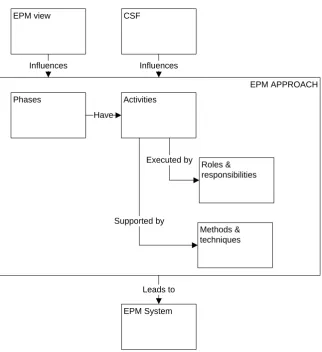
On the basis of the research questions a conceptual framework has been developed. The idea of developing such a framework comes from the sourcebook for qualitative data analysis of Miles and Huberman [MH94]. At a later stage the framework will be used to structure qualitative data and to build the method around. The developed framework is shown in Figure 2.
Roles & responsibilities
Phases Activities
Methods & techniques CSF
EPM System Leads to Have
Executed by
Supported by Influences
EPM APPROACH EPM view
Influences
Page | 23 The framework consists of three parts, which are also used to structure the chapters within this thesis. The upper part (‘EPM view’ and ‘CSF’) are the factors which influence the content of the approach. The approach itself consists of ‘Phases’ which on its turn has ‘Activities’. These activities are executed by persons having different ‘roles & responsibilities’ and are supported by the use of several ‘methods & techniques’. The contents of these four boxes combined make the method to design and implement an EPM solution. The last part of the framework is the ‘EPM system’ itself, which is the result when the method has been executed.
The boxes of this framework are based on the project`s research questions (see paragraph 2.1). The box ‘EPM view’ and ‘EPM system’ are incorporated to get insight into the answer to the question ‘What are the properties of an EPM solution in practice?’, and to understand what an EPM system
could look like in practice.The box ‘EPM view’ includes statements about how the company should
be organized and how EPM should support this management method. This box also includes statements about the way EPM should be scoped. The box ‘CSF’ (critical success factors) is
incorporated to answer the question ‘What are constraints one has to deal with when designing and
implementing an EPM solution in practice?’. The question ‘What phases can be distinguished within the design and implementation process of an EPM solution in practice?’ is answered by the box ‘phases’. The box ‘activities’ entails the high-level activities which are performed when conducting EPM, such as project management and change management. It provides answers to the question ‘What steps or activities can be executed when designing and implementing an EPM solution in practice?’. It has activities executed in a specific order (steps), activities executed within specific phases and activities executed during multiple phases. The box ‘methods & techniques’ copes with
the question ‘What methods and techniques can be used to support these steps or activities in
practice?’ The box ‘roles & responsibilities’ has been added to summarize the (group of) persons to be involved in an EPM project and the responsibilities of these persons for different activities within EPM.
2.4
Data sources of evidence
As mentioned before, the method is created by combining literature and current practices. The literature study has been conducted by gathering and analyzing journal papers, conference papers and scientific books. To be sure most of the literature about this subject was gathered, keyword search and forward and backward reference search was applied by using diverse search engines in the likes of IngentaConnect, Scopus and Google Scholar. The approaches of Webster and Watson [WW02] and Levy and Ellis [LE06] were used to conduct the literature review and to validate the quality of found literature by focusing on top journals and conferences.
The analysis of current practices is done by interviewing five experts in the field. To ensure the corroboration of evidence, documents of the experts were used in the form of PowerPoint slides, whitepapers, leaflets and books. The next paragraph (2.5) will elaborate on this by summarizing the research procedures.
Page | 24
2.5
Research procedures: case study protocol
Within the analysis of current practices the expert interviews are leading. The questions used in these interviews are derived from the literature study and the conceptual framework from paragraph 2.3. The questions can be recovered from Appendix A: Interview questions.
As with the conceptual framework, the case study protocol is based on the sourcebook for qualitative data analysis of Miles and Huberman [MH94]. The interviews were approached in an open way with a relatively passive interviewer. In this way as much information as possible was gained from the interviews and the objectivity of the interview results can be assured. For this reason the question list was primarily used as a reference guide, i.e. not all of the questions from this list were literally asked.
The interviews were recorded and then transcribed and analyzed with the help of a text coding program. The transcriptions were coded, categorizing text pieces using a list of nodes. The used ‘node list’ can be recovered from Appendix B: Node list to structure interviews results. The pieces of text at each of these nodes were used to summarize the interviews per topic, serving as the backbone for the analysis of the current practices.
2.6
Multiple-case design: five experts
As explained in paragraph 2.2, this research uses five cases to analyze current practices. This paragraph describes the different backgrounds of the experts, thus summarizing the different cases used within the analysis of current practices. An additional summary of the cases can be found in Appendix C: Additional interview data.
The interviews with the experts were held between February 24th and March 13th 2009. Each
interview took between 1 and 1 ½ hour. The interviews were recorded with agreement of the respondents.
2.6.1 Respondent 1
The first case entails a small, very specialized consultancy company working with EPM for over fifteen years. It has implementations at both small and large companies, with no specific branch focus. The size of the projects also differs. For example only the help of this company is required at certain stages of the EPM project. The company has worked with forty to fifty clients from which fifteen to twenty are guided for the duration of the full EPM project. These types of projects normally have a time span of over a year.
The expert has a lot of experience with EPM. He has written books about the subject, teaches classes about it at the university and is director of his own company. His role is that of a coach within an EPM project, i.e. instead of taking over the steering wheel himself, he goes to a company and tries to get the company manage itself in a better way.
2.6.2 Respondent 2
Page | 25 consulting network, which collaborates on “thought leadership, best practices, training and real life experiences to create a unique perspective on the successful implementation of EPM solutions.”
The expert is director of the company and has many years of experience with EPM. This includes experience gained within his current company and his previous jobs at a large international consultancy firm and a large software vendor.
2.6.3 Respondent 3
The third case entails a large international firm in consultancy, ICT and outsourcing. Its client base is diverse, but mainly focused on the top eighteen organizations in the finance & public sector. The firm does the whole EPM project, i.e. from developing the strategy till the actual implementation of an EPM solution. When executing an EPM project, personnel from different departments are put to action. For example the strategy is developed within a different part of the company than the implementation of the actual EPM solution. The duration of an EPM project executed by this company differs a lot. It can take two to three months or, when making a complete environment, two to three years.
The expert is partner at the firm and describes himself as an expert on management inquiries, consultancy for EPM, BI, data warehouses, ETL and decision support. He has done this job for approximately ten years at this firm. He sees himself as an architect of the EPM project, i.e. setting out the big lines and setting up quality assurance.
2.6.4 Respondent 4
The fourth case deals with a large international IT-service provider. It has a large client base, whereby the respondent has done two complete EPM projects at the private sector and five at the public sector. About thirty percent of all the sales is retrieved in the area of management information and EPM at the public sector. This respondent also denotes that his EPM projects differ a lot in size and duration.
The expert is senior organizational advisor at this firm for the duration of five and a half years. He is also a university teacher and has written a book about the subject.
2.6.5 Respondent 5
The last case concerns a medium sized IT service provider, specialized in performance management, system and network management, system development and maintenance, and output management systems. Its client base is very large, including all large Dutch companies and two hundred large companies outside the Netherlands. Performance management is one of the four business units of the company.
Page | 27
3
Literature review
Within this chapter an elaboration is given on the current state of affairs in literature regarding performance measurement systems and enterprise performance management (EPM) systems. Literature about both types of systems is reviewed, because performance measurement is intertwined with performance management [Leb95].
Whereas one can interpret the term enterprise performance management in different ways, this chapter starts with an explanation of the term as it is used within this thesis (paragraph 3.1).
The remaining part of this chapter is structured according to the three parts of the conceptual framework. Paragraph 3.2 describes the system models available in literature. It describes the performance measurement system models and the functions an EPM system must have. Only the functions of an EPM system are mentioned, whereas no holistic EPM model was found in literature. (see paragraph 1.4)
Paragraph 3.3 describes the factors influencing the EPM method. This entails the critical success factors (CSF) found in literature and preliminary theory on the view on EPM. The CSF`s are the factors one has to deal with in order to increase the likelihood of successful EPM introduction. These factors should be covered by the activities within the proposed method.
Paragraph 3.4 gives a literature review on enterprise performance management and performance measurement system models and frameworks. Comparisons are provided to emphasize the similarities and differences of these models and frameworks, thereby indicating their usefulness for the development of the EPM design and implementation method.
At the end of this chapter (paragraph 3.5) a conclusion is provided, reflecting on the current state of
literature regarding EPM. Hereby the first research question ‘What is the current state of affairs in
Page | 28
3.1
Definition of Enterprise Performance Management
In order to define performance measurement, one must first agree on what performance is. Performance is used in many different contexts with as many different uses of the term. [FBJ07] Neely et al. [NGP95] define performance as the efficiency and effectiveness of action, whereby a performing business is the one which takes efficient and effective actions. According to Lebas [Leb95], performance is the potential for future successful implementation of actions in order to reach the objectives and targets. This definition views a performing business as the one that will achieve the objectives set by the managing coalition, not necessary the one that has achieved the objectives. Within this research, the combination of both definitions is used to define performance:
Performance is the efficiency and effectiveness of action, whereby a performing business is the one which will achieve the objectives set by the managing coalition.
Measurements must be taken in order to know the likelihood of reaching the objectives set by management. To do so, one has to make use of a performance measurement system. Neely et al. [NGP95] define a performance measurement system as a set of metrics used to quantify both the efficiency and effectiveness of actions. Combining this definition with the previously described definition of performance, the next definition of a performance measurement system is formed:
A performance measurement system is a set of metrics used to quantify the efficiency and effectiveness of action, whereby a performing business is the one which will achieve the objectives set by the managing coalition.
Enterprise performance management uses the information gathered through this performance measurement system to effect positive change in organizational culture, systems and processes. [AB02] It enables an organization to effectively monitor, control, and manage the implementation of strategic initiatives. [FA06] Hereby it combines business strategy and technological structure to direct the entire organization towards accomplishing common organizational objectives. [AF08] Within this project, again a combination of definitions is used to define enterprise performance management:
Page | 29
3.2
Enterprise performance management system models
This paragraph serves as theoretical background on how an Enterprise performance management system model looks like. First performance measurement system (PMS) models are described and compared. Next, a summary is given on the functions an EPM system must have. Only the functions of an EPM system are mentioned, whereas no holistic EPM model was found in literature.
3.2.1 Performance measurement system models
Within this section performance measurement system models are summarized and compared. These models are quite abstract, giving guidance to companies on a high level by supplying a way to visualize a performance measurement solution.
3.2.1.1 Balanced scorecard
Although the balanced scorecard (BSC) was introduced in 1992 by Kaplan and Norton [KN92] as a pure measurement tool, it soon evolved towards a strategic management system. As a strategic management system, the BSC enables a company to link long-term strategy to short term actions. [KN96]
[image:29.595.81.501.433.700.2]As Mooraj at al. [MOH99] state, the Balanced Scorecard is a tool which adds value by providing both relevant and balanced information in a concise way for managers, creating an environment which is conducive to learning organizations and eliminating the need for managers to ‘choose’ which type of control system to use at any given time. It contains outcome measures and the performance drivers of outcomes, linked together in cause-and-effect relationships and thus aims to be a feed-forward control system. [Nor00]
Page | 30 The basis of the BSC lies around the use of four perspectives, namely the financial, customer, internal business process and learning and growth perspectives, to determine the business performance. Within this method, the company translates its vision and strategy towards concrete goals with appropriate indicators, showing the degree of achieving these goals. Figure 3 represents the balanced scorecard.
After its creation, several applications of the BSC were introduced. Examples are the balanced IS scorecard by Martinsons[Mar99] to measure and evaluate IS activities, the IT balanced scorecard by Van Grembergen and Saull[VS01] to measure the performance of an IT project or IT department, and the Web Services Balanced Scorecard Framework by Huang and Hu [HH04] to match potential benefits of web services with corporate strategy.
3.2.1.2 Performance Pyramid System
The Performance Pyramid System (PPS) was originally developed by Judson in 1990[Jud90], and later improved by Lynch and Cross [LC91]. The purpose of the PPS is to link an organization's strategy with its operations by translating objectives from the top down (based on customer priorities) and measures from the bottom up. [Lai02]
The framework (Figure 4) ties together the hierarchical view of business performance measurement with the business process view. It also makes explicit the difference between measures that are of interest to external parties (customer satisfaction, quality and delivery) and measures that are primarily of interest within the business (productivity, cycle time and waste). [NMPR00]
3.2.1.3 EFQM Business Excellence Framework
[image:30.595.299.569.265.473.2]The introduction of the Business Excellence Model came after the European Foundation for Quality Management (EFQM) was founded in 1988, set up by 14 major European companies due to a lack of quality, productivity and competiveness in a dynamic world market. [WSG03] It was used as the assessment model for the European Quality Award since 1991, and later transformed into the Business Excellence Model as shown in Figure 5. [POG98] It consists of criteria a company can manipulate, the enablers, and criteria a company will achieve, the results.
Page | 31
Figure 5 - EFQM Business Excellence Model [POG98]
3.2.1.4 Integrated Performance
Measurement System
Laitinen [Lai02] created the
Integrated performance
mea-surement system (IPMS), specially designed for use within SMEs (see Figure 6). It is meant to be a useful managerial tool for measuring and improving performance in business firms.
The system is based on seven main dimensions of measures, classified
as two external dimensions
(financial performance and
competitiveness) and five internal
dimensions (costs, production
factors, activities, products and revenues) linked by a causal chain. The internal dimensions are used to monitor the whole production
process, and the external
[image:31.595.246.539.313.746.2]dimensions are used to monitor the position of the company in its competitive context. [GBB05]
Page | 32
3.2.1.5 Integrated dynamic performance measurement model
Bitici and Turner [BTB00] state that a performance measurement system should be a dynamic system in order to keep the integrity, agility and responsiveness of the organization. In this way one can cope with changes in the internal as well as the external environment. Their view, as depicted by Figure 7, involves the principle of continuous improvement. The PDSA cycle, also known as the PDCA cycle, [Dem86] is incorporated to ensure that gains achieved through improvement programs are maintained.
The dynamic performance measurement system consists of an external and internal monitoring system to continuous monitor developments and changes, a review system to decide internal objectives and priorities, and an internal deployment system to deploy the revised objectives and priorities to critical parts of the system.
Whereas the need for change does not always come from top-management, Bitici and Turner [BTB00] state that Figure 7 applies to the whole business as well as to each business unit or business process within the business. Therefore the model is applied at different layers in the company, resulting in an integrated model as visualized in Figure 7. The elements of this integrated model are linked to each other, deploying objectives and priorities from higher levels down to lower levels.
Page | 33
3.2.1.6 Performance measurement grid
[image:33.595.52.535.413.694.2]Medori and Steeple [MS00] designed a framework for auditing and enhancing performance measurement systems (PMSs) as dealt with in paragraph 3.4.2.5. This framework includes the use of a performance measurement grid to select the best measures as shown in Table 1.
Table 1 - Medori and Steeple performance measurement grid [MS00]
Folan and Browne [FB05] extended this grid, as can be seen in Figure 8. They linked performance measurements to three perspectives: the internal, supplier and customer perspectives. This resulted in adapted measurement categories linked to critical success factors.
Page | 34
3.2.1.7 Comparison of performance measurement system models
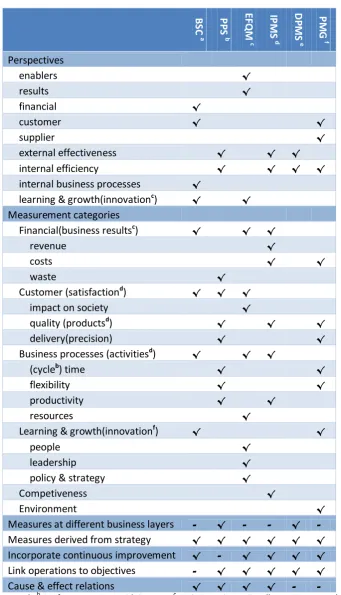
This section provides an overview of performance measurement system models in literature. These models are quite abstract, giving guidance to companies on a high level by supplying a way to visualize a performance measurement solution. A comparison of these models has been made by developing a concept-matrix as depicted by Table 2. Within this matrix concepts from each of the PMS models are extracted and categorized. Similar concepts are combined, as indicated by the
checkmark (√). The table is divided in three parts, which are explained below.
Perspectives
The comparison starts with a summary of the perspectives incorporated within the different models. Herein it is proposed that one should look at an enterprise not only from a financial point of view, but also non-financial using different perspectives. This incorporates an internal as well as an external view, thus focusing on how the company operates internally as well as on how its environment responds to these operations.
Measurement categories
As a consequence of viewing the company from different perspectives, measurements must also be set from different points of view. The resulting categories as mentioned within the PMS models can therefore be placed within the defined perspectives. Within this comparison the measurement categories have been positioned under the perspectives of the balanced scorecard. Two measurement categories appear to be outside these perspectives, namely the competiveness and environment categories. Competiveness should help to determine how well the company is doing in the market, thus the level of how good it can compete with its competitors. The environment entails the working atmosphere within the company, thus having effect on the employees` satisfaction and indirectly on the productivity within the company.
General comparison
Page | 35
Table 2 - Comparison of PMS models
B
SC
a
P
P
S b
EF Q M c IP M
S d
D
P
M
S e
P
M
G
f
Perspectives
enablers √
results √
financial √
customer √ √
supplier √
external effectiveness √ √ √
internal efficiency √ √ √ √
internal business processes √
learning & growth(innovationc) √ √
Measurement categories
Financial(business resultsc) √ √ √
revenue √
costs √ √
waste √
Customer (satisfactiond) √ √ √
impact on society √
quality (productsd) √ √ √
delivery(precision) √ √
Business processes (activitiesd) √ √ √
(cycleb) time √ √
flexibility √ √
productivity √ √
resources √
Learning & growth(innovationf) √ √
people √
leadership √
policy & strategy √
Competiveness √
Environment √
Measures at different business layers - √ - - √ -
Measures derived from strategy √ √ √ √ √ √
Incorporate continuous improvement √ - √ √ √ √
Link operations to objectives - √ √ √ √ √
Cause & effect relations √ √ √ √ - -
a
Balanced scorecard, b Performance Pyramid System, c EFQM Business Excellence Framework, d Integrated
Performance Measurement System, e Integrated dynamic performance measurement model, f Performance
Page | 36
3.2.2 EPM functions
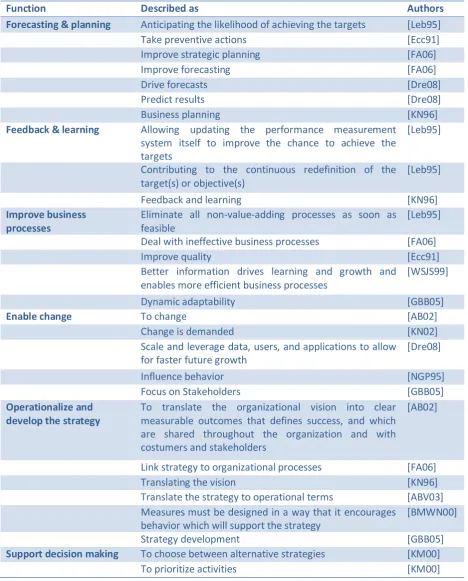
[image:36.595.65.534.178.759.2]Whereas literature does not provide a comprehensive model or list of functions of Enterprise performance management (and Performance measurement systems), a proposition of functions is made within this paragraph. Table 3 summarizes these properties which are based upon the frameworks and models of the previous paragraph, extended with suggestions from literature.
Table 3 - EPM functions
Function Described as Authors
Forecasting & planning Anticipating the likelihood of achieving the targets [Leb95]
Take preventive actions [Ecc91]
Improve strategic planning [FA06]
Improve forecasting [FA06]
Drive forecasts [Dre08]
Predict results [Dre08]
Business planning [KN96]
Feedback & learning Allowing updating the performance measurement system itself to improve the chance to achieve the targets
[Leb95]
Contributing to the continuous redefinition of the target(s) or objective(s)
[Leb95]
Feedback and learning [KN96]
Improve business processes
Eliminate all non-value-adding processes as soon as feasible
[Leb95]
Deal with ineffective business processes [FA06]
Improve quality [Ecc91]
Better information drives learning and growth and enables more efficient business processes
[WSJS99]
Dynamic adaptability [GBB05]
Enable change To change [AB02]
Change is demanded [KN02]
Scale and leverage data, users, and applications to allow for faster future growth
[Dre08]
Influence behavior [NGP95]
Focus on Stakeholders [GBB05]
Operationalize and develop the strategy
To translate the organizational vision into clear measurable outcomes that defines success, and which are shared throughout the organization and with costumers and stakeholders
[AB02]
Link strategy to organizational processes [FA06]
Translating the vision [KN96]
Translate the strategy to operational terms [ABV03]
Measures must be designed in a way that it encourages behavior which will support the strategy
[BMWN00]
Strategy development [GBB05]
Support decision making To choose between alternative strategies [KM00]
Page | 37 Direct and focus the attention of decision makers on
results and determinants
[KM00]
Make aligned decisions across the enterprise based on insights derived from one version of the truth
[Dre08]
Set targets [ABV03]
Budgeting [Sha02]
Link rewards to performance
Linking incentives to performance [Ecc91]
Linking rewards to performance measures [ABV03]
Deliver insights Competitive benchmarking [Ecc91]
Understand the impact of changes across the enterprise [Dre08]
Piloting the business [Leb95]
Explore potentials [Ecc91]
Report To evaluate Information and Communication Technology projects
[MM04]
Show the health of the company [Sch04]
Monitoring operations [NMPR00]
Reporting [Sha02]
Report on outcomes internally & externally [Dre08]
Support cooperation Communicating and linking [KN96]
Improve cross-functional cooperation along the supply chain to offer shorter delivery times, more flexibility and faster introductions of new products
[LFW04]
Better synchronization across functional and national boundaries
[LFW04]
To streamline Operations across a chain of separate companies to offer better service to end customers against lower costs for the supply chain in its totality
[LFW04]
An EPM system must facilitate collaboration and information sharing
[Dre08]
Increase visibility Increase visibility [Dre08]
Alert the players enterprise wide to things happening, and what needs presents action
[LFW04]
Create transparency and visibility across the enterprise [Dre08]
Deliver visibility of information [Sha02]
Information management
Improve data integrity Improvement of data integrity [Dre08]
Improve timeliness of information
Time lag between business and IT planning processes [ZJ99]
Increase information accessibility
An EPM system must provide the right information at the right time in the right format to the people who need it
Page | 38
3.3
Factors influencing the method
Within this paragraph the factors influencing the method to design and implement EPM are summarized. This is done in two parts: critical success factors and ‘EPM view’. The last one is incorporated to gain knowledge about the way the companies’ organization and management method influences the EPM method.
3.3.1 Critical success factors
When designing and implementing an EPM system, one has to deal with several factors in order to make the project successful. Ariyachandra and Frolick [AF08] developed a list of ten critical success factors one needs to cope with when undertaking an EPM project. Within this overview, an elaboration on the list of Ariyachandra and Frolick is given by incorporating views of other authors. These factors are:
Champion
One should have a committed, energetic project champion who actively supports and promotes the BPM project often providing information, material resources, and political support.
Management of Resistance
The willingness or urgency to change and the corporate culture plays a crucial role in EPM success. [LFW04] [KN02] [KM00] Establishing a culture that embraces the use of performance measurement to manage the business is crucial, whereas e.g. the culture of an organization can encourage everyone to lie [NGP95] and measurement is considered to be a non-value adding activity which has to be endured. [KN02]
Management Support
As Schultz [Sch04] denotes, the total company, virtually all employees, must buy in to the EPM concept for it to be effective. Top managers must understand the project and its potential hurdles, as they determine the allocation of personnel and financial resources. When difficulties arise, top management is then best placed to help the project team deal with them effectively. [Bie07] Therefore, strong sponsorship and support from upper management is needed. [FA06]
Sufficient Resources
Resources required for an EPM effort include monetary resources, people, and time.
Team Skills
Page | 39
User Support
User participation and support ensures that user requirements are accurately captured and communicated to the development team.
Effective Communication
The facilitation of communication between business and IT functions leads to a mutual
understanding of the organization’s strategic direction and goals.
Clear Link to Business Strategy
Because EPM systems combine business strategy and technological structure, a clear link between the measures and the business strategy is needed [AF08], i.e. the measures must be designed in a way that it encourages behavior which will support the strategy. [BMWN00]
State of Existing Data Management Infrastructure
To be able to deploy an EPM solution, organizations need an integrated data repository or BI infrastructure that can be used as a trusted source which delivers the single version of the truth. [Dre08] [Sch04] Being the only information source of the company, other sources must be included in the EPM system. [FA06] Therefore the state of the existing data management infrastructure plays a crucial role in the feasibility of an EPM project.
Evolutionary Development Methodology
Ariyachandra and Frolick state that an evolutionary development methodology is widely acknowledged as a key factor for system success. This includes that senior management review and update the system and measures, and the used framework is clear and balanced. [FB03]
Other factors are those one has less influence on. These include environmental uncertainties, speed/pace of the business, government regulations and growth/change in business. [FA06]
3.3.2 EPM view
As a result of the interviews, it became clear that the structure of a company is of influence on the way EPM is applied. Therefore the organizational structure is included within the literature review. One must analyze the current organizational structure and decide which way to go. For example a company having a vertical functional structure can choose to transform its structure to a network structure by decentralizing decisions and reducing the chain of command. The structure will change from vertical to horizontal, improving horizontal communication. This is a constraint to define a learning organization [Daf03], improving transparency within the organization and thereby supporting the implementation of a complete EPM system. Because EPM must support decision making (see EPM functions, paragraph 3.2.2), also decision making models are treated within this section.
3.3.2.1 Organizational structure
Page | 40 divisional, matrix, team-based or network approach. These approaches are visualized in Appendix D: Approaches to structural design.
Within a functional structure the grouping of positions into departments is based on similar skills, expertise and resource use. A divisional structure has departments grouped based on similar organizational outputs. The matrix approach utilizes functional and divisional chains of command simultaneously in the same part of the organization. With the team-based structure the entire organization is made up of teams that coordinate their work and work directly with customers to accomplish the organization`s goals. This structure is also referred to as horizontal grouping [Daf04] whereby employees are organized around core work processes, the end-to-end work, information, and material flows that provide value directly to customers. The network structure disaggregates major functions to separate companies that are brokered by a small headquarters organization.
Because `structure follows strategy’ [Daf04], the company`s strategy determines how an EPM design should look like. Whereas the organizational structure to-be is determined within the EPM strategy, the EPM strategy must follow the business strategy. Other factors influencing structure are (EPM) technology and interdependence. Interdependence is the extent to which departments depend on each other for resources or materials to accomplish their tasks.
3.3.2.2 Decision making models
According to Daft [Daf03] three different decision making models exist, namely the classical, administrative and the political model. Each of these models is used in different situations, as summarized in Table 4. Because within an EPM system objectives and targets are defined, different alternatives are analyzed and rational choices are made, it is proposed that EPM best supports the classical decision model. When the company has an administrative or political model, it should try to convert this to the classical model. Otherwise, the EPM system should be designed or used differently.
Table 4 - Decision making models [Daf03]
Classical model Administrative model Political model
clear-cut problem and goals vague problem and goals pluralistic; conflicting goals
condition of certainty condition of uncertainty condition of
uncertainty/ambiguity full information about
alternatives and their outcomes
limited information about alternatives and their outcomes
inconsistent viewpoints; ambiguous information
rational choice by individual for maximizing outcomes
satisficing2 choice for resolving
problem using intuition
bargaining and discussion among coalition members
2
Page | 41
3.4
EPM method: system design and implementation frameworks
This section deals with the frameworks to design and implement performance measurement systems (PMSs) and enterprise performance management (EPM) systems from literature. Hereby it must be noted that designing and implementing an EPM system is done in parallel with the design and implementation of a PMS, whereas these are intertwined with each other. Because of this, the phases and steps/activities from the PMS framework should also be included within the phases and steps/activities from the EPM framework.
At the end of this section the frameworks are compared to recover phases and steps/activities needed when designing and implementing an EPM solution. The outcomes will be used in the solution design (chapter 5), and to structure the recovered phases and steps within the analysis of current practices (chapter 4).
3.4.1 Enterprise performance management system frameworks
3.4.1.1 Otley`s main set of questions
Otley [Otl99] state that when developing a framework for managing organizational performance, five main sets of questions must be addressed. These questions are constant, but organizations need to constantly develop new answers to them. Table 5 shows these questions and its corresponsive issues.
Table 5 - Main set of questions[Otl99]
Issues to be addressed when developing a framework for managing organizational performance
Objectives
What are the key objectives that are central to the organization’s overall future success, and how does it go about evaluating its achievement for each of these objectives?
Strategies and plans
What strategies and plans has the organization adopted and what are the processes and activities that it has decided will be required for it to successfully implement these? How does it assess and measure the performance of these activities?
Targets
What level of performance does the organization need to achieve in each of the areas defined in the above two questions) and how does it go about setting appropriate performance targets for them?
Rewards
What rewards will managers (and other employees) gain by achieving these performance targets (or, conversely, what penalties will they suffer by failing to achieve them)?
Feedback
Page | 42
3.4.1.2 BPM framework by Frolick and Ariyachandra
Frolick and Ariyachandra [FA06] developed the Business Performance Management framework in 2006, which is a framework for understanding the set of ideas, conditions, and assumptions that determine how to approach EPM. It consists of four core processes which, in their view, are the foundation for designing, implementing and managing BPM. The steps form a closed loop that captures business strategy, which is then translated into strategically aligned business operations. The framework can be recovered from Figure 9. A short explanation of the processes is given below.
Strategize
Within the strategizing process the organization establishes what it wants to achieve. Herein objectives are set and key performance indicators are determined.
Plan
The planning step is used to develop a program of action on how to carry out the strategy.
Monitor and analyze
This step facilitates constant monitoring of performance results versus benchmark metrics. It helps to evaluate individual and business unit performance.
Take corrective action
This step entails taking timely, appropriate action to changes in performance uncovered during monitoring and analysis. It provides users with guidelines and suggestions on how to deal with problems that arise.
3.4.1.3 Business Performance Management Lifecycle by Zeng et al.
Zeng et al. [ZLDC06] came up with the Business performance management (BPM) lifecycle, consisting of five steps as displayed in Figure 10. It is a policy-driven approach to implement dynamic EPM solution evolutions, thereby applying continuous improvement to be able to react on changes. One should notice that their cycle must be read counterclockwise. An explanation of the steps is given below.
Model
The first step is to model the BPM solution as an abstraction of an observation system, which captures the requirements of BPM solutions.
Deploy
In the deployment phase, after performing a series of transformations on an observation model, the executable code is generated and then deployed into the runtime platform.
Figure 9 - BPM framework[FA06]
Page | 43 Monitor
Once the BPM runtime component is deployed, it monitors business activities by measuring metrics and detecting business situations.
Analyze
The monitoring results are used to perform further analysis, e.g. what-if or root-cause analysis.
Act
The final phase is taking actions for improving the business performance. These actions may include for example re-engineering business processes.
3.4.1.4 Six stage system by Kaplan and Norton
Kaplan and Norton [KN08] claim that they have formulated the architecture for a comprehensive and integrated management system that explicitly links strategy formulation and planning with operational execution. The closed-loop helps companies to validate and challenge their strategic hypothesis and, if necessary, modify and change it in a timely, proactive way. It consists of six steps, as illustrated in Figure 11. These are:
Stage 1: Develop the strategy
The system begins when executives develop their strategy. In this stage, companies address three questions:
- What business are we in, and why?
- What are the key issues we face?
- How can we best compete?
Stage 2: Plan the strategy
Managers plan the strategy by developing strategic objectives, measures, targets, initiatives, and budgets that guide action and resource allocation. In order to do so, five questions are to be addressed:
- How do we describe our strategy?
- How do we measure our plan?
- What action programs does our strategy need?
- How do we fund our initiatives?
- Who will lead strategy execution?
Stage 3: Align the organization
According to Kaplan and Norton, executives must link company strategy to the strategies of their business and functional units, and must align and motivate employees. Three questions are addressed:
- How do we ensure that all business units are aligned?
- How do we align support units with business-unit and corporate strategies?
- Ho do we motivate employees to help us execute the strategy?
Stage 4: Plan operations
Page | 44
- Which business process improvements are most critical for executing the strategy?
- How do we link strategy with operating plans and budgets?
Stage 5: Monitor and learn
Companies should hold separate operational and strategy review meetings in order to avoid having short-term operational and tactical issues displace discussion of strategy implementation and adaptation. Different questions are addressed within these two meetings:
- Are our operations under control?
- Are we executing our strategy well?
Stage 6: Test and adapt the strategy
The strategy testing and adapting meeting, addresses the fundamental question:
- Do we have the right strategy?
[image:44.595.128.465.351.676.2]Note that testing and adapting the existing strategy should be part of the strategic analysis done in the first management system stage.
Page | 45
3.4.1.5 BPM solution guidelines by Chowdhary et al.
Chowdhary et al. [CBCC06] developed a set of guidelines for the design and development of a complex EPM solution. They’ve noted that although it is expressed as six steps, it might take several iterations of design and development before an optimal level of solution maturity is achieved and business monitoring requirements are met. Th
![Figure 3 - Balanced Scorecard [KN96]](https://thumb-us.123doks.com/thumbv2/123dok_us/1222759.646456/29.595.81.501.433.700/figure-balanced-scorecard-kn.webp)
![Figure 4 - Performance Pyramid System[LC91]](https://thumb-us.123doks.com/thumbv2/123dok_us/1222759.646456/30.595.299.569.265.473/figure-performance-pyramid-system-lc.webp)
![Figure 6 - IPMS by Laitinen [Lai02]](https://thumb-us.123doks.com/thumbv2/123dok_us/1222759.646456/31.595.246.539.313.746/figure-ipms-by-laitinen-lai.webp)
![Table 1 - Medori and Steeple performance measurement grid [MS00]](https://thumb-us.123doks.com/thumbv2/123dok_us/1222759.646456/33.595.52.535.413.694/table-medori-steeple-performance-measurement-grid-ms.webp)
![Figure 11 - A closed-loop management system linking strategy and operations[KN08]](https://thumb-us.123doks.com/thumbv2/123dok_us/1222759.646456/44.595.128.465.351.676/figure-closed-loop-management-linking-strategy-operations-kn.webp)
![Figure 13 - EPM methodology by Dresner[Dre08]](https://thumb-us.123doks.com/thumbv2/123dok_us/1222759.646456/47.595.72.512.67.558/figure-epm-methodology-by-dresner-dre.webp)
![Figure 14 - Phases in PMS development[BMWN00]](https://thumb-us.123doks.com/thumbv2/123dok_us/1222759.646456/48.595.80.397.218.483/figure-phases-in-pms-development-bmwn.webp)
