Modern Trends in Educations for Effective Learning in
Electronics Engineering using Augmented Reality
Krishna. Nandkumar Goverdhane1, Dr. Gayatri M, Phade2
1
Student, Professor, Electronics and Telecommunication Department, Sandip Institute of Technology and research, Centre, Pune University
Abstract: Since ancient times, the knowledge acquired by people of that times was passed on from one generation to another and is reflected even in the teachings of today. The term ‘education’ has been depicted by different people in different ways. Some people refer to it as formal schooling or too lifelong process of learning. Some others refer to it as redemption, of knowledge, skills and attitudes. Accordingly to modern thinking education is said to be nothing, but training of people’s mind in a particular direction to bring. Electronics engineering includes more imaginary and logical thinking that includes basic working and concepts of about desired changes that can give desire output. Our brain is considered to be most powerful 3D supercomputer in the world. Brain stores and processes data in 3D form. Our brain processes 2D data seen by eyes and process it into a 3D form for its understanding it. This trick is used by memory artists to remember a sequence of numbers or objects by placing related images or objects along a room or street. What if we could have provided a 3D image to brain directly that could help humans to learn and remember things and complex concepts in easier quicker and faster way? This was not possible up to last few decades but now it is possible using a new technology called (Augmented reality) AR technology. This technology taps our 3D supercomputer that makes us understand most in effective way. Our project is based on using such an interactive technology for learning in Electronics Engineering components. We use this AR technology for clearing theoretical and practical concepts in electronics that helps in easy, effortless and conceptual learnings.
Keywords: AR (augmented reality),3D models, Feature extraction, Descriptors ,Homography.
I. INTRODUCTION
II. ANOVERVIEWOFAUGMENTEDREALITY
The term augmented reality in 1990, Thomas described the term that how the head-mounted displays was used by electricians while assembling complicated wiring harnesses worked. Initially, in 1998 the first commercial AR application was used in Football match in which the yellow line use to appear on football court. At present there are number of AR products such as Google glass and heads-up displays in car windshields, for industries work has been done including healthcare, public safety, tourism, marketing, gas and oil. Now special 3D programs are been introduced by developers to combine animation or contextual digital information in program to an augmented reality "marker" in the real world. When any computing device or AR app or browser plug-in receives digital information from a known familiar marker, it begins to execute the marker's code and layer the correct image or images along with projection of 3D models. New .apk files for AR application used in smartphones are compatible are been used in providing global positioning system to provide exact user's location and its compass obtain orientation of device. Refined AR programs used by the military for training that may include machine vision, object recognition and gesture recognition technologies [5].AR can be defined as to integrate digital information with the user's environment in real time. Other than virtual reality, which fully creates an (virtual) artificial environment, augmented reality uses the existing current environment in real time and overlays new information on top of it.
There are various types of AR as follows: Projection based AR, Recognition based AR, Location based AR Outlining AR and Superimposition based AR in Projection based AR, AR projects digital images on physical objects in the real physical space. It is interactive and project a digital keyboard on your desk, or a dialler on your hand. It is non-interactive but still it can be used to create projection of objects that you can position and seen. Recognition based AR In Recognition based AR when any QR code is scan, or scan an image and it comes to live that is real 3D model you are actually using a recognition based AR. Example of this is a type of recognition based AR that translates words seen in frame through the camera. This type of AR also seems to be the most widely used one along with the next one. Location based AR In location based AR uses smart devices to get location detection features. Example of such an application is for a traveller and you want to discover places, it uses location by reading your smart device’s GPS, compass and accelerometer and provide relevant information on your screen. Outlining AR the line here is a bit blurry outlining AR uses object recognition to work, and might look a bit like a projection based AR. For example while parking modern car in the dark, outlining AR recognizes the boundaries of the road and outlines them. Superimposition based AR Superimposition based AR also uses object recognition to replace an entire object or a part of it with an augmented view [6]. For example, this technology superimposes an X-ray view of a patient’s broken arm bone on a real image to provide a clear understanding of actual damage.
III.LITERATURESURVEY
Augmented reality has been around for longer than most people realize. Believe it or not, it has necessarily been around for numerous decade. New technology has always been boon for development interactive learning. Since last few decades, uses of
technology in education has always played a vital role and will be more effective in future too.
As new technology bring a lot of underactive and effective solutions for skilful learnings. Augmented reality can be used in any learning or training purpose. It includes various aspects learnings. Many attempts were made to implement augmented reality in educations [7].
Initially in 1998 it was first used for NFL games by sportvision with help of ten line computer system, Presently this first down markers concept is been used in regular matched eve in crickets football etc. This was the first time when augmented reality was introduced to people. In 1999, a hybrid synthetic vision system was implemented by NASA that integrated augmented reality in their X-38 spacecraft. The AR technology was used to navigation during pilots test flights [8]. In 2000 new age of development began where world was introduced to first AR platform called AR Tool Kit formed at Nara Institute of Science and Technology in Japan.In 2003, popular skycam was introduced which was used for aerial views of the field. Also a magazine named Esquire used to print media by using software [9]. Modern days of AR will now be used in various ways in number of fields. In 2013, augmented reality was used by Volkswagen as car manual. An app named MARTA app was used to view the internal workings of the vehicle to help service mechanics. Now the world came up with Hololens, Google glasses and number of other products are presently still costly but soon will be implemented during modern development [10].
electromagnetic forces, behaviour. One of the researcher produced a definitions of AR as assert that AR provides additional missing information in real life by adding virtual objects to real world. , another definition different then above is that “AR is considered to be technologies that project digital materials on real world objects.” These definitions are based on one of the features of AR that is the possibility of superimposing virtual information to real objects. Work related to AR was in form of different fields such as for kids an interactive books were provided with an AR targeted images. By scanning these images basic interactive learning were provided to students so that they could focus with playful learning. For science students efforts were made to understand difficult concepts of molecules and atoms their structures. Also for learnings in special fields like medical for body structure detailed labelling, for mechanical engineering to understand proper concepts with details. Also various others applications are been used we can summarize that in simple ways as follows. [11][12][13][14].
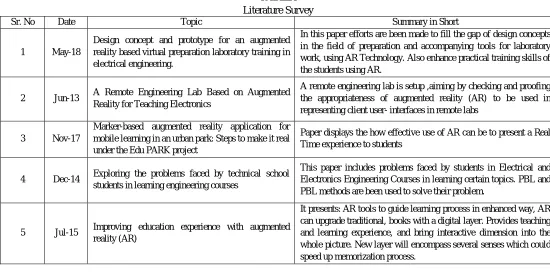
TABLEI
Literature Survey
Sr. No Date Topic Summary in Short
1 May-18
Design concept and prototype for an augmented reality based virtual preparation laboratory training in electrical engineering.
In this paper efforts are been made to fill the gap of design concepts in the field of preparation and accompanying tools for laboratory work, using AR Technology. Also enhance practical training skills of the students using AR.
2 Jun-13 A Remote Engineering Lab Based on Augmented
Reality for Teaching Electronics
A remote engineering lab is setup ,aiming by checking and proofing the appropriateness of augmented reality (AR) to be used in representing client user- interfaces in remote labs
3 Nov-17
Marker-based augmented reality application for mobile learning in an urban park: Steps to make it real under the Edu PARK project
Paper displays the how effective use of AR can be to present a Real Time experience to students
4 Dec-14 Exploring the problems faced by technical school students in learning engineering courses
This paper includes problems faced by students in Electrical and Electronics Engineering Courses in learning certain topics. PBL and PBL methods are been used to solve their problem.
5 Jul-15 Improving education experience with augmented
reality (AR)
It presents: AR tools to guide learning process in enhanced way, AR can upgrade traditional, books with a digital layer. Provides teaching and learning experience, and bring interactive dimension into the whole picture. New layer will encompass several senses which could speed up memorization process.
IV.PROPOSEDSYSTEM
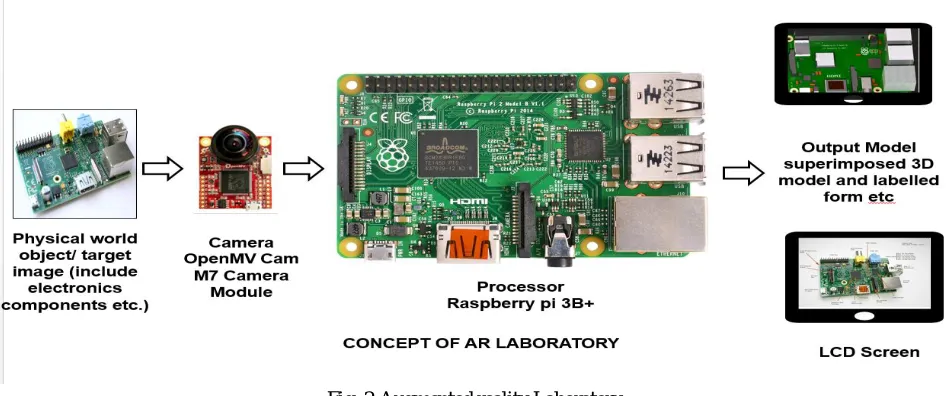
[image:3.612.28.578.224.496.2]System consists of two parts firstly for handheld devices such tablets, smartphones etc. while other part consists of laboratory specific arrangements to project 3D models. Main difference is that both are useful for 3Dmodel projection but using AR technology. Reason to implement this in two ways is to clarify practical as well as theoretical knowledge of students and nurture their skillsets to fulfil industrial requirements..
[image:3.612.76.557.568.720.2]For handheld devices arrangements are just install an application .apk file generated by any available platform, here we have used maxst and unity to generate AR application It all begins with search of requirements i.e. the targeted images or components or boards after that we need to find the required models available to be projected using AR camera, that are available in 3D form. If not available we can design required 3D electronics models in certain applications like blender and many more software’s can be used. After proper designing and generating application in required format example ios or .apk etc. we can use it in any handheld device. Here we have used components, boards and other electronics devices 3D models to get projected.
Fig. 2 Augmented reality Laboratory
Secondly for Laboratory work we are using raspberry pi as our processor with an HD high resolution camera as input to processor to collect process and project the 3D model on display screen or projector. Programming is been done in opencv and python. We have used Logitech High definition webcam as an input to processor. Processor includes raspberry pi 3b+. For output we are using desktop screen we can also use projector screen as per requirements.
V. WORKFLOWOFSYSTEM
It include following basic steps such as target Surface recognition, Homographic estimations, Pose estimations, model projections are been done and 3D models are projected. Work flow of the system follows basic simple steps. For AR application all these steps such as Surface target detection, feature matching, homography and pose estimation are being done at backend of application. While processing for augmented reality are same for both AR classrooms and AR Labs. First step is to detect surface target image to obtain base for models then target image is detected and required descriptors are obtained from surface to get the matrix form.
We need to find the homographic matrix component that is matrix that require with reference to z Plane. We also need to calibrate camera, Values are obtained by recovering and external camera calibration matrix and homography equation where
S1 =r1, S2=r2, S3=t are reference coordinates of camera.
Sf = [S1 S2 S3] = C-1 H (1) Equation (1)….. This is Matrix for Camera calibration.
We have target surface recognition that has feature detection feature description and feature matching.
For feature extraction special features of respective object/images are been extracted and stored for further reference in database. Now after obtaining the homographic equation 3D models is projected in coordinate system.
3D Matrix Projected =C [R1' R21 R31 t] Equation(2)…..
Fig.3 Work flow of augmented reality
VI.EXPERIMENTALSETUPANDINTERFACINGMETHODS
As mentioned project involves interactive methods of learning. We have implemented two of these methods firstly by using AR classroom using handheld devices while second is AR laboratory for practical on site experience. For study of electronics we have include learnings from three sources (target images) like images of components, circuit boards also along with this we includes real time components and circuit boards. By scanning these target images we provide output in form 3D models.
A. Process Includes
1) Just open AR Electronics Classroom Application.
2) We can easily scan various Electronics Components, to know more
3) Information & specifications about components.
4) We can scan images from the textbooks to get information.
5) We can Scan Electronics circuits to know more information about
6) The components, Subsystems e.g. types of connectors, identify components etc.
7) Also we can scan image of circuits and get 3D models, specifications of circuits,
For Qualitative analysis following are the targeted images, components and circuit boards that project the output as 3D models). Output is in form of 3D models that are labelled and with specifications of components and images. Output is obtained using 2 ways AR classroom mobile application is uses Android Studio for Building and editing application, Unity Platform for development, and Vulforia SDK. For AR laboratory we have projected 3D model using Python and opencv combination for algorithms and using Raspberry pi along with camera and LCD screen as output.
Fig 5 Components in 3D
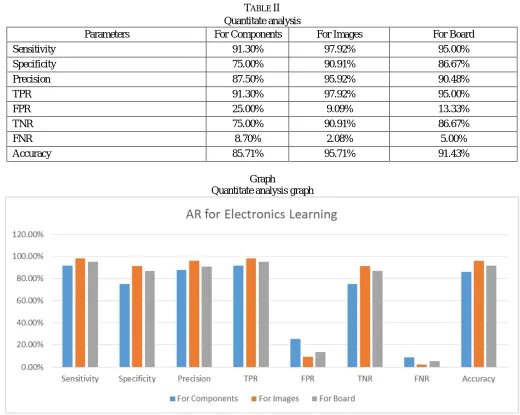
For Quantitative analysis we have obtained certain parameters to calculated accuracy of the model used. We have considered three cases such as True positive (TP), True Negative (TN), False positive (FP), and False negative (FN).Where true positive case is when targeted images is detected and model is projected, False positive is when target image is absent still model is projected, True negative is when targeted image is present and still no model is projected, While false negative is when targeted image is absent and no model is projected. We have 100 attempts through which we obtain outputs as follows:
TABLE II Quantitate analysis
Parameters For Components For Images For Board
Sensitivity 91.30% 97.92% 95.00%
Specificity 75.00% 90.91% 86.67%
Precision 87.50% 95.92% 90.48%
TPR 91.30% 97.92% 95.00%
FPR 25.00% 9.09% 13.33%
TNR 75.00% 90.91% 86.67%
FNR 8.70% 2.08% 5.00%
Accuracy 85.71% 95.71% 91.43%
Graph
[image:6.612.44.564.319.734.2]VII. CONCLUSION
Augmented reality technology is now a days creating a well-developed and passive learning process instead of regular critical thinking. Thus contributing to large extend in Educational field. By developing such a platform that can help students and teachers to easily understand the difficult concepts and get familiar with topics related to electronics engineering. Thus contributing for a proper hold on Theoretical and deepen their Practical knowledge and skills of respective subjects in electronics via getting trained through AR technology. Resulting into highly skilled and trained students that are industry ready and fulfil the needs and requirements accordingly to industrial revolution 4.0.And develop this technology further work wellbeing of mankind and future.
REFERENCES
[1] Doug A. Bowman,(17 April 2018)”A Systematic Review of 10 Years of Augmented Reality Usability Studies: 2005 to 2014” Virginia Tech, United States systematic review Frontiers in Robotics and AI Volume 5 | Article 37, 1, April 2018.
[2] Miller MR, Jun H, Herrera F, Yu Villa J, Welch G, Bailenson JN Social interaction in augmented reality. PLoS ONE 14(5): e0216290. May 14, 2019. [3] Roope Raisamo, Ismo Rakkolainen, PäiviMajaranta ,Katri Salminen Jussi Rantala,Ahmed Farooq.Human Augmentation:past,present and future Science
Direct, International Journal of Human-Computer 17 May 2019
[4] Lúcia Pombo and Margarida Morais Marques Marker-based augmented reality application for mobile learning in an urban park: Steps to make it real under the EduPARK project Authors: URL: [email protected]; [email protected] ISSN No: 978-1-5386-0648-3/17, May 2017.
[5] Ramlee mustapha,Zaharatul laili abdul rahim, Mohamed nor azhari azman, “Exploring the problems faced by technical school students in learning engineering courses” Journal of Engineering Science and Technology Vol. 9, No. 6 690 – 70,Oct 2014,
[6] Kangdon Lee “Augmented Reality in Education and Training” Volume 56, Number 2 TechTrends May 2012.
[7] Jorge Bacca1 Fabregat1, Sabine Graf2 and Kinshuk2 Silvia Baldiris1, Ramon Augmented Reality Trends in Education: “A Systematic Review of Research and Applications” September 2014.
[8] Wu, H.-K., & Hsu, Y.-S. “Integrating a mobile augmented reality activity to contextualize student learning of a socioscientific issue.” British Journal of Educational Technology, 44(3), E95–E99. 10.1111/j.1467-8535.2012.01379 .May 2013.
[9] Kangdon Lee “Augmented Reality in Education and Training ” Volume 56, Number 2 TechTrends [10] Mehmet Kesima, Yasin Ozarslanb” Augmented reality in education: current technologies and the [11] potential for education ” Procedia - Social and Behavioural Sciences 47 ( 2012 ) 297 – 302 [12] https://www.augmentedminds.com/en/ augmented -reality/ar-hardware-devices/
[13] https://www.dailydot.com/what-is-augmented- reality-ar/